Dr. Utsav
Agrawal
 Credited to Jackson and Waugh (1961)
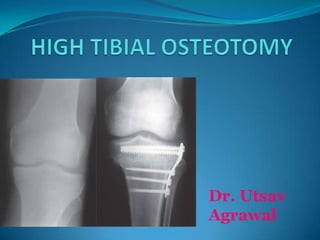
 High tibial osteotomy (HTO) corrects alignment of the
knee, relieving pressure from the arthritic portion of
the joint, and transferring it to an area of more normal
cartilage.
 This frequently leads to pain relief
and, subsequently, improved function.
 Well established procedure for unicompartmental
arthritis with 80 % satisfactory results.
 Biomechanical basis  unloading of the affected
compartment
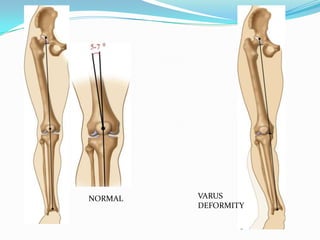
NORMAL VARUS
DEFORMITY
Indications
 Pain and disability interfering employment or
recreation
 Radiographic evidence of degenerative changes
confined to 1 compartment with malalignment
 Ability to carry out proper rehabilitation program
 Medial knee pain asso. With cartilage defect
Contraindications
 Correction needed >20˚
 Flexion contracture >15˚
 Knee flexion <90˚
 Tibial subluxation >1cm
 Medial compartment tibial bone loss >3mm
 Patella baja
 Inflammatory arthritis
 Morbid obesity
 Relative  Age >60yrs
Load sharing by the medial and
lateral compartment
Position % weight through medial comp
Normal i.e. 2˚ varus 75 %
Centre 70%
4˚ valgus 50%
6˚ valgus 40%
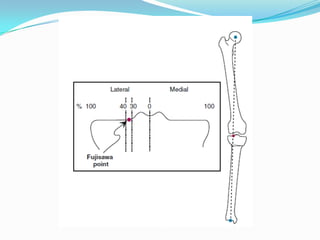
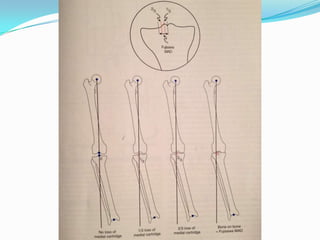
3˚-6˚ mechanical valgus is recommended for treatment of MCOA
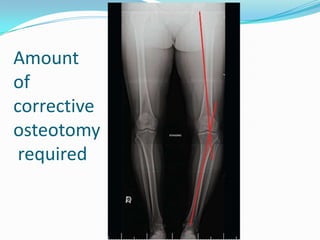
Amount
of
corrective
osteotomy
required
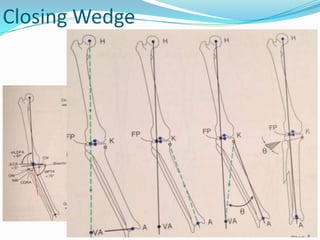
Closing Wedge
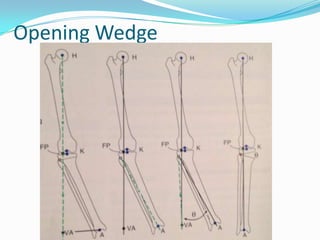
Opening Wedge
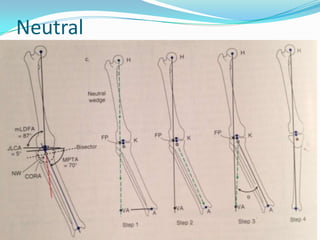
Neutral
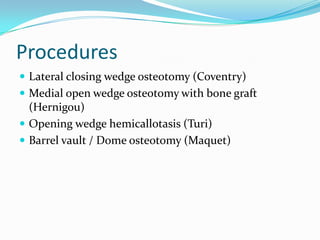
Procedures
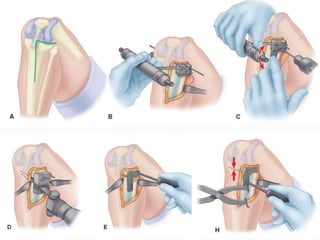
 Lateral closing wedge osteotomy (Coventry)
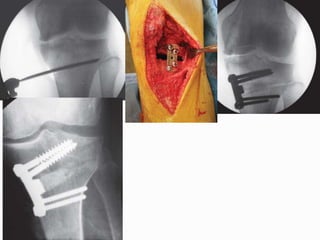
 Medial open wedge osteotomy with bone graft
(Hernigou)
 Opening wedge hemicallotasis (Turi)
 Barrel vault / Dome osteotomy (Maquet)
 First by Jackson and Waugh (1961)  was either a
closing wedge or dome with osteotomy distal to
tuberosity
 Coventry (1965)  closing wedge osteotomy proximal
to tibial tuberosity
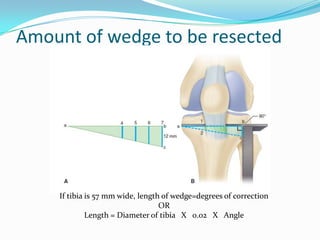
Amount of wedge to be resected
If tibia is 57 mm wide, length of wedge=degrees of correction
OR
Length = Diameter of tibia X 0.02 X Angle
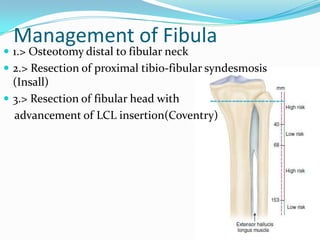
Management of Fibula
 1.> Osteotomy distal to fibular neck
 2.> Resection of proximal tibio-fibular syndesmosis
(Insall)
 3.> Resection of fibular head with
advancement of LCL insertion(Coventry)
Pros
 Most stable
 Early consolidation
 Early mobilisation
 Exploration of knee joint through same approach
Cons
 Limb shortening
 Nerve injury
 LCL laxity
 Patella Baja
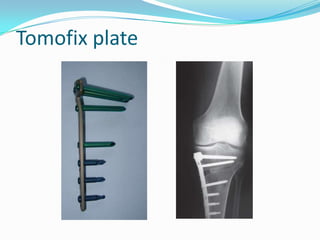
Tomofix plate
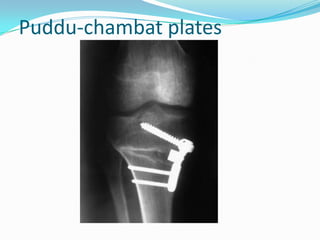
Puddu-chambat plates
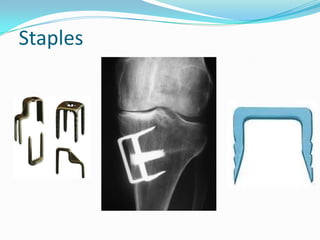
Staples
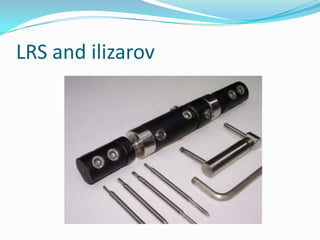
LRS and ilizarov
Advantages
 Usual deformity is proximal tibia vara, which is
addressed directly
 Preservation of bone at proximal tibia
 No disruption of proximal tibio fibular joint or anterior
compartment
 Less chances of nerve injury
 Correction can be modified intra-operatively
Disadvantages
 Non-union
 Longer time to consolidation
 Longer duration of immobilisation
 Donor site morbidity
 Limb lengthning
 Shifts tibial tubercle laterally  Patello-femoral
symptoms
Opening Wedge hemicallotasis
 Schwartsman  After tibial osteotomy Ilizarov
Advantages :
• More reliable healing
• Less chances of patella baja
• Less bone loss
• Ability to translate distal fragment to correct
mechanical axis
Disadvantages :
• Cumbersome, reduced complaince
• Pin loosening
• Pin site infection
• Turi et al  dynamic uniplanar external fixator
Effect
On
Cartilage ???
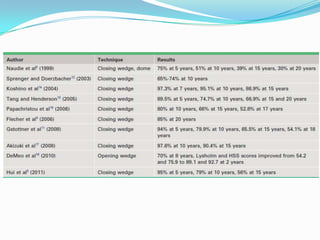
Results
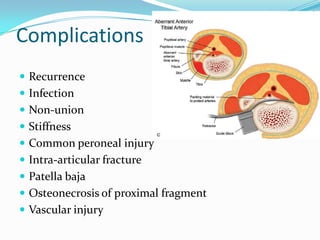
Complications
 Recurrence
 Infection
 Non-union
 Stiffness
 Common peroneal injury
 Intra-articular fracture
 Patella baja
 Osteonecrosis of proximal fragment
 Vascular injury
Dr. Utsav Agrawal

High Tibial Osteotomy_UTSAV

  • 1.
  • 2.
     Credited toJackson and Waugh (1961)  High tibial osteotomy (HTO) corrects alignment of the knee, relieving pressure from the arthritic portion of the joint, and transferring it to an area of more normal cartilage.  This frequently leads to pain relief and, subsequently, improved function.  Well established procedure for unicompartmental arthritis with 80 % satisfactory results.  Biomechanical basis  unloading of the affected compartment
  • 4.
  • 5.
    Indications  Pain anddisability interfering employment or recreation  Radiographic evidence of degenerative changes confined to 1 compartment with malalignment  Ability to carry out proper rehabilitation program  Medial knee pain asso. With cartilage defect
  • 6.
    Contraindications  Correction needed>20˚  Flexion contracture >15˚  Knee flexion <90˚  Tibial subluxation >1cm  Medial compartment tibial bone loss >3mm  Patella baja  Inflammatory arthritis  Morbid obesity  Relative  Age >60yrs
  • 7.
    Load sharing bythe medial and lateral compartment Position % weight through medial comp Normal i.e. 2˚ varus 75 % Centre 70% 4˚ valgus 50% 6˚ valgus 40% 3˚-6˚ mechanical valgus is recommended for treatment of MCOA
  • 10.
  • 11.
  • 12.
  • 13.
  • 14.
    Procedures  Lateral closingwedge osteotomy (Coventry)  Medial open wedge osteotomy with bone graft (Hernigou)  Opening wedge hemicallotasis (Turi)  Barrel vault / Dome osteotomy (Maquet)
  • 16.
     First byJackson and Waugh (1961)  was either a closing wedge or dome with osteotomy distal to tuberosity  Coventry (1965)  closing wedge osteotomy proximal to tibial tuberosity
  • 17.
    Amount of wedgeto be resected If tibia is 57 mm wide, length of wedge=degrees of correction OR Length = Diameter of tibia X 0.02 X Angle
  • 19.
    Management of Fibula 1.> Osteotomy distal to fibular neck  2.> Resection of proximal tibio-fibular syndesmosis (Insall)  3.> Resection of fibular head with advancement of LCL insertion(Coventry)
  • 20.
    Pros  Most stable Early consolidation  Early mobilisation  Exploration of knee joint through same approach Cons  Limb shortening  Nerve injury  LCL laxity  Patella Baja
  • 23.
  • 24.
  • 25.
  • 26.
  • 27.
    Advantages  Usual deformityis proximal tibia vara, which is addressed directly  Preservation of bone at proximal tibia  No disruption of proximal tibio fibular joint or anterior compartment  Less chances of nerve injury  Correction can be modified intra-operatively
  • 28.
    Disadvantages  Non-union  Longertime to consolidation  Longer duration of immobilisation  Donor site morbidity  Limb lengthning  Shifts tibial tubercle laterally  Patello-femoral symptoms
  • 29.
    Opening Wedge hemicallotasis Schwartsman  After tibial osteotomy Ilizarov Advantages : • More reliable healing • Less chances of patella baja • Less bone loss • Ability to translate distal fragment to correct mechanical axis Disadvantages : • Cumbersome, reduced complaince • Pin loosening • Pin site infection • Turi et al  dynamic uniplanar external fixator
  • 31.
  • 32.
  • 34.
    Complications  Recurrence  Infection Non-union  Stiffness  Common peroneal injury  Intra-articular fracture  Patella baja  Osteonecrosis of proximal fragment  Vascular injury
  • 35.