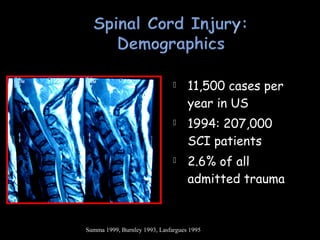
 11,500 cases per
year in US
 1994: 207,000
SCI patients
 2.6% of all
admitted trauma
Summa 1999, Burnley 1993, Lasfargues 1995
 #1 : Male teenagers and young adults
 Relative increase in 60-70 y/o
 MVA (44.5%)
 Falls (18.1%)
 Violence (16.6%)
Summa 1999
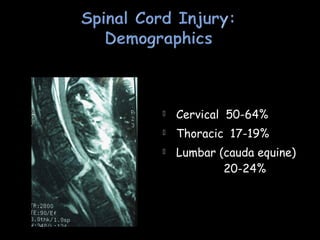
 Cervical 50-64%
 Thoracic 17-19%
 Lumbar (cauda equine)
20-24%
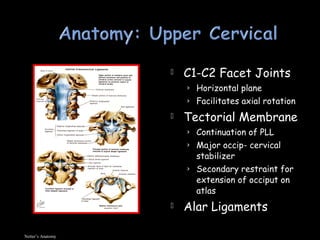
 C1-C2 Facet Joints
› Horizontal plane
› Facilitates axial rotation
 Tectorial Membrane
› Continuation of PLL
› Major occip- cervical
stabilizer
› Secondary restraint for
extension of occiput on
atlas
 Alar Ligaments
Netter’s Anatomy
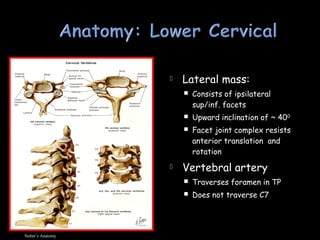
 Lateral mass:
 Consists of ipsilateral
sup/inf. facets
 Upward inclination of ~ 400
 Facet joint complex resists
anterior translation and
rotation
 Vertebral artery
 Traverses foramen in TP
 Does not traverse C7
Netter’s Anatomy
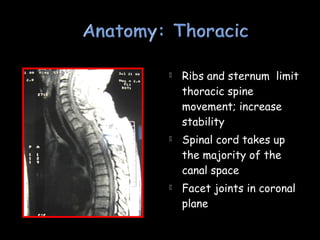
 Ribs and sternum limit
thoracic spine
movement; increase
stability
 Spinal cord takes up
the majority of the
canal space
 Facet joints in coronal
plane
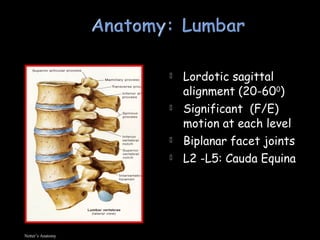
 Lordotic sagittal
alignment (20-600
)
 Significant (F/E)
motion at each level
 Biplanar facet joints
 L2 -L5: Cauda Equina
Netter’s Anatomy
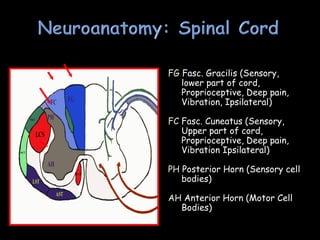
FG Fasc. Gracilis (Sensory,
lower part of cord,
Proprioceptive, Deep pain,
Vibration, Ipsilateral)
FC Fasc. Cuneatus (Sensory,
Upper part of cord,
Proprioceptive, Deep pain,
Vibration Ipsilateral)
PH Posterior Horn (Sensory cell
bodies)
AH Anterior Horn (Motor Cell
Bodies)
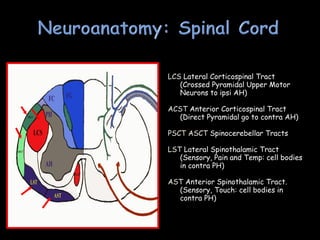
LCS Lateral Corticospinal Tract
(Crossed Pyramidal Upper Motor
Neurons to ipsi AH)
ACST Anterior Corticospinal Tract
(Direct Pyramidal go to contra AH)
PSCT ASCT Spinocerebellar Tracts
LST Lateral Spinothalamic Tract
(Sensory, Pain and Temp: cell bodies
in contra PH)
AST Anterior Spinothalamic Tract.
(Sensory, Touch: cell bodies in
contra PH)
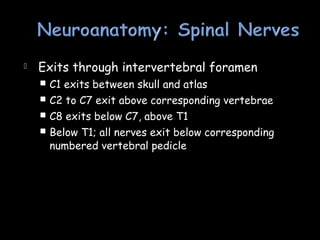
 Exits through intervertebral foramen
 C1 exits between skull and atlas
 C2 to C7 exit above corresponding vertebrae
 C8 exits below C7, above T1
 Below T1; all nerves exit below corresponding
numbered vertebral pedicle
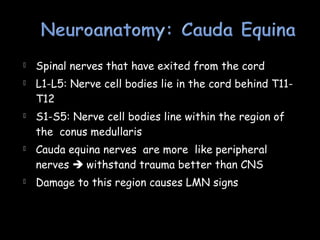
 Spinal nerves that have exited from the cord
 L1-L5: Nerve cell bodies lie in the cord behind T11-
T12
 S1-S5: Nerve cell bodies line within the region of
the conus medullaris
 Cauda equina nerves are more like peripheral
nerves  withstand trauma better than CNS
 Damage to this region causes LMN signs
 Primary mechanical insult
 Rapid compression due to bone displacement
from burst or dislocation
 Distraction ***
 Shear ***
 Penetration
 Primary injury leads to cascade of
secondary injury mechanisms
*** Portends poor prognosis !!!
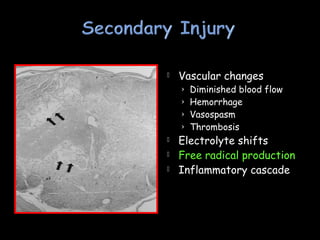
 Vascular changes
› Diminished blood flow
› Hemorrhage
› Vasospasm
› Thrombosis
 Electrolyte shifts
 Free radical production
 Inflammatory cascade
 Final pathway is neuron death by:
 Cell necrosis with structural dissolution
 Apoptosis: chemical trigger initiates process that
removes non-functioning neurons but also kills
normal neurons in zone of injury
 Aggressive field resuscitation
› Maintain systemic BP
› Maintain optimal oxygenation
 Steroids
› NASCIS-2 8 hour window
› NASCIS-3 < 3 hrs---24 hrs;
3-8 hrs---48 hrs.
 30mg/kg bolus then 5.4mg/kg/hr
 Surgical decompression? Timing ?
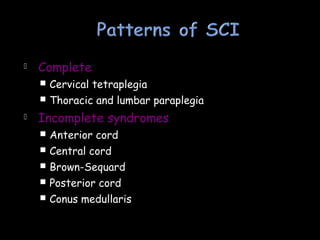
 Complete
 Cervical tetraplegia
 Thoracic and lumbar paraplegia
 Incomplete syndromes
 Anterior cord
 Central cord
 Brown-Sequard
 Posterior cord
 Conus medullaris
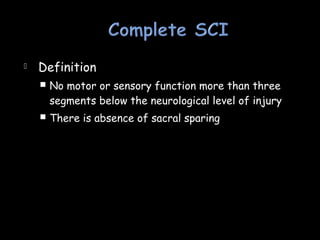
 Definition
 No motor or sensory function more than three
segments below the neurological level of injury
 There is absence of sacral sparing
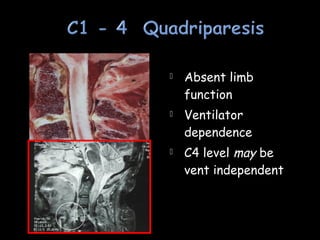
 Absent limb
function
 Ventilator
dependence
 C4 level may be
vent independent
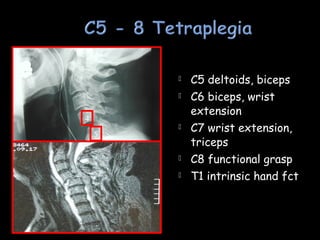
 C5 deltoids, biceps
 C6 biceps, wrist
extension
 C7 wrist extension,
triceps
 C8 functional grasp
 T1 intrinsic hand fct
4
5
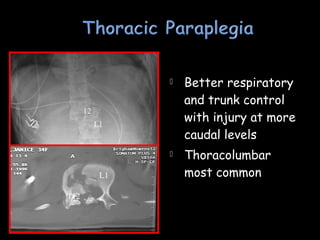
 Better respiratory
and trunk control
with injury at more
caudal levels
 Thoracolumbar
most commonL1
T12
12
L1
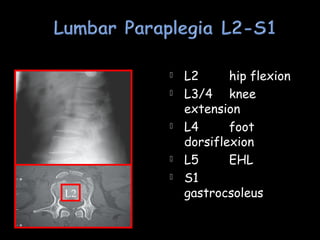
 L2 hip flexion
 L3/4 knee
extension
 L4 foot
dorsiflexion
 L5 EHL
 S1
gastrocsoleus
L2
L2
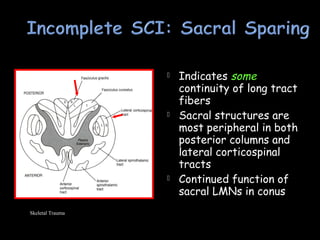
 Indicates some
continuity of long tract
fibers
 Sacral structures are
most peripheral in both
posterior columns and
lateral corticospinal
tracts
 Continued function of
sacral LMNs in conus
Skeletal Trauma
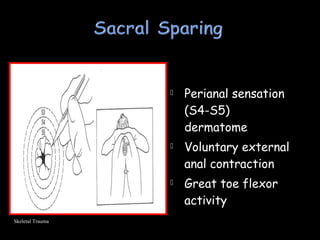
 Perianal sensation
(S4-S5)
dermatome
 Voluntary external
anal contraction
 Great toe flexor
activity
Skeletal Trauma
 Affects the anterior 2/3 of cord
 Preserves the posterior column:
proprioception, vibratory sensation
 May be due to persistent retropulsed bone
or disc material/ mechanical insult
 Vascular component
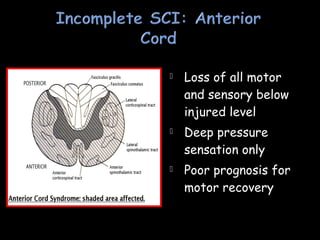
 Loss of all motor
and sensory below
injured level
 Deep pressure
sensation only
 Poor prognosis for
motor recovery
 Older patients with preexisting spondylosis
 MOI: Hyperextension injury: fall, whiplash
 Spinal cord pinched by osteophytes
anteriorly and the underlying hypertrophic
ligamentum flavum posteriorly; leads to
significant injury to the “central portion” of
the cord
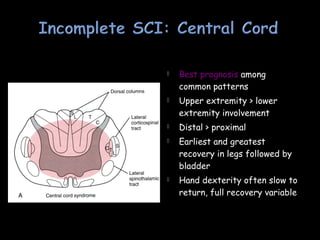
 Best prognosis among
common patterns
 Upper extremity > lower
extremity involvement
 Distal > proximal
 Earliest and greatest
recovery in legs followed by
bladder
 Hand dexterity often slow to
return, full recovery variable
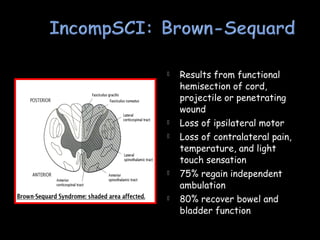
 Results from functional
hemisection of cord,
projectile or penetrating
wound
 Loss of ipsilateral motor
 Loss of contralateral pain,
temperature, and light
touch sensation
 75% regain independent
ambulation
 80% recover bowel and
bladder function
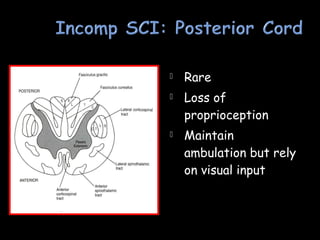
 Rare
 Loss of
proprioception
 Maintain
ambulation but rely
on visual input
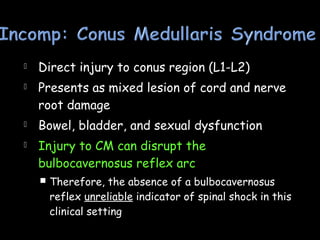
 Direct injury to conus region (L1-L2)
 Presents as mixed lesion of cord and nerve
root damage
 Bowel, bladder, and sexual dysfunction
 Injury to CM can disrupt the
bulbocavernosus reflex arc
 Therefore, the absence of a bulbocavernosus
reflex unreliable indicator of spinal shock in this
clinical setting
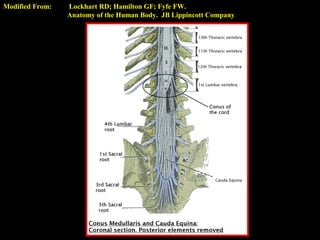
Modified From: Lockhart RD; Hamilton GF; Fyfe FW.
Anatomy of the Human Body. JB Lippincott Company
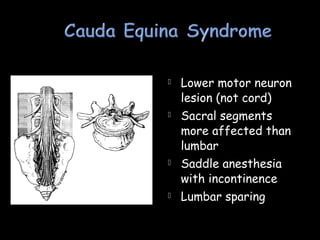
 Lower motor neuron
lesion (not cord)
 Sacral segments
more affected than
lumbar
 Saddle anesthesia
with incontinence
 Lumbar sparing
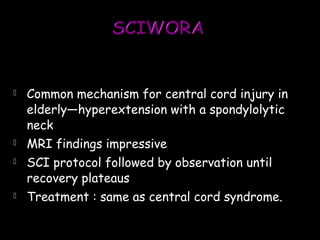
 Common mechanism for central cord injury in
elderly—hyperextension with a spondylolytic
neck
 MRI findings impressive
 SCI protocol followed by observation until
recovery plateaus
 Treatment : same as central cord syndrome.
Be aware of the clinical triad of
 neurological injury and
 concomitant lamina fracture with
 burst pattern (Cammisa, 1989)---trapped
roots
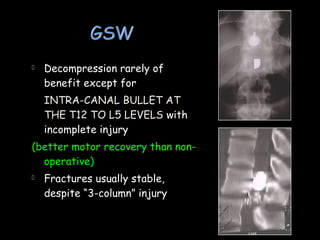
 Decompression rarely of
benefit except for
INTRA-CANAL BULLET AT
THE T12 TO L5 LEVELS with
incomplete injury
(better motor recovery than non-
operative)
 Fractures usually stable,
despite “3-column” injury
 More favorable prognosis than cord injuries
 In c-spine injuries: frequently see complete
cord injury with varying levels of root injury
 Good chance of recovery of one level
 Recovery dependent on level of injury
 ATLS guidelines: A-B-C’s
 Examine for head, neck, or back trauma –
need to logroll
 Paradoxical diaphragmatic breathing
 Priapism
 Neurogenic shock: hypotension and
bradycardia
 Loss of sympathetic tone
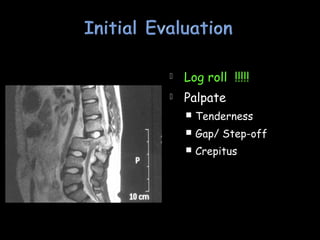
 Log roll !!!!!
 Palpate
 Tenderness
 Gap/ Step-off
 Crepitus
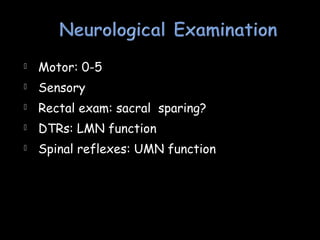
 Motor: 0-5
 Sensory
 Rectal exam: sacral sparing?
 DTRs: LMN function
 Spinal reflexes: UMN function
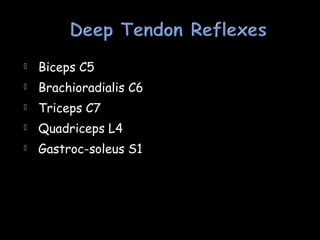
 Biceps C5
 Brachioradialis C6
 Triceps C7
 Quadriceps L4
 Gastroc-soleus S1
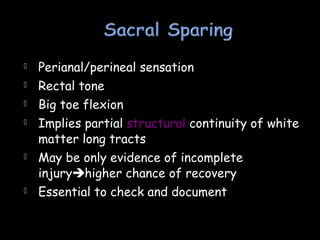
 Perianal/perineal sensation
 Rectal tone
 Big toe flexion
 Implies partial structural continuity of white
matter long tracts
 May be only evidence of incomplete
injuryhigher chance of recovery
 Essential to check and document
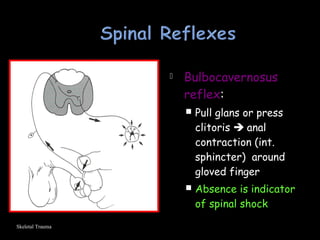
 Bulbocavernosus
reflex:
 Pull glans or press
clitoris  anal
contraction (int.
sphincter) around
gloved finger
 Absence is indicator
of spinal shock
Skeletal Trauma
 Scapulohumeral reflex (C3)
 Tap on spine of scapula =>abd and elev arm
 Hoffman’s
 Inverted Radial Reflex
 Tap BR =>finger flexion (C6 root)
 Superficial abdomenal
 Cremaster
 Crossed adductor response
 Tap Medial Fem Condyle =>add contra leg
 Temporary loss of all or most spinal reflex
activity below level of injury
 Lasts around 24 hours (max 48 hrs)
 Ends when bulbocavernosus reflex and/or
anal wink returns
 An injury cannot be considered complete
until resolution of spinal shock
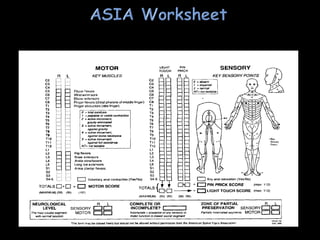
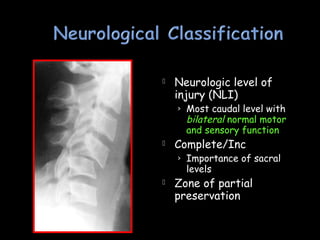
 Neurologic level of
injury (NLI)
› Most caudal level with
bilateral normal motor
and sensory function
 Complete/Inc
› Importance of sacral
levels
 Zone of partial
preservation
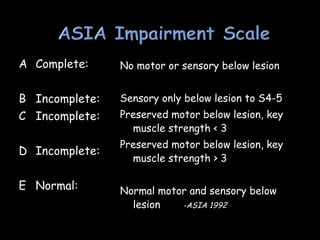
A Complete:
B Incomplete:
C Incomplete:
D Incomplete:
E Normal:
No motor or sensory below lesion
Sensory only below lesion to S4-5
Preserved motor below lesion, key
muscle strength < 3
Preserved motor below lesion, key
muscle strength > 3
Normal motor and sensory below
lesion -ASIA 1992
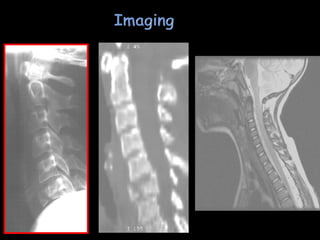
 X-rays
 CT
 MRI
 MRA
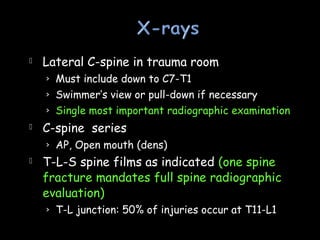
 Lateral C-spine in trauma room
› Must include down to C7-T1
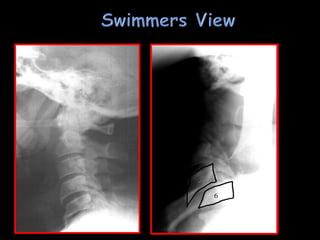
› Swimmer’s view or pull-down if necessary
› Single most important radiographic examination
 C-spine series
› AP, Open mouth (dens)
 T-L-S spine films as indicated (one spine
fracture mandates full spine radiographic
evaluation)
› T-L junction: 50% of injuries occur at T11-L1
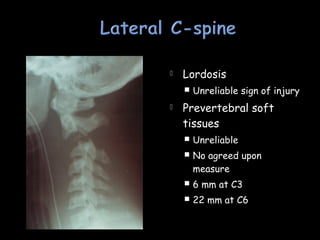
 Lordosis
 Unreliable sign of injury
 Prevertebral soft
tissues
 Unreliable
 No agreed upon
measure
 6 mm at C3
 22 mm at C6
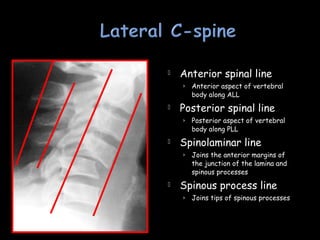
 Anterior spinal line
› Anterior aspect of vertebral
body along ALL
 Posterior spinal line
› Posterior aspect of vertebral
body along PLL
 Spinolaminar line
› Joins the anterior margins of
the junction of the lamina and
spinous processes
 Spinous process line
› Joins tips of spinous processes
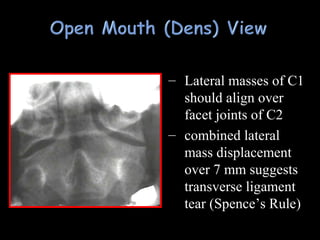
– Lateral masses of C1Lateral masses of C1
should align overshould align over
facet joints of C2facet joints of C2
– combined lateralcombined lateral
mass displacementmass displacement
over 7 mm suggestsover 7 mm suggests
transverse ligamenttransverse ligament
tear (Spence’s Rule)tear (Spence’s Rule)
 Injury suspected on plain films
 Better visualize fracture (specificity and
sensitivity)
 Unable to adequately assess on plain films
 Sagittal and/or coronal reconstructions can be
helpful (particularly at Oc.-cervical and C-T
jcts.)
 Fracture or soft tissue injury in the plane of
the CT can be missed
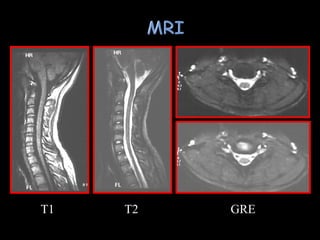
 Invaluable for assessing cord and soft tissues
 R/O associated disc herniation ( facet
dislocations)
 Hemorrhage vs edema in soft tissues ????
 Ligamentous tears and facet capsule disruptions
visualized with fat suppression
 May allow prognostic assessment of final motor
function
› Intrasubstance hematoma
T1 T2 GRE
 Roaf, 1960 – pure axial load or pure flexion
leads to little posterior ligamentous injury
 Nagel, 1981 – 20 degrees of kyphosis or 10
degrees lateral angulation implies
incompetence of PLL and posterior elements,
thus inferring instability
 Panjabi, 1981 – it takes sectioning of PLL and
posterior annulus to destabilize a motion
segment with the addition of facet capsule
and interspinous ligament disruption
 James et al, ’94 – middle column offers
little additional resistance to kyphosis with
increasing axial load
 The Issues
 Often difficult to diagnose
 Missed or delayed diagnosis can lead to
catastrophic neurologic disability
 No agreed upon protocol in the intoxicated,
multiply-injured, or head-injured patient
 The Problems
 Unnecessary imaging?
 Should every patient with blunt trauma gets x-rays?
 Overzealous consultation
 When and who should ‘clear the c-spine’ ??
 The Hard Collar Dilemma:
 Prolonged hard collar use leads to decubiti as well as
neck pain
 Hoffman, Mower, et al., NEJM 2000
 Multicenter study
 34,069 patients with blunt trauma
 AP/Lat/Open Mouth on all patients
 810 with positive x-rays
 Only 8 with false-negative x-rays
 Only 2 clinically significant
 Harris, Kronlage, et al. Spine 2000
 Polytrauma, intoxicated, CHI patients
 IRB Protocol: Includes intra-op flex/ext with
fluoro after all films read as normal
 Goal: Identify ligamentous injuries
 3/ 153 (+) --- all required surgical stabilization
 Criteria for clinical clearance
› No posterior midline tenderness
› Full pain-free active ROM
› No focal neurologic deficit
› Normal level of alertness
› No evidence of intoxication
› No ‘distracting injury’
 If x-rays negative, but patient c/o neck pain,
active flexion/extension x-rays when able.
Rarely helpful in acute setting
 If neurologic deficit attributable to neck
injury, immediate MRI
 Controversy over the polytrauma or
intoxicated patient remains
 EAST practice guidelines: trauma series and thin
cut axial CT through C1-2
 CT of cervical –thoracic junction if poor
visualization on plain and swimmer’s
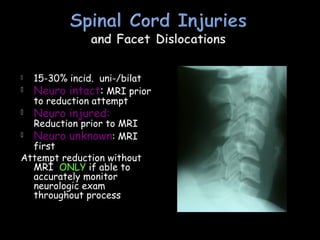
 15-30% incid. uni-/bilat
 Neuro intact: MRI prior
to reduction attempt
 Neuro injured:
Reduction prior to MRI
 Neuro unknown: MRI
first
Attempt reduction without
MRI ONLY if able to
accurately monitor
neurologic exam
throughout process
 Experimental evidence
 Clinical evidence
 Non-operative
 Operative
 Numerous studies
 Classic: Tarlov 1954
 Delamarter 1995
 Dimar 1999
 Experimental models: Balloons, clips, cables,
spacers
 Beagles, rabbits, rats
 Severity of SCI dependent on:
 Force of compression
 Duration of compression
 Displacement, canal narrowing
 Surgical decompression does attenuate the
deleterious effects of acute SCI
 Persistent compression is a potentially reversible
form of secondary injury
 Most studies uncontrolled and retrospective
analyses
 Spontaneous recovery unpredictable, but
generally occurs
 Timing to reduction is important
 Most dramatic benefit in bilateral jumped
facets
 Surgical benefit must be weighed against
limited non-operative benefit
 Numerous studies, almost exclusively
retrospective
 Timing: early, late, and later
 The only prospective randomized trial
 62 patients with cervical SCI
 34 “Early” (< 72 hrs) surgery
 28 Late (> 5 days) surgery
 ASIA assessment
 No difference in neurological outcome
 Most studies retrospective with historical
controls
 No clear consensus on timing
 No statistical evidence that surgical
decompression influences neurologic outcome
 Tator et al 1999
 Retrospective, multicenter (36)
 Examined use and timing of surgery in
acute SCI
 9 month period 1994 to 1995
 All within 24 hours of injury
 16 to 75 years old
 Non-penetrating trauma
 585 patients
 Complete SCI in 57.8%
 Traction 47%
 Surgery 65.4%
 < 24 hrs: 23.5%
 25-48hrs: 15.8%
 48-96hrs: 19%
 > 5 days: 41.7%
 C-spine vs. T-L spine
 Partial vs. complete
› Spinal shock
 Definition of early surgery
 Role of steroids
 Type of decompression
› traction vs. anterior vs. posterior
 High energy vs. low energy
 Associated injuries
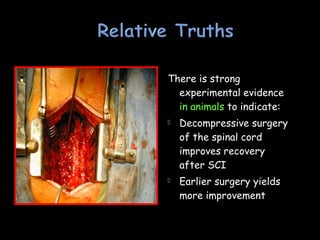
There is strong
experimental evidence
in animals to indicate:
 Decompressive surgery
of the spinal cord
improves recovery
after SCI
 Earlier surgery yields
more improvement
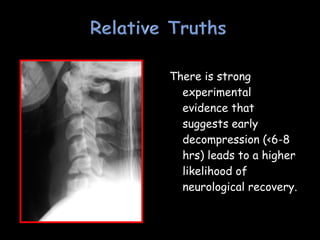
There is strong
experimental
evidence that
suggests early
decompression (<6-8
hrs) leads to a higher
likelihood of
neurological recovery.
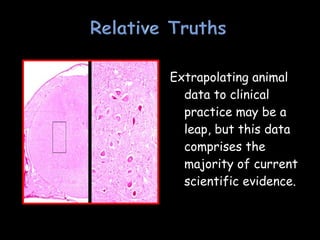
Extrapolating animal
data to clinical
practice may be a
leap, but this data
comprises the
majority of current
scientific evidence.
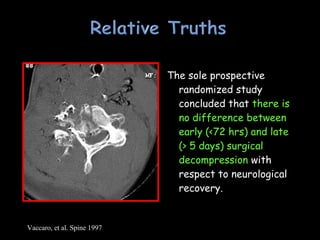
The sole prospective
randomized study
concluded that there is
no difference between
early (<72 hrs) and late
(> 5 days) surgical
decompression with
respect to neurological
recovery.
Vaccaro, et al. Spine 1997
Spinal Injuries

Spinal Injuries

  • 2.
     11,500 casesper year in US  1994: 207,000 SCI patients  2.6% of all admitted trauma Summa 1999, Burnley 1993, Lasfargues 1995
  • 3.
     #1 :Male teenagers and young adults  Relative increase in 60-70 y/o  MVA (44.5%)  Falls (18.1%)  Violence (16.6%) Summa 1999
  • 4.
     Cervical 50-64% Thoracic 17-19%  Lumbar (cauda equine) 20-24%
  • 5.
     C1-C2 FacetJoints › Horizontal plane › Facilitates axial rotation  Tectorial Membrane › Continuation of PLL › Major occip- cervical stabilizer › Secondary restraint for extension of occiput on atlas  Alar Ligaments Netter’s Anatomy
  • 6.
     Lateral mass: Consists of ipsilateral sup/inf. facets  Upward inclination of ~ 400  Facet joint complex resists anterior translation and rotation  Vertebral artery  Traverses foramen in TP  Does not traverse C7 Netter’s Anatomy
  • 7.
     Ribs andsternum limit thoracic spine movement; increase stability  Spinal cord takes up the majority of the canal space  Facet joints in coronal plane
  • 8.
     Lordotic sagittal alignment(20-600 )  Significant (F/E) motion at each level  Biplanar facet joints  L2 -L5: Cauda Equina Netter’s Anatomy
  • 9.
    FG Fasc. Gracilis(Sensory, lower part of cord, Proprioceptive, Deep pain, Vibration, Ipsilateral) FC Fasc. Cuneatus (Sensory, Upper part of cord, Proprioceptive, Deep pain, Vibration Ipsilateral) PH Posterior Horn (Sensory cell bodies) AH Anterior Horn (Motor Cell Bodies)
  • 10.
    LCS Lateral CorticospinalTract (Crossed Pyramidal Upper Motor Neurons to ipsi AH) ACST Anterior Corticospinal Tract (Direct Pyramidal go to contra AH) PSCT ASCT Spinocerebellar Tracts LST Lateral Spinothalamic Tract (Sensory, Pain and Temp: cell bodies in contra PH) AST Anterior Spinothalamic Tract. (Sensory, Touch: cell bodies in contra PH)
  • 11.
     Exits throughintervertebral foramen  C1 exits between skull and atlas  C2 to C7 exit above corresponding vertebrae  C8 exits below C7, above T1  Below T1; all nerves exit below corresponding numbered vertebral pedicle
  • 12.
     Spinal nervesthat have exited from the cord  L1-L5: Nerve cell bodies lie in the cord behind T11- T12  S1-S5: Nerve cell bodies line within the region of the conus medullaris  Cauda equina nerves are more like peripheral nerves  withstand trauma better than CNS  Damage to this region causes LMN signs
  • 13.
     Primary mechanicalinsult  Rapid compression due to bone displacement from burst or dislocation  Distraction ***  Shear ***  Penetration  Primary injury leads to cascade of secondary injury mechanisms *** Portends poor prognosis !!!
  • 14.
     Vascular changes ›Diminished blood flow › Hemorrhage › Vasospasm › Thrombosis  Electrolyte shifts  Free radical production  Inflammatory cascade
  • 15.
     Final pathwayis neuron death by:  Cell necrosis with structural dissolution  Apoptosis: chemical trigger initiates process that removes non-functioning neurons but also kills normal neurons in zone of injury
  • 16.
     Aggressive fieldresuscitation › Maintain systemic BP › Maintain optimal oxygenation  Steroids › NASCIS-2 8 hour window › NASCIS-3 < 3 hrs---24 hrs; 3-8 hrs---48 hrs.  30mg/kg bolus then 5.4mg/kg/hr  Surgical decompression? Timing ?
  • 17.
     Complete  Cervicaltetraplegia  Thoracic and lumbar paraplegia  Incomplete syndromes  Anterior cord  Central cord  Brown-Sequard  Posterior cord  Conus medullaris
  • 18.
     Definition  Nomotor or sensory function more than three segments below the neurological level of injury  There is absence of sacral sparing
  • 19.
     Absent limb function Ventilator dependence  C4 level may be vent independent
  • 20.
     C5 deltoids,biceps  C6 biceps, wrist extension  C7 wrist extension, triceps  C8 functional grasp  T1 intrinsic hand fct 4 5
  • 21.
     Better respiratory andtrunk control with injury at more caudal levels  Thoracolumbar most commonL1 T12 12 L1
  • 22.
     L2 hipflexion  L3/4 knee extension  L4 foot dorsiflexion  L5 EHL  S1 gastrocsoleus L2 L2
  • 23.
     Indicates some continuityof long tract fibers  Sacral structures are most peripheral in both posterior columns and lateral corticospinal tracts  Continued function of sacral LMNs in conus Skeletal Trauma
  • 24.
     Perianal sensation (S4-S5) dermatome Voluntary external anal contraction  Great toe flexor activity Skeletal Trauma
  • 25.
     Affects theanterior 2/3 of cord  Preserves the posterior column: proprioception, vibratory sensation  May be due to persistent retropulsed bone or disc material/ mechanical insult  Vascular component
  • 26.
     Loss ofall motor and sensory below injured level  Deep pressure sensation only  Poor prognosis for motor recovery
  • 27.
     Older patientswith preexisting spondylosis  MOI: Hyperextension injury: fall, whiplash  Spinal cord pinched by osteophytes anteriorly and the underlying hypertrophic ligamentum flavum posteriorly; leads to significant injury to the “central portion” of the cord
  • 28.
     Best prognosisamong common patterns  Upper extremity > lower extremity involvement  Distal > proximal  Earliest and greatest recovery in legs followed by bladder  Hand dexterity often slow to return, full recovery variable
  • 29.
     Results fromfunctional hemisection of cord, projectile or penetrating wound  Loss of ipsilateral motor  Loss of contralateral pain, temperature, and light touch sensation  75% regain independent ambulation  80% recover bowel and bladder function
  • 30.
     Rare  Lossof proprioception  Maintain ambulation but rely on visual input
  • 31.
     Direct injuryto conus region (L1-L2)  Presents as mixed lesion of cord and nerve root damage  Bowel, bladder, and sexual dysfunction  Injury to CM can disrupt the bulbocavernosus reflex arc  Therefore, the absence of a bulbocavernosus reflex unreliable indicator of spinal shock in this clinical setting
  • 32.
    Modified From: LockhartRD; Hamilton GF; Fyfe FW. Anatomy of the Human Body. JB Lippincott Company
  • 33.
     Lower motorneuron lesion (not cord)  Sacral segments more affected than lumbar  Saddle anesthesia with incontinence  Lumbar sparing
  • 34.
     Common mechanismfor central cord injury in elderly—hyperextension with a spondylolytic neck  MRI findings impressive  SCI protocol followed by observation until recovery plateaus  Treatment : same as central cord syndrome.
  • 35.
    Be aware ofthe clinical triad of  neurological injury and  concomitant lamina fracture with  burst pattern (Cammisa, 1989)---trapped roots
  • 36.
     Decompression rarelyof benefit except for INTRA-CANAL BULLET AT THE T12 TO L5 LEVELS with incomplete injury (better motor recovery than non- operative)  Fractures usually stable, despite “3-column” injury
  • 37.
     More favorableprognosis than cord injuries  In c-spine injuries: frequently see complete cord injury with varying levels of root injury  Good chance of recovery of one level  Recovery dependent on level of injury
  • 38.
     ATLS guidelines:A-B-C’s  Examine for head, neck, or back trauma – need to logroll  Paradoxical diaphragmatic breathing  Priapism  Neurogenic shock: hypotension and bradycardia  Loss of sympathetic tone
  • 39.
     Log roll!!!!!  Palpate  Tenderness  Gap/ Step-off  Crepitus
  • 40.
     Motor: 0-5 Sensory  Rectal exam: sacral sparing?  DTRs: LMN function  Spinal reflexes: UMN function
  • 42.
     Biceps C5 Brachioradialis C6  Triceps C7  Quadriceps L4  Gastroc-soleus S1
  • 43.
     Perianal/perineal sensation Rectal tone  Big toe flexion  Implies partial structural continuity of white matter long tracts  May be only evidence of incomplete injuryhigher chance of recovery  Essential to check and document
  • 44.
     Bulbocavernosus reflex:  Pullglans or press clitoris  anal contraction (int. sphincter) around gloved finger  Absence is indicator of spinal shock Skeletal Trauma
  • 45.
     Scapulohumeral reflex(C3)  Tap on spine of scapula =>abd and elev arm  Hoffman’s  Inverted Radial Reflex  Tap BR =>finger flexion (C6 root)  Superficial abdomenal  Cremaster  Crossed adductor response  Tap Medial Fem Condyle =>add contra leg
  • 46.
     Temporary lossof all or most spinal reflex activity below level of injury  Lasts around 24 hours (max 48 hrs)  Ends when bulbocavernosus reflex and/or anal wink returns  An injury cannot be considered complete until resolution of spinal shock
  • 47.
     Neurologic levelof injury (NLI) › Most caudal level with bilateral normal motor and sensory function  Complete/Inc › Importance of sacral levels  Zone of partial preservation
  • 48.
    A Complete: B Incomplete: CIncomplete: D Incomplete: E Normal: No motor or sensory below lesion Sensory only below lesion to S4-5 Preserved motor below lesion, key muscle strength < 3 Preserved motor below lesion, key muscle strength > 3 Normal motor and sensory below lesion -ASIA 1992
  • 49.
  • 50.
     Lateral C-spinein trauma room › Must include down to C7-T1 › Swimmer’s view or pull-down if necessary › Single most important radiographic examination  C-spine series › AP, Open mouth (dens)  T-L-S spine films as indicated (one spine fracture mandates full spine radiographic evaluation) › T-L junction: 50% of injuries occur at T11-L1
  • 51.
     Lordosis  Unreliablesign of injury  Prevertebral soft tissues  Unreliable  No agreed upon measure  6 mm at C3  22 mm at C6
  • 52.
     Anterior spinalline › Anterior aspect of vertebral body along ALL  Posterior spinal line › Posterior aspect of vertebral body along PLL  Spinolaminar line › Joins the anterior margins of the junction of the lamina and spinous processes  Spinous process line › Joins tips of spinous processes
  • 54.
    – Lateral massesof C1Lateral masses of C1 should align overshould align over facet joints of C2facet joints of C2 – combined lateralcombined lateral mass displacementmass displacement over 7 mm suggestsover 7 mm suggests transverse ligamenttransverse ligament tear (Spence’s Rule)tear (Spence’s Rule)
  • 55.
     Injury suspectedon plain films  Better visualize fracture (specificity and sensitivity)  Unable to adequately assess on plain films  Sagittal and/or coronal reconstructions can be helpful (particularly at Oc.-cervical and C-T jcts.)  Fracture or soft tissue injury in the plane of the CT can be missed
  • 56.
     Invaluable forassessing cord and soft tissues  R/O associated disc herniation ( facet dislocations)  Hemorrhage vs edema in soft tissues ????  Ligamentous tears and facet capsule disruptions visualized with fat suppression  May allow prognostic assessment of final motor function › Intrasubstance hematoma
  • 57.
  • 59.
     Roaf, 1960– pure axial load or pure flexion leads to little posterior ligamentous injury  Nagel, 1981 – 20 degrees of kyphosis or 10 degrees lateral angulation implies incompetence of PLL and posterior elements, thus inferring instability
  • 60.
     Panjabi, 1981– it takes sectioning of PLL and posterior annulus to destabilize a motion segment with the addition of facet capsule and interspinous ligament disruption  James et al, ’94 – middle column offers little additional resistance to kyphosis with increasing axial load
  • 61.
     The Issues Often difficult to diagnose  Missed or delayed diagnosis can lead to catastrophic neurologic disability  No agreed upon protocol in the intoxicated, multiply-injured, or head-injured patient
  • 62.
     The Problems Unnecessary imaging?  Should every patient with blunt trauma gets x-rays?  Overzealous consultation  When and who should ‘clear the c-spine’ ??  The Hard Collar Dilemma:  Prolonged hard collar use leads to decubiti as well as neck pain
  • 63.
     Hoffman, Mower,et al., NEJM 2000  Multicenter study  34,069 patients with blunt trauma  AP/Lat/Open Mouth on all patients  810 with positive x-rays  Only 8 with false-negative x-rays  Only 2 clinically significant
  • 64.
     Harris, Kronlage,et al. Spine 2000  Polytrauma, intoxicated, CHI patients  IRB Protocol: Includes intra-op flex/ext with fluoro after all films read as normal  Goal: Identify ligamentous injuries  3/ 153 (+) --- all required surgical stabilization
  • 65.
     Criteria forclinical clearance › No posterior midline tenderness › Full pain-free active ROM › No focal neurologic deficit › Normal level of alertness › No evidence of intoxication › No ‘distracting injury’
  • 66.
     If x-raysnegative, but patient c/o neck pain, active flexion/extension x-rays when able. Rarely helpful in acute setting  If neurologic deficit attributable to neck injury, immediate MRI  Controversy over the polytrauma or intoxicated patient remains  EAST practice guidelines: trauma series and thin cut axial CT through C1-2  CT of cervical –thoracic junction if poor visualization on plain and swimmer’s
  • 67.
     15-30% incid.uni-/bilat  Neuro intact: MRI prior to reduction attempt  Neuro injured: Reduction prior to MRI  Neuro unknown: MRI first Attempt reduction without MRI ONLY if able to accurately monitor neurologic exam throughout process
  • 68.
     Experimental evidence Clinical evidence  Non-operative  Operative
  • 69.
     Numerous studies Classic: Tarlov 1954  Delamarter 1995  Dimar 1999  Experimental models: Balloons, clips, cables, spacers  Beagles, rabbits, rats
  • 70.
     Severity ofSCI dependent on:  Force of compression  Duration of compression  Displacement, canal narrowing  Surgical decompression does attenuate the deleterious effects of acute SCI  Persistent compression is a potentially reversible form of secondary injury
  • 71.
     Most studiesuncontrolled and retrospective analyses  Spontaneous recovery unpredictable, but generally occurs  Timing to reduction is important  Most dramatic benefit in bilateral jumped facets
  • 72.
     Surgical benefitmust be weighed against limited non-operative benefit  Numerous studies, almost exclusively retrospective  Timing: early, late, and later
  • 73.
     The onlyprospective randomized trial  62 patients with cervical SCI  34 “Early” (< 72 hrs) surgery  28 Late (> 5 days) surgery  ASIA assessment  No difference in neurological outcome
  • 74.
     Most studiesretrospective with historical controls  No clear consensus on timing  No statistical evidence that surgical decompression influences neurologic outcome
  • 75.
     Tator etal 1999  Retrospective, multicenter (36)  Examined use and timing of surgery in acute SCI  9 month period 1994 to 1995  All within 24 hours of injury  16 to 75 years old  Non-penetrating trauma
  • 76.
     585 patients Complete SCI in 57.8%  Traction 47%  Surgery 65.4%  < 24 hrs: 23.5%  25-48hrs: 15.8%  48-96hrs: 19%  > 5 days: 41.7%
  • 77.
     C-spine vs.T-L spine  Partial vs. complete › Spinal shock  Definition of early surgery  Role of steroids  Type of decompression › traction vs. anterior vs. posterior  High energy vs. low energy  Associated injuries
  • 78.
    There is strong experimentalevidence in animals to indicate:  Decompressive surgery of the spinal cord improves recovery after SCI  Earlier surgery yields more improvement
  • 79.
    There is strong experimental evidencethat suggests early decompression (<6-8 hrs) leads to a higher likelihood of neurological recovery.
  • 80.
    Extrapolating animal data toclinical practice may be a leap, but this data comprises the majority of current scientific evidence.
  • 81.
    The sole prospective randomizedstudy concluded that there is no difference between early (<72 hrs) and late (> 5 days) surgical decompression with respect to neurological recovery. Vaccaro, et al. Spine 1997

Editor's Notes

  • #70 This provides the biological rationale for early treatment of patients with acute SCI
  • #77 Wide assortment.