MODERATOR: PROF. DR. M.S. DHILLON
PRESENTED BY: DR. ROHIT KANSAL
•INTRODUCTION
•HISTORY
•CONCEPT OF TENSION BAND
•TYPES
•APPLICATION
•TENSION BAND WIRING
•TENSION BAND PLATE
•COMPLICATIONS
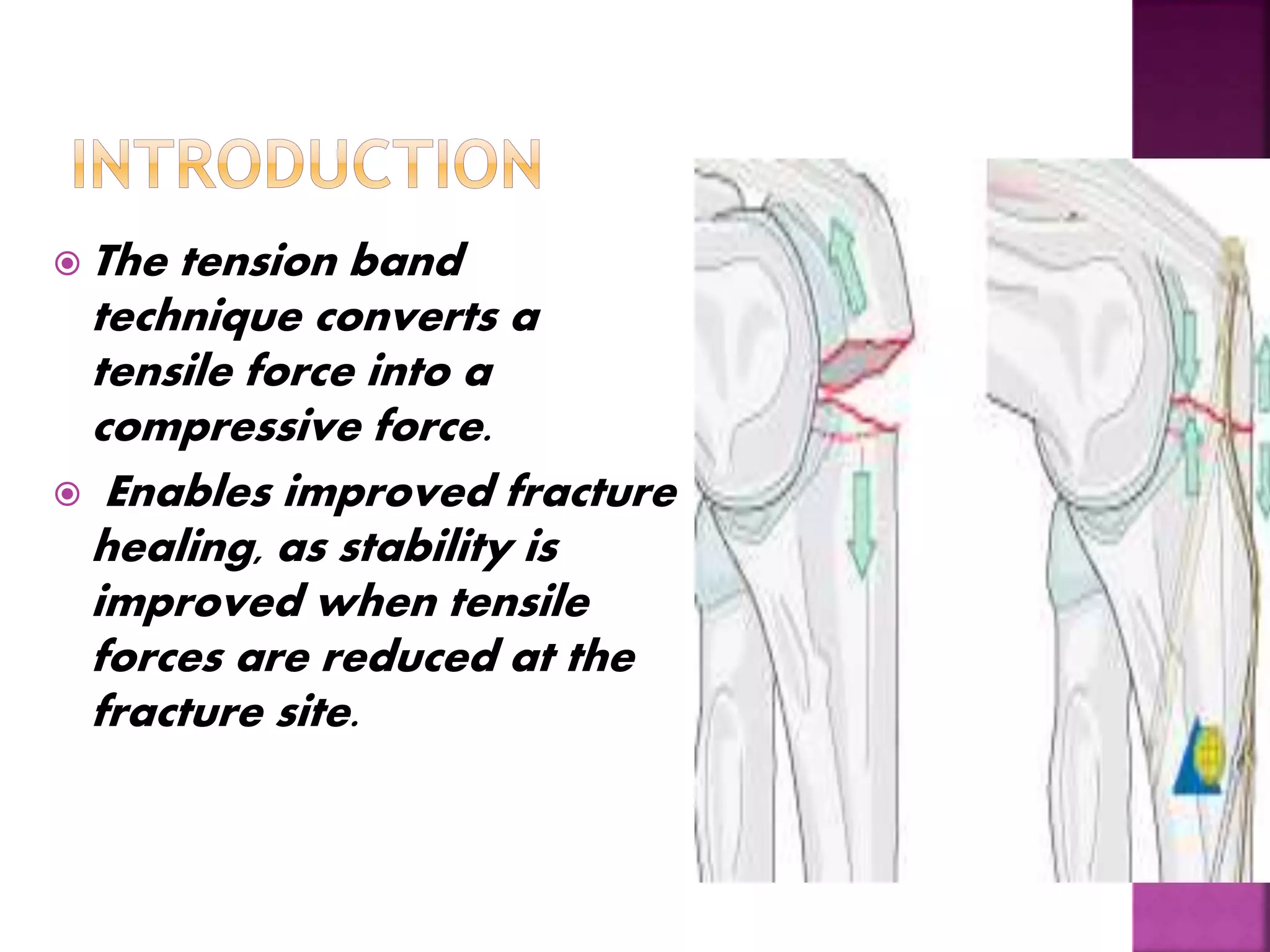
 The tension band
technique converts a
tensile force into a
compressive force.
 Enables improved fracture
healing, as stability is
improved when tensile
forces are reduced at the
fracture site.
What is a Tension Band
A tension band is a
device which
exerts a force
equal in magnitude
but opposite in
direction to an
applied distracting
tensile force
REF: MANUAL OF INTERNAL FIXATION BY M.E. MULLER 3RD EDITION
The tensionband conceptwas
introducedto
orthopedicsby Freidrich
Pauwels in the1930's and
was
appliedtointernalfixationof
eccentricallyloadedbone
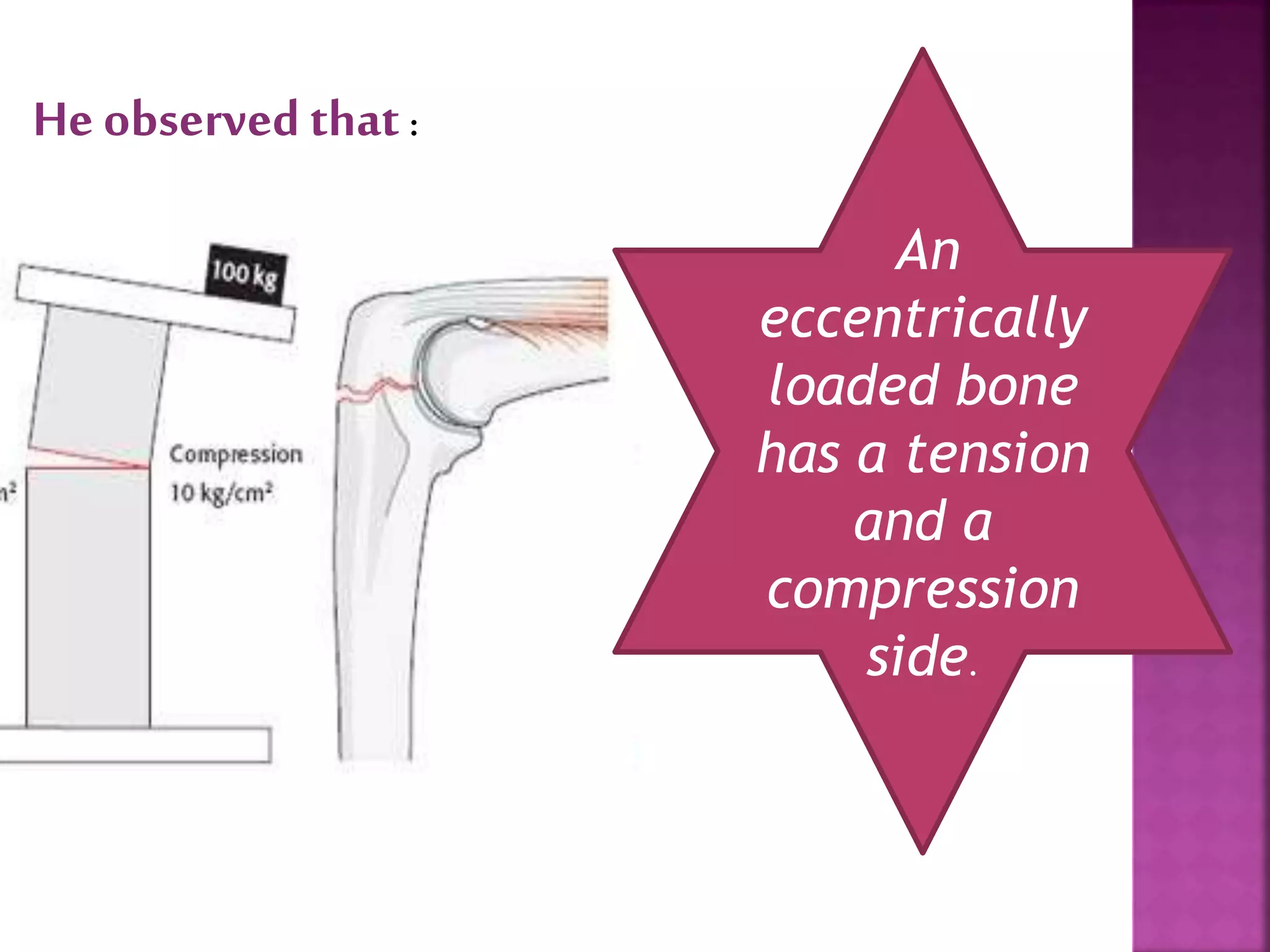
He observed that :
An
eccentrically
loaded bone
has a tension
and a
compression
side.
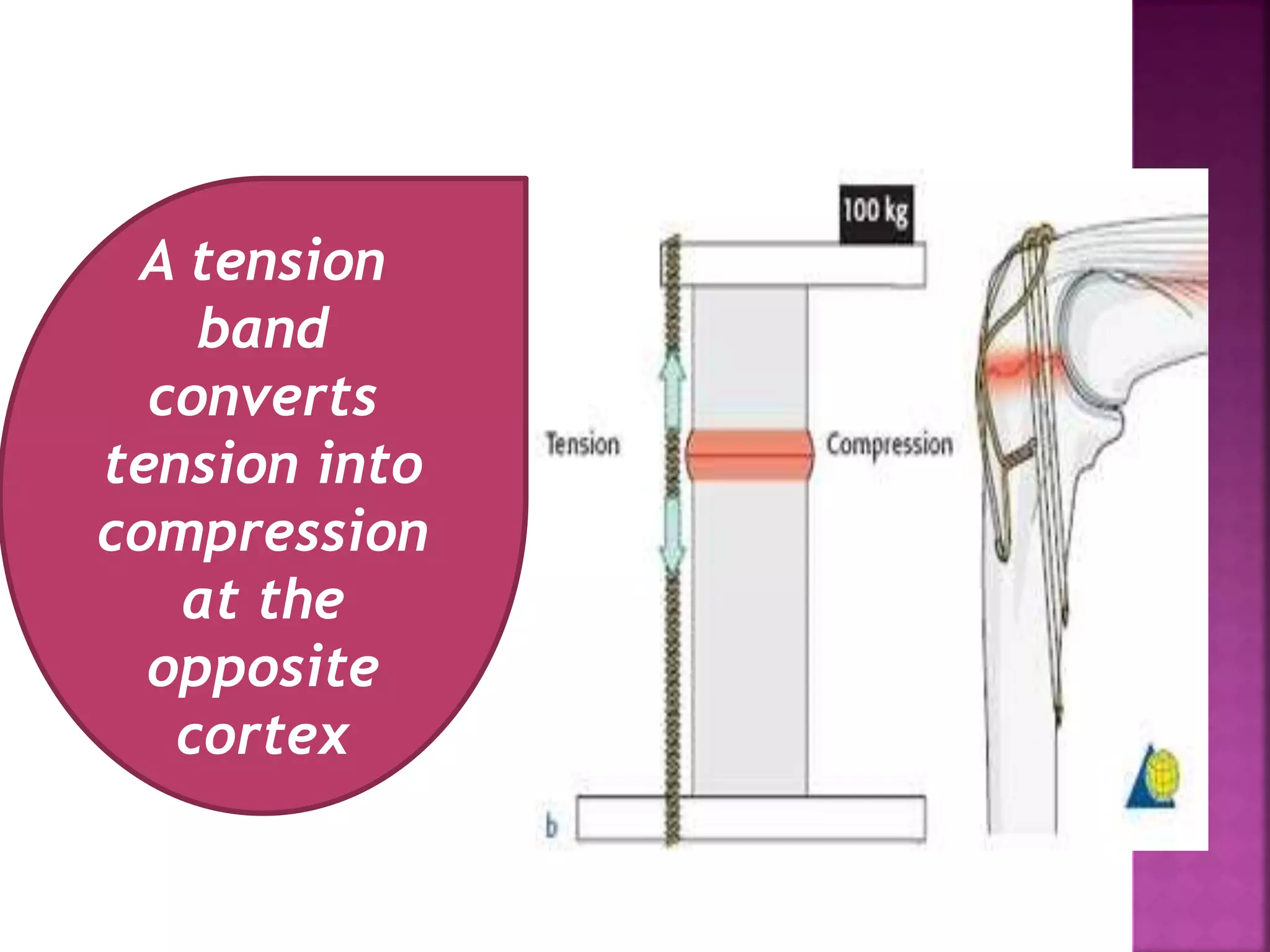
A tension
band
converts
tension into
compression
at the
opposite
cortex
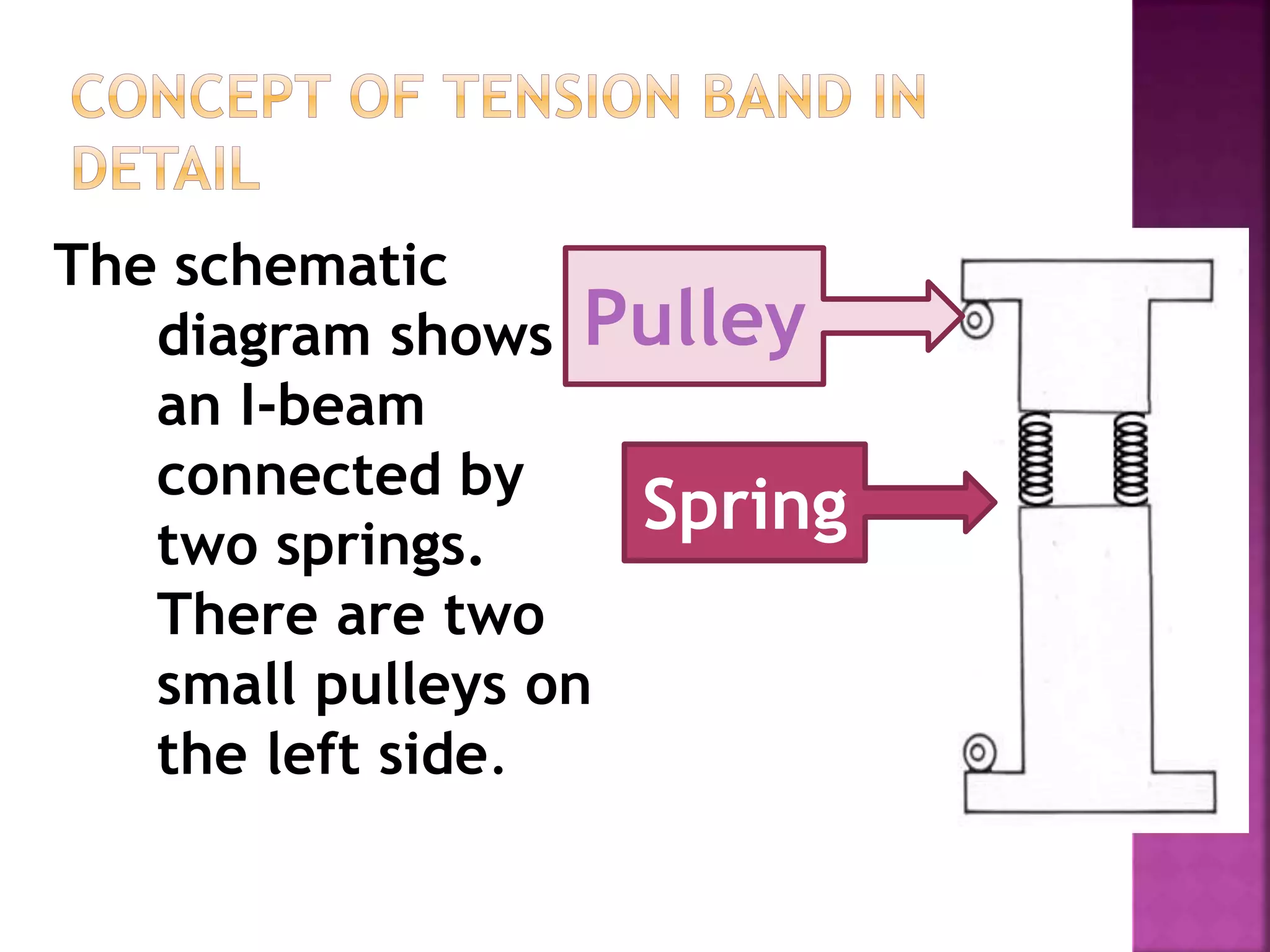
The schematic
diagram shows
an I-beam
connected by
two springs.
There are two
small pulleys on
the left side.
Pulley
Spring
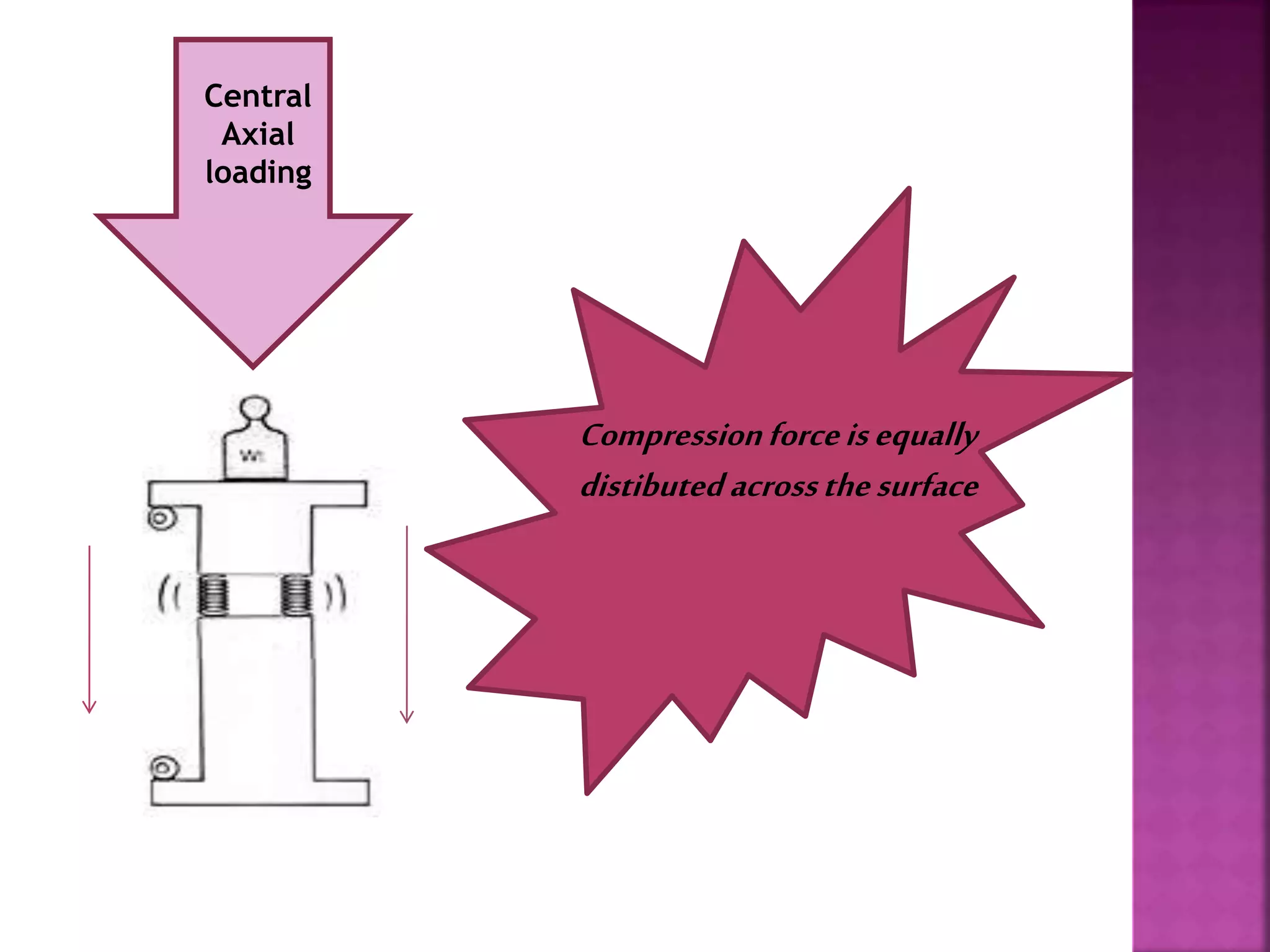
Central
Axial
loading
Compressionforceisequally
distibuted acrossthesurface
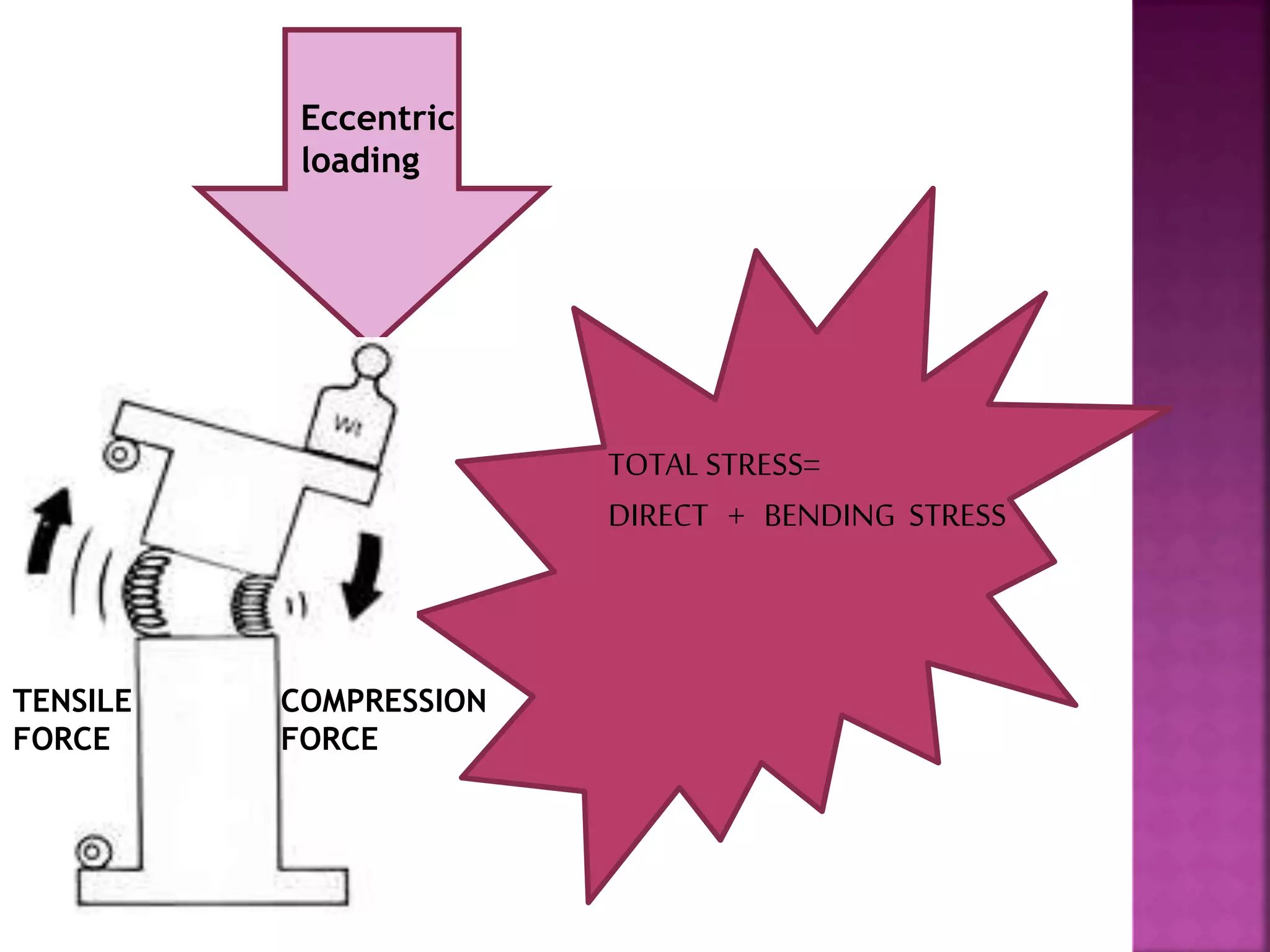
Eccentric
loading
TOTALSTRESS=
DIRECT + BENDING STRESS
COMPRESSION
FORCE
TENSILE
FORCE
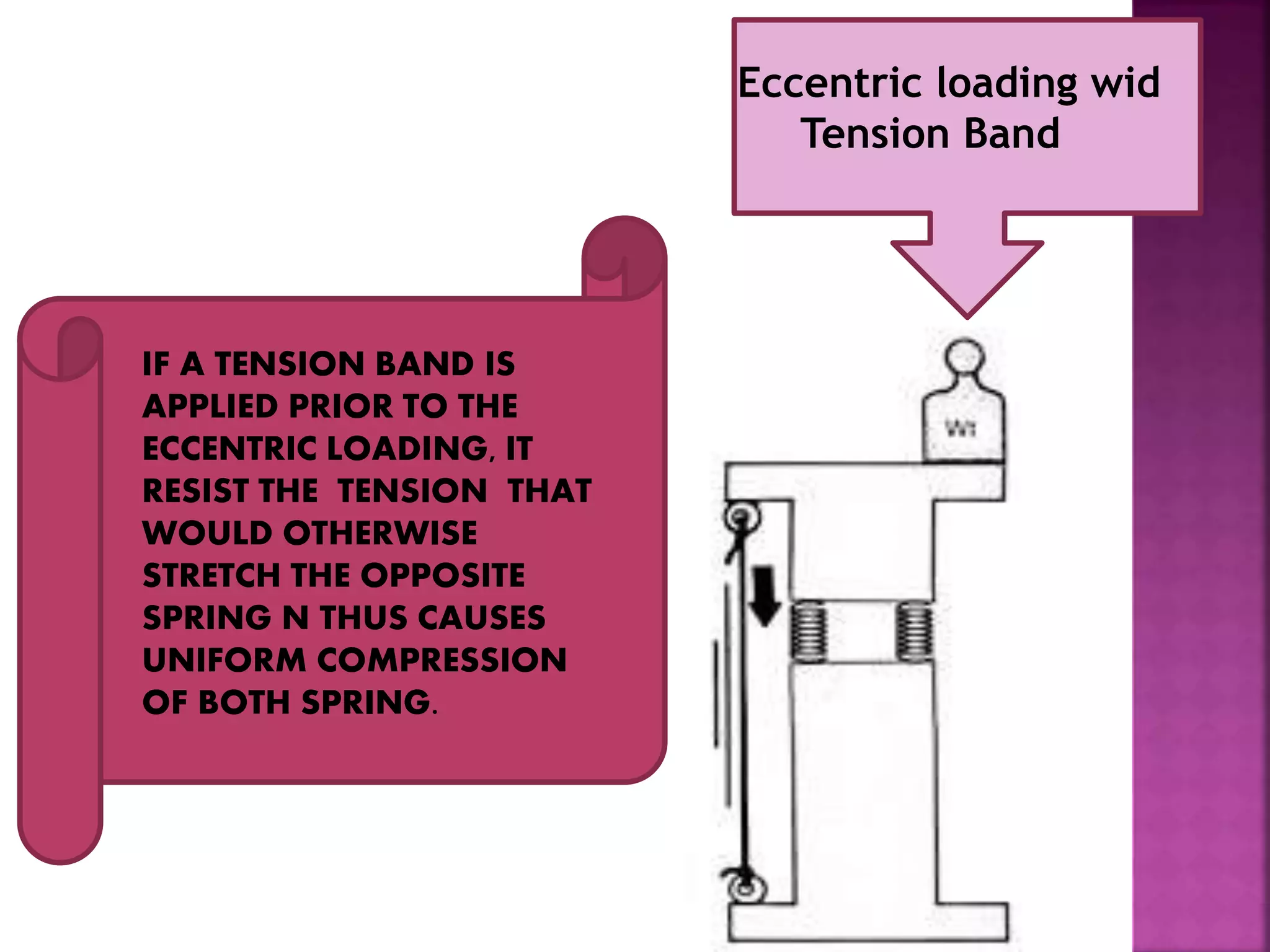
Eccentric loading wid
Tension Band
IF A TENSION BAND IS
APPLIED PRIOR TO THE
ECCENTRIC LOADING, IT
RESIST THE TENSION THAT
WOULD OTHERWISE
STRETCH THE OPPOSITE
SPRING N THUS CAUSES
UNIFORM COMPRESSION
OF BOTH SPRING.
Antero-lateral
surface
TENSION
Postero-Medial
surface
COMPRESSION
Femur is an eccentrically
loaded bone, which is
bowed both in :-
• Coronal plane
• Saggital plane
In curved long bones like femur which are eccentrically loaded,
the convex side of the diaphysis indicates the tension side.
 Tubular Long bones :-
1. Femur
2. Humerus
3. Radius
4. Ulna
In general, the concave surface acts as
the compression surface and the
convex as the tension surface.
 Tension band must be applied on the
tension surface of the bone.
 Must be prestressed(tightened).
 Must be strong to withstand tension
load.
 Strong opposite bone cortex must be
present to withstand dynamic
compressive loads.
 Joint movement must be encouraged to
improve congruity n compression.
PRESTRESSINGOF TENSION
BAND KEEPTHE FRACTURE
FRAGMENT UNDER STATIC
COMPRESSION.
IMPORTANCE OF INTACT
OPPOSITE CORTEX
IF TENSION BAND IS
APPLIED ON THE
FRACURE SITE WITH
DEFICIENT MEDIAL
CORTEX , MEDIAL
CORTEX WILL
FURTHER COLLAPSE N
WILL ULTIMATELY
LEAD TO IMPLANT
BENDING N FAILURE
What all devices can act as
tension bands ???
• Stainless steel wire either alone or in
combination with K-wires and/or Screws
• Plates
• External fixators
• Metal cables
• Non absorbable Polyester sutures
(Ethibond)
 A tension band that produces compression
at the time of application is called a STATIC
TENSION BAND, as the forces at the
fracture site remain fairly constant during
movement.
 Tension band application to the medial
malleolus is an example of a static tension
band.
STATIC TENSION BAND
EXAMPLE OF STATIC TENSION BAND
MEDIAL
MALLEOLU
S
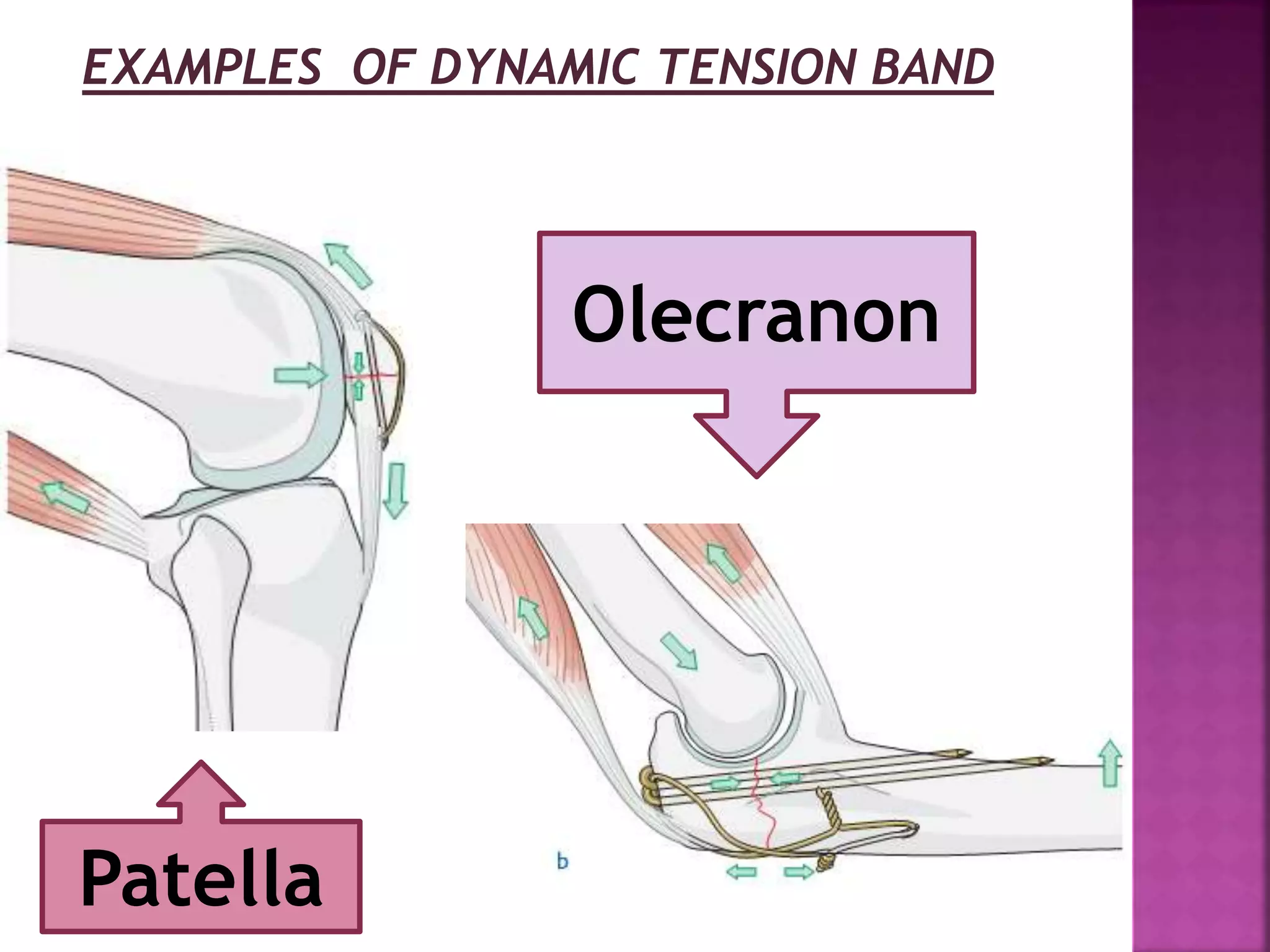
 If the compression force increases with
motion, it is known as DYNAMIC TENSION
BAND
 A good example is the application of the
tension band principle to a fracture of the
patella. Upon knee flexion, the increased
tensile force is converted to compression
force.
DYNAMIC TENSION BAND
Patella
Olecranon
EXAMPLES OF DYNAMIC TENSION BAND
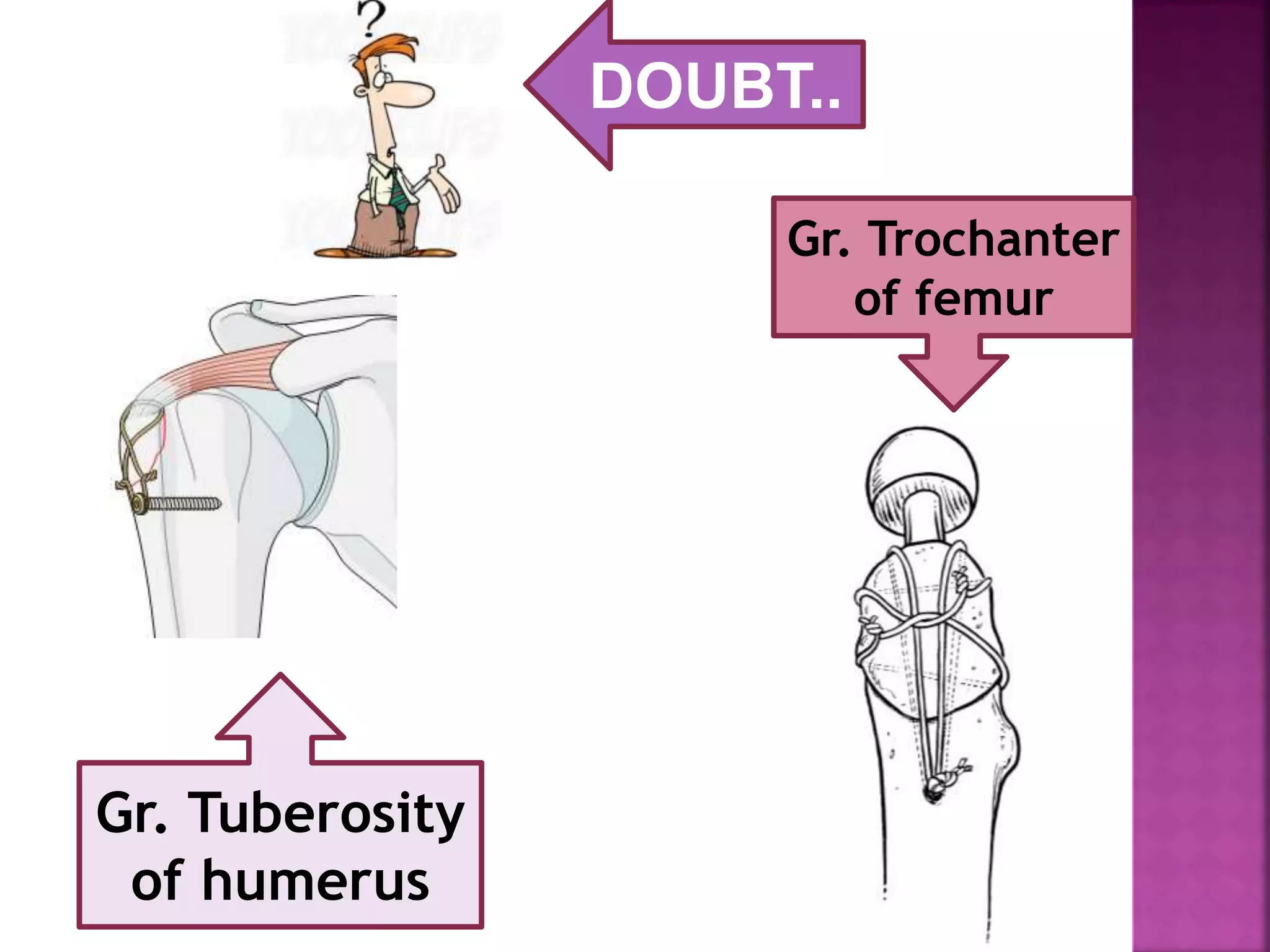
Gr. Tuberosity
of humerus
Gr. Trochanter
of femur
DOUBT..
....
(REF: AO PRINCIPLE OF FRACTURE MANAGEMENT)
1. The tension band
principle with wire
loops is often applied
to articular fractures
of the patella and
olecranon,
converting tension
from muscle pull into
compressive force
on the articular side
of the fracture.
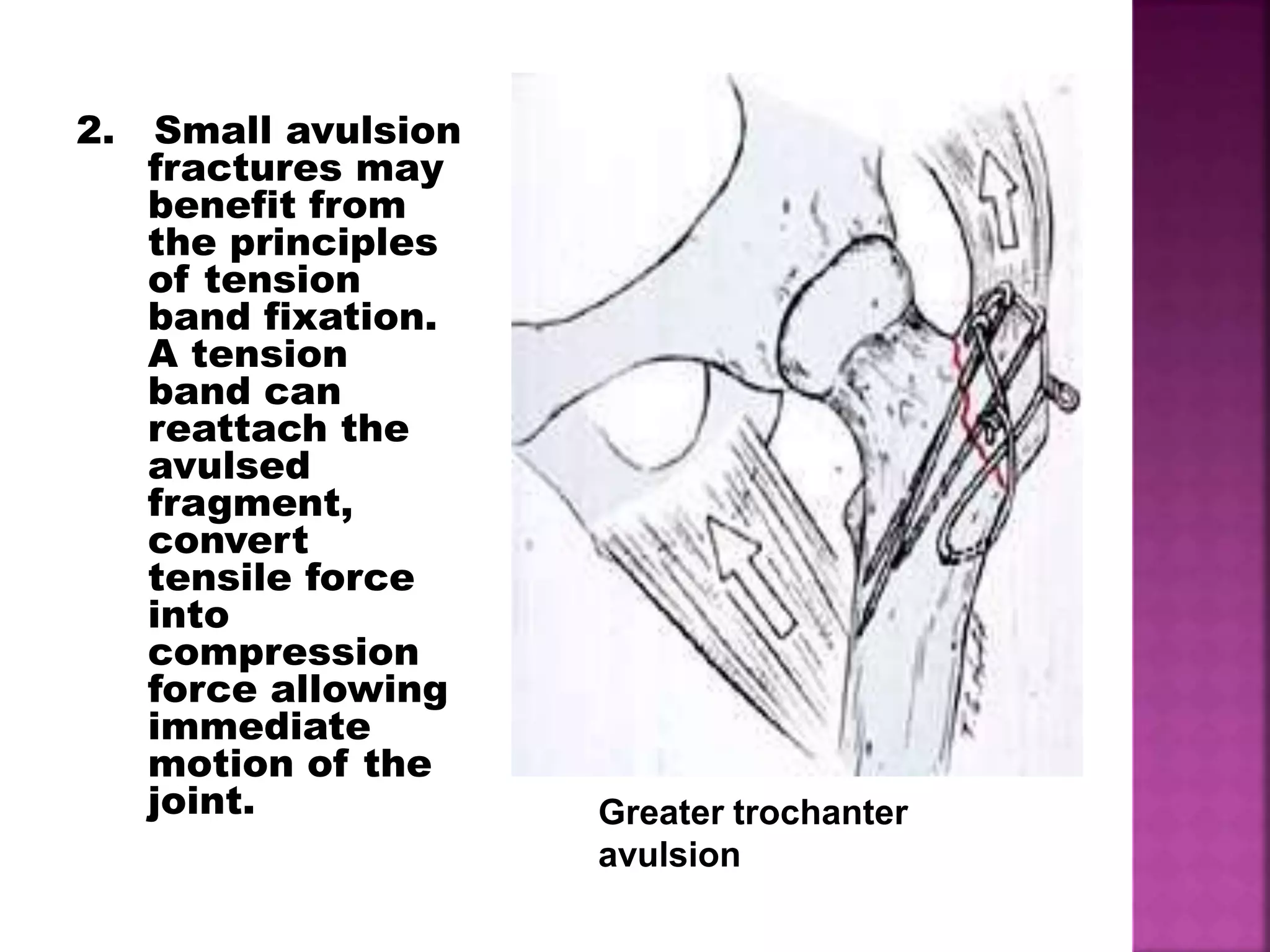
2. Small avulsion
fractures may
benefit from
the principles
of tension
band fixation.
A tension
band can
reattach the
avulsed
fragment,
convert
tensile force
into
compression
force allowing
immediate
motion of the
joint. Greater trochanter
avulsion
• Bones subjected to Eccentric pull of tendons/ligaments also have
tensile forces n compressive forces acting on its surfaces
1. Olecranon process of ulna
2. Patella
3. Greater tuberosity of humerus
4. Greater trochanter of femur
5. Medial and Lateral malleoli of tibia
6. Phalanges near attachments of tendons/ligaments
7. Tibial tuberosity at patellar tendon insertion
3. The principles of tension band fixation
with a plate can also be applied in
diaphyseal fractures such as the femoral
shaft.
4. Similarly, in delayed bony unions or in
nonunions, where the presence of angular
deformity creates a tension side in the
bone, adherence to the tension band
principles becomes extremely important.
TBW is a fixation
technique which
results in
ABSOLUTE
STABILITY
Therefore,
Interfragmentary
compression n
direct bone
healing is
obtained.
(REF: AO PRINCIPLE OF FRACTURE FIXATION)
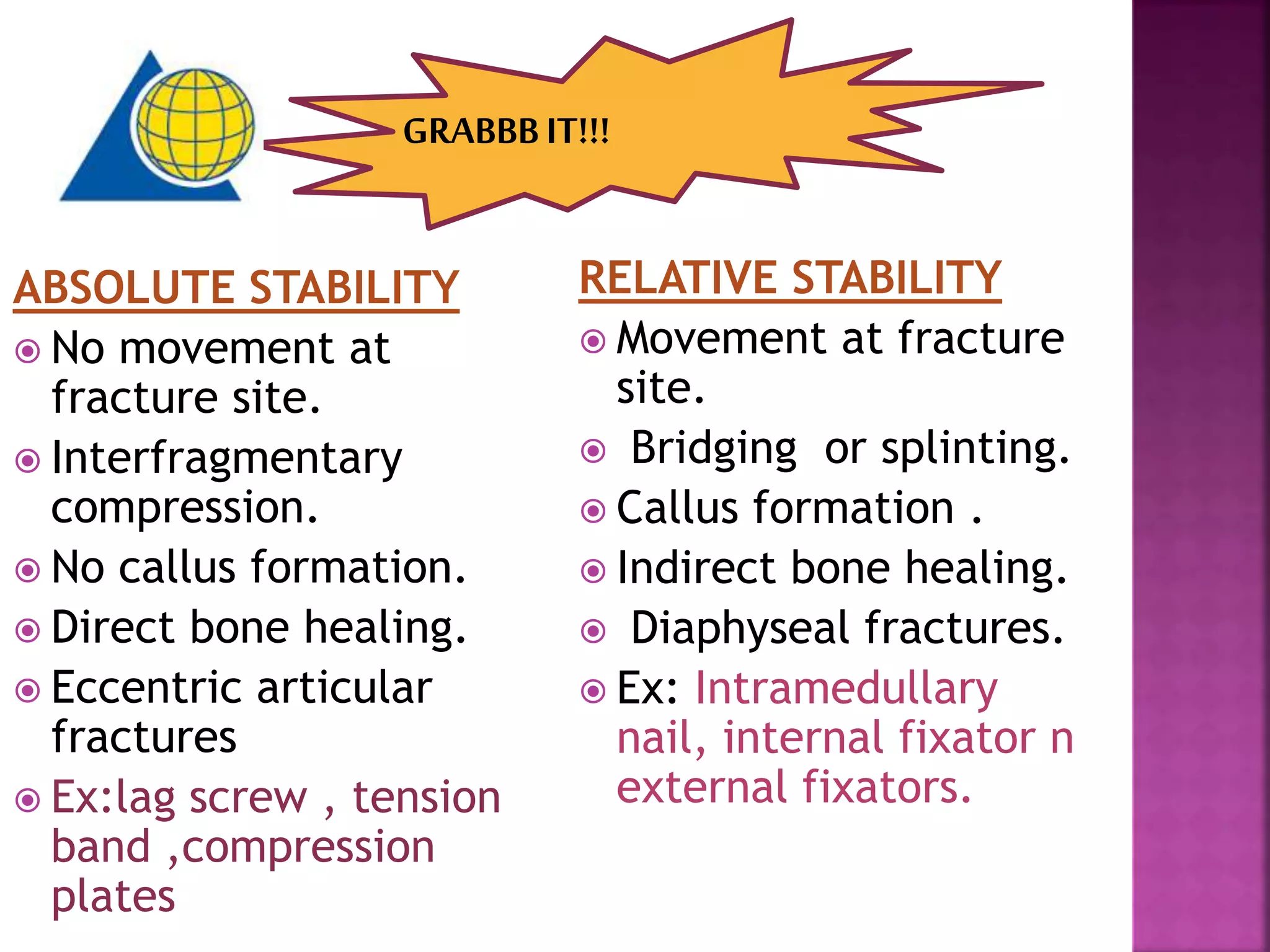
ABSOLUTE STABILITY
 No movement at
fracture site.
 Interfragmentary
compression.
 No callus formation.
 Direct bone healing.
 Eccentric articular
fractures
 Ex:lag screw , tension
band ,compression
plates
RELATIVE STABILITY
 Movement at fracture
site.
 Bridging or splinting.
 Callus formation .
 Indirect bone healing.
 Diaphyseal fractures.
 Ex: Intramedullary
nail, internal fixator n
external fixators.
GRABBBIT!!!
TENSIONBAND WIRING
REF: THE ELEMENT OF FRACTURE FIXATION BY ANAND
J.THAKUR, 2ND EDITION, CH-7
A wire , a cable or a non-absorbable suture is
used to perform the function of a tension band.
Usually wires from 0.4 to 1.5 mm are used.
A 1.2mm wire is used as a tension band.
Tension band wire is often applied in a figure
of 8 fashion around previously inserted, parallel
n longitudinally place kirschner wires, steinmann
pins, or cancellous lag screws.
POINTS TO REMEMBER!!!
Implants like steinmann pin, cancellous screw,
n k-wires are used as an adjunctive fixation wid
TBW to prevent displacement of the fracture
fragments through shearing , translation, or
rotation .
Crossed k wires are less stable and interfere
with interfragmentary compression.
The parallel k wires also provide anchorage
points around which the tension band wire is
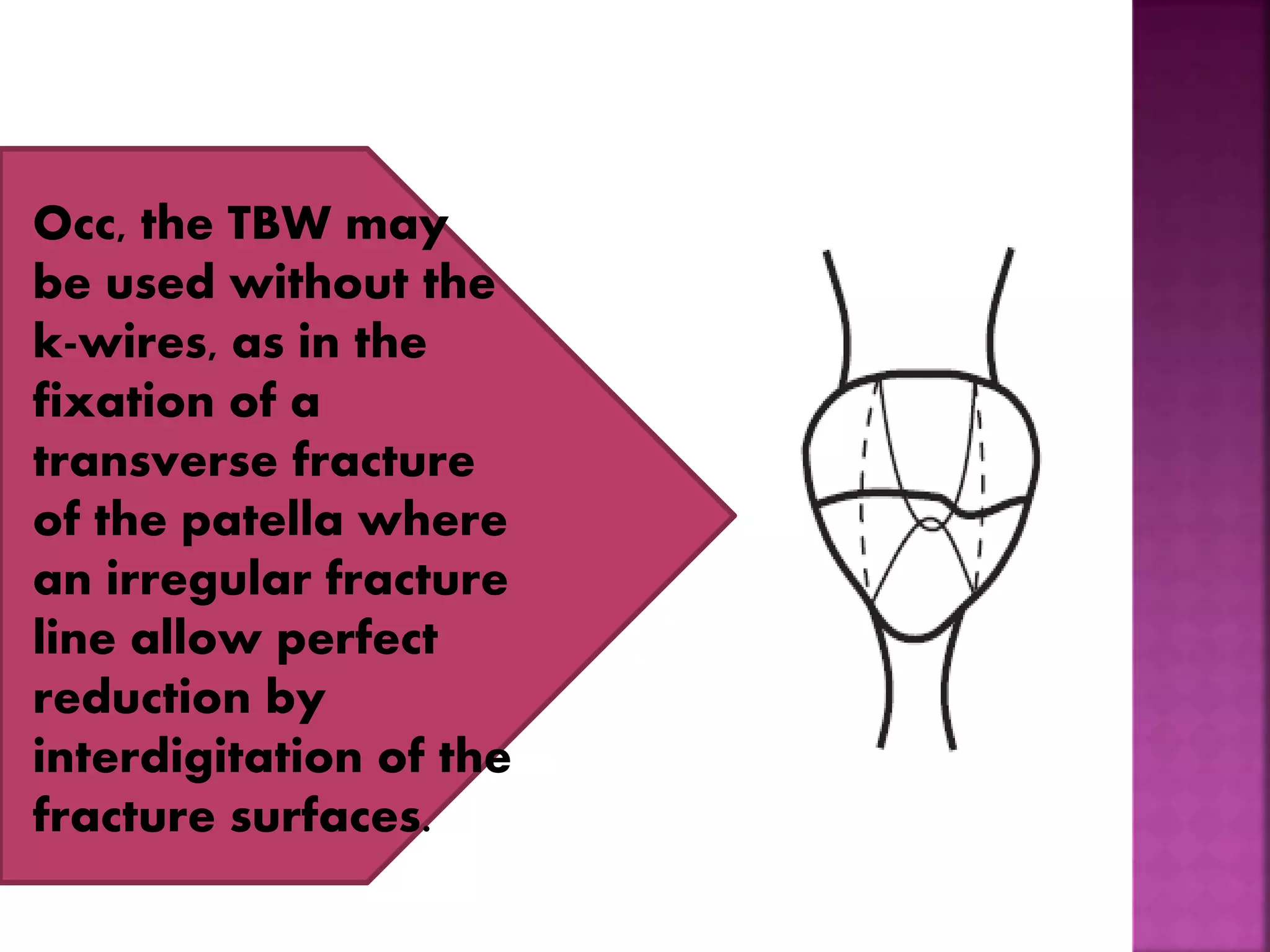
Occ, the TBW may
be used without the
k-wires, as in the
fixation of a
transverse fracture
of the patella where
an irregular fracture
line allow perfect
reduction by
interdigitation of the
fracture surfaces.
UNUSUAL SITES FOR
TBW(REF: ELEMENT OF FRACTURE FIXATION BY ANAND J
THAKUR, 2ND EDIT, CH 7)
1. Lateral end of clavicle.
• Efffective method of securing
small fragments.
• chances of migration of k wire to
vital organs are high.
2. DIAPHYSIS OF METACARPAL N
METATARSAL
• For isolated metacarpals or
metatarsals
3. ARTHRODESIS OF THE THUMB
• when the two phalanges are quit small
and the bone is porotic.
4. ARTHRODESIS OF WRIST
• In porotic bone stock, plating is impossible
n TBW is a viable option
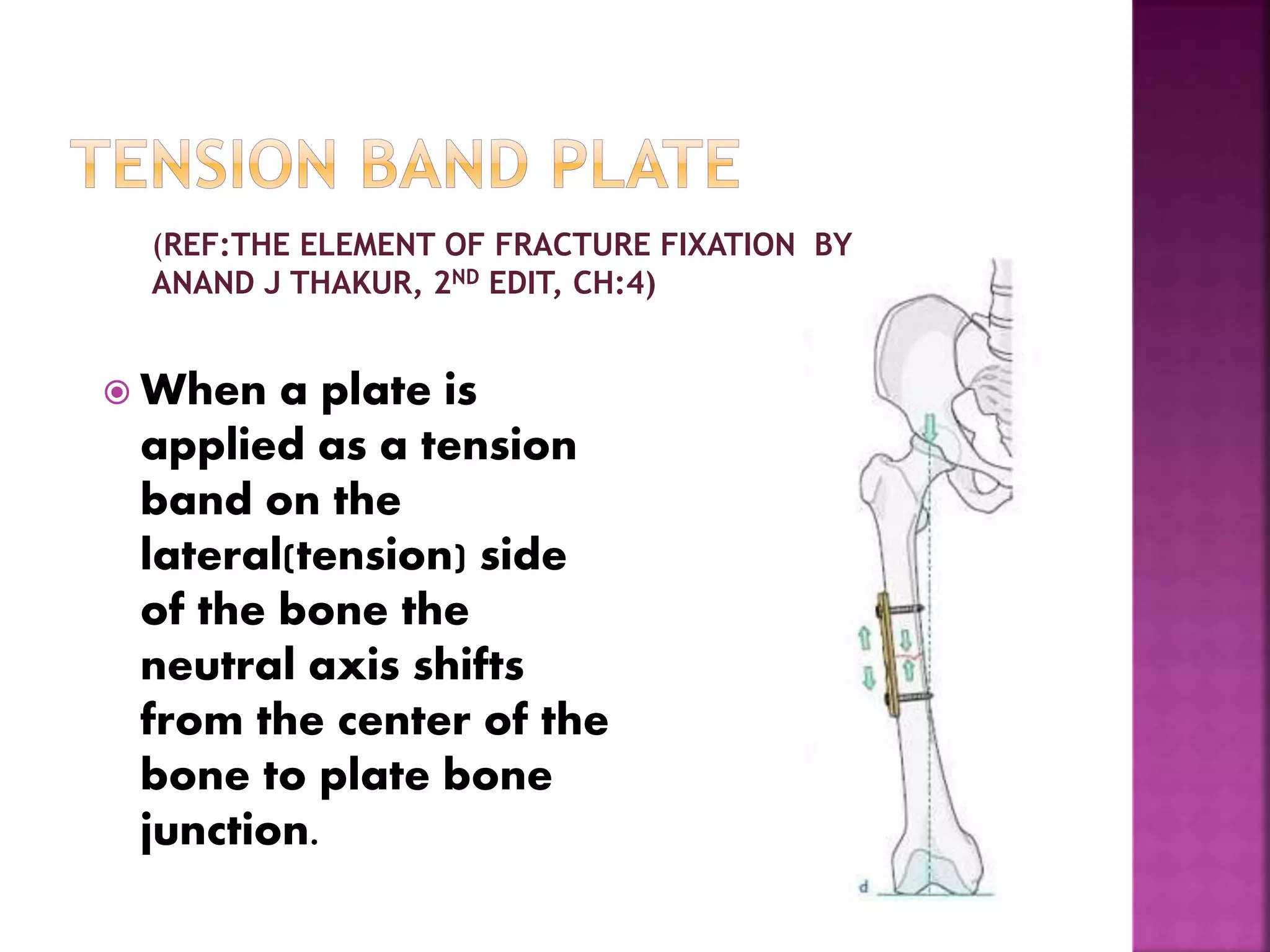
 When a plate is
applied as a tension
band on the
lateral(tension) side
of the bone the
neutral axis shifts
from the center of the
bone to plate bone
junction.
(REF:THE ELEMENT OF FRACTURE FIXATION BY
ANAND J THAKUR, 2ND EDIT, CH:4)
 Any axial loading produces tension in the
plate n distributes pure compression forces
across the fracture line
 The load is shared by plate n the bone
“A bone will act
as a tension
band only if it is
applied to the
tension side of a
bone”
 When a plate is applied as tension band in
the bending close construct, the working
lenght for bending of plate is minimal,
since it is in contact with bone on either
side of fracture.
BENDING
FORCE
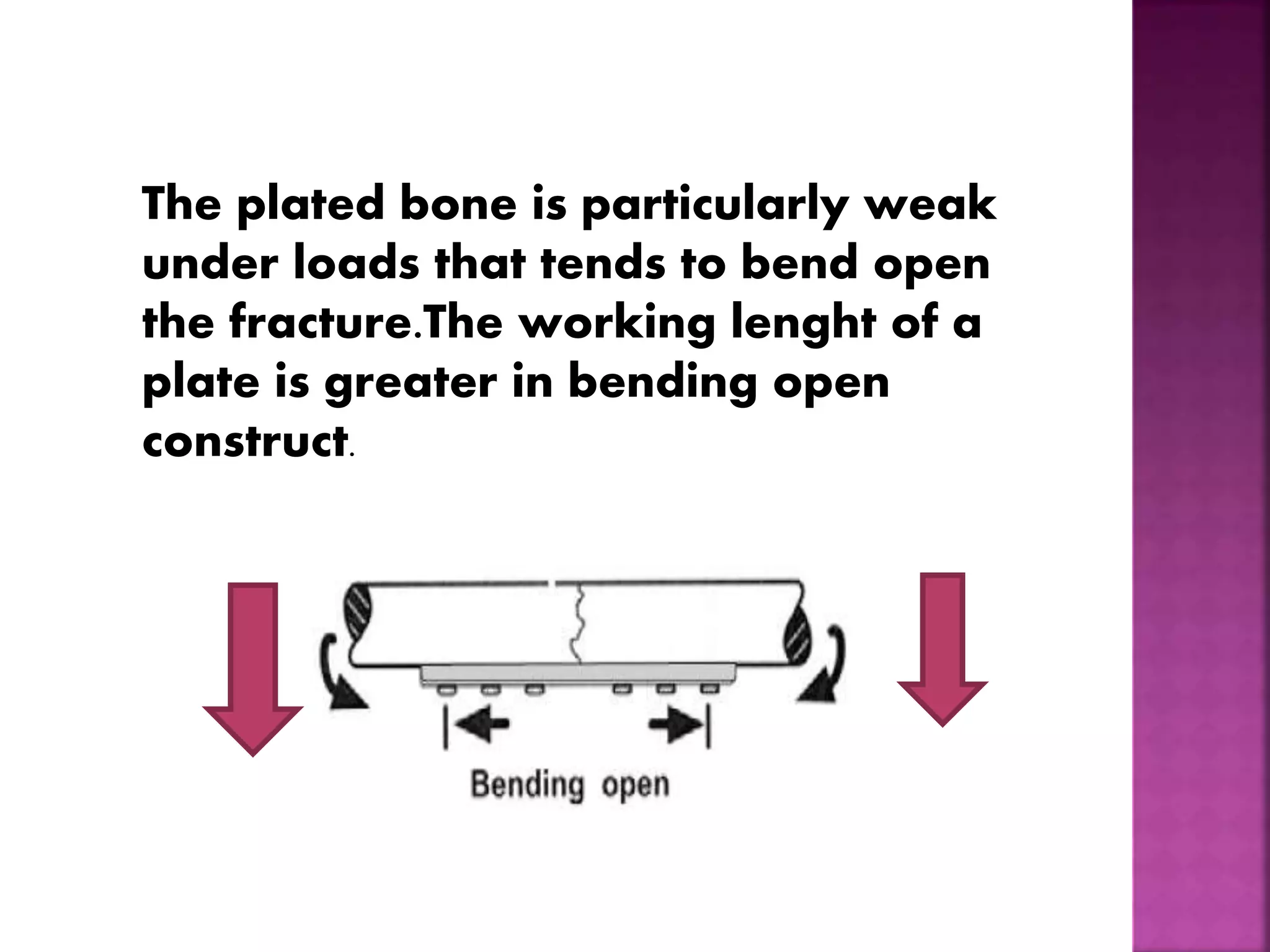
The plated bone is particularly weak
under loads that tends to bend open
the fracture.The working lenght of a
plate is greater in bending open
construct.
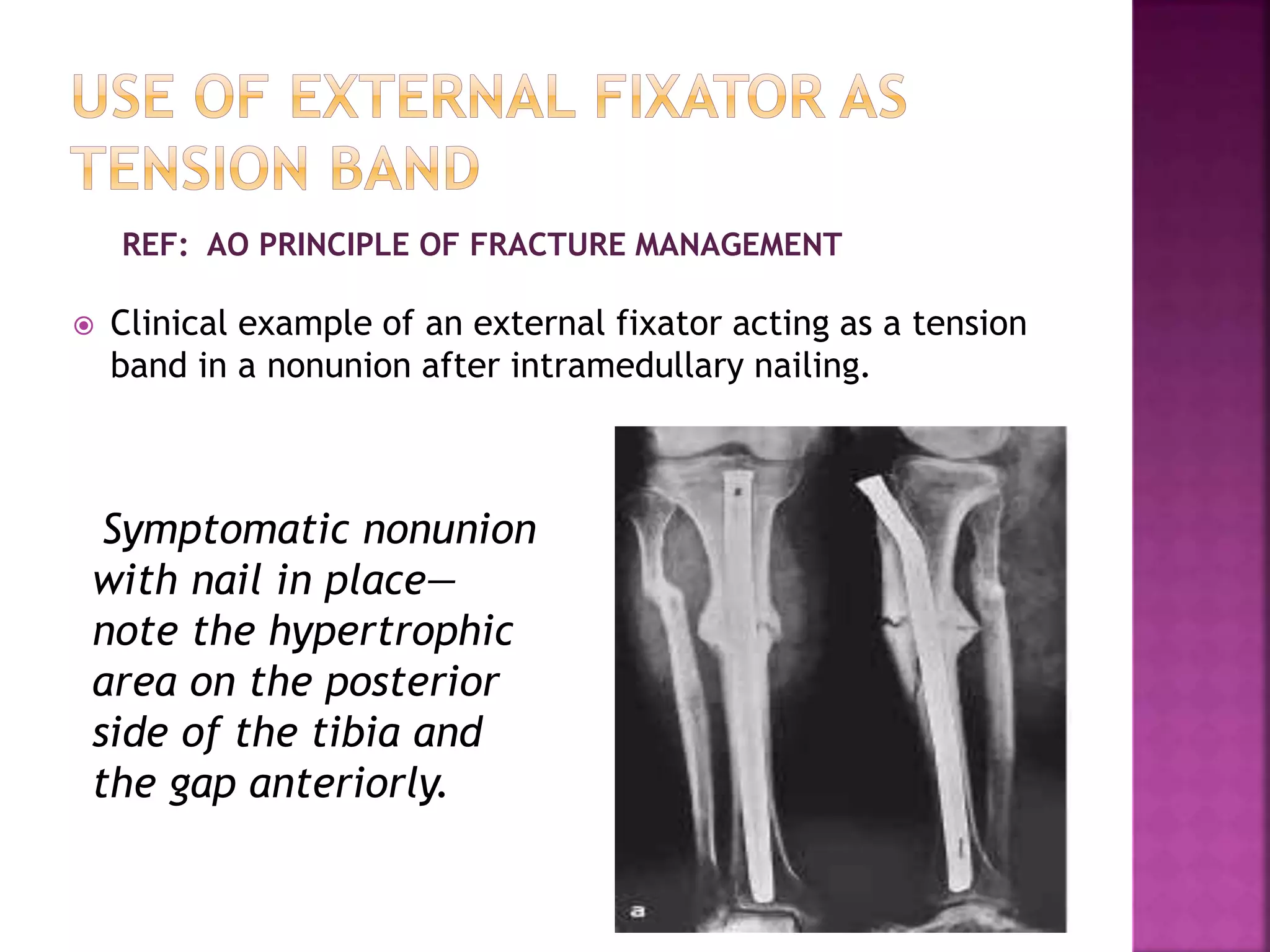
 Clinical example of an external fixator acting as a tension
band in a nonunion after intramedullary nailing.
REF: AO PRINCIPLE OF FRACTURE MANAGEMENT
Symptomatic nonunion
with nail in place—
note the hypertrophic
area on the posterior
side of the tibia and
the gap anteriorly.
After removal of the
intramedullary nail, a
unilateral external fixator
was applied anteriorly in the
sagittal plane, and full
weight bearing was
encouraged. The nonunion
consolidated.
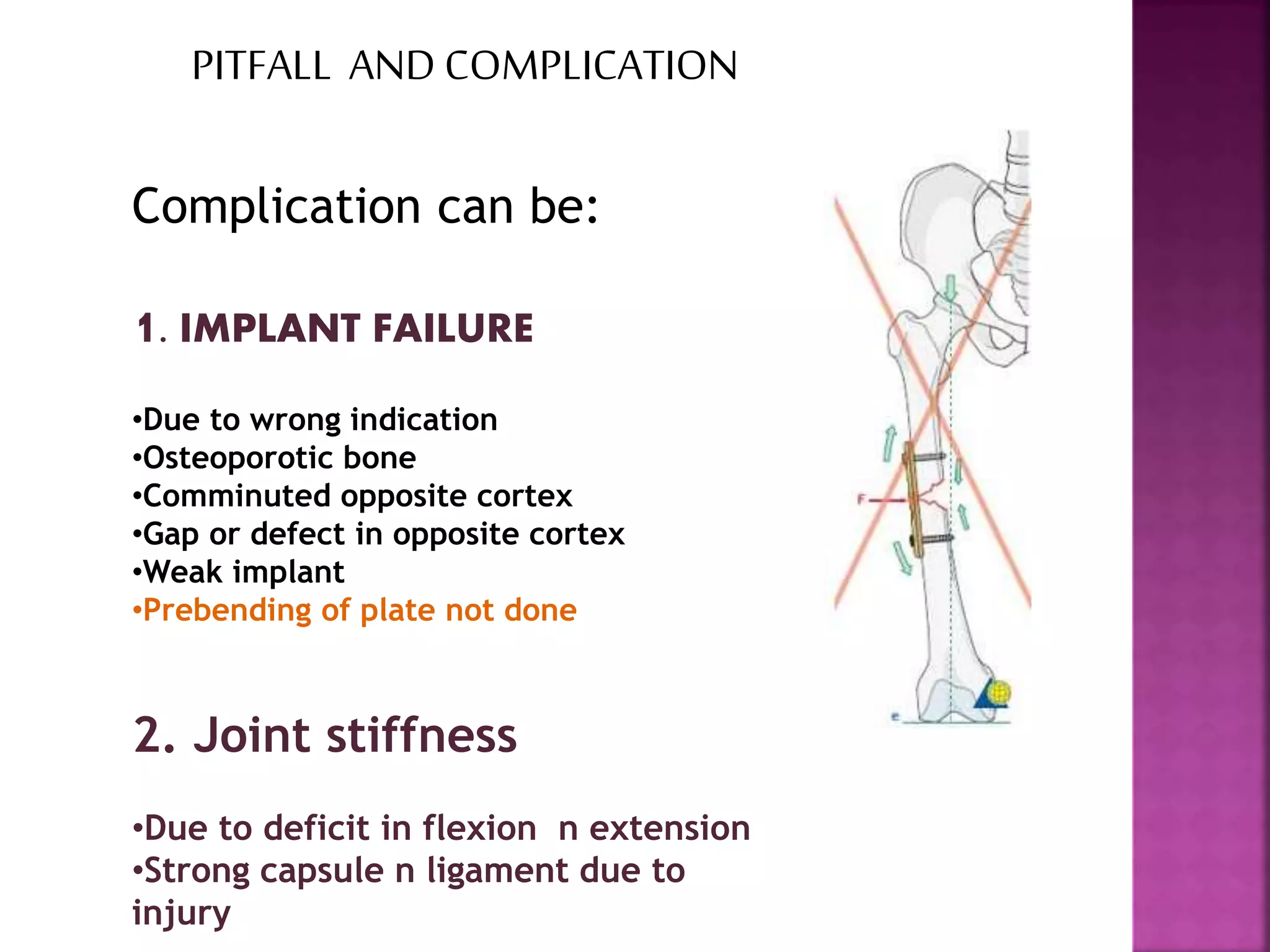
Complication can be:
1. IMPLANT FAILURE
•Due to wrong indication
•Osteoporotic bone
•Comminuted opposite cortex
•Gap or defect in opposite cortex
•Weak implant
•Prebending of plate not done
2. Joint stiffness
•Due to deficit in flexion n extension
•Strong capsule n ligament due to
injury
PITFALL AND COMPLICATION
PREBENDING
PREBENDING OF
PLATE
REMEMBER!!!
A wire put under pure
tension is very strong.
However, if bending forces
are added, it will break
quite rapidly due to
fatigue. This principle of
fatigue failure also holds
true for plates.
3) HARDWARE
PROMINENCE
• Is a common
patient problem
associated wid
tension band fixation
• may also l/t skin
breakdown n
subsequent infection.
• Wire prominence is
usually related to
improper k-wire
seating at the time of
surgery.
The tips of
the k-wires
should be U-
bent,
shortened n
impacted in
the bone
4)Another
occasional
complication seen
wid tension band
wire for olecranon
fracture is its
cutting out of the
distal fragment if
the wire is not
inserted deep
enough below the
Principle of tension band wiring n its application

Principle of tension band wiring n its application

  • 1.
    MODERATOR: PROF. DR.M.S. DHILLON PRESENTED BY: DR. ROHIT KANSAL
  • 2.
    •INTRODUCTION •HISTORY •CONCEPT OF TENSIONBAND •TYPES •APPLICATION •TENSION BAND WIRING •TENSION BAND PLATE •COMPLICATIONS
  • 3.
     The tensionband technique converts a tensile force into a compressive force.  Enables improved fracture healing, as stability is improved when tensile forces are reduced at the fracture site.
  • 4.
    What is aTension Band A tension band is a device which exerts a force equal in magnitude but opposite in direction to an applied distracting tensile force REF: MANUAL OF INTERNAL FIXATION BY M.E. MULLER 3RD EDITION
  • 5.
    The tensionband conceptwas introducedto orthopedicsbyFreidrich Pauwels in the1930's and was appliedtointernalfixationof eccentricallyloadedbone
  • 6.
    He observed that: An eccentrically loaded bone has a tension and a compression side.
  • 7.
  • 8.
    The schematic diagram shows anI-beam connected by two springs. There are two small pulleys on the left side. Pulley Spring
  • 9.
  • 10.
    Eccentric loading TOTALSTRESS= DIRECT + BENDINGSTRESS COMPRESSION FORCE TENSILE FORCE
  • 11.
    Eccentric loading wid TensionBand IF A TENSION BAND IS APPLIED PRIOR TO THE ECCENTRIC LOADING, IT RESIST THE TENSION THAT WOULD OTHERWISE STRETCH THE OPPOSITE SPRING N THUS CAUSES UNIFORM COMPRESSION OF BOTH SPRING.
  • 12.
    Antero-lateral surface TENSION Postero-Medial surface COMPRESSION Femur is aneccentrically loaded bone, which is bowed both in :- • Coronal plane • Saggital plane In curved long bones like femur which are eccentrically loaded, the convex side of the diaphysis indicates the tension side.
  • 13.
     Tubular Longbones :- 1. Femur 2. Humerus 3. Radius 4. Ulna In general, the concave surface acts as the compression surface and the convex as the tension surface.
  • 14.
     Tension bandmust be applied on the tension surface of the bone.  Must be prestressed(tightened).  Must be strong to withstand tension load.  Strong opposite bone cortex must be present to withstand dynamic compressive loads.  Joint movement must be encouraged to improve congruity n compression.
  • 15.
    PRESTRESSINGOF TENSION BAND KEEPTHEFRACTURE FRAGMENT UNDER STATIC COMPRESSION.
  • 16.
    IMPORTANCE OF INTACT OPPOSITECORTEX IF TENSION BAND IS APPLIED ON THE FRACURE SITE WITH DEFICIENT MEDIAL CORTEX , MEDIAL CORTEX WILL FURTHER COLLAPSE N WILL ULTIMATELY LEAD TO IMPLANT BENDING N FAILURE
  • 17.
    What all devicescan act as tension bands ??? • Stainless steel wire either alone or in combination with K-wires and/or Screws • Plates • External fixators • Metal cables • Non absorbable Polyester sutures (Ethibond)
  • 18.
     A tensionband that produces compression at the time of application is called a STATIC TENSION BAND, as the forces at the fracture site remain fairly constant during movement.  Tension band application to the medial malleolus is an example of a static tension band. STATIC TENSION BAND
  • 19.
    EXAMPLE OF STATICTENSION BAND MEDIAL MALLEOLU S
  • 20.
     If thecompression force increases with motion, it is known as DYNAMIC TENSION BAND  A good example is the application of the tension band principle to a fracture of the patella. Upon knee flexion, the increased tensile force is converted to compression force. DYNAMIC TENSION BAND
  • 21.
  • 22.
    Gr. Tuberosity of humerus Gr.Trochanter of femur DOUBT.. ....
  • 23.
    (REF: AO PRINCIPLEOF FRACTURE MANAGEMENT) 1. The tension band principle with wire loops is often applied to articular fractures of the patella and olecranon, converting tension from muscle pull into compressive force on the articular side of the fracture.
  • 24.
    2. Small avulsion fracturesmay benefit from the principles of tension band fixation. A tension band can reattach the avulsed fragment, convert tensile force into compression force allowing immediate motion of the joint. Greater trochanter avulsion
  • 25.
    • Bones subjectedto Eccentric pull of tendons/ligaments also have tensile forces n compressive forces acting on its surfaces 1. Olecranon process of ulna 2. Patella 3. Greater tuberosity of humerus 4. Greater trochanter of femur 5. Medial and Lateral malleoli of tibia 6. Phalanges near attachments of tendons/ligaments 7. Tibial tuberosity at patellar tendon insertion
  • 26.
    3. The principlesof tension band fixation with a plate can also be applied in diaphyseal fractures such as the femoral shaft. 4. Similarly, in delayed bony unions or in nonunions, where the presence of angular deformity creates a tension side in the bone, adherence to the tension band principles becomes extremely important.
  • 27.
    TBW is afixation technique which results in ABSOLUTE STABILITY Therefore, Interfragmentary compression n direct bone healing is obtained. (REF: AO PRINCIPLE OF FRACTURE FIXATION)
  • 28.
    ABSOLUTE STABILITY  Nomovement at fracture site.  Interfragmentary compression.  No callus formation.  Direct bone healing.  Eccentric articular fractures  Ex:lag screw , tension band ,compression plates RELATIVE STABILITY  Movement at fracture site.  Bridging or splinting.  Callus formation .  Indirect bone healing.  Diaphyseal fractures.  Ex: Intramedullary nail, internal fixator n external fixators. GRABBBIT!!!
  • 29.
    TENSIONBAND WIRING REF: THEELEMENT OF FRACTURE FIXATION BY ANAND J.THAKUR, 2ND EDITION, CH-7 A wire , a cable or a non-absorbable suture is used to perform the function of a tension band. Usually wires from 0.4 to 1.5 mm are used. A 1.2mm wire is used as a tension band. Tension band wire is often applied in a figure of 8 fashion around previously inserted, parallel n longitudinally place kirschner wires, steinmann pins, or cancellous lag screws.
  • 30.
    POINTS TO REMEMBER!!! Implantslike steinmann pin, cancellous screw, n k-wires are used as an adjunctive fixation wid TBW to prevent displacement of the fracture fragments through shearing , translation, or rotation . Crossed k wires are less stable and interfere with interfragmentary compression. The parallel k wires also provide anchorage points around which the tension band wire is
  • 31.
    Occ, the TBWmay be used without the k-wires, as in the fixation of a transverse fracture of the patella where an irregular fracture line allow perfect reduction by interdigitation of the fracture surfaces.
  • 32.
    UNUSUAL SITES FOR TBW(REF:ELEMENT OF FRACTURE FIXATION BY ANAND J THAKUR, 2ND EDIT, CH 7) 1. Lateral end of clavicle. • Efffective method of securing small fragments. • chances of migration of k wire to vital organs are high. 2. DIAPHYSIS OF METACARPAL N METATARSAL • For isolated metacarpals or metatarsals
  • 33.
    3. ARTHRODESIS OFTHE THUMB • when the two phalanges are quit small and the bone is porotic. 4. ARTHRODESIS OF WRIST • In porotic bone stock, plating is impossible n TBW is a viable option
  • 34.
     When aplate is applied as a tension band on the lateral(tension) side of the bone the neutral axis shifts from the center of the bone to plate bone junction. (REF:THE ELEMENT OF FRACTURE FIXATION BY ANAND J THAKUR, 2ND EDIT, CH:4)
  • 35.
     Any axialloading produces tension in the plate n distributes pure compression forces across the fracture line  The load is shared by plate n the bone
  • 36.
    “A bone willact as a tension band only if it is applied to the tension side of a bone”
  • 37.
     When aplate is applied as tension band in the bending close construct, the working lenght for bending of plate is minimal, since it is in contact with bone on either side of fracture. BENDING FORCE
  • 38.
    The plated boneis particularly weak under loads that tends to bend open the fracture.The working lenght of a plate is greater in bending open construct.
  • 39.
     Clinical exampleof an external fixator acting as a tension band in a nonunion after intramedullary nailing. REF: AO PRINCIPLE OF FRACTURE MANAGEMENT Symptomatic nonunion with nail in place— note the hypertrophic area on the posterior side of the tibia and the gap anteriorly.
  • 40.
    After removal ofthe intramedullary nail, a unilateral external fixator was applied anteriorly in the sagittal plane, and full weight bearing was encouraged. The nonunion consolidated.
  • 41.
    Complication can be: 1.IMPLANT FAILURE •Due to wrong indication •Osteoporotic bone •Comminuted opposite cortex •Gap or defect in opposite cortex •Weak implant •Prebending of plate not done 2. Joint stiffness •Due to deficit in flexion n extension •Strong capsule n ligament due to injury PITFALL AND COMPLICATION
  • 42.
  • 43.
    REMEMBER!!! A wire putunder pure tension is very strong. However, if bending forces are added, it will break quite rapidly due to fatigue. This principle of fatigue failure also holds true for plates.
  • 44.
    3) HARDWARE PROMINENCE • Isa common patient problem associated wid tension band fixation • may also l/t skin breakdown n subsequent infection. • Wire prominence is usually related to improper k-wire seating at the time of surgery. The tips of the k-wires should be U- bent, shortened n impacted in the bone
  • 45.
    4)Another occasional complication seen wid tensionband wire for olecranon fracture is its cutting out of the distal fragment if the wire is not inserted deep enough below the