Renaissance and Baroque Europe Chapter 16
Renaissance Renaissance-”rebirth” Science was a major influence Accuracy and naturalism were valued A revived interest in the art and ideas of classical Greece and Rome Major Renaissance ideas stemmed from Italy
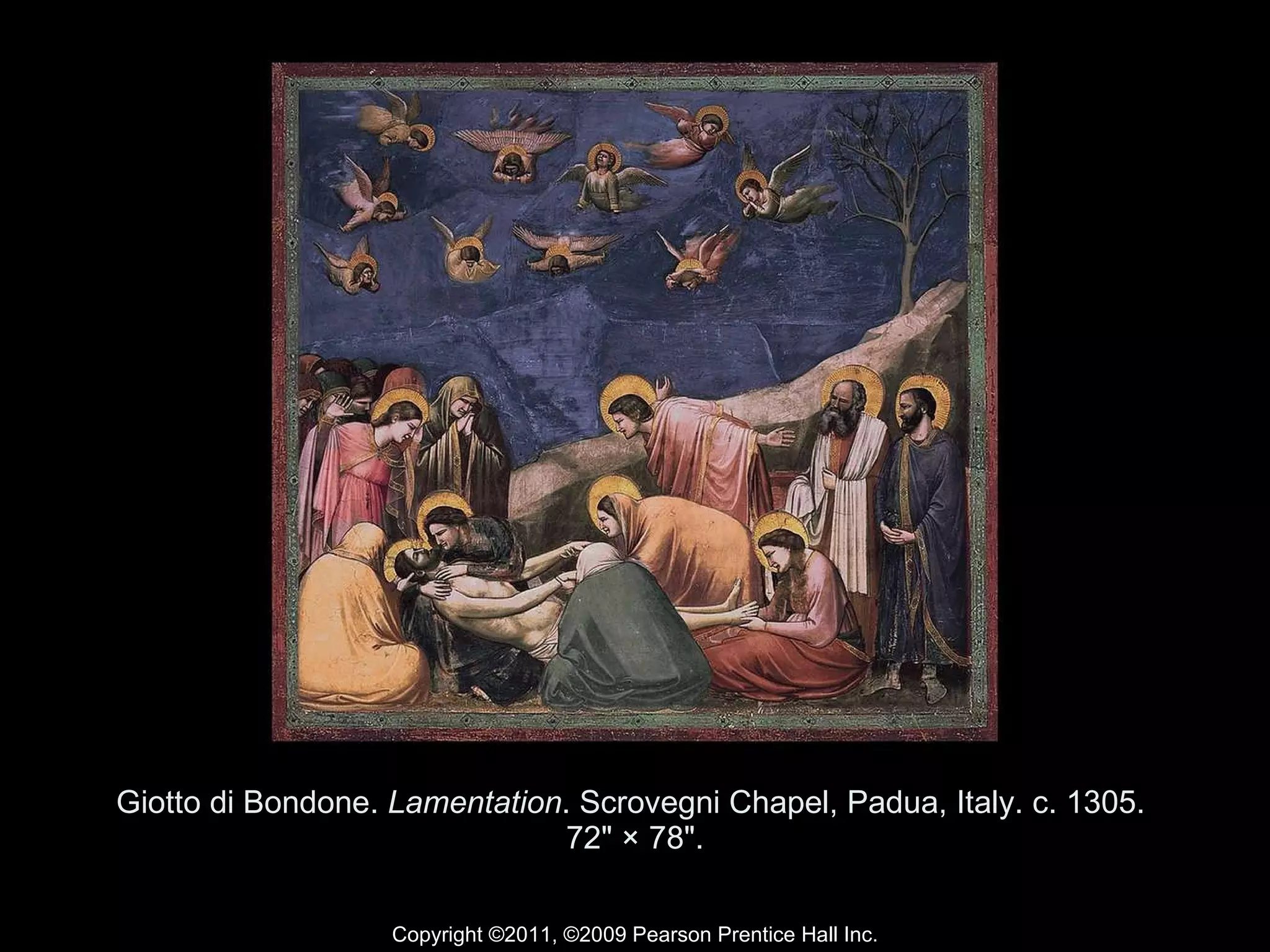
Giotto di Bondone.  Lamentation . Scrovegni Chapel, Padua, Italy. c. 1305.  72" × 78". Copyright ©2011, ©2009 Pearson Prentice Hall Inc.
Lamentation by Giotto Departed from the abstract Byzantine style Giotto began to show mass, space, and light in a more naturalistic way The scene is very stage-like and shallow in terms of space He takes pains to portray the emotion and the grief of the scene
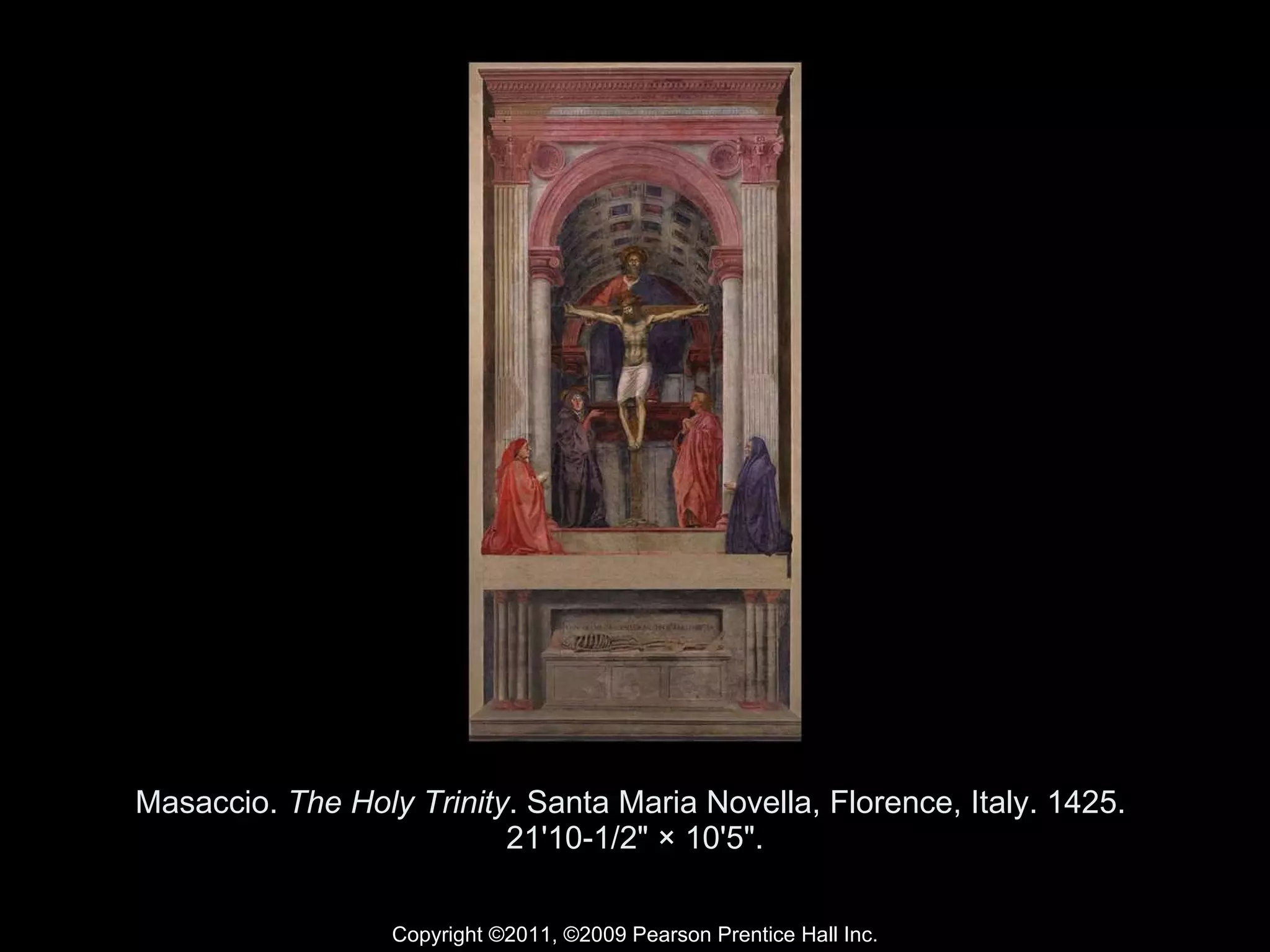
Masaccio.  The Holy Trinity . Santa Maria Novella, Florence, Italy. 1425.  21'10-1/2" × 10'5". Copyright ©2011, ©2009 Pearson Prentice Hall Inc.
The Holy Trinity by Masaccio Considered to be the first painting made using linear perspective Filippo Brunelleschi is considered the “inventor” of linear perspective The trinity is represented here God the father as a seated figure Christ the son on the cross The Holy Spirit as a white dove On either side of the cross stand Mary and St. John Kneeling on the outside are the donors that paid for the painting Masaccio’s figures have lifelike presence and realistic folds in their clothing
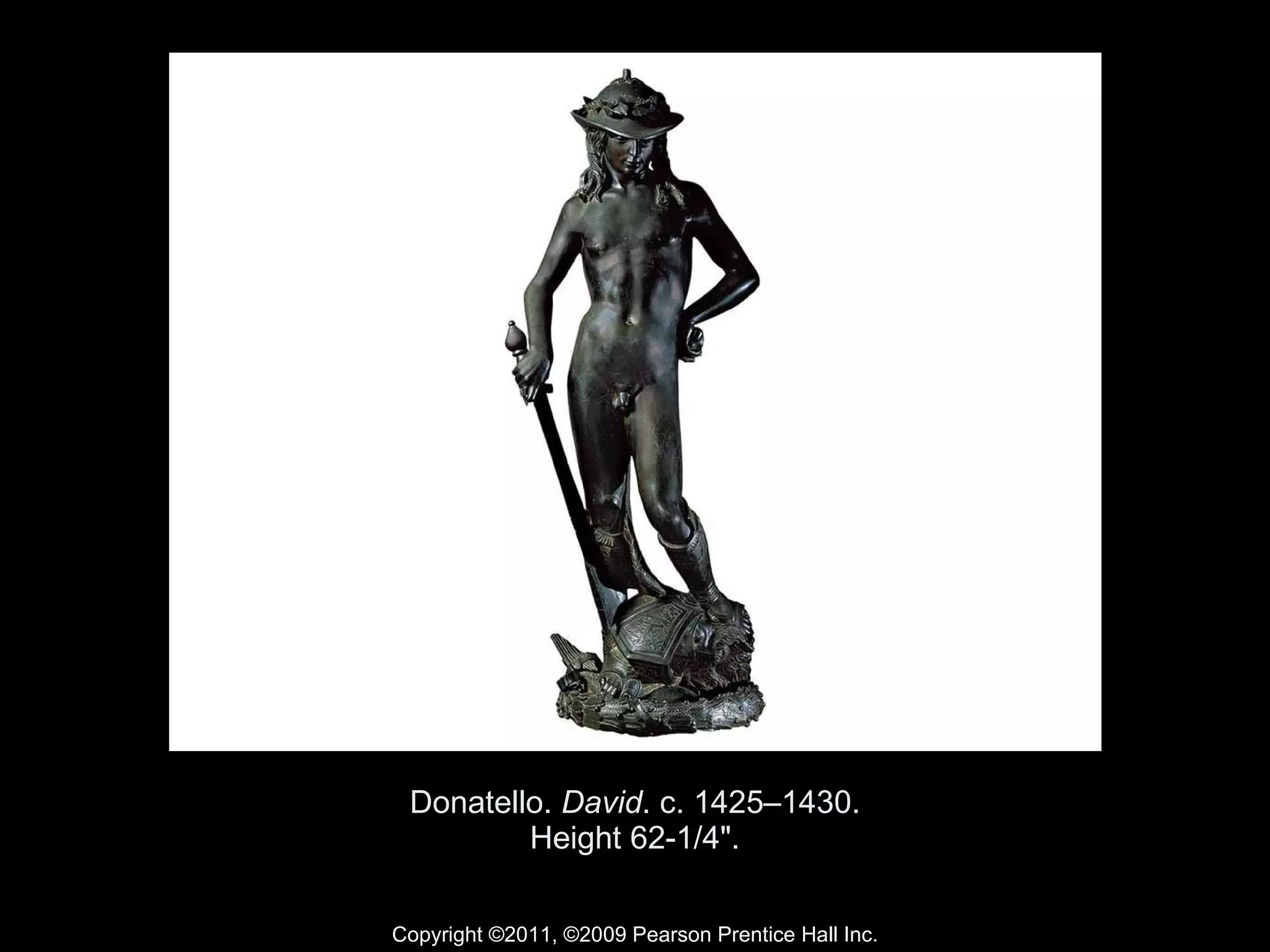
Donatello.  David . c. 1425–1430. Height 62-1/4". Copyright ©2011, ©2009 Pearson Prentice Hall Inc.
David by Donatello Donatello sculpts the way that Masaccio paints Donatello studied the Greek and Roman sculptures  He takes a more naturalistic approach This sculpture show David just after slaying the giant Goliath David stands in a contrapposto position  This David is more sensual than most previous sculptures
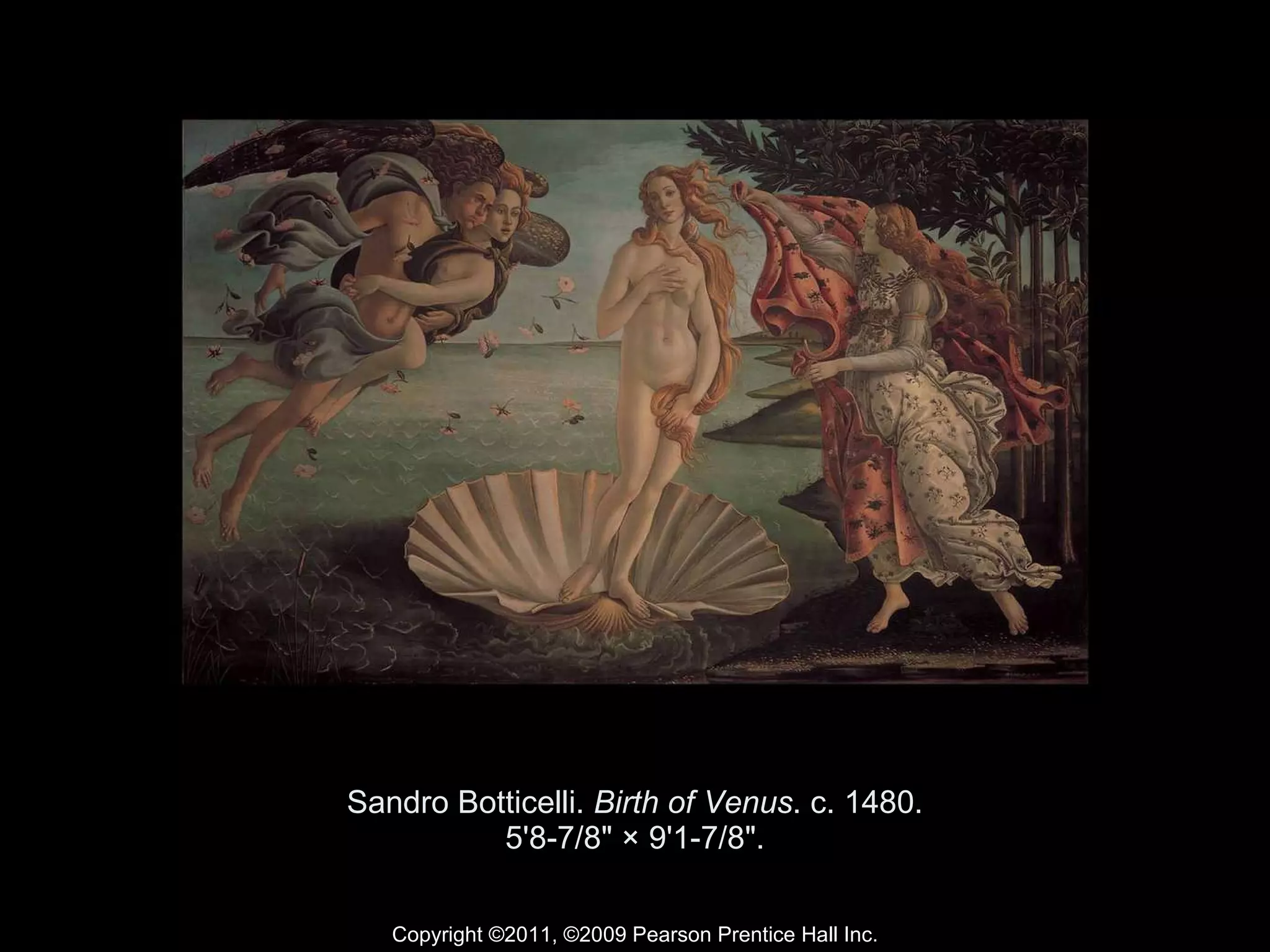
Sandro Botticelli.  Birth of Venus . c. 1480. 5'8-7/8" × 9'1-7/8". Copyright ©2011, ©2009 Pearson Prentice Hall Inc.
Birth of Venus by Botticelli The first large mythological painting since antiquity Portrays the goddess Venus at her birth The posture denotes modesty, probably copied from the Roman sculpture of Venus He shows the idealized female form, an idea taken from Greece, but infuses it with feeling  Putting a pagan goddess as a central figure in a painting was revolutionary, usually that spot was reserved for Mary
The High Renaissance High Renaissance-between 1490-1530 Italian art reached its peak in the cities of Florence, Rome, and Venice The major artists Leonardo, Michelangelo, and Raphael developed a style that combined Christianity and Greek philosphy
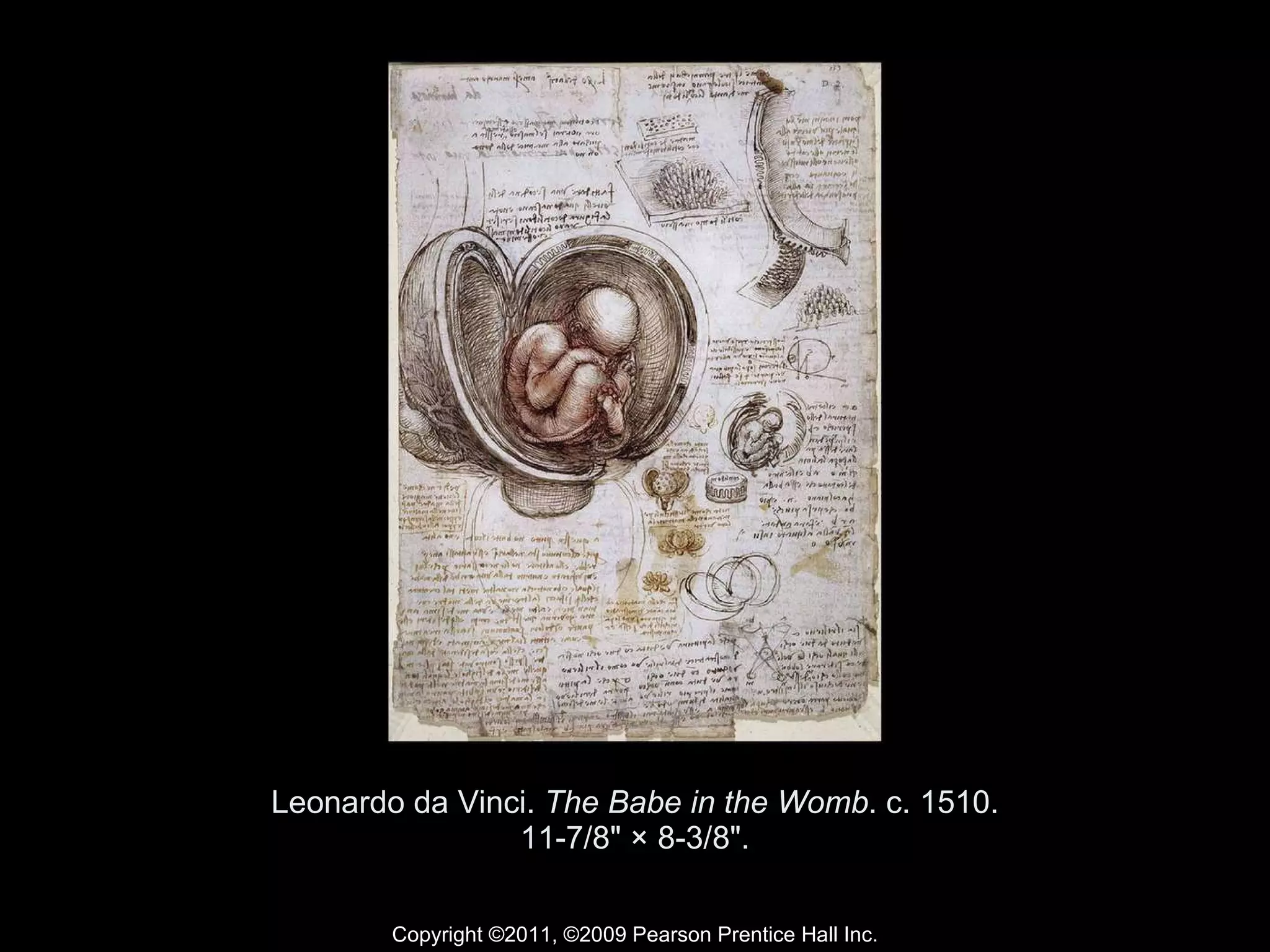
Leonardo da Vinci Highly intelligent and curious, Leonardo kept journals of his research His journals contain, anatomy studies, explorations, and mechanical devices
Leonardo da Vinci.  The Babe in the Womb . c. 1510. 11-7/8" × 8-3/8". Copyright ©2011, ©2009 Pearson Prentice Hall Inc.
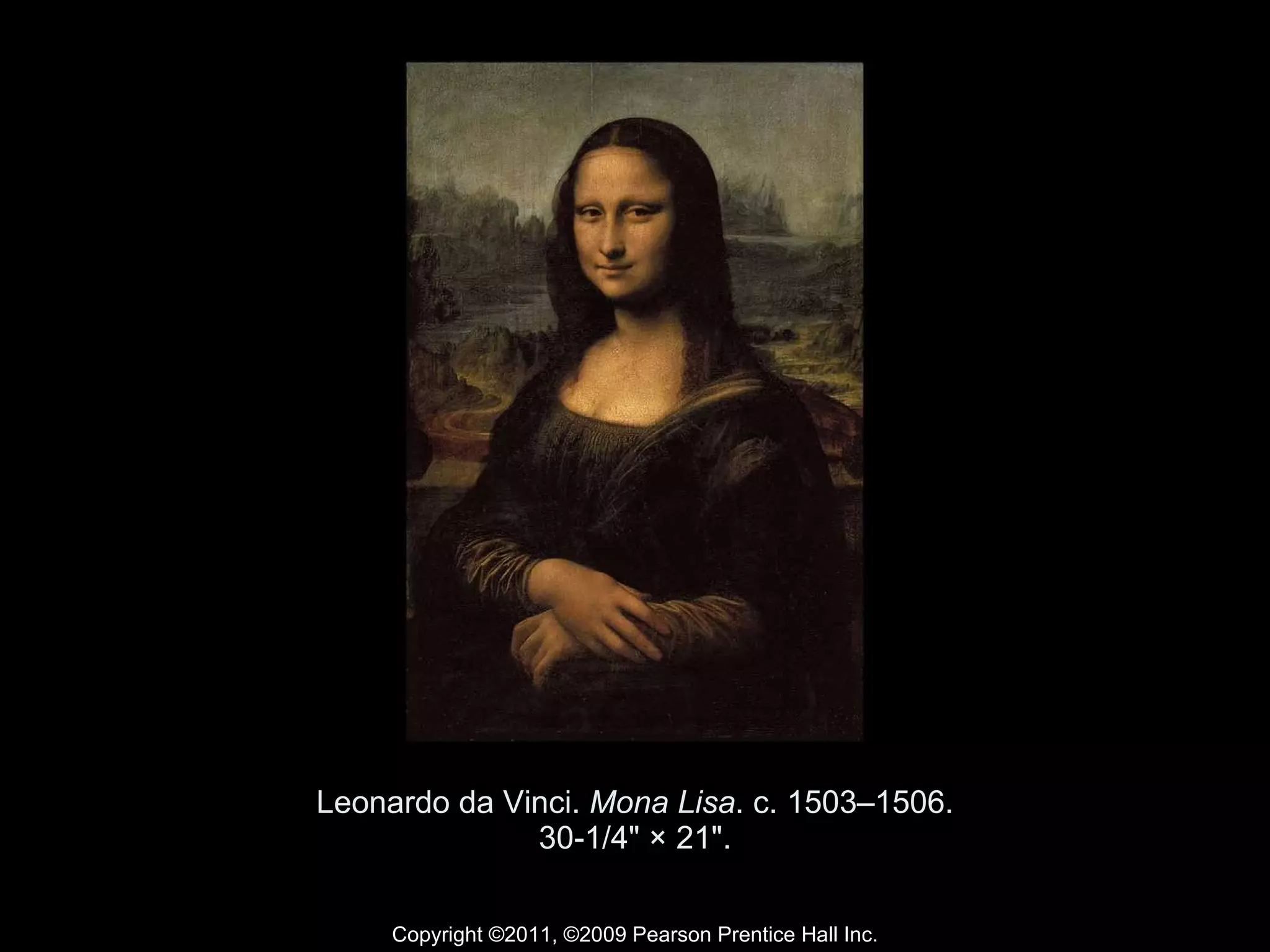
Leonardo da Vinci.  Mona Lisa . c. 1503–1506. 30-1/4" × 21". Copyright ©2011, ©2009 Pearson Prentice Hall Inc.
Mona Lisa by Leonardo da Vinci Her actual identity is unknown Her slight smile is world famous This piece is also famed for it’s hazy quality called sfumato Sfumato-”without lines”
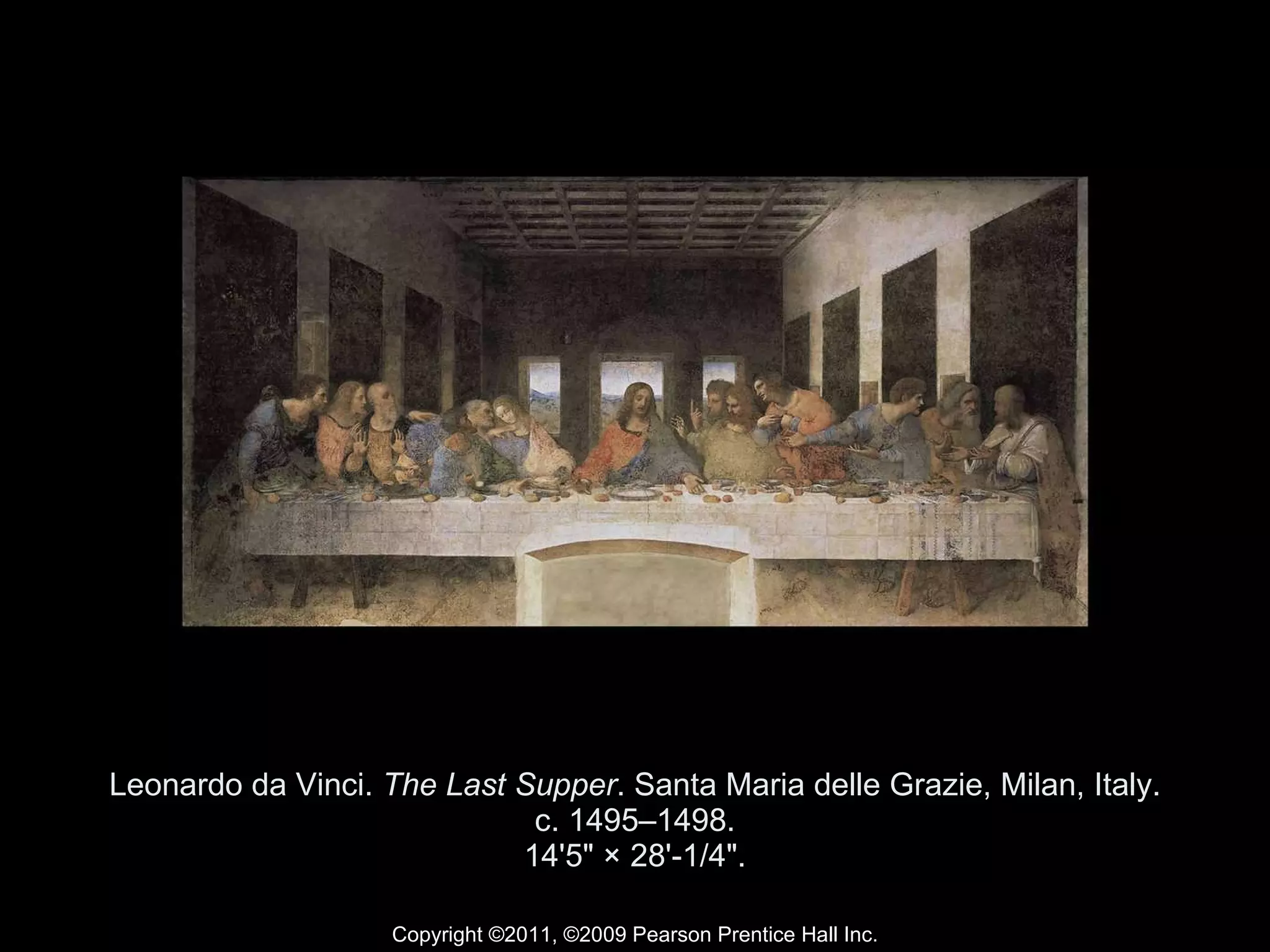
Leonardo da Vinci.  The Last Supper . Santa Maria delle Grazie, Milan, Italy. c. 1495–1498. 14'5" × 28'-1/4". Copyright ©2011, ©2009 Pearson Prentice Hall Inc.
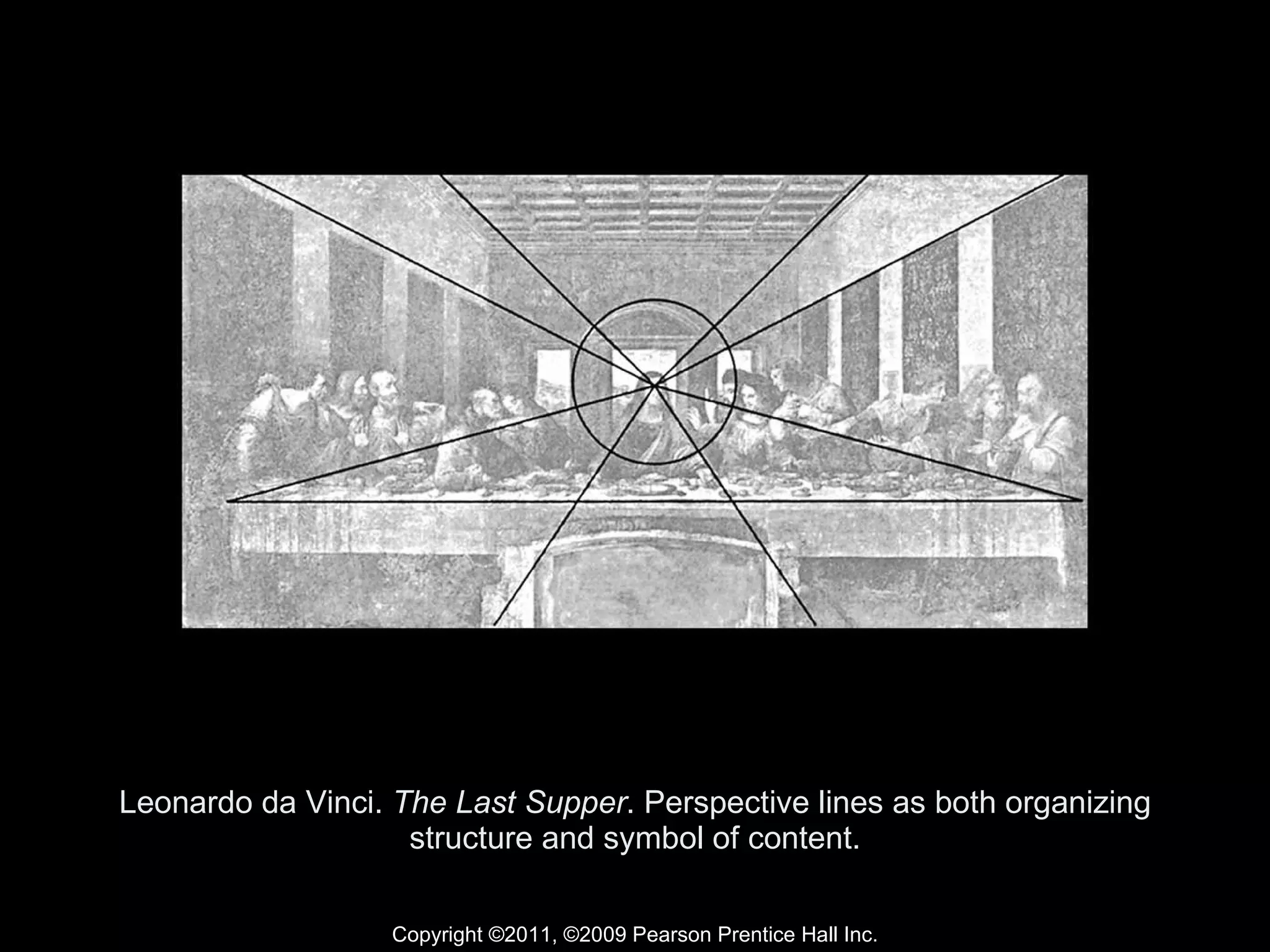
Leonardo da Vinci.  The Last Supper . Perspective lines as both organizing structure and symbol of content. Copyright ©2011, ©2009 Pearson Prentice Hall Inc.
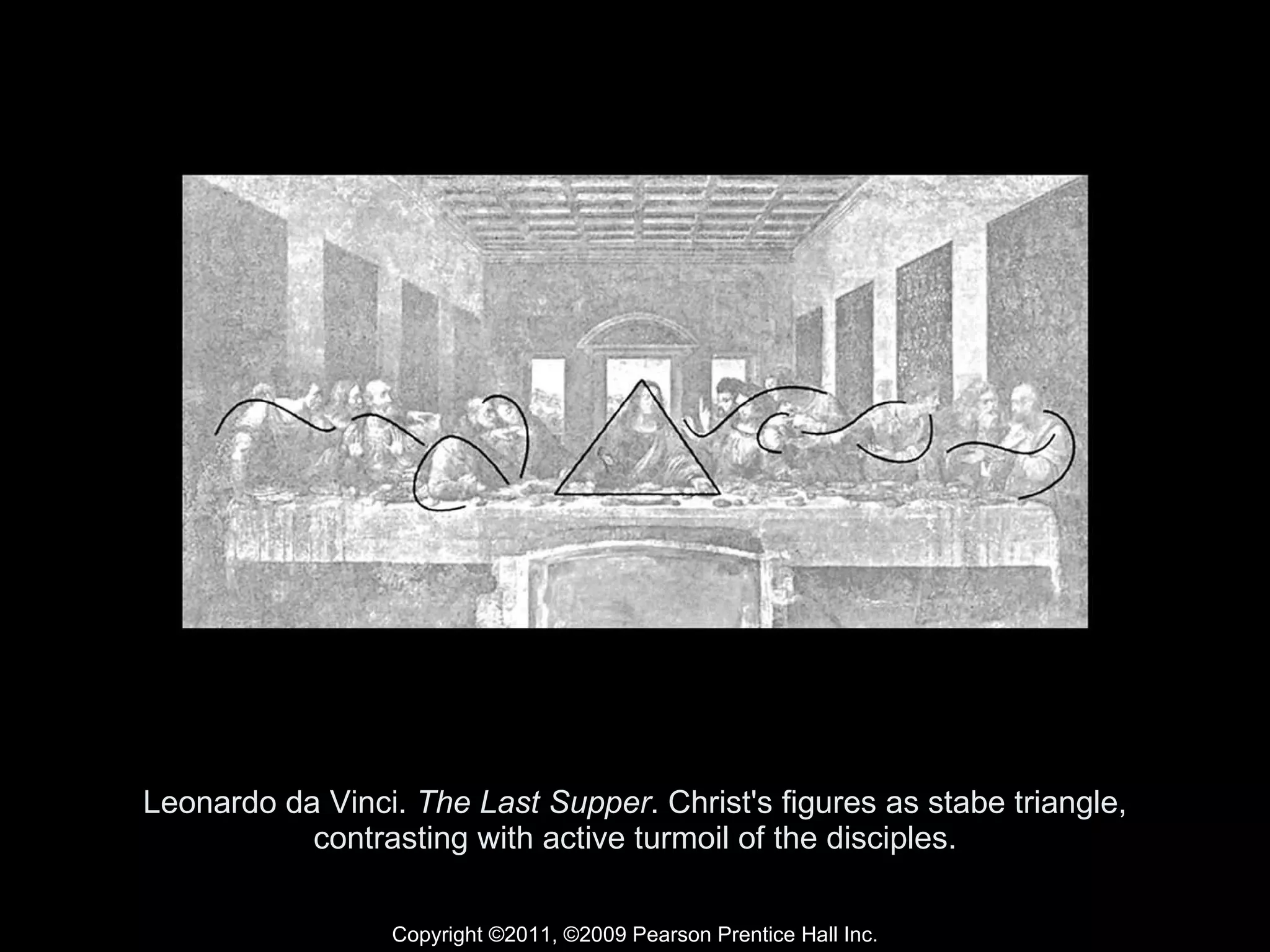
Leonardo da Vinci.  The Last Supper . Christ's figures as stabe triangle, contrasting with active turmoil of the disciples. Copyright ©2011, ©2009 Pearson Prentice Hall Inc.
Last Supper by Leonardo da Vinci Contains a hidden geometry and linear perspective Leonardo depicts Jesus as an approachable and human being Jesus sits in the center surrounded by his disciples The fresco depicts the disciples’ reactions to Jesus' announcement that one of them will betray him Judas is the darkest figure and the only one in full profile showing his guilt
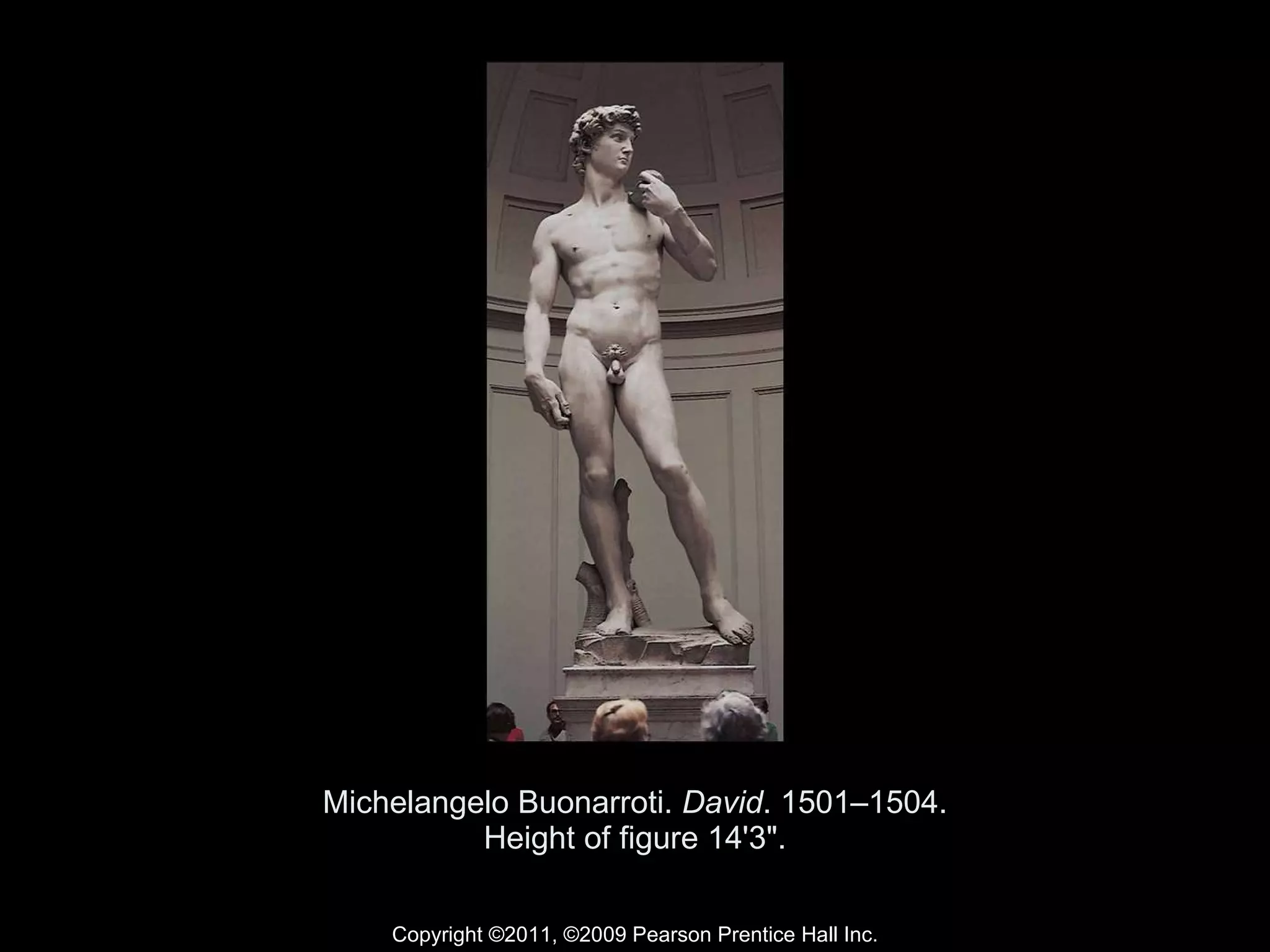
Michelangelo Buonarroti.  David . 1501–1504. Height of figure 14'3". Copyright ©2011, ©2009 Pearson Prentice Hall Inc.
David by Michelangelo Buonarotti Depicts the biblical hero David just before his battle with Goliath Made in the idealized Greek style David stands in contrapposto with his weight on one foot as he begins to tense for his battle This took 3 years for Michelangelo to sculpt
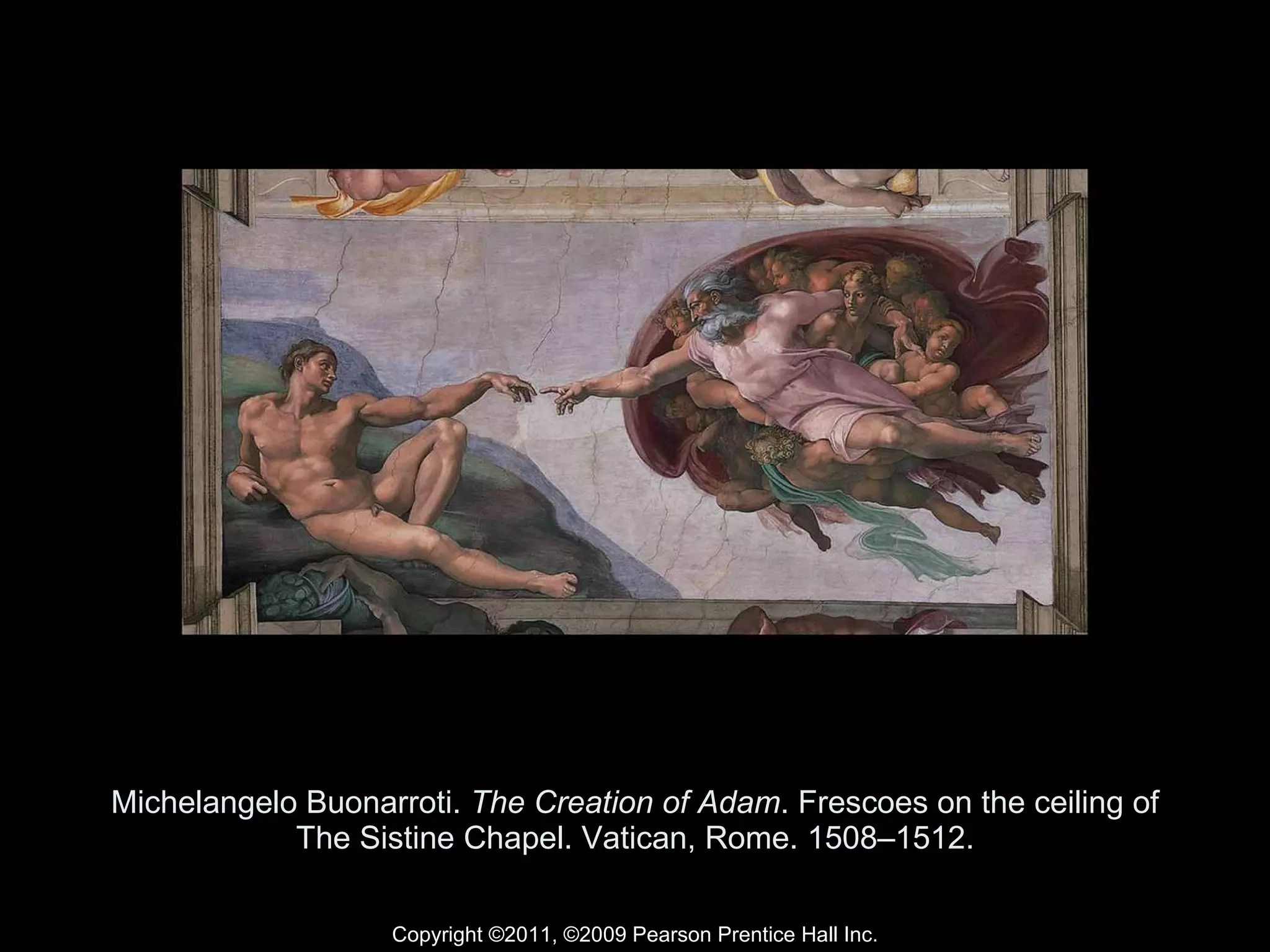
Michelangelo Buonarroti.  The Creation of Adam . Frescoes on the ceiling of The Sistine Chapel. Vatican, Rome. 1508–1512. Copyright ©2011, ©2009 Pearson Prentice Hall Inc.
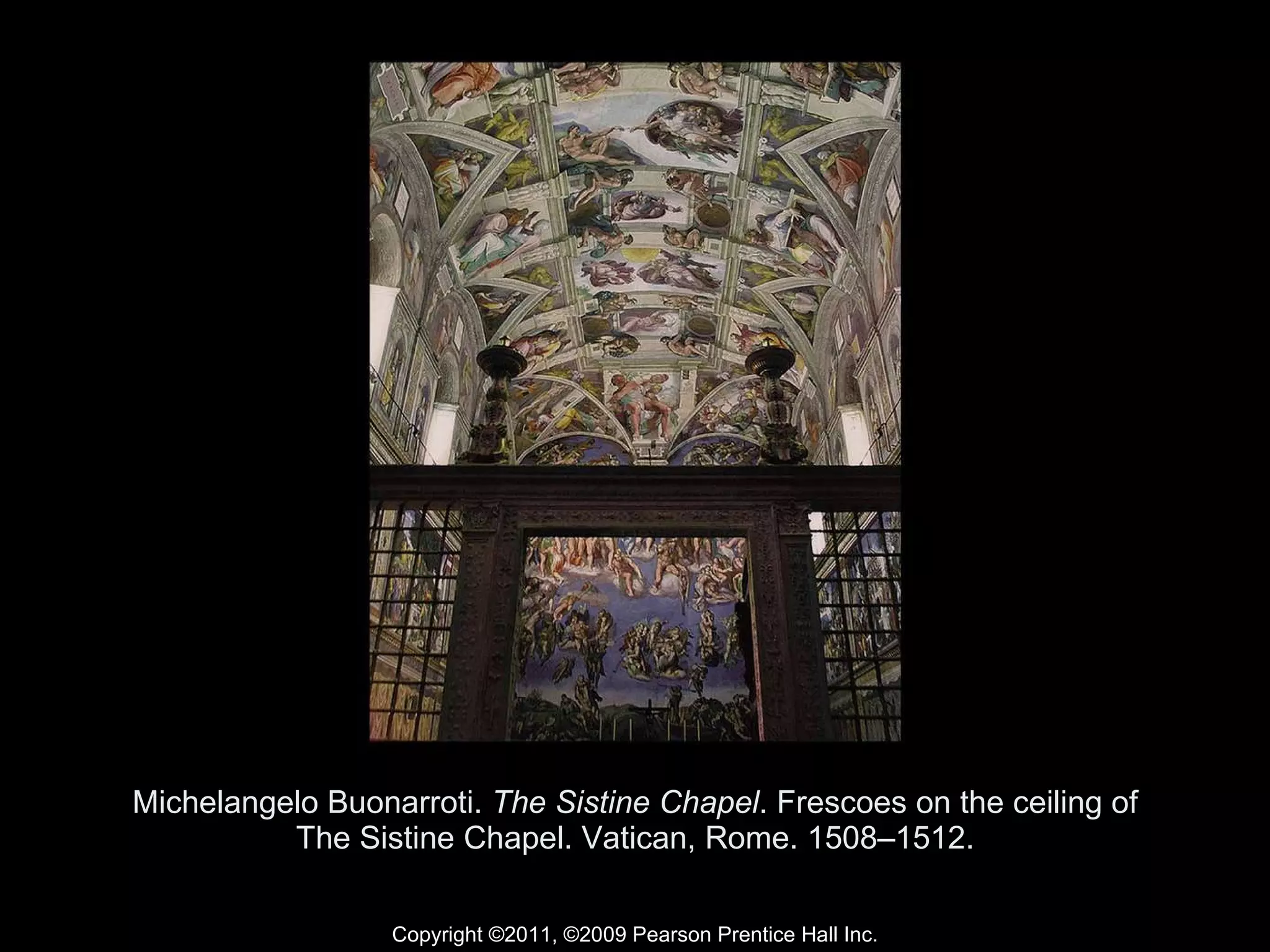
Michelangelo Buonarroti.  The Sistine Chapel . Frescoes on the ceiling of The Sistine Chapel. Vatican, Rome. 1508–1512. Copyright ©2011, ©2009 Pearson Prentice Hall Inc.
Sistine Chapel Ceiling by Michelangelo Michelangelo had to be talked into this commission  Took four years to complete In the highest portion, he paints the creation of the world In the second portion, he paints prophets and sibyls In the lowest level, he paints the judgement
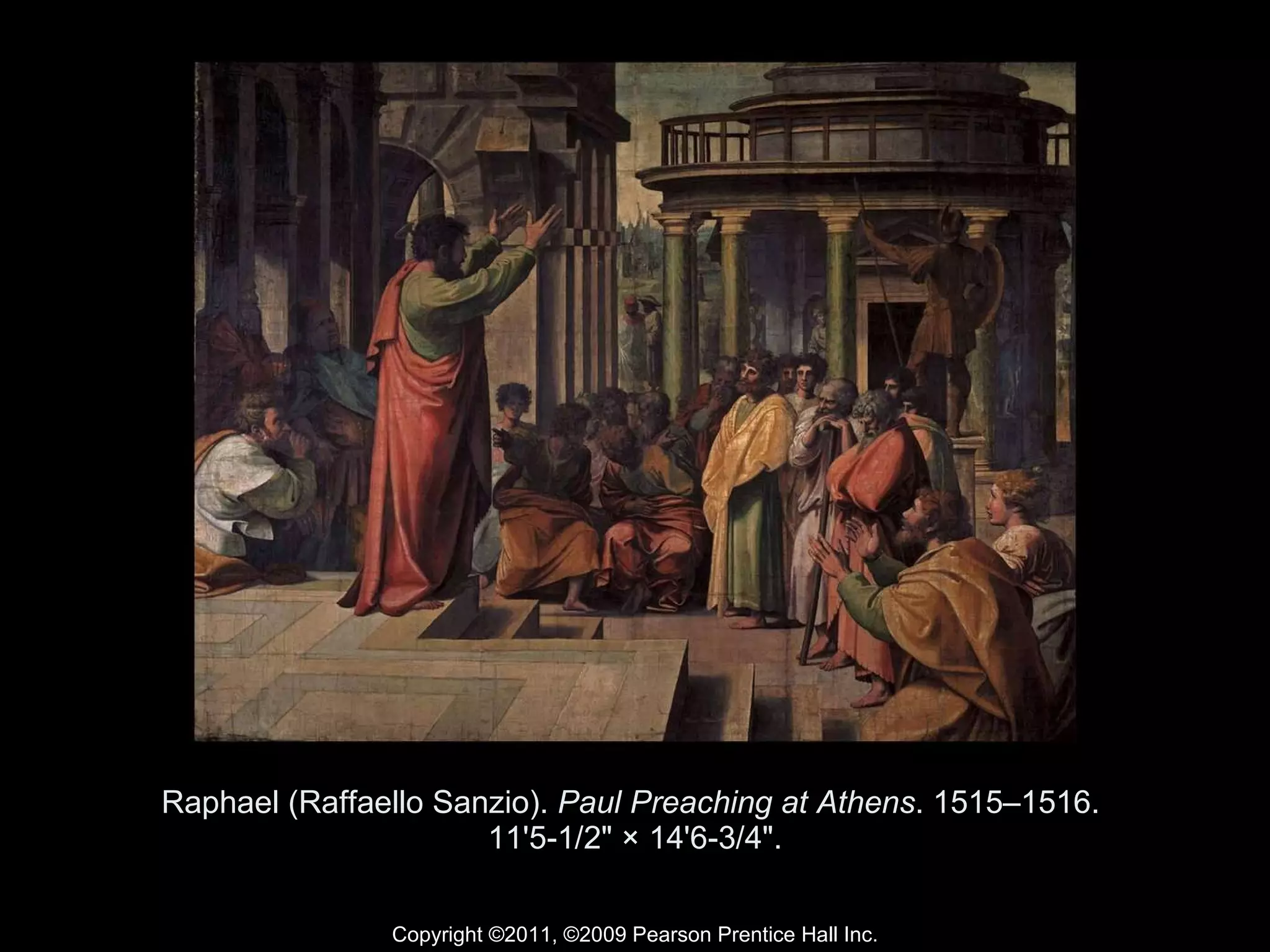
Raphael (Raffaello Sanzio).  Paul Preaching at Athens . 1515–1516.  11'5-1/2" × 14'6-3/4". Copyright ©2011, ©2009 Pearson Prentice Hall Inc.
Paul Preaching at Athens by Raphael Sophisticated use of space and a very real 3d quality Reason can transmit religious truth
The Renaissance in Northern Europe A new interest in realism was also arising in northern Europe These artist were even more concerned with depicting life in the real world
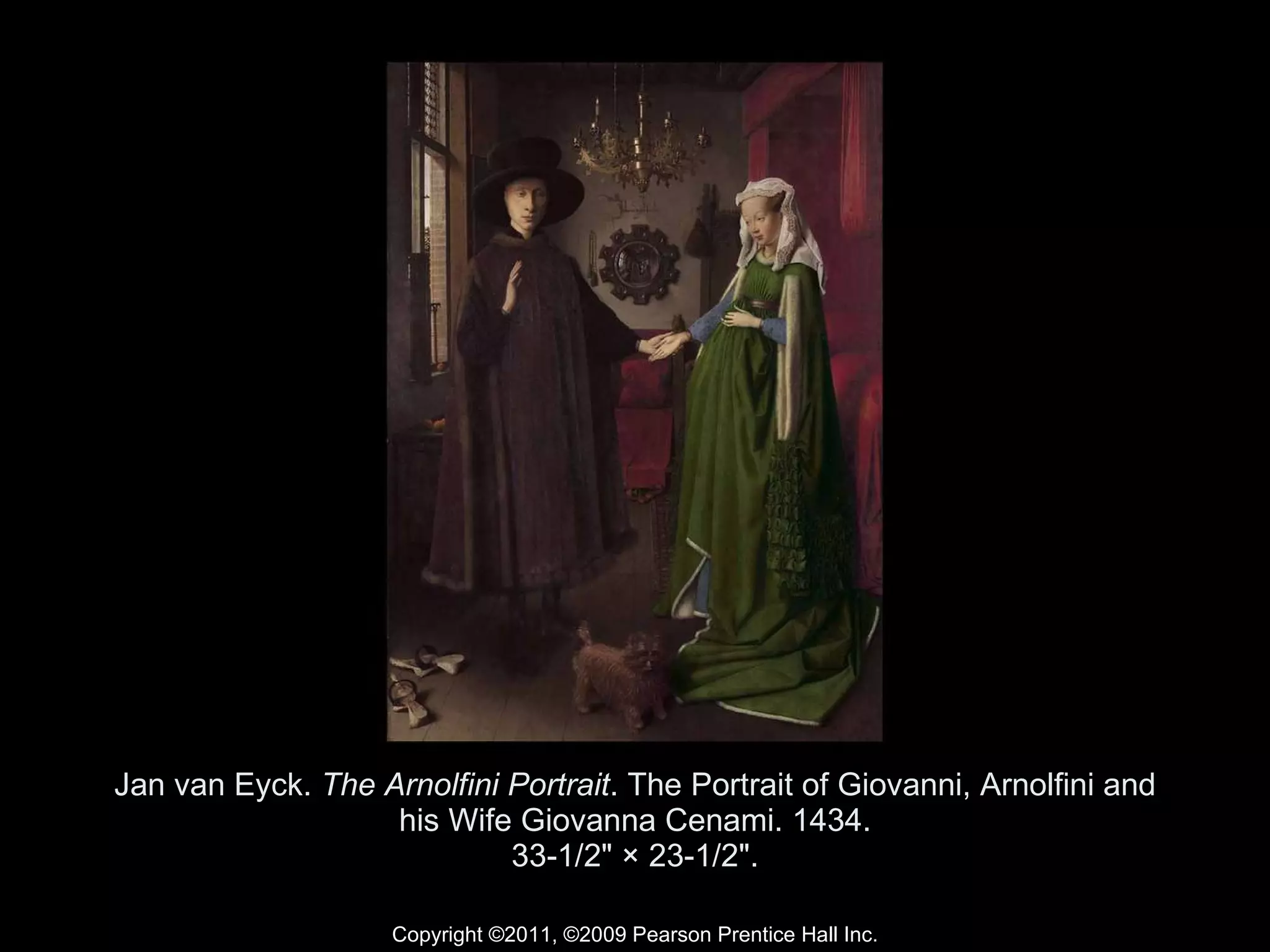
Jan van Eyck.  The Arnolfini Portrait . The Portrait of Giovanni, Arnolfini and his Wife Giovanna Cenami. 1434. 33-1/2" × 23-1/2". Copyright ©2011, ©2009 Pearson Prentice Hall Inc.
The Arnolfini Portrait by Jan van Eyck Jan van Eyck was THE painter of Flanders (Belgium, Netherlands, France) He was one of the first to use oil paint  He mostly painted on wooden panels Jan van Eyck is know for his use of detail and the illusion of depth and light In the Arnolfini portrait, each object has a specific meaning or significance The reflection in the mirror is very exact and you can see Jan van Eyck in that mirror as he paints the couple
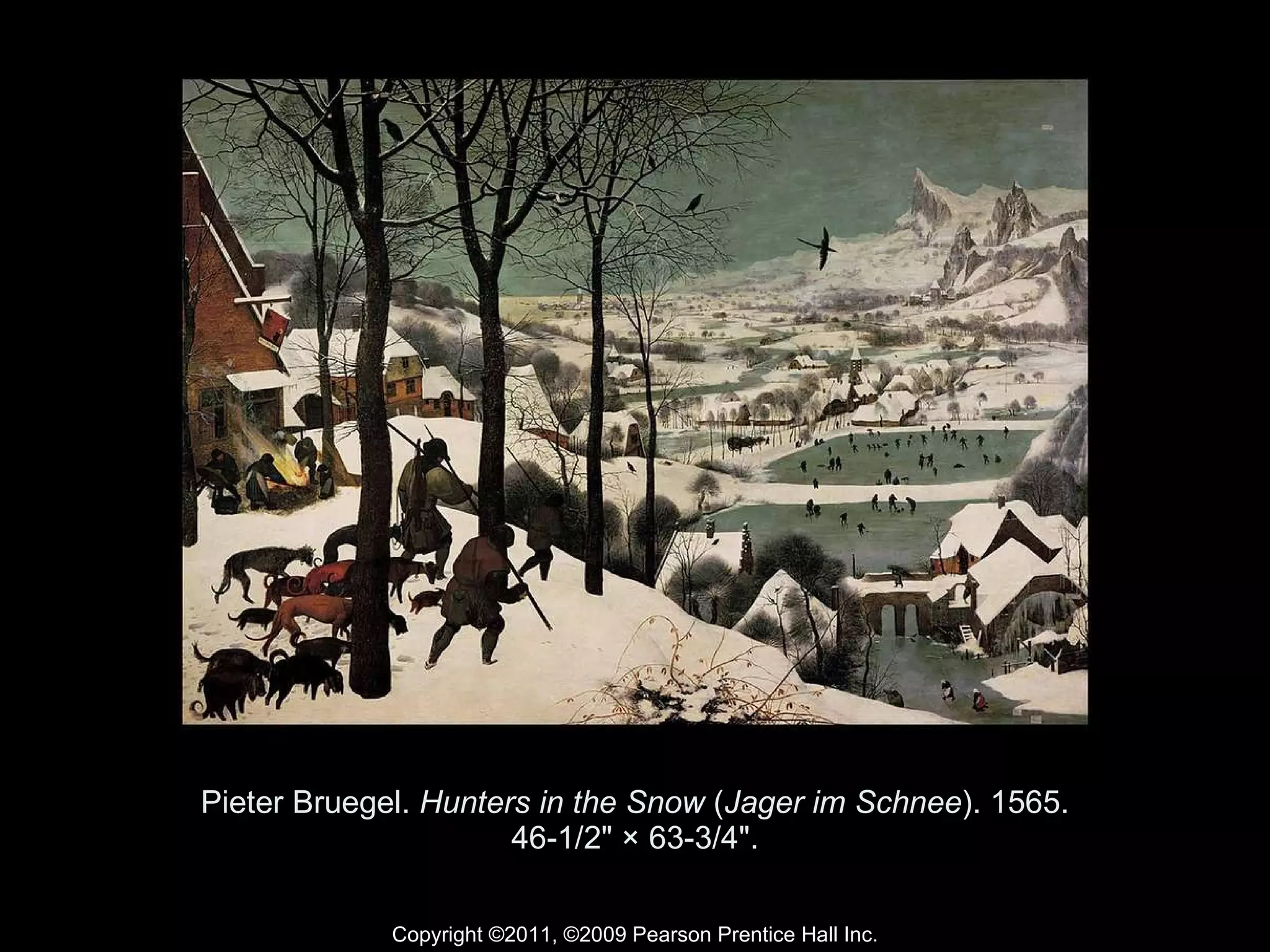
Pieter Bruegel.  Hunters in the Snow  ( Jager im Schnee ). 1565. 46-1/2" × 63-3/4". Copyright ©2011, ©2009 Pearson Prentice Hall Inc.
Hunters in the Snow by Pieter Bruegel Pieter Bruegel developed a new style He painted the lives of the surrounding countryside and the common people This is called a genre painting This painting is from a series depicting the seasons Andrea Palladio.  Villa Rotonda . Vicenza, Italy. 1567–1570.
Baroque Baroque 1600-1770 Uses the techniques of the Renaissance but moves in the direction of drama, emotion, and splendor A new sense of vivid realism
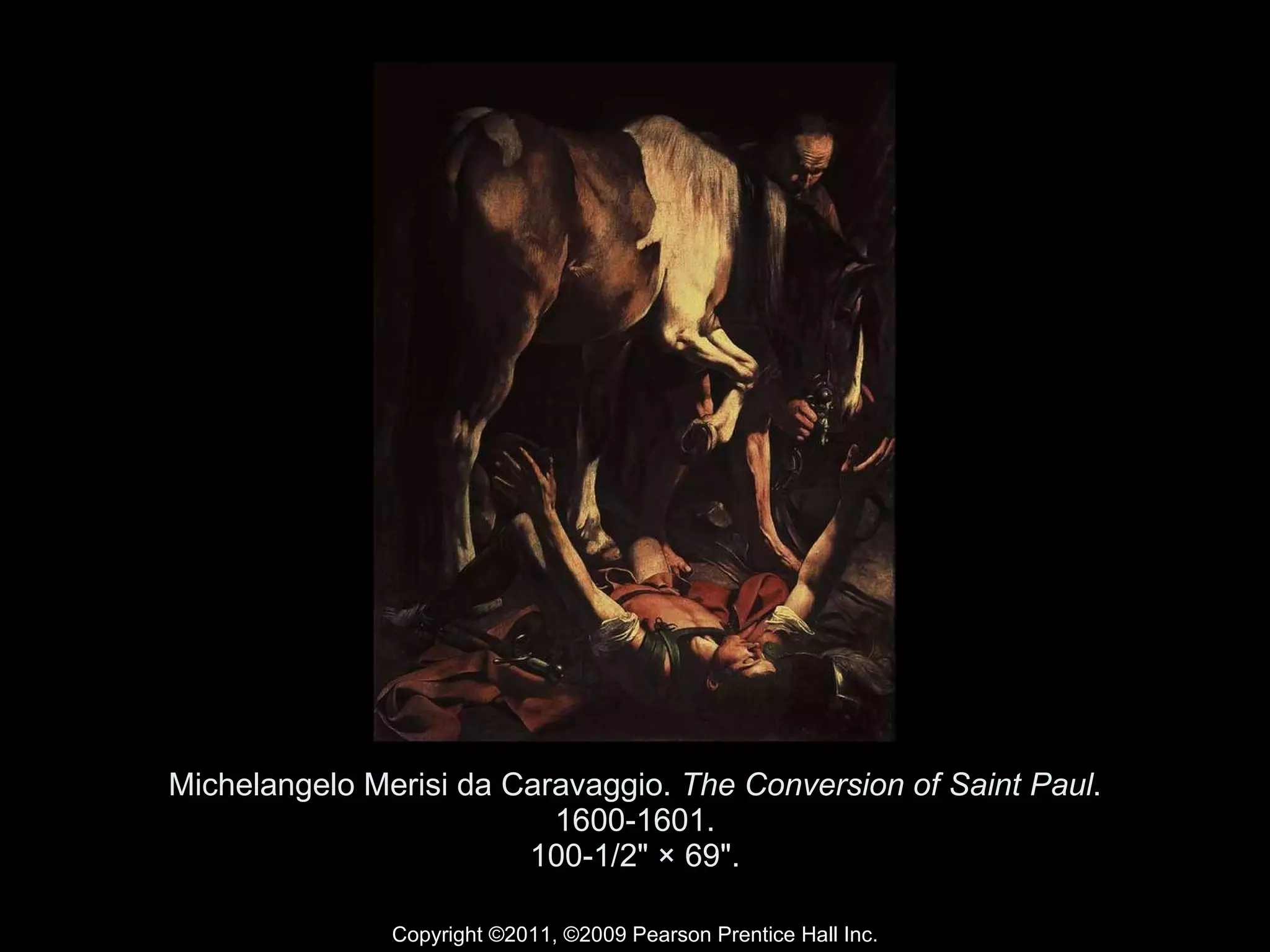
Michelangelo Merisi da Caravaggio.  The Conversion of Saint Paul . 1600-1601. 100-1/2" × 69". Copyright ©2011, ©2009 Pearson Prentice Hall Inc.
The Conversion of St. Paul by Caravaggio Created a dramatic use of light called  chiaroscuro , a strong directional light This painting shows St. Paul’s earth shattering conversion  An extreme view that uses foreshortening
Gian Lorenzo Bernini.  David . 1623. Life-size. Copyright ©2011, ©2009 Pearson Prentice Hall Inc.
David by Bernini A life size sculpture rather than monumental in size In this depiction of David, Bernini decides to show David in the midst of the battle about to fling the stone that kills Goliath Emotional intensity is key
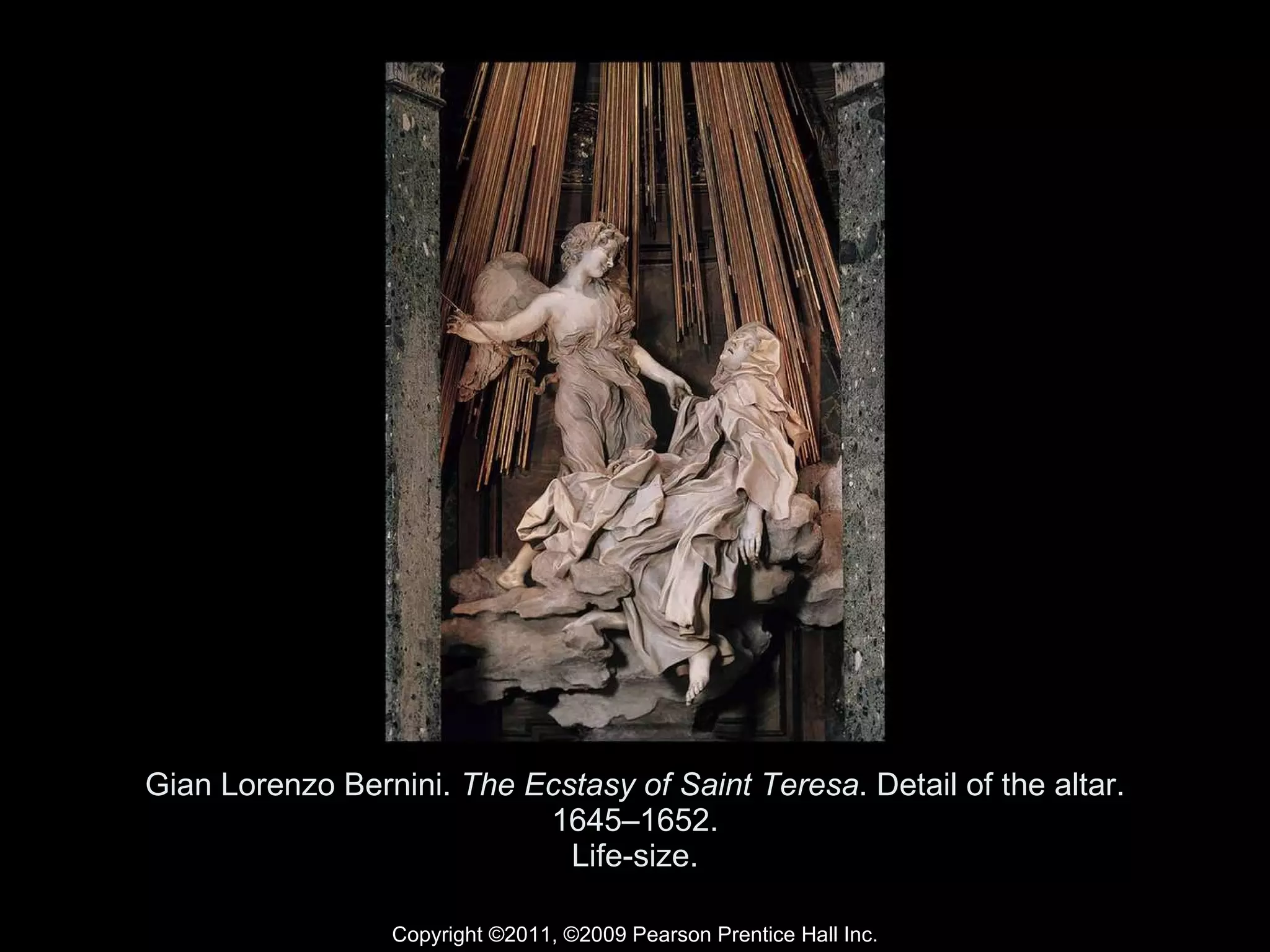
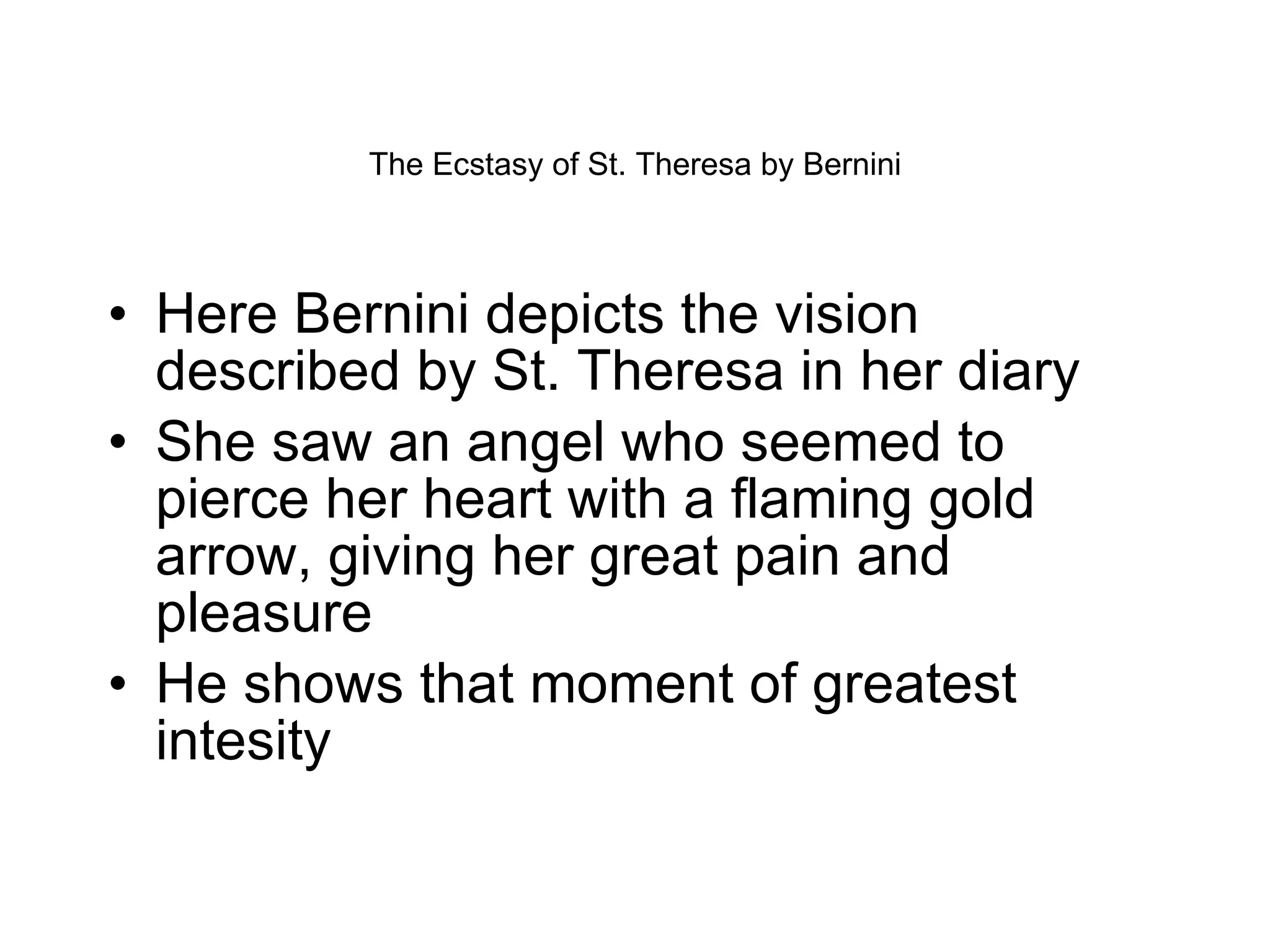
Gian Lorenzo Bernini.  The Ecstasy of Saint Teresa . Detail of the altar. 1645–1652. Life-size. Copyright ©2011, ©2009 Pearson Prentice Hall Inc.
The Ecstasy of St. Theresa by Bernini Here Bernini depicts the vision described by St. Theresa in her diary She saw an angel who seemed to pierce her heart with a flaming gold arrow, giving her great pain and pleasure He shows that moment of greatest intesity
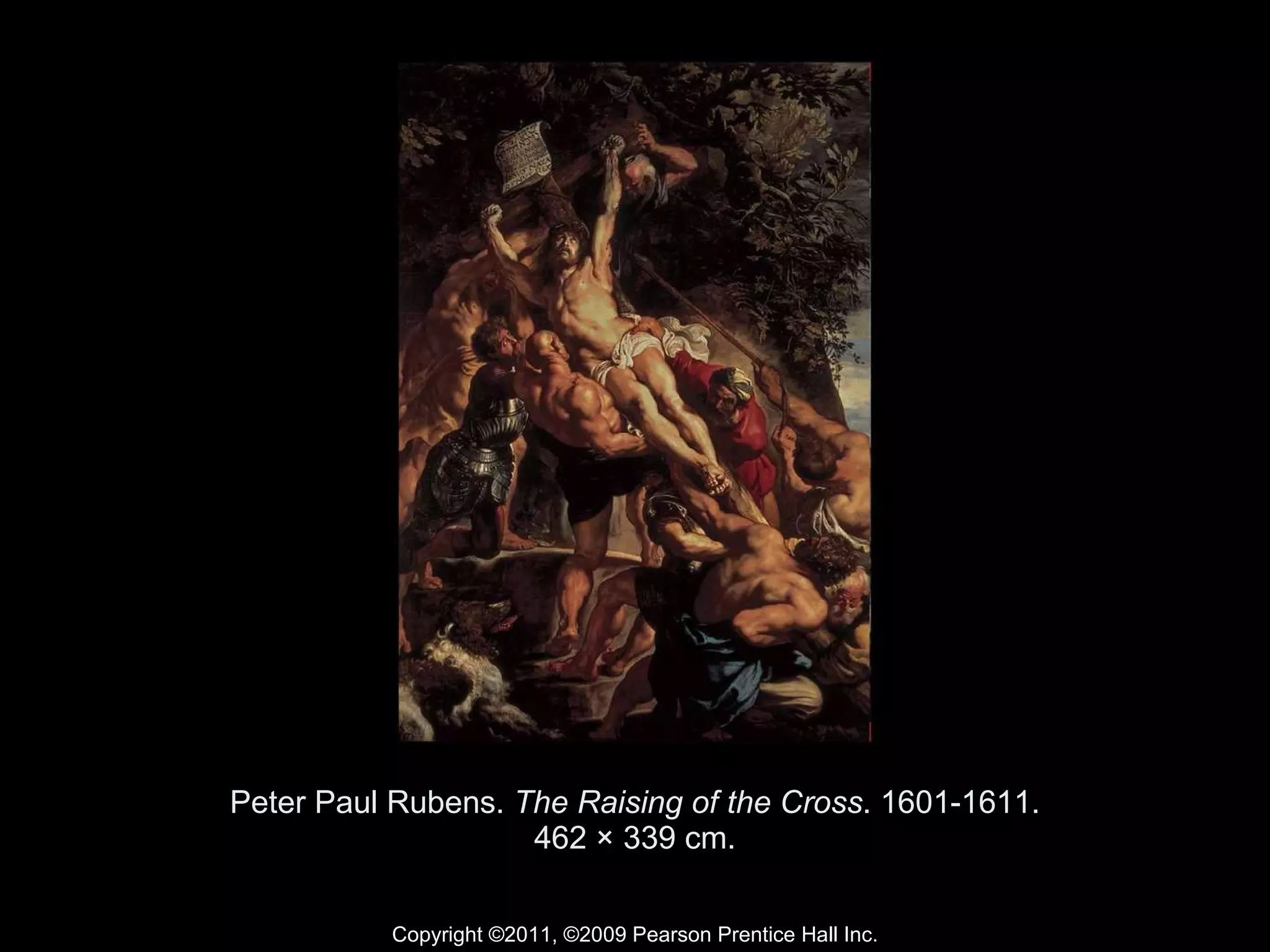
Peter Paul Rubens.  The Raising of the Cross . 1601-1611. 462 × 339 cm. Copyright ©2011, ©2009 Pearson Prentice Hall Inc.
The Raising of the Cross by Peter Paul Rubens Strong diagonal composition The musculature of the men was influenced by the Italian painters he saw on a trip to Italy Strong sense of action
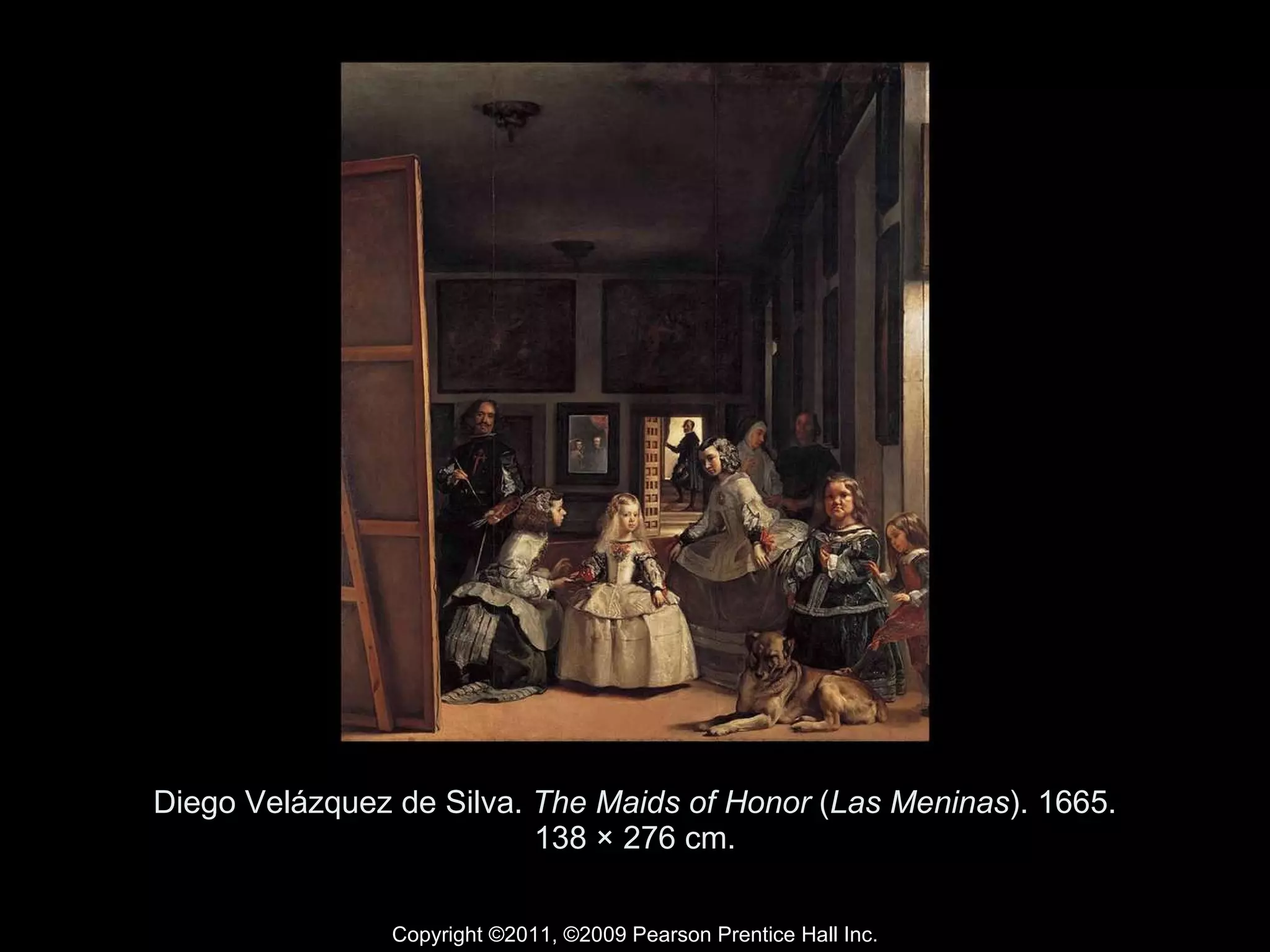
Diego Velázquez de Silva.  The Maids of Honor  ( Las Meninas ). 1665. 138 × 276 cm. Copyright ©2011, ©2009 Pearson Prentice Hall Inc.
The Maids of Honor by Diego Velasquez de Silva The artist is visible peaking out from behind his canvas The maids of honor surround the king’s daughter She is the brightest object in the painting The king and queen are reflected in the mirror This painting is an elaborate game
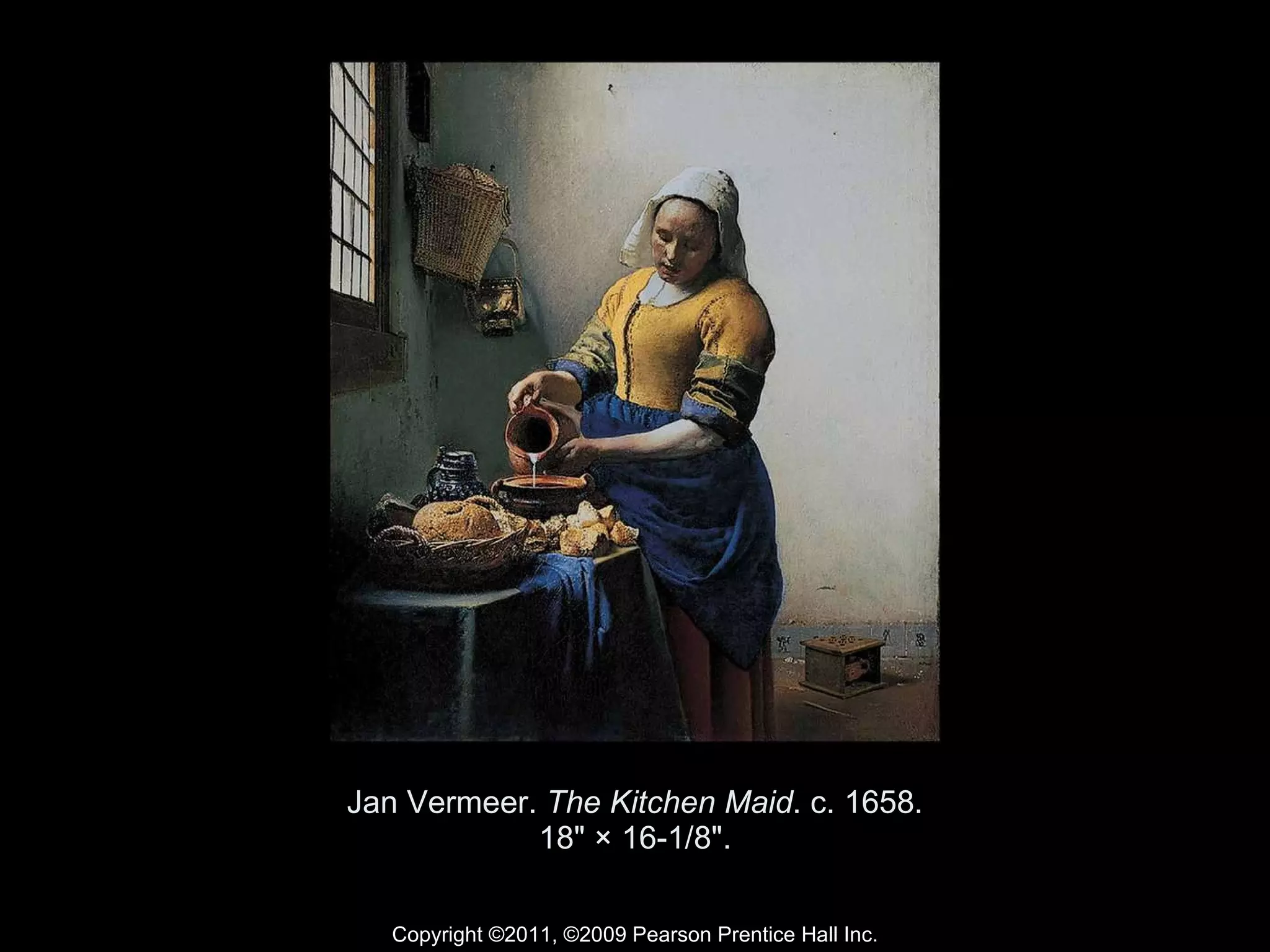
The Kitchen Maid by Jan Vermeer Takes everyday life and raises it to the level of a religious portrayal Light reveals each texture in exquisite detail
Jan Vermeer.  The Kitchen Maid . c. 1658. 18" × 16-1/8". Copyright ©2011, ©2009 Pearson Prentice Hall Inc.
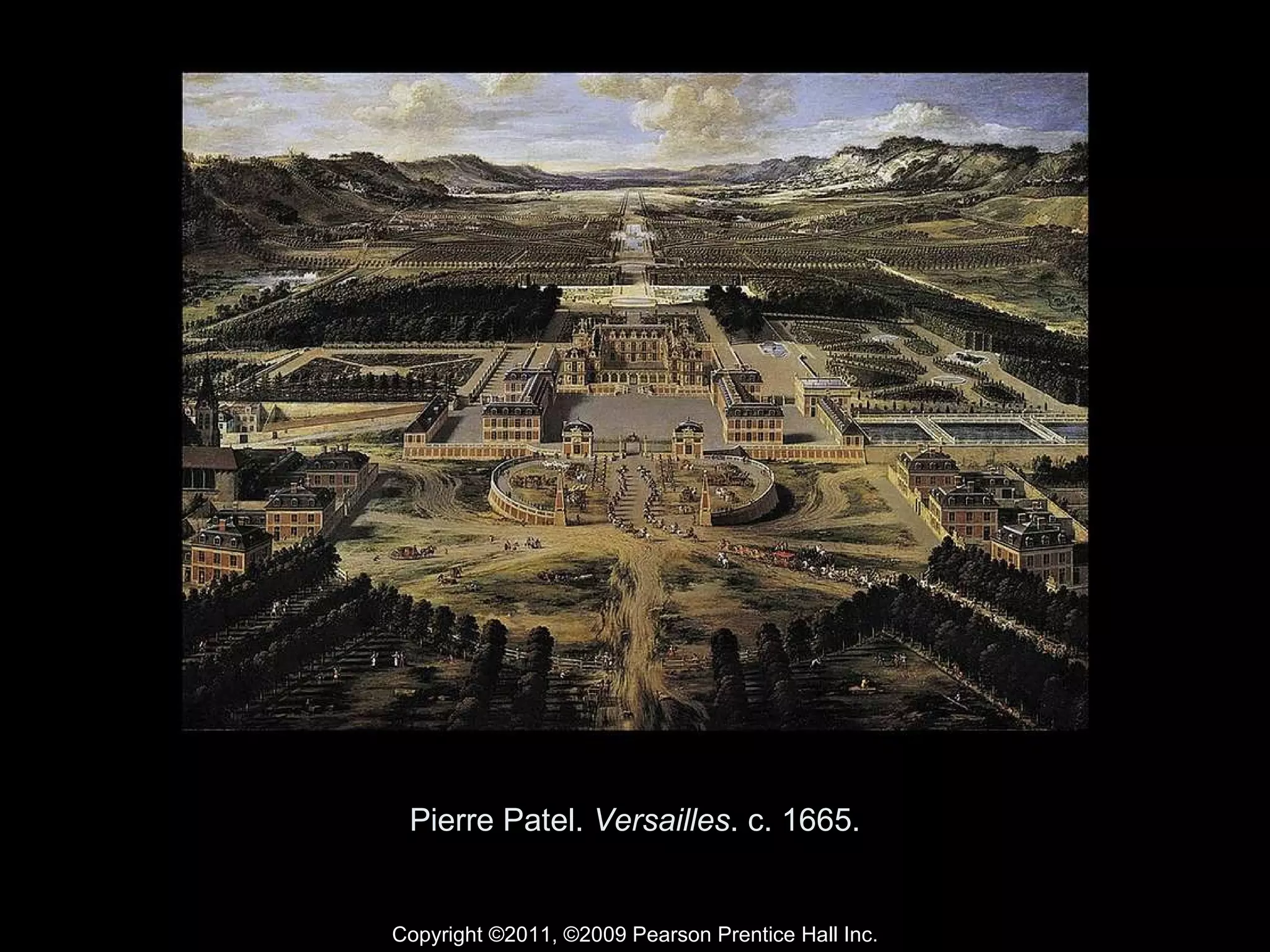
Pierre Patel.  Versailles . c. 1665. Copyright ©2011, ©2009 Pearson Prentice Hall Inc.
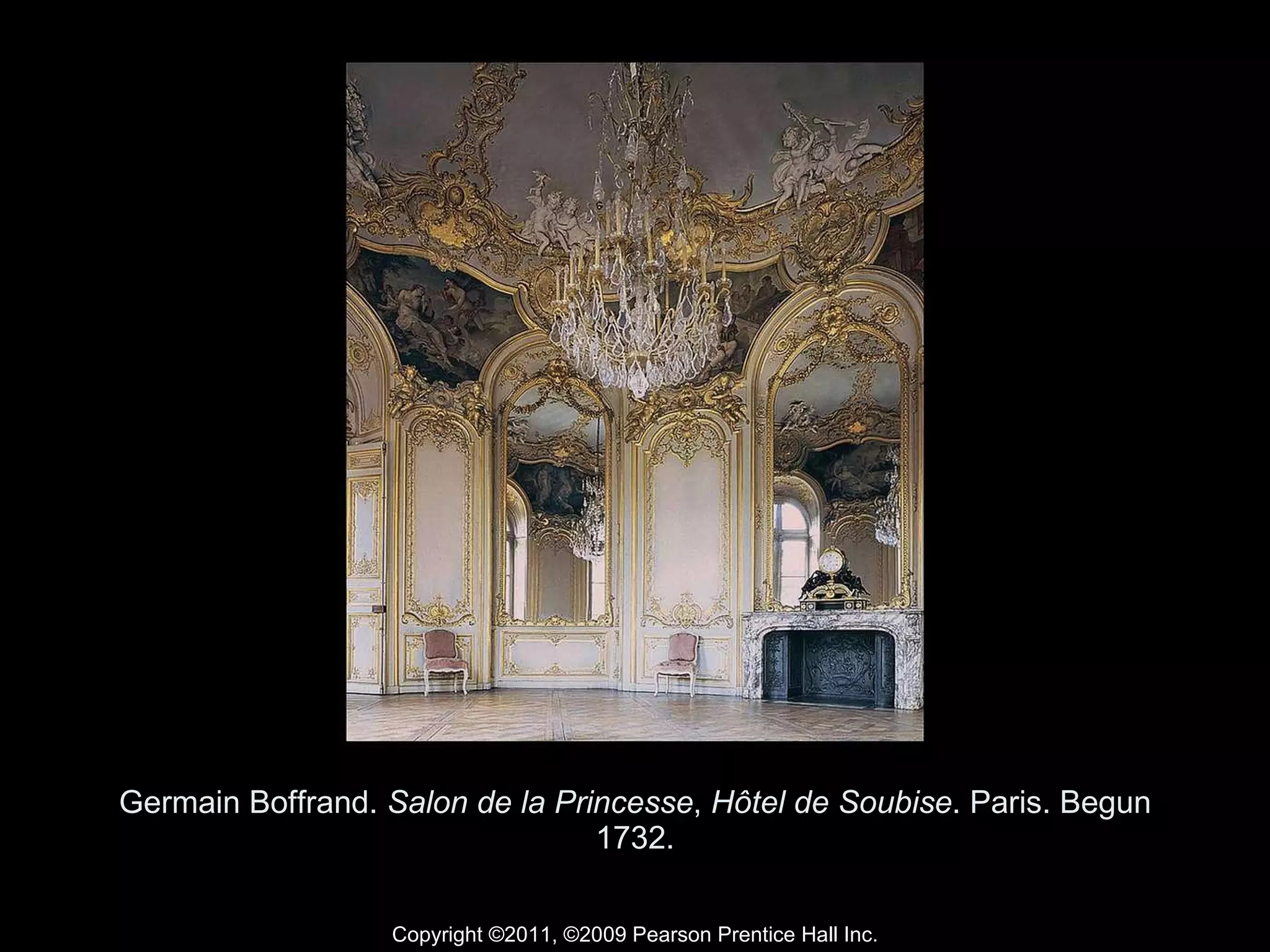
Germain Boffrand.  Salon de la Princesse ,  Hôtel de Soubise . Paris. Begun 1732. Copyright ©2011, ©2009 Pearson Prentice Hall Inc.
Art Appreciation-Chapter16

  • 1.
    Renaissance and BaroqueEurope Chapter 16
  • 2.
    Renaissance Renaissance-”rebirth” Sciencewas a major influence Accuracy and naturalism were valued A revived interest in the art and ideas of classical Greece and Rome Major Renaissance ideas stemmed from Italy
  • 3.
    Giotto di Bondone. Lamentation . Scrovegni Chapel, Padua, Italy. c. 1305. 72" × 78". Copyright ©2011, ©2009 Pearson Prentice Hall Inc.
  • 4.
    Lamentation by GiottoDeparted from the abstract Byzantine style Giotto began to show mass, space, and light in a more naturalistic way The scene is very stage-like and shallow in terms of space He takes pains to portray the emotion and the grief of the scene
  • 5.
    Masaccio. TheHoly Trinity . Santa Maria Novella, Florence, Italy. 1425. 21'10-1/2" × 10'5". Copyright ©2011, ©2009 Pearson Prentice Hall Inc.
  • 6.
    The Holy Trinityby Masaccio Considered to be the first painting made using linear perspective Filippo Brunelleschi is considered the “inventor” of linear perspective The trinity is represented here God the father as a seated figure Christ the son on the cross The Holy Spirit as a white dove On either side of the cross stand Mary and St. John Kneeling on the outside are the donors that paid for the painting Masaccio’s figures have lifelike presence and realistic folds in their clothing
  • 7.
    Donatello. David. c. 1425–1430. Height 62-1/4". Copyright ©2011, ©2009 Pearson Prentice Hall Inc.
  • 8.
    David by DonatelloDonatello sculpts the way that Masaccio paints Donatello studied the Greek and Roman sculptures He takes a more naturalistic approach This sculpture show David just after slaying the giant Goliath David stands in a contrapposto position This David is more sensual than most previous sculptures
  • 9.
    Sandro Botticelli. Birth of Venus . c. 1480. 5'8-7/8" × 9'1-7/8". Copyright ©2011, ©2009 Pearson Prentice Hall Inc.
  • 10.
    Birth of Venusby Botticelli The first large mythological painting since antiquity Portrays the goddess Venus at her birth The posture denotes modesty, probably copied from the Roman sculpture of Venus He shows the idealized female form, an idea taken from Greece, but infuses it with feeling Putting a pagan goddess as a central figure in a painting was revolutionary, usually that spot was reserved for Mary
  • 11.
    The High RenaissanceHigh Renaissance-between 1490-1530 Italian art reached its peak in the cities of Florence, Rome, and Venice The major artists Leonardo, Michelangelo, and Raphael developed a style that combined Christianity and Greek philosphy
  • 12.
    Leonardo da VinciHighly intelligent and curious, Leonardo kept journals of his research His journals contain, anatomy studies, explorations, and mechanical devices
  • 13.
    Leonardo da Vinci. The Babe in the Womb . c. 1510. 11-7/8" × 8-3/8". Copyright ©2011, ©2009 Pearson Prentice Hall Inc.
  • 14.
    Leonardo da Vinci. Mona Lisa . c. 1503–1506. 30-1/4" × 21". Copyright ©2011, ©2009 Pearson Prentice Hall Inc.
  • 15.
    Mona Lisa byLeonardo da Vinci Her actual identity is unknown Her slight smile is world famous This piece is also famed for it’s hazy quality called sfumato Sfumato-”without lines”
  • 16.
    Leonardo da Vinci. The Last Supper . Santa Maria delle Grazie, Milan, Italy. c. 1495–1498. 14'5" × 28'-1/4". Copyright ©2011, ©2009 Pearson Prentice Hall Inc.
  • 17.
    Leonardo da Vinci. The Last Supper . Perspective lines as both organizing structure and symbol of content. Copyright ©2011, ©2009 Pearson Prentice Hall Inc.
  • 18.
    Leonardo da Vinci. The Last Supper . Christ's figures as stabe triangle, contrasting with active turmoil of the disciples. Copyright ©2011, ©2009 Pearson Prentice Hall Inc.
  • 19.
    Last Supper byLeonardo da Vinci Contains a hidden geometry and linear perspective Leonardo depicts Jesus as an approachable and human being Jesus sits in the center surrounded by his disciples The fresco depicts the disciples’ reactions to Jesus' announcement that one of them will betray him Judas is the darkest figure and the only one in full profile showing his guilt
  • 20.
    Michelangelo Buonarroti. David . 1501–1504. Height of figure 14'3". Copyright ©2011, ©2009 Pearson Prentice Hall Inc.
  • 21.
    David by MichelangeloBuonarotti Depicts the biblical hero David just before his battle with Goliath Made in the idealized Greek style David stands in contrapposto with his weight on one foot as he begins to tense for his battle This took 3 years for Michelangelo to sculpt
  • 22.
    Michelangelo Buonarroti. The Creation of Adam . Frescoes on the ceiling of The Sistine Chapel. Vatican, Rome. 1508–1512. Copyright ©2011, ©2009 Pearson Prentice Hall Inc.
  • 23.
    Michelangelo Buonarroti. The Sistine Chapel . Frescoes on the ceiling of The Sistine Chapel. Vatican, Rome. 1508–1512. Copyright ©2011, ©2009 Pearson Prentice Hall Inc.
  • 24.
    Sistine Chapel Ceilingby Michelangelo Michelangelo had to be talked into this commission Took four years to complete In the highest portion, he paints the creation of the world In the second portion, he paints prophets and sibyls In the lowest level, he paints the judgement
  • 25.
    Raphael (Raffaello Sanzio). Paul Preaching at Athens . 1515–1516. 11'5-1/2" × 14'6-3/4". Copyright ©2011, ©2009 Pearson Prentice Hall Inc.
  • 26.
    Paul Preaching atAthens by Raphael Sophisticated use of space and a very real 3d quality Reason can transmit religious truth
  • 27.
    The Renaissance inNorthern Europe A new interest in realism was also arising in northern Europe These artist were even more concerned with depicting life in the real world
  • 28.
    Jan van Eyck. The Arnolfini Portrait . The Portrait of Giovanni, Arnolfini and his Wife Giovanna Cenami. 1434. 33-1/2" × 23-1/2". Copyright ©2011, ©2009 Pearson Prentice Hall Inc.
  • 29.
    The Arnolfini Portraitby Jan van Eyck Jan van Eyck was THE painter of Flanders (Belgium, Netherlands, France) He was one of the first to use oil paint He mostly painted on wooden panels Jan van Eyck is know for his use of detail and the illusion of depth and light In the Arnolfini portrait, each object has a specific meaning or significance The reflection in the mirror is very exact and you can see Jan van Eyck in that mirror as he paints the couple
  • 30.
    Pieter Bruegel. Hunters in the Snow ( Jager im Schnee ). 1565. 46-1/2" × 63-3/4". Copyright ©2011, ©2009 Pearson Prentice Hall Inc.
  • 31.
    Hunters in theSnow by Pieter Bruegel Pieter Bruegel developed a new style He painted the lives of the surrounding countryside and the common people This is called a genre painting This painting is from a series depicting the seasons Andrea Palladio. Villa Rotonda . Vicenza, Italy. 1567–1570.
  • 32.
    Baroque Baroque 1600-1770Uses the techniques of the Renaissance but moves in the direction of drama, emotion, and splendor A new sense of vivid realism
  • 33.
    Michelangelo Merisi daCaravaggio. The Conversion of Saint Paul . 1600-1601. 100-1/2" × 69". Copyright ©2011, ©2009 Pearson Prentice Hall Inc.
  • 34.
    The Conversion ofSt. Paul by Caravaggio Created a dramatic use of light called chiaroscuro , a strong directional light This painting shows St. Paul’s earth shattering conversion An extreme view that uses foreshortening
  • 35.
    Gian Lorenzo Bernini. David . 1623. Life-size. Copyright ©2011, ©2009 Pearson Prentice Hall Inc.
  • 36.
    David by BerniniA life size sculpture rather than monumental in size In this depiction of David, Bernini decides to show David in the midst of the battle about to fling the stone that kills Goliath Emotional intensity is key
  • 37.
    Gian Lorenzo Bernini. The Ecstasy of Saint Teresa . Detail of the altar. 1645–1652. Life-size. Copyright ©2011, ©2009 Pearson Prentice Hall Inc.
  • 38.
    The Ecstasy ofSt. Theresa by Bernini Here Bernini depicts the vision described by St. Theresa in her diary She saw an angel who seemed to pierce her heart with a flaming gold arrow, giving her great pain and pleasure He shows that moment of greatest intesity
  • 39.
    Peter Paul Rubens. The Raising of the Cross . 1601-1611. 462 × 339 cm. Copyright ©2011, ©2009 Pearson Prentice Hall Inc.
  • 40.
    The Raising ofthe Cross by Peter Paul Rubens Strong diagonal composition The musculature of the men was influenced by the Italian painters he saw on a trip to Italy Strong sense of action
  • 41.
    Diego Velázquez deSilva. The Maids of Honor ( Las Meninas ). 1665. 138 × 276 cm. Copyright ©2011, ©2009 Pearson Prentice Hall Inc.
  • 42.
    The Maids ofHonor by Diego Velasquez de Silva The artist is visible peaking out from behind his canvas The maids of honor surround the king’s daughter She is the brightest object in the painting The king and queen are reflected in the mirror This painting is an elaborate game
  • 43.
    The Kitchen Maidby Jan Vermeer Takes everyday life and raises it to the level of a religious portrayal Light reveals each texture in exquisite detail
  • 44.
    Jan Vermeer. The Kitchen Maid . c. 1658. 18" × 16-1/8". Copyright ©2011, ©2009 Pearson Prentice Hall Inc.
  • 45.
    Pierre Patel. Versailles . c. 1665. Copyright ©2011, ©2009 Pearson Prentice Hall Inc.
  • 46.
    Germain Boffrand. Salon de la Princesse , Hôtel de Soubise . Paris. Begun 1732. Copyright ©2011, ©2009 Pearson Prentice Hall Inc.

Editor's Notes

  • #4 Photograph: Alinori/Art Resource, NY.
  • #6 Photograph: Copyright Scala/Art Resource, NY.
  • #8 Museo Nazionale del Bargello, Florence. Photograph: Copyright Scala/Art Resource, NY.
  • #10 Uffizi Gallery, Florence, Italy. Photograph: Copyright Scala/Art Resource, NY.
  • #14 The Royal Collection © 2009 Her Majesty Queen Elizabeth II. Photograph: EZM. RL19102r.
  • #15 Musée du Louvre, Paris, France. Photograph: Copyright Scala/Art Resource, NY.
  • #17 Photograph: Copyright Scala/Art Resource, NY.
  • #18 Credit
  • #19 Credit
  • #21 Accademia, Florence. Photograph: Duane Preble.
  • #23 Vatican Museums, Rome, Italy.
  • #24 Vatican Museums, Rome, Italy. © Reuters NewMedia Inc./Corbis.
  • #26 Victoria and Albert Museum, London. Art Resource, NY.
  • #29 National Gallery, London, U.K. Photograph: Bridgeman Art Library.
  • #31 Kunsthistorisches Museum, Vienna, Austria.
  • #34 Santa Maria del Popolo, Rome, Italy. Photograph: Scala/Art Resource, NY.
  • #36 Galleria Borghese, Rome/Canali PhotoBank, Milan/SuperStock.
  • #38 Cornaro Chapel, Santa Maria della Vittoria, Rome, Italy. Photograph: Scala/Art Resource, NY.
  • #40 Onze Lieve Vrouwkerk, Antwerp Cathedral, Belgium. Photograph: Peter Willi/Bridgeman Art Library International Ltd.
  • #42 Museo del Prado, Madrid, Spain. Photograph: Erich Lessing/Art Resource, NY.
  • #45 Rijksmuseum, Amsterdam.
  • #46 Chateau de Versailles et de Trianon, Versailles, France. Photograph: Copyright Giraudon/Art Resource, NY.
  • #47 Photograph: Hirmer Fotoarchiv, Munich, Germany.