
COLLAPSE OF THE MYCENEAN DOMINANCE 1 1 TH 
CENTURY BCE 
GEOMETRIC PERIOD 900-600 BCE 
ORIENTALIZING PERIOD 700 -600 BCE 
ARCHAIC PERIOD 600- 480 BCE
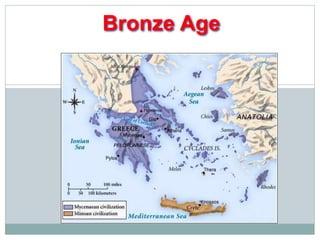
Bronze Age
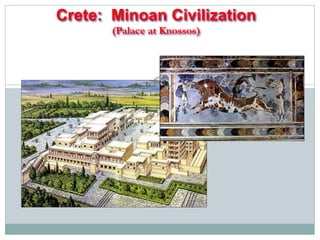
Crete: Minoan Civilization 
(Palace at Knossos)
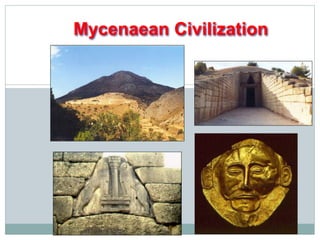
Mycenaean Civilization
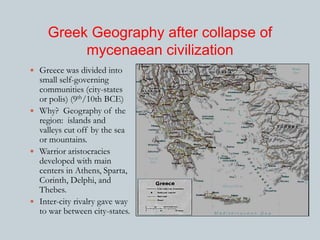
Greek Geography after collapse of 
mycenaean civilization 
 Greece was divided into 
small self-governing 
communities (city-states 
or polis) (9th/10th BCE) 
 Why? Geography of the 
region: islands and 
valleys cut off by the sea 
or mountains. 
 Warrior aristocracies 
developed with main 
centers in Athens, Sparta, 
Corinth, Delphi, and 
Thebes. 
 Inter-city rivalry gave way 
to war between city-states.
Greek “Dark Age” to Archaic 
 “Dark Age” (1150 B.C.E.- 700 B.C.E.) –Greek isolation 
 Ended when Phoenician ships entered the Aegean and gave 
the Greeks a writing system (phonetical) , helped develop 
Eastern Mediterranean and SW Asia. 
 Much of Greece remained oral culture 
 Theatrical drama, philosophical dialogues, and oratory from 
interaction of speaking and writing.
GEOMETRIC 
PERIOD 
900 – 750 BCE
8 
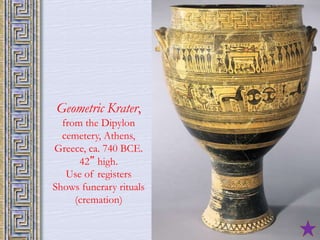
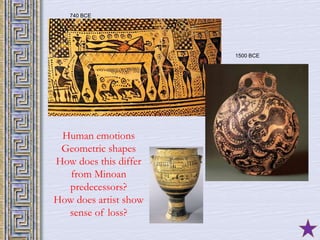
Geometric Krater, 
from the Dipylon 
cemetery, Athens, 
Greece, ca. 740 BCE. 
42” high. 
Use of registers 
Shows funerary rituals 
(cremation)
9 
740 BCE 
Human emotions 
Geometric shapes 
How does this differ 
from Minoan 
predecessors? 
How does artist show 
sense of loss? 
1500 BCE
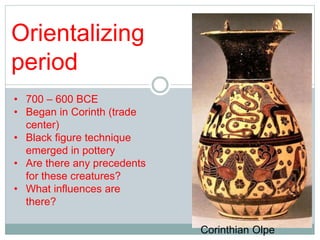
Orientalizing 
period 
• 700 – 600 BCE 
• Began in Corinth (trade 
center) 
• Black figure technique 
emerged in pottery 
• Are there any precedents 
for these creatures? 
• What influences are 
there? 
Corinthian Olpe
Archaic Greece 
600 BCE - 480 BCE
Greek RELIGIOUS BELIEFS 
 Immortal gods on Mt. Olympus, but took 
human form with human weaknesses 
 Zeus & Hera the power couple 
 Sanctuaries dedicated to the gods (before 
temples) 
 http://youtu.be/eJCm8W5RZes
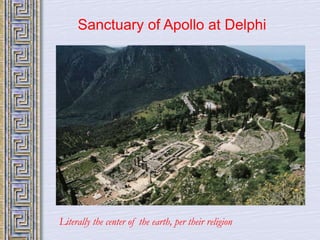
Sanctuary of Apollo at Delphi 
Literally the center of the earth, per their religion
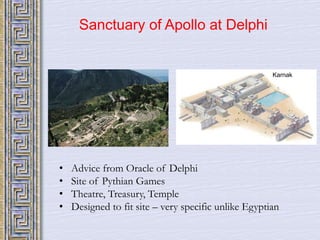
Sanctuary of Apollo at Delphi 
Karnak 
• Advice from Oracle of Delphi 
• Site of Pythian Games 
• Theatre, Treasury, Temple 
• Designed to fit site – very specific unlike Egyptian
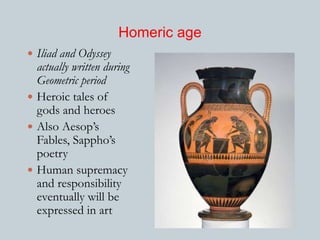
Homeric age 
 Iliad and Odyssey 
actually written during 
Geometric period 
 Heroic tales of 
gods and heroes 
 Also Aesop’s 
Fables, Sappho’s 
poetry 
 Human supremacy 
and responsibility 
eventually will be 
expressed in art
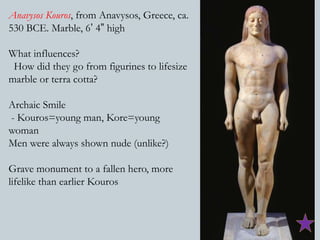
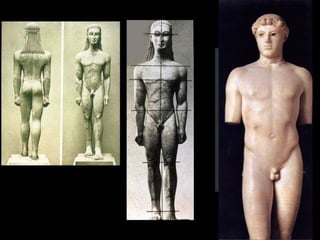
Anavysos Kouros, from Anavysos, Greece, ca. 
530 BCE. Marble, 6’ 4” high 
What influences? 
How did they go from figurines to lifesize 
marble or terra cotta? 
Archaic Smile 
- Kouros=young man, Kore=young 
woman 
Men were always shown nude (unlike?) 
Grave monument to a fallen hero, more 
lifelike than earlier Kouros
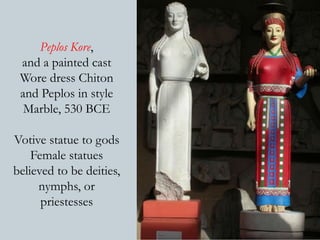
Peplos Kore, 
and a painted cast 
Wore dress Chiton 
and Peplos in style 
Marble, 530 BCE 
Votive statue to gods 
Female statues 
believed to be deities, 
nymphs, or 
priestesses
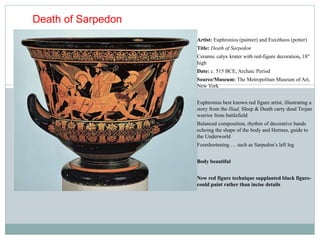
Artist: Euphronios (painter) and Euxitheos (potter) 
Title: Death of Sarpedon 
Ceramic calyx krater with red-figure decoration, 18" 
high 
Date: c. 515 BCE, Archaic Period 
Source/Museum: The Metropolitan Museum of Art, 
New York 
Euphronius best known red figure artist, illustrating a 
story from the Iliad, Sleep & Death carry dead Trojan 
warrior from battlefield 
Balanced composition, rhythm of decorative bands 
echoing the shape of the body and Hermes, guide to 
the Underworld 
Foreshortening … such as Sarpedon’s left leg 
Body beautiful 
New red figure technique supplanted black figure-could 
paint rather than incise details 
Death of Sarpedon
The Arts & Sciences (Pre-Socratic) 
DRAMA (tragedians): 
 Sophocles (496-406 B.C.E.) 
 Euripides (480-406 B.C.E.) 
THE SCIENCES: 
 Pythagoras (580-490 B.C.E.?) - father of mathematics 
 Democritus (460-370 B.C.E.)- all matter made up of 
small atoms. 
 Hippocrates (460-370 B.C.E.) “Father of Medicine”
Early Athenian Lawgivers 
Draco (7th C B.C.E.)- “draconian” 
Solon (6th C B.C.E.) - lawgiver; divided Athens 
into four classes based on farm yields; avert civil 
war 
Cleisthenes (5th C B.C.E.) - created the first 
“democracy” 
Pericles- Athenian democracy: Assembly, Council of 500, 
People’s Court; Parthenon
Great Athenian Philosophers 
Socrates (470-399 B.C.E.) 
 Know thyself ! 
 question everything; Socratic Method 
 only the pursuit of goodness 
brings happiness. 
Plato (428-347 B.C.E.) 
 The Academy 
 The world of the FORMS - mimeticism 
 The Republic  philosopher-king
Great Athenian Philosophers 
Aristotle (384-322 B.C.E.) 
 The Lyceum 
 Collect and categorize a vast array of knowledge: politics, philosophy, 
ethics, logic, poetry, rhetoric, physics, astronomy, meteorology, zoology, 
and psychology; 
 Modern disciplines and the Scientific method. 
 Alexander’s Tutor
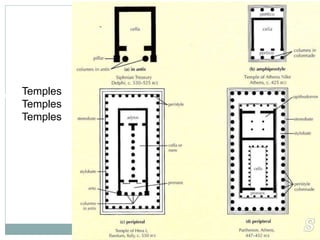
Greek 
Temples 
Temple 
Temples 
Plans 
Temples
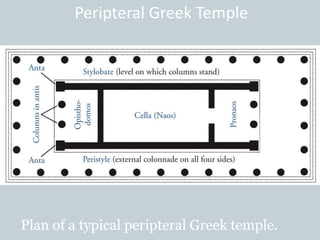
Peripteral Greek Temple 
Plan of a typical peripteral Greek temple.
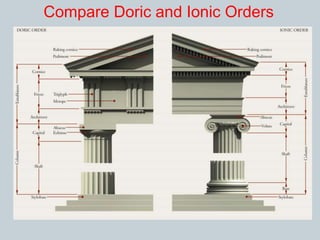
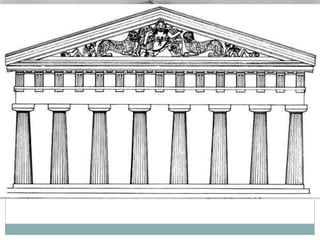
Compare Doric and Ionic Orders
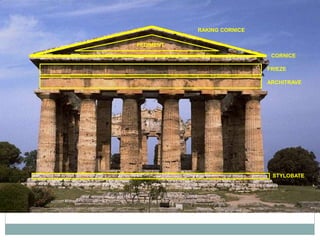
FRIEZE 
ARCHITRAVE 
STYLOBATE 
PEDIMENT 
RAKING CORNICE 
CORNICE
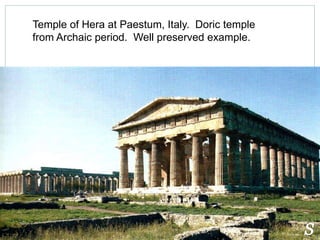
Temple of Hera at Paestum, Italy. Doric temple 
from Archaic period. Well preserved example.
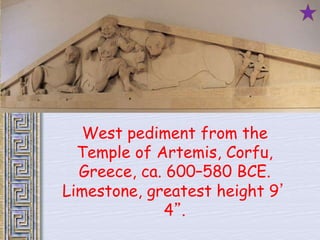
West pediment from the 
Temple of Artemis, Corfu, 
Greece, ca. 600–580 BCE. 
Limestone, greatest height 9’ 
4”.
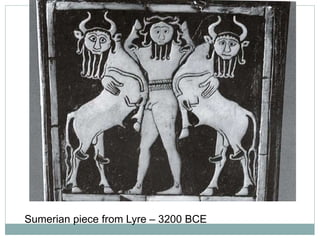
Sumerian piece from Lyre – 3200 BCE
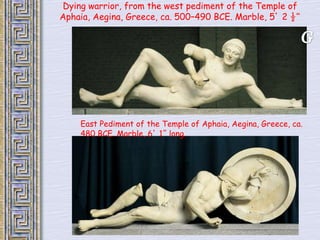
Dying warrior, from the west pediment of the Temple of 
Aphaia, Aegina, Greece, ca. 500–490 BCE. Marble, 5’ 2 ½“ 
East Pediment of the Temple of Aphaia, Aegina, Greece, ca. 
480 BCE. Marble, 6’ 1” long.
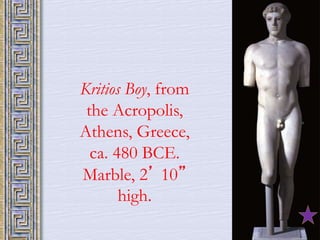
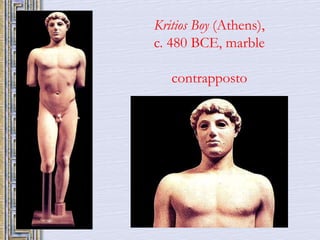
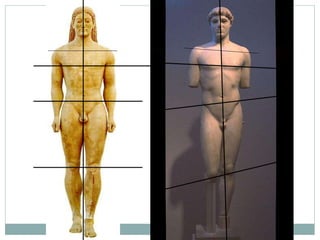
Kritios Boy, from 
the Acropolis, 
Athens, Greece, 
ca. 480 BCE. 
Marble, 2’ 10” 
high.
Kritios Boy (Athens), 
c. 480 BCE, marble 
contrapposto
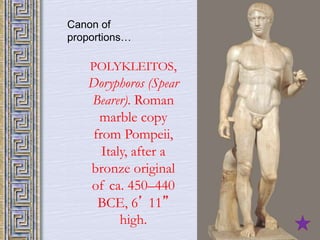
Canon of 
proportions… 
POLYKLEITOS, 
Doryphoros (Spear 
Bearer). Roman 
marble copy 
from Pompeii, 
Italy, after a 
bronze original 
of ca. 450–440 
BCE, 6’ 11” 
high.
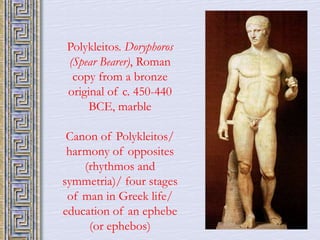
Polykleitos. Doryphoros 
(Spear Bearer), Roman 
copy from a bronze 
original of c. 450-440 
BCE, marble 
Canon of Polykleitos/ 
harmony of opposites 
(rhythmos and 
symmetria)/ four stages 
of man in Greek life/ 
education of an ephebe 
(or ephebos)
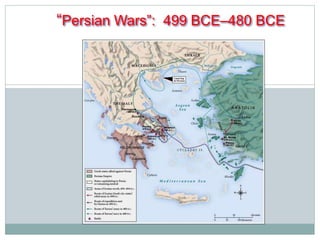
“Persian Wars”: 499 BCE–480 BCE
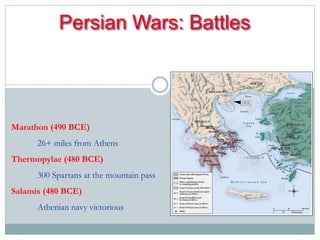
Persian Wars: Battles 
Marathon (490 BCE) 
26+ miles from Athens 
Thermopylae (480 BCE) 
300 Spartans at the mountain pass 
Salamis (480 BCE) 
Athenian navy victorious
44 
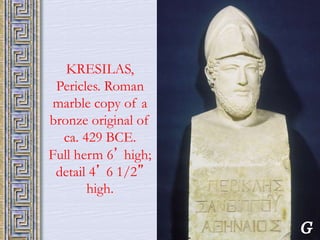
KRESILAS, 
Pericles. Roman 
marble copy of a 
bronze original of 
ca. 429 BCE. 
Full herm 6’ high; 
detail 4’ 6 1/2” 
high.
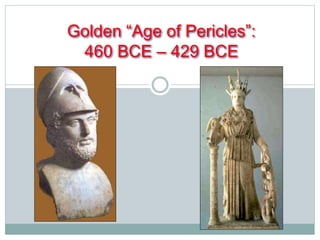
Golden “Age of Pericles”: 
460 BCE – 429 BCE
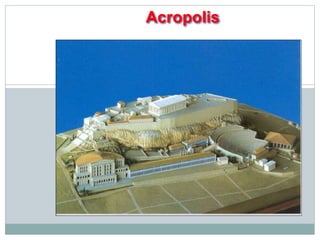
Acropolis
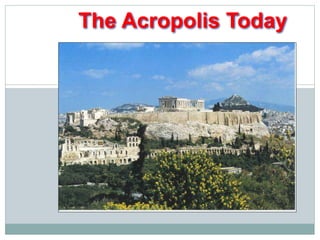
The Acropolis Today
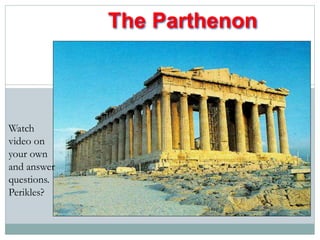
The Parthenon 
Watch 
video on 
your own 
and answer 
questions. 
Perikles?
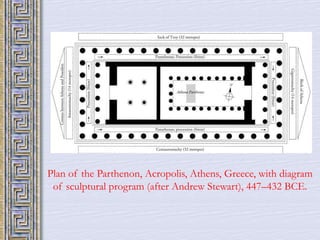
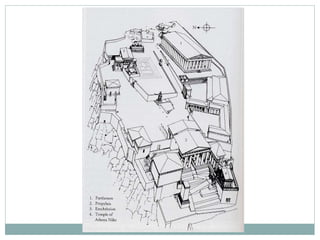
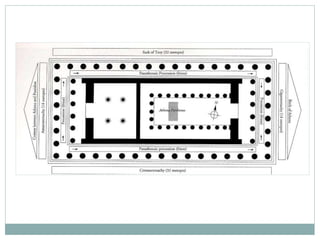
Plan of the Parthenon, Acropolis, Athens, Greece, with diagram 
of sculptural program (after Andrew Stewart), 447–432 BCE.
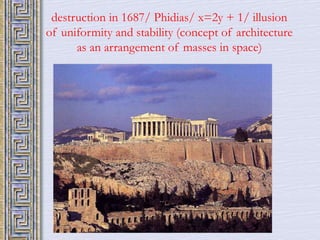
destruction in 1687/ Phidias/ x=2y + 1/ illusion 
of uniformity and stability (concept of architecture 
as an arrangement of masses in space)
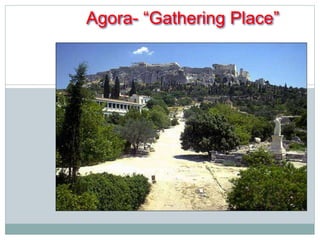
Agora- “Gathering Place”
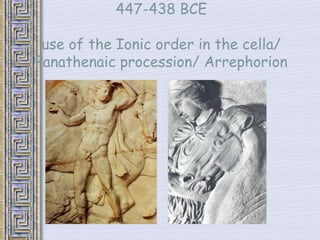
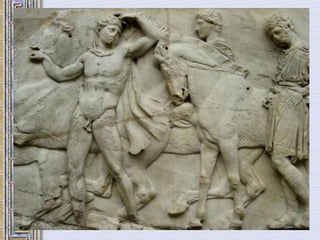
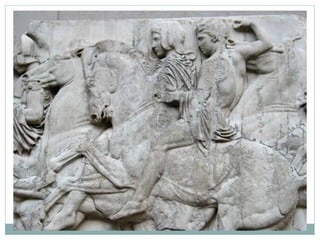
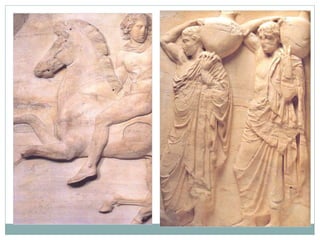
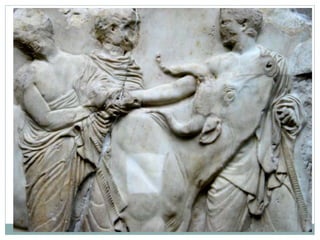
Inner Ionic frieze of the Parthenon, 
447-438 BCE 
use of the Ionic order in the cella/ 
Panathenaic procession/ Arrephorion
French color drawing 
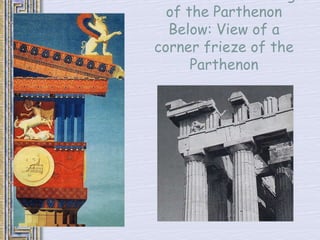
of the Parthenon 
Below: View of a 
corner frieze of the 
Parthenon
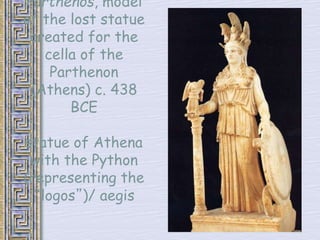
Parthenos, model 
of the lost statue 
created for the 
cella of the 
Parthenon 
(Athens) c. 438 
BCE 
statue of Athena 
with the Python 
(representing the 
“logos”)/ aegis
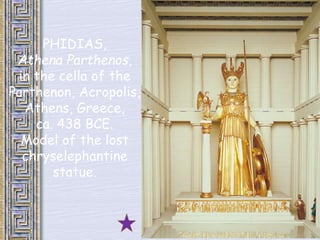
PHIDIAS, 
Athena Parthenos, 
in the cella of the 
Parthenon, Acropolis, 
Athens, Greece, 
ca. 438 BCE. 
Model of the lost 
chryselephantine 
statue.
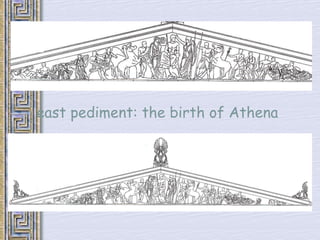
east pediment: the birth of Athena
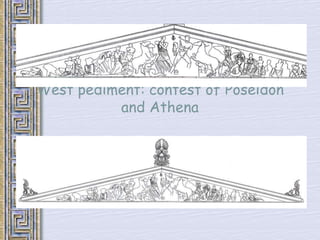
West pediment: contest of Poseidon 
and Athena
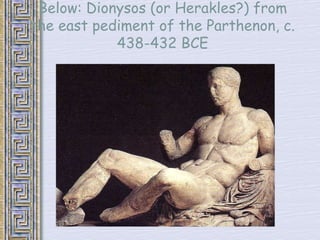
Below: Dionysos (or Herakles?) from 
the east pediment of the Parthenon, c. 
438-432 BCE
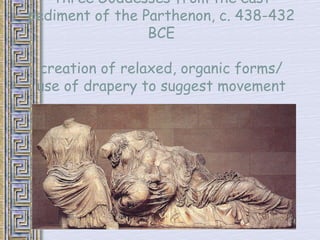
Three Goddesses from the east 
pediment of the Parthenon, c. 438-432 
BCE 
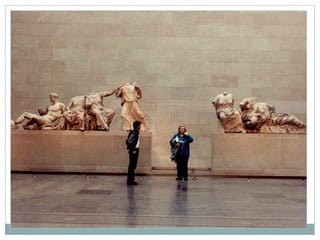
creation of relaxed, organic forms/ 
use of drapery to suggest movement
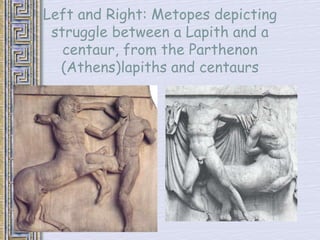
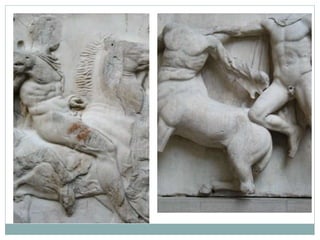
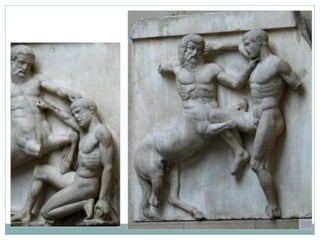
Left and Right: Metopes depicting 
struggle between a Lapith and a 
centaur, from the Parthenon 
(Athens)lapiths and centaurs
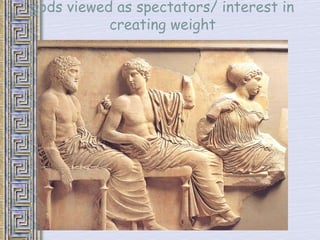
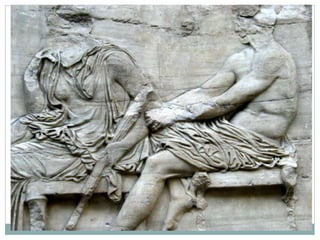
gods viewed as spectators/ interest in 
creating weight
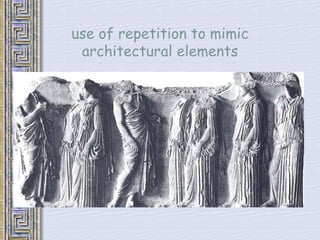
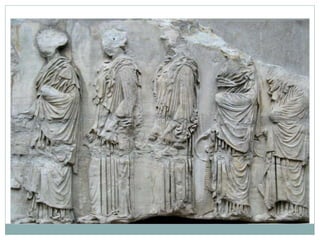
use of repetition to mimic 
architectural elements
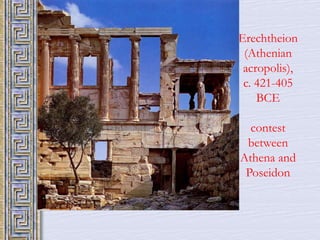
Erechtheion 
(Athenian 
acropolis), 
c. 421-405 
BCE 
contest 
between 
Athena and 
Poseidon
75 
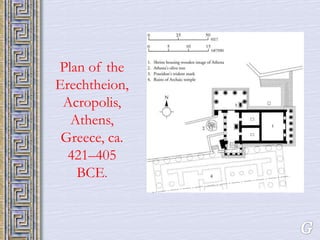
Plan of the 
Erechtheion, 
Acropolis, 
Athens, 
Greece, ca. 
421–405 
BCE.
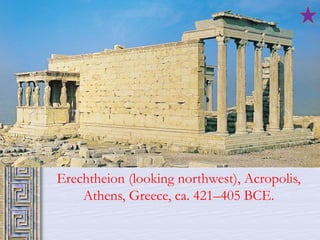
Erechtheion (looking northwest), Acropolis, 
Athens, Greece, ca. 421–405 BCE.
78 
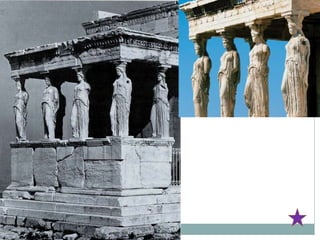
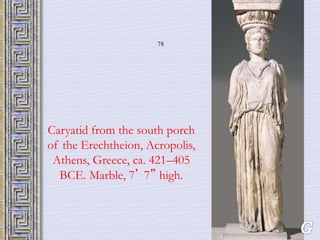
Caryatid from the south porch 
of the Erechtheion, Acropolis, 
Athens, Greece, ca. 421–405 
BCE. Marble, 7’ 7” high.
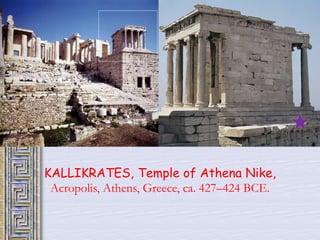
KALLIKRATES, Temple of Athena Nike, 
Acropolis, Athens, Greece, ca. 427–424 BCE.
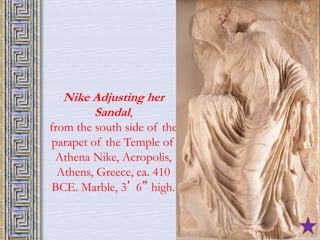
Nike Adjusting her 
Sandal , 
from the south side of the 
parapet of the Temple of 
Athena Nike, Acropolis, 
Athens, Greece, ca. 410 
BCE. Marble, 3’ 6” high.
81 
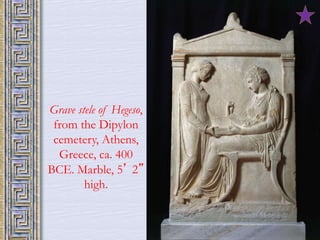
Grave stele of Hegeso, 
from the Dipylon 
cemetery, Athens, 
Greece, ca. 400 
BCE. Marble, 5’ 2” 
high.
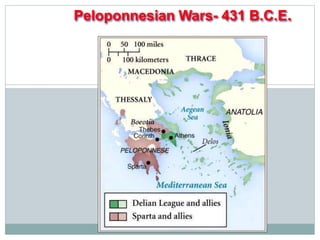
Peloponnesian Wars- 431 B.C.E.
The Peloponnesian Wars 
 The emergence of Athens as an imperial power after the 
Persian Wars led to open hostilities with former allies. 
 Mainly between the Spartans (financed by the Persians) and 
the Athenians, lasted three decades with a Spartan victory. 
 Persia regained much of its control and because of uprisings 
in Egypt, Cyprus, and Phoenicia, it did not return to attack 
Greece. 
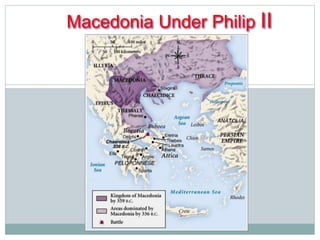
 In northern Greece, Macedonians, Philip II and his son, 
Alexander, would reshape the eastern Mediterranean and 
western Asia in this vacuum.
Macedonia Under Philip II

Early greek thru early classical

  • 1.
    COLLAPSE OF THEMYCENEAN DOMINANCE 1 1 TH CENTURY BCE GEOMETRIC PERIOD 900-600 BCE ORIENTALIZING PERIOD 700 -600 BCE ARCHAIC PERIOD 600- 480 BCE
  • 2.
  • 3.
    Crete: Minoan Civilization (Palace at Knossos)
  • 4.
  • 5.
    Greek Geography aftercollapse of mycenaean civilization  Greece was divided into small self-governing communities (city-states or polis) (9th/10th BCE)  Why? Geography of the region: islands and valleys cut off by the sea or mountains.  Warrior aristocracies developed with main centers in Athens, Sparta, Corinth, Delphi, and Thebes.  Inter-city rivalry gave way to war between city-states.
  • 6.
    Greek “Dark Age”to Archaic  “Dark Age” (1150 B.C.E.- 700 B.C.E.) –Greek isolation  Ended when Phoenician ships entered the Aegean and gave the Greeks a writing system (phonetical) , helped develop Eastern Mediterranean and SW Asia.  Much of Greece remained oral culture  Theatrical drama, philosophical dialogues, and oratory from interaction of speaking and writing.
  • 7.
  • 8.
    8 Geometric Krater, from the Dipylon cemetery, Athens, Greece, ca. 740 BCE. 42” high. Use of registers Shows funerary rituals (cremation)
  • 9.
    9 740 BCE Human emotions Geometric shapes How does this differ from Minoan predecessors? How does artist show sense of loss? 1500 BCE
  • 10.
    Orientalizing period •700 – 600 BCE • Began in Corinth (trade center) • Black figure technique emerged in pottery • Are there any precedents for these creatures? • What influences are there? Corinthian Olpe
  • 11.
    Archaic Greece 600BCE - 480 BCE
  • 12.
    Greek RELIGIOUS BELIEFS  Immortal gods on Mt. Olympus, but took human form with human weaknesses  Zeus & Hera the power couple  Sanctuaries dedicated to the gods (before temples)  http://youtu.be/eJCm8W5RZes
  • 13.
    Sanctuary of Apolloat Delphi Literally the center of the earth, per their religion
  • 14.
    Sanctuary of Apolloat Delphi Karnak • Advice from Oracle of Delphi • Site of Pythian Games • Theatre, Treasury, Temple • Designed to fit site – very specific unlike Egyptian
  • 15.
    Homeric age Iliad and Odyssey actually written during Geometric period  Heroic tales of gods and heroes  Also Aesop’s Fables, Sappho’s poetry  Human supremacy and responsibility eventually will be expressed in art
  • 17.
    Anavysos Kouros, fromAnavysos, Greece, ca. 530 BCE. Marble, 6’ 4” high What influences? How did they go from figurines to lifesize marble or terra cotta? Archaic Smile - Kouros=young man, Kore=young woman Men were always shown nude (unlike?) Grave monument to a fallen hero, more lifelike than earlier Kouros
  • 18.
    Peplos Kore, anda painted cast Wore dress Chiton and Peplos in style Marble, 530 BCE Votive statue to gods Female statues believed to be deities, nymphs, or priestesses
  • 19.
    Artist: Euphronios (painter)and Euxitheos (potter) Title: Death of Sarpedon Ceramic calyx krater with red-figure decoration, 18" high Date: c. 515 BCE, Archaic Period Source/Museum: The Metropolitan Museum of Art, New York Euphronius best known red figure artist, illustrating a story from the Iliad, Sleep & Death carry dead Trojan warrior from battlefield Balanced composition, rhythm of decorative bands echoing the shape of the body and Hermes, guide to the Underworld Foreshortening … such as Sarpedon’s left leg Body beautiful New red figure technique supplanted black figure-could paint rather than incise details Death of Sarpedon
  • 21.
    The Arts &Sciences (Pre-Socratic) DRAMA (tragedians):  Sophocles (496-406 B.C.E.)  Euripides (480-406 B.C.E.) THE SCIENCES:  Pythagoras (580-490 B.C.E.?) - father of mathematics  Democritus (460-370 B.C.E.)- all matter made up of small atoms.  Hippocrates (460-370 B.C.E.) “Father of Medicine”
  • 22.
    Early Athenian Lawgivers Draco (7th C B.C.E.)- “draconian” Solon (6th C B.C.E.) - lawgiver; divided Athens into four classes based on farm yields; avert civil war Cleisthenes (5th C B.C.E.) - created the first “democracy” Pericles- Athenian democracy: Assembly, Council of 500, People’s Court; Parthenon
  • 23.
    Great Athenian Philosophers Socrates (470-399 B.C.E.)  Know thyself !  question everything; Socratic Method  only the pursuit of goodness brings happiness. Plato (428-347 B.C.E.)  The Academy  The world of the FORMS - mimeticism  The Republic  philosopher-king
  • 24.
    Great Athenian Philosophers Aristotle (384-322 B.C.E.)  The Lyceum  Collect and categorize a vast array of knowledge: politics, philosophy, ethics, logic, poetry, rhetoric, physics, astronomy, meteorology, zoology, and psychology;  Modern disciplines and the Scientific method.  Alexander’s Tutor
  • 26.
    Greek Temples Temple Temples Plans Temples
  • 27.
    Peripteral Greek Temple Plan of a typical peripteral Greek temple.
  • 28.
    Compare Doric andIonic Orders
  • 29.
    FRIEZE ARCHITRAVE STYLOBATE PEDIMENT RAKING CORNICE CORNICE
  • 30.
    Temple of Heraat Paestum, Italy. Doric temple from Archaic period. Well preserved example.
  • 31.
    West pediment fromthe Temple of Artemis, Corfu, Greece, ca. 600–580 BCE. Limestone, greatest height 9’ 4”.
  • 33.
    Sumerian piece fromLyre – 3200 BCE
  • 34.
    Dying warrior, fromthe west pediment of the Temple of Aphaia, Aegina, Greece, ca. 500–490 BCE. Marble, 5’ 2 ½“ East Pediment of the Temple of Aphaia, Aegina, Greece, ca. 480 BCE. Marble, 6’ 1” long.
  • 36.
    Kritios Boy, from the Acropolis, Athens, Greece, ca. 480 BCE. Marble, 2’ 10” high.
  • 38.
    Kritios Boy (Athens), c. 480 BCE, marble contrapposto
  • 40.
    Canon of proportions… POLYKLEITOS, Doryphoros (Spear Bearer). Roman marble copy from Pompeii, Italy, after a bronze original of ca. 450–440 BCE, 6’ 11” high.
  • 41.
    Polykleitos. Doryphoros (SpearBearer), Roman copy from a bronze original of c. 450-440 BCE, marble Canon of Polykleitos/ harmony of opposites (rhythmos and symmetria)/ four stages of man in Greek life/ education of an ephebe (or ephebos)
  • 42.
  • 43.
    Persian Wars: Battles Marathon (490 BCE) 26+ miles from Athens Thermopylae (480 BCE) 300 Spartans at the mountain pass Salamis (480 BCE) Athenian navy victorious
  • 44.
    44 KRESILAS, Pericles.Roman marble copy of a bronze original of ca. 429 BCE. Full herm 6’ high; detail 4’ 6 1/2” high.
  • 45.
    Golden “Age ofPericles”: 460 BCE – 429 BCE
  • 46.
  • 47.
  • 48.
    The Parthenon Watch video on your own and answer questions. Perikles?
  • 49.
    Plan of theParthenon, Acropolis, Athens, Greece, with diagram of sculptural program (after Andrew Stewart), 447–432 BCE.
  • 50.
    destruction in 1687/Phidias/ x=2y + 1/ illusion of uniformity and stability (concept of architecture as an arrangement of masses in space)
  • 51.
  • 54.
    Inner Ionic friezeof the Parthenon, 447-438 BCE use of the Ionic order in the cella/ Panathenaic procession/ Arrephorion
  • 59.
    French color drawing of the Parthenon Below: View of a corner frieze of the Parthenon
  • 60.
    Parthenos, model ofthe lost statue created for the cella of the Parthenon (Athens) c. 438 BCE statue of Athena with the Python (representing the “logos”)/ aegis
  • 61.
    PHIDIAS, Athena Parthenos, in the cella of the Parthenon, Acropolis, Athens, Greece, ca. 438 BCE. Model of the lost chryselephantine statue.
  • 62.
    east pediment: thebirth of Athena
  • 63.
    West pediment: contestof Poseidon and Athena
  • 65.
    Below: Dionysos (orHerakles?) from the east pediment of the Parthenon, c. 438-432 BCE
  • 66.
    Three Goddesses fromthe east pediment of the Parthenon, c. 438-432 BCE creation of relaxed, organic forms/ use of drapery to suggest movement
  • 67.
    Left and Right:Metopes depicting struggle between a Lapith and a centaur, from the Parthenon (Athens)lapiths and centaurs
  • 70.
    gods viewed asspectators/ interest in creating weight
  • 72.
    use of repetitionto mimic architectural elements
  • 74.
    Erechtheion (Athenian acropolis), c. 421-405 BCE contest between Athena and Poseidon
  • 75.
    75 Plan ofthe Erechtheion, Acropolis, Athens, Greece, ca. 421–405 BCE.
  • 76.
    Erechtheion (looking northwest),Acropolis, Athens, Greece, ca. 421–405 BCE.
  • 78.
    78 Caryatid fromthe south porch of the Erechtheion, Acropolis, Athens, Greece, ca. 421–405 BCE. Marble, 7’ 7” high.
  • 79.
    KALLIKRATES, Temple ofAthena Nike, Acropolis, Athens, Greece, ca. 427–424 BCE.
  • 80.
    Nike Adjusting her Sandal , from the south side of the parapet of the Temple of Athena Nike, Acropolis, Athens, Greece, ca. 410 BCE. Marble, 3’ 6” high.
  • 81.
    81 Grave steleof Hegeso, from the Dipylon cemetery, Athens, Greece, ca. 400 BCE. Marble, 5’ 2” high.
  • 82.
  • 83.
    The Peloponnesian Wars  The emergence of Athens as an imperial power after the Persian Wars led to open hostilities with former allies.  Mainly between the Spartans (financed by the Persians) and the Athenians, lasted three decades with a Spartan victory.  Persia regained much of its control and because of uprisings in Egypt, Cyprus, and Phoenicia, it did not return to attack Greece.  In northern Greece, Macedonians, Philip II and his son, Alexander, would reshape the eastern Mediterranean and western Asia in this vacuum.
  • 84.