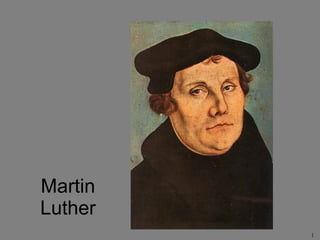
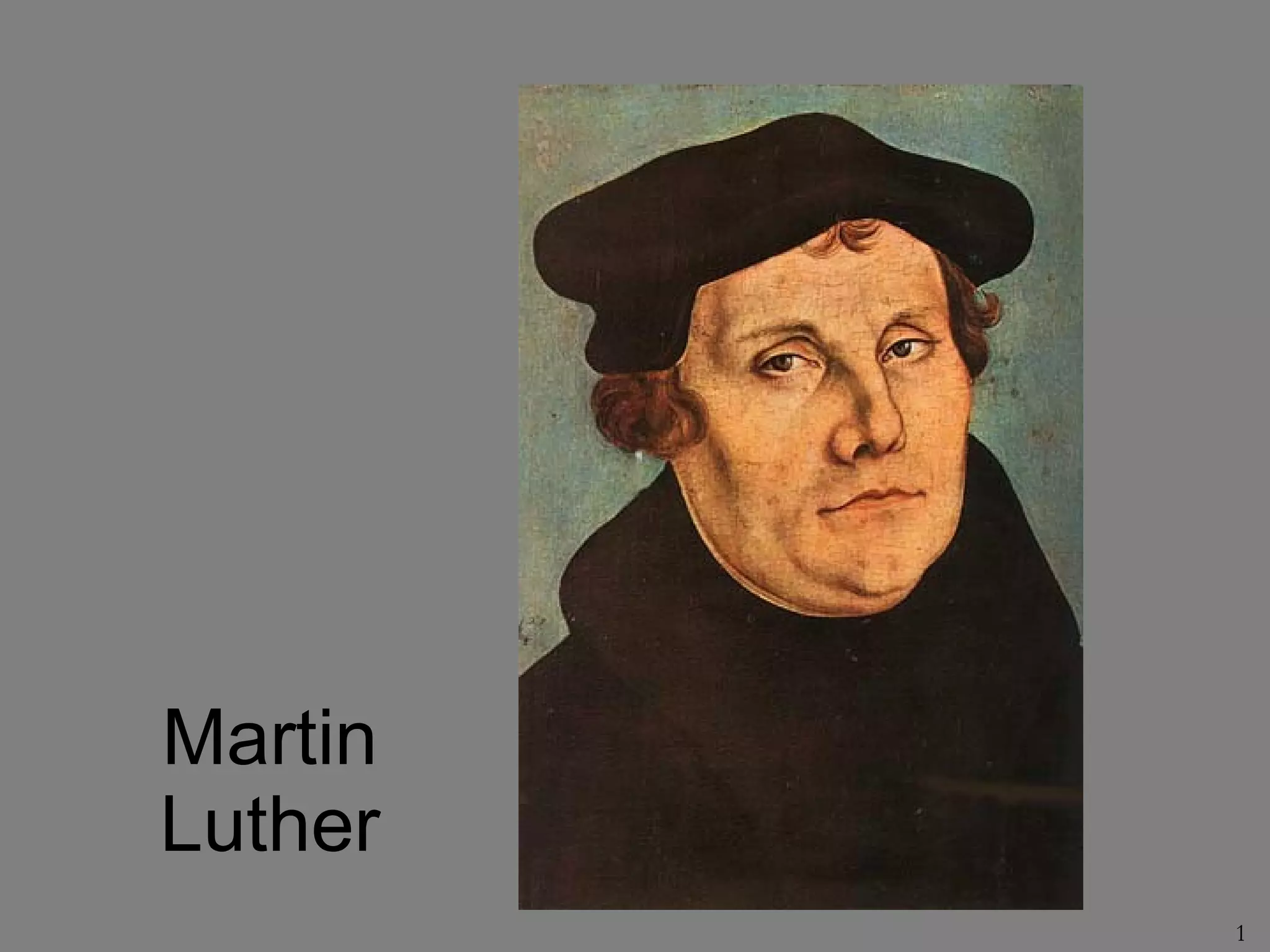




Martin Luther
Emphasized by Luther in the 95 Theses: The Pope is a false authority. The bible was the one true authority. All people with faith in Christ were equal. People did not need priest and bishops to interpret the bible for them. They could read it themselves and make up their own minds. People could only win salvation by faith in God's forgiveness. The Church taught that faith, along with good works was needed for salvation.
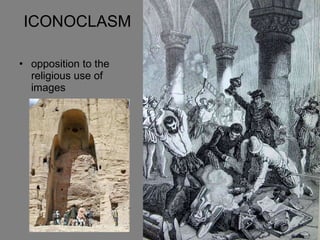
ICONOCLASM opposition to the religious use of images
17 th  Century
Baroque Art:  energy, theatrical emotion, rich primary colors, dynamic composition and the strong presence of light The Baroque Period lasted from about 1600 to 1750- the period of the Counter Reformation in the Catholic countries of Europe. It is also called the “Age of Colonization,” or “Age of Kings,” Rococo:  pastel colors, lighthearted, secular subjects, art for the aristocracy Neoclassical:  Italian Renaissance, classical compositions and motifs Chapter Seventeen The 17th and 18th Centuries
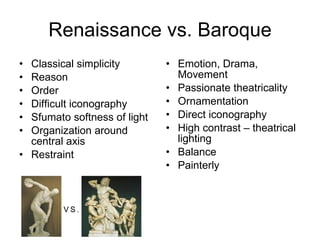
Renaissance vs. Baroque Classical simplicity Reason Order Difficult iconography Sfumato softness of light Organization around central axis Restraint Emotion, Drama, Movement Passionate theatricality Ornamentation Direct iconography  High contrast – theatrical lighting Balance Painterly
Baroque Insistent/forceful movement and transformation – curvy, swirling, diagonally based compositions  Secularization of subjects Art techniques taught formally  Rise of Opera Theatricality of Art
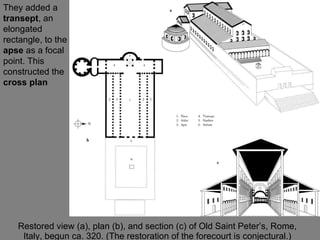
Restored view (a), plan (b), and section (c) of Old Saint Peter’s, Rome, Italy, begun ca. 320. (The restoration of the forecourt is conjectural.) They added a  transept , an elongated rectangle, to the  apse  as a focal point. This constructed the  cross plan
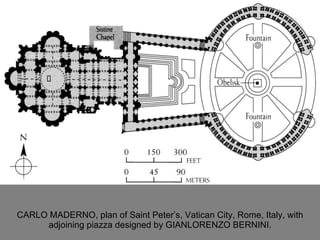
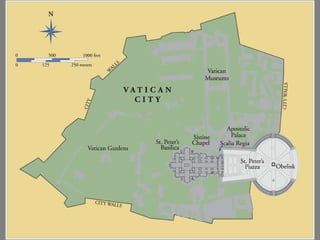
CARLO MADERNO, plan of Saint Peter’s, Vatican City, Rome, Italy, with adjoining piazza designed by GIANLORENZO BERNINI.
 
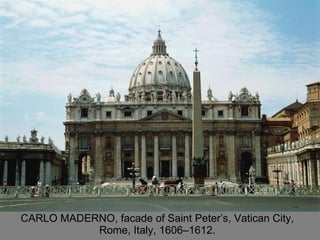
CARLO MADERNO, facade of Saint Peter’s, Vatican City, Rome, Italy, 1606–1612.
 
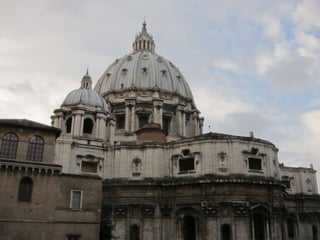
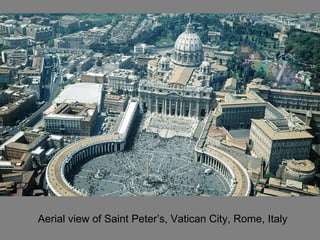
Aerial view of Saint Peter’s, Vatican City, Rome, Italy
St. Peter’s Basilica How is this different than Old St. Peter’s? For work on St Peter's, Pope Nicholas V bought 2,522 cartloads of stone from the badly damaged Roman Colosseum. Quarrying of stone for the Colosseum had, in turn, been paid for with treasure looted at the Fall of Jerusalem and destruction of the temple by the emperor Vespasian's general (and the future emperor) Titus in 70 AD.
 
 
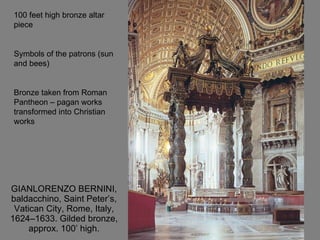
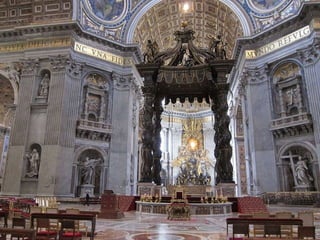
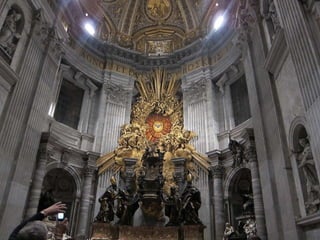
GIANLORENZO BERNINI, baldacchino, Saint Peter’s, Vatican City, Rome, Italy, 1624–1633. Gilded bronze, approx. 100’ high. 100 feet high bronze altar piece Symbols of the patrons (sun and bees) Bronze taken from Roman Pantheon – pagan works transformed into Christian works
 
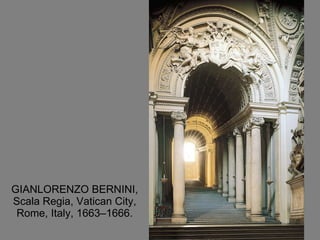
GIANLORENZO BERNINI, Scala Regia, Vatican City, Rome, Italy, 1663–1666.
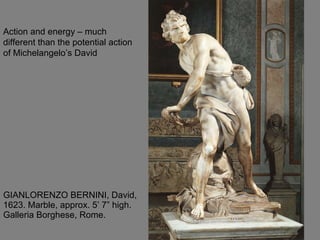
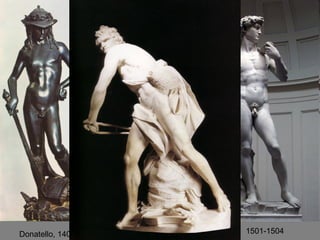
GIANLORENZO BERNINI, David, 1623. Marble, approx. 5’ 7” high. Galleria Borghese, Rome.  Action and energy – much different than the potential action of Michelangelo’s David
Donatello, 1408 Verrocchio, 1470 1501-1504


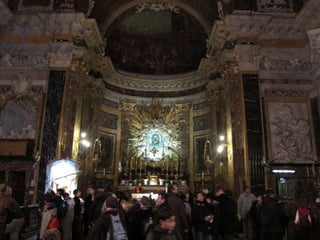
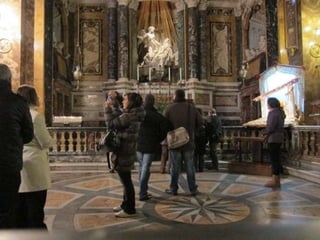
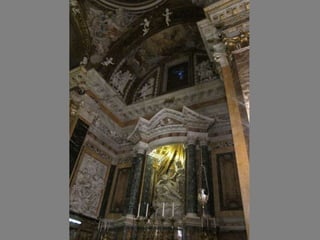
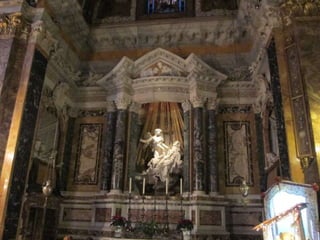
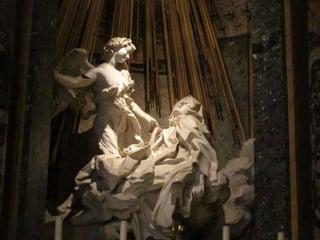
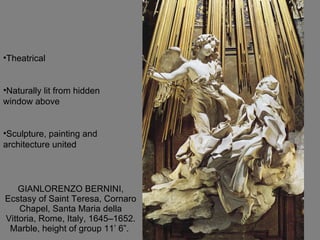
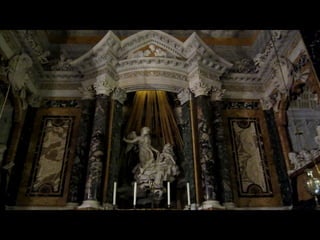
GIANLORENZO BERNINI, Ecstasy of Saint Teresa, Cornaro Chapel, Santa Maria della Vittoria, Rome, Italy, 1645–1652. Marble, height of group 11’ 6”.  Theatrical Naturally lit from hidden window above Sculpture, painting and architecture united


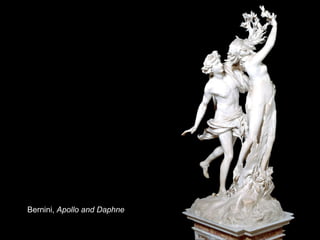
Bernini,  Apollo and Daphne
Baroque Architecture long, narrow naves are replaced by broader, occasionally circular forms dramatic use of light, either strong light-and-shade contrasts, chiaroscuro effects  opulent use of ornaments large-scale ceiling frescoes Frequently used flying figures Highly skilled perspective and foreshortening the interior is often no more than a shell for the  blending and unification of architecture, sculpture, and painting
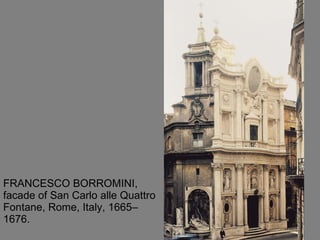
FRANCESCO BORROMINI, facade of San Carlo alle Quattro Fontane, Rome, Italy, 1665–1676.
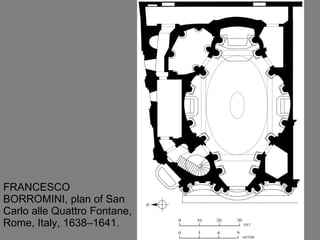
FRANCESCO BORROMINI, plan of San Carlo alle Quattro Fontane, Rome, Italy, 1638–1641.
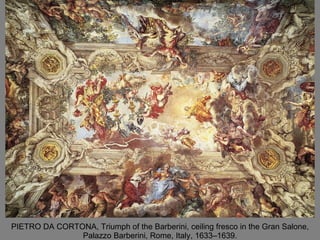
PIETRO DA CORTONA, Triumph of the Barberini, ceiling fresco in the Gran Salone, Palazzo Barberini, Rome, Italy, 1633–1639.
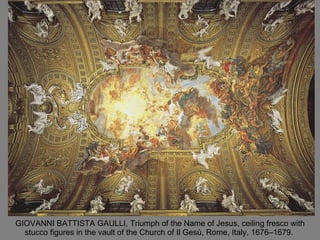
GIOVANNI BATTISTA GAULLI, Triumph of the Name of Jesus, ceiling fresco with stucco figures in the vault of the Church of Il Gesù, Rome, Italy, 1676–1679.
 
 
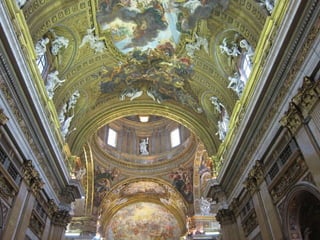
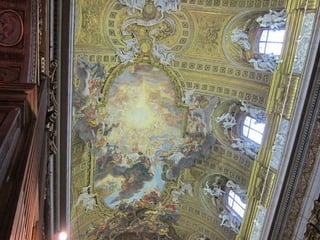
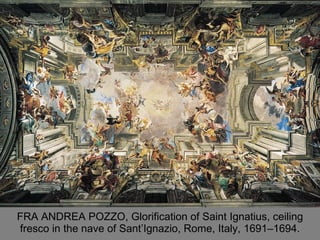
FRA ANDREA POZZO, Glorification of Saint Ignatius, ceiling fresco in the nave of Sant’Ignazio, Rome, Italy, 1691–1694.
Caravaggio Recast biblical scenes or themes in new light Used naturalism but instead did not idealize the narratives  Uses lower classes/common people for models Life-based rather than based on classical sculptures Strong use of light as if a spotlight were placed on the figures -  tenebrism
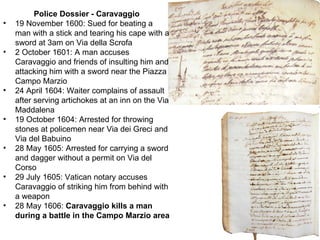
Police Dossier - Caravaggio 19 November 1600: Sued for beating a man with a stick and tearing his cape with a sword at 3am on Via della Scrofa  2 October 1601: A man accuses Caravaggio and friends of insulting him and attacking him with a sword near the Piazza Campo Marzio  24 April 1604: Waiter complains of assault after serving artichokes at an inn on the Via Maddalena  19 October 1604: Arrested for throwing stones at policemen near Via dei Greci and Via del Babuino  28 May 1605: Arrested for carrying a sword and dagger without a permit on Via del Corso  29 July 1605: Vatican notary accuses Caravaggio of striking him from behind with a weapon  28 May 1606:  Caravaggio kills a man during a battle in the Campo Marzio area
Differentiate between chiaroscuro and tenebrism. Chiaroscuro:   light and shadow used to show modeling Tenebrism:  violent   contrasts of   light used to heighten drama and emotion and add to theatrical effects.
 
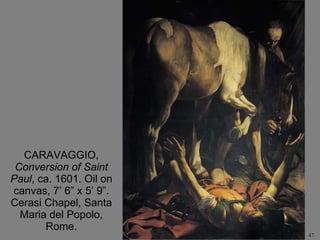
CARAVAGGIO,  Conversion of Saint Paul , ca. 1601. Oil on canvas, 7’ 6” x 5’ 9”. Cerasi Chapel, Santa Maria del Popolo, Rome.
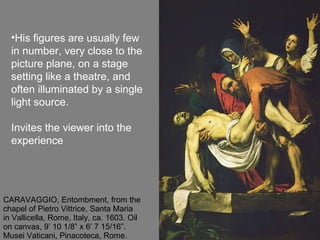
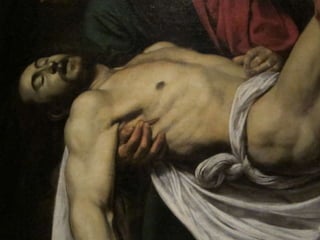
CARAVAGGIO, Entombment, from the chapel of Pietro Vittrice, Santa Maria in Vallicella, Rome, Italy, ca. 1603. Oil on canvas, 9’ 10 1/8” x 6’ 7 15/16”. Musei Vaticani, Pinacoteca, Rome. His figures are usually few in number, very close to the picture plane, on a stage setting like a theatre, and  often illuminated by a single light source. Invites the viewer into the experience
 
 
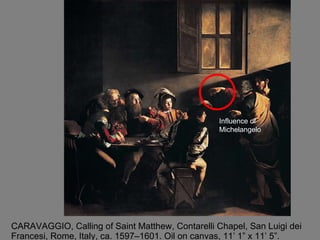
CARAVAGGIO, Calling of Saint Matthew, Contarelli Chapel, San Luigi dei Francesi, Rome, Italy, ca. 1597–1601. Oil on canvas, 11’ 1” x 11’ 5”.  Influence of Michelangelo
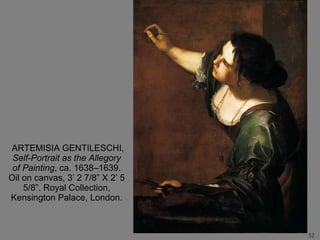
ARTEMISIA GENTILESCHI,  Self-Portrait as the Allegory of Painting , ca. 1638–1639. Oil on canvas, 3’ 2 7/8” X 2’ 5 5/8”. Royal Collection, Kensington Palace, London.
 
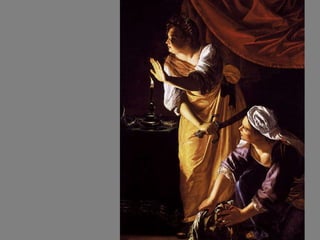
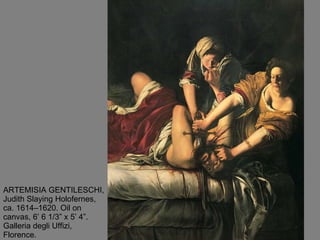
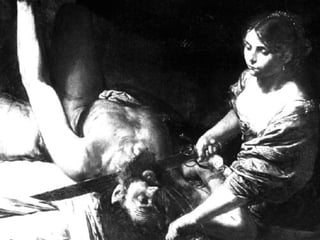
ARTEMISIA GENTILESCHI, Judith Slaying Holofernes, ca. 1614–1620. Oil on canvas, 6’ 6 1/3” x 5’ 4”. Galleria degli Uffizi, Florence.
 
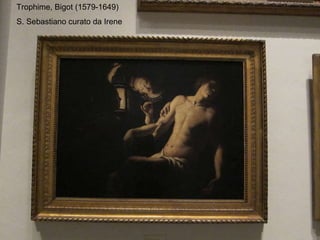
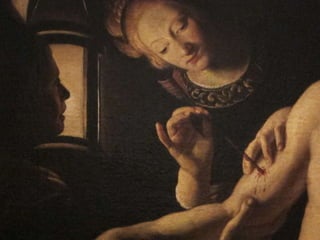
Trophime, Bigot (1579-1649) S. Sebastiano curato da Irene
 
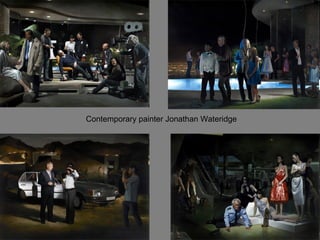
Contemporary painter Jonathan Wateridge
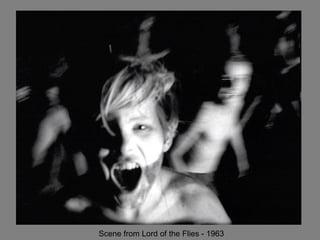
Scene from Lord of the Flies - 1963
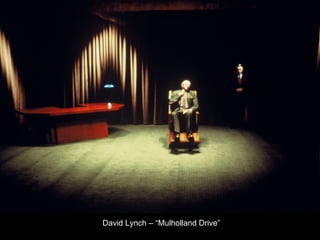
David Lynch – “Mulholland Drive”
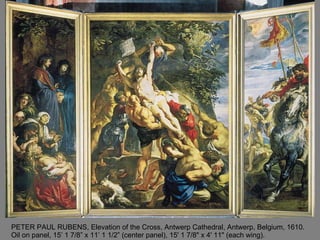
PETER PAUL RUBENS, Elevation of the Cross, Antwerp Cathedral, Antwerp, Belgium, 1610. Oil on panel, 15’ 1 7/8” x 11’ 1 1/2” (center panel), 15' 1 7/8" x 4' 11" (each wing).
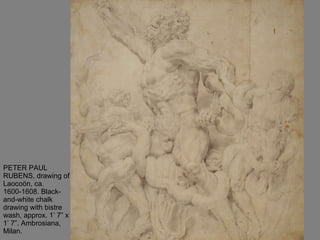
PETER PAUL RUBENS, drawing of Laocoön, ca. 1600-1608. Black-and-white chalk drawing with bistre wash, approx. 1’ 7” x 1’ 7”. Ambrosiana, Milan.
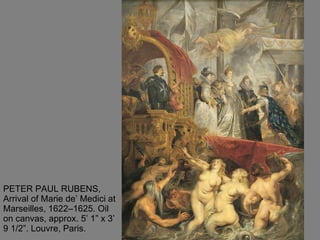
PETER PAUL RUBENS, Arrival of Marie de’ Medici at Marseilles, 1622–1625. Oil on canvas, approx. 5’ 1” x 3’ 9 1/2”. Louvre, Paris.
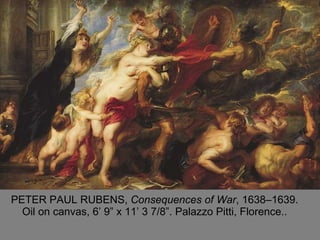
PETER PAUL RUBENS,  Consequences of War , 1638–1639. Oil on canvas, 6’ 9” x 11’ 3 7/8”. Palazzo Pitti, Florence..
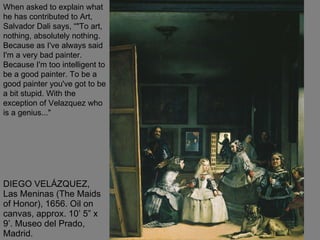
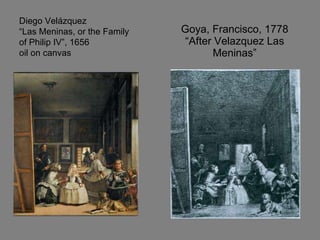
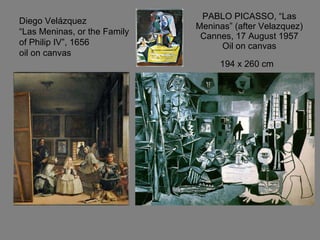
DIEGO VELÁZQUEZ, Las Meninas (The Maids of Honor), 1656. Oil on canvas, approx. 10’ 5” x 9’. Museo del Prado, Madrid.  When asked to explain what he has contributed to Art, Salvador Dali says, “"To art, nothing, absolutely nothing. Because as I've always said I'm a very bad painter. Because I'm too intelligent to be a good painter. To be a good painter you've got to be a bit stupid. With the exception of Velazquez who is a genius..."
Goya, Francisco, 1778 “After Velazquez Las Meninas” Diego Velázquez “Las Meninas, or the Family of Philip IV”, 1656 oil on canvas
PABLO PICASSO, “Las Meninas” (after Velazquez) Cannes, 17 August 1957 Oil on canvas 194 x 260 cm   Diego Velázquez “Las Meninas, or the Family of Philip IV”, 1656 oil on canvas
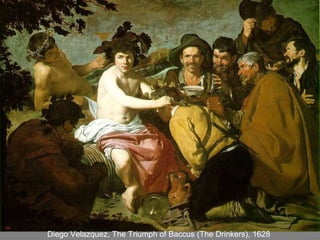
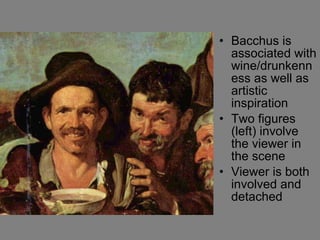
Diego Velazquez, The Triumph of Baccus (The Drinkers), 1628
Bacchus is associated with wine/drunkenness as well as artistic inspiration Two figures (left) involve the viewer in the scene Viewer is both involved and detached
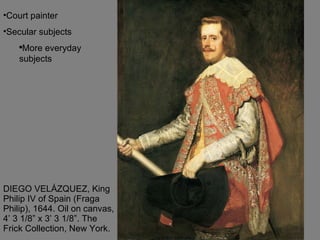
DIEGO VELÁZQUEZ, King Philip IV of Spain (Fraga Philip), 1644. Oil on canvas, 4’ 3 1/8” x 3’ 3 1/8”. The Frick Collection, New York.  Court painter Secular subjects More everyday subjects
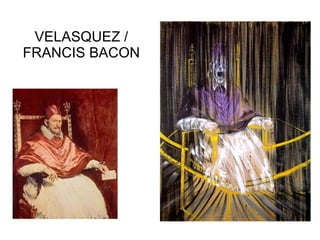
VELASQUEZ / FRANCIS BACON
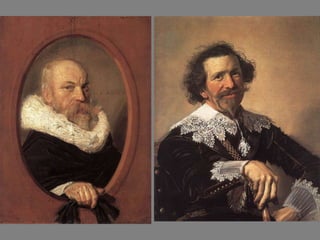
The Golden Age of Dutch Art The Dutch Republic was based on commerce and trade; merchant class held power, wealth Without a royal court or Catholic church commissions, artists turned to merchant class for work Portraiture rose in popularity as did works showing their possessions and land Still lifes, landscapes, genre scenes and portraits
Art of the Dutch Republic  Merchant patrons Realism Genre Scenes, still life Little religious art Moralizing Landscapes that showed work ethic Bourgeoisie portraits showed status without being ostentatious Artists Frans Hals:  Portraits 1581-1666 Rembrandt Van Rijin   1606-1669 Jan Vermeer:  1632-75 Interior genre scenes of the bourgeoisie
 
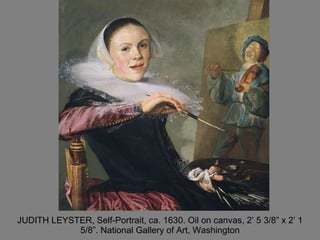
JUDITH LEYSTER, Self-Portrait, ca. 1630. Oil on canvas, 2’ 5 3/8” x 2’ 1 5/8”. National Gallery of Art, Washington
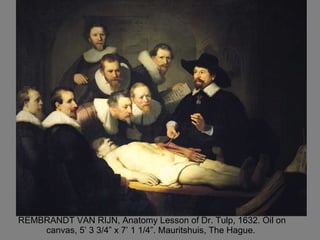
REMBRANDT VAN RIJN, Anatomy Lesson of Dr. Tulp, 1632. Oil on canvas, 5’ 3 3/4” x 7’ 1 1/4”. Mauritshuis, The Hague.
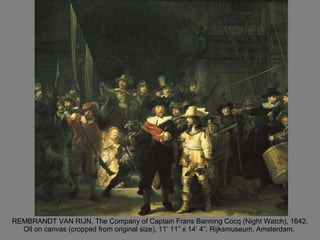
REMBRANDT VAN RIJN, The Company of Captain Frans Banning Cocq (Night Watch), 1642. Oil on canvas (cropped from original size), 11’ 11” x 14’ 4”. Rijksmuseum, Amsterdam.
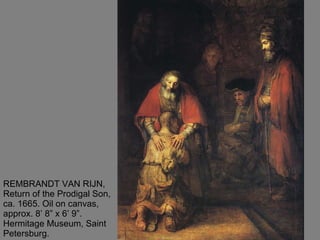
REMBRANDT VAN RIJN, Return of the Prodigal Son, ca. 1665. Oil on canvas, approx. 8’ 8” x 6’ 9”. Hermitage Museum, Saint Petersburg.
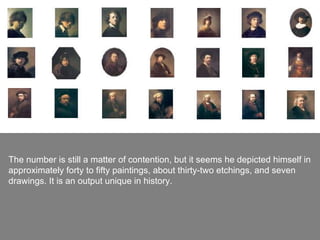
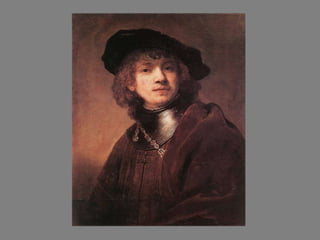
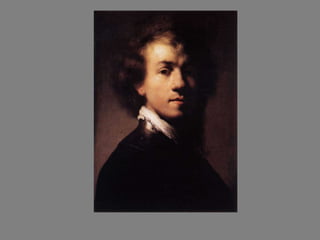
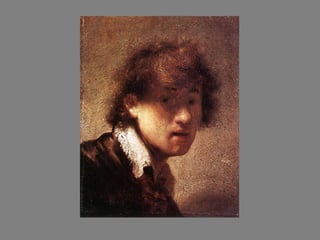
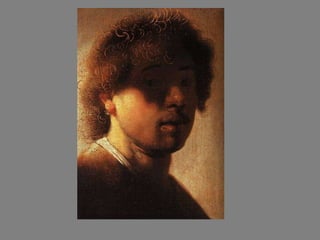
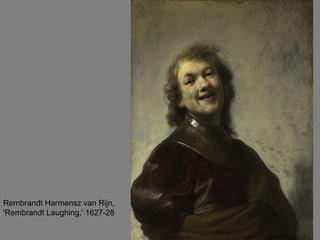
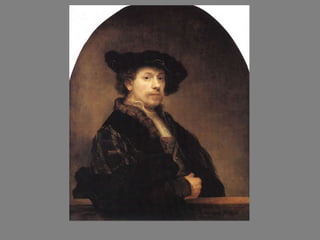
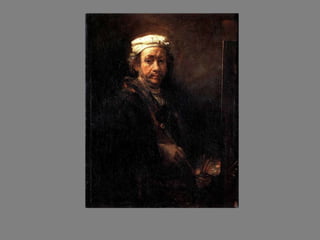
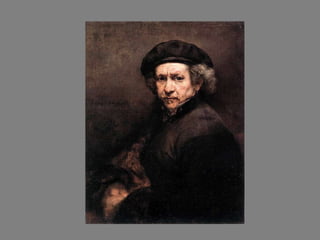
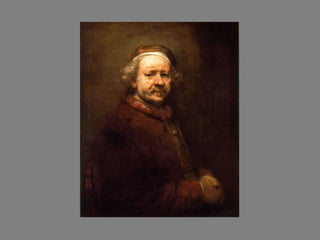
The number is still a matter of contention, but it seems he depicted himself in approximately forty to fifty paintings, about thirty-two etchings, and seven drawings. It is an output unique in history.


Rembrandt Harmensz van Rijn, 'Rembrandt Laughing,' 1627-28


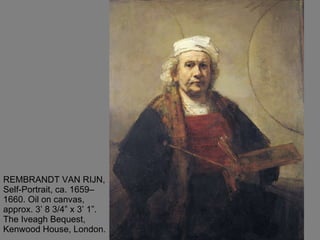
REMBRANDT VAN RIJN, Self-Portrait, ca. 1659–1660. Oil on canvas, approx. 3’ 8 3/4” x 3’ 1”. The Iveagh Bequest, Kenwood House, London.
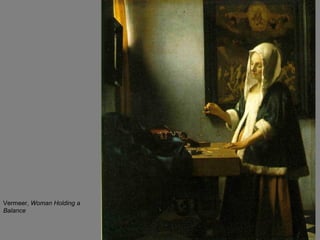
Vermeer,  Woman Holding a Balance
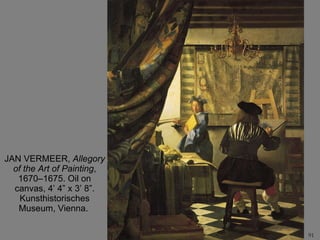
JAN VERMEER,  Allegory of the Art of Painting , 1670–1675. Oil on canvas, 4’ 4” x 3’ 8”. Kunsthistorisches Museum, Vienna.


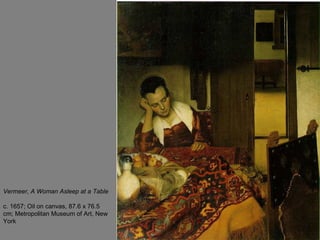
Vermeer, A Woman Asleep at a Table   c. 1657; Oil on canvas, 87.6 x 76.5 cm; Metropolitan Museum of Art, New York
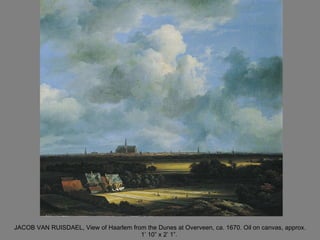
JACOB VAN RUISDAEL, View of Haarlem from the Dunes at Overveen, ca. 1670. Oil on canvas, approx. 1’ 10” x 2’ 1”.
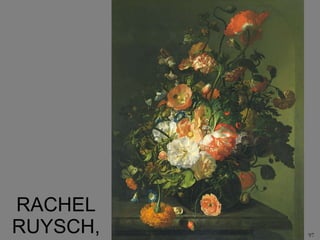
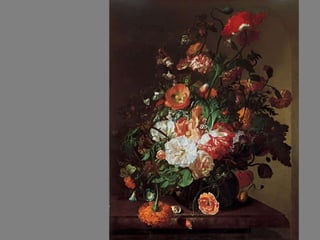
RACHEL RUYSCH,  Flower Still Life , after 1700. Oil on canvas, 2’ 5 3/4” x 1’ 11 7/8”. The Toledo Museum of Art, Toledo
 
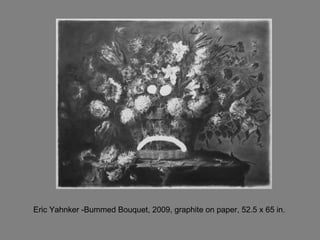
Eric Yahnker -Bummed Bouquet, 2009, graphite on paper, 52.5 x 65 in.
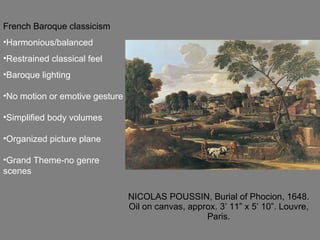
NICOLAS POUSSIN, Burial of Phocion, 1648. Oil on canvas, approx. 3’ 11” x 5’ 10”. Louvre, Paris. French Baroque classicism Harmonious/balanced Restrained classical feel Baroque lighting No motion or emotive gesture Simplified body volumes Organized picture plane Grand Theme-no genre scenes
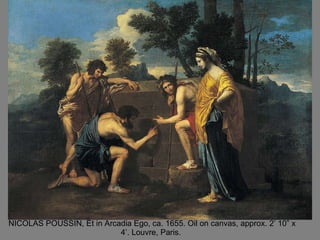
NICOLAS POUSSIN, Et in Arcadia Ego, ca. 1655. Oil on canvas, approx. 2’ 10” x 4’. Louvre, Paris.
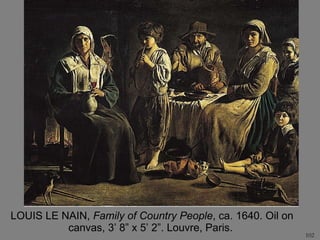
LOUIS LE NAIN,  Family of Country People , ca. 1640. Oil on canvas, 3’ 8” x 5’ 2”. Louvre, Paris.
18 th  Century Rococo and Neo-Classical
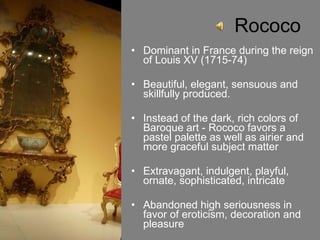
Rococo Dominant in France during the reign of Louis XV (1715-74) Beautiful, elegant, sensuous and skillfully produced.  Instead of the dark, rich colors of Baroque art - Rococo favors a pastel palette as well as airier and more graceful subject matter Extravagant, indulgent, playful, ornate, sophisticated, intricate Abandoned high seriousness in favor of eroticism, decoration and pleasure
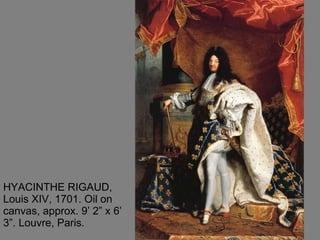
HYACINTHE RIGAUD, Louis XIV, 1701. Oil on canvas, approx. 9’ 2” x 6’ 3”. Louvre, Paris.
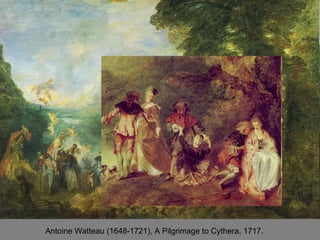
Antoine Watteau (1648-1721), A Pilgrimage to Cythera, 1717.
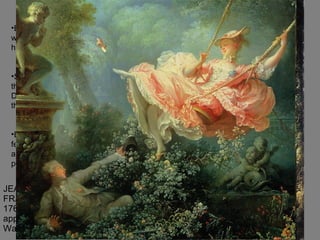
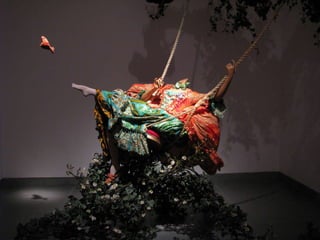
JEAN-HONORÉ FRAGONARD, The Swing, 1766. Oil on canvas, approx. 2’ 11” x 2’ 8”. The Wallace Collection, London.  Bishop swings a woman whose lover hides below She kicks her shoe at the little statue of Discretion and toward the lover Exaggeratedly delicate femininity – tiny hands and feet and layers of petticoats
 
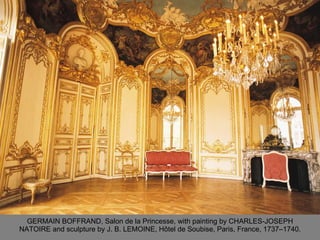
GERMAIN BOFFRAND, Salon de la Princesse, with painting by CHARLES-JOSEPH NATOIRE and sculpture by J. B. LEMOINE, Hôtel de Soubise, Paris, France, 1737–1740.
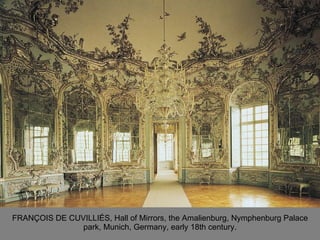
FRANÇOIS DE CUVILLIÉS, Hall of Mirrors, the Amalienburg, Nymphenburg Palace park, Munich, Germany, early 18th century.
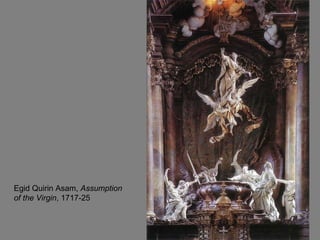
Egid Quirin Asam,  Assumption of the Virgin , 1717-25
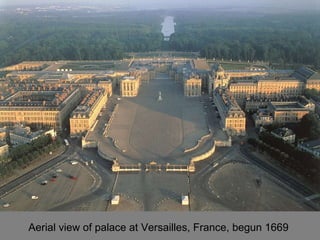
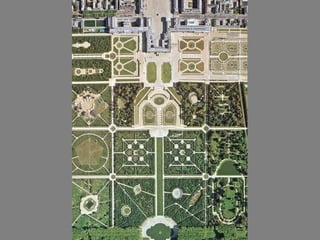
Aerial view of palace at Versailles, France, begun 1669
 
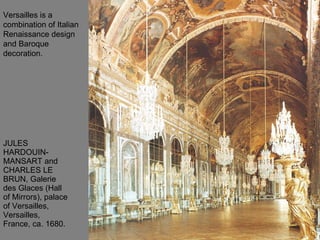
JULES HARDOUIN-MANSART and CHARLES LE BRUN, Galerie des Glaces (Hall of Mirrors), palace of Versailles, Versailles, France, ca. 1680. Versailles is a combination of Italian Renaissance design and Baroque decoration.


French Revolution Monarchy is gone Feudal customs are gone Slavery is abolished France becomes democratic country Napoleon Miliatary rule/dictatorship for next 15 years
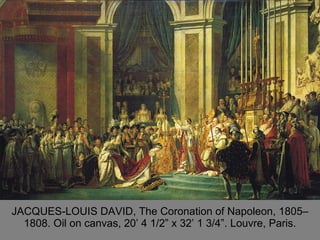
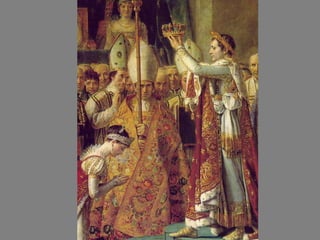
JACQUES-LOUIS DAVID, The Coronation of Napoleon, 1805–1808. Oil on canvas, 20’ 4 1/2” x 32’ 1 3/4”. Louvre, Paris.
 
Characteristics Neo-Classical Style Neo-classical art rebelled against the extravagancies and decadence of the Rococo period.  Reason above Passion Looked for universal rules, standards and goals in relation to which values and social practices ought to be judged Sought to shape morals/behaviors
Neo-Classical The style is often reasoned, serious, tight and inspired by Antiquity.  Re-introduction of classical forms of art/aesthetics In France it represented and helped foster the French Revolution of 1789 Strong horizontal and vertical structure to compositions
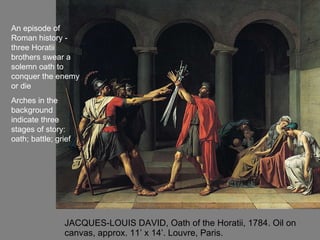
JACQUES-LOUIS DAVID, Oath of the Horatii, 1784. Oil on canvas, approx. 11’ x 14’. Louvre, Paris. An episode of Roman history - three Horatii brothers swear a solemn oath to conquer the enemy or die  Arches in the background indicate three stages of story: oath; battle; grief
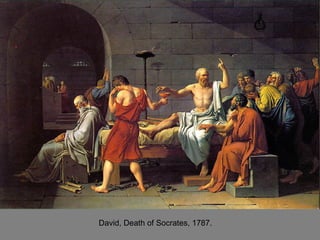
 David, Death of Socrates, 1787.
Jacques Louis David Leads Neoclassical movement as a reaction to the frivolous style of Rococo Represented the ideals of the French Revolution Sought an art form that was dignified and reflected their concerns/ideals Virtues such as bravery, honor, and loyalty
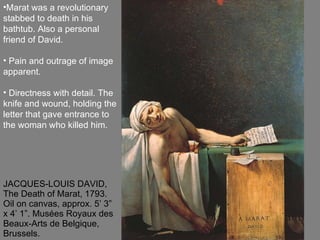
JACQUES-LOUIS DAVID, The Death of Marat, 1793. Oil on canvas, approx. 5’ 3” x 4’ 1”. Musées Royaux des Beaux-Arts de Belgique, Brussels. Marat was a revolutionary stabbed to death in his bathtub. Also a personal friend of David. Pain and outrage of image apparent. Directness with detail. The knife and wound, holding the letter that gave entrance to the woman who killed him.
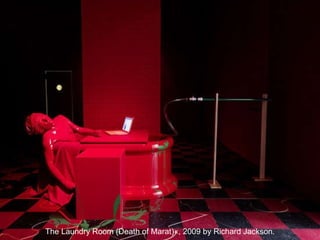
The Laundry Room (Death of Marat)«, 2009 by Richard Jackson.
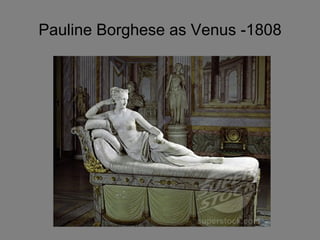
Pauline Borghese as Venus -1808
Colonial America  Neoclassicism Inspired by the unearthing of the ruins at Pompeii 18 th  century – Industrial Revolution  Enlightment brings on rejection of royal & aristocratic authority- stressing independent thought Classical Training at academies around Europe and the US
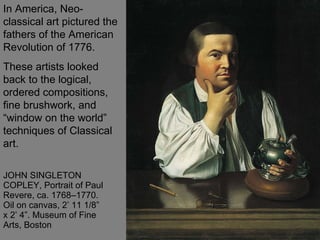
JOHN SINGLETON COPLEY, Portrait of Paul Revere, ca. 1768–1770. Oil on canvas, 2’ 11 1/8” x 2’ 4”. Museum of Fine Arts, Boston  In America, Neo-classical art pictured the fathers of the American Revolution of 1776.  These artists looked back to the logical, ordered compositions, fine brushwork, and “window on the world” techniques of Classical art.
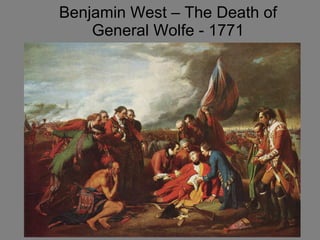
Benjamin West – The Death of General Wolfe - 1771


Week9 17thand18th C

  • 1.
  • 2.
    Emphasized by Lutherin the 95 Theses: The Pope is a false authority. The bible was the one true authority. All people with faith in Christ were equal. People did not need priest and bishops to interpret the bible for them. They could read it themselves and make up their own minds. People could only win salvation by faith in God's forgiveness. The Church taught that faith, along with good works was needed for salvation.
  • 3.
    ICONOCLASM opposition tothe religious use of images
  • 4.
    17 th Century
  • 5.
    Baroque Art: energy, theatrical emotion, rich primary colors, dynamic composition and the strong presence of light The Baroque Period lasted from about 1600 to 1750- the period of the Counter Reformation in the Catholic countries of Europe. It is also called the “Age of Colonization,” or “Age of Kings,” Rococo: pastel colors, lighthearted, secular subjects, art for the aristocracy Neoclassical: Italian Renaissance, classical compositions and motifs Chapter Seventeen The 17th and 18th Centuries
  • 6.
    Renaissance vs. BaroqueClassical simplicity Reason Order Difficult iconography Sfumato softness of light Organization around central axis Restraint Emotion, Drama, Movement Passionate theatricality Ornamentation Direct iconography High contrast – theatrical lighting Balance Painterly
  • 7.
    Baroque Insistent/forceful movementand transformation – curvy, swirling, diagonally based compositions Secularization of subjects Art techniques taught formally Rise of Opera Theatricality of Art
  • 8.
    Restored view (a),plan (b), and section (c) of Old Saint Peter’s, Rome, Italy, begun ca. 320. (The restoration of the forecourt is conjectural.) They added a transept , an elongated rectangle, to the apse as a focal point. This constructed the cross plan
  • 9.
    CARLO MADERNO, planof Saint Peter’s, Vatican City, Rome, Italy, with adjoining piazza designed by GIANLORENZO BERNINI.
  • 10.
  • 11.
    CARLO MADERNO, facadeof Saint Peter’s, Vatican City, Rome, Italy, 1606–1612.
  • 12.
  • 13.
    Aerial view ofSaint Peter’s, Vatican City, Rome, Italy
  • 14.
    St. Peter’s BasilicaHow is this different than Old St. Peter’s? For work on St Peter's, Pope Nicholas V bought 2,522 cartloads of stone from the badly damaged Roman Colosseum. Quarrying of stone for the Colosseum had, in turn, been paid for with treasure looted at the Fall of Jerusalem and destruction of the temple by the emperor Vespasian's general (and the future emperor) Titus in 70 AD.
  • 15.
  • 16.
  • 17.
    GIANLORENZO BERNINI, baldacchino,Saint Peter’s, Vatican City, Rome, Italy, 1624–1633. Gilded bronze, approx. 100’ high. 100 feet high bronze altar piece Symbols of the patrons (sun and bees) Bronze taken from Roman Pantheon – pagan works transformed into Christian works
  • 18.
  • 19.
    GIANLORENZO BERNINI, ScalaRegia, Vatican City, Rome, Italy, 1663–1666.
  • 20.
    GIANLORENZO BERNINI, David,1623. Marble, approx. 5’ 7” high. Galleria Borghese, Rome. Action and energy – much different than the potential action of Michelangelo’s David
  • 21.
  • 22.
  • 23.
  • 24.
  • 25.
  • 26.
  • 27.
  • 28.
  • 29.
  • 30.
    GIANLORENZO BERNINI, Ecstasyof Saint Teresa, Cornaro Chapel, Santa Maria della Vittoria, Rome, Italy, 1645–1652. Marble, height of group 11’ 6”. Theatrical Naturally lit from hidden window above Sculpture, painting and architecture united
  • 31.
  • 32.
  • 33.
  • 34.
    Bernini, Apolloand Daphne
  • 35.
    Baroque Architecture long,narrow naves are replaced by broader, occasionally circular forms dramatic use of light, either strong light-and-shade contrasts, chiaroscuro effects opulent use of ornaments large-scale ceiling frescoes Frequently used flying figures Highly skilled perspective and foreshortening the interior is often no more than a shell for the blending and unification of architecture, sculpture, and painting
  • 36.
    FRANCESCO BORROMINI, facadeof San Carlo alle Quattro Fontane, Rome, Italy, 1665–1676.
  • 37.
    FRANCESCO BORROMINI, planof San Carlo alle Quattro Fontane, Rome, Italy, 1638–1641.
  • 38.
    PIETRO DA CORTONA,Triumph of the Barberini, ceiling fresco in the Gran Salone, Palazzo Barberini, Rome, Italy, 1633–1639.
  • 39.
    GIOVANNI BATTISTA GAULLI,Triumph of the Name of Jesus, ceiling fresco with stucco figures in the vault of the Church of Il Gesù, Rome, Italy, 1676–1679.
  • 40.
  • 41.
  • 42.
    FRA ANDREA POZZO,Glorification of Saint Ignatius, ceiling fresco in the nave of Sant’Ignazio, Rome, Italy, 1691–1694.
  • 43.
    Caravaggio Recast biblicalscenes or themes in new light Used naturalism but instead did not idealize the narratives Uses lower classes/common people for models Life-based rather than based on classical sculptures Strong use of light as if a spotlight were placed on the figures - tenebrism
  • 44.
    Police Dossier -Caravaggio 19 November 1600: Sued for beating a man with a stick and tearing his cape with a sword at 3am on Via della Scrofa 2 October 1601: A man accuses Caravaggio and friends of insulting him and attacking him with a sword near the Piazza Campo Marzio 24 April 1604: Waiter complains of assault after serving artichokes at an inn on the Via Maddalena 19 October 1604: Arrested for throwing stones at policemen near Via dei Greci and Via del Babuino 28 May 1605: Arrested for carrying a sword and dagger without a permit on Via del Corso 29 July 1605: Vatican notary accuses Caravaggio of striking him from behind with a weapon 28 May 1606: Caravaggio kills a man during a battle in the Campo Marzio area
  • 45.
    Differentiate between chiaroscuroand tenebrism. Chiaroscuro: light and shadow used to show modeling Tenebrism: violent contrasts of light used to heighten drama and emotion and add to theatrical effects.
  • 46.
  • 47.
    CARAVAGGIO, Conversionof Saint Paul , ca. 1601. Oil on canvas, 7’ 6” x 5’ 9”. Cerasi Chapel, Santa Maria del Popolo, Rome.
  • 48.
    CARAVAGGIO, Entombment, fromthe chapel of Pietro Vittrice, Santa Maria in Vallicella, Rome, Italy, ca. 1603. Oil on canvas, 9’ 10 1/8” x 6’ 7 15/16”. Musei Vaticani, Pinacoteca, Rome. His figures are usually few in number, very close to the picture plane, on a stage setting like a theatre, and often illuminated by a single light source. Invites the viewer into the experience
  • 49.
  • 50.
  • 51.
    CARAVAGGIO, Calling ofSaint Matthew, Contarelli Chapel, San Luigi dei Francesi, Rome, Italy, ca. 1597–1601. Oil on canvas, 11’ 1” x 11’ 5”. Influence of Michelangelo
  • 52.
    ARTEMISIA GENTILESCHI, Self-Portrait as the Allegory of Painting , ca. 1638–1639. Oil on canvas, 3’ 2 7/8” X 2’ 5 5/8”. Royal Collection, Kensington Palace, London.
  • 53.
  • 54.
    ARTEMISIA GENTILESCHI, JudithSlaying Holofernes, ca. 1614–1620. Oil on canvas, 6’ 6 1/3” x 5’ 4”. Galleria degli Uffizi, Florence.
  • 55.
  • 56.
    Trophime, Bigot (1579-1649)S. Sebastiano curato da Irene
  • 57.
  • 58.
  • 59.
    Scene from Lordof the Flies - 1963
  • 60.
    David Lynch –“Mulholland Drive”
  • 61.
    PETER PAUL RUBENS,Elevation of the Cross, Antwerp Cathedral, Antwerp, Belgium, 1610. Oil on panel, 15’ 1 7/8” x 11’ 1 1/2” (center panel), 15' 1 7/8" x 4' 11" (each wing).
  • 62.
    PETER PAUL RUBENS,drawing of Laocoön, ca. 1600-1608. Black-and-white chalk drawing with bistre wash, approx. 1’ 7” x 1’ 7”. Ambrosiana, Milan.
  • 63.
    PETER PAUL RUBENS,Arrival of Marie de’ Medici at Marseilles, 1622–1625. Oil on canvas, approx. 5’ 1” x 3’ 9 1/2”. Louvre, Paris.
  • 64.
    PETER PAUL RUBENS, Consequences of War , 1638–1639. Oil on canvas, 6’ 9” x 11’ 3 7/8”. Palazzo Pitti, Florence..
  • 65.
    DIEGO VELÁZQUEZ, LasMeninas (The Maids of Honor), 1656. Oil on canvas, approx. 10’ 5” x 9’. Museo del Prado, Madrid. When asked to explain what he has contributed to Art, Salvador Dali says, “"To art, nothing, absolutely nothing. Because as I've always said I'm a very bad painter. Because I'm too intelligent to be a good painter. To be a good painter you've got to be a bit stupid. With the exception of Velazquez who is a genius..."
  • 66.
    Goya, Francisco, 1778“After Velazquez Las Meninas” Diego Velázquez “Las Meninas, or the Family of Philip IV”, 1656 oil on canvas
  • 67.
    PABLO PICASSO, “LasMeninas” (after Velazquez) Cannes, 17 August 1957 Oil on canvas 194 x 260 cm Diego Velázquez “Las Meninas, or the Family of Philip IV”, 1656 oil on canvas
  • 68.
    Diego Velazquez, TheTriumph of Baccus (The Drinkers), 1628
  • 69.
    Bacchus is associatedwith wine/drunkenness as well as artistic inspiration Two figures (left) involve the viewer in the scene Viewer is both involved and detached
  • 70.
    DIEGO VELÁZQUEZ, KingPhilip IV of Spain (Fraga Philip), 1644. Oil on canvas, 4’ 3 1/8” x 3’ 3 1/8”. The Frick Collection, New York. Court painter Secular subjects More everyday subjects
  • 71.
  • 72.
    The Golden Ageof Dutch Art The Dutch Republic was based on commerce and trade; merchant class held power, wealth Without a royal court or Catholic church commissions, artists turned to merchant class for work Portraiture rose in popularity as did works showing their possessions and land Still lifes, landscapes, genre scenes and portraits
  • 73.
    Art of theDutch Republic Merchant patrons Realism Genre Scenes, still life Little religious art Moralizing Landscapes that showed work ethic Bourgeoisie portraits showed status without being ostentatious Artists Frans Hals: Portraits 1581-1666 Rembrandt Van Rijin 1606-1669 Jan Vermeer: 1632-75 Interior genre scenes of the bourgeoisie
  • 74.
  • 75.
    JUDITH LEYSTER, Self-Portrait,ca. 1630. Oil on canvas, 2’ 5 3/8” x 2’ 1 5/8”. National Gallery of Art, Washington
  • 76.
    REMBRANDT VAN RIJN,Anatomy Lesson of Dr. Tulp, 1632. Oil on canvas, 5’ 3 3/4” x 7’ 1 1/4”. Mauritshuis, The Hague.
  • 77.
    REMBRANDT VAN RIJN,The Company of Captain Frans Banning Cocq (Night Watch), 1642. Oil on canvas (cropped from original size), 11’ 11” x 14’ 4”. Rijksmuseum, Amsterdam.
  • 78.
    REMBRANDT VAN RIJN,Return of the Prodigal Son, ca. 1665. Oil on canvas, approx. 8’ 8” x 6’ 9”. Hermitage Museum, Saint Petersburg.
  • 79.
    The number isstill a matter of contention, but it seems he depicted himself in approximately forty to fifty paintings, about thirty-two etchings, and seven drawings. It is an output unique in history.
  • 80.
  • 81.
  • 82.
  • 83.
  • 84.
    Rembrandt Harmensz vanRijn, 'Rembrandt Laughing,' 1627-28
  • 85.
  • 86.
  • 87.
  • 88.
  • 89.
    REMBRANDT VAN RIJN,Self-Portrait, ca. 1659–1660. Oil on canvas, approx. 3’ 8 3/4” x 3’ 1”. The Iveagh Bequest, Kenwood House, London.
  • 90.
    Vermeer, WomanHolding a Balance
  • 91.
    JAN VERMEER, Allegory of the Art of Painting , 1670–1675. Oil on canvas, 4’ 4” x 3’ 8”. Kunsthistorisches Museum, Vienna.
  • 92.
  • 93.
  • 94.
  • 95.
    Vermeer, A WomanAsleep at a Table c. 1657; Oil on canvas, 87.6 x 76.5 cm; Metropolitan Museum of Art, New York
  • 96.
    JACOB VAN RUISDAEL,View of Haarlem from the Dunes at Overveen, ca. 1670. Oil on canvas, approx. 1’ 10” x 2’ 1”.
  • 97.
    RACHEL RUYSCH, Flower Still Life , after 1700. Oil on canvas, 2’ 5 3/4” x 1’ 11 7/8”. The Toledo Museum of Art, Toledo
  • 98.
  • 99.
    Eric Yahnker -BummedBouquet, 2009, graphite on paper, 52.5 x 65 in.
  • 100.
    NICOLAS POUSSIN, Burialof Phocion, 1648. Oil on canvas, approx. 3’ 11” x 5’ 10”. Louvre, Paris. French Baroque classicism Harmonious/balanced Restrained classical feel Baroque lighting No motion or emotive gesture Simplified body volumes Organized picture plane Grand Theme-no genre scenes
  • 101.
    NICOLAS POUSSIN, Etin Arcadia Ego, ca. 1655. Oil on canvas, approx. 2’ 10” x 4’. Louvre, Paris.
  • 102.
    LOUIS LE NAIN, Family of Country People , ca. 1640. Oil on canvas, 3’ 8” x 5’ 2”. Louvre, Paris.
  • 103.
    18 th Century Rococo and Neo-Classical
  • 104.
    Rococo Dominant inFrance during the reign of Louis XV (1715-74) Beautiful, elegant, sensuous and skillfully produced. Instead of the dark, rich colors of Baroque art - Rococo favors a pastel palette as well as airier and more graceful subject matter Extravagant, indulgent, playful, ornate, sophisticated, intricate Abandoned high seriousness in favor of eroticism, decoration and pleasure
  • 105.
    HYACINTHE RIGAUD, LouisXIV, 1701. Oil on canvas, approx. 9’ 2” x 6’ 3”. Louvre, Paris.
  • 106.
    Antoine Watteau (1648-1721),A Pilgrimage to Cythera, 1717.
  • 107.
    JEAN-HONORÉ FRAGONARD, TheSwing, 1766. Oil on canvas, approx. 2’ 11” x 2’ 8”. The Wallace Collection, London. Bishop swings a woman whose lover hides below She kicks her shoe at the little statue of Discretion and toward the lover Exaggeratedly delicate femininity – tiny hands and feet and layers of petticoats
  • 108.
  • 109.
    GERMAIN BOFFRAND, Salonde la Princesse, with painting by CHARLES-JOSEPH NATOIRE and sculpture by J. B. LEMOINE, Hôtel de Soubise, Paris, France, 1737–1740.
  • 110.
    FRANÇOIS DE CUVILLIÉS,Hall of Mirrors, the Amalienburg, Nymphenburg Palace park, Munich, Germany, early 18th century.
  • 111.
    Egid Quirin Asam, Assumption of the Virgin , 1717-25
  • 112.
    Aerial view ofpalace at Versailles, France, begun 1669
  • 113.
  • 114.
    JULES HARDOUIN-MANSART andCHARLES LE BRUN, Galerie des Glaces (Hall of Mirrors), palace of Versailles, Versailles, France, ca. 1680. Versailles is a combination of Italian Renaissance design and Baroque decoration.
  • 115.
  • 116.
  • 117.
  • 118.
    French Revolution Monarchyis gone Feudal customs are gone Slavery is abolished France becomes democratic country Napoleon Miliatary rule/dictatorship for next 15 years
  • 119.
    JACQUES-LOUIS DAVID, TheCoronation of Napoleon, 1805–1808. Oil on canvas, 20’ 4 1/2” x 32’ 1 3/4”. Louvre, Paris.
  • 120.
  • 121.
    Characteristics Neo-Classical StyleNeo-classical art rebelled against the extravagancies and decadence of the Rococo period. Reason above Passion Looked for universal rules, standards and goals in relation to which values and social practices ought to be judged Sought to shape morals/behaviors
  • 122.
    Neo-Classical The styleis often reasoned, serious, tight and inspired by Antiquity. Re-introduction of classical forms of art/aesthetics In France it represented and helped foster the French Revolution of 1789 Strong horizontal and vertical structure to compositions
  • 123.
    JACQUES-LOUIS DAVID, Oathof the Horatii, 1784. Oil on canvas, approx. 11’ x 14’. Louvre, Paris. An episode of Roman history - three Horatii brothers swear a solemn oath to conquer the enemy or die Arches in the background indicate three stages of story: oath; battle; grief
  • 124.
     David, Death ofSocrates, 1787.
  • 125.
    Jacques Louis DavidLeads Neoclassical movement as a reaction to the frivolous style of Rococo Represented the ideals of the French Revolution Sought an art form that was dignified and reflected their concerns/ideals Virtues such as bravery, honor, and loyalty
  • 126.
    JACQUES-LOUIS DAVID, TheDeath of Marat, 1793. Oil on canvas, approx. 5’ 3” x 4’ 1”. Musées Royaux des Beaux-Arts de Belgique, Brussels. Marat was a revolutionary stabbed to death in his bathtub. Also a personal friend of David. Pain and outrage of image apparent. Directness with detail. The knife and wound, holding the letter that gave entrance to the woman who killed him.
  • 127.
    The Laundry Room(Death of Marat)«, 2009 by Richard Jackson.
  • 128.
  • 129.
    Colonial America Neoclassicism Inspired by the unearthing of the ruins at Pompeii 18 th century – Industrial Revolution Enlightment brings on rejection of royal & aristocratic authority- stressing independent thought Classical Training at academies around Europe and the US
  • 130.
    JOHN SINGLETON COPLEY,Portrait of Paul Revere, ca. 1768–1770. Oil on canvas, 2’ 11 1/8” x 2’ 4”. Museum of Fine Arts, Boston In America, Neo-classical art pictured the fathers of the American Revolution of 1776. These artists looked back to the logical, ordered compositions, fine brushwork, and “window on the world” techniques of Classical art.
  • 131.
    Benjamin West –The Death of General Wolfe - 1771
  • 132.
  • 133.

Editor's Notes

  • #3 The Baroque Period lasted from about 1600 to 1750, the period of the Counter Reformation in the Catholic countries of Europe. It is nicknamed the “Age of Colonization,” or “Age of Kings,” as our text refers to it. The Baroque Period goes beyond the Renaissance philosophy of attempting to recreate the stoic, intellectual, classical art of Antiquity, by instilling their art with emotion, dynamic composition, energy, richness and sensual color. The patrons of the arts in the Catholic countries of Europe, i.e. Italy, Spain, Flanders, and France, were primarily the Church and the aristocracy. It is important to make a distinction between Baroque art in the Catholic countries of Europe and the art produced in Holland, a Protestant country. Since the Church and the aristocracy were in complete charge of the social structure and operation of Catholic countries, in a way they worked in collusion to maintain a particular status quo. They determined the character of the art produced under their auspices. Holland, to the contrary, was not beholden to the Pope, the Catholic Church or an aristocratic segment of society, and was mostly middle-class in nature. Finnish artists only had to answer to their personal taste and their pocket books. In Holland, a Protestant country, religious subject matter was not nearly as common as themes taken from everyday life such as landscapes, still-lifes, genre scenes and portraits.