ILL-SUSTAINED
ACCOMMODATION
Noor Munirah binti Awang Abu Bakar
Optometrist
Outlines
 Description
 Characteristics (Signs & Symptoms)
 Etiology
 Management & Care Process
 Case study
 Conclusion
Description
 WHAT?:
 A condition in which the AA is normal under
typical test conditions, but deteriorates over time
with repeated accommodative stimulation.
 If ill-sustained acc. is suspected, important to
repeat AA test several times.
 AKA accommodative fatigue.
 Sub-classification of accommodative
insufficiency.
 An early stage of accommodative insufficiency
(Duane and Duke-Elder & Abrams).
Characteristics-Symptoms
 Symptoms (~ Accommodative Insufficiency)
 Blurred at near vision after prolong work
 Discomfort and eyestrain associated with near
task
 Fatigue & sleepiness associated with near point
tasks
 Difficulty with attention and concentration when
reading
 WHY?:
 The accommodative system fails to sustain long-
term accommodative effort
Characteristics
 Signs (Hard on clinical tests that require stimulation of accommodation):
 AA:
 Decreased if repeated 5-10 times;
 Normal if administered once only.
 PRA: Low /reduced
 Acc. Facility test:
 Fail –ve lens (monocularly or binocularly)
 Performance decreases over time
 Esophoria at near
 MEM: High (>+0.75DS)
 Fused cross cylinder: High
Distance
Near
•Ill-sustained accommodation is similar to accommodative
insufficiency except print may initially appear clear and easy to read
without effort. 
• With time, the task at near begins to require more effort to focus. 
•Blurred vision, eyestrain and headaches can occur with sustained
effort. 
Etiology
1. Stage of convalescence from
debilitating(weakening) illness
2. Stage of generalized tiredness general
muscle fatigue
3. Uncorrected refractive error especially
hyperopia or astigmatism
4. Small difference of anisometropia between 2
eyes
Management & Care Process
 3 options for management:
1. Correction of ametropia
 Uncorrected rx can cause acc. Fatigue.
 Small degrees of ametropia may significant to prescribe.
 Can be first management for acc. fatigue.
1. Added lenses
 Ill-sustained accommodation respond best to added plus
lenses
 Suitable for pt with hard to stimulate accommodation.
1. Vision therapy (VT)
 To restore normal accommodative function.
Management & Care Process
 Plus lenses and vision therapy are effective in
treating ill-sustained accommodation. Vision
therapy is used to improve the speed of the
accommodative response, and it is generally
the treatment of choice. (AOA, 2011)
Management & Care Process
 Vision therapy (VT)
 3 phases
 Table 1 : Objectives
 Table 2 : Samples of VT program
Vision Therapy: Phase 1 (Table 1)
Vision Therapy: Phase 1 (Table 2)
Vision Therapy: Phase 2 (Table 1)
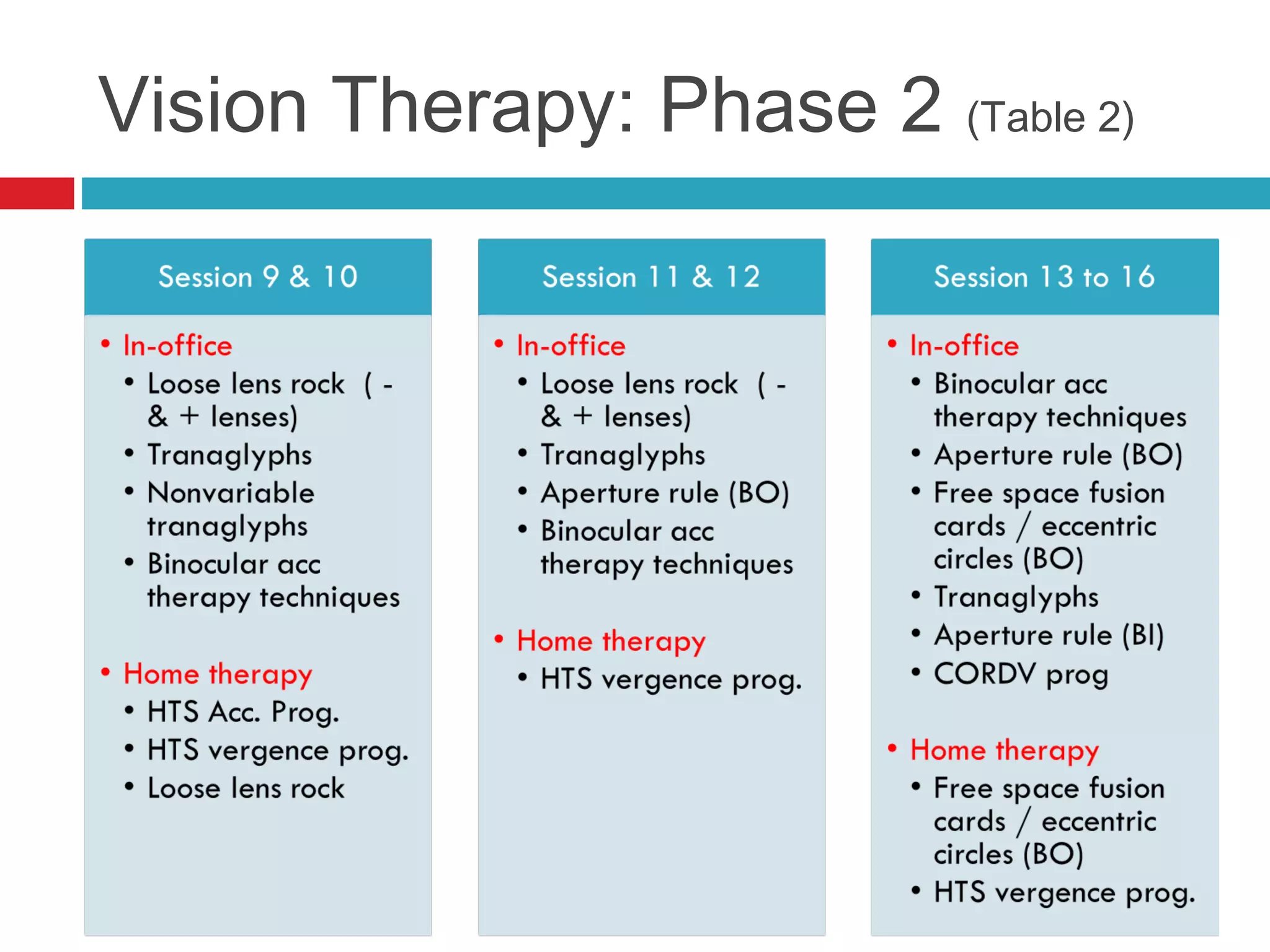
Vision Therapy: Phase 2 (Table 2)
Vision Therapy: Phase 3 (Table 1)
Vision Therapy: Phase 3 (Table 2)
Vision therapy
Brock string
Lens
sorting
Vision therapy
Variable tranaglyphs
Vision therapy
Hart Chart rock
Vision therapy
 Re-evaluate about 3 to 4 weeks
 If no improvement, there may be an underlying
organic basis to low AA.
 Terminate VT, start with added plus lenses
 If got improvement, re-evaluate till the end of
therapy.
 Once VT completed, recommend home VT
maintenance programme.
Management & Care Process
 Patient education
 Accommodative anomalies are neuromuscular
problems and not refractive problems.
 The effective treatment not only spectacles, but
active vision therapy to eliminate neuromuscular
dysfunction.
 Prognosis & Follow up
 Cooperation from patient for excellent prognosis
 Follow-up: for this case, requires 12-24 in-office
visits
Case study: 13/C/M
 Chief complaint:
 Discomfort, blurred vision & tearing after 30-40 minutes
of reading.
 Began about 6-9 months ago.
 Had already been to see 2 doctors, but no eye problem
detected.
 Ocularhistory:
 Never had ocular problems & did not wear glass before
 Health Condition:
 Healthy and not taking any medication
 Family History:
 Unremarkable
Case study: 13/C/M (cont.)
 Examination results:
 Pupils were normal, colour vision normal, comitant deviation, all
external & internal health tests were negative
Test RE LE
VA (D/N) D: 6/6 ; N:6/6 D: 6/6 ; N:6/6
NPC 5cm
Covertest -D Orthophoria
-N
4 Exophoria
Subj RX Plano Plano
Case study: 13/C/M (cont.)
 Vergence assessment
Test
Phoria -D Orthophoria
Vergence -D BI: X/6/4 BO: X/16/9
Phoria -N 4 exophoria
Vergence -N BI: 9/15/10 BO: 10/17/10
-1.00 gradiet Ortho
Gradient AC/A 4:1
Vergence facility 16cpm
Case study: 13/C/M (cont.)
 Accommodative assessment
Test RE LE
AA (Exp= 14D) 10D 10D
Repeated AA 8D 8D
MAF 5cpm (hard on minus &
performance deteriorates
after 30 secs)
5cpm (hard on minus &
performance deteriorates
after 30 secs)
BAF 3cpm (hard on minus & performance deteriorates
after 30 secs)
PRA -2.00D
NRA +2.50D
MEM +0.75D +0.75D
Case study: 13/C/M (cont.)
 Diagnosis: Ill-sustained accommodation
 Management :
(Patie nt & pare nts pre fe rre d the tre atm e nt witho ut the ne e d o f g lasse s)
 Remember 3 options: Correction, added plus & vision
therapy.
 Vision therapy was given as in Table 1 & Table 2.
 18 visits of therapy done.
 End of treatment results as following:
 AA : 14D RE & LE
 MAF : 18cpm RE & LE
 BAF : 15cpm
 MEM : +0.50D RE & LE
 Patient now comfortable when reading , no discomfort.
 Thus, dismiss from active VT, start maintenance
program
Case analysis
 Distance & near phoria are both normal
 Thus, the best initial approach to analyze
accommodative data:
 Difficulty with MAF & BAF test:
 Hard on minus lens
 Overal cpm are borderline
 Gradual deterioration with minus lens after 30secs
 Amplitude of Accommodation (AA)
 AA was repeated 10 times: Gradually decreased over time: Final
AA: 8D
 Other findings within normal range
 PRA: slightly reduced
 MEM: high side of normal
Case analysis
 This case is characteristic of Ill-sustained
accommodation.
 Match the symptoms and complete
measurement of accommodative component
findings would help to elicit the diagnosis:
 Accommodative facility test, repeated AA
measurement, MEM & PRA
 One time measurement wont be able to elicit the
meaningful results.
Conclusion
 Ill-sustained accommodation is a condition in
which the AA is normal, but fatigue occurs with
repeated accommodative stimulation.
 It is medically necessary for the optometrist
 to evaluate all accommodative components,
repeated measurement.
 to diagnose the condition accurately
 to discuss the diagnosis, risks & potential
treatment
References
1. Scheiman, M. & Wick, B., 2014. Clinical Management
of Binocular Vision: Heterophoric, Accommodative,
and Eye Movement Disorders (4th
ed.). Lippincott
Williams & Wilkins.
2. Cooper, J.S., Burns C.R., Cotter, S.A., Daum, K.M.,
Griffin, J.R., & Scheiman, M.M., 2011. Care of the
patient with Accommodative and Vergence
dysfunction. American Optometric Association.

Ill-sustained accommodation

  • 1.
  • 2.
    Outlines  Description  Characteristics(Signs & Symptoms)  Etiology  Management & Care Process  Case study  Conclusion
  • 3.
    Description  WHAT?:  Acondition in which the AA is normal under typical test conditions, but deteriorates over time with repeated accommodative stimulation.  If ill-sustained acc. is suspected, important to repeat AA test several times.  AKA accommodative fatigue.  Sub-classification of accommodative insufficiency.  An early stage of accommodative insufficiency (Duane and Duke-Elder & Abrams).
  • 4.
    Characteristics-Symptoms  Symptoms (~Accommodative Insufficiency)  Blurred at near vision after prolong work  Discomfort and eyestrain associated with near task  Fatigue & sleepiness associated with near point tasks  Difficulty with attention and concentration when reading  WHY?:  The accommodative system fails to sustain long- term accommodative effort
  • 5.
    Characteristics  Signs (Hardon clinical tests that require stimulation of accommodation):  AA:  Decreased if repeated 5-10 times;  Normal if administered once only.  PRA: Low /reduced  Acc. Facility test:  Fail –ve lens (monocularly or binocularly)  Performance decreases over time  Esophoria at near  MEM: High (>+0.75DS)  Fused cross cylinder: High
  • 6.
    Distance Near •Ill-sustained accommodation issimilar to accommodative insufficiency except print may initially appear clear and easy to read without effort.  • With time, the task at near begins to require more effort to focus.  •Blurred vision, eyestrain and headaches can occur with sustained effort. 
  • 7.
    Etiology 1. Stage ofconvalescence from debilitating(weakening) illness 2. Stage of generalized tiredness general muscle fatigue 3. Uncorrected refractive error especially hyperopia or astigmatism 4. Small difference of anisometropia between 2 eyes
  • 8.
    Management & CareProcess  3 options for management: 1. Correction of ametropia  Uncorrected rx can cause acc. Fatigue.  Small degrees of ametropia may significant to prescribe.  Can be first management for acc. fatigue. 1. Added lenses  Ill-sustained accommodation respond best to added plus lenses  Suitable for pt with hard to stimulate accommodation. 1. Vision therapy (VT)  To restore normal accommodative function.
  • 9.
    Management & CareProcess  Plus lenses and vision therapy are effective in treating ill-sustained accommodation. Vision therapy is used to improve the speed of the accommodative response, and it is generally the treatment of choice. (AOA, 2011)
  • 10.
    Management & CareProcess  Vision therapy (VT)  3 phases  Table 1 : Objectives  Table 2 : Samples of VT program
  • 11.
  • 12.
  • 13.
  • 14.
  • 15.
  • 16.
  • 17.
  • 18.
  • 19.
  • 20.
    Vision therapy  Re-evaluateabout 3 to 4 weeks  If no improvement, there may be an underlying organic basis to low AA.  Terminate VT, start with added plus lenses  If got improvement, re-evaluate till the end of therapy.  Once VT completed, recommend home VT maintenance programme.
  • 21.
    Management & CareProcess  Patient education  Accommodative anomalies are neuromuscular problems and not refractive problems.  The effective treatment not only spectacles, but active vision therapy to eliminate neuromuscular dysfunction.  Prognosis & Follow up  Cooperation from patient for excellent prognosis  Follow-up: for this case, requires 12-24 in-office visits
  • 22.
    Case study: 13/C/M Chief complaint:  Discomfort, blurred vision & tearing after 30-40 minutes of reading.  Began about 6-9 months ago.  Had already been to see 2 doctors, but no eye problem detected.  Ocularhistory:  Never had ocular problems & did not wear glass before  Health Condition:  Healthy and not taking any medication  Family History:  Unremarkable
  • 23.
    Case study: 13/C/M(cont.)  Examination results:  Pupils were normal, colour vision normal, comitant deviation, all external & internal health tests were negative Test RE LE VA (D/N) D: 6/6 ; N:6/6 D: 6/6 ; N:6/6 NPC 5cm Covertest -D Orthophoria -N 4 Exophoria Subj RX Plano Plano
  • 24.
    Case study: 13/C/M(cont.)  Vergence assessment Test Phoria -D Orthophoria Vergence -D BI: X/6/4 BO: X/16/9 Phoria -N 4 exophoria Vergence -N BI: 9/15/10 BO: 10/17/10 -1.00 gradiet Ortho Gradient AC/A 4:1 Vergence facility 16cpm
  • 25.
    Case study: 13/C/M(cont.)  Accommodative assessment Test RE LE AA (Exp= 14D) 10D 10D Repeated AA 8D 8D MAF 5cpm (hard on minus & performance deteriorates after 30 secs) 5cpm (hard on minus & performance deteriorates after 30 secs) BAF 3cpm (hard on minus & performance deteriorates after 30 secs) PRA -2.00D NRA +2.50D MEM +0.75D +0.75D
  • 26.
    Case study: 13/C/M(cont.)  Diagnosis: Ill-sustained accommodation  Management : (Patie nt & pare nts pre fe rre d the tre atm e nt witho ut the ne e d o f g lasse s)  Remember 3 options: Correction, added plus & vision therapy.  Vision therapy was given as in Table 1 & Table 2.  18 visits of therapy done.  End of treatment results as following:  AA : 14D RE & LE  MAF : 18cpm RE & LE  BAF : 15cpm  MEM : +0.50D RE & LE  Patient now comfortable when reading , no discomfort.  Thus, dismiss from active VT, start maintenance program
  • 27.
    Case analysis  Distance& near phoria are both normal  Thus, the best initial approach to analyze accommodative data:  Difficulty with MAF & BAF test:  Hard on minus lens  Overal cpm are borderline  Gradual deterioration with minus lens after 30secs  Amplitude of Accommodation (AA)  AA was repeated 10 times: Gradually decreased over time: Final AA: 8D  Other findings within normal range  PRA: slightly reduced  MEM: high side of normal
  • 28.
    Case analysis  Thiscase is characteristic of Ill-sustained accommodation.  Match the symptoms and complete measurement of accommodative component findings would help to elicit the diagnosis:  Accommodative facility test, repeated AA measurement, MEM & PRA  One time measurement wont be able to elicit the meaningful results.
  • 29.
    Conclusion  Ill-sustained accommodationis a condition in which the AA is normal, but fatigue occurs with repeated accommodative stimulation.  It is medically necessary for the optometrist  to evaluate all accommodative components, repeated measurement.  to diagnose the condition accurately  to discuss the diagnosis, risks & potential treatment
  • 30.
    References 1. Scheiman, M.& Wick, B., 2014. Clinical Management of Binocular Vision: Heterophoric, Accommodative, and Eye Movement Disorders (4th ed.). Lippincott Williams & Wilkins. 2. Cooper, J.S., Burns C.R., Cotter, S.A., Daum, K.M., Griffin, J.R., & Scheiman, M.M., 2011. Care of the patient with Accommodative and Vergence dysfunction. American Optometric Association.