Hepatitis B, C & D Viruses
Dr. Masood Ahmad
Viral hepatitis B
Etiology


Hepatitis B virus (HBV)



HBV is a kind of hepadnavirus
Three particles in serum:



spherical particles and tubular particles with a
diameter of 20 nm, composed of HBsAg
large particles with a diameter of 42 nm, named Dane
particle. It consists of an outer protein shell (envelope,
contain HBsAg) and an inner body ( core, contain
HBcAg, HBeAg, HBV-DNA and DNAP )
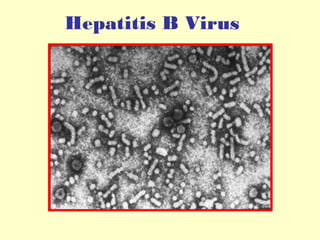
Hepatitis B Virus
pathology











Three antigen-antibody system
HBsAg-- anti-HBs system:
HBsAg appears 1-2 weeks (late up to 11-12 weeks)
after exposure, persists for 1-6 weeks( even 5 months)
in acute hepatitis B.
In chronic patients or carrier, HBsAg persist many
years
HBsAg is the marker of infectivity
HBsAg can be found in blood and secretions: saliva,
urine, semen, tears, sweat and breast milk
Anti-HBs appear after HBsAg disappear several weeks
(or months) anti-HBs is protective antibody, can persist
for many years
pathology
HBcAg—anti-HBc system
 HBcAg can be found in the nuclei of liver cells, no free
HBcAg in serum
 HBcAg is the marker of replication of HBV
 The stage called window phase
 Anti-HBc IgM is a marker of acute infection and acute
attack of chronic infection of HBV. Anti-HBc IgG is the
marker of past infection, high titer means low level
replication of HBV
pathology
HBeAg—anti-HBe system





HBeAg is a soluable antigen
HBeAg is a reliable indicator of active replication of
HBV
Anti-HBe is a marker of reduced infectivity. If exist
long may be a marker of integration of HBV into liver
cell
Pathogenesis


Hepatitis B:




HBV invades into the human body by skin and
mucosa, Via blood flow enters the liver and other
organs such as pancreas, bile ducts, vessels, WBC,
bone marrow, glomerular basement membrane
HBcAg,HBsAg,HBeAg and HLA-Ⅰ appear on the
liver cells infected with are recognized by CTL
simultaneously and lead to the cytolysis of liver cells
Pathogenesis


Helper T cell are activated by the receptor of HLAon its surface combing with HBsAg, HBcAg and
HLA- antigen on the B cells promote B cell to
release anti-HBs and clear HBV



The representation of HBcAg on the liver cells may
cause cytopathy
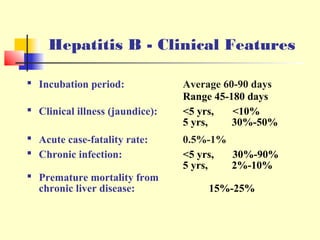
Hepatitis B - Clinical Features
 Incubation period:
 Clinical illness (jaundice):
 Acute case-fatality rate:
 Chronic infection:
 Premature mortality from
chronic liver disease:

Average 60-90 days
Range 45-180 days
<5 yrs,
<10%
5 yrs,
30%-50%
0.5%-1%
<5 yrs,
30%-90%
5 yrs,
2%-10%
15%-25%
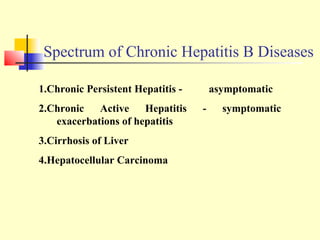
Spectrum of Chronic Hepatitis B Diseases
1.Chronic Persistent Hepatitis 2.Chronic
Active
Hepatitis
exacerbations of hepatitis
3.Cirrhosis of Liver
4.Hepatocellular Carcinoma

asymptomatic
-

symptomatic
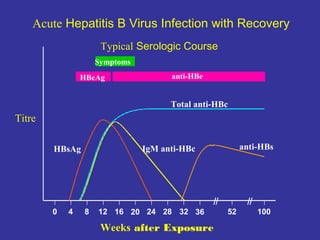
Acute Hepatitis B Virus Infection with Recovery
Typical Serologic Course
Symptoms
HBeAg

anti-HBe

Total anti-HBc

Titre

0

4

anti-HBs

IgM anti-HBc

HBsAg

8

12 16 20 24 28 32 36

Weeks after Exposure

52

100
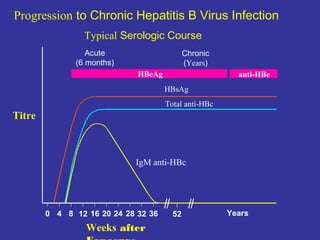
Progression to Chronic Hepatitis B Virus Infection
Typical Serologic Course
Acute
(6 months)

Chronic
(Years)
HBeAg

anti-HBe
HBsAg
Total anti-HBc

Titre

IgM anti-HBc

0 4 8 12 16 20 24 28 32 36

Weeks after

52

Years
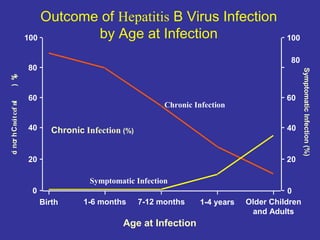
Outcome of Hepatitis B Virus Infection
by Age at Infection
100

100
80

) %
(
c no h C no t cef nI
i r
i

60

40

Chronic Infection

60

40

Chronic Infection (%)

20

20
Symptomatic Infection

0
Birth

1-6 months

7-12 months

Age at Infection

1-4 years

0
Older Children
and Adults

Symptomatic Infection (%)

80
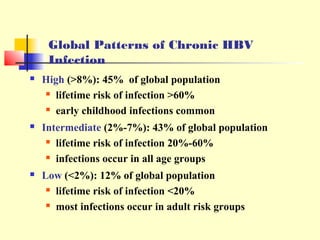
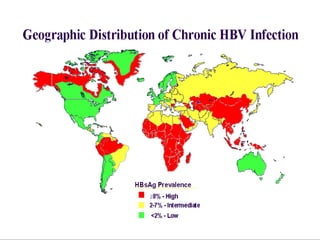
Global Patterns of Chronic HBV
Infection


High (>8%): 45% of global population
 lifetime risk of infection >60%
 early childhood infections common



Intermediate (2%-7%): 43% of global population
 lifetime risk of infection 20%-60%
 infections occur in all age groups



Low (<2%): 12% of global population
 lifetime risk of infection <20%
 most infections occur in adult risk groups
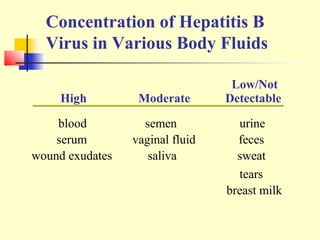
Concentration of Hepatitis B
Virus in Various Body Fluids
High

Moderate

blood
serum
wound exudates

semen
vaginal fluid
saliva

Low/Not
Detectable
urine
feces
sweat
tears
breast milk
Hepatitis B Virus
Modes of Transmission
 Sexual - sex workers and homosexuals are
particular at risk.
 Parenteral - IVDA, Health Workers are at
increased risk.
 Perinatal - Mothers who are HBeAg positive are
much more likely to transmit to their offspring
than those who are not. Perinatal transmission is
the main means of transmission in high
prevalence populations.
.











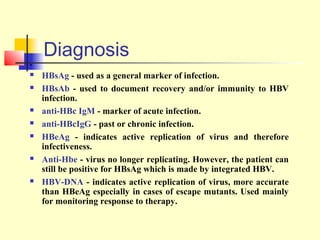
Diagnosis
HBsAg - used as a general marker of infection.
HBsAb - used to document recovery and/or immunity to HBV
infection.
anti-HBc IgM - marker of acute infection.
anti-HBcIgG - past or chronic infection.
HBeAg - indicates active replication of virus and therefore
infectiveness.
Anti-Hbe - virus no longer replicating. However, the patient can
still be positive for HBsAg which is made by integrated HBV.
HBV-DNA - indicates active replication of virus, more accurate
than HBeAg especially in cases of escape mutants. Used mainly
for monitoring response to therapy.
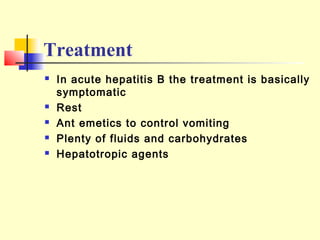
Treatment







In acute hepatitis B the treatment is basically
symptomatic
Rest
Ant emetics to control vomiting
Plenty of fluids and carbohydrates
Hepatotropic agents
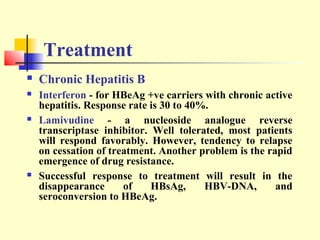
Treatment


Chronic Hepatitis B



Interferon - for HBeAg +ve carriers with chronic active
hepatitis. Response rate is 30 to 40%.
Lamivudine - a nucleoside analogue reverse
transcriptase inhibitor. Well tolerated, most patients
will respond favorably. However, tendency to relapse
on cessation of treatment. Another problem is the rapid
emergence of drug resistance.
Successful response to treatment will result in the
disappearance
of
HBsAg,
HBV-DNA,
and
seroconversion to HBeAg.




Prevention


Vaccination - highly effective recombinant vaccines are
now available. Vaccine can be given to those who are at
increased risk of HBV infection such as health care
workers. It is also given routinely to neonates as
universal vaccination in many countries.



Hepatitis B Immunoglobulin - HBIG may be used to
protect persons who are exposed to hepatitis B. It is
particular efficacious within 48 hours of the incident. It
may also be given to neonates who are at increased risk
of contracting hepatitis B i.e. whose mothers are
HBsAg and HBeAg positive.



Other measures - screening of blood donors, blood and
body fluid precautions.
Hepatitis C Virus












Hepatitis C virus (HCV)
HCV is a member of flavivirus family.
HCV genome is a single stranded positive-sense RNA
and contains 9.4kb
HCV genome may be divided into many types and
subtypes.
Resistance
Antigen-antibody system
The concentration of HCV in blood is low, HCV Ag has
not be detected, anti-HCV is the indicator of infection
and the marker of infectivity
HCV-RNA
HCV-RNA may be detected from blood or liver tissue,
it’s the direct evidence of infectivity
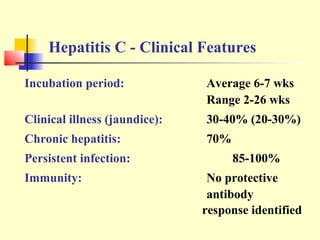
Hepatitis C - Clinical Features
Incubation period:

Average 6-7 wks
Range 2-26 wks

Clinical illness (jaundice):

30-40% (20-30%)

Chronic hepatitis:

70%

Persistent infection:
Immunity:

85-100%
No protective
antibody
response identified
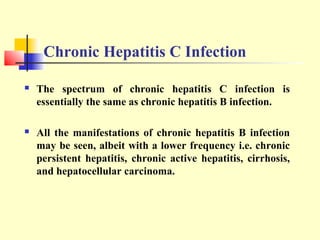
Chronic Hepatitis C Infection


The spectrum of chronic hepatitis C infection is
essentially the same as chronic hepatitis B infection.



All the manifestations of chronic hepatitis B infection
may be seen, albeit with a lower frequency i.e. chronic
persistent hepatitis, chronic active hepatitis, cirrhosis,
and hepatocellular carcinoma.
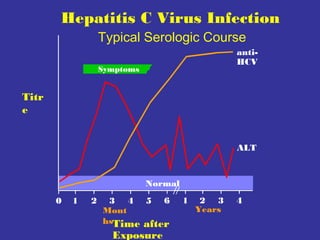
Hepatitis C Virus Infection
Typical Serologic Course
antiHCV

Symptoms

Titr
e
ALT

Normal
0

1

2

3 4 5 6
Mont
hsTime after

Exposure

1

2 3
Years

4
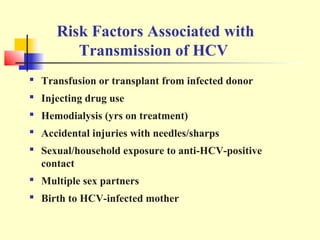
Risk Factors Associated with
Transmission of HCV
 Transfusion or transplant from infected donor
 Injecting drug use
 Hemodialysis (yrs on treatment)
 Accidental injuries with needles/sharps
 Sexual/household exposure to anti-HCV-positive
contact
 Multiple sex partners
 Birth to HCV-infected mother
Laboratory Diagnosis


HCV antibody - generally used to diagnose hepatitis C
infection. Not useful in the acute phase as it takes at
least 4 weeks after infection before antibody appears.



HCV-RNA - various techniques are available e.g. PCR
and branched DNA. May be used to diagnose HCV
infection in the acute phase. However, its main use is in
monitoring the response to antiviral therapy.
Treatment


Acute infection



Chronic infection



Interferon - may be considered for patients with
chronic active hepatitis. The response rate is around
50% but 50% of responders will relapse upon
withdrawal of treatment. However addition of



Ribavirin – Improves the response rate to almost 70%.
Treatment






Different genotypes of HCV have been identified and
have been named as genotype 1 to 8 and there are still
many which presently are untypeable.
Many different types of interferons are also available
including conventional, pegylated, and consensus
interferon.
Genotype 2 & 3(common subtypes in Pakistan) respond
well to conventional interferon
Prevention of Hepatitis C
 Screening of blood, organ, tissue donors
 High-risk behavior modification
 Blood and body fluid precautions


Hepatitis D (Delta) Virus












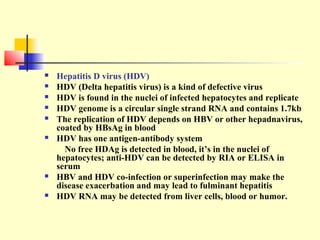
Hepatitis D virus (HDV)
HDV (Delta hepatitis virus) is a kind of defective virus
HDV is found in the nuclei of infected hepatocytes and replicate
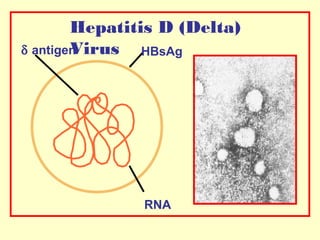
HDV genome is a circular single strand RNA and contains 1.7kb
The replication of HDV depends on HBV or other hepadnavirus,
coated by HBsAg in blood
HDV has one antigen-antibody system
No free HDAg is detected in blood, it’s in the nuclei of
hepatocytes; anti-HDV can be detected by RIA or ELISA in
serum
HBV and HDV co-infection or superinfection may make the
disease exacerbation and may lead to fulminant hepatitis
HDV RNA may be detected from liver cells, blood or humor.
Hepatitis D (Delta)
Virus HBsAg
δ antigen

RNA
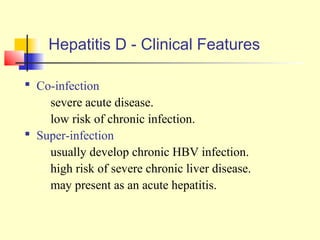
Hepatitis D - Clinical Features
 Co-infection
– severe acute disease.
– low risk of chronic infection.
 Super-infection
– usually develop chronic HBV infection.
– high risk of severe chronic liver disease.
– may present as an acute hepatitis.
Hepatitis D Virus Modes of
Transmission
 Percutaneous exposures
 injecting drug use
 Per mucosal exposures
 sex contact
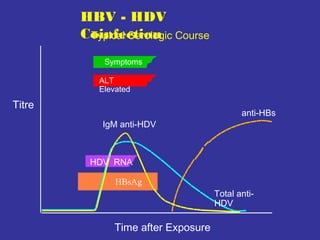
HBV - HDV
Coinfection Course
Typical Serologic
Symptoms
ALT
Elevated

Titre
IgM anti-HDV

anti-HBs

HDV RNA
HBsAg
Total antiHDV

Time after Exposure
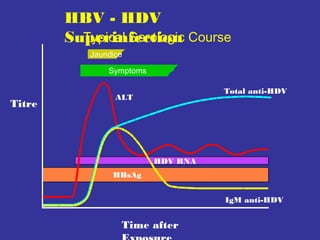
HBV - HDV
Typical Serologic
Superinfection Course
Jaundice
Symptoms

Titre

Total anti-HDV

ALT

HDV RNA
HBsAg
IgM anti-HDV

Time after
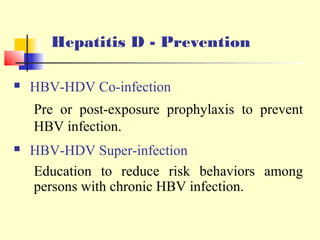
Hepatitis D - Prevention


HBV-HDV Co-infection
Pre or post-exposure prophylaxis to prevent
HBV infection.



HBV-HDV Super-infection
Education to reduce risk behaviors among
persons with chronic HBV infection.
Thanks

Hepatitis b,c, &d

  • 1.
    Hepatitis B, C& D Viruses Dr. Masood Ahmad
  • 2.
  • 3.
    Etiology  Hepatitis B virus(HBV)  HBV is a kind of hepadnavirus Three particles in serum:  spherical particles and tubular particles with a diameter of 20 nm, composed of HBsAg large particles with a diameter of 42 nm, named Dane particle. It consists of an outer protein shell (envelope, contain HBsAg) and an inner body ( core, contain HBcAg, HBeAg, HBV-DNA and DNAP )
  • 4.
  • 5.
    pathology       Three antigen-antibody system HBsAg--anti-HBs system: HBsAg appears 1-2 weeks (late up to 11-12 weeks) after exposure, persists for 1-6 weeks( even 5 months) in acute hepatitis B. In chronic patients or carrier, HBsAg persist many years HBsAg is the marker of infectivity HBsAg can be found in blood and secretions: saliva, urine, semen, tears, sweat and breast milk Anti-HBs appear after HBsAg disappear several weeks (or months) anti-HBs is protective antibody, can persist for many years
  • 6.
    pathology HBcAg—anti-HBc system  HBcAgcan be found in the nuclei of liver cells, no free HBcAg in serum  HBcAg is the marker of replication of HBV  The stage called window phase  Anti-HBc IgM is a marker of acute infection and acute attack of chronic infection of HBV. Anti-HBc IgG is the marker of past infection, high titer means low level replication of HBV
  • 7.
    pathology HBeAg—anti-HBe system    HBeAg isa soluable antigen HBeAg is a reliable indicator of active replication of HBV Anti-HBe is a marker of reduced infectivity. If exist long may be a marker of integration of HBV into liver cell
  • 8.
    Pathogenesis  Hepatitis B:   HBV invadesinto the human body by skin and mucosa, Via blood flow enters the liver and other organs such as pancreas, bile ducts, vessels, WBC, bone marrow, glomerular basement membrane HBcAg,HBsAg,HBeAg and HLA-Ⅰ appear on the liver cells infected with are recognized by CTL simultaneously and lead to the cytolysis of liver cells
  • 9.
    Pathogenesis  Helper T cellare activated by the receptor of HLAon its surface combing with HBsAg, HBcAg and HLA- antigen on the B cells promote B cell to release anti-HBs and clear HBV  The representation of HBcAg on the liver cells may cause cytopathy
  • 10.
    Hepatitis B -Clinical Features  Incubation period:  Clinical illness (jaundice):  Acute case-fatality rate:  Chronic infection:  Premature mortality from chronic liver disease: Average 60-90 days Range 45-180 days <5 yrs, <10% 5 yrs, 30%-50% 0.5%-1% <5 yrs, 30%-90% 5 yrs, 2%-10% 15%-25%
  • 11.
    Spectrum of ChronicHepatitis B Diseases 1.Chronic Persistent Hepatitis 2.Chronic Active Hepatitis exacerbations of hepatitis 3.Cirrhosis of Liver 4.Hepatocellular Carcinoma asymptomatic - symptomatic
  • 12.
    Acute Hepatitis BVirus Infection with Recovery Typical Serologic Course Symptoms HBeAg anti-HBe Total anti-HBc Titre 0 4 anti-HBs IgM anti-HBc HBsAg 8 12 16 20 24 28 32 36 Weeks after Exposure 52 100
  • 13.
    Progression to ChronicHepatitis B Virus Infection Typical Serologic Course Acute (6 months) Chronic (Years) HBeAg anti-HBe HBsAg Total anti-HBc Titre IgM anti-HBc 0 4 8 12 16 20 24 28 32 36 Weeks after 52 Years
  • 14.
    Outcome of HepatitisB Virus Infection by Age at Infection 100 100 80 ) % ( c no h C no t cef nI i r i 60 40 Chronic Infection 60 40 Chronic Infection (%) 20 20 Symptomatic Infection 0 Birth 1-6 months 7-12 months Age at Infection 1-4 years 0 Older Children and Adults Symptomatic Infection (%) 80
  • 15.
    Global Patterns ofChronic HBV Infection  High (>8%): 45% of global population  lifetime risk of infection >60%  early childhood infections common  Intermediate (2%-7%): 43% of global population  lifetime risk of infection 20%-60%  infections occur in all age groups  Low (<2%): 12% of global population  lifetime risk of infection <20%  most infections occur in adult risk groups
  • 17.
    Concentration of HepatitisB Virus in Various Body Fluids High Moderate blood serum wound exudates semen vaginal fluid saliva Low/Not Detectable urine feces sweat tears breast milk
  • 18.
    Hepatitis B Virus Modesof Transmission  Sexual - sex workers and homosexuals are particular at risk.  Parenteral - IVDA, Health Workers are at increased risk.  Perinatal - Mothers who are HBeAg positive are much more likely to transmit to their offspring than those who are not. Perinatal transmission is the main means of transmission in high prevalence populations.
  • 19.
    .        Diagnosis HBsAg - usedas a general marker of infection. HBsAb - used to document recovery and/or immunity to HBV infection. anti-HBc IgM - marker of acute infection. anti-HBcIgG - past or chronic infection. HBeAg - indicates active replication of virus and therefore infectiveness. Anti-Hbe - virus no longer replicating. However, the patient can still be positive for HBsAg which is made by integrated HBV. HBV-DNA - indicates active replication of virus, more accurate than HBeAg especially in cases of escape mutants. Used mainly for monitoring response to therapy.
  • 20.
    Treatment      In acute hepatitisB the treatment is basically symptomatic Rest Ant emetics to control vomiting Plenty of fluids and carbohydrates Hepatotropic agents
  • 21.
    Treatment  Chronic Hepatitis B  Interferon- for HBeAg +ve carriers with chronic active hepatitis. Response rate is 30 to 40%. Lamivudine - a nucleoside analogue reverse transcriptase inhibitor. Well tolerated, most patients will respond favorably. However, tendency to relapse on cessation of treatment. Another problem is the rapid emergence of drug resistance. Successful response to treatment will result in the disappearance of HBsAg, HBV-DNA, and seroconversion to HBeAg.  
  • 22.
    Prevention  Vaccination - highlyeffective recombinant vaccines are now available. Vaccine can be given to those who are at increased risk of HBV infection such as health care workers. It is also given routinely to neonates as universal vaccination in many countries.  Hepatitis B Immunoglobulin - HBIG may be used to protect persons who are exposed to hepatitis B. It is particular efficacious within 48 hours of the incident. It may also be given to neonates who are at increased risk of contracting hepatitis B i.e. whose mothers are HBsAg and HBeAg positive.  Other measures - screening of blood donors, blood and body fluid precautions.
  • 23.
  • 24.
            Hepatitis C virus(HCV) HCV is a member of flavivirus family. HCV genome is a single stranded positive-sense RNA and contains 9.4kb HCV genome may be divided into many types and subtypes. Resistance Antigen-antibody system The concentration of HCV in blood is low, HCV Ag has not be detected, anti-HCV is the indicator of infection and the marker of infectivity HCV-RNA HCV-RNA may be detected from blood or liver tissue, it’s the direct evidence of infectivity
  • 25.
    Hepatitis C -Clinical Features Incubation period: Average 6-7 wks Range 2-26 wks Clinical illness (jaundice): 30-40% (20-30%) Chronic hepatitis: 70% Persistent infection: Immunity: 85-100% No protective antibody response identified
  • 26.
    Chronic Hepatitis CInfection  The spectrum of chronic hepatitis C infection is essentially the same as chronic hepatitis B infection.  All the manifestations of chronic hepatitis B infection may be seen, albeit with a lower frequency i.e. chronic persistent hepatitis, chronic active hepatitis, cirrhosis, and hepatocellular carcinoma.
  • 27.
    Hepatitis C VirusInfection Typical Serologic Course antiHCV Symptoms Titr e ALT Normal 0 1 2 3 4 5 6 Mont hsTime after Exposure 1 2 3 Years 4
  • 28.
    Risk Factors Associatedwith Transmission of HCV  Transfusion or transplant from infected donor  Injecting drug use  Hemodialysis (yrs on treatment)  Accidental injuries with needles/sharps  Sexual/household exposure to anti-HCV-positive contact  Multiple sex partners  Birth to HCV-infected mother
  • 30.
    Laboratory Diagnosis  HCV antibody- generally used to diagnose hepatitis C infection. Not useful in the acute phase as it takes at least 4 weeks after infection before antibody appears.  HCV-RNA - various techniques are available e.g. PCR and branched DNA. May be used to diagnose HCV infection in the acute phase. However, its main use is in monitoring the response to antiviral therapy.
  • 31.
    Treatment  Acute infection  Chronic infection  Interferon- may be considered for patients with chronic active hepatitis. The response rate is around 50% but 50% of responders will relapse upon withdrawal of treatment. However addition of  Ribavirin – Improves the response rate to almost 70%.
  • 32.
    Treatment    Different genotypes ofHCV have been identified and have been named as genotype 1 to 8 and there are still many which presently are untypeable. Many different types of interferons are also available including conventional, pegylated, and consensus interferon. Genotype 2 & 3(common subtypes in Pakistan) respond well to conventional interferon
  • 33.
    Prevention of HepatitisC  Screening of blood, organ, tissue donors  High-risk behavior modification  Blood and body fluid precautions
  • 34.
  • 35.
            Hepatitis D virus(HDV) HDV (Delta hepatitis virus) is a kind of defective virus HDV is found in the nuclei of infected hepatocytes and replicate HDV genome is a circular single strand RNA and contains 1.7kb The replication of HDV depends on HBV or other hepadnavirus, coated by HBsAg in blood HDV has one antigen-antibody system No free HDAg is detected in blood, it’s in the nuclei of hepatocytes; anti-HDV can be detected by RIA or ELISA in serum HBV and HDV co-infection or superinfection may make the disease exacerbation and may lead to fulminant hepatitis HDV RNA may be detected from liver cells, blood or humor.
  • 36.
    Hepatitis D (Delta) VirusHBsAg δ antigen RNA
  • 37.
    Hepatitis D -Clinical Features  Co-infection – severe acute disease. – low risk of chronic infection.  Super-infection – usually develop chronic HBV infection. – high risk of severe chronic liver disease. – may present as an acute hepatitis.
  • 38.
    Hepatitis D VirusModes of Transmission  Percutaneous exposures  injecting drug use  Per mucosal exposures  sex contact
  • 39.
    HBV - HDV CoinfectionCourse Typical Serologic Symptoms ALT Elevated Titre IgM anti-HDV anti-HBs HDV RNA HBsAg Total antiHDV Time after Exposure
  • 40.
    HBV - HDV TypicalSerologic Superinfection Course Jaundice Symptoms Titre Total anti-HDV ALT HDV RNA HBsAg IgM anti-HDV Time after
  • 42.
    Hepatitis D -Prevention  HBV-HDV Co-infection Pre or post-exposure prophylaxis to prevent HBV infection.  HBV-HDV Super-infection Education to reduce risk behaviors among persons with chronic HBV infection.
  • 43.