Hepatitis A-E Viruses
An Overview
AA“Infectious”
“Serum”
Viral hepatitis
Enterically
transmitted
Parenterall
y
transmitted
F, G, TTV
? other
EE
NANBNANB
BB DD CC
Viral Hepatitis - Historical Perspectives
Source of
virus
feces blood/
blood-derived
body fluids
blood/
blood-derived
body fluids
blood/
blood-derived
body fluids
feces
Route of
transmission
fecal-oral percutaneous
permucosal
percutaneous
permucosal
percutaneous
permucosal
fecal-oral
Chronic
infection
no yes yes yes no
Prevention pre/post-
exposure
immunization
pre/post-
exposure
immunization
blood donor
screening;
risk behavior
modification
pre/post-
exposure
immunization;
risk behavior
modification
ensure safe
drinking
water
Type of Hepatitis
A B C D E
Hepatitis A Virus
Hepatitis A Virus
 Naked RNA virus
 Related to enteroviruses, formerly known as
enterovirus 72, now put in its own family: heptovirus
 One stable serotype only
 Difficult to grow in cell culture: primary marmoset cell
culture and also in vivo in chimpanzees and
marmosets
 4 genotypes exist, but in practice most of them are
group 1
 Incubation period: Average 30 days
Range 15-50 days
 Jaundice by <6 yrs, <10%
age group: 6-14 yrs, 40%-50%
>14 yrs, 70%-80%
 Complications: Fulminant hepatitis
Cholestatic hepatitis
Relapsing hepatitis
 Chronic sequelae: None
Hepatitis A - Clinical
Features
Fecal
HAV
Symptoms
0 1 2 3 4 5 6 1
2
2
4
Hepatitis A Infection
Total anti-
HAV
Titre ALT
IgM anti-HAV
Months after exposure
Typical Serological Course
 Close personal contact
(e.g., household contact, sex contact,
child day care centers)
 Contaminated food, water
(e.g., infected food handlers, raw
shellfish)
 Blood exposure (rare)
(e.g., injecting drug use, transfusion)
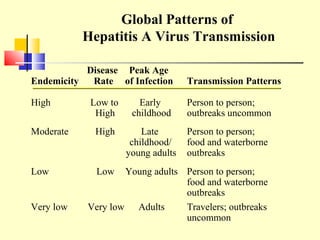
Hepatitis A Virus Transmission
Endemicity
Disease
Rate
Peak Age
of Infection Transmission Patterns
High Low to
High
Early
childhood
Person to person;
outbreaks uncommon
Moderate High Late
childhood/
young adults
Person to person;
food and waterborne
outbreaks
Low Low Young adults Person to person;
food and waterborne
outbreaks
Very low Very low Adults Travelers; outbreaks
uncommon
Global Patterns of
Hepatitis A Virus Transmission
Laboratory Diagnosis
 Acute infection is diagnosed by the detection of HAV-IgM
in serum by EIA.
 Past Infection i.e. immunity is determined by the detection
of HAV-IgG by EIA.
 Cell culture – difficult and take up to 4 weeks, not
routinely performed
 Direct Detection – EM, RT-PCR of faeces. Can
detect illness earlier than serology but rarely
performed.
 Many cases occur in community-wide outbreaks
 no risk factor identified for most cases
 highest attack rates in 5-14 year olds
 children serve as reservoir of infection
 Persons at increased risk of infection
 travelers
 homosexual men
 injecting drug users
Hepatitis A Vaccination Strategies
Epidemiologic Considerations
 Pre-exposure
 travelers to intermediate and high
HAV-endemic regions
 Post-exposure (within 14 days)
Routine
 household and other intimate contacts
Selected situations
 institutions (e.g., day care centers)
 common source exposure (e.g., food prepared by
infected food handler)
Hepatitis A Prevention - Immune
Globulin
Hepatitis B Virus
Hepatitis B Virus - Virology
 Double stranded DNA virus,the + strand not complete
 Replication involves a reverse transcriptase.
 Complete Dane particle 42 nm, 28 nm electron dense core, containing HBcAg
and HBeAg. The coat and the 22 nm free particles contain HBsAg
 At least 4 phenotypes of HBsAg are recognized;
adw, adr, ayw and ayr.
 The HBcAg is of a single serotype
 Hepatitis B virus (HBV) has been classified into 8 genotypes (A-H).
 Genotypes A and C predominate in the US. However, genotypes B and D are also
present in the US. Genotype F predominates in South America and in Alaska, while
A, D and E predominate in Africa. Genotype D predominates in Russia and in all its
prior dominions, while in Asia, genotypes B and C predominate.
 Available data suggests that genotype produces a milder disease, respond better to
IFN therapy, and is less likely to develop hepatocellular carcinoma.
 It has not yet been possible to propagate the virus
in cell culture.
 Incubation period: Average 60-90 days
Range 45-180 days
 Clinical illness (jaundice): <5 yrs, <10%
5 yrs, 30%-50%
 Acute case-fatality rate: 0.5%-1%
 Chronic infection: <5 yrs, 30%-90%
5 yrs, 2%-10%
 Premature mortality from
chronic liver disease: 15%-25%
Hepatitis B - Clinical Features
Spectrum of Chronic Hepatitis B Diseases
1Chronic Persistent Hepatitis -
asymptomatic
2. Chronic Active Hepatitis -
symptomatic exacerbations of hepatitis
3. Cirrhosis of Liver
4. Hepatocellular Carcinoma
Symptoms
HBeAg anti-HBe
Total anti-HBc
IgM anti-HBc anti-HBsHBsAg
0 4 8 12 16 20 24 28 32 36 52 100
Acute Hepatitis B Virus Infection with Recovery
Typical Serologic Course
Weeks after Exposure
Titre
IgM anti-HBc
Total anti-HBc
HBsAg
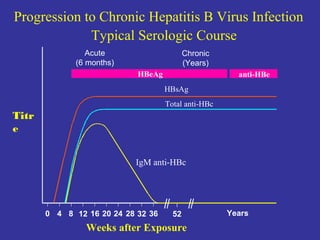
Acute
(6 months)
HBeAg
Chronic
(Years)
anti-HBe
0 4 8 12 16 20 24 28 32 36 52 Years
Weeks after Exposure
Titr
e
Progression to Chronic Hepatitis B Virus Infection
Typical Serologic Course
Symptomatic Infection
Chronic Infection
Age at Infection
Chronic Infection (%)
SymptomaticInfection(%)
Birth 1-6 months 7-12 months 1-4 years Older Children
and Adults
0
20
40
60
80
100100
80
60
40
20
0
Outcome of Hepatitis B Virus Infection
by Age at Infection
ChronicInfection(%)
 High (>8%): 45% of global population
 lifetime risk of infection >60%
 early childhood infections common
 Intermediate (2%-7%): 43% of global population
 lifetime risk of infection 20%-60%
 infections occur in all age groups
 Low (<2%): 12% of global population
 lifetime risk of infection <20%
 most infections occur in adult risk groups
Global Patterns of Chronic
HBV Infection
High Moderate
Low/Not
Detectable
blood semen urine
serum vaginal fluid feces
wound exudates saliva sweat
tears
breastmilk
Concentration of Hepatitis B
Virus in Various Body Fluids
 Sexual - sex workers and homosexuals are
particular at risk.
 Parenteral - IVDA, Health Workers are at
increased risk.
 Perinatal - Mothers who are HBeAg positive are
much more likely to transmit to their offspring
than those who are not. Perinatal transmission is
the main means of transmission in high
prevalence populations.
Hepatitis B Virus
Modes of Transmission
Diagnosis
 A battery of serological tests are used for the diagnosis of acute and
chronic hepatitis B infection.
 HBsAg - used as a general marker of infection.
 HBsAb - used to document recovery and/or immunity to HBV
infection.
 anti-HBc IgM - marker of acute infection.
 anti-HBcIgG - past or chronic infection.
 HBeAg - indicates active replication of virus and therefore
infectiveness.
 Anti-Hbe - virus no longer replicating. However, the patient can still
be positive for HBsAg which is made by integrated HBV.
 HBV-DNA - indicates active replication of virus, more accurate than
HBeAg especially in cases of escape mutants. Used mainly for
monitoring response to therapy.
Treatment
 Interferon - for HBeAg +ve carriers with chronic active hepatitis. Response
rate is 30 to 40%.
 alpha-interferon 2b (original)
 alpha-interferon 2a (newer, claims to be more efficacious and efficient)
 Lamivudine - a nucleoside analogue reverse transcriptase inhibitor. Well
tolerated, most patients will respond favorably. However, tendency to relapse
on cessation of treatment. Another problem is the rapid emergence of drug
resistance.
 Adefovir – less likely to develop resistance than Lamivudine and may be used
to treat Lamivudine resistance HBV. However more expensive and toxic
 Entecavir – most powerful antiviral known, similar to Adefovir
 Successful response to treatment will result in the disappearance of HBsAg,
HBV-DNA, and seroconversion to HBeAg.
Prevention
 Vaccination - highly effective recombinant vaccines are now
available. Vaccine can be given to those who are at increased
risk of HBV infection such as health care workers. It is also
given routinely to neonates as universal vaccination in many
countries.
 Hepatitis B Immunoglobulin - HBIG may be used to protect
persons who are exposed to hepatitis B. It is particular
efficacious within 48 hours of the incident. It may also be given
to neonates who are at increased risk of contracting hepatitis B
i.e. whose mothers are HBsAg and HBeAg positive.
 Other measures - screening of blood donors, blood and body
fluid precautions.
hypervariable
region
capsid envelop
e
protein
protease/helic
ase
RNA-
dependent
RNA
polymerase
c22
5’
cor
e
E1 E2 NS
2
NS
3
33c
NS
4
c-100
NS
5
3’
Hepatitis C Virus
Hepatitis C Virus

Genome resembled that of a flavivirus
positive stranded RNA genome of around 10,000 bases

1 single reading frame, structural genes at the 5' end, the non-structural
genes at the 3' end.
enveloped virus, virion thought to 30-60nm in diameter

morphological structure remains unknown

HCV has been classified into a total of six genotypes (type 1 to
6) on the basis of phylogenetic analysis

Genotype 1 and 4 has a poorer prognosis and response to
interferon therapy,

In Hong Kong, genotype 1 accounts for around 67% of cases
and genotype 6 around 25%.
Terminology
Term Definition % Nucleotide
Similarity
Genotype Genetic heterogeneity among
different HCV isolates
65.7-68.9
Subtype Closely related isolates within each
of the major genotypes
76.9-80.1
Quasispecies Complex of genetic variants within
individual isolates
90.8-99
Family Genus Species Genotype Subtype Quasispecies
Incubation period: Average 6-7 wks
Range 2-26 wks
Clinical illness (jaundice): 30-40% (20-30%)
Chronic hepatitis: 70%
Persistent infection: 85-100%
Immunity: No protective
antibody
response identified
Hepatitis C - Clinical
Features
Chronic Hepatitis C Infection
 The spectrum of chronic hepatitis C infection is
essentially the same as chronic hepatitis B
infection.
 All the manifestations of chronic hepatitis B
infection may be seen, albeit with a lower
frequency i.e. chronic persistent hepatitis, chronic
active hepatitis, cirrhosis, and hepatocellular
carcinoma.
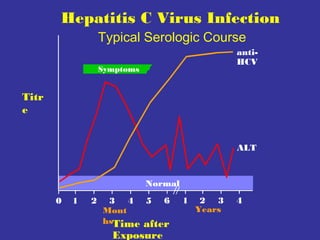
Symptoms
anti-
HCV
ALT
Normal
0 1 2 3 4 5 6 1 2 3 4
Hepatitis C Virus Infection
Typical Serologic Course
Titr
e
Mont
hs
Years
Time after
Exposure
 Transfusion or transplant from infected donor
 Injecting drug use
 Hemodialysis (yrs on treatment)
 Accidental injuries with needles/sharps
 Sexual/household exposure to anti-HCV-positive
contact
 Multiple sex partners
 Birth to HCV-infected mother
Risk Factors Associated
with Transmission of HCV
Laboratory Diagnosis
 HCV antibody - generally used to diagnose hepatitis C
infection. Not useful in the acute phase as it takes at least 4
weeks after infection before antibody appears.
 HCV-RNA - various techniques are available e.g. PCR and
branched DNA. May be used to diagnose HCV infection in
the acute phase. However, its main use is in monitoring the
response to antiviral therapy.
 HCV-antigen - an EIA for HCV antigen is available. It is
used in the same capacity as HCV-RNA tests but is much
easier to carry out.
Prognostic Tests
 Genotyping – genotype 1 and 4 have a worse prognosis overall and
respond poorly to interferon therapy. A number of commercial and in-
house assays are available.
 Genotypic methods – DNA sequencing, PCR-hybridization e.g. INNO-
LIPA.
 Serotyping – particularly useful when the patient does not have detectable
RNA.
 Viral Load – patients with high viral load are thought to have a poorer
prognosis. Viral load is also used for monitoring response to IFN
therapy. A number of commercial and in-house tests are available.
Treatment
 Interferon - may be considered for patients with
chronic active hepatitis. The response rate is
around 50% but 50% of responders will relapse
upon withdrawal of treatment.
 Ribavirin - there is less experience with ribavirin
than interferon. However, recent studies suggest
that a combination of interferon and ribavirin is
more effective than interferon alone.
 Screening of blood, organ, tissue donors
 High-risk behavior modification
 Blood and body fluid precautions
Prevention of Hepatitis
C
HBsAg
RNA
δ antigen
Hepatitis D (Delta)
Virus
Hepatitis D Virus
 The delta agent is a defective virus which
shows similarities with the viroids in plants.
 The agent consists of a particle 35 nm in diameter
consisting of the delta antigen surrounded by an
outer coat of HBsAg.
 The genome of the virus is very small and consists
of a single-stranded RNA
 Coinfection
– severe acute disease.
– low risk of chronic infection.
 Superinfection
– usually develop chronic HDV infection.
– high risk of severe chronic liver disease.
– may present as an acute hepatitis.
Hepatitis D - Clinical Features
 Percutanous exposures
injecting drug use
 Permucosal exposures
sex contact
Hepatitis D Virus Modes
of Transmission
anti-HBs
Symptoms
ALT
Elevated
Total anti-HDV
IgM anti-HDV
HDV RNA
HBsAg
HBV - HDV Coinfection
Typical Serologic Course
Time after Exposure
Titre
anti-HBs
Symptoms
ALT
Elevated
Total anti-
HDV
IgM anti-HDV
HDV RNA
HBsAg
HBV - HDV Coinfection
Typical Serologic Course
Time after Exposure
Titre
Jaundice
Symptoms
ALT
Total anti-HDV
IgM anti-HDV
HDV RNA
HBsAg
HBV - HDV
SuperinfectionTypical Serologic Course
Time after
Titre
 HBV-HDV Coinfection
Pre or postexposure prophylaxis to prevent
HBV infection.
 HBV-HDV Superinfection
Education to reduce risk behaviors among
persons with chronic HBV infection.
Hepatitis D - Prevention
Hepatitis E Virus
Hepatitis E Virus
 Calicivirus-like viruses
 unenveloped RNA virus, 32-34nm in
diameter
 +ve stranded RNA genome, 7.6 kb in
size.
 very labile and sensitive
 Can only be cultured recently
 Incubation period: Average 40 days
Range 15-60 days
 Case-fatality rate: Overall, 1%-3%
Pregnant women,
15%-25%
 Illness severity: Increased with age
 Chronic sequelae: None identified
Hepatitis E - Clinical Features
Symptoms
ALT IgG anti-HEV
IgM anti-HEV
Virus in stool
0 1 2 3 4 5 6 7 8 9 1
0
1
1
1
2
1
3
Hepatitis E Virus Infection
Typical Serologic
Course
Titer
Weeks after
 Most outbreaks associated with faecally contaminated drinking
water.
 Several other large epidemics have occurred since in the Indian
subcontinent and the USSR, China, Africa and Mexico.
 In the United States and other nonendemic areas, where
outbreaks of hepatitis E have not been documented to occur, a
low prevalence of anti-HEV (<2%) has been found in healthy
populations. The source of infection for these persons is
unknown.
 Minimal person-to-person transmission.
Hepatitis E -
Epidemiologic Features
 Avoid drinking water (and beverages with ice) of
unknown purity, uncooked shellfish, and
uncooked fruit/vegetables not peeled or prepared
by traveler.
 IG prepared from donors in Western countries
does not prevent infection.
 Unknown efficacy of IG prepared from donors in
endemic areas.
 Vaccine?
Prevention and Control Measures for
Travelers to HEV-Endemic Regions

Hepatitis

  • 1.
  • 2.
    AA“Infectious” “Serum” Viral hepatitis Enterically transmitted Parenterall y transmitted F, G,TTV ? other EE NANBNANB BB DD CC Viral Hepatitis - Historical Perspectives
  • 3.
    Source of virus feces blood/ blood-derived bodyfluids blood/ blood-derived body fluids blood/ blood-derived body fluids feces Route of transmission fecal-oral percutaneous permucosal percutaneous permucosal percutaneous permucosal fecal-oral Chronic infection no yes yes yes no Prevention pre/post- exposure immunization pre/post- exposure immunization blood donor screening; risk behavior modification pre/post- exposure immunization; risk behavior modification ensure safe drinking water Type of Hepatitis A B C D E
  • 4.
  • 5.
    Hepatitis A Virus Naked RNA virus  Related to enteroviruses, formerly known as enterovirus 72, now put in its own family: heptovirus  One stable serotype only  Difficult to grow in cell culture: primary marmoset cell culture and also in vivo in chimpanzees and marmosets  4 genotypes exist, but in practice most of them are group 1
  • 6.
     Incubation period:Average 30 days Range 15-50 days  Jaundice by <6 yrs, <10% age group: 6-14 yrs, 40%-50% >14 yrs, 70%-80%  Complications: Fulminant hepatitis Cholestatic hepatitis Relapsing hepatitis  Chronic sequelae: None Hepatitis A - Clinical Features
  • 7.
    Fecal HAV Symptoms 0 1 23 4 5 6 1 2 2 4 Hepatitis A Infection Total anti- HAV Titre ALT IgM anti-HAV Months after exposure Typical Serological Course
  • 8.
     Close personalcontact (e.g., household contact, sex contact, child day care centers)  Contaminated food, water (e.g., infected food handlers, raw shellfish)  Blood exposure (rare) (e.g., injecting drug use, transfusion) Hepatitis A Virus Transmission
  • 9.
    Endemicity Disease Rate Peak Age of InfectionTransmission Patterns High Low to High Early childhood Person to person; outbreaks uncommon Moderate High Late childhood/ young adults Person to person; food and waterborne outbreaks Low Low Young adults Person to person; food and waterborne outbreaks Very low Very low Adults Travelers; outbreaks uncommon Global Patterns of Hepatitis A Virus Transmission
  • 11.
    Laboratory Diagnosis  Acuteinfection is diagnosed by the detection of HAV-IgM in serum by EIA.  Past Infection i.e. immunity is determined by the detection of HAV-IgG by EIA.  Cell culture – difficult and take up to 4 weeks, not routinely performed  Direct Detection – EM, RT-PCR of faeces. Can detect illness earlier than serology but rarely performed.
  • 12.
     Many casesoccur in community-wide outbreaks  no risk factor identified for most cases  highest attack rates in 5-14 year olds  children serve as reservoir of infection  Persons at increased risk of infection  travelers  homosexual men  injecting drug users Hepatitis A Vaccination Strategies Epidemiologic Considerations
  • 13.
     Pre-exposure  travelersto intermediate and high HAV-endemic regions  Post-exposure (within 14 days) Routine  household and other intimate contacts Selected situations  institutions (e.g., day care centers)  common source exposure (e.g., food prepared by infected food handler) Hepatitis A Prevention - Immune Globulin
  • 14.
  • 15.
    Hepatitis B Virus- Virology  Double stranded DNA virus,the + strand not complete  Replication involves a reverse transcriptase.  Complete Dane particle 42 nm, 28 nm electron dense core, containing HBcAg and HBeAg. The coat and the 22 nm free particles contain HBsAg  At least 4 phenotypes of HBsAg are recognized; adw, adr, ayw and ayr.  The HBcAg is of a single serotype  Hepatitis B virus (HBV) has been classified into 8 genotypes (A-H).  Genotypes A and C predominate in the US. However, genotypes B and D are also present in the US. Genotype F predominates in South America and in Alaska, while A, D and E predominate in Africa. Genotype D predominates in Russia and in all its prior dominions, while in Asia, genotypes B and C predominate.  Available data suggests that genotype produces a milder disease, respond better to IFN therapy, and is less likely to develop hepatocellular carcinoma.  It has not yet been possible to propagate the virus in cell culture.
  • 16.
     Incubation period:Average 60-90 days Range 45-180 days  Clinical illness (jaundice): <5 yrs, <10% 5 yrs, 30%-50%  Acute case-fatality rate: 0.5%-1%  Chronic infection: <5 yrs, 30%-90% 5 yrs, 2%-10%  Premature mortality from chronic liver disease: 15%-25% Hepatitis B - Clinical Features
  • 17.
    Spectrum of ChronicHepatitis B Diseases 1Chronic Persistent Hepatitis - asymptomatic 2. Chronic Active Hepatitis - symptomatic exacerbations of hepatitis 3. Cirrhosis of Liver 4. Hepatocellular Carcinoma
  • 18.
    Symptoms HBeAg anti-HBe Total anti-HBc IgManti-HBc anti-HBsHBsAg 0 4 8 12 16 20 24 28 32 36 52 100 Acute Hepatitis B Virus Infection with Recovery Typical Serologic Course Weeks after Exposure Titre
  • 19.
    IgM anti-HBc Total anti-HBc HBsAg Acute (6months) HBeAg Chronic (Years) anti-HBe 0 4 8 12 16 20 24 28 32 36 52 Years Weeks after Exposure Titr e Progression to Chronic Hepatitis B Virus Infection Typical Serologic Course
  • 20.
    Symptomatic Infection Chronic Infection Ageat Infection Chronic Infection (%) SymptomaticInfection(%) Birth 1-6 months 7-12 months 1-4 years Older Children and Adults 0 20 40 60 80 100100 80 60 40 20 0 Outcome of Hepatitis B Virus Infection by Age at Infection ChronicInfection(%)
  • 21.
     High (>8%):45% of global population  lifetime risk of infection >60%  early childhood infections common  Intermediate (2%-7%): 43% of global population  lifetime risk of infection 20%-60%  infections occur in all age groups  Low (<2%): 12% of global population  lifetime risk of infection <20%  most infections occur in adult risk groups Global Patterns of Chronic HBV Infection
  • 23.
    High Moderate Low/Not Detectable blood semenurine serum vaginal fluid feces wound exudates saliva sweat tears breastmilk Concentration of Hepatitis B Virus in Various Body Fluids
  • 24.
     Sexual -sex workers and homosexuals are particular at risk.  Parenteral - IVDA, Health Workers are at increased risk.  Perinatal - Mothers who are HBeAg positive are much more likely to transmit to their offspring than those who are not. Perinatal transmission is the main means of transmission in high prevalence populations. Hepatitis B Virus Modes of Transmission
  • 25.
    Diagnosis  A batteryof serological tests are used for the diagnosis of acute and chronic hepatitis B infection.  HBsAg - used as a general marker of infection.  HBsAb - used to document recovery and/or immunity to HBV infection.  anti-HBc IgM - marker of acute infection.  anti-HBcIgG - past or chronic infection.  HBeAg - indicates active replication of virus and therefore infectiveness.  Anti-Hbe - virus no longer replicating. However, the patient can still be positive for HBsAg which is made by integrated HBV.  HBV-DNA - indicates active replication of virus, more accurate than HBeAg especially in cases of escape mutants. Used mainly for monitoring response to therapy.
  • 26.
    Treatment  Interferon -for HBeAg +ve carriers with chronic active hepatitis. Response rate is 30 to 40%.  alpha-interferon 2b (original)  alpha-interferon 2a (newer, claims to be more efficacious and efficient)  Lamivudine - a nucleoside analogue reverse transcriptase inhibitor. Well tolerated, most patients will respond favorably. However, tendency to relapse on cessation of treatment. Another problem is the rapid emergence of drug resistance.  Adefovir – less likely to develop resistance than Lamivudine and may be used to treat Lamivudine resistance HBV. However more expensive and toxic  Entecavir – most powerful antiviral known, similar to Adefovir  Successful response to treatment will result in the disappearance of HBsAg, HBV-DNA, and seroconversion to HBeAg.
  • 27.
    Prevention  Vaccination -highly effective recombinant vaccines are now available. Vaccine can be given to those who are at increased risk of HBV infection such as health care workers. It is also given routinely to neonates as universal vaccination in many countries.  Hepatitis B Immunoglobulin - HBIG may be used to protect persons who are exposed to hepatitis B. It is particular efficacious within 48 hours of the incident. It may also be given to neonates who are at increased risk of contracting hepatitis B i.e. whose mothers are HBsAg and HBeAg positive.  Other measures - screening of blood donors, blood and body fluid precautions.
  • 28.
  • 29.
    Hepatitis C Virus  Genomeresembled that of a flavivirus positive stranded RNA genome of around 10,000 bases  1 single reading frame, structural genes at the 5' end, the non-structural genes at the 3' end. enveloped virus, virion thought to 30-60nm in diameter  morphological structure remains unknown  HCV has been classified into a total of six genotypes (type 1 to 6) on the basis of phylogenetic analysis  Genotype 1 and 4 has a poorer prognosis and response to interferon therapy,  In Hong Kong, genotype 1 accounts for around 67% of cases and genotype 6 around 25%.
  • 30.
    Terminology Term Definition %Nucleotide Similarity Genotype Genetic heterogeneity among different HCV isolates 65.7-68.9 Subtype Closely related isolates within each of the major genotypes 76.9-80.1 Quasispecies Complex of genetic variants within individual isolates 90.8-99 Family Genus Species Genotype Subtype Quasispecies
  • 31.
    Incubation period: Average6-7 wks Range 2-26 wks Clinical illness (jaundice): 30-40% (20-30%) Chronic hepatitis: 70% Persistent infection: 85-100% Immunity: No protective antibody response identified Hepatitis C - Clinical Features
  • 32.
    Chronic Hepatitis CInfection  The spectrum of chronic hepatitis C infection is essentially the same as chronic hepatitis B infection.  All the manifestations of chronic hepatitis B infection may be seen, albeit with a lower frequency i.e. chronic persistent hepatitis, chronic active hepatitis, cirrhosis, and hepatocellular carcinoma.
  • 33.
    Symptoms anti- HCV ALT Normal 0 1 23 4 5 6 1 2 3 4 Hepatitis C Virus Infection Typical Serologic Course Titr e Mont hs Years Time after Exposure
  • 34.
     Transfusion ortransplant from infected donor  Injecting drug use  Hemodialysis (yrs on treatment)  Accidental injuries with needles/sharps  Sexual/household exposure to anti-HCV-positive contact  Multiple sex partners  Birth to HCV-infected mother Risk Factors Associated with Transmission of HCV
  • 36.
    Laboratory Diagnosis  HCVantibody - generally used to diagnose hepatitis C infection. Not useful in the acute phase as it takes at least 4 weeks after infection before antibody appears.  HCV-RNA - various techniques are available e.g. PCR and branched DNA. May be used to diagnose HCV infection in the acute phase. However, its main use is in monitoring the response to antiviral therapy.  HCV-antigen - an EIA for HCV antigen is available. It is used in the same capacity as HCV-RNA tests but is much easier to carry out.
  • 37.
    Prognostic Tests  Genotyping– genotype 1 and 4 have a worse prognosis overall and respond poorly to interferon therapy. A number of commercial and in- house assays are available.  Genotypic methods – DNA sequencing, PCR-hybridization e.g. INNO- LIPA.  Serotyping – particularly useful when the patient does not have detectable RNA.  Viral Load – patients with high viral load are thought to have a poorer prognosis. Viral load is also used for monitoring response to IFN therapy. A number of commercial and in-house tests are available.
  • 38.
    Treatment  Interferon -may be considered for patients with chronic active hepatitis. The response rate is around 50% but 50% of responders will relapse upon withdrawal of treatment.  Ribavirin - there is less experience with ribavirin than interferon. However, recent studies suggest that a combination of interferon and ribavirin is more effective than interferon alone.
  • 39.
     Screening ofblood, organ, tissue donors  High-risk behavior modification  Blood and body fluid precautions Prevention of Hepatitis C
  • 40.
  • 41.
    Hepatitis D Virus The delta agent is a defective virus which shows similarities with the viroids in plants.  The agent consists of a particle 35 nm in diameter consisting of the delta antigen surrounded by an outer coat of HBsAg.  The genome of the virus is very small and consists of a single-stranded RNA
  • 42.
     Coinfection – severeacute disease. – low risk of chronic infection.  Superinfection – usually develop chronic HDV infection. – high risk of severe chronic liver disease. – may present as an acute hepatitis. Hepatitis D - Clinical Features
  • 43.
     Percutanous exposures injectingdrug use  Permucosal exposures sex contact Hepatitis D Virus Modes of Transmission
  • 44.
    anti-HBs Symptoms ALT Elevated Total anti-HDV IgM anti-HDV HDVRNA HBsAg HBV - HDV Coinfection Typical Serologic Course Time after Exposure Titre
  • 45.
    anti-HBs Symptoms ALT Elevated Total anti- HDV IgM anti-HDV HDVRNA HBsAg HBV - HDV Coinfection Typical Serologic Course Time after Exposure Titre
  • 46.
    Jaundice Symptoms ALT Total anti-HDV IgM anti-HDV HDVRNA HBsAg HBV - HDV SuperinfectionTypical Serologic Course Time after Titre
  • 48.
     HBV-HDV Coinfection Preor postexposure prophylaxis to prevent HBV infection.  HBV-HDV Superinfection Education to reduce risk behaviors among persons with chronic HBV infection. Hepatitis D - Prevention
  • 49.
  • 50.
    Hepatitis E Virus Calicivirus-like viruses  unenveloped RNA virus, 32-34nm in diameter  +ve stranded RNA genome, 7.6 kb in size.  very labile and sensitive  Can only be cultured recently
  • 51.
     Incubation period:Average 40 days Range 15-60 days  Case-fatality rate: Overall, 1%-3% Pregnant women, 15%-25%  Illness severity: Increased with age  Chronic sequelae: None identified Hepatitis E - Clinical Features
  • 52.
    Symptoms ALT IgG anti-HEV IgManti-HEV Virus in stool 0 1 2 3 4 5 6 7 8 9 1 0 1 1 1 2 1 3 Hepatitis E Virus Infection Typical Serologic Course Titer Weeks after
  • 53.
     Most outbreaksassociated with faecally contaminated drinking water.  Several other large epidemics have occurred since in the Indian subcontinent and the USSR, China, Africa and Mexico.  In the United States and other nonendemic areas, where outbreaks of hepatitis E have not been documented to occur, a low prevalence of anti-HEV (<2%) has been found in healthy populations. The source of infection for these persons is unknown.  Minimal person-to-person transmission. Hepatitis E - Epidemiologic Features
  • 55.
     Avoid drinkingwater (and beverages with ice) of unknown purity, uncooked shellfish, and uncooked fruit/vegetables not peeled or prepared by traveler.  IG prepared from donors in Western countries does not prevent infection.  Unknown efficacy of IG prepared from donors in endemic areas.  Vaccine? Prevention and Control Measures for Travelers to HEV-Endemic Regions