ILLNESS
CAUSES & RISK FACTORS
ILLNESS BEHAVIOUR
Mr. Melvin Jacob
MSc (Nursing)
1Mr. Melvin Jacob
INTRODUCTION
 Illness is a personal state in which the person feels
unhealthy or ill.
• Illness may or may not be related todisease.
• Illness is a state in which a person’s physical,
emotional, intellectual, social, developmental or
• spiritual functioning is diminished or impairment
compared with previousexperience.
2Mr. Melvin Jacob
Risk factors
1.Genetic and Physiological Factors- Heredity, or genetic
predisposition to specific illness, is a major physical risk
factor.
2.Age increases or decreases susceptibility to certain illnesses
(the riskof heart diseases increases with agefor both sexes)
•The risk of birth defects and complications of pregnancy
increase in women bearing children after the ageof 35 years
3Mr. Melvin Jacob
3. Environment
• The physical environment in which a person works or lives can
increase the risk
4. Lifestyle
•Many activities, habits and practices involve riskfactors.
• Lifestyle practices and behaviours have positive or negative
effects on health.
•Stress can be a lifestyle risk factor if it is severe or prolonged, or if
the personis unable to cope.
• Stress can threaten mental health & physical well-being
4Mr. Melvin Jacob
Common causes of disease
1. BiologicAgents
2. Inherited GenericDefects
3. PhysicalAgents
4. ChemicalAgents
5. Tissueresponse to irritation/injury (fever,inflammation)
6. Faulty chemical or metabolicprocess
7. Emotional or physicalreaction tostress
5Mr. Melvin Jacob
Accordingto EtiologicFactors
• Hereditary. Due to defect in the genes of one or other parent
which istransmitted to theoffspring.
• Congenital. Due to a defect in the development, hereditary
factors, or prenatal infection; present at birth.
(e.g. cleft lip, cleft palate)
• Metabolic. Due to disturbances or abnormality in the
intricate processesofmetabolism.
6Mr. Melvin Jacob
• Deficiency. Results from inadequate intake of
absorption of essential dietaryfactors.
• Traumatic.Dueto injury
• Allergic. Due to abnormal response of the body to
chemical or protein substances or to physical stimuli.
• Neoplastic. Due to abnormal or uncontrolled
growth of cells.
7Mr. Melvin Jacob
• Idiopathic. Cause is unknown; Self-originated; of
spontaneousorigin.
• Degenerative. Results from the degenerative
changesthat occur in tissue andorgans.
• Latrogenic. Results from the treatment of a
disease
8Mr. Melvin Jacob
According to Duration orOnset
1. AcuteIllness. Usually hasashort duration andsevere.
The signs and symptoms appear abruptly, subside after a relatively
shortperiod.
• Following an acute illness a person may return to normal level
of wellness
2. Chronic Illness. Slow onset. Persists, usually longer than 6
months and canalso affect functioning in anydimension.
• long term diseaseprocess,maybelifethreatening
9Mr. Melvin Jacob
Dimensions of health
1.Physical dimension
Genetic make-up, age, developmental level, race and
sex are all part of an individual’s physical dimension
and strongly influence health status and health
practices.
10Mr. Melvin Jacob
2. Emotional dimension
• How the mind and body interact to affect body
function and to respond to body conditions also
influences health.
• Long-term stress affects the body systems and
anxiety affects health habits
• conversely, calm acceptance and relaxation can
actually change body responses to illness.
11Mr. Melvin Jacob
3. Intellectual dimension
• The intellectual dimension encompasses cognitive
abilities, educational background and past
experiences.
• These influence a client’s responses to teaching
about health and reactions to health care during
illness.
• They also play a major role in health behaviors.
12Mr. Melvin Jacob
4. Environmental dimension
• The environment has many influences on
health and illness.
• Housing, sanitation, climate, and pollution of
air, food and water are aspects of
environmental dimension.
13Mr. Melvin Jacob
5. Sociocultural dimension
 Health practices and beliefs are strongly influenced by a
person’s economic level, life style, family and culture.
 Low-income groups are less likely to seek health care to
prevent or treat illness; high-income groups are more prone
to stress-related habits and illness.
 The family and the culture to which the person belongs
determine patterns of living and values about health and
illness that are often unalterable.
14Mr. Melvin Jacob
6. Spiritual dimension
• Spiritual and religious beliefs and values are
important components of the way the person
behaves in health and illness.
15Mr. Melvin Jacob
ILLNESS BEHAVIOUR
16Mr. Melvin Jacob
DETERMINANTS OF ILLNESS BEHAVIOR
Recognisability of illness symptoms.
The extent the person perceives symptoms as serious.
Information, knowledge and cultural assumption.
Disruption in family work and social activity.
Frequency of appearance.
Toleration level.
Physical proximity of treatment resources
17Mr. Melvin Jacob
18
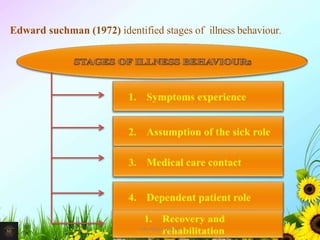
Edward suchman (1972) identified stages of illness behaviour.
Mr. Melvin Jacob
Stages of illness behavior
Stage 1: Symptom experience
 The person is aware that "something is wrong". A person
usually recognizes a physical sensation or a limitation in
functioning but does not suspect a specific diagnosis.
 The person's perception of a symptom includes awareness
of a physical change such as pain, a rash or a lump;
evaluation of this change and a decision that it is a
symptom of an illness, and an emotional response.
19Mr. Melvin Jacob
Stage 2 : Assumption of the sick role
• If symptoms persist and become severe, clients
assume the sick role.
• At this point the illness becomes a social
phenomenon
• Sick people seek confirmation from their families and
social groups that they are indeed ill
• Excused from normal duties and role expectations.
20Mr. Melvin Jacob
Stage 3: Medical care contact
• If symptoms persist despite the home remedies,
become severe, or require emergency care, the
person is motivated to seek professional health
services.
• In this stage the client seeks expert
acknowledgement of the illness as well as the
treatment.
21Mr. Melvin Jacob
Stage 4 : Dependent client role
• The client depends on health care professionals for the relief
of symptoms.
• The client accepts care, sympathy and protection from the
demands and stresses of life.
• A client can adopt the dependent role in a health care
institution, at home, or in a community setting.
• The client must also adjust to the disruption of a daily
schedule.
22Mr. Melvin Jacob
Stage 5 : Recovery and rehabilitation
• This stage can arrive suddenly, such as when
the symptoms disappeared.
• In the case of chronic illness, the final stage
may involve in an adjustment to a prolonged
reduction in health and functioning.
23Mr. Melvin Jacob
Important terminologies
• Disease. Disturbance of structure or function of the
body or its constituentparts.
• Morbidity. Condition of beingdiseased.
• Morbidity Rate. The proportion of disease to health
ina community
24Mr. Melvin Jacob
• Mortality. Condition or quality of being
subject todeath
• Familial -occurs in several individuals of the
same family (e.g. hypertension,cancer)
• Venereal - Usually acquired through sexual
relation (AIDS,gonorrhea)
25Mr. Melvin Jacob
• Epidemic. Attacks a large number of individuals in a
community at the sametime(SARS)
• Endemic. Present more or less continuously or recurs in
thecommunity.
• Pandemic. Epidemic diseases which is extremely
widespread involving anentire country orcontinent.
• Sporadic.Adiseasein which only occasionalcases occur.
26Mr. Melvin Jacob
• Epidemiology. Study of the patterns of health and
disease, its occurrence and distribution in man, for the
purpose of control and prevention ofdisease.
• Susceptibility. The degree of resistance the potential
host hasagainst the pathogen.
• Etiologic Agent. One that possesses the potential for
producing injury or disease. (e.g.Streptococcus,
Staphylococcus)
27Mr. Melvin Jacob
28Mr. Melvin Jacob

Illness causes & risk factors, illness behavior

  • 1.
    ILLNESS CAUSES & RISKFACTORS ILLNESS BEHAVIOUR Mr. Melvin Jacob MSc (Nursing) 1Mr. Melvin Jacob
  • 2.
    INTRODUCTION  Illness isa personal state in which the person feels unhealthy or ill. • Illness may or may not be related todisease. • Illness is a state in which a person’s physical, emotional, intellectual, social, developmental or • spiritual functioning is diminished or impairment compared with previousexperience. 2Mr. Melvin Jacob
  • 3.
    Risk factors 1.Genetic andPhysiological Factors- Heredity, or genetic predisposition to specific illness, is a major physical risk factor. 2.Age increases or decreases susceptibility to certain illnesses (the riskof heart diseases increases with agefor both sexes) •The risk of birth defects and complications of pregnancy increase in women bearing children after the ageof 35 years 3Mr. Melvin Jacob
  • 4.
    3. Environment • Thephysical environment in which a person works or lives can increase the risk 4. Lifestyle •Many activities, habits and practices involve riskfactors. • Lifestyle practices and behaviours have positive or negative effects on health. •Stress can be a lifestyle risk factor if it is severe or prolonged, or if the personis unable to cope. • Stress can threaten mental health & physical well-being 4Mr. Melvin Jacob
  • 5.
    Common causes ofdisease 1. BiologicAgents 2. Inherited GenericDefects 3. PhysicalAgents 4. ChemicalAgents 5. Tissueresponse to irritation/injury (fever,inflammation) 6. Faulty chemical or metabolicprocess 7. Emotional or physicalreaction tostress 5Mr. Melvin Jacob
  • 6.
    Accordingto EtiologicFactors • Hereditary.Due to defect in the genes of one or other parent which istransmitted to theoffspring. • Congenital. Due to a defect in the development, hereditary factors, or prenatal infection; present at birth. (e.g. cleft lip, cleft palate) • Metabolic. Due to disturbances or abnormality in the intricate processesofmetabolism. 6Mr. Melvin Jacob
  • 7.
    • Deficiency. Resultsfrom inadequate intake of absorption of essential dietaryfactors. • Traumatic.Dueto injury • Allergic. Due to abnormal response of the body to chemical or protein substances or to physical stimuli. • Neoplastic. Due to abnormal or uncontrolled growth of cells. 7Mr. Melvin Jacob
  • 8.
    • Idiopathic. Causeis unknown; Self-originated; of spontaneousorigin. • Degenerative. Results from the degenerative changesthat occur in tissue andorgans. • Latrogenic. Results from the treatment of a disease 8Mr. Melvin Jacob
  • 9.
    According to DurationorOnset 1. AcuteIllness. Usually hasashort duration andsevere. The signs and symptoms appear abruptly, subside after a relatively shortperiod. • Following an acute illness a person may return to normal level of wellness 2. Chronic Illness. Slow onset. Persists, usually longer than 6 months and canalso affect functioning in anydimension. • long term diseaseprocess,maybelifethreatening 9Mr. Melvin Jacob
  • 10.
    Dimensions of health 1.Physicaldimension Genetic make-up, age, developmental level, race and sex are all part of an individual’s physical dimension and strongly influence health status and health practices. 10Mr. Melvin Jacob
  • 11.
    2. Emotional dimension •How the mind and body interact to affect body function and to respond to body conditions also influences health. • Long-term stress affects the body systems and anxiety affects health habits • conversely, calm acceptance and relaxation can actually change body responses to illness. 11Mr. Melvin Jacob
  • 12.
    3. Intellectual dimension •The intellectual dimension encompasses cognitive abilities, educational background and past experiences. • These influence a client’s responses to teaching about health and reactions to health care during illness. • They also play a major role in health behaviors. 12Mr. Melvin Jacob
  • 13.
    4. Environmental dimension •The environment has many influences on health and illness. • Housing, sanitation, climate, and pollution of air, food and water are aspects of environmental dimension. 13Mr. Melvin Jacob
  • 14.
    5. Sociocultural dimension Health practices and beliefs are strongly influenced by a person’s economic level, life style, family and culture.  Low-income groups are less likely to seek health care to prevent or treat illness; high-income groups are more prone to stress-related habits and illness.  The family and the culture to which the person belongs determine patterns of living and values about health and illness that are often unalterable. 14Mr. Melvin Jacob
  • 15.
    6. Spiritual dimension •Spiritual and religious beliefs and values are important components of the way the person behaves in health and illness. 15Mr. Melvin Jacob
  • 16.
  • 17.
    DETERMINANTS OF ILLNESSBEHAVIOR Recognisability of illness symptoms. The extent the person perceives symptoms as serious. Information, knowledge and cultural assumption. Disruption in family work and social activity. Frequency of appearance. Toleration level. Physical proximity of treatment resources 17Mr. Melvin Jacob
  • 18.
    18 Edward suchman (1972)identified stages of illness behaviour. Mr. Melvin Jacob
  • 19.
    Stages of illnessbehavior Stage 1: Symptom experience  The person is aware that "something is wrong". A person usually recognizes a physical sensation or a limitation in functioning but does not suspect a specific diagnosis.  The person's perception of a symptom includes awareness of a physical change such as pain, a rash or a lump; evaluation of this change and a decision that it is a symptom of an illness, and an emotional response. 19Mr. Melvin Jacob
  • 20.
    Stage 2 :Assumption of the sick role • If symptoms persist and become severe, clients assume the sick role. • At this point the illness becomes a social phenomenon • Sick people seek confirmation from their families and social groups that they are indeed ill • Excused from normal duties and role expectations. 20Mr. Melvin Jacob
  • 21.
    Stage 3: Medicalcare contact • If symptoms persist despite the home remedies, become severe, or require emergency care, the person is motivated to seek professional health services. • In this stage the client seeks expert acknowledgement of the illness as well as the treatment. 21Mr. Melvin Jacob
  • 22.
    Stage 4 :Dependent client role • The client depends on health care professionals for the relief of symptoms. • The client accepts care, sympathy and protection from the demands and stresses of life. • A client can adopt the dependent role in a health care institution, at home, or in a community setting. • The client must also adjust to the disruption of a daily schedule. 22Mr. Melvin Jacob
  • 23.
    Stage 5 :Recovery and rehabilitation • This stage can arrive suddenly, such as when the symptoms disappeared. • In the case of chronic illness, the final stage may involve in an adjustment to a prolonged reduction in health and functioning. 23Mr. Melvin Jacob
  • 24.
    Important terminologies • Disease.Disturbance of structure or function of the body or its constituentparts. • Morbidity. Condition of beingdiseased. • Morbidity Rate. The proportion of disease to health ina community 24Mr. Melvin Jacob
  • 25.
    • Mortality. Conditionor quality of being subject todeath • Familial -occurs in several individuals of the same family (e.g. hypertension,cancer) • Venereal - Usually acquired through sexual relation (AIDS,gonorrhea) 25Mr. Melvin Jacob
  • 26.
    • Epidemic. Attacksa large number of individuals in a community at the sametime(SARS) • Endemic. Present more or less continuously or recurs in thecommunity. • Pandemic. Epidemic diseases which is extremely widespread involving anentire country orcontinent. • Sporadic.Adiseasein which only occasionalcases occur. 26Mr. Melvin Jacob
  • 27.
    • Epidemiology. Studyof the patterns of health and disease, its occurrence and distribution in man, for the purpose of control and prevention ofdisease. • Susceptibility. The degree of resistance the potential host hasagainst the pathogen. • Etiologic Agent. One that possesses the potential for producing injury or disease. (e.g.Streptococcus, Staphylococcus) 27Mr. Melvin Jacob
  • 28.