
SUBJECT NAME: APPLIED BIOCHEMISTRY
UNIT NO.: V
UNIT NAME: ACID BASE MAINTENANCE
TOPIC NAME(S): CLINICAL ENZYMOLOGY
Prepared By:
Dr. Rahul Sharma
PH – DEFINITION, NORMAL VALUE
Definition: pH is a measure of how
acidic or basic (alkaline) a solution is. It
represents the concentration of
hydrogen ions (H ) in a solution and is
⁺
expressed on a logarithmic scale
ranging from 0 to 14.
PH – DEFINITION, NORMAL VALUE
A low pH (0–6.9) indicates an acidic
solution.
A pH of 7 is considered neutral (e.g.,
pure water).
A high pH (7.1–14) indicates a basic
or alkaline solution.
PH – DEFINITION, NORMAL VALUE
In general chemistry (e.g., water):
Neutral: pH 7
Acidic: < 7
Basic: > 7
PH – DEFINITION, NORMAL VALUE
In human blood (clinical setting):
Normal arterial blood pH: 7.35 –
7.45
Below 7.35: Acidosis
Above 7.45: Alkalosis
REGULATION OF BLOOD PH
Maintaining a stable blood pH
(normal: 7.35–7.45) is vital for enzyme
function, cellular metabolism, and
overall homeostasis. The body uses
three main mechanisms to regulate pH:
REGULATION OF BLOOD PH
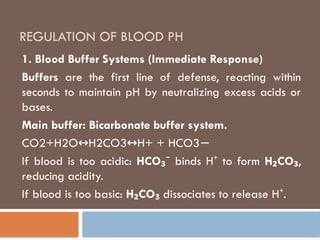
1. Blood Buffer Systems (Immediate Response)
Buffers are the first line of defense, reacting within
seconds to maintain pH by neutralizing excess acids or
bases.
Main buffer: Bicarbonate buffer system.
CO2​
+H2​
O H2​
CO3​ H+
↔ ↔ + HCO3 ​
−
If blood is too acidic: HCO₃⁻ binds H to form
⁺ H CO
₂ ₃,
reducing acidity.
If blood is too basic: H CO
₂ ₃ dissociates to release H .
⁺
REGULATION OF BLOOD PH
2. Respiratory Regulation (Fast Response – Minutes)
The lungs control pH by regulating the level of carbon
dioxide (CO )
₂ in the blood.
• CO is acidic in solution (forms H CO ).
₂ ₂ ₃
• If blood pH drops (acidosis): Respiration rate
increases more CO exhaled pH rises.
→ ₂ →
• If blood pH rises (alkalosis): Respiration rate slows →
CO retained pH lowers.
₂ →
REGULATION OF BLOOD PH
3. Renal Regulation (Slow Response –
Hours to Days)
The kidneys maintain long-term acid-base
balance by:
Excreting H⁺ ions in urine
Reabsorbing or excreting HCO₃⁻
(bicarbonate) based on need
ABG – ARTERIAL BLOOD GAS: NORMAL
VALUES
Arterial Blood Gas (ABG) analysis
measures the acidity, oxygenation, and
carbon dioxide levels in arterial blood. It's
a key test to assess respiratory and
metabolic function.
ABG – ARTERIAL BLOOD GAS: NORMAL
VALUES
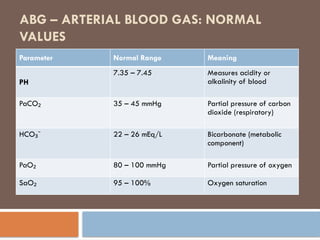
Parameter Normal Range Meaning
PH
7.35 – 7.45 Measures acidity or
alkalinity of blood
PaCO₂ 35 – 45 mmHg Partial pressure of carbon
dioxide (respiratory)
HCO₃⁻ 22 – 26 mEq/L Bicarbonate (metabolic
component)
PaO₂ 80 – 100 mmHg Partial pressure of oxygen
SaO₂ 95 – 100% Oxygen saturation
ACID BASE DISORDERS – TYPES, DEFINITION &
CAUSES
1. Metabolic Acidosis:
Definition:
Decrease in bicarbonate (HCO ) with a
₃⁻
resulting decrease in blood pH.
ACID BASE DISORDERS – TYPES, DEFINITION &
CAUSES
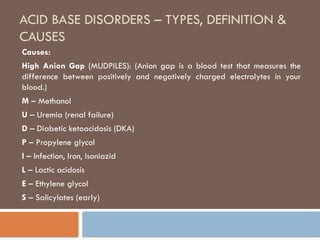
Causes:
High Anion Gap (MUDPILES): (Anion gap is a blood test that measures the
difference between positively and negatively charged electrolytes in your
blood.)
M – Methanol
U – Uremia (renal failure)
D – Diabetic ketoacidosis (DKA)
P – Propylene glycol
I – Infection, Iron, Isoniazid
L – Lactic acidosis
E – Ethylene glycol
S – Salicylates (early)
ACID BASE DISORDERS – TYPES, DEFINITION &
CAUSES
2. Metabolic Alkalosis:
Definition:
Increase in bicarbonate (HCO ) with an
₃⁻
increase in pH
ACID BASE DISORDERS – TYPES, DEFINITION &
CAUSES
Causes:
Vomiting (loss of HCl)
Nasogastric suction
Diuretic use (loop, thiazide)
Hyperaldosteronism
Excessive bicarbonate intake
ACID BASE DISORDERS – TYPES, DEFINITION &
CAUSES
3. Respiratory Acidosis
🔹 Definition:
Retention of CO leading to decreased pH.
₂
ACID BASE DISORDERS – TYPES, DEFINITION &
CAUSES
Causes:
Hypoventilation from:
COPD
Drug overdose (e.g., opioids, sedatives)
Neuromuscular disorders (e.g., Guillain-Barré,
myasthenia gravis)
Airway obstruction
Severe pneumonia or ARDS
.
ACID BASE DISORDERS – TYPES, DEFINITION &
CAUSES
4. Respiratory Alkalosis
🔹 Definition:
Excessive CO loss due to hyperventilation, causing
₂
increased pH.
.
ACID BASE DISORDERS – TYPES, DEFINITION &
CAUSES
Causes:
Hyperventilation from:
Anxiety, panic attacks
Pain
Fever
Sepsis
High altitude
Salicylate poisoning (early stage)
Pulmonary embolism
.

Unit-V Acid base maintenance.pptx. in biochemistry

  • 1.
    SUBJECT NAME: APPLIEDBIOCHEMISTRY UNIT NO.: V UNIT NAME: ACID BASE MAINTENANCE TOPIC NAME(S): CLINICAL ENZYMOLOGY Prepared By: Dr. Rahul Sharma
  • 2.
    PH – DEFINITION,NORMAL VALUE Definition: pH is a measure of how acidic or basic (alkaline) a solution is. It represents the concentration of hydrogen ions (H ) in a solution and is ⁺ expressed on a logarithmic scale ranging from 0 to 14.
  • 3.
    PH – DEFINITION,NORMAL VALUE A low pH (0–6.9) indicates an acidic solution. A pH of 7 is considered neutral (e.g., pure water). A high pH (7.1–14) indicates a basic or alkaline solution.
  • 4.
    PH – DEFINITION,NORMAL VALUE In general chemistry (e.g., water): Neutral: pH 7 Acidic: < 7 Basic: > 7
  • 5.
    PH – DEFINITION,NORMAL VALUE In human blood (clinical setting): Normal arterial blood pH: 7.35 – 7.45 Below 7.35: Acidosis Above 7.45: Alkalosis
  • 6.
    REGULATION OF BLOODPH Maintaining a stable blood pH (normal: 7.35–7.45) is vital for enzyme function, cellular metabolism, and overall homeostasis. The body uses three main mechanisms to regulate pH:
  • 7.
    REGULATION OF BLOODPH 1. Blood Buffer Systems (Immediate Response) Buffers are the first line of defense, reacting within seconds to maintain pH by neutralizing excess acids or bases. Main buffer: Bicarbonate buffer system. CO2​ +H2​ O H2​ CO3​ H+ ↔ ↔ + HCO3 ​ − If blood is too acidic: HCO₃⁻ binds H to form ⁺ H CO ₂ ₃, reducing acidity. If blood is too basic: H CO ₂ ₃ dissociates to release H . ⁺
  • 8.
    REGULATION OF BLOODPH 2. Respiratory Regulation (Fast Response – Minutes) The lungs control pH by regulating the level of carbon dioxide (CO ) ₂ in the blood. • CO is acidic in solution (forms H CO ). ₂ ₂ ₃ • If blood pH drops (acidosis): Respiration rate increases more CO exhaled pH rises. → ₂ → • If blood pH rises (alkalosis): Respiration rate slows → CO retained pH lowers. ₂ →
  • 9.
    REGULATION OF BLOODPH 3. Renal Regulation (Slow Response – Hours to Days) The kidneys maintain long-term acid-base balance by: Excreting H⁺ ions in urine Reabsorbing or excreting HCO₃⁻ (bicarbonate) based on need
  • 10.
    ABG – ARTERIALBLOOD GAS: NORMAL VALUES Arterial Blood Gas (ABG) analysis measures the acidity, oxygenation, and carbon dioxide levels in arterial blood. It's a key test to assess respiratory and metabolic function.
  • 11.
    ABG – ARTERIALBLOOD GAS: NORMAL VALUES Parameter Normal Range Meaning PH 7.35 – 7.45 Measures acidity or alkalinity of blood PaCO₂ 35 – 45 mmHg Partial pressure of carbon dioxide (respiratory) HCO₃⁻ 22 – 26 mEq/L Bicarbonate (metabolic component) PaO₂ 80 – 100 mmHg Partial pressure of oxygen SaO₂ 95 – 100% Oxygen saturation
  • 12.
    ACID BASE DISORDERS– TYPES, DEFINITION & CAUSES 1. Metabolic Acidosis: Definition: Decrease in bicarbonate (HCO ) with a ₃⁻ resulting decrease in blood pH.
  • 13.
    ACID BASE DISORDERS– TYPES, DEFINITION & CAUSES Causes: High Anion Gap (MUDPILES): (Anion gap is a blood test that measures the difference between positively and negatively charged electrolytes in your blood.) M – Methanol U – Uremia (renal failure) D – Diabetic ketoacidosis (DKA) P – Propylene glycol I – Infection, Iron, Isoniazid L – Lactic acidosis E – Ethylene glycol S – Salicylates (early)
  • 14.
    ACID BASE DISORDERS– TYPES, DEFINITION & CAUSES 2. Metabolic Alkalosis: Definition: Increase in bicarbonate (HCO ) with an ₃⁻ increase in pH
  • 15.
    ACID BASE DISORDERS– TYPES, DEFINITION & CAUSES Causes: Vomiting (loss of HCl) Nasogastric suction Diuretic use (loop, thiazide) Hyperaldosteronism Excessive bicarbonate intake
  • 16.
    ACID BASE DISORDERS– TYPES, DEFINITION & CAUSES 3. Respiratory Acidosis 🔹 Definition: Retention of CO leading to decreased pH. ₂
  • 17.
    ACID BASE DISORDERS– TYPES, DEFINITION & CAUSES Causes: Hypoventilation from: COPD Drug overdose (e.g., opioids, sedatives) Neuromuscular disorders (e.g., Guillain-Barré, myasthenia gravis) Airway obstruction Severe pneumonia or ARDS .
  • 18.
    ACID BASE DISORDERS– TYPES, DEFINITION & CAUSES 4. Respiratory Alkalosis 🔹 Definition: Excessive CO loss due to hyperventilation, causing ₂ increased pH. .
  • 19.
    ACID BASE DISORDERS– TYPES, DEFINITION & CAUSES Causes: Hyperventilation from: Anxiety, panic attacks Pain Fever Sepsis High altitude Salicylate poisoning (early stage) Pulmonary embolism .