
D . B A S E M E L S A I D E N A N Y
L E C T U R E R O F C A R D I O L O G Y
A I N S H A M S U N I V E R S I T Y
Acute HF
Definition
A physiologic state characterized by
Inadequate tissue perfusion
Clinically manifested by
Hemodynamic disturbances
Organ dysfunction
Initial signs of end organ dysfunction
Tachycardia
Tachypnea
Metabolic acidosis
Oliguria
Cool and clammy skin
End Organ Dysfunction
Progressive irreversible dysfunction
Oliguria or anuria
Progressive acidosis and decreased CO
Agitation, obtundation, and coma
Patient death
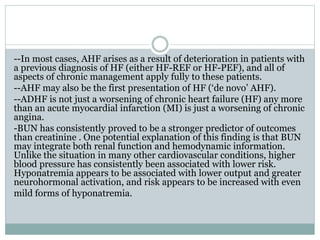
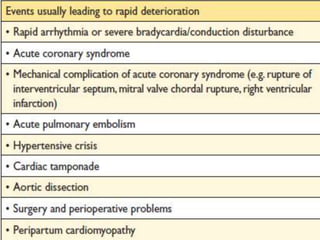
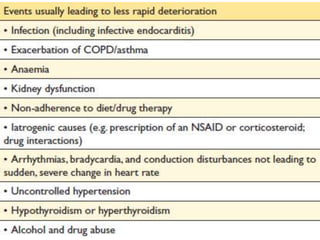
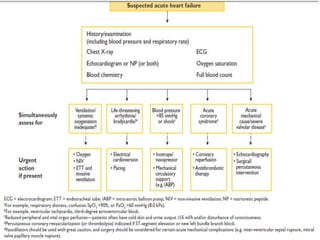
--In most cases, AHF arises as a result of deterioration in patients with
a previous diagnosis of HF (either HF-REF or HF-PEF), and all of
aspects of chronic management apply fully to these patients.
--AHF may also be the first presentation of HF (‘de novo’ AHF).
--ADHF is not just a worsening of chronic heart failure (HF) any more
than an acute myocardial infarction (MI) is just a worsening of chronic
angina.
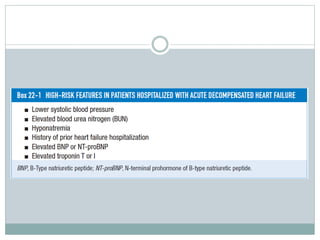
-BUN has consistently proved to be a stronger predictor of outcomes
than creatinine . One potential explanation of this finding is that BUN
may integrate both renal function and hemodynamic information.
Unlike the situation in many other cardiovascular conditions, higher
blood pressure has consistently been associated with lower risk.
Hyponatremia appears to be associated with lower output and greater
neurohormonal activation, and risk appears to be increased with even
mild forms of hyponatremia.
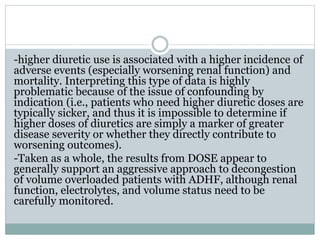
-higher diuretic use is associated with a higher incidence of
adverse events (especially worsening renal function) and
mortality. Interpreting this type of data is highly
problematic because of the issue of confounding by
indication (i.e., patients who need higher diuretic doses are
typically sicker, and thus it is impossible to determine if
higher doses of diuretics are simply a marker of greater
disease severity or whether they directly contribute to
worsening outcomes).
-Taken as a whole, the results from DOSE appear to
generally support an aggressive approach to decongestion
of volume overloaded patients with ADHF, although renal
function, electrolytes, and volume status need to be
carefully monitored.
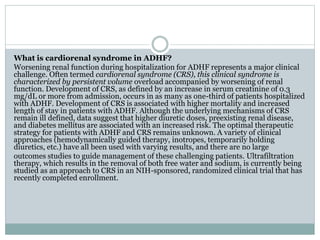
What is cardiorenal syndrome in ADHF?
Worsening renal function during hospitalization for ADHF represents a major clinical
challenge. Often termed cardiorenal syndrome (CRS), this clinical syndrome is
characterized by persistent volume overload accompanied by worsening of renal
function. Development of CRS, as defined by an increase in serum creatinine of 0.3
mg/dL or more from admission, occurs in as many as one-third of patients hospitalized
with ADHF. Development of CRS is associated with higher mortality and increased
length of stay in patients with ADHF. Although the underlying mechanisms of CRS
remain ill defined, data suggest that higher diuretic doses, preexisting renal disease,
and diabetes mellitus are associated with an increased risk. The optimal therapeutic
strategy for patients with ADHF and CRS remains unknown. A variety of clinical
approaches (hemodynamically guided therapy, inotropes, temporarily holding
diuretics, etc.) have all been used with varying results, and there are no large
outcomes studies to guide management of these challenging patients. Ultrafiltration
therapy, which results in the removal of both free water and sodium, is currently being
studied as an approach to CRS in an NIH-sponsored, randomized clinical trial that has
recently completed enrollment.
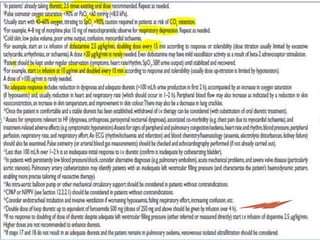
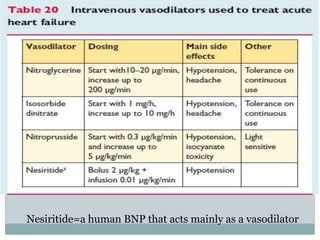
Nesiritide=a human BNP that acts mainly as a vasodilator
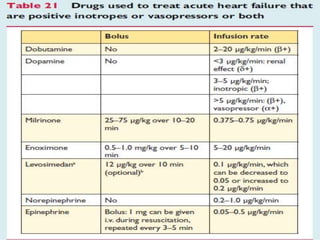
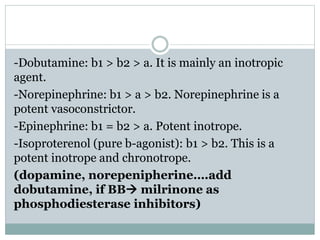
-Dobutamine: b1 > b2 > a. It is mainly an inotropic
agent.
-Norepinephrine: b1 > a > b2. Norepinephrine is a
potent vasoconstrictor.
-Epinephrine: b1 = b2 > a. Potent inotrope.
-Isoproterenol (pure b-agonist): b1 > b2. This is a
potent inotrope and chronotrope.
(dopamine, norepenipherine….add
dobutamine, if BB milrinone as
phosphodiesterase inhibitors)
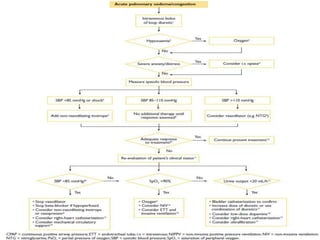
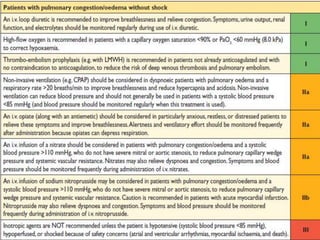
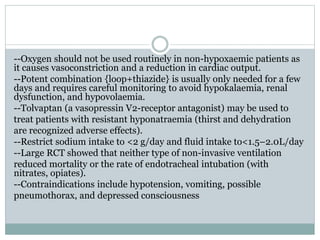
--Oxygen should not be used routinely in non-hypoxaemic patients as
it causes vasoconstriction and a reduction in cardiac output.
--Potent combination {loop+thiazide} is usually only needed for a few
days and requires careful monitoring to avoid hypokalaemia, renal
dysfunction, and hypovolaemia.
--Tolvaptan (a vasopressin V2-receptor antagonist) may be used to
treat patients with resistant hyponatraemia (thirst and dehydration
are recognized adverse effects).
--Restrict sodium intake to <2 g/day and fluid intake to<1.5–2.0L/day
--Large RCT showed that neither type of non-invasive ventilation
reduced mortality or the rate of endotracheal intubation (with
nitrates, opiates).
--Contraindications include hypotension, vomiting, possible
pneumothorax, and depressed consciousness
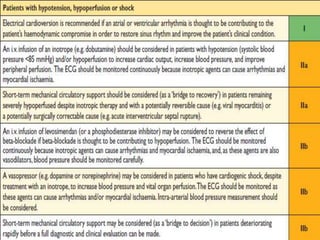
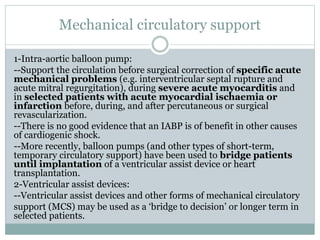
Mechanical circulatory support
1-Intra-aortic balloon pump:
--Support the circulation before surgical correction of specific acute
mechanical problems (e.g. interventricular septal rupture and
acute mitral regurgitation), during severe acute myocarditis and
in selected patients with acute myocardial ischaemia or
infarction before, during, and after percutaneous or surgical
revascularization.
--There is no good evidence that an IABP is of benefit in other causes
of cardiogenic shock.
--More recently, balloon pumps (and other types of short-term,
temporary circulatory support) have been used to bridge patients
until implantation of a ventricular assist device or heart
transplantation.
2-Ventricular assist devices:
--Ventricular assist devices and other forms of mechanical circulatory
support (MCS) may be used as a ‘bridge to decision’ or longer term in
selected patients.
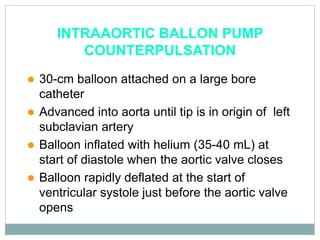
INTRAAORTIC BALLON PUMP
COUNTERPULSATION
 30-cm balloon attached on a large bore
catheter
 Advanced into aorta until tip is in origin of left
subclavian artery
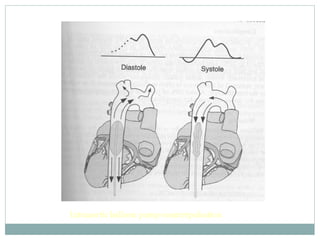
 Balloon inflated with helium (35-40 mL) at
start of diastole when the aortic valve closes
 Balloon rapidly deflated at the start of
ventricular systole just before the aortic valve
opens
Intraaortic balloon pump counterpulsation
INTRAAORTIC BALLOON PUMP
COUNTERPULSATION
Mechanics
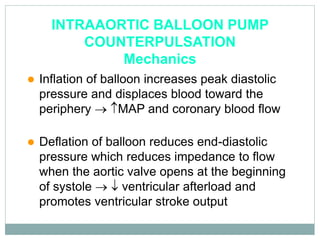
 Inflation of balloon increases peak diastolic
pressure and displaces blood toward the
periphery  MAP and coronary blood flow
 Deflation of balloon reduces end-diastolic
pressure which reduces impedance to flow
when the aortic valve opens at the beginning
of systole   ventricular afterload and
promotes ventricular stroke output
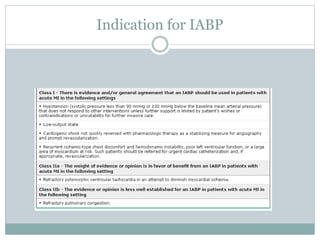
Indication for IABP
Contraindications to IABP
Significant aortic regurgitation or significant arteriovenous
shunting
Abdominal aortic aneurysm or aortic dissection
Uncontrolled sepsis
Uncontrolled bleeding disorder
Severe bilateral peripheral vascular disease
Bilateral femoral popliteal bypass grafts for severe peripheral
vascular disease.
Complications of IABP
Cholesterol Embolization
CVA
Sepsis
Balloon rupture
Thrombocytopenia
Hemolysis
Groin Infection
Peripheral Neuropathy
Thank you

management of acute Heart failure

  • 1.
    D . BA S E M E L S A I D E N A N Y L E C T U R E R O F C A R D I O L O G Y A I N S H A M S U N I V E R S I T Y Acute HF
  • 2.
    Definition A physiologic statecharacterized by Inadequate tissue perfusion Clinically manifested by Hemodynamic disturbances Organ dysfunction
  • 3.
    Initial signs ofend organ dysfunction Tachycardia Tachypnea Metabolic acidosis Oliguria Cool and clammy skin
  • 4.
    End Organ Dysfunction Progressiveirreversible dysfunction Oliguria or anuria Progressive acidosis and decreased CO Agitation, obtundation, and coma Patient death
  • 5.
    --In most cases,AHF arises as a result of deterioration in patients with a previous diagnosis of HF (either HF-REF or HF-PEF), and all of aspects of chronic management apply fully to these patients. --AHF may also be the first presentation of HF (‘de novo’ AHF). --ADHF is not just a worsening of chronic heart failure (HF) any more than an acute myocardial infarction (MI) is just a worsening of chronic angina. -BUN has consistently proved to be a stronger predictor of outcomes than creatinine . One potential explanation of this finding is that BUN may integrate both renal function and hemodynamic information. Unlike the situation in many other cardiovascular conditions, higher blood pressure has consistently been associated with lower risk. Hyponatremia appears to be associated with lower output and greater neurohormonal activation, and risk appears to be increased with even mild forms of hyponatremia.
  • 12.
    -higher diuretic useis associated with a higher incidence of adverse events (especially worsening renal function) and mortality. Interpreting this type of data is highly problematic because of the issue of confounding by indication (i.e., patients who need higher diuretic doses are typically sicker, and thus it is impossible to determine if higher doses of diuretics are simply a marker of greater disease severity or whether they directly contribute to worsening outcomes). -Taken as a whole, the results from DOSE appear to generally support an aggressive approach to decongestion of volume overloaded patients with ADHF, although renal function, electrolytes, and volume status need to be carefully monitored.
  • 13.
    What is cardiorenalsyndrome in ADHF? Worsening renal function during hospitalization for ADHF represents a major clinical challenge. Often termed cardiorenal syndrome (CRS), this clinical syndrome is characterized by persistent volume overload accompanied by worsening of renal function. Development of CRS, as defined by an increase in serum creatinine of 0.3 mg/dL or more from admission, occurs in as many as one-third of patients hospitalized with ADHF. Development of CRS is associated with higher mortality and increased length of stay in patients with ADHF. Although the underlying mechanisms of CRS remain ill defined, data suggest that higher diuretic doses, preexisting renal disease, and diabetes mellitus are associated with an increased risk. The optimal therapeutic strategy for patients with ADHF and CRS remains unknown. A variety of clinical approaches (hemodynamically guided therapy, inotropes, temporarily holding diuretics, etc.) have all been used with varying results, and there are no large outcomes studies to guide management of these challenging patients. Ultrafiltration therapy, which results in the removal of both free water and sodium, is currently being studied as an approach to CRS in an NIH-sponsored, randomized clinical trial that has recently completed enrollment.
  • 16.
    Nesiritide=a human BNPthat acts mainly as a vasodilator
  • 18.
    -Dobutamine: b1 >b2 > a. It is mainly an inotropic agent. -Norepinephrine: b1 > a > b2. Norepinephrine is a potent vasoconstrictor. -Epinephrine: b1 = b2 > a. Potent inotrope. -Isoproterenol (pure b-agonist): b1 > b2. This is a potent inotrope and chronotrope. (dopamine, norepenipherine….add dobutamine, if BB milrinone as phosphodiesterase inhibitors)
  • 23.
    --Oxygen should notbe used routinely in non-hypoxaemic patients as it causes vasoconstriction and a reduction in cardiac output. --Potent combination {loop+thiazide} is usually only needed for a few days and requires careful monitoring to avoid hypokalaemia, renal dysfunction, and hypovolaemia. --Tolvaptan (a vasopressin V2-receptor antagonist) may be used to treat patients with resistant hyponatraemia (thirst and dehydration are recognized adverse effects). --Restrict sodium intake to <2 g/day and fluid intake to<1.5–2.0L/day --Large RCT showed that neither type of non-invasive ventilation reduced mortality or the rate of endotracheal intubation (with nitrates, opiates). --Contraindications include hypotension, vomiting, possible pneumothorax, and depressed consciousness
  • 24.
    Mechanical circulatory support 1-Intra-aorticballoon pump: --Support the circulation before surgical correction of specific acute mechanical problems (e.g. interventricular septal rupture and acute mitral regurgitation), during severe acute myocarditis and in selected patients with acute myocardial ischaemia or infarction before, during, and after percutaneous or surgical revascularization. --There is no good evidence that an IABP is of benefit in other causes of cardiogenic shock. --More recently, balloon pumps (and other types of short-term, temporary circulatory support) have been used to bridge patients until implantation of a ventricular assist device or heart transplantation. 2-Ventricular assist devices: --Ventricular assist devices and other forms of mechanical circulatory support (MCS) may be used as a ‘bridge to decision’ or longer term in selected patients.
  • 25.
    INTRAAORTIC BALLON PUMP COUNTERPULSATION 30-cm balloon attached on a large bore catheter  Advanced into aorta until tip is in origin of left subclavian artery  Balloon inflated with helium (35-40 mL) at start of diastole when the aortic valve closes  Balloon rapidly deflated at the start of ventricular systole just before the aortic valve opens
  • 26.
    Intraaortic balloon pumpcounterpulsation
  • 27.
    INTRAAORTIC BALLOON PUMP COUNTERPULSATION Mechanics Inflation of balloon increases peak diastolic pressure and displaces blood toward the periphery  MAP and coronary blood flow  Deflation of balloon reduces end-diastolic pressure which reduces impedance to flow when the aortic valve opens at the beginning of systole   ventricular afterload and promotes ventricular stroke output
  • 28.
  • 29.
    Contraindications to IABP Significantaortic regurgitation or significant arteriovenous shunting Abdominal aortic aneurysm or aortic dissection Uncontrolled sepsis Uncontrolled bleeding disorder Severe bilateral peripheral vascular disease Bilateral femoral popliteal bypass grafts for severe peripheral vascular disease.
  • 30.
    Complications of IABP CholesterolEmbolization CVA Sepsis Balloon rupture Thrombocytopenia Hemolysis Groin Infection Peripheral Neuropathy
  • 32.