Lifestyles, Fitness
and Rehabilitation

                                      Heart Failure
                                        CCF/CHF
                 LVF 1st              + RVF 2nd = CCF/CHF
                                                   By :
                                             Mr Murdin b Amit
                      Bsc in Health Science (Hons), Ba in Buissness Administration (Hrm)(Hons)
                                 Head of Medical Science Subject
                                College of Assistant Medical Officer,
                                     Seremban, Negeri Sembilan
                                      murdin_1966@yahoo.com
                                        HP: 012 - 6044385
Lifestyles, Fitness       Heart Failure
and Rehabilitation


         • What is Heart Failure?
             – The heart is not pumping as well as it
               should
             – Usually, the heart has been weakened
               by an underlying condition
                  •   Blocked arteries
                  •   Heart attack
                  •   High blood pressure
                  •   Infections
                  •   Heart valve abnormalities
Lifestyles, Fitness   Heart Failure
and Rehabilitation


         • What is Heart Failure?
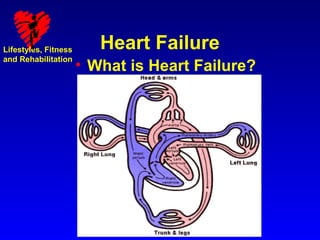
             – Heart failure can involve the left or right
               side of the heart or both
             – Usually the left side is affected first
             – Heart failure occurs when either side of
               the heart cannot keep up with the flow
               of blood
Lifestyles, Fitness      Heart Failure
and Rehabilitation
                      • What is Heart Failure?
Lifestyles, Fitness     Heart Failure
and Rehabilitation


        • What is Left Heart Failure?
             – Involves the left ventricle (lower
               chamber) of the heart
             – Systolic failure
                 • The heart looses it’s ability to contract or
                   pump blood into the circulation
             – Diastolic failure
                 • The heart looses it’s ability to relax because
                   it becomes stiff
                 • Heart cannot fill properly between each beat
Lifestyles, Fitness   Heart Failure
and Rehabilitation


       • What is Left Heart Failure?
           – Systolic and diastolic heart failure are
             treated with different types of
             medications
           – In both types, blood may “back up” in
             the lungs causing fluid to leak into the
             lungs (pulmonary edema)
           – Fluid may also build up in tissues
             throughout the body (edema)
Lifestyles, Fitness   Heart Failure
and Rehabilitation


       • What is Right Heart Failure?
           – Usually occurs as a result of left heart
             failure
           – The right ventricle pumps blood to the
             lungs for oxygen
           – Occasionally isolated right heart failure
             can occur due to lung disease or blood
             clots to the lung (pulmonary embolism)
Lifestyles, Fitness   Heart Failure
and Rehabilitation


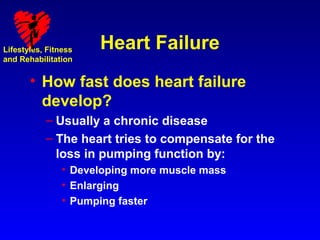
       • How fast does heart failure
         develop?
           – Usually a chronic disease
           – The heart tries to compensate for the
             loss in pumping function by:
                • Developing more muscle mass
                • Enlarging
                • Pumping faster
Lifestyles, Fitness      Heart Failure
and Rehabilitation


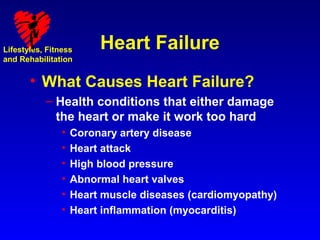
       • What Causes Heart Failure?
           – Health conditions that either damage
             the heart or make it work too hard
                •   Coronary artery disease
                •   Heart attack
                •   High blood pressure
                •   Abnormal heart valves
                •   Heart muscle diseases (cardiomyopathy)
                •   Heart inflammation (myocarditis)
Lifestyles, Fitness      Heart Failure
and Rehabilitation


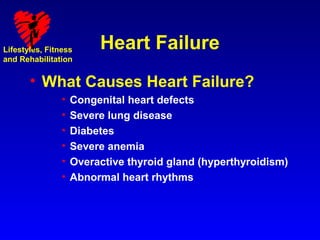
       • What Causes Heart Failure?
                •   Congenital heart defects
                •   Severe lung disease
                •   Diabetes
                •   Severe anemia
                •   Overactive thyroid gland (hyperthyroidism)
                •   Abnormal heart rhythms
Lifestyles, Fitness   Heart Failure
and Rehabilitation


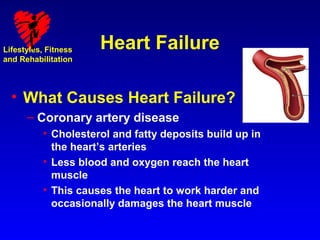
  • What Causes Heart Failure?
      – Coronary artery disease
          • Cholesterol and fatty deposits build up in
            the heart’s arteries
          • Less blood and oxygen reach the heart
            muscle
          • This causes the heart to work harder and
            occasionally damages the heart muscle
Heart Failure
Lifestyles, Fitness
and Rehabilitation


• What Causes Heart Failure?
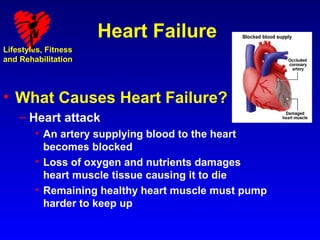
    – Heart attack
        • An artery supplying blood to the heart
          becomes blocked
        • Loss of oxygen and nutrients damages
          heart muscle tissue causing it to die
        • Remaining healthy heart muscle must pump
          harder to keep up
Heart Failure
Lifestyles, Fitness
and Rehabilitation

          • What Causes Heart Failure?
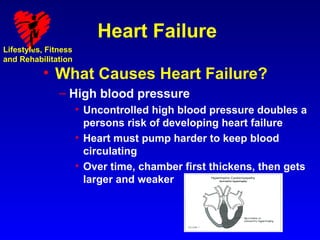
               – High blood pressure
                      • Uncontrolled high blood pressure doubles a
                        persons risk of developing heart failure
                      • Heart must pump harder to keep blood
                        circulating
                      • Over time, chamber first thickens, then gets
                        larger and weaker
Heart Failure
Lifestyles, Fitness
and Rehabilitation


        • What Causes Heart Failure?
             – Abnormal heart valves
             – Heart muscle disease
                 • Damage to heart muscle due to drugs,
                   alcohol or infections
             – Congenital heart disease
             – Severe lung disease
Heart Failure
Lifestyles, Fitness
and Rehabilitation


        • What Causes Heart Failure?
             – Diabetes
                 • Tend to have other conditions that make the
                   heart work harder
                 • Obesity
                 • Hypertension
                 • High cholesterol
Heart Failure
Lifestyles, Fitness
and Rehabilitation


        • What Causes Heart Failure?
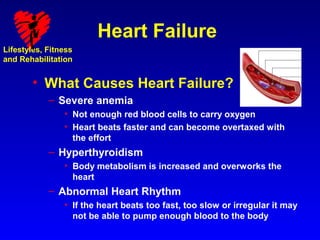
            – Severe anemia
                • Not enough red blood cells to carry oxygen
                • Heart beats faster and can become overtaxed with
                  the effort
            – Hyperthyroidism
                • Body metabolism is increased and overworks the
                  heart
            – Abnormal Heart Rhythm
                • If the heart beats too fast, too slow or irregular it may
                  not be able to pump enough blood to the body
Heart Failure
Lifestyles, Fitness
and Rehabilitation


        • Signs and Symptoms of Heart Failure
            – Shortness of Breath (dyspnea)
                • WHY?
                      – Blood “backs up” in the pulmonary veins
                        because the heart can’t keep up with the supply
                        an fluid leaks into the lungs
                • SYMPTOMS
                      – Dyspnea on exertion or at rest
                      – Difficulty breathing when lying flat
                      – Waking up short of breath
Heart Failure
Lifestyles, Fitness
and Rehabilitation


        • Signs and Symptoms of Heart Failure
            – Persistent Cough or Wheezing
                • WHY?
                      – Fluid “backs up” in the lungs
                • SYMPTOMS
                      – Coughing that produces white or pink blood-
                        tinged sputum (Froty Sputum)
Heart Failure
Lifestyles, Fitness
and Rehabilitation


        • Signs and Symptoms of Heart Failure
            – Edema
                • WHY?
                      – Decreased blood flow out of the weak heart
                      – Blood returning to the heart from the veins
                        “backs up” causing fluid to build up in tissues
                • SYMPTOMS
                      – Swelling in feet, ankles, legs or abdomen
                      – Weight gain
Heart Failure
Lifestyles, Fitness
and Rehabilitation


        • Signs and Symptoms of Heart Failure
            – Tiredness, fatigue
                • WHY?
                      – Heart can’t pump enough blood to meet needs of
                        bodies tissues
                      – Body diverts blood away from less vital organs
                        (muscles in limbs) and sends it to the heart and
                        brain
                • SYMPTOMS
                      – Constant tired feeling
                      – Difficulty with everyday activities
Heart Failure
Lifestyles, Fitness
and Rehabilitation


        • Signs and Symptoms of Heart Failure
            – Lack of appetite/ Nausea
                • WHY?
                      – The digestive system receives less blood
                        causing problems with digestion
                      – Physiological disturbance to Vagus nerve
                • SYMPTOMS
                      – Feeling of being full or sick to your stomach
Heart Failure
Lifestyles, Fitness
and Rehabilitation


        • Signs and Symptoms of Heart Failure
            – Confusion/ Impaired thinking
                • WHY?
                      – Changing levels of substances in the blood
                        ( sodium) can cause confusion
                      – Lack of O2 reach to the brain
                • SYMPTOMS
                      – Memory loss or feeling of disorientation
                      – Relative or caregiver may notice this first
Heart Failure
Lifestyles, Fitness
and Rehabilitation


        • Signs and Symptoms of Heart Failure
            – Increased heart rate
                • WHY?
                      – The heart beats faster to “make up for” the loss
                        in pumping function
                • SYMPTOMS
                      – Heart palpitations
                      – May feel like the heart is racing or throbbing
Heart Failure
Lifestyles, Fitness
and Rehabilitation
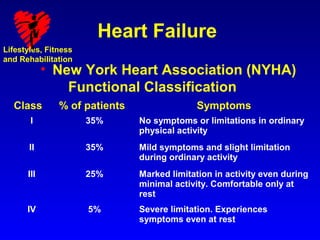
            • New York Heart Association (NYHA)
                Functional Classification
  Class        % of patients                Symptoms
       I              35%      No symptoms or limitations in ordinary
                               physical activity
       II             35%      Mild symptoms and slight limitation
                               during ordinary activity
      III             25%      Marked limitation in activity even during
                               minimal activity. Comfortable only at
                               rest
      IV              5%       Severe limitation. Experiences
                               symptoms even at rest
Heart Failure
Lifestyles, Fitness
and Rehabilitation


          • Treatment Options
              – The more common forms of heart failure
                cannot be cured, but can be treated
                  • Lifestyle changes
                  • Medications
                  • Surgery
Heart Failure
Lifestyles, Fitness
and Rehabilitation


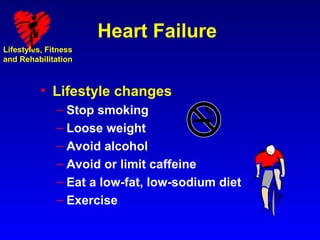
          • Lifestyle changes
              – Stop smoking
              – Loose weight
              – Avoid alcohol
              – Avoid or limit caffeine
              – Eat a low-fat, low-sodium diet
              – Exercise
Heart Failure
Lifestyles, Fitness
and Rehabilitation


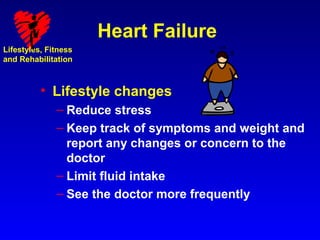
          • Lifestyle changes
              – Reduce stress
              – Keep track of symptoms and weight and
                report any changes or concern to the
                doctor
              – Limit fluid intake
              – See the doctor more frequently
Heart Failure
Lifestyles, Fitness
and Rehabilitation


          • Medications used to treat Heart
            Failure
              – ACE Inhibitors (Enalapril 5-10mg bd/tds)
                  • Cornerstone of heart failure therapy
                  • Proven to slow the progression of heart
                    failure
                  • Vasodilator – cause blood vessels to
                    expand lowering blood pressure and the
                    hearts work load
Heart Failure
Lifestyles, Fitness
and Rehabilitation


   • Medications used to treat Heart Failure
        – Diuretics (water pills) – Frusemide 40-80mg
            • Prescribed for fluid build up, swelling or edema
            • Cause kidneys to remove more sodium and
              water from the bloodstream
            • Decreases workload of the heart and edema
            • Fine balance – removing too much fluid can
              strain kidneys or cause low blood pressure
Heart Failure
Lifestyles, Fitness
and Rehabilitation


          • Medications used to treat Heart
            Failure
              – Potassium
                  • Most diuretics remove potassium from the
                    body
                  • Potassium pills compensate for the amount
                    lost in the urine
                  • Potassium helps control heart rhythm and
                    is essential for the normal work of the
                    nervous system and muscles
Heart Failure
Lifestyles, Fitness
and Rehabilitation


• Medications used to treat Heart Failure
     – Vasodilators
         •   Hydrallazine 100mg stat or Prazosin 1-2mg bd/tds
         •   Cause blood vessel walls to relax
         •   Occasionally used if patient cannot tolerate ACE
         •   Decrease workload of the heart
Heart Failure
Lifestyles, Fitness
and Rehabilitation


 • Medications used to treat Heart Failure
     – Digitalis preparations
          • Digoxin 0.25mg-0.5mg bd
          • Increases the force of the hearts contractions,
            increases the blood stroke volume
          • Relieves symptoms
          • Slows heart rate and certain irregular heart beats
Heart Failure
Lifestyles, Fitness
and Rehabilitation


 • Medications used to treat Heart Failure
     – Beta-blockers (Tab Metoprolol 50-200mg)
          • Lower the heart rate and blood pressure
          • Decrease the workload of the heart
     – Blood-thinners (coumadin)
          • Used in patients at risk for developing blood clots
            in the blood vessels, legs, lung and heart
          • Used in irregular heart rhythms due to risk of
            stroke
Heart Failure
Lifestyles, Fitness
and Rehabilitation


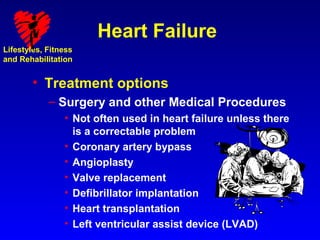
        • Treatment options
            – Surgery and other Medical Procedures
                • Not often used in heart failure unless there
                  is a correctable problem
                • Coronary artery bypass
                • Angioplasty
                • Valve replacement
                • Defibrillator implantation
                • Heart transplantation
                • Left ventricular assist device (LVAD)

Lvf + rvf heart failure

  • 1.
    Lifestyles, Fitness and Rehabilitation Heart Failure CCF/CHF LVF 1st + RVF 2nd = CCF/CHF By : Mr Murdin b Amit Bsc in Health Science (Hons), Ba in Buissness Administration (Hrm)(Hons) Head of Medical Science Subject College of Assistant Medical Officer, Seremban, Negeri Sembilan murdin_1966@yahoo.com HP: 012 - 6044385
  • 2.
    Lifestyles, Fitness Heart Failure and Rehabilitation • What is Heart Failure? – The heart is not pumping as well as it should – Usually, the heart has been weakened by an underlying condition • Blocked arteries • Heart attack • High blood pressure • Infections • Heart valve abnormalities
  • 3.
    Lifestyles, Fitness Heart Failure and Rehabilitation • What is Heart Failure? – Heart failure can involve the left or right side of the heart or both – Usually the left side is affected first – Heart failure occurs when either side of the heart cannot keep up with the flow of blood
  • 4.
    Lifestyles, Fitness Heart Failure and Rehabilitation • What is Heart Failure?
  • 5.
    Lifestyles, Fitness Heart Failure and Rehabilitation • What is Left Heart Failure? – Involves the left ventricle (lower chamber) of the heart – Systolic failure • The heart looses it’s ability to contract or pump blood into the circulation – Diastolic failure • The heart looses it’s ability to relax because it becomes stiff • Heart cannot fill properly between each beat
  • 6.
    Lifestyles, Fitness Heart Failure and Rehabilitation • What is Left Heart Failure? – Systolic and diastolic heart failure are treated with different types of medications – In both types, blood may “back up” in the lungs causing fluid to leak into the lungs (pulmonary edema) – Fluid may also build up in tissues throughout the body (edema)
  • 7.
    Lifestyles, Fitness Heart Failure and Rehabilitation • What is Right Heart Failure? – Usually occurs as a result of left heart failure – The right ventricle pumps blood to the lungs for oxygen – Occasionally isolated right heart failure can occur due to lung disease or blood clots to the lung (pulmonary embolism)
  • 8.
    Lifestyles, Fitness Heart Failure and Rehabilitation • How fast does heart failure develop? – Usually a chronic disease – The heart tries to compensate for the loss in pumping function by: • Developing more muscle mass • Enlarging • Pumping faster
  • 9.
    Lifestyles, Fitness Heart Failure and Rehabilitation • What Causes Heart Failure? – Health conditions that either damage the heart or make it work too hard • Coronary artery disease • Heart attack • High blood pressure • Abnormal heart valves • Heart muscle diseases (cardiomyopathy) • Heart inflammation (myocarditis)
  • 10.
    Lifestyles, Fitness Heart Failure and Rehabilitation • What Causes Heart Failure? • Congenital heart defects • Severe lung disease • Diabetes • Severe anemia • Overactive thyroid gland (hyperthyroidism) • Abnormal heart rhythms
  • 11.
    Lifestyles, Fitness Heart Failure and Rehabilitation • What Causes Heart Failure? – Coronary artery disease • Cholesterol and fatty deposits build up in the heart’s arteries • Less blood and oxygen reach the heart muscle • This causes the heart to work harder and occasionally damages the heart muscle
  • 12.
    Heart Failure Lifestyles, Fitness andRehabilitation • What Causes Heart Failure? – Heart attack • An artery supplying blood to the heart becomes blocked • Loss of oxygen and nutrients damages heart muscle tissue causing it to die • Remaining healthy heart muscle must pump harder to keep up
  • 13.
    Heart Failure Lifestyles, Fitness andRehabilitation • What Causes Heart Failure? – High blood pressure • Uncontrolled high blood pressure doubles a persons risk of developing heart failure • Heart must pump harder to keep blood circulating • Over time, chamber first thickens, then gets larger and weaker
  • 14.
    Heart Failure Lifestyles, Fitness andRehabilitation • What Causes Heart Failure? – Abnormal heart valves – Heart muscle disease • Damage to heart muscle due to drugs, alcohol or infections – Congenital heart disease – Severe lung disease
  • 15.
    Heart Failure Lifestyles, Fitness andRehabilitation • What Causes Heart Failure? – Diabetes • Tend to have other conditions that make the heart work harder • Obesity • Hypertension • High cholesterol
  • 16.
    Heart Failure Lifestyles, Fitness andRehabilitation • What Causes Heart Failure? – Severe anemia • Not enough red blood cells to carry oxygen • Heart beats faster and can become overtaxed with the effort – Hyperthyroidism • Body metabolism is increased and overworks the heart – Abnormal Heart Rhythm • If the heart beats too fast, too slow or irregular it may not be able to pump enough blood to the body
  • 17.
    Heart Failure Lifestyles, Fitness andRehabilitation • Signs and Symptoms of Heart Failure – Shortness of Breath (dyspnea) • WHY? – Blood “backs up” in the pulmonary veins because the heart can’t keep up with the supply an fluid leaks into the lungs • SYMPTOMS – Dyspnea on exertion or at rest – Difficulty breathing when lying flat – Waking up short of breath
  • 18.
    Heart Failure Lifestyles, Fitness andRehabilitation • Signs and Symptoms of Heart Failure – Persistent Cough or Wheezing • WHY? – Fluid “backs up” in the lungs • SYMPTOMS – Coughing that produces white or pink blood- tinged sputum (Froty Sputum)
  • 19.
    Heart Failure Lifestyles, Fitness andRehabilitation • Signs and Symptoms of Heart Failure – Edema • WHY? – Decreased blood flow out of the weak heart – Blood returning to the heart from the veins “backs up” causing fluid to build up in tissues • SYMPTOMS – Swelling in feet, ankles, legs or abdomen – Weight gain
  • 20.
    Heart Failure Lifestyles, Fitness andRehabilitation • Signs and Symptoms of Heart Failure – Tiredness, fatigue • WHY? – Heart can’t pump enough blood to meet needs of bodies tissues – Body diverts blood away from less vital organs (muscles in limbs) and sends it to the heart and brain • SYMPTOMS – Constant tired feeling – Difficulty with everyday activities
  • 21.
    Heart Failure Lifestyles, Fitness andRehabilitation • Signs and Symptoms of Heart Failure – Lack of appetite/ Nausea • WHY? – The digestive system receives less blood causing problems with digestion – Physiological disturbance to Vagus nerve • SYMPTOMS – Feeling of being full or sick to your stomach
  • 22.
    Heart Failure Lifestyles, Fitness andRehabilitation • Signs and Symptoms of Heart Failure – Confusion/ Impaired thinking • WHY? – Changing levels of substances in the blood ( sodium) can cause confusion – Lack of O2 reach to the brain • SYMPTOMS – Memory loss or feeling of disorientation – Relative or caregiver may notice this first
  • 23.
    Heart Failure Lifestyles, Fitness andRehabilitation • Signs and Symptoms of Heart Failure – Increased heart rate • WHY? – The heart beats faster to “make up for” the loss in pumping function • SYMPTOMS – Heart palpitations – May feel like the heart is racing or throbbing
  • 24.
    Heart Failure Lifestyles, Fitness andRehabilitation • New York Heart Association (NYHA) Functional Classification Class % of patients Symptoms I 35% No symptoms or limitations in ordinary physical activity II 35% Mild symptoms and slight limitation during ordinary activity III 25% Marked limitation in activity even during minimal activity. Comfortable only at rest IV 5% Severe limitation. Experiences symptoms even at rest
  • 25.
    Heart Failure Lifestyles, Fitness andRehabilitation • Treatment Options – The more common forms of heart failure cannot be cured, but can be treated • Lifestyle changes • Medications • Surgery
  • 26.
    Heart Failure Lifestyles, Fitness andRehabilitation • Lifestyle changes – Stop smoking – Loose weight – Avoid alcohol – Avoid or limit caffeine – Eat a low-fat, low-sodium diet – Exercise
  • 27.
    Heart Failure Lifestyles, Fitness andRehabilitation • Lifestyle changes – Reduce stress – Keep track of symptoms and weight and report any changes or concern to the doctor – Limit fluid intake – See the doctor more frequently
  • 28.
    Heart Failure Lifestyles, Fitness andRehabilitation • Medications used to treat Heart Failure – ACE Inhibitors (Enalapril 5-10mg bd/tds) • Cornerstone of heart failure therapy • Proven to slow the progression of heart failure • Vasodilator – cause blood vessels to expand lowering blood pressure and the hearts work load
  • 29.
    Heart Failure Lifestyles, Fitness andRehabilitation • Medications used to treat Heart Failure – Diuretics (water pills) – Frusemide 40-80mg • Prescribed for fluid build up, swelling or edema • Cause kidneys to remove more sodium and water from the bloodstream • Decreases workload of the heart and edema • Fine balance – removing too much fluid can strain kidneys or cause low blood pressure
  • 30.
    Heart Failure Lifestyles, Fitness andRehabilitation • Medications used to treat Heart Failure – Potassium • Most diuretics remove potassium from the body • Potassium pills compensate for the amount lost in the urine • Potassium helps control heart rhythm and is essential for the normal work of the nervous system and muscles
  • 31.
    Heart Failure Lifestyles, Fitness andRehabilitation • Medications used to treat Heart Failure – Vasodilators • Hydrallazine 100mg stat or Prazosin 1-2mg bd/tds • Cause blood vessel walls to relax • Occasionally used if patient cannot tolerate ACE • Decrease workload of the heart
  • 32.
    Heart Failure Lifestyles, Fitness andRehabilitation • Medications used to treat Heart Failure – Digitalis preparations • Digoxin 0.25mg-0.5mg bd • Increases the force of the hearts contractions, increases the blood stroke volume • Relieves symptoms • Slows heart rate and certain irregular heart beats
  • 33.
    Heart Failure Lifestyles, Fitness andRehabilitation • Medications used to treat Heart Failure – Beta-blockers (Tab Metoprolol 50-200mg) • Lower the heart rate and blood pressure • Decrease the workload of the heart – Blood-thinners (coumadin) • Used in patients at risk for developing blood clots in the blood vessels, legs, lung and heart • Used in irregular heart rhythms due to risk of stroke
  • 34.
    Heart Failure Lifestyles, Fitness andRehabilitation • Treatment options – Surgery and other Medical Procedures • Not often used in heart failure unless there is a correctable problem • Coronary artery bypass • Angioplasty • Valve replacement • Defibrillator implantation • Heart transplantation • Left ventricular assist device (LVAD)