D.Basem elsaid enany
Lecturer of cardiology
Ainshams university
Acute coronary syndrome
History:
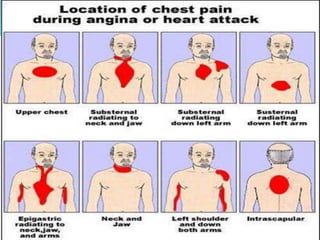
• Substernal/left sided chest pressure or tightness is
common
• Onset is gradual
• Pain radiating to shoulders or pain with exertion increases

relative risk
• "Atypical" symptoms (eg, dyspnea, weakness) more
common in elderly, women, diabetics
Examination:
Nonspecific
• May detect signs of HF
ECG:
• ST segment elevations, Q waves, new left bundle
branch block are evidence of AMI
• Single ECG is not sensitive for ACS
• Prominent R waves with ST segment depressions in V1
and V2 strongly suggests posterior AMI
Chest x ray:
• Nonspecific
• May show evidence of HF
Additional tests:
• Troponin and/or CK-MB elevations diagnose AMI
• Single set of biomarkers is not sufficiently sensitive to
rule out AMI
Additional data:
Assume symptoms of ACS within days or a few weeks of
PCI or CABG is from an occluded artery or graft
Aortic dissection
History:
• Sudden onset of sharp, tearing, or ripping pain
• Maximal severity at onset
• Most often begins in chest, can begin in back
• Can mimic: stroke, ACS, mesenteric ischemia, kidney stone
Examination:
• Absent upper extremity or carotid pulse is suggestive
• Discrepancy in systolic BP >20 mmHg between right
and left upper extremity is suggestive
• Up to 30 % with neurologic findings
• Findings vary with arteries affected
ECG:
• Ischemic changes in 15 %
• Nonspecific ST and T changes in 30 %
Chest X ray:
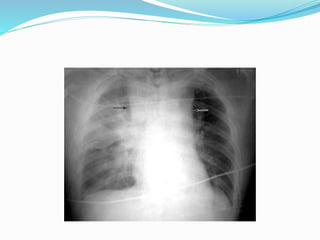
• Wide mediastinum or loss of normal aortic knob
contour is common (up to 76 %)
• 10 % have normal CXR
Additional tests:
TEE, MSCT
Additional data:
• Can mimic many diseases depending on branch
arteries involved (eg, AMI, stroke)
Pulmonary embolism
History:
• Many possible presentations, including pleuritic pain
and painless dyspnea
• Often sudden onset
• Dyspnea often dominant feature
Examiantion:
• No finding is sensitive or specific
• Extremity exam generally normal
• Lung exam generally nonspecific; focal wheezing may
be present; tachypnea is common
ECG:
• Usually abnormal but nonspecific
• Signs of right heart strain suggestive (eg, RAD, RBBB,
RAE, sinus tachycardia)
Chest X ray:
• Great majority are normal
• May show: atelectasis, elevated hemidiaphragm,
pleural effusion
Additional tests:
• A high-sensitivity D-dimer is useful to rule out PE only
when negative in low-risk patients
• Echo: RV dilatation, hypokinesia, may see embolus in
PA
• MSCT
Tension pneumothorax
History:
• Often sudden onset
• Initial pain often sharp and pleuritic
• Dyspnea often dominant feature
Examiantion:
• Ipsilateral diminished or absent breath sounds
• Subcutaneous emphysema is uncommon
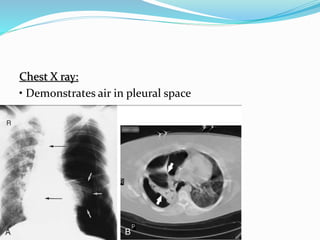
Chest X ray:
• Demonstrates air in pleural space
Pericarditis:
History:
• Pain from pericarditis is most often sharp anterior chest
pain made worse by inspiration or lying supine and relieved
by sitting forward
• Dyspnea is common
Examination:
• Severe tamponade creates obstructive shock, and
causes jugular venous distension, pulsus paradoxus
• Pericarditis can cause friction rub
ECG:
• Decreased voltage and electrical alternans can appear
with significant effusions
• Diffuse PR segment depressions and/or ST segment
elevations can appear with acute pericarditis
Chest X ray:
• May reveal enlarged heart
Additional investigation:
• Ultrasound reveals pericardial effusion with
tamponade
Mediastinitis
History:
• Forceful vomiting often precedes esophageal rupture
• Recent upper endoscopy or instrumentation increases risk of
perforation
• Coexistent respiratory and gastrointestinal complaints may occur
Examiantion:
• Ill-appearing; shock, fever
• May hear (Hamman's) crunch over mediastinum
Chest X ray:
• Large majority have some abnormality:
pneumomediastinum, pleural effusion, pneumothorax
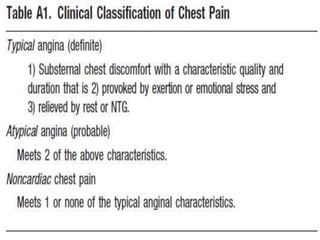
Noninvasive stress testing is best indicated in patients with an intermediate pretest
probability of disease. The addition of an imaging modality to stress is best indicated
in patients in whom an exercise ECG will be nondiagnostic for ischemia, eg, LBBB,
ventricular pacing, greater than 1 mm of resting ST segment depression. A man over
the age 40 and a woman over the age of 60 with typical angina have a high
pretest probability for coronary disease and all things being equal should be referred
for coronary angiography directly for the diagnosis. A 50-year-old asymptomatic
woman has a very low pretest probability for disease and does not warrant further
investigation. A 45-year-old woman with a history of atypical chest pain also has a low
pre-test probability of disease and may not require a stress test. With a normal resting
ECG a stress ECG would be the preferred initial modality. Despite her young age, the
symptoms of typical angina, even in a 30-year-old woman, place her at an intermediate
risk of coronary disease, increased further by the presence of resting ST segment
depression. Given that she would have a nondiagnostic stress ECG a stress imaging
study is appropriate.
-Thallium and technetium are the two most commonly
used isotopes in Nuclear Cardiology tests. Technetium
has a higher energy, less radiation danger as better
penetration
-Sestamibi no redistribution after 24 h , not used in
viability
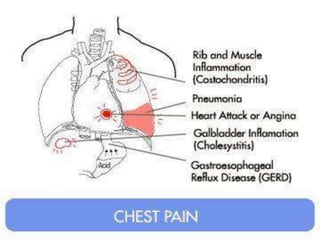
What are some of the common causes of chest pain that
can be identified on a chest radiograph?
Aortic dissection
Pneumonia
Pneumothorax
Pulmonary embolism
Subcutaneous emphysema
Pericarditis (if a large pericardial effusion is suggested by the
radiograph)
Esophageal rupture
Hiatal hernia
Thank you…….

Chest pain differential diagnosis

  • 1.
    D.Basem elsaid enany Lecturerof cardiology Ainshams university
  • 2.
    Acute coronary syndrome History: •Substernal/left sided chest pressure or tightness is common • Onset is gradual • Pain radiating to shoulders or pain with exertion increases relative risk • "Atypical" symptoms (eg, dyspnea, weakness) more common in elderly, women, diabetics
  • 5.
  • 6.
    ECG: • ST segmentelevations, Q waves, new left bundle branch block are evidence of AMI • Single ECG is not sensitive for ACS • Prominent R waves with ST segment depressions in V1 and V2 strongly suggests posterior AMI
  • 7.
    Chest x ray: •Nonspecific • May show evidence of HF
  • 8.
    Additional tests: • Troponinand/or CK-MB elevations diagnose AMI • Single set of biomarkers is not sufficiently sensitive to rule out AMI
  • 9.
    Additional data: Assume symptomsof ACS within days or a few weeks of PCI or CABG is from an occluded artery or graft
  • 10.
    Aortic dissection History: • Suddenonset of sharp, tearing, or ripping pain • Maximal severity at onset • Most often begins in chest, can begin in back • Can mimic: stroke, ACS, mesenteric ischemia, kidney stone
  • 11.
    Examination: • Absent upperextremity or carotid pulse is suggestive • Discrepancy in systolic BP >20 mmHg between right and left upper extremity is suggestive • Up to 30 % with neurologic findings • Findings vary with arteries affected
  • 12.
    ECG: • Ischemic changesin 15 % • Nonspecific ST and T changes in 30 %
  • 13.
    Chest X ray: •Wide mediastinum or loss of normal aortic knob contour is common (up to 76 %) • 10 % have normal CXR Additional tests: TEE, MSCT
  • 15.
    Additional data: • Canmimic many diseases depending on branch arteries involved (eg, AMI, stroke)
  • 16.
    Pulmonary embolism History: • Manypossible presentations, including pleuritic pain and painless dyspnea • Often sudden onset • Dyspnea often dominant feature
  • 17.
    Examiantion: • No findingis sensitive or specific • Extremity exam generally normal • Lung exam generally nonspecific; focal wheezing may be present; tachypnea is common
  • 18.
    ECG: • Usually abnormalbut nonspecific • Signs of right heart strain suggestive (eg, RAD, RBBB, RAE, sinus tachycardia)
  • 19.
    Chest X ray: •Great majority are normal • May show: atelectasis, elevated hemidiaphragm, pleural effusion
  • 20.
    Additional tests: • Ahigh-sensitivity D-dimer is useful to rule out PE only when negative in low-risk patients • Echo: RV dilatation, hypokinesia, may see embolus in PA • MSCT
  • 21.
    Tension pneumothorax History: • Oftensudden onset • Initial pain often sharp and pleuritic • Dyspnea often dominant feature
  • 22.
    Examiantion: • Ipsilateral diminishedor absent breath sounds • Subcutaneous emphysema is uncommon
  • 23.
    Chest X ray: •Demonstrates air in pleural space
  • 24.
    Pericarditis: History: • Pain frompericarditis is most often sharp anterior chest pain made worse by inspiration or lying supine and relieved by sitting forward • Dyspnea is common
  • 25.
    Examination: • Severe tamponadecreates obstructive shock, and causes jugular venous distension, pulsus paradoxus • Pericarditis can cause friction rub
  • 26.
    ECG: • Decreased voltageand electrical alternans can appear with significant effusions • Diffuse PR segment depressions and/or ST segment elevations can appear with acute pericarditis
  • 27.
    Chest X ray: •May reveal enlarged heart
  • 28.
    Additional investigation: • Ultrasoundreveals pericardial effusion with tamponade
  • 29.
    Mediastinitis History: • Forceful vomitingoften precedes esophageal rupture • Recent upper endoscopy or instrumentation increases risk of perforation • Coexistent respiratory and gastrointestinal complaints may occur
  • 30.
    Examiantion: • Ill-appearing; shock,fever • May hear (Hamman's) crunch over mediastinum
  • 31.
    Chest X ray: •Large majority have some abnormality: pneumomediastinum, pleural effusion, pneumothorax
  • 34.
    Noninvasive stress testingis best indicated in patients with an intermediate pretest probability of disease. The addition of an imaging modality to stress is best indicated in patients in whom an exercise ECG will be nondiagnostic for ischemia, eg, LBBB, ventricular pacing, greater than 1 mm of resting ST segment depression. A man over the age 40 and a woman over the age of 60 with typical angina have a high pretest probability for coronary disease and all things being equal should be referred for coronary angiography directly for the diagnosis. A 50-year-old asymptomatic woman has a very low pretest probability for disease and does not warrant further investigation. A 45-year-old woman with a history of atypical chest pain also has a low pre-test probability of disease and may not require a stress test. With a normal resting ECG a stress ECG would be the preferred initial modality. Despite her young age, the symptoms of typical angina, even in a 30-year-old woman, place her at an intermediate risk of coronary disease, increased further by the presence of resting ST segment depression. Given that she would have a nondiagnostic stress ECG a stress imaging study is appropriate.
  • 35.
    -Thallium and technetiumare the two most commonly used isotopes in Nuclear Cardiology tests. Technetium has a higher energy, less radiation danger as better penetration -Sestamibi no redistribution after 24 h , not used in viability
  • 37.
    What are someof the common causes of chest pain that can be identified on a chest radiograph? Aortic dissection Pneumonia Pneumothorax Pulmonary embolism Subcutaneous emphysema Pericarditis (if a large pericardial effusion is suggested by the radiograph) Esophageal rupture Hiatal hernia
  • 38.