INFECTIVE
ENDOCARDITIS
By
DR. Vijayanand Palanisamy
Associate consultant-cardiac surgery
Madras Medical Mission Hospital
DEFINITION:
 Infective Endocarditis is the microbial infection of
heart valve (Native or prosthetic) the lining of
cardiac chamber or blood vessel, or congenital
anomaly (v. Septal defect).
 Causative organism is usually bacteria, ricketsia
(coxiella burnetii endocarditis), chlamydia or
fungus.
 Left>Right.
 Mitral>Aortic
 Regurgitant>Stenotic
 Prosthetic valve endocarditis:
Early- Within 60 days (Staph most
common).
Late- After 60 days (Strep most
common).
DEFINITION
Infective Endocarditis (IE): an infection
of the heart’s endocardial surface
Main Classification:
–Native Valve IE
–Prosthetic Valve IE
Additional Consideration
–Intravenous drug abuse (IVDA) IE
–Nosocomial IE
5
INFECTIVE ENDOCARDITIS
• Acute
– Toxic presentation
– Progressive valve destruction & metastatic infection
developing in days to weeks
– Most commonly caused by S. aureus
• Sub acute
– Mild toxicity
– Presentation over weeks to months
– Rarely leads to metastatic infection
– Most commonly S. viridans or enterococcus
6
ESSENTIALS OF DIAGNOSIS
Preexisting organic heart lesion.
Fever
New or changing heart murmur
Evidence of systemic emboli
Positive blood culture
Evidence of vegetation on
echocardiography.
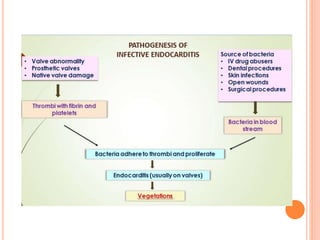
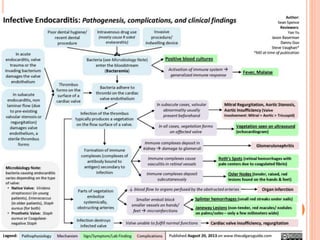
PATHOPHYSIOLOGY
Preexisting endocardial damage
Virulent organism (Staphylococci) cause
endocarditis in normal valves of heart ,
tricuspid valve endocarditis in IVDU
Wide variety of acquired & congenital cardiac
lesions are vulnerable to endocarditis
Breaks in skin
Any indwelling device/catheter
Defects associated with jet lesions (High
pressure jets of blood) of VSD, MR, AR,
stenotic lesions susceptible to
endocarditis.
Low pressure lesions like large ASD
endocarditis is less likely
At the sites of endocardial damage
infection occur.
These areas attract platelet & fibrin.
Colonization of blood born organism
Vegetation break away & embolise.
Adjacent tissue may be destroyed
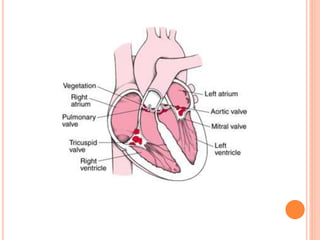
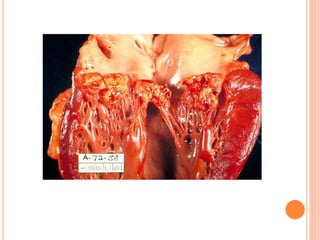
 When infections is established,
vegetation consisting of organism, fibrin,
platelets grow & become large.
 Vegetations can erode into underlying
myocardium producing abscesses (ring
abscess)
 Perforation or disruption of chordae.
 Extra cardiac manifestation eg.
vasculitis, skin lesions and emboli or
immune complex deposit.
 At postmortem: Infarction of kidney,
spleen, immune complex GN.
AETIOLOGY
• Majority of cases of IE are caused by gram +ve bacteria
• Staphylococcus aureus(SA) is now more common (31-
54%) than oral Streptococci
• Methicillin Sensitive SA is more frequent in community-
acquired IE, infects mainly native valves & is associated
with bacteraemia of unknown origin
• MRSA is more related to nosocomial infection, wound
infection, permanent IV catheters or surgery in previous
6/12
AETIOLOGY
• Strep viridans is now less common (12-
26%) but difficult to isolate & confers
partial resistance to ABx
• Coag -ve Staph were main cause of
prosthetic valve endocarditits in the past,
esp within first 6-12/12 after valve surgery,
MRSA is now more common
AETIOLOGY
• Enterococci
• HACEK group:
• Haemophilus group
• Actinobacillus group
• Cardiobacterium hominis
• Eikenella corrodens
• Kingella kingae
• All commensals in the oral cavity
OTHER CAUSES
• Candida & Aspergillus species cause the majority of fungal
IE (1-3% of IE)
• Patients with IV DRUG USER, prosthetic valve & long-
term CENTRAL VENOUS CATHETER are more likely to
have fungal IE: needs to be considered in presence of
bulky vegetations, metastatic infection, perivalvular
invasion, or embolisation to large blood vessels despite -ve
BC
• In 10-15% of all cases of endocarditis no organism can be
isolated from Blood Culture (“culture-negative”
endocarditis)
OTHER CAUSES
• Whenever BC -ve IE is suspected other organisms such as
Coxiella burnetti, Legionella spp, Brucella spp, Bartonella
spp &, Chlamydiae spp, must be considered
CLINICAL FINDINGS
SYMPTOMS & SIGNS
 Febrile illness
 Nonspecific symptom cough, dyspnea,
arthalgia or arthritis, diarrhea,
abdominal pain
 Cerebral emboli
 Sub conjunctival haemorrage
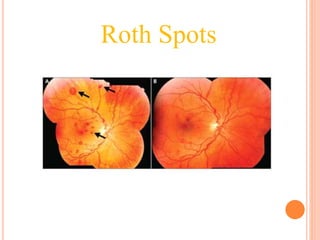
 Roth’s spot in fundi
Petechial hemorrhage in mucous
membrane & fundi
Varying murmurs
Conduction disorders
Cardiac failure
Splenomegaly
Hematuria
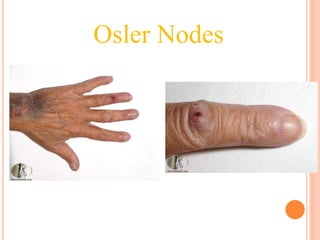
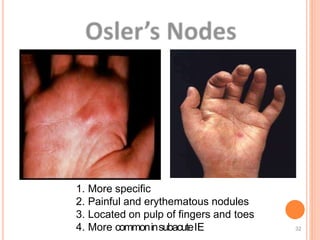
Osler’s nodes
Digital clubbing
Splinter haemorrhage
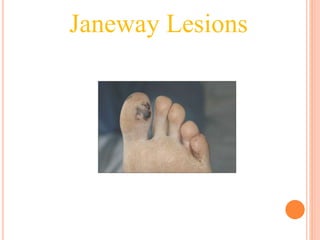
Janeway lesions
Systemic emboli
Petechial rash
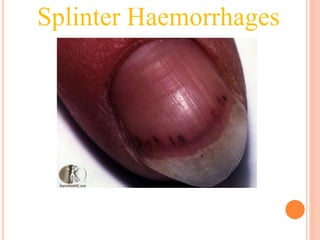
Splinter Haemorrhages
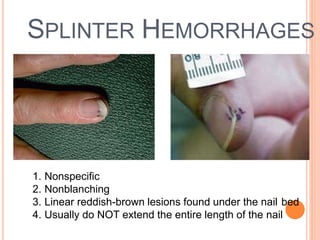
SPLINTER HEMORRHAGES
1. Nonspecific
2. Nonblanching
3. Linear reddish-brown lesions found under the nail bed
4. Usually do NOT extend the entire length of the nail
23
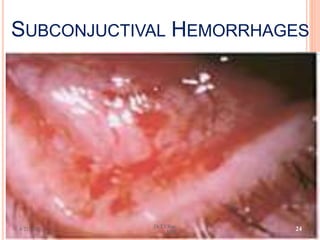
SUBCONJUCTIVAL HEMORRHAGES
6/21/2013
Dr.T.V.Rao
MD
24
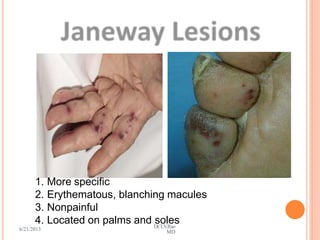
Janeway Lesions
1. More specific
2. Erythematous, blanching macules
3. Nonpainful
4. Located on palms and soles
6/21/2013
Dr.T.V.Rao
MD
26
Osler Nodes
1. More specific
2. Painful and erythematous nodules
3. Located on pulp of fingers and toes
4. More commoninsubacuteIE 32
Roth Spots
DIAGNOSIS
• The modified Duke criteria based on clinical,
microbiological & echo findings providing high sensitivity
& specificity (~80%) for diagnosis of IE when applied to
patients with native valve IE with +ve BC
MODIFIED DUKE CRITERIA
 Major Diagnostic Criteria
 Blood culture positive for IE
Typical microorganisms consistent with IE from 2 separate blood cultures:
Viridans streptococci, Streptococcus bovis, HACEK group, Staphylococcus
aureus; or community-acquired enterococci in the absence of a primary
focus, or microorganisms consistent with IE from persistently positive blood
cultures defined as follows: at least 2 positive cultures of blood samples
drawn >12 h apart or all 3 or a majority of ≥4 separate cultures of blood (with
first and last sample drawn at least 1 h apart)
Single positive blood culture for Coxiella burnetii or anti–phase 1 IgG
antibody titer ≥1:800
Evidence of endocardial involvement by echo.
Echocardiogram positive for IE (TEE recommended for patients with
prosthetic valves, rated at least possible IE by clinical criteria, or
complicated IE [paravalvular abscess]; TTE as first test in other
patients) defined as follows: oscillating intracardiac mass on valve or
supporting structures, in the path of regurgitant jets, or on implanted
material in the absence of an alternative anatomic explanation; abscess;
or new partial dehiscence of prosthetic valve or new valvular regurgitation
(worsening or changing or pre-existing murmur not sufficient)
 Minor Diagnostic Criteria
 Predisposing heart condition or intravenous drug use
 Temp >38 degrees C (100.4 degrees F)
 Vascular phenomena: arterial emboli, pulmonary infarcts,
mycotic aneurysms, intracranial bleed, conjunctival
hemorrhages, Janeway lesions
 Immunologic phenomena: glomerulonephritis, Osler nodes,
Roth spots, rheumatoid factor
 Microbiological evidence: positive blood culture but does not
meet a major criterion as noted above or serological evidence
of active infection with organism consistent with endocarditis
(excluding coag neg staph, and other common contaminants)
 Echocardiographic minor criteria eliminated
DIAGNOSIS
INVESTIGATIONS
Blood culture three –1 hour interval
from three different sites.
 50% of fungal endocarditis – negative
blood culture
Using PCR has been proposed in these cases
PCR of excised valve tissue or embolic
material should be performed in culture -ve
IE (in cases of valve surgery or
embolectomy)
 ESR
 CRP
 CXR –PA View
 ECG
 Echocardiography Transthoracic -3-5mm
of vegetation sensitivity(65%)
 TEE –1-1.5mm of vegetation sensitivity
(90%)
ECHO
• Findings:
• Vegetation (hallmark lesion of IE)
• Periannular abscess
• New dehiscence of valvular prosthesis
• Aortic/mitral regurg is secondary to valvular necrosis, perforation or
prolapse
• ~50-60% of pts with IE develop Heart Failure secondary to
valvular destruction & require early surgery (mortality
without surgery ~80%)
COMPLICATIONS
 Damage to valves & heart
 Embolic episodes
 Regurgitations
 Extension of infection to myocardium
 Abscess
 Conduction disorders
 Pulmonary abscesses.
PROPHYLAXIS
1. Prosthetic cardiac valves, including transcatheter-implanted
prostheses and homografts.
2. Prosthetic material used for cardiac valve repair, such as
annuloplasty rings and chords.
3. Previous IE.
4. Unrepaired cyanotic congenital heart disease or repaired
congenital heart disease, with residual shunts or valvular
regurgitation at the site of or adjacent to the site of a prosthetic
patch or prosthetic device.
5. Cardiac transplant with valve regurgitation due to a
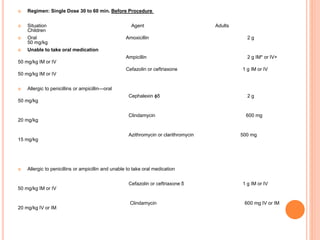
 Regimen: Single Dose 30 to 60 min. Before Procedure
 Situation Agent Adults
Children
 Oral Amoxicillin 2 g
50 mg/kg
 Unable to take oral medication
Ampicillin 2 g IM* or IV+
50 mg/kg IM or IV
Cefazolin or ceftriaxone 1 g IM or IV
50 mg/kg IM or IV
 Allergic to penicillins or ampicillin—oral
Cephalexin ɸδ 2 g
50 mg/kg
Clindamycin 600 mg
20 mg/kg
Azithromycin or clarithromycin 500 mg
15 mg/kg
 Allergic to penicillins or ampicillin and unable to take oral medication
Cefazolin or ceftriaxone δ 1 g IM or IV
50 mg/kg IM or IV
Clindamycin 600 mg IV or IM
20 mg/kg IV or IM
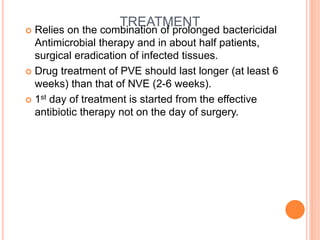
TREATMENT
 Relies on the combination of prolonged bactericidal
Antimicrobial therapy and in about half patients,
surgical eradication of infected tissues.
 Drug treatment of PVE should last longer (at least 6
weeks) than that of NVE (2-6 weeks).
 1st day of treatment is started from the effective
antibiotic therapy not on the day of surgery.
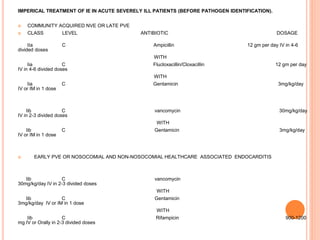
IMPERICAL TREATMENT OF IE IN ACUTE SEVERELY ILL PATIENTS (BEFORE PATHOGEN IDENTIFICATION).
 COMMUNITY ACQUIRED NVE OR LATE PVE
 CLASS LEVEL ANTIBIOTIC DOSAGE
IIa C Ampicillin 12 gm per day IV in 4-6
divided doses
WITH
Iia C Flucloxacillin/Cloxacillin 12 gm per day
IV in 4-6 divided doses
WITH
Iia C Gentamicin 3mg/kg/day
IV or IM in 1 dose
Iib C vancomycin 30mg/kg/day
IV in 2-3 divided doses
WITH
Iib C Gentamicin 3mg/kg/day
IV or IM in 1 dose
 EARLY PVE OR NOSOCOMIAL AND NON-NOSOCOMIAL HEALTHCARE ASSOCIATED ENDOCARDITIS
Iib C vancomycin
30mg/kg/day IV in 2-3 divided doses
WITH
Iib C Gentamicin
3mg/kg/day IV or IM in 1 dose
WITH
Iib C Rifampicin 900-1200
mg IV or Orally in 2-3 divided doses
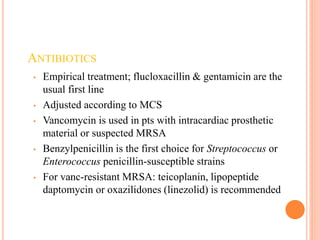
ANTIBIOTICS
• Empirical treatment; flucloxacillin & gentamicin are the
usual first line
• Adjusted according to MCS
• Vancomycin is used in pts with intracardiac prosthetic
material or suspected MRSA
• Benzylpenicillin is the first choice for Streptococcus or
Enterococcus penicillin-susceptible strains
• For vanc-resistant MRSA: teicoplanin, lipopeptide
daptomycin or oxazilidones (linezolid) is recommended
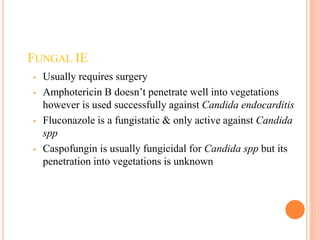
FUNGAL IE
• Usually requires surgery
• Amphotericin B doesn’t penetrate well into vegetations
however is used successfully against Candida endocarditis
• Fluconazole is a fungistatic & only active against Candida
spp
• Caspofungin is usually fungicidal for Candida spp but its
penetration into vegetations is unknown
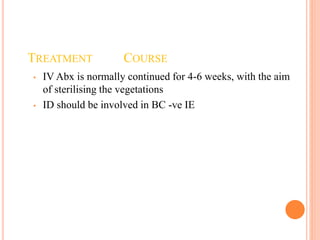
TREATMENT COURSE
• IV Abx is normally continued for 4-6 weeks, with the aim
of sterilising the vegetations
• ID should be involved in BC -ve IE
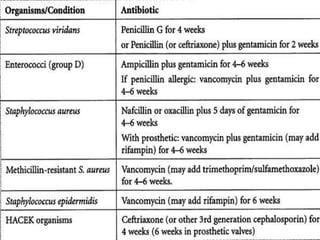
TREATMENT ORGANISM SPECIFIC
SURGERY
• Antimicrobial therapy can only offer curative treatment in
~50%
• The other 50% require surgery
• The surgical goal is valve repair but most require valve
replacement
• Pts with IE + large vegetations, intracardiac abscess (9-
14%) or persisting infection (9-11%) almost always require
surgery
Infective endocarditis

Infective endocarditis

  • 1.
    INFECTIVE ENDOCARDITIS By DR. Vijayanand Palanisamy Associateconsultant-cardiac surgery Madras Medical Mission Hospital
  • 3.
    DEFINITION:  Infective Endocarditisis the microbial infection of heart valve (Native or prosthetic) the lining of cardiac chamber or blood vessel, or congenital anomaly (v. Septal defect).  Causative organism is usually bacteria, ricketsia (coxiella burnetii endocarditis), chlamydia or fungus.
  • 4.
     Left>Right.  Mitral>Aortic Regurgitant>Stenotic  Prosthetic valve endocarditis: Early- Within 60 days (Staph most common). Late- After 60 days (Strep most common).
  • 5.
    DEFINITION Infective Endocarditis (IE):an infection of the heart’s endocardial surface Main Classification: –Native Valve IE –Prosthetic Valve IE Additional Consideration –Intravenous drug abuse (IVDA) IE –Nosocomial IE 5
  • 6.
    INFECTIVE ENDOCARDITIS • Acute –Toxic presentation – Progressive valve destruction & metastatic infection developing in days to weeks – Most commonly caused by S. aureus • Sub acute – Mild toxicity – Presentation over weeks to months – Rarely leads to metastatic infection – Most commonly S. viridans or enterococcus 6
  • 7.
    ESSENTIALS OF DIAGNOSIS Preexistingorganic heart lesion. Fever New or changing heart murmur Evidence of systemic emboli Positive blood culture Evidence of vegetation on echocardiography.
  • 10.
    PATHOPHYSIOLOGY Preexisting endocardial damage Virulentorganism (Staphylococci) cause endocarditis in normal valves of heart , tricuspid valve endocarditis in IVDU Wide variety of acquired & congenital cardiac lesions are vulnerable to endocarditis Breaks in skin Any indwelling device/catheter
  • 11.
    Defects associated withjet lesions (High pressure jets of blood) of VSD, MR, AR, stenotic lesions susceptible to endocarditis. Low pressure lesions like large ASD endocarditis is less likely At the sites of endocardial damage infection occur. These areas attract platelet & fibrin. Colonization of blood born organism Vegetation break away & embolise. Adjacent tissue may be destroyed
  • 12.
     When infectionsis established, vegetation consisting of organism, fibrin, platelets grow & become large.  Vegetations can erode into underlying myocardium producing abscesses (ring abscess)  Perforation or disruption of chordae.  Extra cardiac manifestation eg. vasculitis, skin lesions and emboli or immune complex deposit.  At postmortem: Infarction of kidney, spleen, immune complex GN.
  • 14.
    AETIOLOGY • Majority ofcases of IE are caused by gram +ve bacteria • Staphylococcus aureus(SA) is now more common (31- 54%) than oral Streptococci • Methicillin Sensitive SA is more frequent in community- acquired IE, infects mainly native valves & is associated with bacteraemia of unknown origin • MRSA is more related to nosocomial infection, wound infection, permanent IV catheters or surgery in previous 6/12
  • 15.
    AETIOLOGY • Strep viridansis now less common (12- 26%) but difficult to isolate & confers partial resistance to ABx • Coag -ve Staph were main cause of prosthetic valve endocarditits in the past, esp within first 6-12/12 after valve surgery, MRSA is now more common
  • 16.
    AETIOLOGY • Enterococci • HACEKgroup: • Haemophilus group • Actinobacillus group • Cardiobacterium hominis • Eikenella corrodens • Kingella kingae • All commensals in the oral cavity
  • 17.
    OTHER CAUSES • Candida& Aspergillus species cause the majority of fungal IE (1-3% of IE) • Patients with IV DRUG USER, prosthetic valve & long- term CENTRAL VENOUS CATHETER are more likely to have fungal IE: needs to be considered in presence of bulky vegetations, metastatic infection, perivalvular invasion, or embolisation to large blood vessels despite -ve BC • In 10-15% of all cases of endocarditis no organism can be isolated from Blood Culture (“culture-negative” endocarditis)
  • 18.
    OTHER CAUSES • WheneverBC -ve IE is suspected other organisms such as Coxiella burnetti, Legionella spp, Brucella spp, Bartonella spp &, Chlamydiae spp, must be considered
  • 19.
    CLINICAL FINDINGS SYMPTOMS &SIGNS  Febrile illness  Nonspecific symptom cough, dyspnea, arthalgia or arthritis, diarrhea, abdominal pain  Cerebral emboli  Sub conjunctival haemorrage  Roth’s spot in fundi
  • 20.
    Petechial hemorrhage inmucous membrane & fundi Varying murmurs Conduction disorders Cardiac failure Splenomegaly Hematuria
  • 21.
    Osler’s nodes Digital clubbing Splinterhaemorrhage Janeway lesions Systemic emboli Petechial rash
  • 22.
  • 23.
    SPLINTER HEMORRHAGES 1. Nonspecific 2.Nonblanching 3. Linear reddish-brown lesions found under the nail bed 4. Usually do NOT extend the entire length of the nail 23
  • 24.
  • 25.
  • 26.
    1. More specific 2.Erythematous, blanching macules 3. Nonpainful 4. Located on palms and soles 6/21/2013 Dr.T.V.Rao MD 26
  • 27.
  • 28.
    1. More specific 2.Painful and erythematous nodules 3. Located on pulp of fingers and toes 4. More commoninsubacuteIE 32
  • 29.
  • 30.
    DIAGNOSIS • The modifiedDuke criteria based on clinical, microbiological & echo findings providing high sensitivity & specificity (~80%) for diagnosis of IE when applied to patients with native valve IE with +ve BC
  • 31.
    MODIFIED DUKE CRITERIA Major Diagnostic Criteria  Blood culture positive for IE Typical microorganisms consistent with IE from 2 separate blood cultures: Viridans streptococci, Streptococcus bovis, HACEK group, Staphylococcus aureus; or community-acquired enterococci in the absence of a primary focus, or microorganisms consistent with IE from persistently positive blood cultures defined as follows: at least 2 positive cultures of blood samples drawn >12 h apart or all 3 or a majority of ≥4 separate cultures of blood (with first and last sample drawn at least 1 h apart) Single positive blood culture for Coxiella burnetii or anti–phase 1 IgG antibody titer ≥1:800 Evidence of endocardial involvement by echo. Echocardiogram positive for IE (TEE recommended for patients with prosthetic valves, rated at least possible IE by clinical criteria, or complicated IE [paravalvular abscess]; TTE as first test in other patients) defined as follows: oscillating intracardiac mass on valve or supporting structures, in the path of regurgitant jets, or on implanted material in the absence of an alternative anatomic explanation; abscess; or new partial dehiscence of prosthetic valve or new valvular regurgitation (worsening or changing or pre-existing murmur not sufficient)
  • 32.
     Minor DiagnosticCriteria  Predisposing heart condition or intravenous drug use  Temp >38 degrees C (100.4 degrees F)  Vascular phenomena: arterial emboli, pulmonary infarcts, mycotic aneurysms, intracranial bleed, conjunctival hemorrhages, Janeway lesions  Immunologic phenomena: glomerulonephritis, Osler nodes, Roth spots, rheumatoid factor  Microbiological evidence: positive blood culture but does not meet a major criterion as noted above or serological evidence of active infection with organism consistent with endocarditis (excluding coag neg staph, and other common contaminants)  Echocardiographic minor criteria eliminated
  • 33.
  • 34.
    INVESTIGATIONS Blood culture three–1 hour interval from three different sites.  50% of fungal endocarditis – negative blood culture Using PCR has been proposed in these cases PCR of excised valve tissue or embolic material should be performed in culture -ve IE (in cases of valve surgery or embolectomy)
  • 35.
     ESR  CRP CXR –PA View  ECG  Echocardiography Transthoracic -3-5mm of vegetation sensitivity(65%)  TEE –1-1.5mm of vegetation sensitivity (90%)
  • 36.
    ECHO • Findings: • Vegetation(hallmark lesion of IE) • Periannular abscess • New dehiscence of valvular prosthesis • Aortic/mitral regurg is secondary to valvular necrosis, perforation or prolapse • ~50-60% of pts with IE develop Heart Failure secondary to valvular destruction & require early surgery (mortality without surgery ~80%)
  • 37.
    COMPLICATIONS  Damage tovalves & heart  Embolic episodes  Regurgitations  Extension of infection to myocardium  Abscess  Conduction disorders  Pulmonary abscesses.
  • 38.
    PROPHYLAXIS 1. Prosthetic cardiacvalves, including transcatheter-implanted prostheses and homografts. 2. Prosthetic material used for cardiac valve repair, such as annuloplasty rings and chords. 3. Previous IE. 4. Unrepaired cyanotic congenital heart disease or repaired congenital heart disease, with residual shunts or valvular regurgitation at the site of or adjacent to the site of a prosthetic patch or prosthetic device. 5. Cardiac transplant with valve regurgitation due to a
  • 39.
     Regimen: SingleDose 30 to 60 min. Before Procedure  Situation Agent Adults Children  Oral Amoxicillin 2 g 50 mg/kg  Unable to take oral medication Ampicillin 2 g IM* or IV+ 50 mg/kg IM or IV Cefazolin or ceftriaxone 1 g IM or IV 50 mg/kg IM or IV  Allergic to penicillins or ampicillin—oral Cephalexin ɸδ 2 g 50 mg/kg Clindamycin 600 mg 20 mg/kg Azithromycin or clarithromycin 500 mg 15 mg/kg  Allergic to penicillins or ampicillin and unable to take oral medication Cefazolin or ceftriaxone δ 1 g IM or IV 50 mg/kg IM or IV Clindamycin 600 mg IV or IM 20 mg/kg IV or IM
  • 40.
    TREATMENT  Relies onthe combination of prolonged bactericidal Antimicrobial therapy and in about half patients, surgical eradication of infected tissues.  Drug treatment of PVE should last longer (at least 6 weeks) than that of NVE (2-6 weeks).  1st day of treatment is started from the effective antibiotic therapy not on the day of surgery.
  • 41.
    IMPERICAL TREATMENT OFIE IN ACUTE SEVERELY ILL PATIENTS (BEFORE PATHOGEN IDENTIFICATION).  COMMUNITY ACQUIRED NVE OR LATE PVE  CLASS LEVEL ANTIBIOTIC DOSAGE IIa C Ampicillin 12 gm per day IV in 4-6 divided doses WITH Iia C Flucloxacillin/Cloxacillin 12 gm per day IV in 4-6 divided doses WITH Iia C Gentamicin 3mg/kg/day IV or IM in 1 dose Iib C vancomycin 30mg/kg/day IV in 2-3 divided doses WITH Iib C Gentamicin 3mg/kg/day IV or IM in 1 dose  EARLY PVE OR NOSOCOMIAL AND NON-NOSOCOMIAL HEALTHCARE ASSOCIATED ENDOCARDITIS Iib C vancomycin 30mg/kg/day IV in 2-3 divided doses WITH Iib C Gentamicin 3mg/kg/day IV or IM in 1 dose WITH Iib C Rifampicin 900-1200 mg IV or Orally in 2-3 divided doses
  • 42.
    ANTIBIOTICS • Empirical treatment;flucloxacillin & gentamicin are the usual first line • Adjusted according to MCS • Vancomycin is used in pts with intracardiac prosthetic material or suspected MRSA • Benzylpenicillin is the first choice for Streptococcus or Enterococcus penicillin-susceptible strains • For vanc-resistant MRSA: teicoplanin, lipopeptide daptomycin or oxazilidones (linezolid) is recommended
  • 43.
    FUNGAL IE • Usuallyrequires surgery • Amphotericin B doesn’t penetrate well into vegetations however is used successfully against Candida endocarditis • Fluconazole is a fungistatic & only active against Candida spp • Caspofungin is usually fungicidal for Candida spp but its penetration into vegetations is unknown
  • 44.
    TREATMENT COURSE • IVAbx is normally continued for 4-6 weeks, with the aim of sterilising the vegetations • ID should be involved in BC -ve IE
  • 45.
  • 46.
    SURGERY • Antimicrobial therapycan only offer curative treatment in ~50% • The other 50% require surgery • The surgical goal is valve repair but most require valve replacement • Pts with IE + large vegetations, intracardiac abscess (9- 14%) or persisting infection (9-11%) almost always require surgery