Computer Science
(A Level)
Von Neumann
Architecture
• The Von Neumann architecture has been incredibly successful, with most
modern computers following the idea.
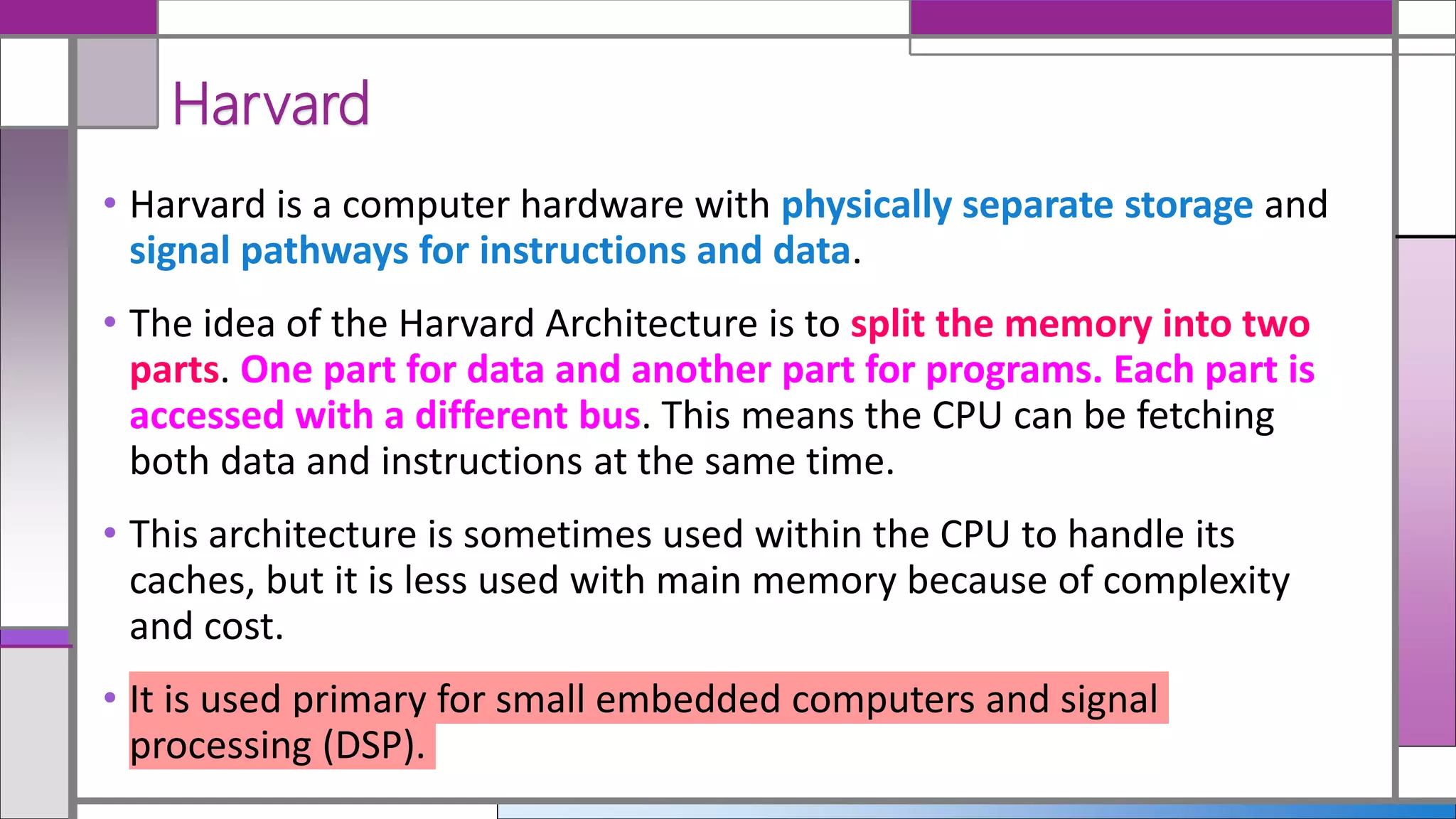
• You will find the CPU chip of a personal computer holding a control unit
and the arithmetic logic unit (along with some local memory) and the
main memory is in the form of RAM sticks located on the motherboard.
• Von Neumann architecture is also known as Stored-Program architecture.
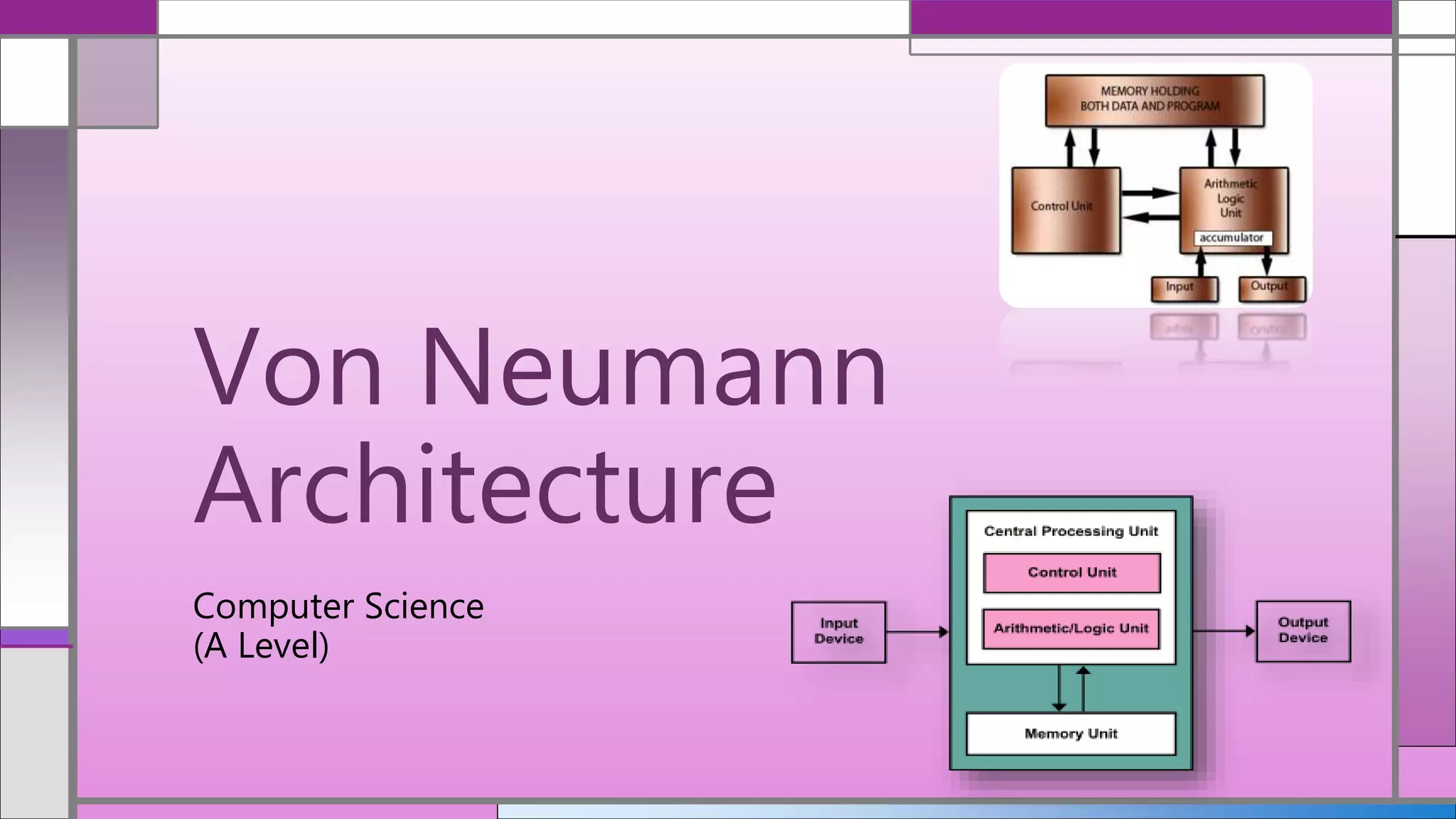
• The most important feature is the Memory that holds both data and
program.
• It is better for desktop computers, laptops, workstations and high
performance computers.
Von Neumann
Von Neumann
Advantages
• The control unit gets data and instructions in the same way from one
memory. It simplifies design and development of the Control Unit.
• Data from memory and from devices are accessed in the same way.
• Development of Control Unit is cheaper and faster than Harvard.
• Easy memory organisation for the user.
• It is better for desktop computers, laptops, workstations and high
performance computers.
• The programs can be optimised in smaller size.
• The code is executed serially and takes more clock cycles
Von Neumann
Disadvantages
• Bottlenecking is an issue because only one bit of information can be
accessed at once
• Confusion between data and instructions can lead to a system crash.
• Instruction stored in the same memory as the data can be accidently
rewritten by an error in a program.
• Serial instruction processing does not allow parallel execution of the
program. Parallel execution are simulated later by the Operating System.
• Only handles one task at a time.
Computer Science
(A Level)
Harvard Architecture
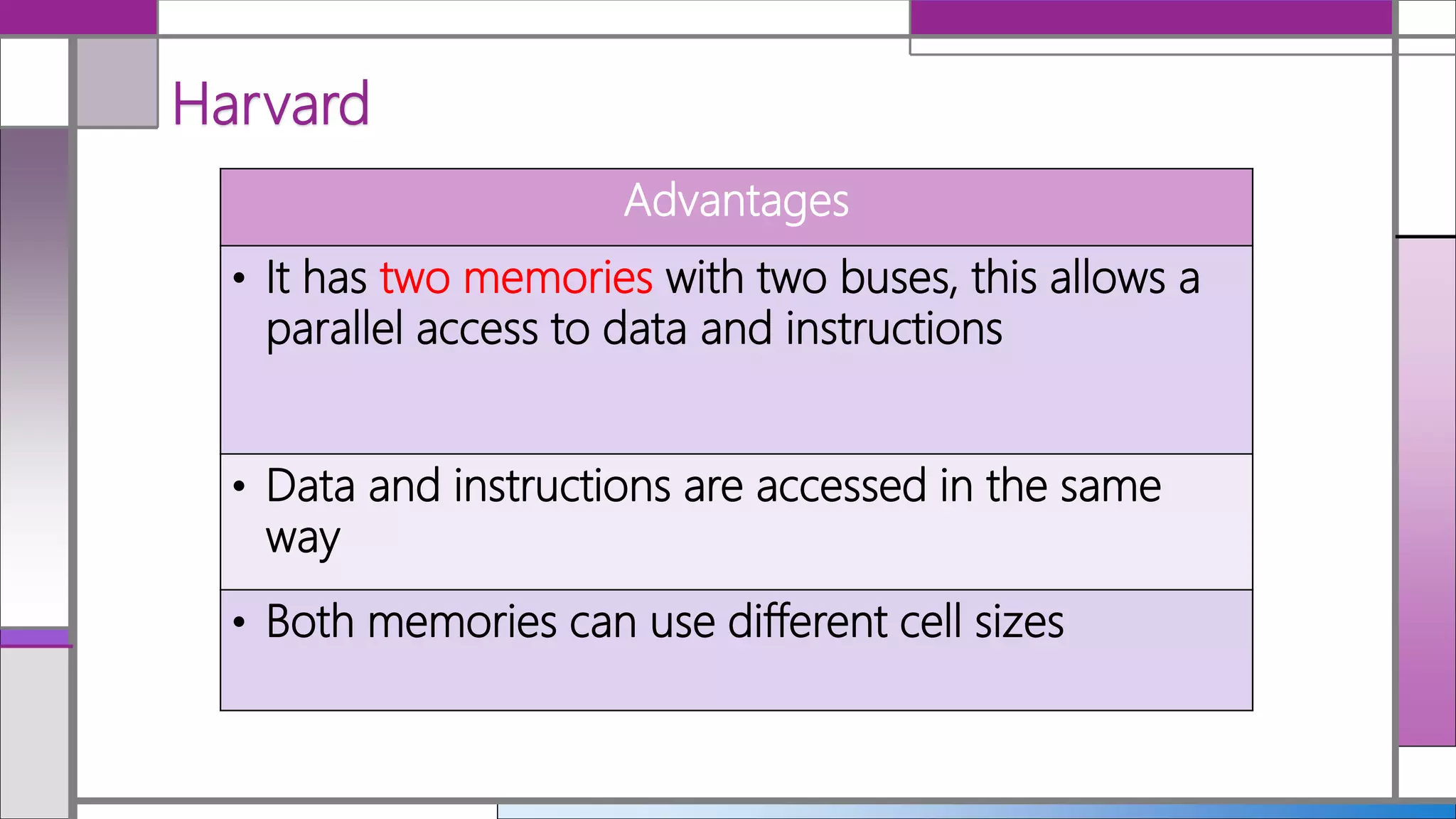
• Harvard is a computer hardware with physically separate storage and
signal pathways for instructions and data.
• The idea of the Harvard Architecture is to split the memory into two
parts. One part for data and another part for programs. Each part is
accessed with a different bus. This means the CPU can be fetching
both data and instructions at the same time.
• This architecture is sometimes used within the CPU to handle its
caches, but it is less used with main memory because of complexity
and cost.
• It is used primary for small embedded computers and signal
processing (DSP).
Harvard
Harvard
Advantages
• It has two memories with two buses, this allows a
parallel access to data and instructions
• Data and instructions are accessed in the same
way
• Both memories can use different cell sizes
Harvard
Disadvantages
• Free data memory cannot be used for instructions and vice-versa
• The program cannot write itself.
• Development of the control unit is expensive and needs more time
• Less chance of program corruption
• Instead of one data bus there are now two. Which means more pins on
the CPU, a more complex motherboard and doubling up on RAM chips as
well as more complex cache design. This is why it is rarely used outside
the CPU.
• Production of a computer with two buses is expensive and needs more
time

Harvard vs Von Neumann Architecture

  • 1.
    Computer Science (A Level) VonNeumann Architecture
  • 2.
    • The VonNeumann architecture has been incredibly successful, with most modern computers following the idea. • You will find the CPU chip of a personal computer holding a control unit and the arithmetic logic unit (along with some local memory) and the main memory is in the form of RAM sticks located on the motherboard. • Von Neumann architecture is also known as Stored-Program architecture. • The most important feature is the Memory that holds both data and program. • It is better for desktop computers, laptops, workstations and high performance computers. Von Neumann
  • 3.
    Von Neumann Advantages • Thecontrol unit gets data and instructions in the same way from one memory. It simplifies design and development of the Control Unit. • Data from memory and from devices are accessed in the same way. • Development of Control Unit is cheaper and faster than Harvard. • Easy memory organisation for the user. • It is better for desktop computers, laptops, workstations and high performance computers. • The programs can be optimised in smaller size. • The code is executed serially and takes more clock cycles
  • 4.
    Von Neumann Disadvantages • Bottleneckingis an issue because only one bit of information can be accessed at once • Confusion between data and instructions can lead to a system crash. • Instruction stored in the same memory as the data can be accidently rewritten by an error in a program. • Serial instruction processing does not allow parallel execution of the program. Parallel execution are simulated later by the Operating System. • Only handles one task at a time.
  • 5.
  • 6.
    • Harvard isa computer hardware with physically separate storage and signal pathways for instructions and data. • The idea of the Harvard Architecture is to split the memory into two parts. One part for data and another part for programs. Each part is accessed with a different bus. This means the CPU can be fetching both data and instructions at the same time. • This architecture is sometimes used within the CPU to handle its caches, but it is less used with main memory because of complexity and cost. • It is used primary for small embedded computers and signal processing (DSP). Harvard
  • 7.
    Harvard Advantages • It hastwo memories with two buses, this allows a parallel access to data and instructions • Data and instructions are accessed in the same way • Both memories can use different cell sizes
  • 8.
    Harvard Disadvantages • Free datamemory cannot be used for instructions and vice-versa • The program cannot write itself. • Development of the control unit is expensive and needs more time • Less chance of program corruption • Instead of one data bus there are now two. Which means more pins on the CPU, a more complex motherboard and doubling up on RAM chips as well as more complex cache design. This is why it is rarely used outside the CPU. • Production of a computer with two buses is expensive and needs more time