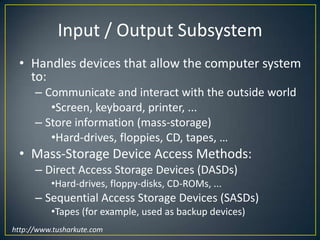
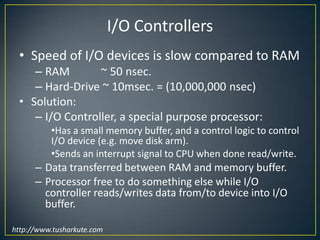
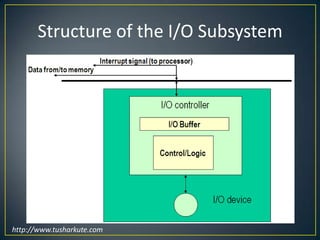
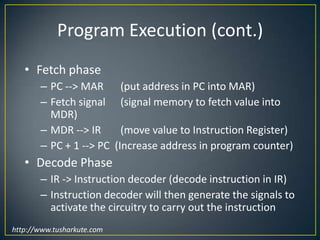
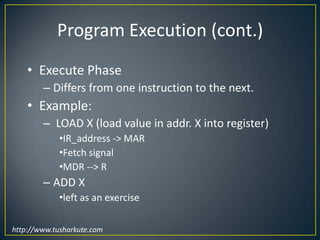
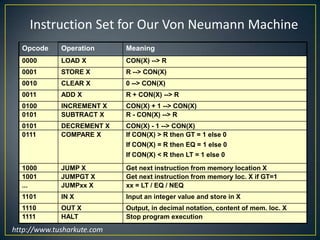
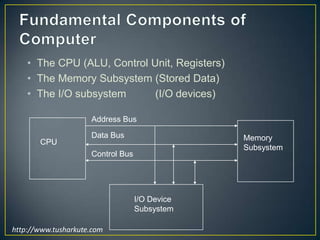
Computer Organization and ArchitectureTushar B Kute,Department of Information Technology, Sandip Institute of Technology and Research Centre, Nashik.
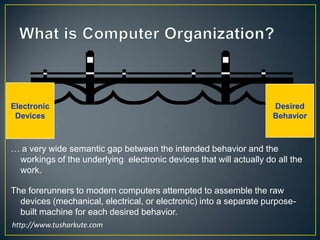
What is Computer Organization?ElectronicDevicesDesiredBehavior… a very wide semantic gap between the intended behavior and the workings of the underlying  electronic devices that will actually do all the work.The forerunners to modern computers attempted to assemble the raw devices (mechanical, electrical, or electronic) into a separate purpose-built machine for each desired behavior.http://www.tusharkute.com
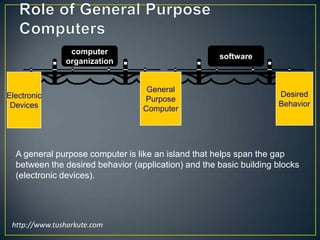
Role of General Purpose ComputerscomputerorganizationsoftwareElectronicDevicesDesiredBehaviorGeneralPurposeComputerA general purpose computer is like an island that helps span the gap between the desired behavior (application) and the basic building blocks (electronic devices).http://www.tusharkute.com
Computer Architecture - DefinitionComputer Architecture = ISA + MOInstruction Set ArchitectureWhat the executable can “see” as underlying hardwareLogical ViewMachine OrganizationHow the hardware implements ISA ?Physical Viewhttp://www.tusharkute.com
Impact of changing ISAEarly 1990’s Apple switched instruction set architecture of the MacintoshFrom Motorola 68000-based machinesTo PowerPC architectureIntel 80x86 Family: many implementations of same architectureprogram written in 1978 for 8086 can be run on latest Pentium chiphttp://www.tusharkute.com
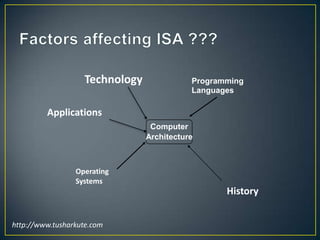
Factors affecting ISA ???TechnologyProgrammingLanguagesApplicationsComputerArchitectureOperatingSystemsHistoryhttp://www.tusharkute.com
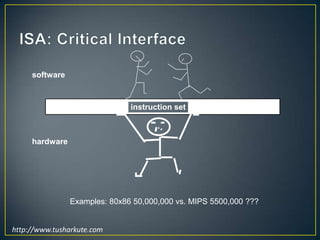
ISA: Critical Interfacesoftwareinstruction sethardwareExamples: 80x86 50,000,000 vs. MIPS 5500,000 ??? http://www.tusharkute.com
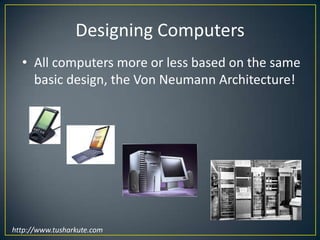
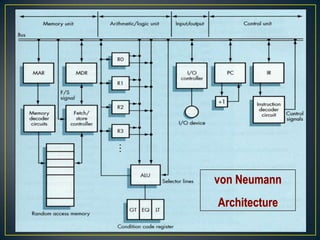
Designing ComputersAll computers more or less based on the same basic design, the Von Neumann Architecture!http://www.tusharkute.com
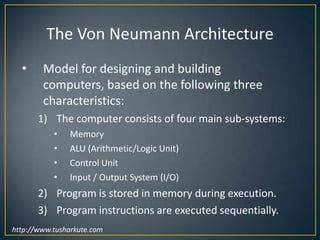
The Von Neumann ArchitectureModel for designing and building computers, based on the following three characteristics:The computer consists of four main sub-systems:Memory
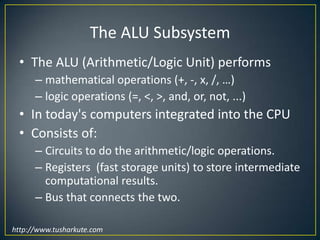
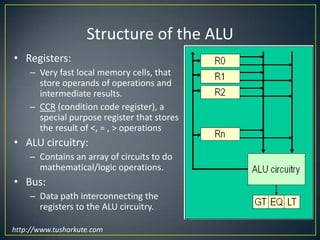
ALU (Arithmetic/Logic Unit)
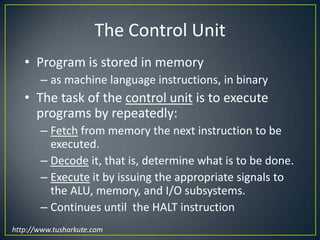
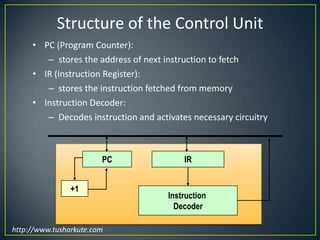
Control Unit
Input / Output System (I/O)Program is stored in memory during execution.Program instructions are executed sequentially.http://www.tusharkute.com
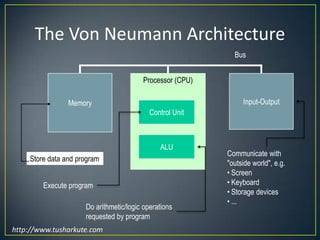
Communicate with"outside world", e.g.  Screen
 Keyboard
 Storage devices
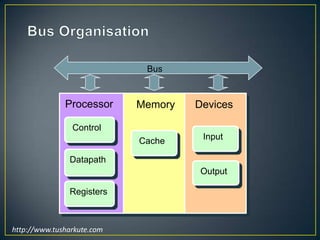
 ...Store data and programExecute programDo arithmetic/logic operationsrequested by programThe Von Neumann ArchitectureBusMemoryProcessor (CPU)Input-OutputControl UnitALUhttp://www.tusharkute.com
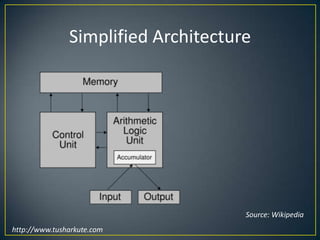
Simplified ArchitectureSource: Wikipediahttp://www.tusharkute.com
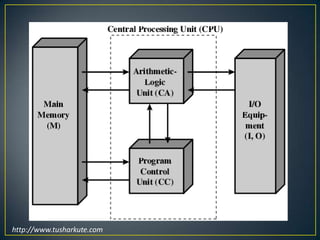
http://www.tusharkute.com
Memory SubsystemMemory, also called RAM (Random Access Memory),
Consists of many memory cells (storage units) of a fixed size. Each cell has an address associated with it: 0, 1, …
All accesses to memory are to a specified address.A cell is the minimum unit of access (fetch/store a complete cell).
The time it takes to fetch/store a cell is the same for all cells.
When the computer is running, both
Program
Data (variables)    are stored in the memory.http://www.tusharkute.com
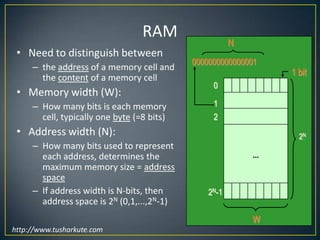
RAMNNeed to distinguish between
the address of a memory cell and the content of a memory cell
Memory width (W):
How many bits is each memory cell, typically one byte (=8 bits)
Address width (N):
How many bits used to represent each address, determines the maximum memory size = address space
If address width is N-bits, then address space is 2N (0,1,...,2N-1)00000000000000011 bit012...2N2N-1W14http://www.tusharkute.com
Memory Size / SpeedTypical memory in a personal computer (PC):
 64MB - 256MB
Memory sizes:
Kilobyte 	(KB)	= 210 = 	               1,024 bytes  ~  1 thousand
Megabyte(MB)	= 220 = 	        1,048,576 bytes  ~  1 million
Gigabyte	(GB)	= 230 = 	 1,073,741,824 bytes  ~  1 billion
Memory Access Time (read from/ write to memory)
50-75 nanoseconds  (1 nsec. = 0.000000001 sec.)
RAM is
volatile (can only store when power is on)
relatively expensivehttp://www.tusharkute.com
Operations on Memory Fetch (address):
Fetch a copy of the content of memory cell with the specified address.
Non-destructive, copies value in memory cell.
Store (address, value):
Store the specified value into the memory cell specified by address.
Destructive, overwrites the previous value of the memory cell.
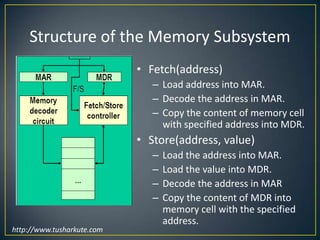
The memory system is interfaced via:
Memory Address Register (MAR)
Memory Data Register (MDR)
Fetch/Store signalhttp://www.tusharkute.com
Structure of the Memory SubsystemFetch(address)
Load address into MAR.
Decode the address in MAR.

Computer architecture and organization