Product Life Cycle
Business Studies
(A Level)
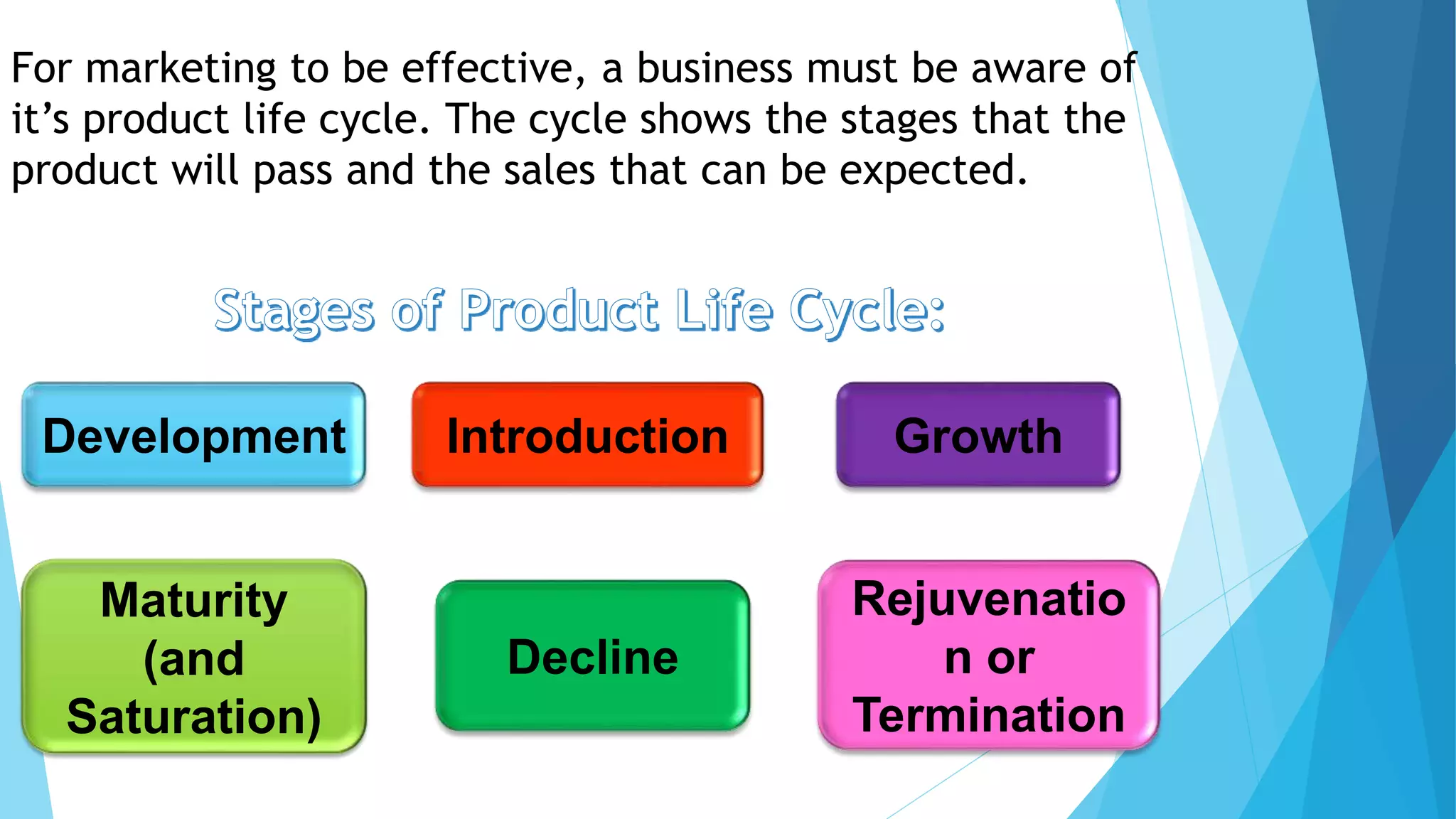
For marketing to be effective, a business must be aware of
it’s product life cycle. The cycle shows the stages that the
product will pass and the sales that can be expected.
Development Introduction Growth
Maturity
(and
Saturation)
Decline
Rejuvenatio
n or
Termination
The product is researched and designed.
Suitable ideas must be investigated,
developed and tested
A prototype or model of the product may be
produced
Decisions are made about the launch
A large number of the products fail and
don’t progress further, due to business being
reluctant to risks of new products
There are high costs and lots of spending
with no sales or revenue.
The product is launched.
As the product is new, sales are usually slow
There is a high cost of promotion and distribution to make consumers
aware of the product
Product may not be profitable
Prices may be set high to cover costs
Prices may be set low to break into the market
Sales may be restricted to early adopters, people will pay high prices
for new fashion trends and technology rather than when they’ve gone
out of fashion
Fast moving consumer goods may enjoy this type of start to the cycle
Sales begin to grow rapidly.
Repeat purchases
Customers are more aware of the product
Production increases, costs fail
Product becomes profitable
If it’s a new product, there are rapid growth sales
and competitors may launch their own versions of
the product (copycat products) which may slow down
sales
Price and promotion need to be considered
Growth in sales may start to level off
Product established with a stable market
share
Sales peaked
Competitors have entered the market to take
advantage of the product profits
New competitors
Some firms are forced out of the market
Sales start to decline.
Sales often decline due to change in
consumer tastes and/or new products
Products lose their appeal to consumers
Eventually, the product is withdrawn or sold
to another business
It would be sensible for a business to start to extend the product’s
life cycle in the maturity stage before sales fall into decline.
Successful extension strategies can transform the position in the
market place.
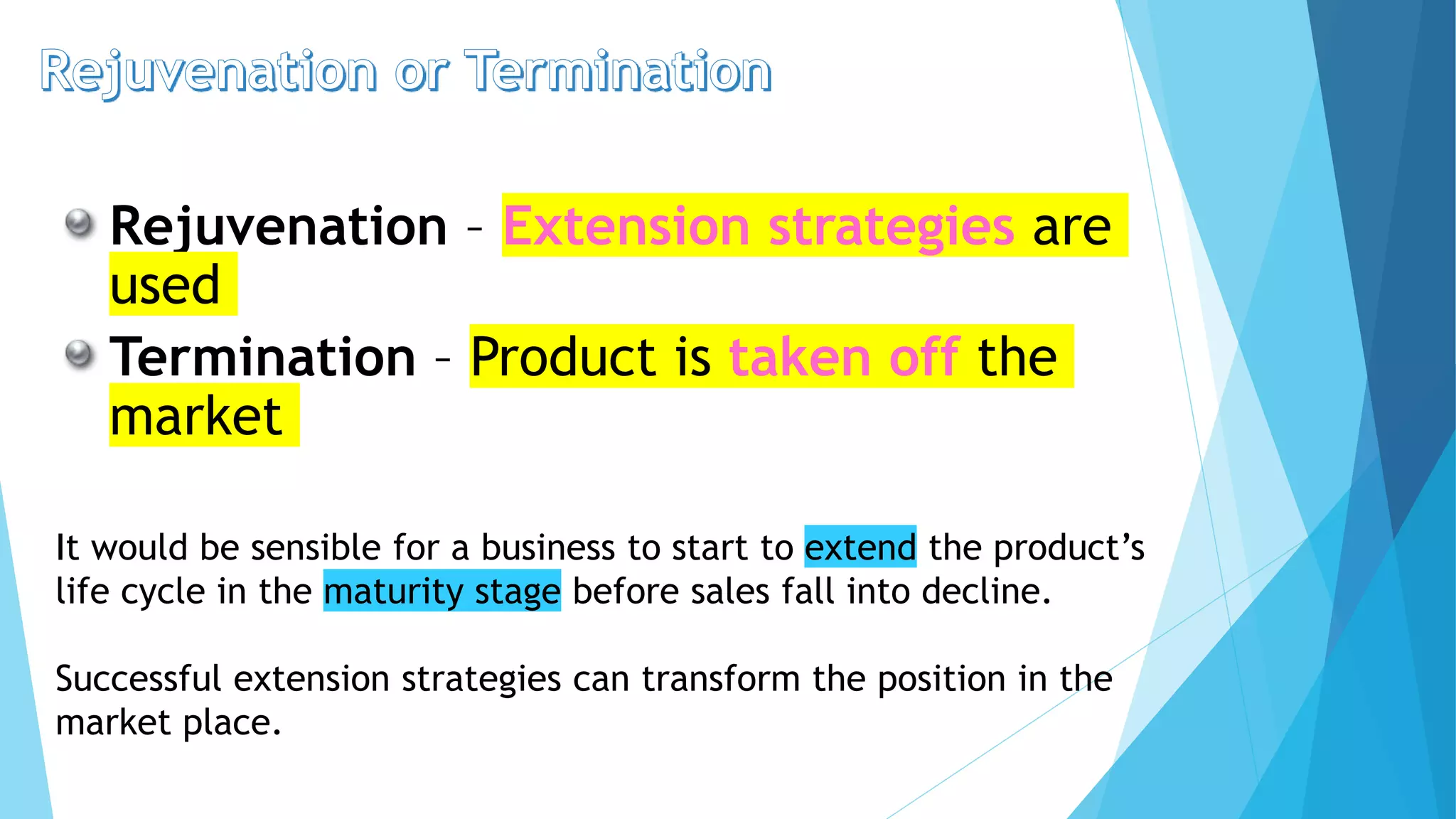
Rejuvenation – Extension strategies are
used
Termination – Product is taken off the
market
Firms may use extension
strategies to increase
product life cycle.
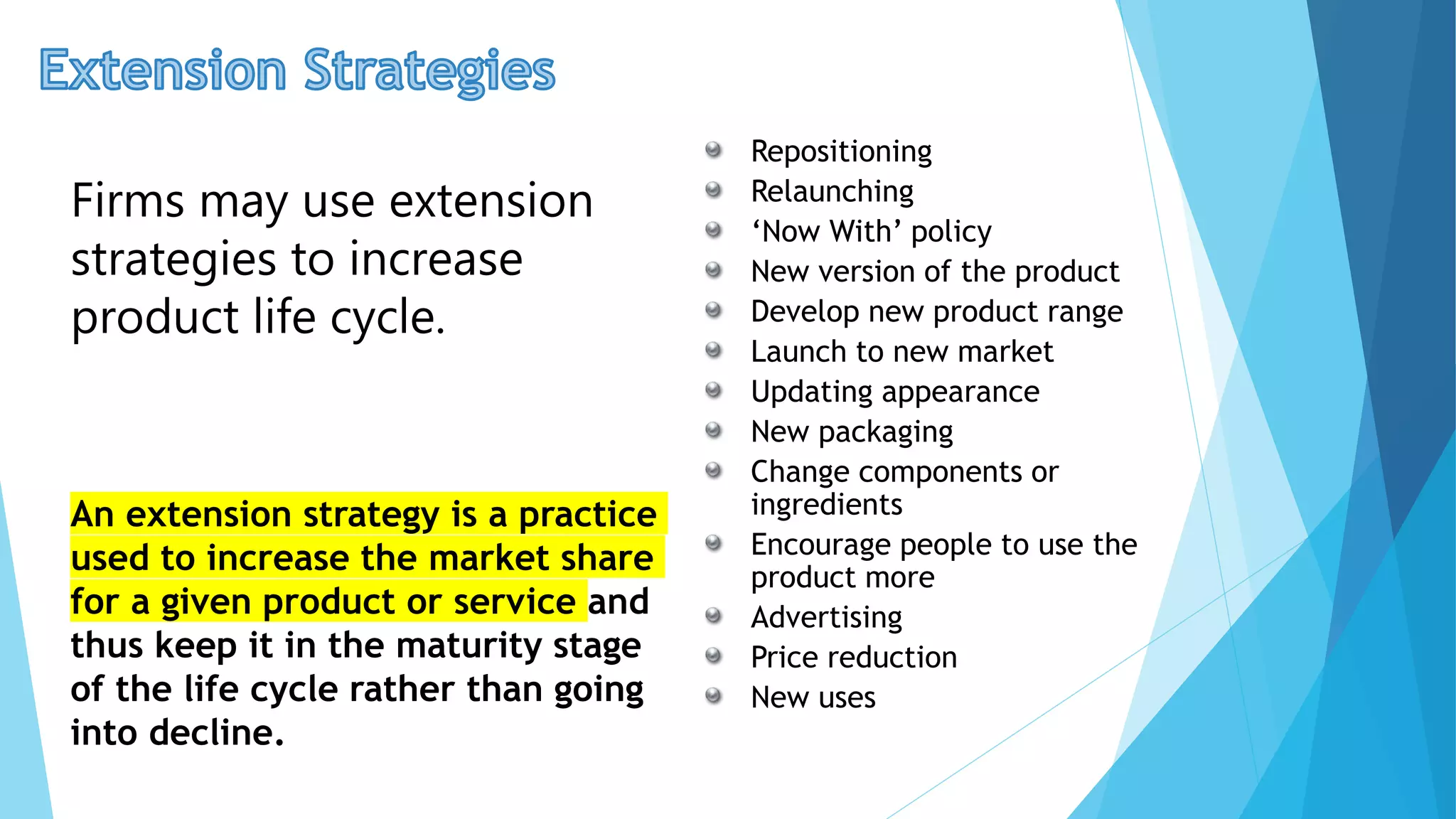
An extension strategy is a practice
used to increase the market share
for a given product or service and
thus keep it in the maturity stage
of the life cycle rather than going
into decline.
Repositioning
Relaunching
‘Now With’ policy
New version of the product
Develop new product range
Launch to new market
Updating appearance
New packaging
Change components or
ingredients
Encourage people to use the
product more
Advertising
Price reduction
New uses
Illustrate broad trends
Identify points to consider launching new
products, older ones are in decline
Identify points for extension strategies to be
introduced
Help identify if, when and where spending is
required
Identify when products should no longer be sold
Manage product portfolio
Indication of profitability at each stage
Plan different styles of marketing needed
Predict future sales
Determine decisions
Advantages Disadvantages
• Give managers the ability to
forecast product direction and
plan for timely execution of
relative competitive moves
• Difficult to foresee transitions
• Helps to formulate marketing mix
decisions
• Difficult to determine what stage
the product is in
• Explanatory tool • Not all products go through every
stage
• Determine when it’s reasonable to
eliminate declining products
• Products may remain in stage for a
long time
• Effectively, only one product per
diagram
• Inefficient when dealing with
Brands and/or services
Why is the product life cycle an
important concept in marketing?
The product life cycle is an important concept in marketing
because it describes the stages a product goes through
from when it was first thought of until it is finally removed
from the market. Not all products reach the final stage,
some continue and some rise and fall.

Product Life Cycle (Stages and Extension Strategies)

  • 1.
    Product Life Cycle BusinessStudies (A Level)
  • 2.
    For marketing tobe effective, a business must be aware of it’s product life cycle. The cycle shows the stages that the product will pass and the sales that can be expected. Development Introduction Growth Maturity (and Saturation) Decline Rejuvenatio n or Termination
  • 3.
    The product isresearched and designed. Suitable ideas must be investigated, developed and tested A prototype or model of the product may be produced Decisions are made about the launch A large number of the products fail and don’t progress further, due to business being reluctant to risks of new products There are high costs and lots of spending with no sales or revenue.
  • 4.
    The product islaunched. As the product is new, sales are usually slow There is a high cost of promotion and distribution to make consumers aware of the product Product may not be profitable Prices may be set high to cover costs Prices may be set low to break into the market Sales may be restricted to early adopters, people will pay high prices for new fashion trends and technology rather than when they’ve gone out of fashion Fast moving consumer goods may enjoy this type of start to the cycle
  • 5.
    Sales begin togrow rapidly. Repeat purchases Customers are more aware of the product Production increases, costs fail Product becomes profitable If it’s a new product, there are rapid growth sales and competitors may launch their own versions of the product (copycat products) which may slow down sales Price and promotion need to be considered
  • 6.
    Growth in salesmay start to level off Product established with a stable market share Sales peaked Competitors have entered the market to take advantage of the product profits New competitors Some firms are forced out of the market
  • 7.
    Sales start todecline. Sales often decline due to change in consumer tastes and/or new products Products lose their appeal to consumers Eventually, the product is withdrawn or sold to another business
  • 8.
    It would besensible for a business to start to extend the product’s life cycle in the maturity stage before sales fall into decline. Successful extension strategies can transform the position in the market place. Rejuvenation – Extension strategies are used Termination – Product is taken off the market
  • 10.
    Firms may useextension strategies to increase product life cycle. An extension strategy is a practice used to increase the market share for a given product or service and thus keep it in the maturity stage of the life cycle rather than going into decline. Repositioning Relaunching ‘Now With’ policy New version of the product Develop new product range Launch to new market Updating appearance New packaging Change components or ingredients Encourage people to use the product more Advertising Price reduction New uses
  • 11.
    Illustrate broad trends Identifypoints to consider launching new products, older ones are in decline Identify points for extension strategies to be introduced Help identify if, when and where spending is required Identify when products should no longer be sold Manage product portfolio Indication of profitability at each stage Plan different styles of marketing needed Predict future sales Determine decisions
  • 12.
    Advantages Disadvantages • Givemanagers the ability to forecast product direction and plan for timely execution of relative competitive moves • Difficult to foresee transitions • Helps to formulate marketing mix decisions • Difficult to determine what stage the product is in • Explanatory tool • Not all products go through every stage • Determine when it’s reasonable to eliminate declining products • Products may remain in stage for a long time • Effectively, only one product per diagram • Inefficient when dealing with Brands and/or services
  • 13.
    Why is theproduct life cycle an important concept in marketing? The product life cycle is an important concept in marketing because it describes the stages a product goes through from when it was first thought of until it is finally removed from the market. Not all products reach the final stage, some continue and some rise and fall.