Lesson 06:
Programmed IO
Chapter 11: Input/Output Organisation
Schaum’s Outline of Theory and Problems of Computer Architecture
Copyright © The McGraw-Hill Companies Inc. Indian Special Edition 2009
2
Objective
• Understand the programmed IO mode of data
transfer
• Learn that the program waits for the ready status
by repeatedly testing the status bit(s) and data
transfer is only when other end ready
Schaum’s Outline of Theory and Problems of Computer Architecture
Copyright © The McGraw-Hill Companies Inc. Indian Special Edition 2009
3
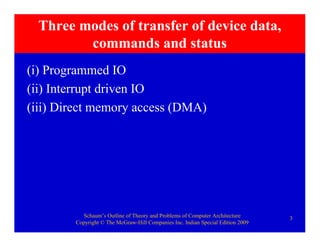
Three modes of transfer of device data,
commands and status
(i) Programmed IO
(ii) Interrupt driven IO
(iii) Direct memory access (DMA)
Schaum’s Outline of Theory and Problems of Computer Architecture
Copyright © The McGraw-Hill Companies Inc. Indian Special Edition 2009
4
Programmed IO mode input data transfer
Schaum’s Outline of Theory and Problems of Computer Architecture
Copyright © The McGraw-Hill Companies Inc. Indian Special Edition 2009
5
Read Input in Programmed IO mode
(i) Each input is read after first testing whether
the device is ready with the input
(a state reflected by a bit in a status register) or
whether the device input buffer is not empty
Schaum’s Outline of Theory and Problems of Computer Architecture
Copyright © The McGraw-Hill Companies Inc. Indian Special Edition 2009
6
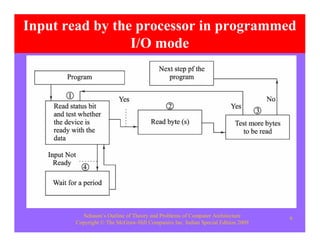
Input read by the processor in programmed
I/O mode
Schaum’s Outline of Theory and Problems of Computer Architecture
Copyright © The McGraw-Hill Companies Inc. Indian Special Edition 2009
7
Input read in Programmed IO mode
• The program waits for the ready status by
repeatedly testing the status bit(s) and till all
targeted bytes are read from the input device
• The program is in busy (non-waiting) state only
after the device gets ready else in wait state
Schaum’s Outline of Theory and Problems of Computer Architecture
Copyright © The McGraw-Hill Companies Inc. Indian Special Edition 2009
8
Programmed IO mode output data transfer
Schaum’s Outline of Theory and Problems of Computer Architecture
Copyright © The McGraw-Hill Companies Inc. Indian Special Edition 2009
9
Output write in Programmed IO mode
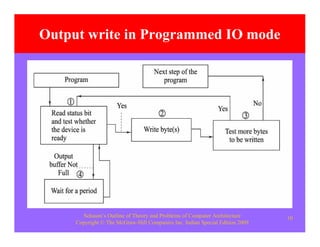
(ii) Each output written after first testing whether
the device is ready to accept the byte(s) at its
output register or output buffer is empty
Schaum’s Outline of Theory and Problems of Computer Architecture
Copyright © The McGraw-Hill Companies Inc. Indian Special Edition 2009
10
Output write in Programmed IO mode
Schaum’s Outline of Theory and Problems of Computer Architecture
Copyright © The McGraw-Hill Companies Inc. Indian Special Edition 2009
11
Output write in Programmed IO mode
• The program waits for the ready status by
repeatedly testing the status bit(s) and till all the
targeted bytes are written to the device
• The program in busy (non-waiting) state only
after the device gets ready else wait state
Schaum’s Outline of Theory and Problems of Computer Architecture
Copyright © The McGraw-Hill Companies Inc. Indian Special Edition 2009
12
Advantage and Disadvantage Programmed
IO mode data transfer
Schaum’s Outline of Theory and Problems of Computer Architecture
Copyright © The McGraw-Hill Companies Inc. Indian Special Edition 2009
13
Advantage of programmed I/O mode
• A program and processor dedicated to wait and
repeatedly tests the status and for IO data
transfer till the IO operation completes
Schaum’s Outline of Theory and Problems of Computer Architecture
Copyright © The McGraw-Hill Companies Inc. Indian Special Edition 2009
14
Disadvantage of programmed I/O mode
• A program has to wait and repeatedly tests the
status; Waiting period for an asynchronous event
can be too large
• Many I/O devices generate asynchronous
events— events that occur at times that the
processor cannot predict or control, but which
the processor must respond to reasonably
quickly to provide acceptable performance
Schaum’s Outline of Theory and Problems of Computer Architecture
Copyright © The McGraw-Hill Companies Inc. Indian Special Edition 2009
15
Example of Unpredictable wait events
• Keyboard on a workstation or PC
• The processor cannot predict when the user will
press a key but must react to the key-press in
well under a second or the response time will be
noticeable to the user
• The programmed I/O mode therefore not
appropriate due to prolonged wait states
Schaum’s Outline of Theory and Problems of Computer Architecture
Copyright © The McGraw-Hill Companies Inc. Indian Special Edition 2009
16
Summary
Schaum’s Outline of Theory and Problems of Computer Architecture
Copyright © The McGraw-Hill Companies Inc. Indian Special Edition 2009
17
• Programmed IO method of IO operations
• The program waits for the ready status by
repeatedly testing the status bit(s) and data
transfer is only when other end ready
We Learnt
Schaum’s Outline of Theory and Problems of Computer Architecture
Copyright © The McGraw-Hill Companies Inc. Indian Special Edition 2009
18
End of Lesson 06 on
Programmed IO

Programed I/O Modul..

  • 1.
    Lesson 06: Programmed IO Chapter11: Input/Output Organisation
  • 2.
    Schaum’s Outline ofTheory and Problems of Computer Architecture Copyright © The McGraw-Hill Companies Inc. Indian Special Edition 2009 2 Objective • Understand the programmed IO mode of data transfer • Learn that the program waits for the ready status by repeatedly testing the status bit(s) and data transfer is only when other end ready
  • 3.
    Schaum’s Outline ofTheory and Problems of Computer Architecture Copyright © The McGraw-Hill Companies Inc. Indian Special Edition 2009 3 Three modes of transfer of device data, commands and status (i) Programmed IO (ii) Interrupt driven IO (iii) Direct memory access (DMA)
  • 4.
    Schaum’s Outline ofTheory and Problems of Computer Architecture Copyright © The McGraw-Hill Companies Inc. Indian Special Edition 2009 4 Programmed IO mode input data transfer
  • 5.
    Schaum’s Outline ofTheory and Problems of Computer Architecture Copyright © The McGraw-Hill Companies Inc. Indian Special Edition 2009 5 Read Input in Programmed IO mode (i) Each input is read after first testing whether the device is ready with the input (a state reflected by a bit in a status register) or whether the device input buffer is not empty
  • 6.
    Schaum’s Outline ofTheory and Problems of Computer Architecture Copyright © The McGraw-Hill Companies Inc. Indian Special Edition 2009 6 Input read by the processor in programmed I/O mode
  • 7.
    Schaum’s Outline ofTheory and Problems of Computer Architecture Copyright © The McGraw-Hill Companies Inc. Indian Special Edition 2009 7 Input read in Programmed IO mode • The program waits for the ready status by repeatedly testing the status bit(s) and till all targeted bytes are read from the input device • The program is in busy (non-waiting) state only after the device gets ready else in wait state
  • 8.
    Schaum’s Outline ofTheory and Problems of Computer Architecture Copyright © The McGraw-Hill Companies Inc. Indian Special Edition 2009 8 Programmed IO mode output data transfer
  • 9.
    Schaum’s Outline ofTheory and Problems of Computer Architecture Copyright © The McGraw-Hill Companies Inc. Indian Special Edition 2009 9 Output write in Programmed IO mode (ii) Each output written after first testing whether the device is ready to accept the byte(s) at its output register or output buffer is empty
  • 10.
    Schaum’s Outline ofTheory and Problems of Computer Architecture Copyright © The McGraw-Hill Companies Inc. Indian Special Edition 2009 10 Output write in Programmed IO mode
  • 11.
    Schaum’s Outline ofTheory and Problems of Computer Architecture Copyright © The McGraw-Hill Companies Inc. Indian Special Edition 2009 11 Output write in Programmed IO mode • The program waits for the ready status by repeatedly testing the status bit(s) and till all the targeted bytes are written to the device • The program in busy (non-waiting) state only after the device gets ready else wait state
  • 12.
    Schaum’s Outline ofTheory and Problems of Computer Architecture Copyright © The McGraw-Hill Companies Inc. Indian Special Edition 2009 12 Advantage and Disadvantage Programmed IO mode data transfer
  • 13.
    Schaum’s Outline ofTheory and Problems of Computer Architecture Copyright © The McGraw-Hill Companies Inc. Indian Special Edition 2009 13 Advantage of programmed I/O mode • A program and processor dedicated to wait and repeatedly tests the status and for IO data transfer till the IO operation completes
  • 14.
    Schaum’s Outline ofTheory and Problems of Computer Architecture Copyright © The McGraw-Hill Companies Inc. Indian Special Edition 2009 14 Disadvantage of programmed I/O mode • A program has to wait and repeatedly tests the status; Waiting period for an asynchronous event can be too large • Many I/O devices generate asynchronous events— events that occur at times that the processor cannot predict or control, but which the processor must respond to reasonably quickly to provide acceptable performance
  • 15.
    Schaum’s Outline ofTheory and Problems of Computer Architecture Copyright © The McGraw-Hill Companies Inc. Indian Special Edition 2009 15 Example of Unpredictable wait events • Keyboard on a workstation or PC • The processor cannot predict when the user will press a key but must react to the key-press in well under a second or the response time will be noticeable to the user • The programmed I/O mode therefore not appropriate due to prolonged wait states
  • 16.
    Schaum’s Outline ofTheory and Problems of Computer Architecture Copyright © The McGraw-Hill Companies Inc. Indian Special Edition 2009 16 Summary
  • 17.
    Schaum’s Outline ofTheory and Problems of Computer Architecture Copyright © The McGraw-Hill Companies Inc. Indian Special Edition 2009 17 • Programmed IO method of IO operations • The program waits for the ready status by repeatedly testing the status bit(s) and data transfer is only when other end ready We Learnt
  • 18.
    Schaum’s Outline ofTheory and Problems of Computer Architecture Copyright © The McGraw-Hill Companies Inc. Indian Special Edition 2009 18 End of Lesson 06 on Programmed IO