Handling	data	skew
adaptively	in Spark using
Dynamic	Repartitioning
Zoltán	Zvara
zoltan.zvara@sztaki.hu
Introduction
• Hungarian	Academy	of	Sciences,	Institute	for	Computer	Science	and	
Control (MTA	SZTAKI)
• Research	institute	with	strong	industry	ties
• Big	Data	projects	using	Spark,	Flink,	Cassandra,	Hadoop	etc.
• Multiple	telco	use	cases	lately,	with	challenging	data	volume	and	
distribution
Agenda
• Our	data-skew	story
• Problem	definitions	&	aims
• Dynamic	Repartitioning
• Architecture
• Component	breakdown
• Repartitioning	 mechanism
• Benchmark	results
• Visualization
• Conclusion
Motivation
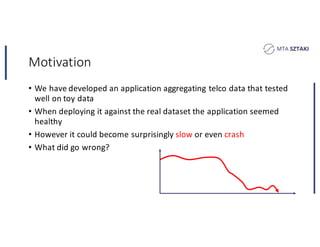
• We	have	developed	an	application	aggregating	telco	data	that	tested	
well	on	toy	data
• When	deploying	it	against	the	real	dataset	the	application	seemed	
healthy
• However	it	could	become	surprisingly	slow or	even	crash
• What	did	go	wrong?
Our	data-skew	story
• We	have	use-cases	when	map-side	combine	is	not	an	option:
groupBy, join
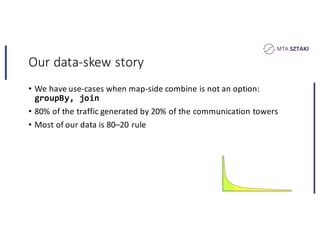
• 80%	of	the	traffic	generated by 20%	of	the	communication towers
• Most	of	our	data	is	80–20	rule
The	problem
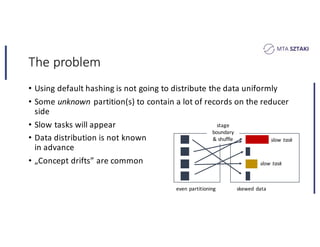
• Using	default	hashing	is	not	going	to	distribute	the	data	uniformly
• Some	unknown	partition(s)	to	contain	a	lot	of	records	on	the	reducer	
side
• Slow	tasks	will	appear
• Data	distribution	is	not	known
in	advance
• „Concept	drifts”	are	common
stage
boundary	
&	shuffle
even	partitioning skewed	data
slow	task
slow	task
Aim
Generally,	make	Spark	a	data-aware	distributed	data-processing	framework
• Collect	information	about	the	data-characteristics	on-the-fly
• Partition	the	data	as	uniformly	as	possible	on-the-fly
• Handle	arbitrary	data	distributions
• Mitigate	the	problem	of	slow	tasks
• Be	lightweight	and	efficient
• Should	not	require	user-guidance
spark.repartitioning = true
Architecture
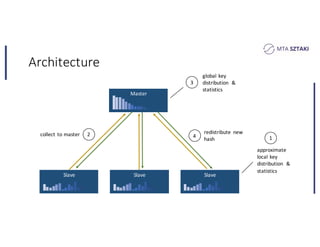
Slave Slave Slave
Master
approximate
local	key
distribution &	
statistics
1
collect to master 2
global key
distribution &	
statistics
3
4
redistribute new
hash
Driver	perspective
• RepartitioningTrackerMaster part	of	SparkEnv
• Listens	to	job	&	stage	submissions
• Holds	a	variety	of	repartitioning	strategies	for	each	job	&	stage
• Decides when &	how to (re)partition
Executor	perspective
• RepartitioningTrackerWorker part	of	SparkEnv
• Duties:
• Stores	ScannerStrategies (Scanner included)	received	from	the	RTM
• Instantiates	 and	binds	Scanners	 to	TaskMetrics (where	data-
characteristics	 is	collected)
• Defines	an	interface	for	Scanners	 to	send	DataCharacteristics back	to	
the	RTM
Scalable sampling
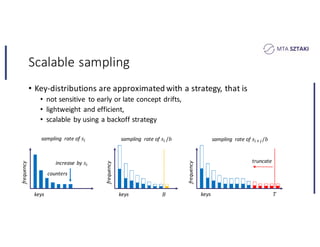
• Key-distributions are approximated with a	strategy,	that is
• not sensitive to early or late concept drifts,
• lightweight and	efficient,
• scalable by using a	backoff strategy
keys
frequency
counters
keys
frequency
sampling	 rate of	𝑠" sampling	 rate of	𝑠" /𝑏
keys
frequency
sampling	 rate of	𝑠"%&/𝑏
truncateincrease by 𝑠"
𝑇𝐵
Complexity-sensitive sampling
• Reducer	run-time	can	highly	correlate	with	the	computational	
complexity of	the	values	for	a	given	key
• Calculating	object	size	is	costly	in	JVM	and	in	some	cases	shows	little	
correlation	to	computational	complexity	(function	on	the	next	stage)
• Solution:
• If	the	user	object	is	Weightable,	 use	complexity-sensitive	 sampling
• When	increasing	the	counter	for	a	specific	value,	consider	its	complexity
Scalable sampling in numbers
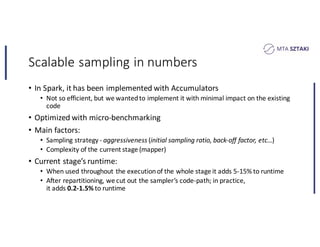
• In	Spark,	it	has	been	implemented	with	Accumulators
• Not	so	efficient,	but	we	wanted	to	implement	it	with	minimal	impact	on	the	existing	
code
• Optimized	with	micro-benchmarking
• Main	factors:
• Sampling	strategy	- aggressiveness (initial	sampling	ratio,	back-off	factor,	etc…)
• Complexity	of	the	current	stage	(mapper)
• Current	stage’s	runtime:
• When	used	throughout	the	execution	of	the	whole	stage	it	adds	5-15%	to	runtime
• After	repartitioning,	we	cut	out	the	sampler’s	code-path; in	practice,
it	adds	0.2-1.5% to	runtime
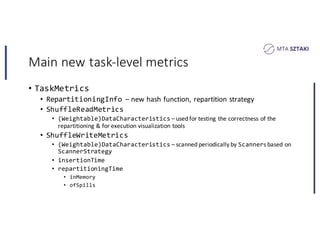
Main	new task-level metrics
• TaskMetrics
• RepartitioningInfo – new	hash	function,	repartition	strategy
• ShuffleReadMetrics
• (Weightable)DataCharacteristics – used	for	testing	the	correctness	of	the	
repartitioning	&	for	execution	visualization	tools
• ShuffleWriteMetrics
• (Weightable)DataCharacteristics – scanned	periodically	by	Scanners	based	on	
ScannerStrategy
• insertionTime
• repartitioningTime
• inMemory
• ofSpills
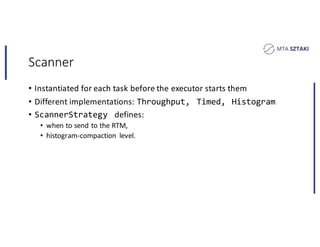
Scanner
• Instantiated	for	each	task	before	the	executor	starts	them
• Different	implementations:	Throughput, Timed, Histogram
• ScannerStrategy defines:
• when	to	send	to	the	RTM,
• histogram-compaction	 level.
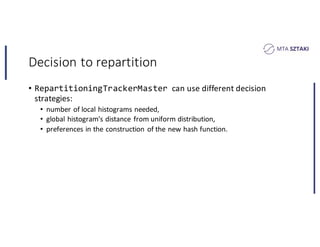
Decision	to	repartition
• RepartitioningTrackerMaster can	use	different	decision	
strategies:
• number	of	local	histograms	needed,
• global	histogram’s	distance	from	uniform	distribution,
• preferences	in	the	construction	of	the	new	hash	function.
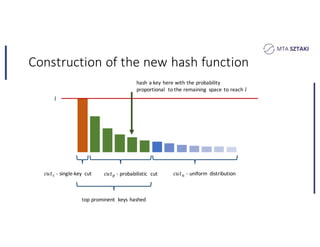
Construction of	the new hash function
𝑐𝑢𝑡, - single-key cut
hash a	key here	with the probability
proportional to the remaining space to reach 𝑙
𝑐𝑢𝑡. - uniform	 distribution
top	prominent keys hashed
𝑙
𝑐𝑢𝑡/ - probabilistic cut
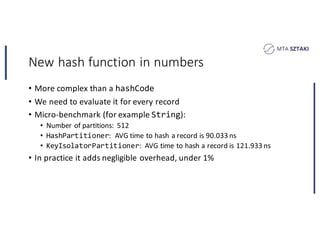
New	hash function in numbers
• More	complex	than	a	hashCode
• We	need	to	evaluate	it	for	every	record
• Micro-benchmark	(for	example	String):
• Number	of	partitions:	 512
• HashPartitioner:	 AVG	time to hash a	record is	90.033 ns
• KeyIsolatorPartitioner:	 AVG	time to hash a	record is	121.933	ns
• In	practice	it	adds	negligible	overhead,	under	1%
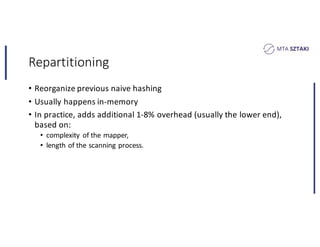
Repartitioning
• Reorganize	previous	naive	hashing
• Usually	happens	in-memory
• In	practice,	adds	additional	1-8%	overhead	(usually	the	lower	end),	
based	on:
• complexity	of	the	mapper,
• length	of	the	scanning	process.
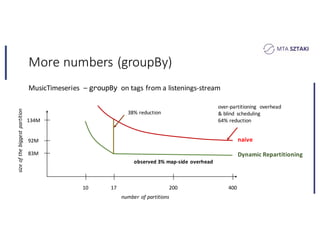
More	numbers (groupBy)
MusicTimeseries – groupBy on tags from a	listenings-stream
1710 200 400
83M
134M
92M
sizeof	thebiggestpartition
number of	partitions
over-partitioning overhead
&	blind scheduling
64%	reduction
observed 3%	map-side overhead
naive
Dynamic Repartitioning
38%	reduction
More	numbers (join)
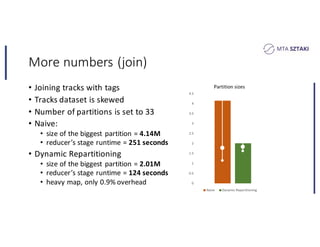
• Joining	tracks	with	tags
• Tracks	dataset	is	skewed
• Number	of	partitions	is	set	to	33
• Naive:
• size	of	the	biggest	partition	=	4.14M
• reducer’s	stage	runtime	=	251	seconds
• Dynamic	Repartitioning
• size	of	the	biggest	partition	=	2.01M
• reducer’s	stage	runtime	=	124 seconds
• heavy	map,	only	0.9%	overhead
Spark REST	API
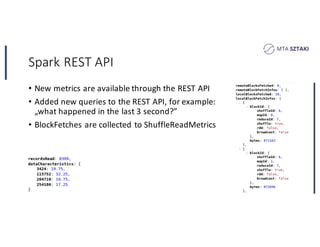
• New	metrics	are	available	through	the	REST	API
• Added	new	queries	to	the	REST	API,	for	example:
„what	happened	in	the	last	3	second?”
• BlockFetches are	collected	to	ShuffleReadMetrics
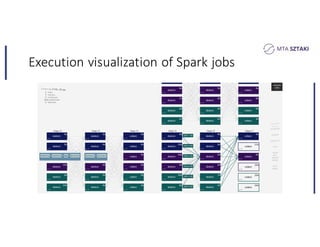
Execution visualization of	Spark jobs
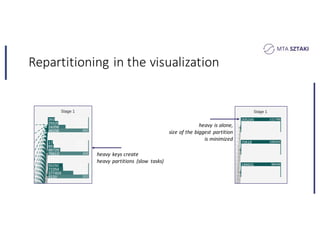
Repartitioning in the visualization
heavy keys create
heavy partitions (slow tasks)
heavy is	alone,
size of	the biggest partition
is	minimized
Conclusion
• Our	Dynamic	Repartitioning can	handle	data	skew	dynamically,	on-
the-fly	on	any	workload	and	arbitrary	key-distributions
• With	very	little	overhead,	data	skew	can	be	handled	in	a	natural &	
general way
• Visualizations	can	aid	developers	to	better	understand	issues	and	
bottlenecks	of	certain	workloads
• Making	Spark	data-aware pays	off
Thank	you	for	your	attention
Zoltán	Zvara
zoltan.zvara@sztaki.hu

Handling Data Skew Adaptively In Spark Using Dynamic Repartitioning