Experimental Design for
Distributed Machine Learning
Myles Baker (@mydpy)
26 October, 2017
1
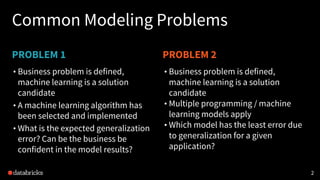
PROBLEM 1 PROBLEM 2
Common Modeling Problems
• Business problem is defined,
machine learning is a solution
candidate
• Multiple programming / machine
learning models apply
• Which model has the least error due
to generalization for a given
application?
• Business problem is defined,
machine learning is a solution
candidate
• A machine learning algorithm has
been selected and implemented
• What is the expected generalization
error? Can be the business be
confident in the model results?
22
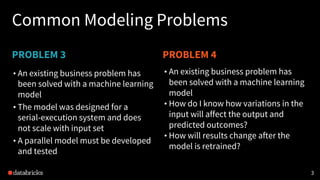
PROBLEM 3 PROBLEM 4
Common Modeling Problems
• An existing business problem has
been solved with a machine learning
model
• How do I know how variations in the
input will affect the output and
predicted outcomes?
• How will results change after the
model is retrained?
• An existing business problem has
been solved with a machine learning
model
• The model was designed for a
serial-execution system and does
not scale with input set
• A parallel model must be developed
and tested
33
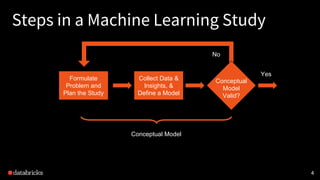
Steps in a Machine Learning Study
4
Formulate
Problem and
Plan the Study
Collect Data &
Insights, &
Define a Model
Conceptual
Model
Valid?
Conceptual Model
Yes
No
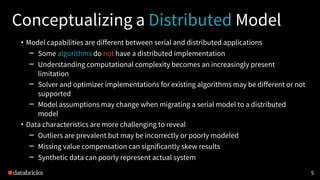
Conceptualizing a Distributed Model
• Model capabilities are different between serial and distributed applications
– Some algorithms do not have a distributed implementation
– Understanding computational complexity becomes an increasingly present
limitation
– Solver and optimizer implementations for existing algorithms may be different or not
supported
– Model assumptions may change when migrating a serial model to a distributed
model
• Data characteristics are more challenging to reveal
– Outliers are prevalent but may be incorrectly or poorly modeled
– Missing value compensation can significantly skew results
– Synthetic data can poorly represent actual system
5
6 6
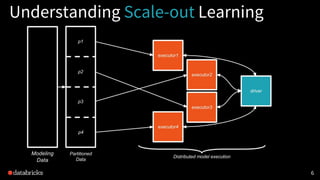
Understanding Scale-out Learning
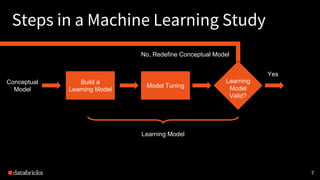
Steps in a Machine Learning Study
7
Build a
Learning Model
Model Tuning
Learning
Model
Valid?
Learning Model
Yes
Conceptual
Model
No, Redefine Conceptual Model
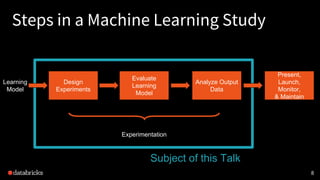
Steps in a Machine Learning Study
8
Design
Experiments
Evaluate
Learning
Model
Experimentation
Learning
Model
Analyze Output
Data
Present,
Launch,
Monitor,
& Maintain
Subject of this Talk
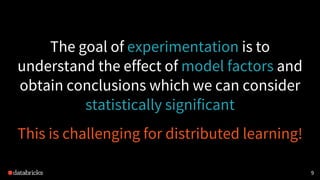
The goal of experimentation is to
understand the effect of model factors and
obtain conclusions which we can consider
statistically significant
9 9
This is challenging for distributed learning!
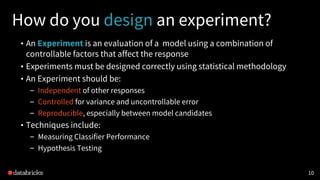
How do you design an experiment?
• An Experiment is an evaluation of a model using a combination of
controllable factors that affect the response
• Experiments must be designed correctly using statistical methodology
• An Experiment should be:
– Independent of other responses
– Controlled for variance and uncontrollable error
– Reproducible, especially between model candidates
• Techniques include:
– Measuring Classifier Performance
– Hypothesis Testing
10
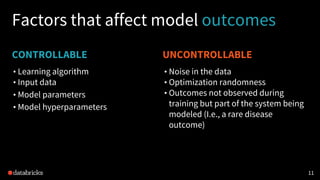
CONTROLLABLE UNCONTROLLABLE
Factors that affect model outcomes
• Noise in the data
• Optimization randomness
• Outcomes not observed during
training but part of the system being
modeled (I.e., a rare disease
outcome)
• Learning algorithm
• Input data
• Model parameters
• Model hyperparameters
1111
1212
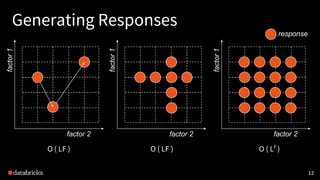
Generating Responses
O ( LF ) O ( LF ) O ( LF
)
1313
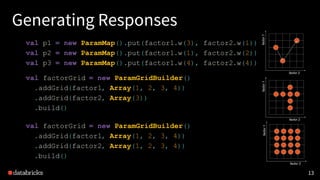
Generating Responses
val p1 = new ParamMap().put(factor1.w(3), factor2.w(1))
val p2 = new ParamMap().put(factor1.w(1), factor2.w(2))
val p3 = new ParamMap().put(factor1.w(4), factor2.w(4))
val factorGrid = new ParamGridBuilder()
.addGrid(factor1, Array(1, 2, 3, 4))
.addGrid(factor2, Array(3))
.build()
val factorGrid = new ParamGridBuilder()
.addGrid(factor1, Array(1, 2, 3, 4))
.addGrid(factor2, Array(1, 2, 3, 4))
.build()
1414
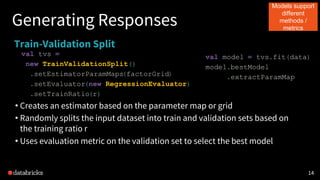
Generating Responses
Train-Validation Split
val tvs =
new TrainValidationSplit()
.setEstimatorParamMaps(factorGrid)
.setEvaluator(new RegressionEvaluator)
.setTrainRatio(r)
• Creates an estimator based on the parameter map or grid
• Randomly splits the input dataset into train and validation sets based on
the training ratio r
• Uses evaluation metric on the validation set to select the best model
val model = tvs.fit(data)
model.bestModel
.extractParamMap
Models support
different
methods /
metrics
1515
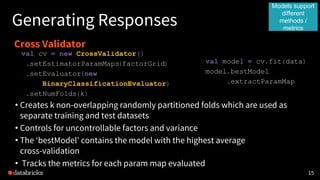
Generating Responses
Cross Validator
val cv = new CrossValidator()
.setEstimatorParamMaps(factorGrid)
.setEvaluator(new
BinaryClassificationEvaluator)
.setNumFolds(k)
• Creates k non-overlapping randomly partitioned folds which are used as
separate training and test datasets
• Controls for uncontrollable factors and variance
• The ‘bestModel’ contains the model with the highest average
cross-validation
• Tracks the metrics for each param map evaluated
val model = cv.fit(data)
model.bestModel
.extractParamMap
Models support
different
methods /
metrics
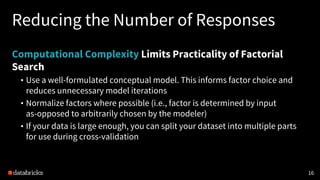
Reducing the Number of Responses
Computational Complexity Limits Practicality of Factorial
Search
• Use a well-formulated conceptual model. This informs factor choice and
reduces unnecessary model iterations
• Normalize factors where possible (i.e., factor is determined by input
as-opposed to arbitrarily chosen by the modeler)
• If your data is large enough, you can split your dataset into multiple parts
for use during cross-validation
16
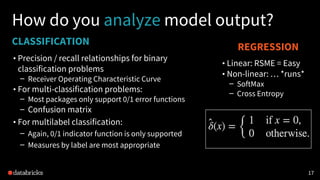
CLASSIFICATION
• Precision / recall relationships for binary
classification problems
– Receiver Operating Characteristic Curve
• For multi-classification problems:
– Most packages only support 0/1 error functions
– Confusion matrix
• For multilabel classification:
– Again, 0/1 indicator function is only supported
– Measures by label are most appropriate
1717
How do you analyze model output?
REGRESSION
• Linear: RSME = Easy
• Non-linear: … *runs*
– SoftMax
– Cross Entropy
1818
Analyzing Model Output
Binary Classification
Metric Spark Implementation
Receiver Operating Characteristic roc
Area Under Receiver Operating
Characteristic Curve
areaUnderROC
Area Under Precision-Recall Curve areaUnderPR
Measures by Threshold {measure}ByThreshold
val metrics = new
BinaryClassificationMetrics(predictionAndLabels.rdd.map( r =>
(r.getAs[Double]("prediction"), r.getAs[Double]("label"))))
Dataframe of
(prediction,
label)
1919
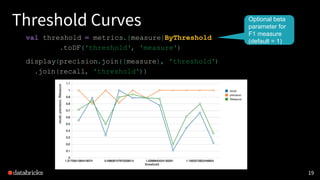
Threshold Curves
val threshold = metrics.{measure}ByThreshold
.toDF('threshold', 'measure')
display(precision.join({measure}, 'threshold')
.join(recall, 'threshold'))
Optional beta
parameter for
F1 measure
(default = 1)
2020
Analyzing Model Output
Multiclass Classification
Metric Spark Implementation
Confusion Matrix confusionMatrix
Accuracy accuracy
Measures by Label {measure}ByLabel
Weighted Measures weighted{Measure}
val metrics = new
MulticlassMetrics(predictionAndLabels.rdd.map( r =>
(r.getAs[Double]("prediction"), r.getAs[Double]("label"))))
Dataframe of
(prediction,
label)
Usually not a
robust metric
by itself
2121
Confusion Matrix
metrics.confusionMatrix
.toArray
//Display using non-Scala tool
%python
confusion = np.array([[...],[...]])
How do I
know my
model is
correct?
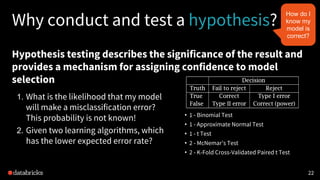
Hypothesis testing describes the significance of the result and
provides a mechanism for assigning confidence to model
selection
22
Why conduct and test a hypothesis?
• 1 - Binomial Test
• 1 - Approximate Normal Test
• 1 - t Test
• 2 - McNemar’s Test
• 2 - K-Fold Cross-Validated Paired t Test
1. What is the likelihood that my model
will make a misclassification error?
This probability is not known!
2. Given two learning algorithms, which
has the lower expected error rate?
2323
Chi-Squared Test
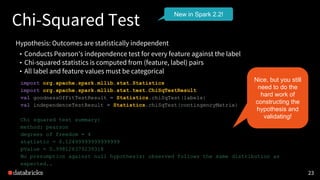
Hypothesis: Outcomes are statistically independent
New in Spark 2.2!
• Conducts Pearson's independence test for every feature against the label
• Chi-squared statistics is computed from (feature, label) pairs
• All label and feature values must be categorical
import org.apache.spark.mllib.stat.Statistics
import org.apache.spark.mllib.stat.test.ChiSqTestResult
val goodnessOfFitTestResult = Statistics.chiSqTest(labels)
val independenceTestResult = Statistics.chiSqTest(contingencyMatrix)
Chi squared test summary:
method: pearson
degrees of freedom = 4
statistic = 0.12499999999999999
pValue = 0.998126379239318
No presumption against null hypothesis: observed follows the same distribution as
expected..
Nice, but you still
need to do the
hard work of
constructing the
hypothesis and
validating!
2424
McNemar’s Test
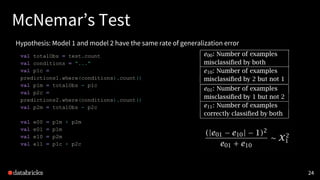
Hypothesis: Model 1 and model 2 have the same rate of generalization error
val totalObs = test.count
val conditions = "..."
val p1c =
predictions1.where(conditions).count()
val p1m = totalObs - p1c
val p2c =
predictions2.where(conditions).count()
val p2m = totalObs - p2c
val e00 = p1m + p2m
val e01 = p1m
val e10 = p2m
val e11 = p1c + p2c
25
Analyzing of Variance (ANOVA)
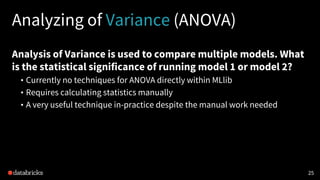
Analysis of Variance is used to compare multiple models. What
is the statistical significance of running model 1 or model 2?
• Currently no techniques for ANOVA directly within MLlib
• Requires calculating statistics manually
• A very useful technique in-practice despite the manual work needed
Thank you
myles.baker@databricks.com
26
References
• Design and Analysis of Machine Learning, Chapter 19 of Introduction to Machine Learning, by Ethem
Alpaydın
• No free lunch in search and optimization
• Moral Machine (MIT)
• Design and Analysis of Classifier Learning Experiments in Bioinformatics: Survey and Case Studies
• Simulation Modeling and Analysis, 3rd Edition, Averill Law and David Kelton
• Spark Scala API documentation, source code
27

Experimental Design for Distributed Machine Learning with Myles Baker

  • 1.
    Experimental Design for DistributedMachine Learning Myles Baker (@mydpy) 26 October, 2017 1
  • 2.
    PROBLEM 1 PROBLEM2 Common Modeling Problems • Business problem is defined, machine learning is a solution candidate • Multiple programming / machine learning models apply • Which model has the least error due to generalization for a given application? • Business problem is defined, machine learning is a solution candidate • A machine learning algorithm has been selected and implemented • What is the expected generalization error? Can be the business be confident in the model results? 22
  • 3.
    PROBLEM 3 PROBLEM4 Common Modeling Problems • An existing business problem has been solved with a machine learning model • How do I know how variations in the input will affect the output and predicted outcomes? • How will results change after the model is retrained? • An existing business problem has been solved with a machine learning model • The model was designed for a serial-execution system and does not scale with input set • A parallel model must be developed and tested 33
  • 4.
    Steps in aMachine Learning Study 4 Formulate Problem and Plan the Study Collect Data & Insights, & Define a Model Conceptual Model Valid? Conceptual Model Yes No
  • 5.
    Conceptualizing a DistributedModel • Model capabilities are different between serial and distributed applications – Some algorithms do not have a distributed implementation – Understanding computational complexity becomes an increasingly present limitation – Solver and optimizer implementations for existing algorithms may be different or not supported – Model assumptions may change when migrating a serial model to a distributed model • Data characteristics are more challenging to reveal – Outliers are prevalent but may be incorrectly or poorly modeled – Missing value compensation can significantly skew results – Synthetic data can poorly represent actual system 5
  • 6.
  • 7.
    Steps in aMachine Learning Study 7 Build a Learning Model Model Tuning Learning Model Valid? Learning Model Yes Conceptual Model No, Redefine Conceptual Model
  • 8.
    Steps in aMachine Learning Study 8 Design Experiments Evaluate Learning Model Experimentation Learning Model Analyze Output Data Present, Launch, Monitor, & Maintain Subject of this Talk
  • 9.
    The goal ofexperimentation is to understand the effect of model factors and obtain conclusions which we can consider statistically significant 9 9 This is challenging for distributed learning!
  • 10.
    How do youdesign an experiment? • An Experiment is an evaluation of a model using a combination of controllable factors that affect the response • Experiments must be designed correctly using statistical methodology • An Experiment should be: – Independent of other responses – Controlled for variance and uncontrollable error – Reproducible, especially between model candidates • Techniques include: – Measuring Classifier Performance – Hypothesis Testing 10
  • 11.
    CONTROLLABLE UNCONTROLLABLE Factors thataffect model outcomes • Noise in the data • Optimization randomness • Outcomes not observed during training but part of the system being modeled (I.e., a rare disease outcome) • Learning algorithm • Input data • Model parameters • Model hyperparameters 1111
  • 12.
    1212 Generating Responses O (LF ) O ( LF ) O ( LF )
  • 13.
    1313 Generating Responses val p1= new ParamMap().put(factor1.w(3), factor2.w(1)) val p2 = new ParamMap().put(factor1.w(1), factor2.w(2)) val p3 = new ParamMap().put(factor1.w(4), factor2.w(4)) val factorGrid = new ParamGridBuilder() .addGrid(factor1, Array(1, 2, 3, 4)) .addGrid(factor2, Array(3)) .build() val factorGrid = new ParamGridBuilder() .addGrid(factor1, Array(1, 2, 3, 4)) .addGrid(factor2, Array(1, 2, 3, 4)) .build()
  • 14.
    1414 Generating Responses Train-Validation Split valtvs = new TrainValidationSplit() .setEstimatorParamMaps(factorGrid) .setEvaluator(new RegressionEvaluator) .setTrainRatio(r) • Creates an estimator based on the parameter map or grid • Randomly splits the input dataset into train and validation sets based on the training ratio r • Uses evaluation metric on the validation set to select the best model val model = tvs.fit(data) model.bestModel .extractParamMap Models support different methods / metrics
  • 15.
    1515 Generating Responses Cross Validator valcv = new CrossValidator() .setEstimatorParamMaps(factorGrid) .setEvaluator(new BinaryClassificationEvaluator) .setNumFolds(k) • Creates k non-overlapping randomly partitioned folds which are used as separate training and test datasets • Controls for uncontrollable factors and variance • The ‘bestModel’ contains the model with the highest average cross-validation • Tracks the metrics for each param map evaluated val model = cv.fit(data) model.bestModel .extractParamMap Models support different methods / metrics
  • 16.
    Reducing the Numberof Responses Computational Complexity Limits Practicality of Factorial Search • Use a well-formulated conceptual model. This informs factor choice and reduces unnecessary model iterations • Normalize factors where possible (i.e., factor is determined by input as-opposed to arbitrarily chosen by the modeler) • If your data is large enough, you can split your dataset into multiple parts for use during cross-validation 16
  • 17.
    CLASSIFICATION • Precision /recall relationships for binary classification problems – Receiver Operating Characteristic Curve • For multi-classification problems: – Most packages only support 0/1 error functions – Confusion matrix • For multilabel classification: – Again, 0/1 indicator function is only supported – Measures by label are most appropriate 1717 How do you analyze model output? REGRESSION • Linear: RSME = Easy • Non-linear: … *runs* – SoftMax – Cross Entropy
  • 18.
    1818 Analyzing Model Output BinaryClassification Metric Spark Implementation Receiver Operating Characteristic roc Area Under Receiver Operating Characteristic Curve areaUnderROC Area Under Precision-Recall Curve areaUnderPR Measures by Threshold {measure}ByThreshold val metrics = new BinaryClassificationMetrics(predictionAndLabels.rdd.map( r => (r.getAs[Double]("prediction"), r.getAs[Double]("label")))) Dataframe of (prediction, label)
  • 19.
    1919 Threshold Curves val threshold= metrics.{measure}ByThreshold .toDF('threshold', 'measure') display(precision.join({measure}, 'threshold') .join(recall, 'threshold')) Optional beta parameter for F1 measure (default = 1)
  • 20.
    2020 Analyzing Model Output MulticlassClassification Metric Spark Implementation Confusion Matrix confusionMatrix Accuracy accuracy Measures by Label {measure}ByLabel Weighted Measures weighted{Measure} val metrics = new MulticlassMetrics(predictionAndLabels.rdd.map( r => (r.getAs[Double]("prediction"), r.getAs[Double]("label")))) Dataframe of (prediction, label) Usually not a robust metric by itself
  • 21.
    2121 Confusion Matrix metrics.confusionMatrix .toArray //Display usingnon-Scala tool %python confusion = np.array([[...],[...]])
  • 22.
    How do I knowmy model is correct? Hypothesis testing describes the significance of the result and provides a mechanism for assigning confidence to model selection 22 Why conduct and test a hypothesis? • 1 - Binomial Test • 1 - Approximate Normal Test • 1 - t Test • 2 - McNemar’s Test • 2 - K-Fold Cross-Validated Paired t Test 1. What is the likelihood that my model will make a misclassification error? This probability is not known! 2. Given two learning algorithms, which has the lower expected error rate?
  • 23.
    2323 Chi-Squared Test Hypothesis: Outcomesare statistically independent New in Spark 2.2! • Conducts Pearson's independence test for every feature against the label • Chi-squared statistics is computed from (feature, label) pairs • All label and feature values must be categorical import org.apache.spark.mllib.stat.Statistics import org.apache.spark.mllib.stat.test.ChiSqTestResult val goodnessOfFitTestResult = Statistics.chiSqTest(labels) val independenceTestResult = Statistics.chiSqTest(contingencyMatrix) Chi squared test summary: method: pearson degrees of freedom = 4 statistic = 0.12499999999999999 pValue = 0.998126379239318 No presumption against null hypothesis: observed follows the same distribution as expected.. Nice, but you still need to do the hard work of constructing the hypothesis and validating!
  • 24.
    2424 McNemar’s Test Hypothesis: Model1 and model 2 have the same rate of generalization error val totalObs = test.count val conditions = "..." val p1c = predictions1.where(conditions).count() val p1m = totalObs - p1c val p2c = predictions2.where(conditions).count() val p2m = totalObs - p2c val e00 = p1m + p2m val e01 = p1m val e10 = p2m val e11 = p1c + p2c
  • 25.
    25 Analyzing of Variance(ANOVA) Analysis of Variance is used to compare multiple models. What is the statistical significance of running model 1 or model 2? • Currently no techniques for ANOVA directly within MLlib • Requires calculating statistics manually • A very useful technique in-practice despite the manual work needed
  • 26.
  • 27.
    References • Design andAnalysis of Machine Learning, Chapter 19 of Introduction to Machine Learning, by Ethem Alpaydın • No free lunch in search and optimization • Moral Machine (MIT) • Design and Analysis of Classifier Learning Experiments in Bioinformatics: Survey and Case Studies • Simulation Modeling and Analysis, 3rd Edition, Averill Law and David Kelton • Spark Scala API documentation, source code 27