1
Admission Control in Impala
Matthew Jacobs | @mattjacobs | mj@cloudera.com
2 ©2014 Cloudera, Inc. All rights reserved.
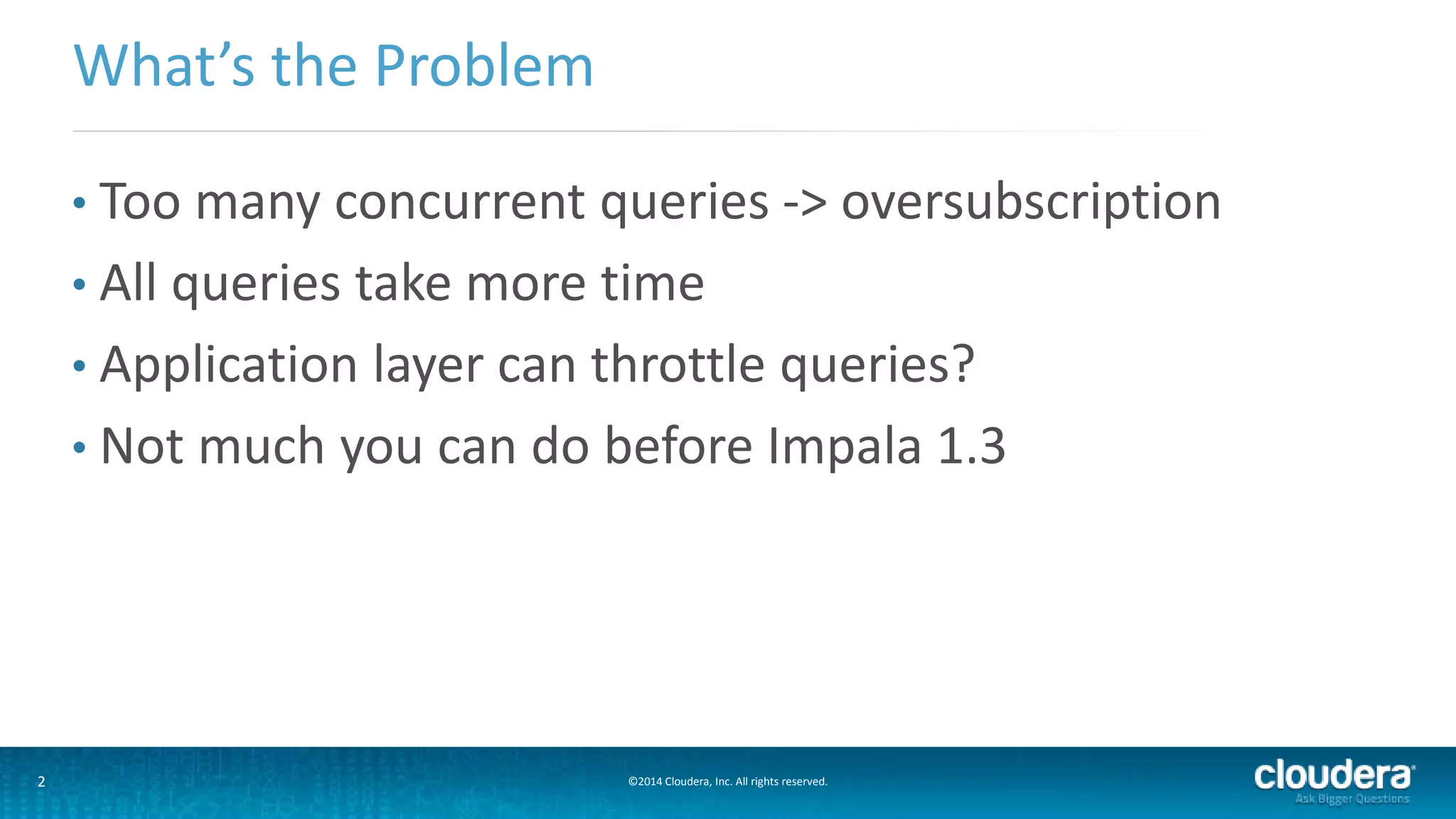
• Too many concurrent queries -> oversubscription
• All queries take more time
• Application layer can throttle queries?
• Not much you can do before Impala 1.3
What’s the Problem
3 ©2014 Cloudera, Inc. All rights reserved.
• Add an admission control mechanism to Impala!
• Throttle incoming requests
• Queues requests when workload increases
• Queued requests executed when resources available
So what do we do?
4 ©2014 Cloudera, Inc. All rights reserved.
• Yarn is a resource manager for Hadoop
• Assumes jobs are composed of tasks, tasks can be restarted
• Need to ask for all resources up front, resources “trickle in”
• Non-trivial overhead: job creates “application master” (AM)
• But cost is small compared to long batch jobs
• Great for MR, things like MR
• Not good for
• Low-latency, high volume workloads
• Gang scheduling, “parts of jobs” can’t be restarted
What about Yarn?
5 ©2014 Cloudera, Inc. All rights reserved.
• “Long Lived Application Master”
• Long running AMs
• Create fake requests to acquire necessary resources
• Provides a “gang scheduling” abstraction, waits for all resources
• Offers a resource expansion mechanism -> don’t need to ask for all
up front
• Offers a throttling mechanism
• Caches Yarn containers -> lower latency
• Looks like a square peg in a round hole…
• To be fair, multi-level scheduling is a hard problem!
Llama Bridges the Gap
6 ©2014 Cloudera, Inc. All rights reserved.
• Good for Impala sharing resources with other frameworks
• Good general purpose resource mgmt solution
However:
• Not everyone wants/needs to run Yarn and Llama
• Still requires round-trips to a central server
• Increases query latency
• Unlikely to scale for highest latency/throughput requirements
• Impala should have a fast, built in throttling mechanism
Impala + Llama + Yarn?
7 ©2014 Cloudera, Inc. All rights reserved.
• Throttle number of concurrent requests or memory
• Fast
• Decentralized
• Works without Yarn/Llama
• Works with CDH4/CDH5
Impala Admission Control
8 ©2014 Cloudera, Inc. All rights reserved.
• Configure one or more resource “pools”
• Max # concurrent queries, max memory, max queue size
• Each Impalad capable of making admission decisions
• No new single bottleneck/single point of failure
• Incoming queries are executed, queued, or rejected
• Queue if too many queries OR not enough memory
• Reject if queue is full
Design Overview
9 ©2014 Cloudera, Inc. All rights reserved.
• Requests admitted or queued locally
• Each Impalad keeps track of local state
• # queries, pool memory, local queue size
• Disseminates local stats via statestore -> global state
• Uses cached global state in admission decisions
• Decisions are fast; negligible impact on query latency
• No single point of failure
Localized Admission Decisions
10 ©2014 Cloudera, Inc. All rights reserved.
• Using cached global state -> may “over-admit”
• E.g. multiple impalads think 1 request can be admitted and admit
before receiving updated state
• Configured pool limits are “soft” limits
• Fn(Submission rate, distribution across impalads)
• Not a big problem in practice
• May occasionally admit a few extra queries
• Can increase statestore heartbeat frequency
• Can add some buffer to configured pool limits
Localized Admission Decisions (II)
11 ©2014 Cloudera, Inc. All rights reserved.
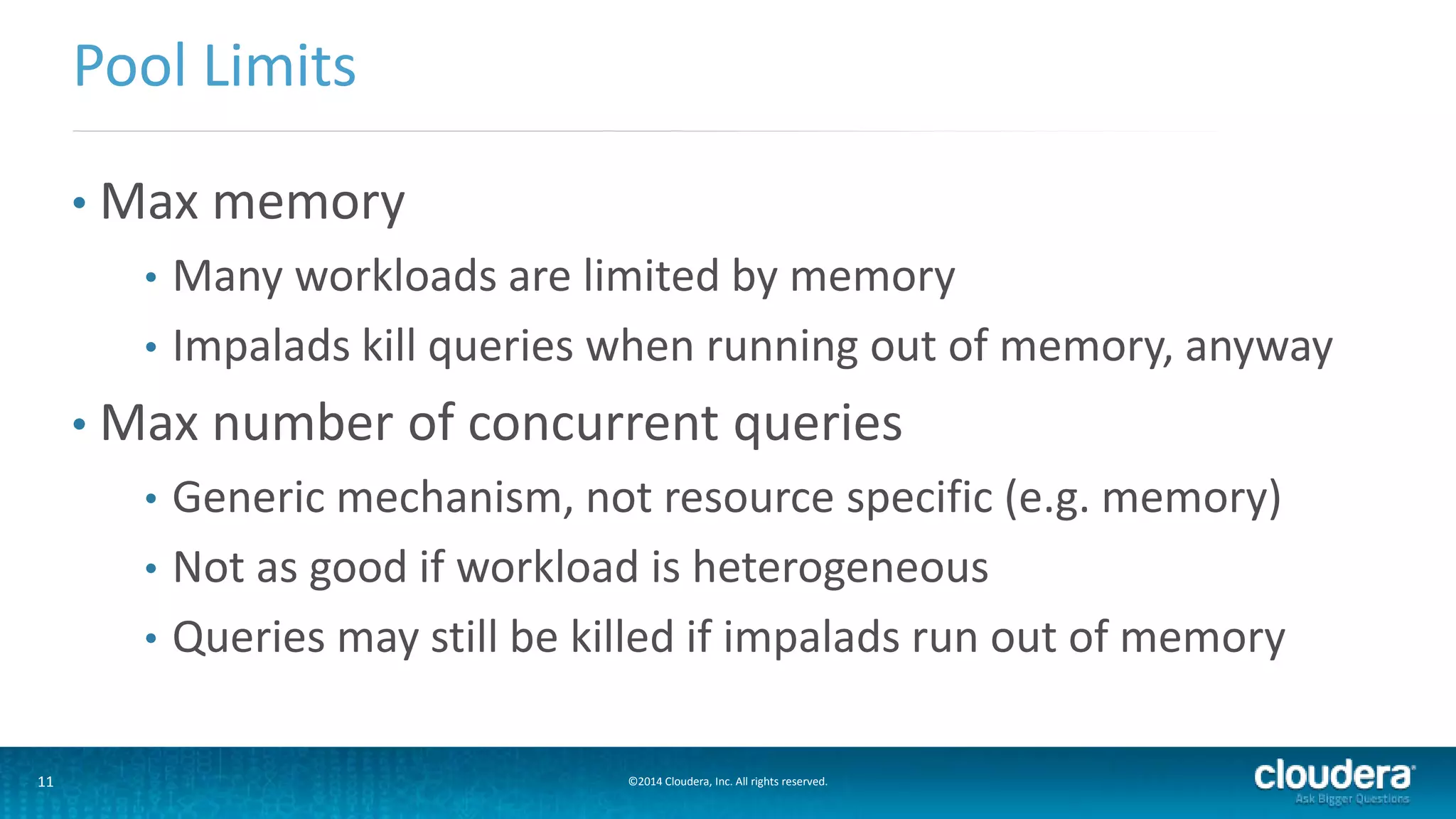
• Max memory
• Many workloads are limited by memory
• Impalads kill queries when running out of memory, anyway
• Max number of concurrent queries
• Generic mechanism, not resource specific (e.g. memory)
• Not as good if workload is heterogeneous
• Queries may still be killed if impalads run out of memory
Pool Limits
12
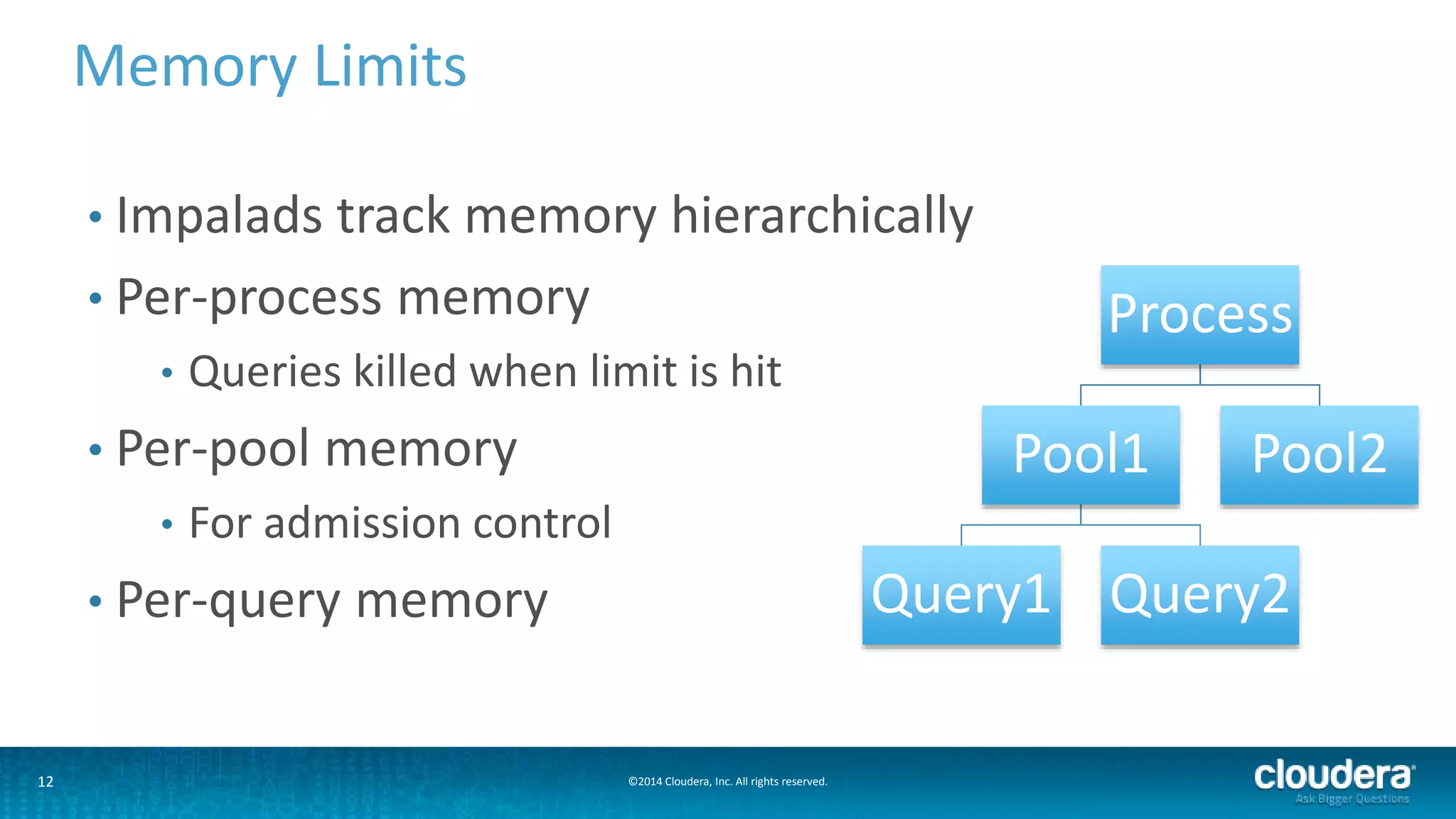
Memory Limits
• Impalads track memory hierarchically
• Per-process memory
• Queries killed when limit is hit
• Per-pool memory
• For admission control
• Per-query memory
Process
Pool1
Query1 Query2
Pool2
©2014 Cloudera, Inc. All rights reserved.
13 ©2014 Cloudera, Inc. All rights reserved.
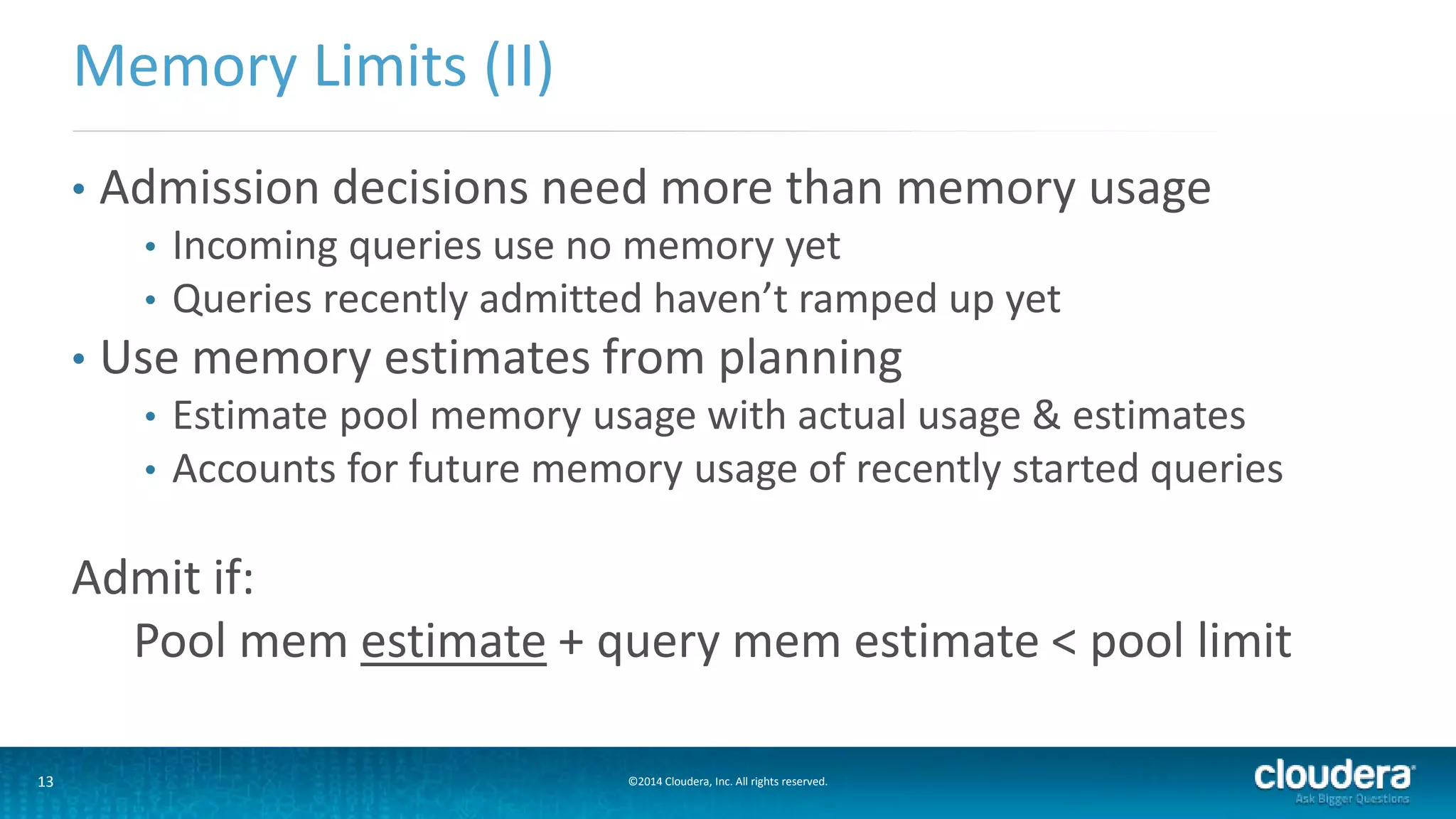
• Admission decisions need more than memory usage
• Incoming queries use no memory yet
• Queries recently admitted haven’t ramped up yet
• Use memory estimates from planning
• Estimate pool memory usage with actual usage & estimates
• Accounts for future memory usage of recently started queries
Admit if:
Pool mem estimate + query mem estimate < pool limit
Memory Limits (II)
14 ©2014 Cloudera, Inc. All rights reserved.
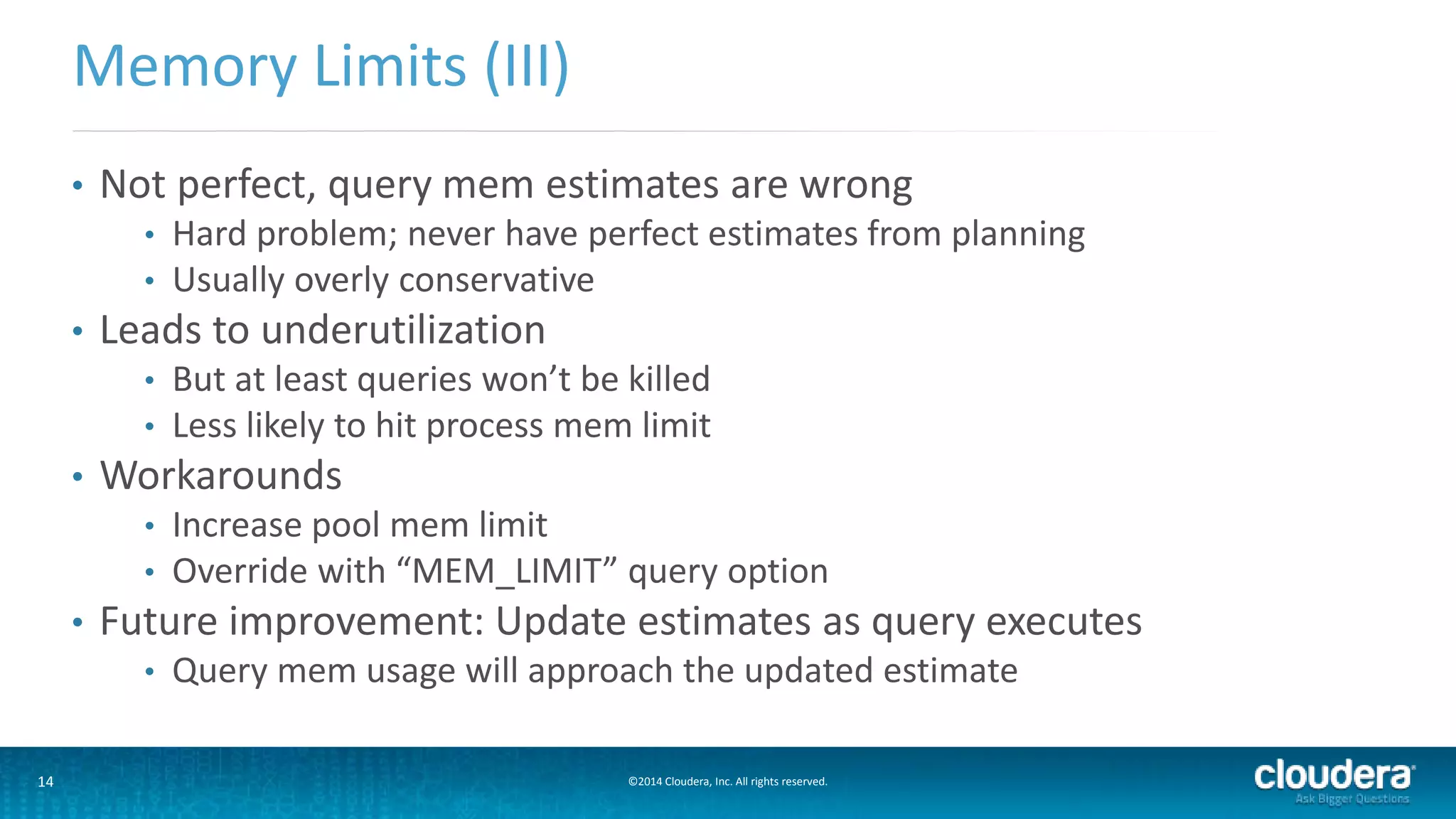
• Not perfect, query mem estimates are wrong
• Hard problem; never have perfect estimates from planning
• Usually overly conservative
• Leads to underutilization
• But at least queries won’t be killed
• Less likely to hit process mem limit
• Workarounds
• Increase pool mem limit
• Override with “MEM_LIMIT” query option
• Future improvement: Update estimates as query executes
• Query mem usage will approach the updated estimate
Memory Limits (III)
15 ©2014 Cloudera, Inc. All rights reserved.
• Modeled after Yarn resource queues
• Same configuration as Yarn queues
• Have a single configuration for Yarn & Impala
• Usually want to have the same resource allocations mapped
to an organization
• E.g. HR gets 10%, Finance gets 30%, Eng gets 60%
Request Pools
16 ©2014 Cloudera, Inc. All rights reserved.
• Users are mapped to pools using the placement policy
• Users are authorized using the specified ACLs
• Pools are defined hierarchically
• ACLs are inherited
• Currently only enforces limits on leaf pools (IMPALA-905)
Request Pools (II)
17 ©2014 Cloudera, Inc. All rights reserved.
• Uses Yarn + Llama configs
• Yarn fair scheduler allocation configuration (fair-
scheduler.xml)
• Llama configuration (llama-site.xml)
• Only some of the configuration properties are used
• See the documentation for sample config files
• Cloudera Manager has a nice UI to configure
• No need to touch the xml files
Request Pool General Configuration
18 ©2014 Cloudera, Inc. All rights reserved.
19 ©2014 Cloudera, Inc. All rights reserved.
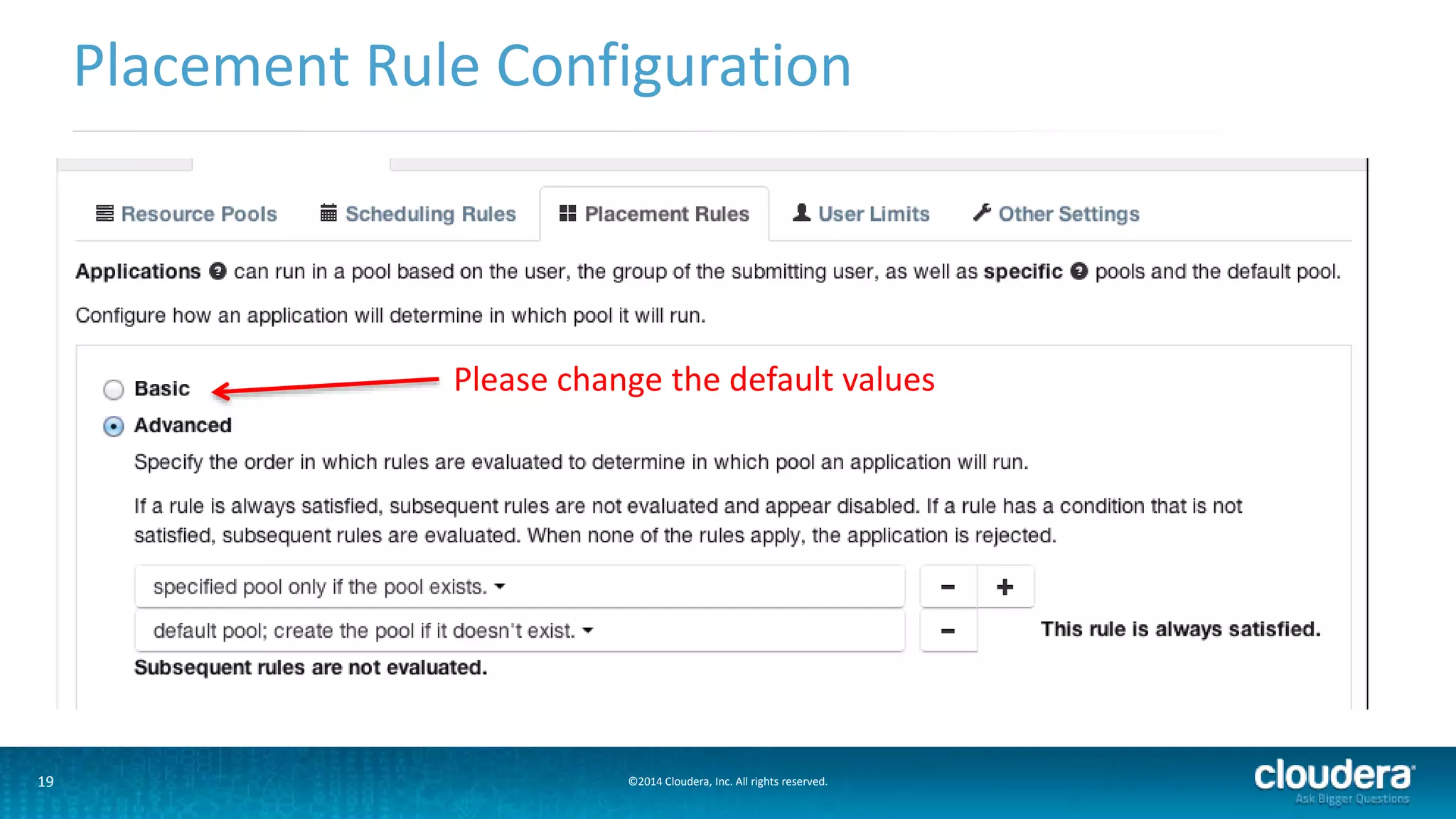
Placement Rule Configuration
Please change the default values
20 ©2014 Cloudera, Inc. All rights reserved.
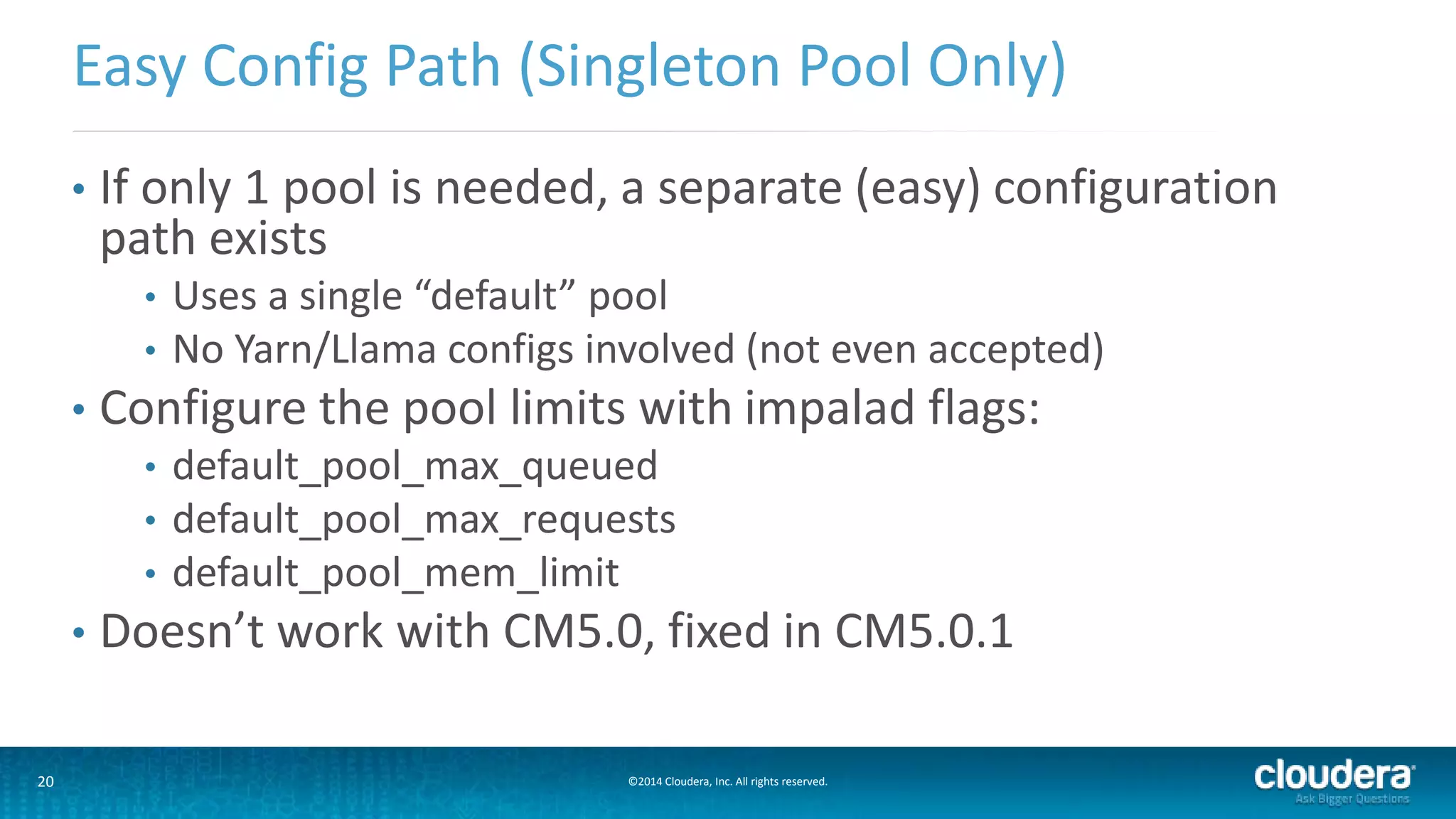
• If only 1 pool is needed, a separate (easy) configuration
path exists
• Uses a single “default” pool
• No Yarn/Llama configs involved (not even accepted)
• Configure the pool limits with impalad flags:
• default_pool_max_queued
• default_pool_max_requests
• default_pool_mem_limit
• Doesn’t work with CM5.0, fixed in CM5.0.1
Easy Config Path (Singleton Pool Only)
21 ©2014 Cloudera, Inc. All rights reserved.
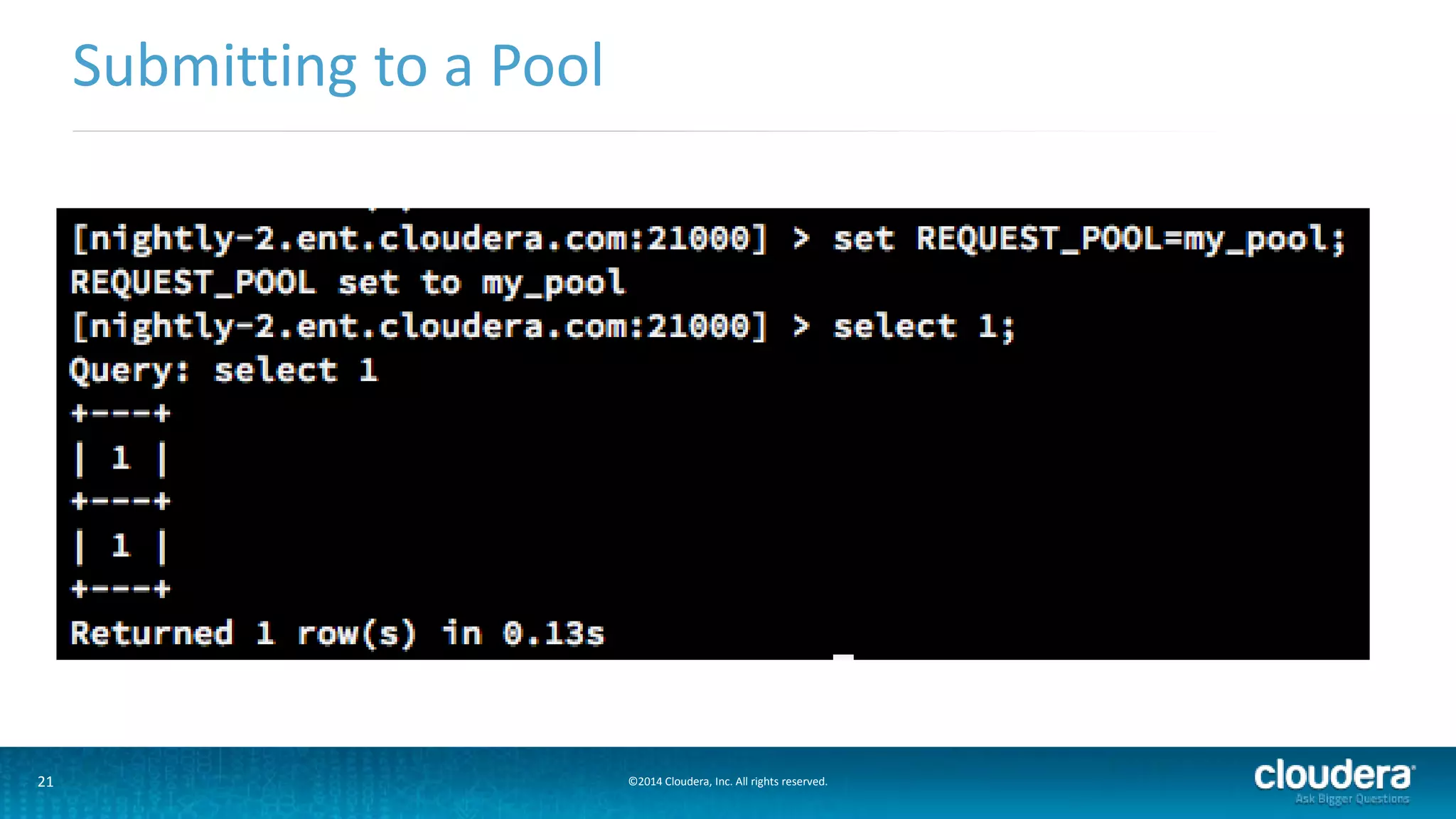
Submitting to a Pool
22 ©2014 Cloudera, Inc. All rights reserved.
• Rejections and timeouts return error messages
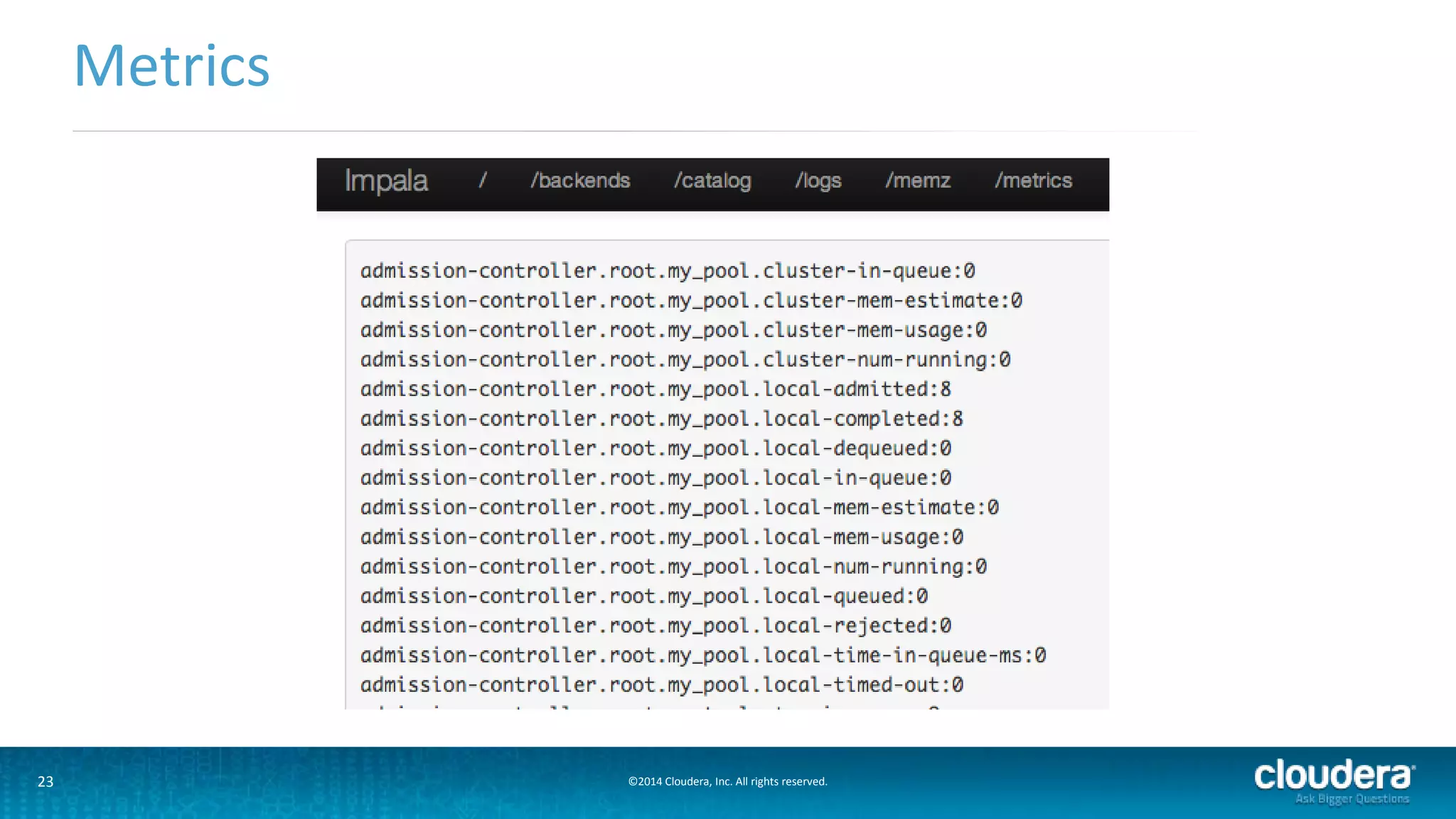
• Metrics
• Exposed in impalad web UI: /metrics
• Will be available in CM5.1
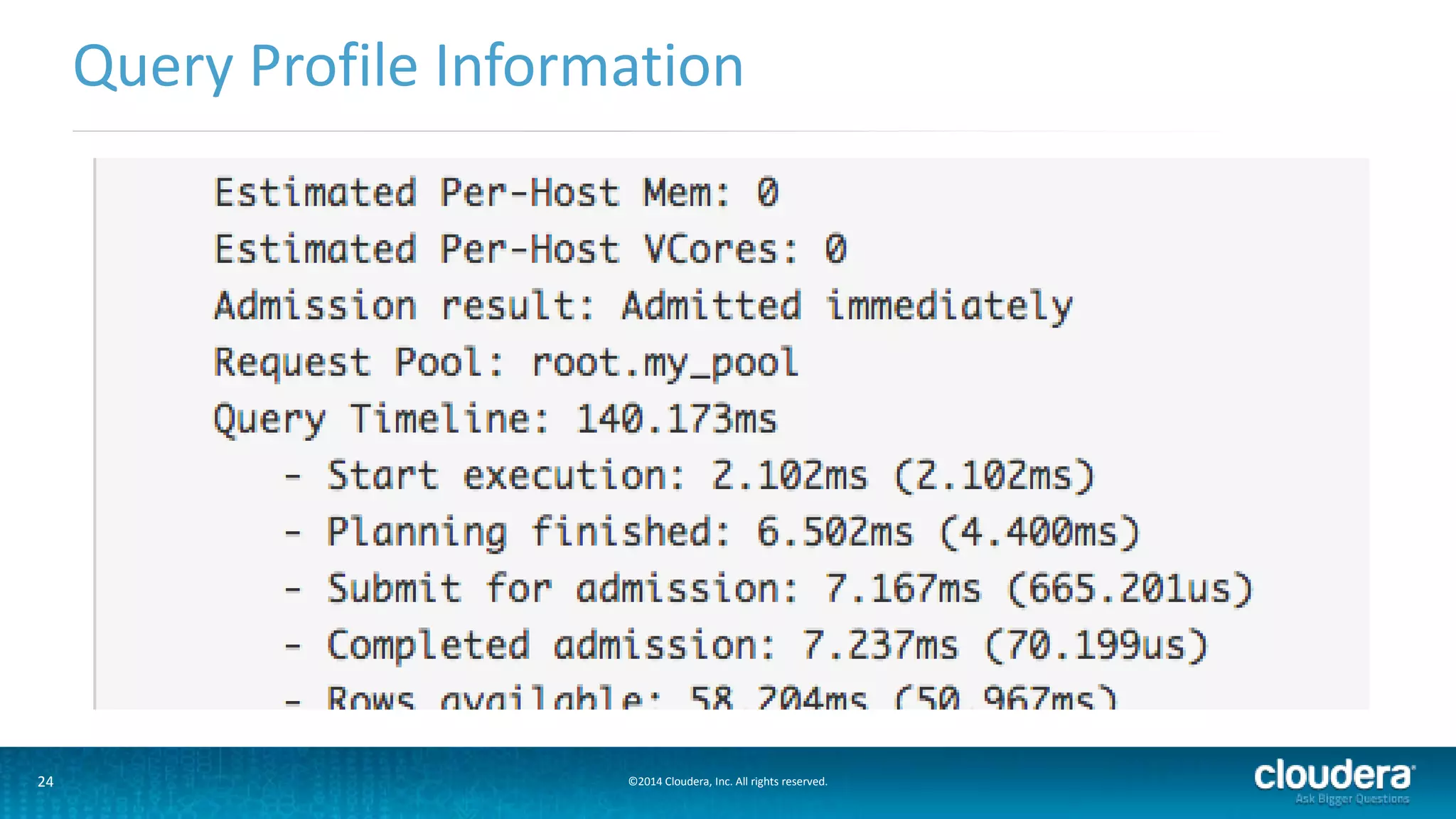
• Query profile has admission result
• Impalad logs have lots of useful information
“Debugging” Admission Control Decisions
admission-controller.cc:259] Schedule for id=c541aae43af74ed1:afdec812127f8097 in pool_name=root.test/admin
PoolConfig(max_requests=20 max_queued=50 mem_limit=-1.00 B) query cluster_mem_estimate=42.00 MB
admission-controller.cc:265] Stats: pool=root.test/admin Total(num_running=20, num_queued=7, mem_usage=239.07
MB, mem_estimate=800.00 MB) Local(num_running=20, num_queued=7, mem_usage=239.07 MB,
mem_estimate=800.00 MB)
admission-controller.cc:303] Queuing, query id=c541aae43af74ed1:afdec812127f8097
23 ©2014 Cloudera, Inc. All rights reserved.
Metrics
24 ©2014 Cloudera, Inc. All rights reserved.
Query Profile Information
25 ©2014 Cloudera, Inc. All rights reserved.
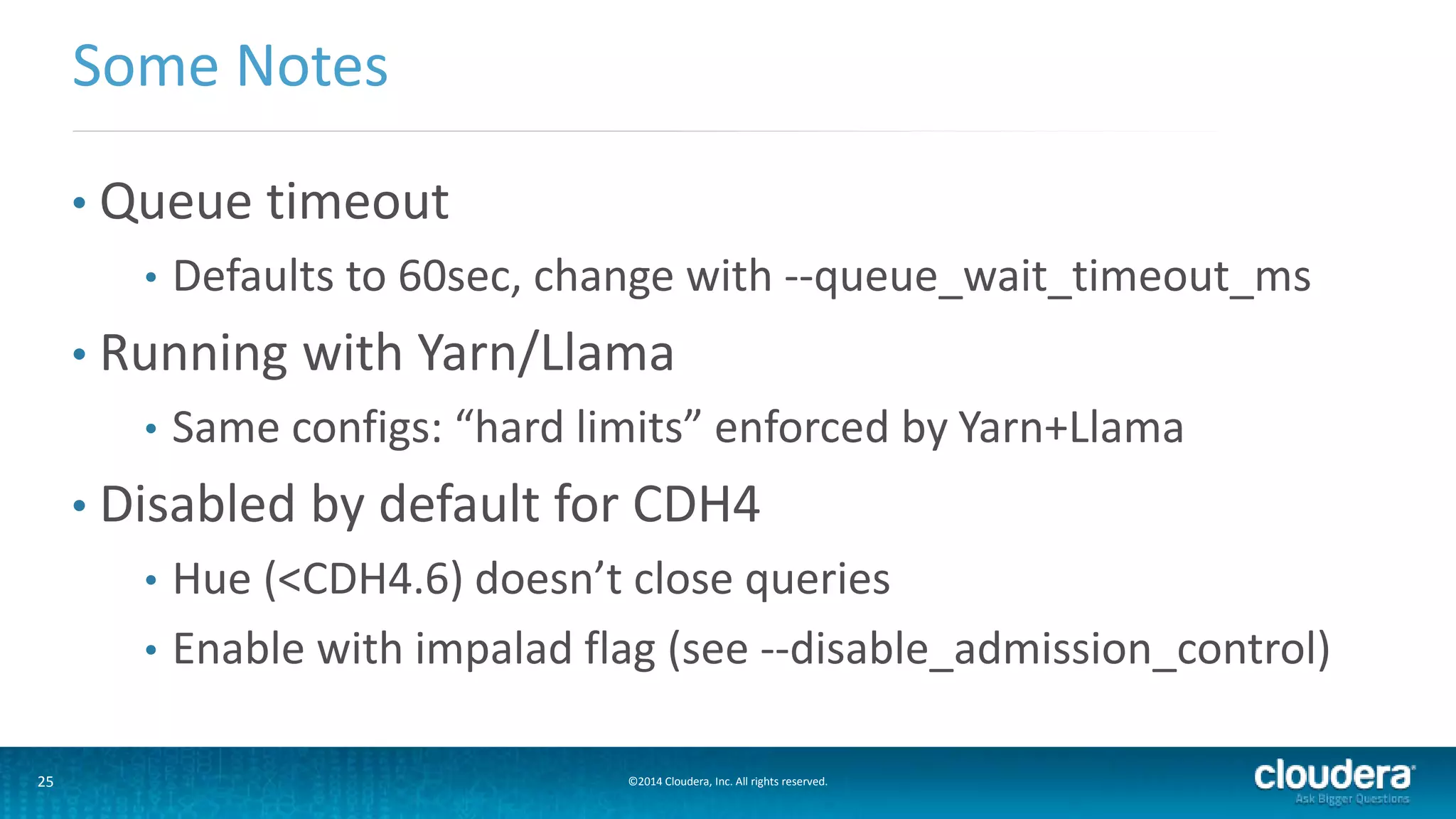
• Queue timeout
• Defaults to 60sec, change with --queue_wait_timeout_ms
• Running with Yarn/Llama
• Same configs: “hard limits” enforced by Yarn+Llama
• Disabled by default for CDH4
• Hue (<CDH4.6) doesn’t close queries
• Enable with impalad flag (see --disable_admission_control)
Some Notes
26 ©2014 Cloudera, Inc. All rights reserved.
Matthew Jacobs
@mattjacobs
mj@cloudera.com

Admission Control in Impala

  • 1.
    1 Admission Control inImpala Matthew Jacobs | @mattjacobs | mj@cloudera.com
  • 2.
    2 ©2014 Cloudera,Inc. All rights reserved. • Too many concurrent queries -> oversubscription • All queries take more time • Application layer can throttle queries? • Not much you can do before Impala 1.3 What’s the Problem
  • 3.
    3 ©2014 Cloudera,Inc. All rights reserved. • Add an admission control mechanism to Impala! • Throttle incoming requests • Queues requests when workload increases • Queued requests executed when resources available So what do we do?
  • 4.
    4 ©2014 Cloudera,Inc. All rights reserved. • Yarn is a resource manager for Hadoop • Assumes jobs are composed of tasks, tasks can be restarted • Need to ask for all resources up front, resources “trickle in” • Non-trivial overhead: job creates “application master” (AM) • But cost is small compared to long batch jobs • Great for MR, things like MR • Not good for • Low-latency, high volume workloads • Gang scheduling, “parts of jobs” can’t be restarted What about Yarn?
  • 5.
    5 ©2014 Cloudera,Inc. All rights reserved. • “Long Lived Application Master” • Long running AMs • Create fake requests to acquire necessary resources • Provides a “gang scheduling” abstraction, waits for all resources • Offers a resource expansion mechanism -> don’t need to ask for all up front • Offers a throttling mechanism • Caches Yarn containers -> lower latency • Looks like a square peg in a round hole… • To be fair, multi-level scheduling is a hard problem! Llama Bridges the Gap
  • 6.
    6 ©2014 Cloudera,Inc. All rights reserved. • Good for Impala sharing resources with other frameworks • Good general purpose resource mgmt solution However: • Not everyone wants/needs to run Yarn and Llama • Still requires round-trips to a central server • Increases query latency • Unlikely to scale for highest latency/throughput requirements • Impala should have a fast, built in throttling mechanism Impala + Llama + Yarn?
  • 7.
    7 ©2014 Cloudera,Inc. All rights reserved. • Throttle number of concurrent requests or memory • Fast • Decentralized • Works without Yarn/Llama • Works with CDH4/CDH5 Impala Admission Control
  • 8.
    8 ©2014 Cloudera,Inc. All rights reserved. • Configure one or more resource “pools” • Max # concurrent queries, max memory, max queue size • Each Impalad capable of making admission decisions • No new single bottleneck/single point of failure • Incoming queries are executed, queued, or rejected • Queue if too many queries OR not enough memory • Reject if queue is full Design Overview
  • 9.
    9 ©2014 Cloudera,Inc. All rights reserved. • Requests admitted or queued locally • Each Impalad keeps track of local state • # queries, pool memory, local queue size • Disseminates local stats via statestore -> global state • Uses cached global state in admission decisions • Decisions are fast; negligible impact on query latency • No single point of failure Localized Admission Decisions
  • 10.
    10 ©2014 Cloudera,Inc. All rights reserved. • Using cached global state -> may “over-admit” • E.g. multiple impalads think 1 request can be admitted and admit before receiving updated state • Configured pool limits are “soft” limits • Fn(Submission rate, distribution across impalads) • Not a big problem in practice • May occasionally admit a few extra queries • Can increase statestore heartbeat frequency • Can add some buffer to configured pool limits Localized Admission Decisions (II)
  • 11.
    11 ©2014 Cloudera,Inc. All rights reserved. • Max memory • Many workloads are limited by memory • Impalads kill queries when running out of memory, anyway • Max number of concurrent queries • Generic mechanism, not resource specific (e.g. memory) • Not as good if workload is heterogeneous • Queries may still be killed if impalads run out of memory Pool Limits
  • 12.
    12 Memory Limits • Impaladstrack memory hierarchically • Per-process memory • Queries killed when limit is hit • Per-pool memory • For admission control • Per-query memory Process Pool1 Query1 Query2 Pool2 ©2014 Cloudera, Inc. All rights reserved.
  • 13.
    13 ©2014 Cloudera,Inc. All rights reserved. • Admission decisions need more than memory usage • Incoming queries use no memory yet • Queries recently admitted haven’t ramped up yet • Use memory estimates from planning • Estimate pool memory usage with actual usage & estimates • Accounts for future memory usage of recently started queries Admit if: Pool mem estimate + query mem estimate < pool limit Memory Limits (II)
  • 14.
    14 ©2014 Cloudera,Inc. All rights reserved. • Not perfect, query mem estimates are wrong • Hard problem; never have perfect estimates from planning • Usually overly conservative • Leads to underutilization • But at least queries won’t be killed • Less likely to hit process mem limit • Workarounds • Increase pool mem limit • Override with “MEM_LIMIT” query option • Future improvement: Update estimates as query executes • Query mem usage will approach the updated estimate Memory Limits (III)
  • 15.
    15 ©2014 Cloudera,Inc. All rights reserved. • Modeled after Yarn resource queues • Same configuration as Yarn queues • Have a single configuration for Yarn & Impala • Usually want to have the same resource allocations mapped to an organization • E.g. HR gets 10%, Finance gets 30%, Eng gets 60% Request Pools
  • 16.
    16 ©2014 Cloudera,Inc. All rights reserved. • Users are mapped to pools using the placement policy • Users are authorized using the specified ACLs • Pools are defined hierarchically • ACLs are inherited • Currently only enforces limits on leaf pools (IMPALA-905) Request Pools (II)
  • 17.
    17 ©2014 Cloudera,Inc. All rights reserved. • Uses Yarn + Llama configs • Yarn fair scheduler allocation configuration (fair- scheduler.xml) • Llama configuration (llama-site.xml) • Only some of the configuration properties are used • See the documentation for sample config files • Cloudera Manager has a nice UI to configure • No need to touch the xml files Request Pool General Configuration
  • 18.
    18 ©2014 Cloudera,Inc. All rights reserved.
  • 19.
    19 ©2014 Cloudera,Inc. All rights reserved. Placement Rule Configuration Please change the default values
  • 20.
    20 ©2014 Cloudera,Inc. All rights reserved. • If only 1 pool is needed, a separate (easy) configuration path exists • Uses a single “default” pool • No Yarn/Llama configs involved (not even accepted) • Configure the pool limits with impalad flags: • default_pool_max_queued • default_pool_max_requests • default_pool_mem_limit • Doesn’t work with CM5.0, fixed in CM5.0.1 Easy Config Path (Singleton Pool Only)
  • 21.
    21 ©2014 Cloudera,Inc. All rights reserved. Submitting to a Pool
  • 22.
    22 ©2014 Cloudera,Inc. All rights reserved. • Rejections and timeouts return error messages • Metrics • Exposed in impalad web UI: /metrics • Will be available in CM5.1 • Query profile has admission result • Impalad logs have lots of useful information “Debugging” Admission Control Decisions admission-controller.cc:259] Schedule for id=c541aae43af74ed1:afdec812127f8097 in pool_name=root.test/admin PoolConfig(max_requests=20 max_queued=50 mem_limit=-1.00 B) query cluster_mem_estimate=42.00 MB admission-controller.cc:265] Stats: pool=root.test/admin Total(num_running=20, num_queued=7, mem_usage=239.07 MB, mem_estimate=800.00 MB) Local(num_running=20, num_queued=7, mem_usage=239.07 MB, mem_estimate=800.00 MB) admission-controller.cc:303] Queuing, query id=c541aae43af74ed1:afdec812127f8097
  • 23.
    23 ©2014 Cloudera,Inc. All rights reserved. Metrics
  • 24.
    24 ©2014 Cloudera,Inc. All rights reserved. Query Profile Information
  • 25.
    25 ©2014 Cloudera,Inc. All rights reserved. • Queue timeout • Defaults to 60sec, change with --queue_wait_timeout_ms • Running with Yarn/Llama • Same configs: “hard limits” enforced by Yarn+Llama • Disabled by default for CDH4 • Hue (<CDH4.6) doesn’t close queries • Enable with impalad flag (see --disable_admission_control) Some Notes
  • 26.
    26 ©2014 Cloudera,Inc. All rights reserved. Matthew Jacobs @mattjacobs mj@cloudera.com