What’s New in the Upcoming
Apache Spark 3.0
Xiao Li gatorsmile
June 2020
• Engineering Manager at Databricks
• Apache Spark Committer and PMC
• Previously, IBM Master Inventor
• Ph.D. in CISE at University of Florida
• GitHub: gatorsmile
About Me
Unified data analytics platform for accelerating innovation across
data science, data engineering, and business analytics
Original creators of popular data and machine learning open source projects
Global company with 5,000 customers and 450+ partners
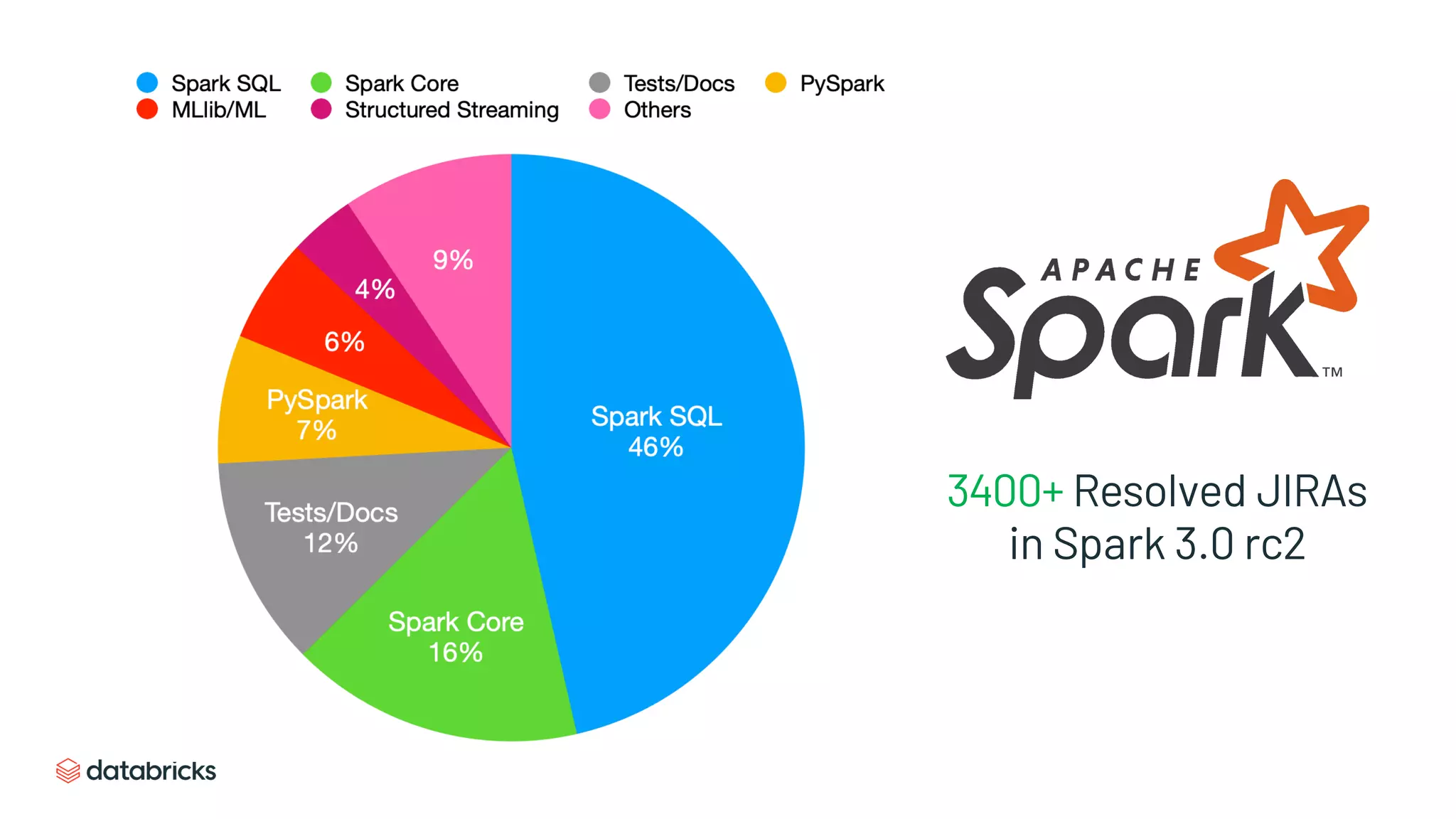
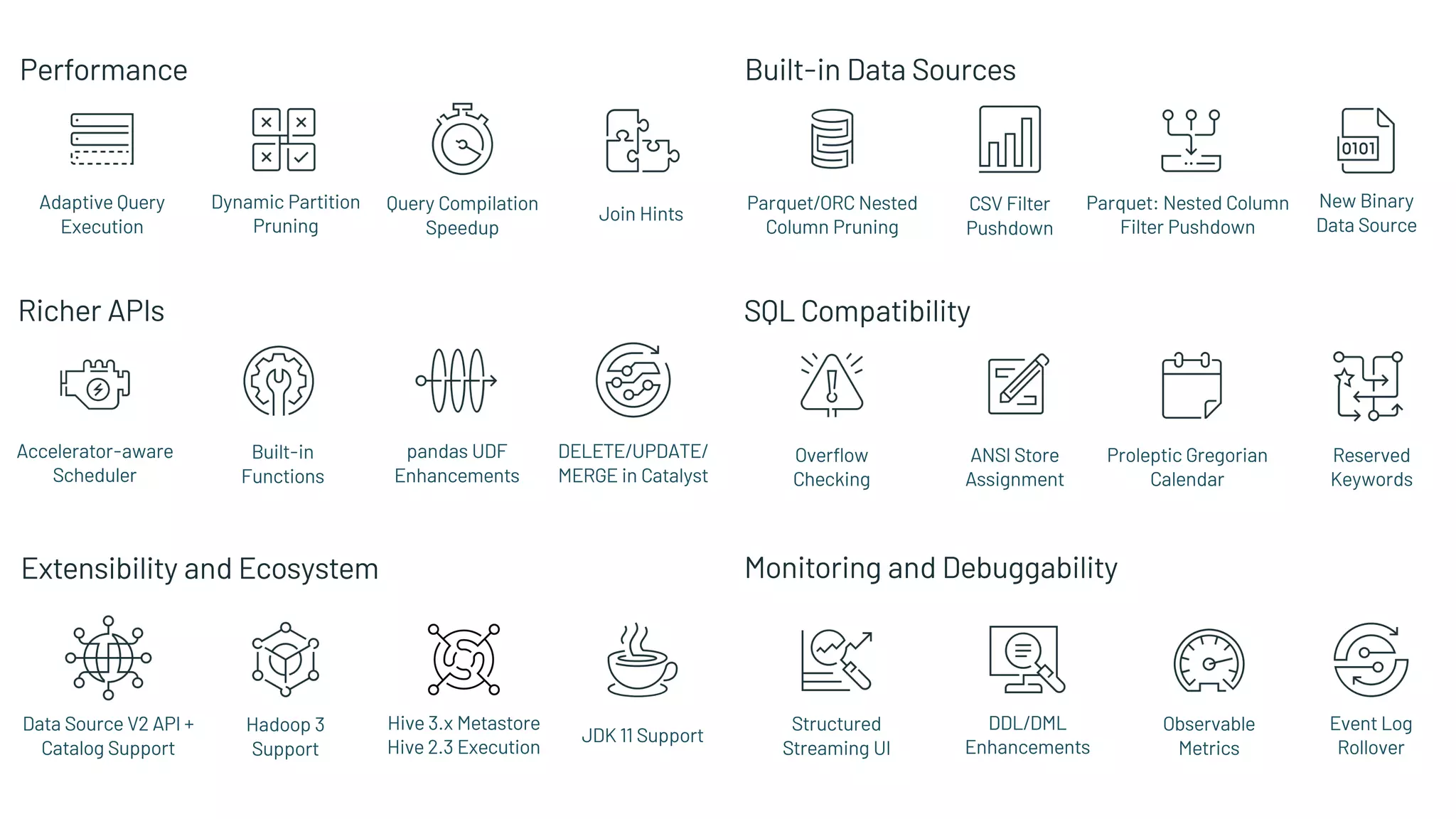
3400+ Resolved JIRAs
in Spark 3.0 rc2
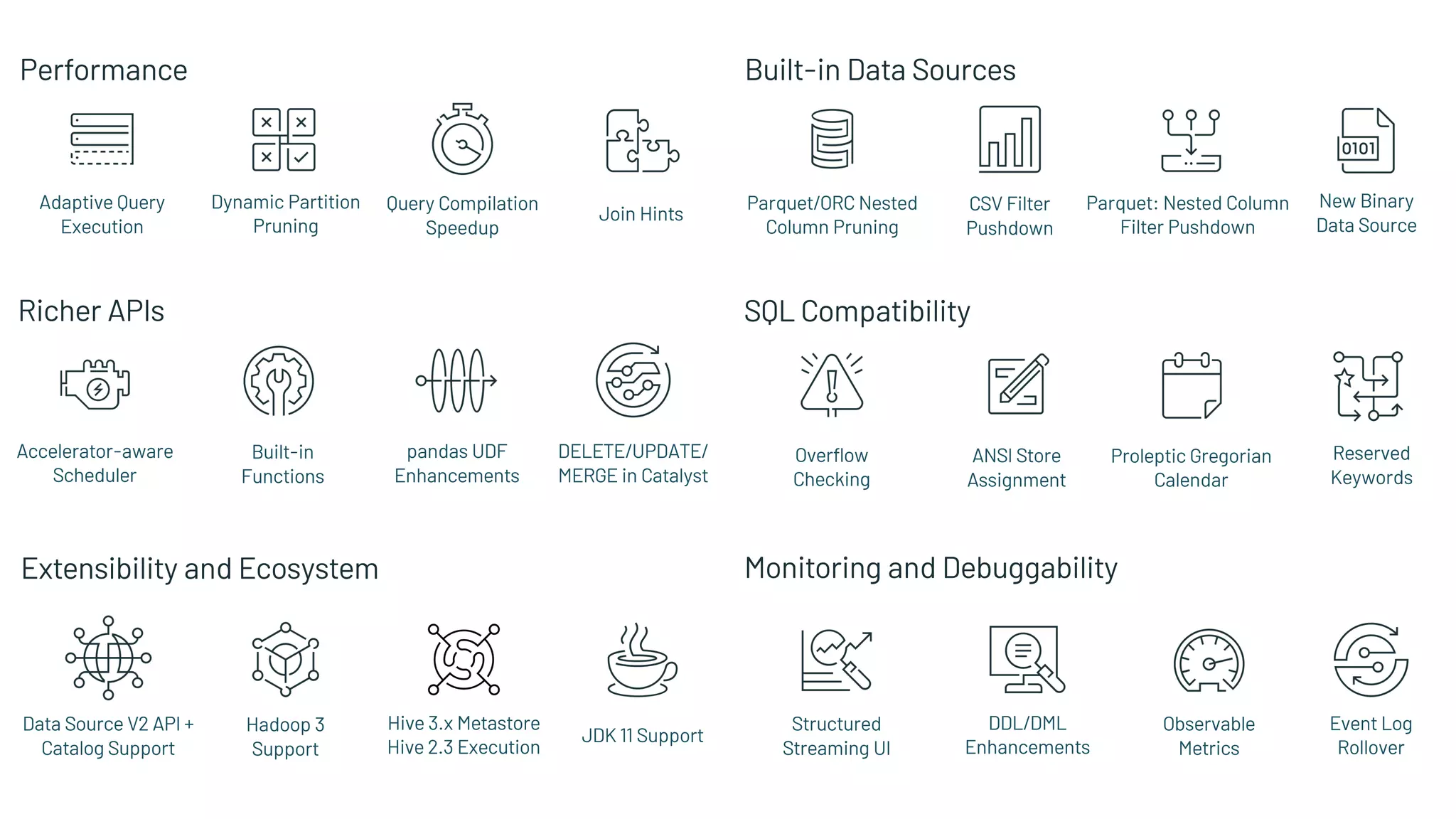
Adaptive Query
Execution
Dynamic Partition
Pruning
Query Compilation
Speedup
Join Hints
Performance
Richer APIs
Accelerator-aware
Scheduler
Built-in
Functions
pandas UDF
Enhancements
DELETE/UPDATE/
MERGE in Catalyst
Reserved
Keywords
Proleptic Gregorian
Calendar
ANSI Store
Assignment
Overflow
Checking
SQL Compatibility
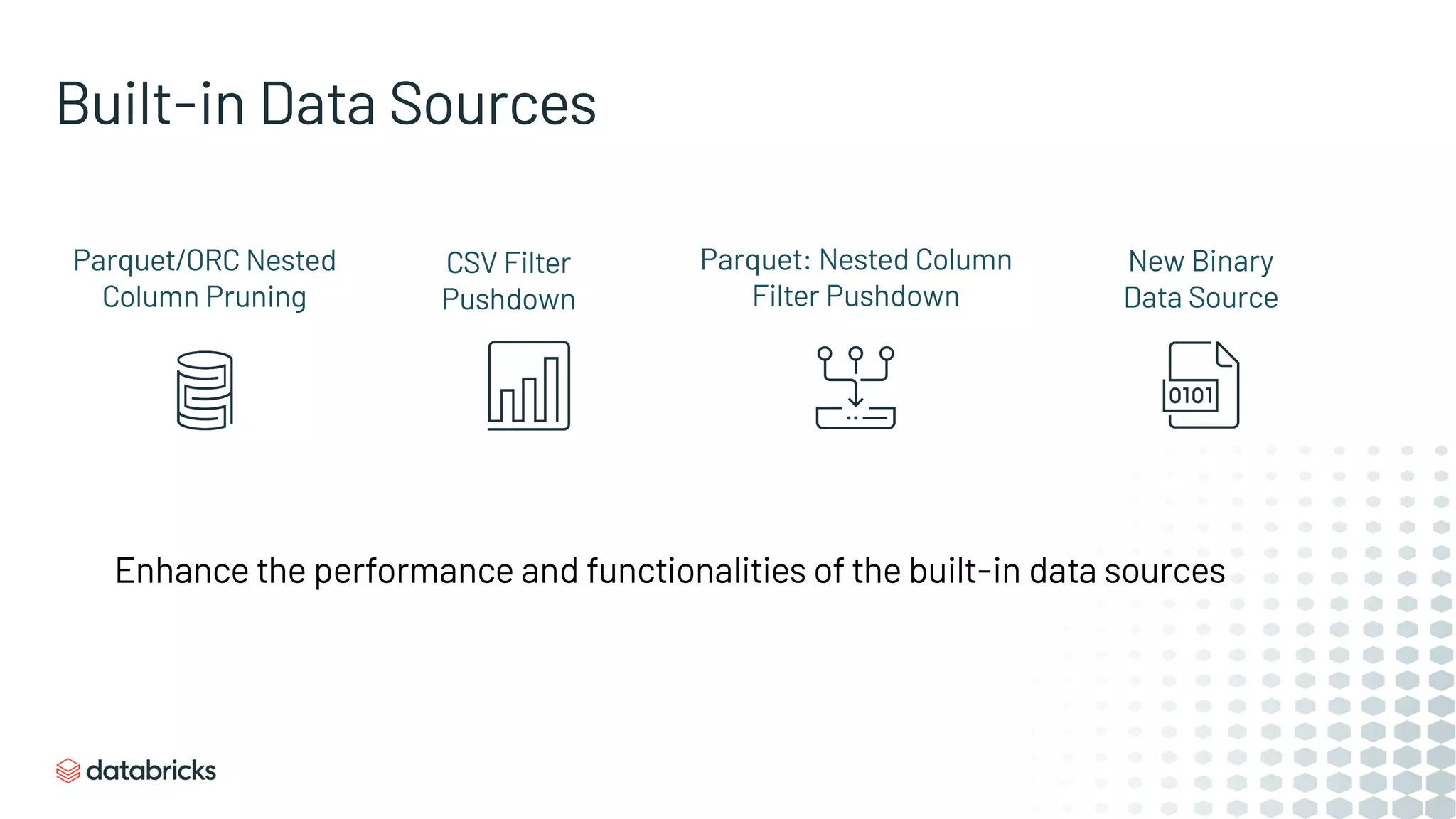
Built-in Data Sources
Parquet/ORC Nested
Column Pruning
Parquet: Nested Column
Filter Pushdown
CSV Filter
Pushdown
New Binary
Data Source
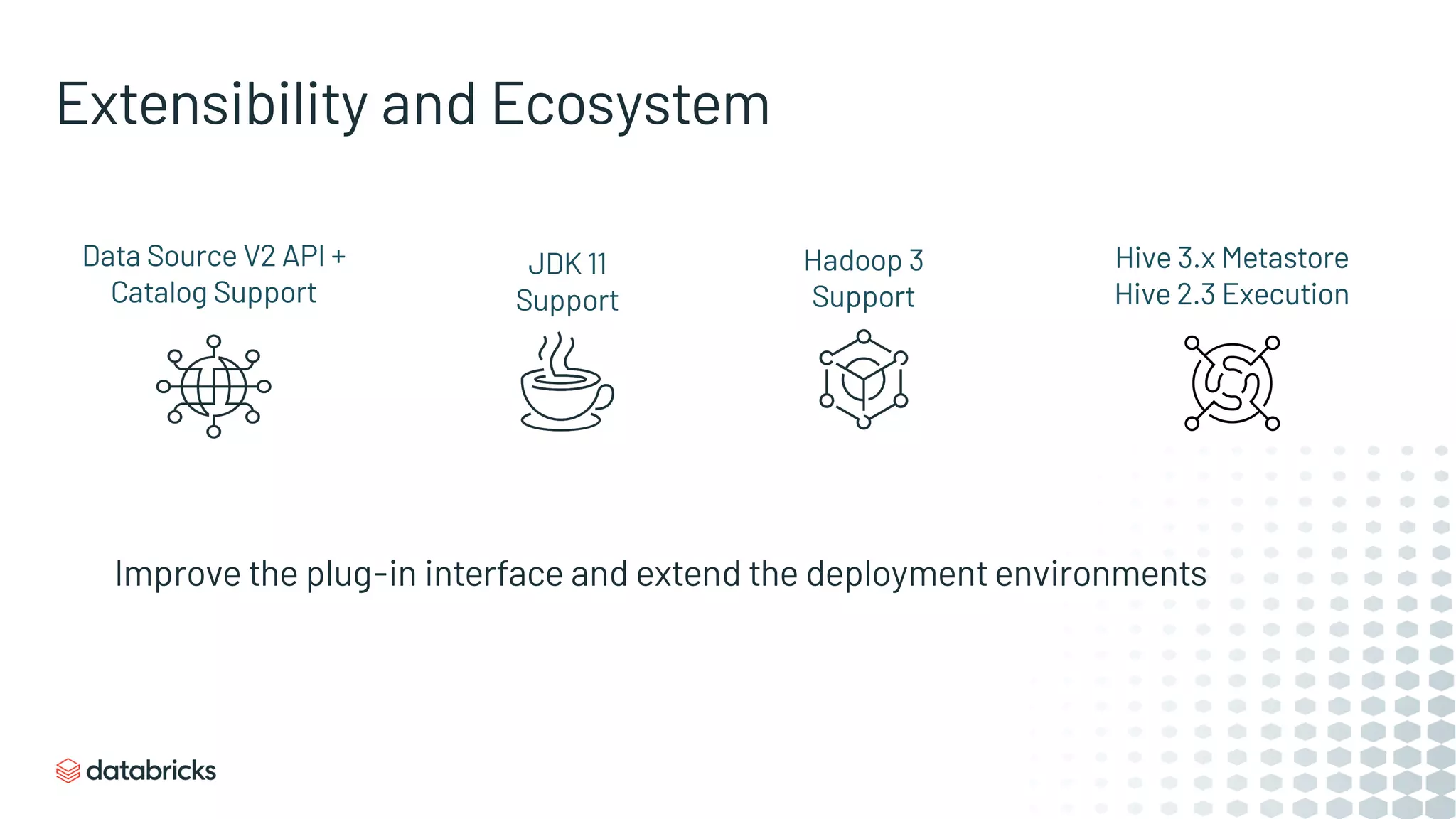
Data Source V2 API +
Catalog Support
JDK 11 Support
Hadoop 3
Support
Hive 3.x Metastore
Hive 2.3 Execution
Extensibility and Ecosystem
Structured
Streaming UI
DDL/DML
Enhancements
Observable
Metrics
Event Log
Rollover
Monitoring and Debuggability
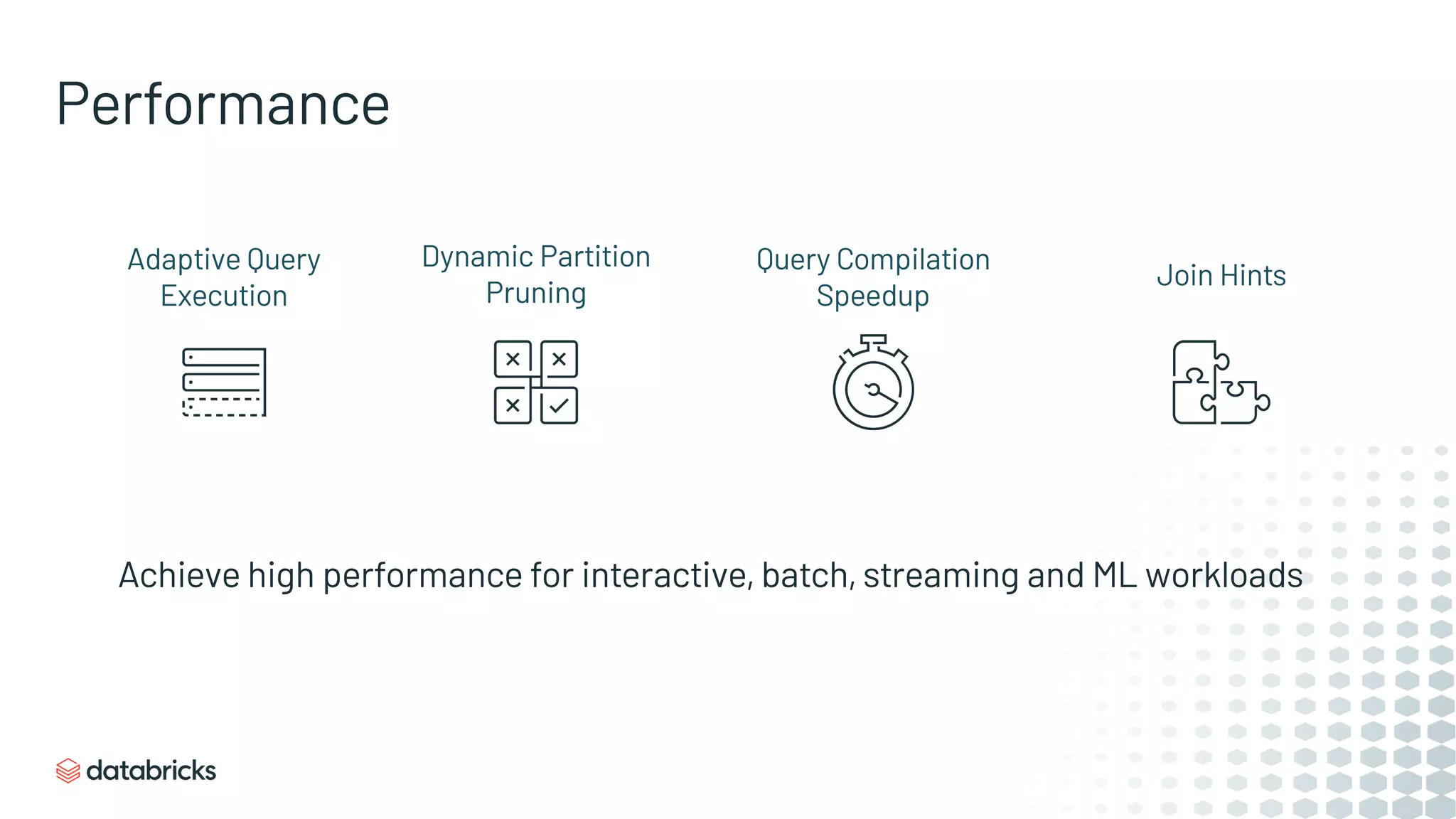
Performance
Achieve high performance for interactive, batch, streaming and ML workloads
Adaptive Query
Execution
Dynamic Partition
Pruning
Query Compilation
Speedup
Join Hints
Performance
Achieve high performance for interactive, batch, streaming and ML workloads
Adaptive Query
Execution
Dynamic Partition
Pruning
Join Hints
Query Compilation
Speedup
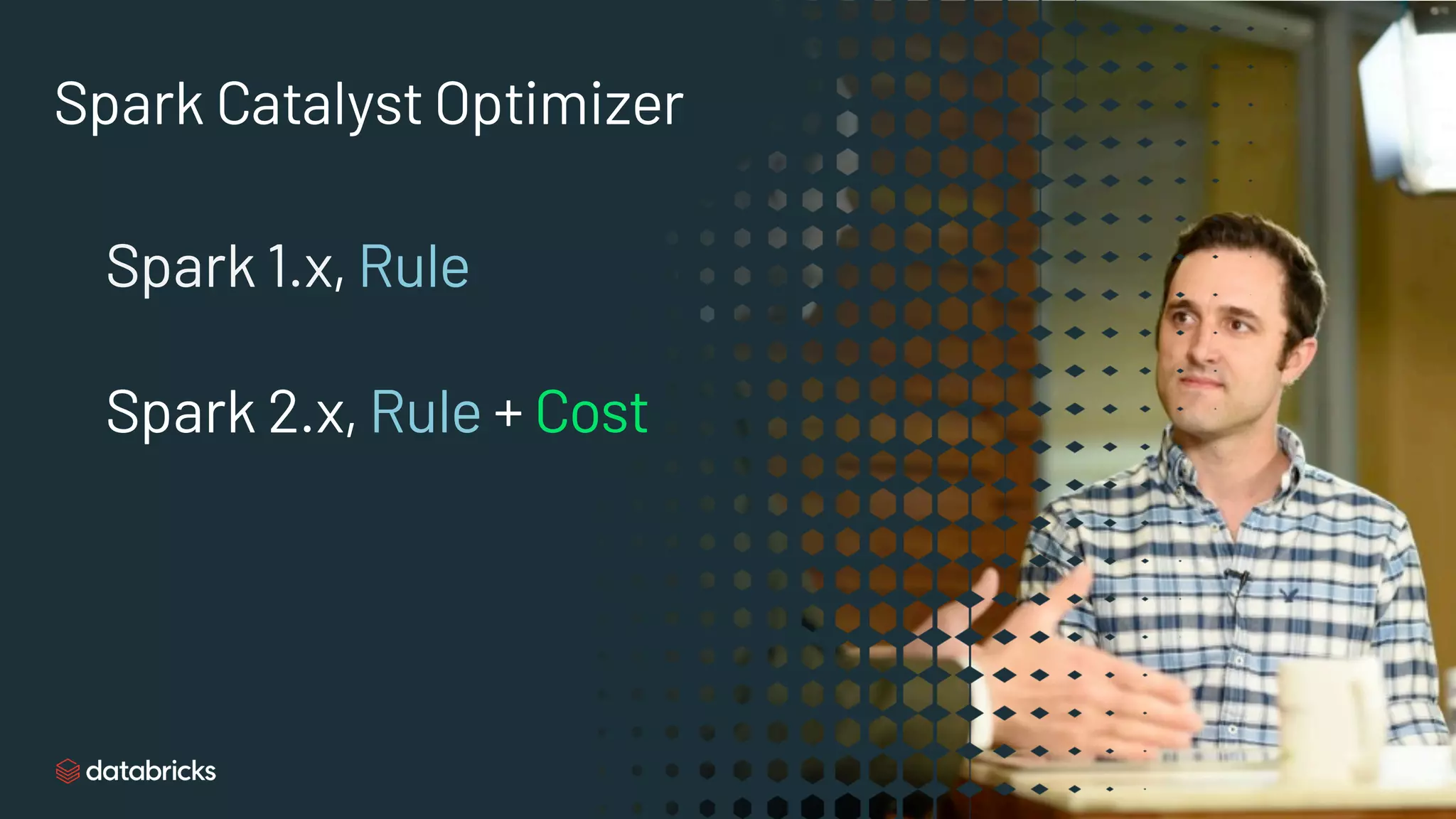
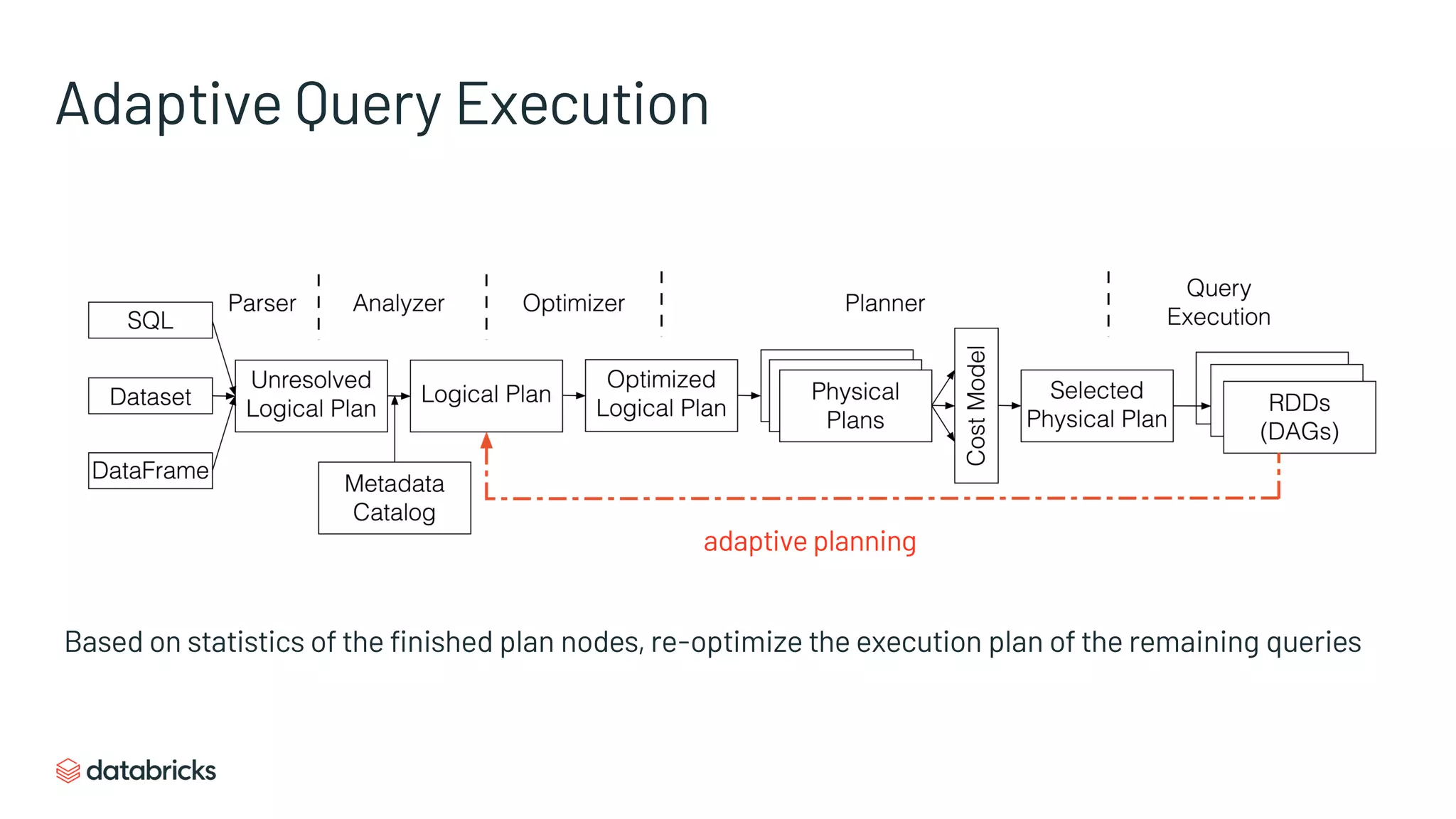
Spark Catalyst Optimizer
Spark 1.x, Rule
Spark 2.x, Rule + Cost
Query Optimization in Spark 2.x
§ Missing statistics
Expensive statistics collection
§ Out-of-date statistics
Compute and storage separated
§ Suboptimal Heuristics
Local
§ Misestimated costs
Complex environments
User-defined functions
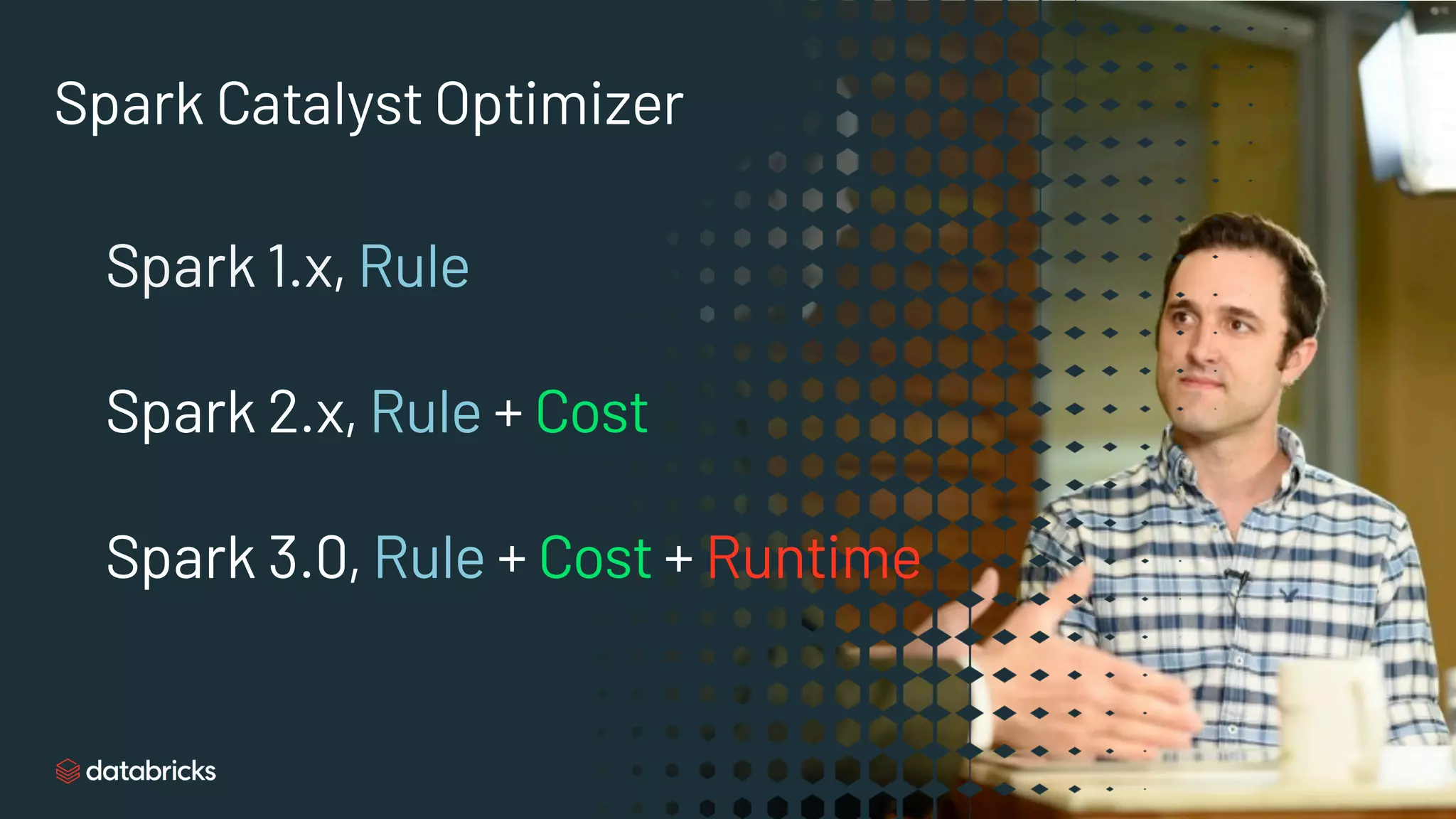
Spark Catalyst Optimizer
Spark 1.x, Rule
Spark 2.x, Rule + Cost
Spark 3.0, Rule + Cost + Runtime
adaptive planning
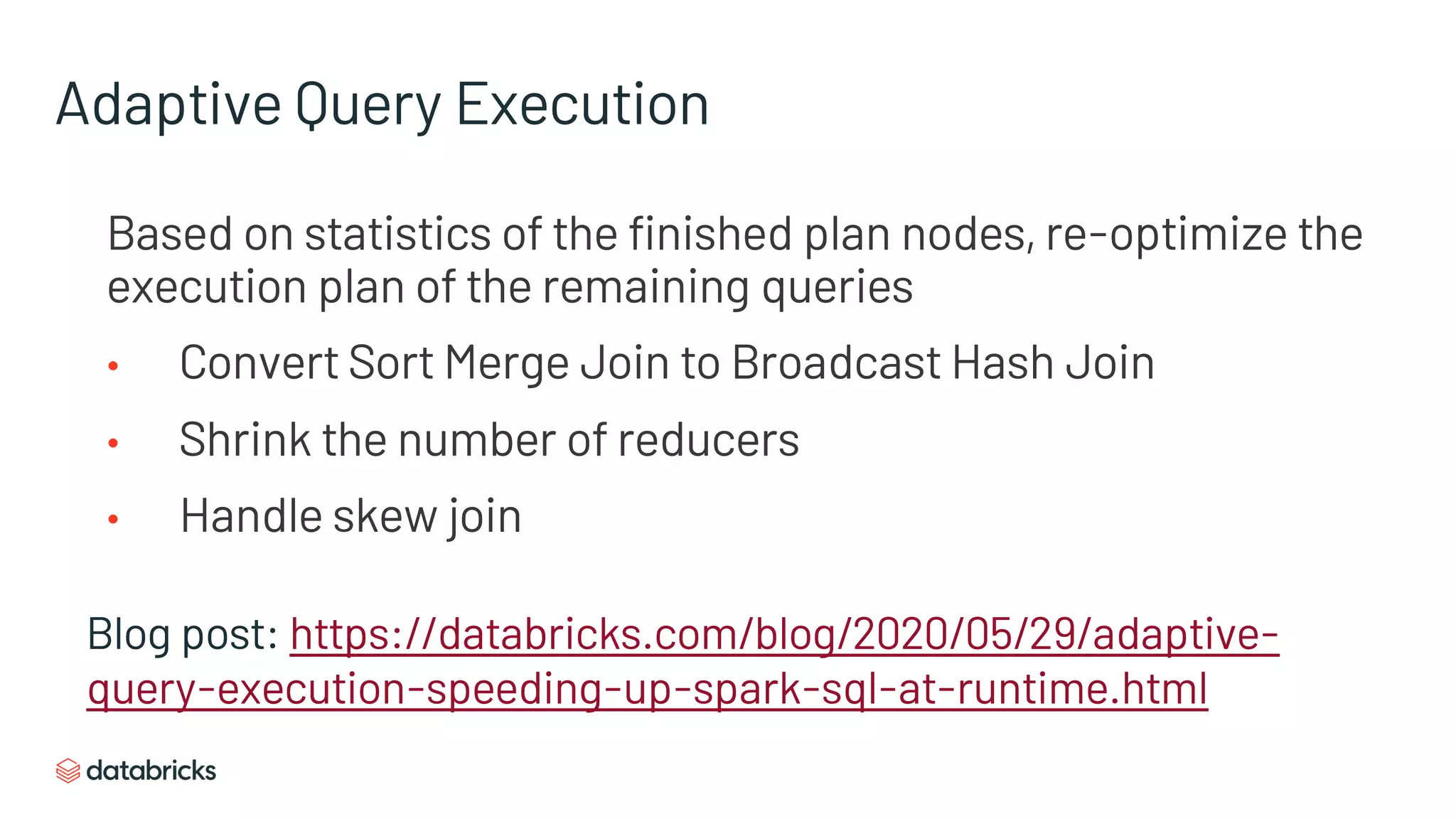
Based on statistics of the finished plan nodes, re-optimize the execution plan of the remaining queries
Adaptive Query Execution
Blog post: https://databricks.com/blog/2020/05/29/adaptive-
query-execution-speeding-up-spark-sql-at-runtime.html
Based on statistics of the finished plan nodes, re-optimize the
execution plan of the remaining queries
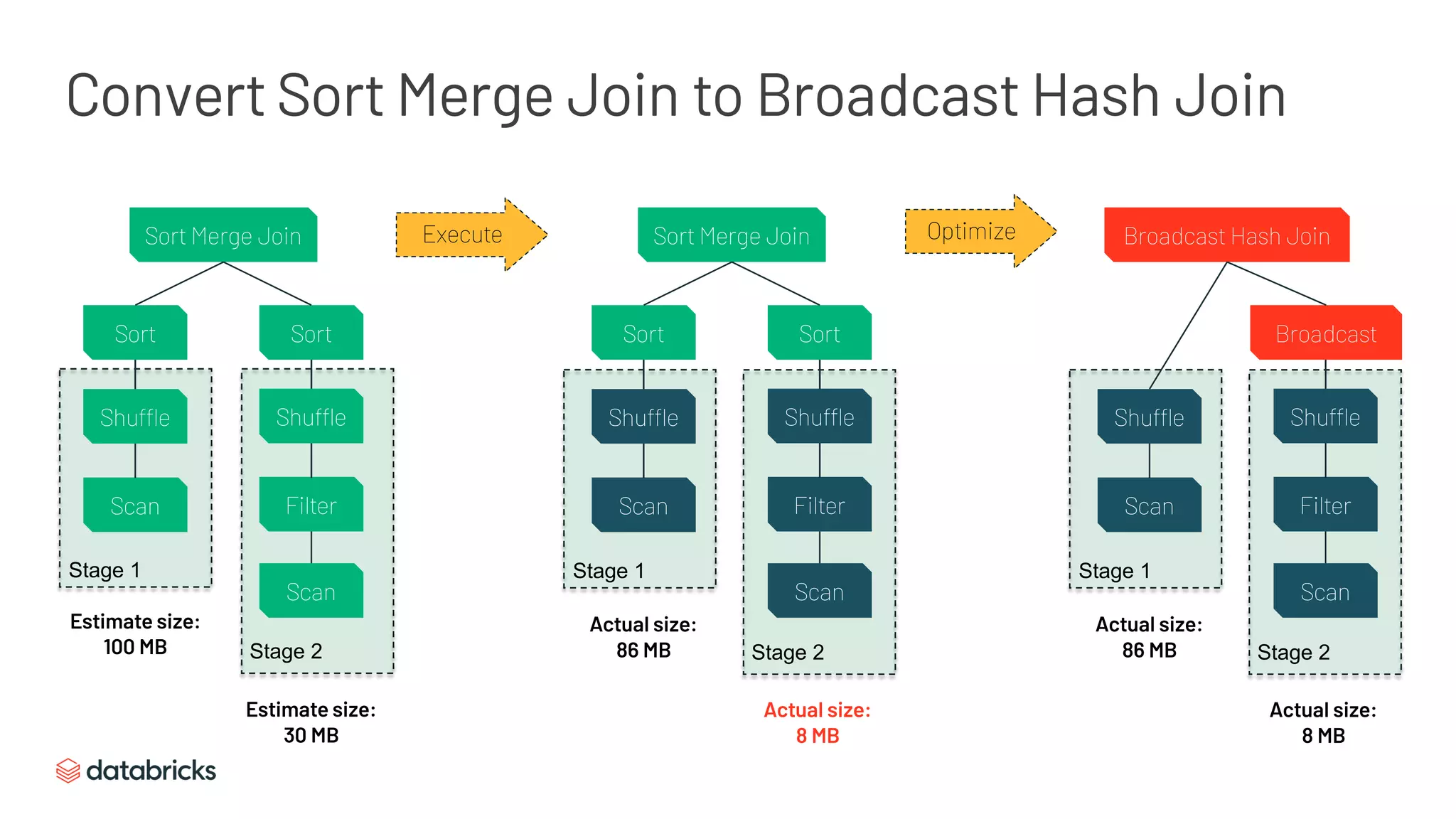
• Convert Sort Merge Join to Broadcast Hash Join
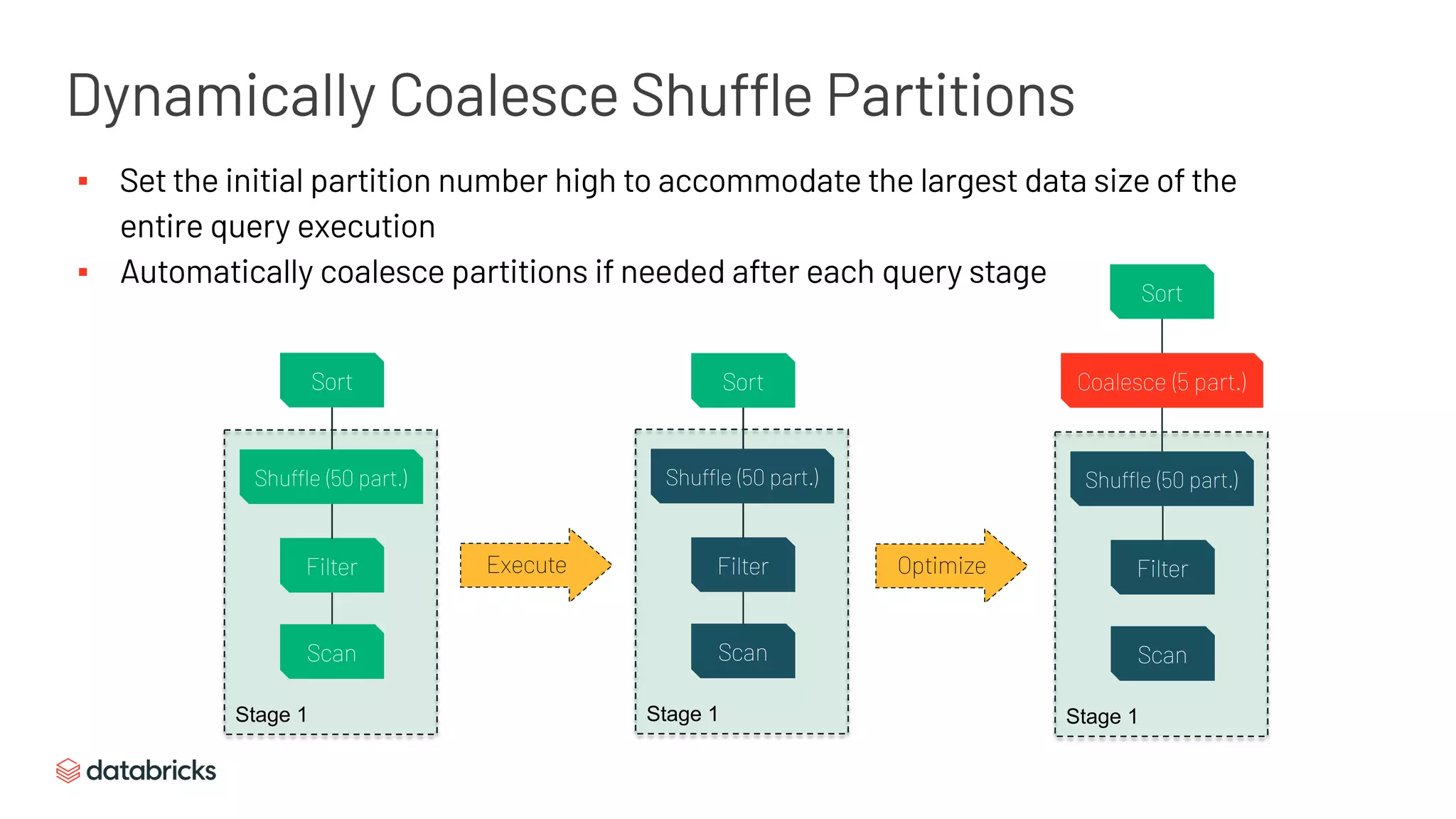
• Shrink the number of reducers
• Handle skew join
Adaptive Query Execution
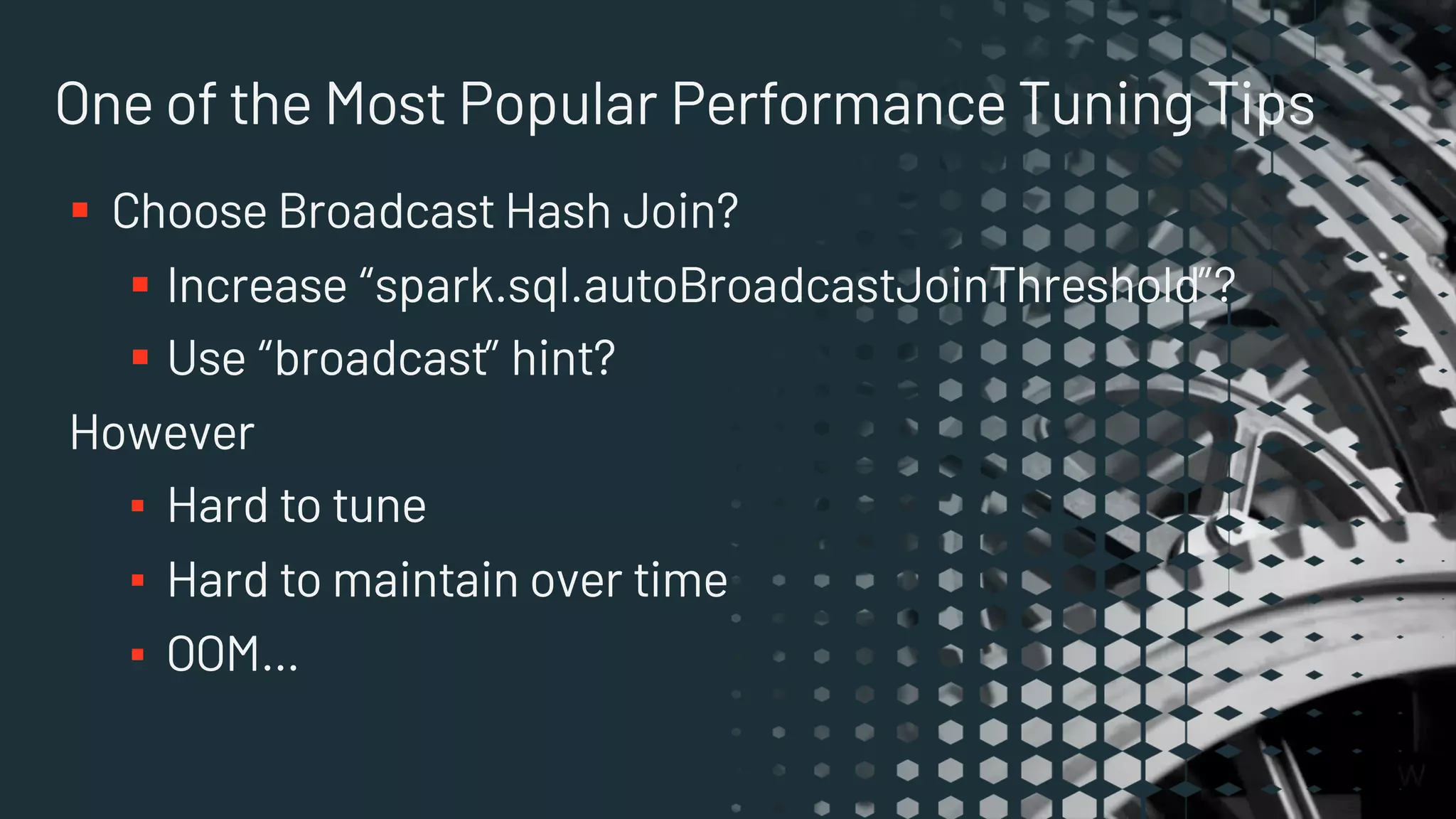
One of the Most Popular Performance Tuning Tips
§ Choose Broadcast Hash Join?
§ Increase “spark.sql.autoBroadcastJoinThreshold”?
§ Use “broadcast” hint?
However
▪ Hard to tune
▪ Hard to maintain over time
▪ OOM…
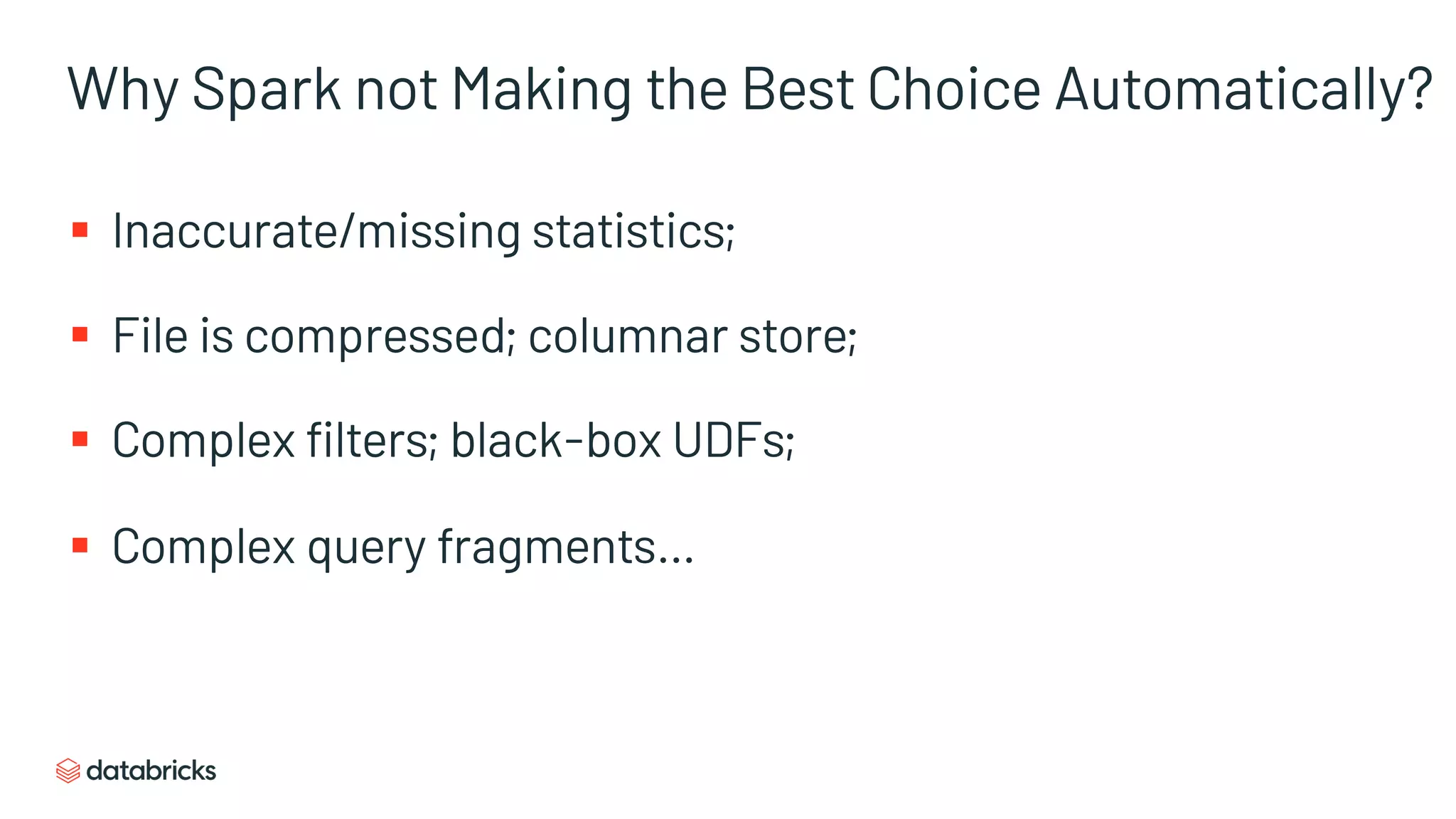
Why Spark not Making the Best Choice Automatically?
§ Inaccurate/missing statistics;
§ File is compressed; columnar store;
§ Complex filters; black-box UDFs;
§ Complex query fragments…
Convert Sort Merge Join to Broadcast Hash Join
Sort Merge Join
Filter
Scan
Execute
Shuffle
Sort
Scan
Shuffle
Sort
Sort Merge Join
Filter
Scan
Shuffle
Sort
Scan
Shuffle
Sort
Stage 1
Stage 2
Stage 1
Stage 2
Estimate size:
100 MB
Estimate size:
30 MB
Actual size:
86 MB
Actual size:
8 MB
Optimize Broadcast Hash Join
Filter
Scan
Shuffle
Broadcast
Scan
Shuffle
Stage 1
Stage 2
Actual size:
86 MB
Actual size:
8 MB
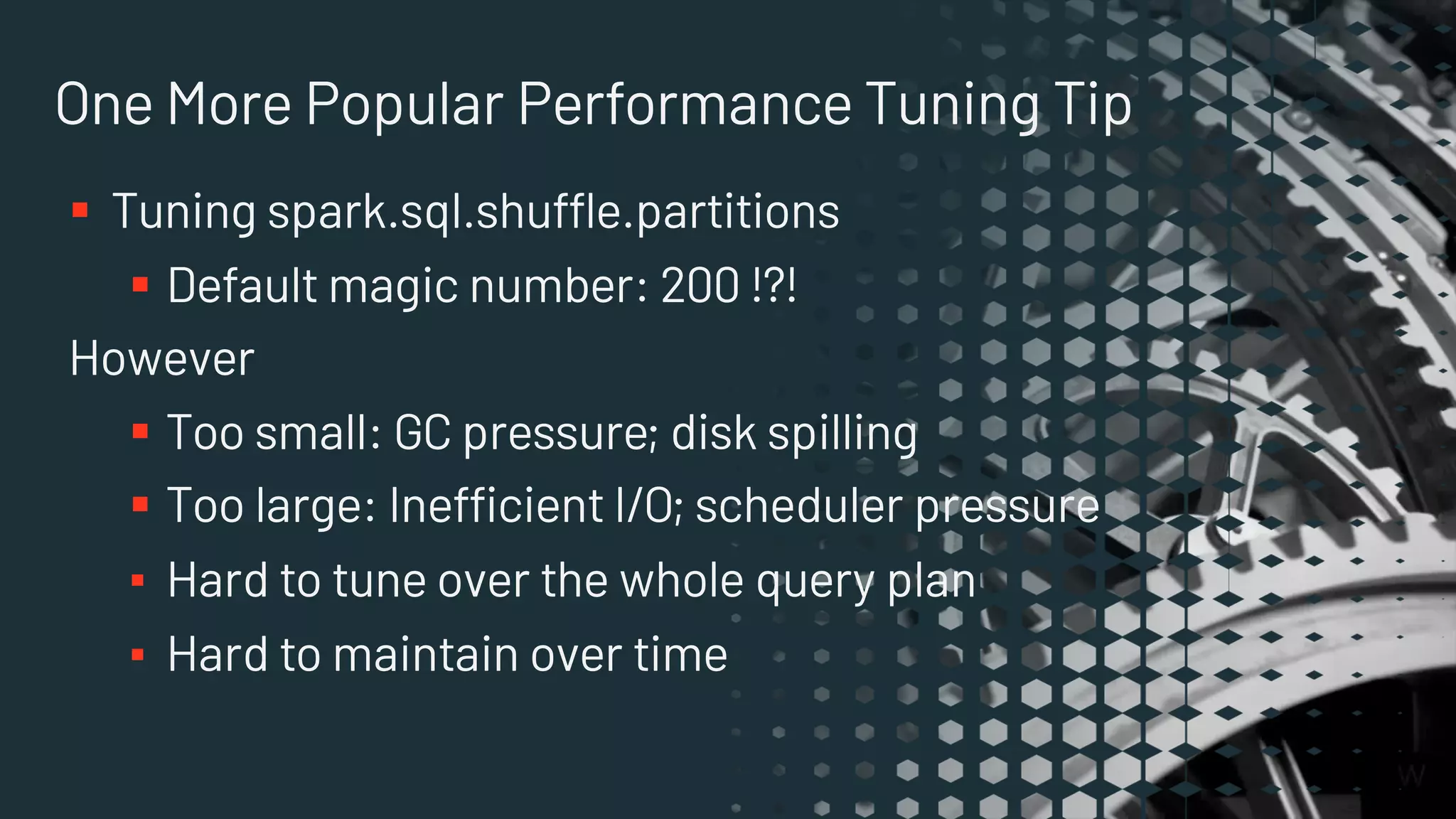
One More Popular Performance Tuning Tip
§ Tuning spark.sql.shuffle.partitions
§ Default magic number: 200 !?!
However
§ Too small: GC pressure; disk spilling
§ Too large: Inefficient I/O; scheduler pressure
▪ Hard to tune over the whole query plan
▪ Hard to maintain over time
Dynamically Coalesce Shuffle Partitions
Filter
Scan
Execute
Shuffle (50 part.)
Sort
Stage 1
OptimizeFilter
Scan
Shuffle (50 part.)
Sort
Stage 1
Filter
Scan
Shuffle (50 part.)
Sort
Stage 1
Coalesce (5 part.)
▪ Set the initial partition number high to accommodate the largest data size of the
entire query execution
▪ Automatically coalesce partitions if needed after each query stage
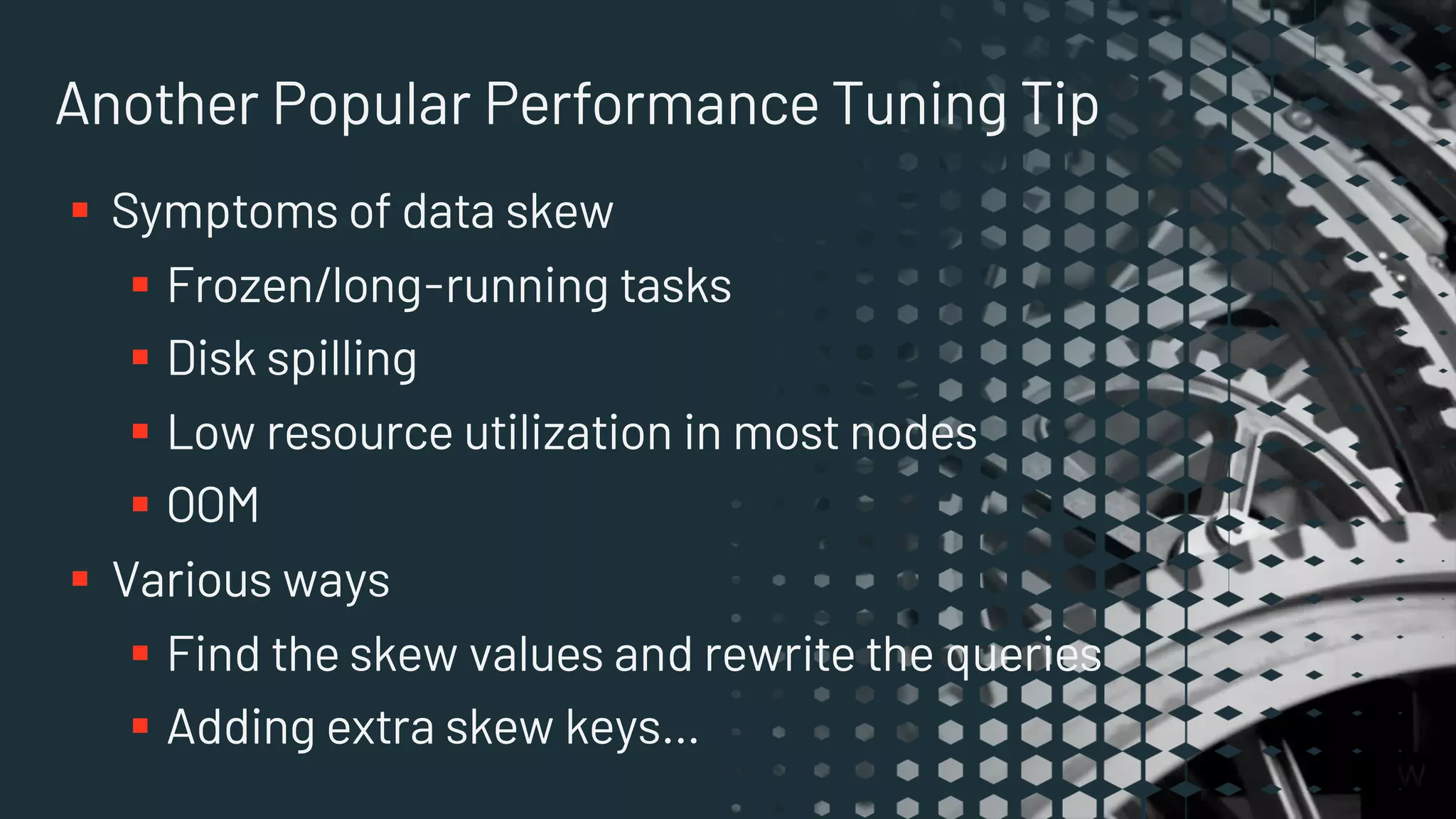
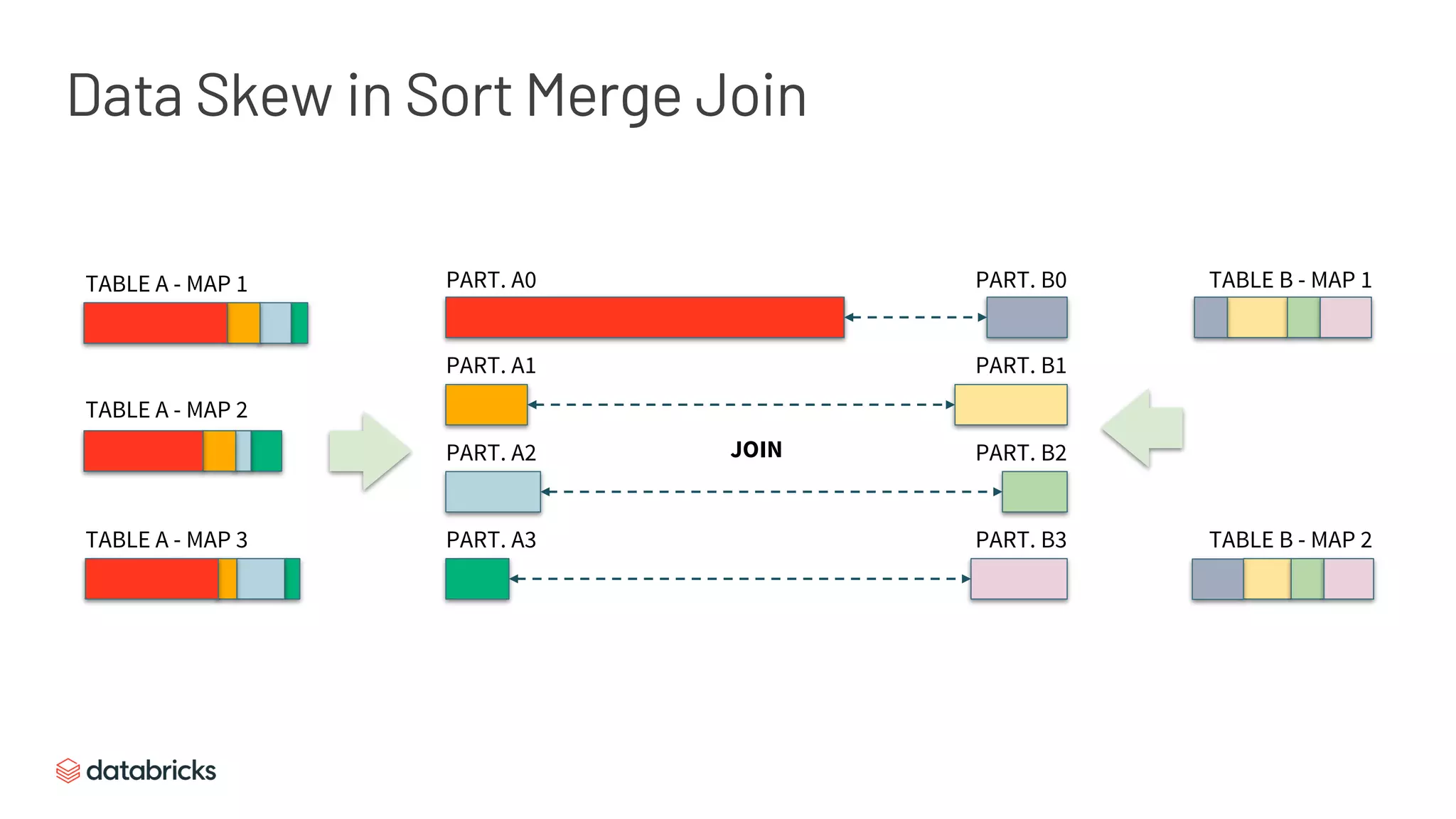
Another Popular Performance Tuning Tip
§ Symptoms of data skew
§ Frozen/long-running tasks
§ Disk spilling
§ Low resource utilization in most nodes
§ OOM
§ Various ways
§ Find the skew values and rewrite the queries
§ Adding extra skew keys…
TABLE A - MAP 1
TABLE A - MAP 2
TABLE A - MAP 3
PART. A0
PART. A1
PART. A2
PART. A3
PART. B0
PART. B1
PART. B2
PART. B3
TABLE B - MAP 1
TABLE B - MAP 2
JOIN
Data Skew in Sort Merge Join
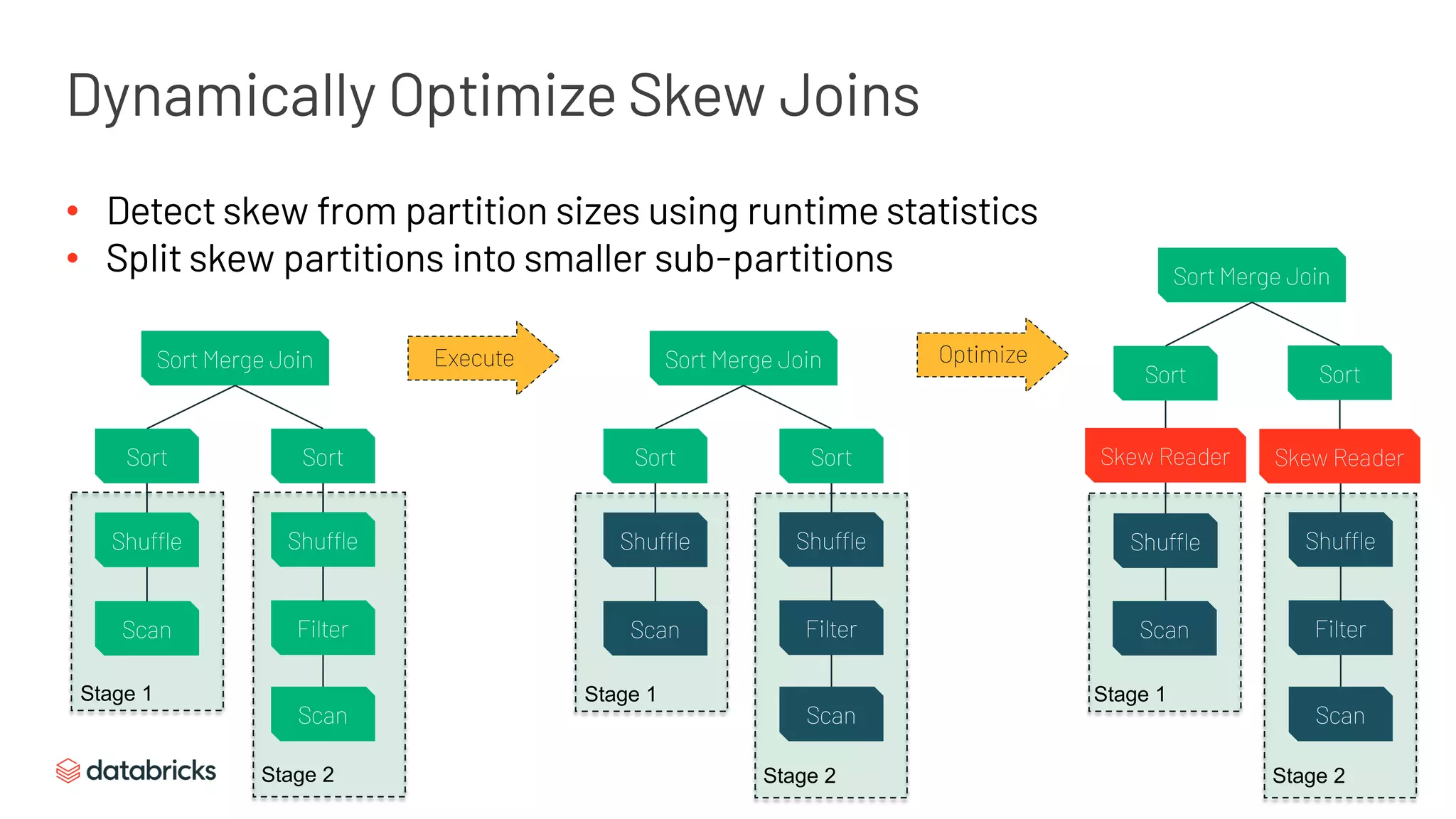
Dynamically Optimize Skew Joins
Sort Merge Join
Filter
Scan
Execute
Shuffle
Sort
Scan
Shuffle
Sort
Sort Merge Join
Filter
Scan
Shuffle
Sort
Scan
Shuffle
Sort
Stage 1
Stage 2
Stage 1
Stage 2
Optimize
Sort Merge Join
Filter
Scan
Shuffle
Sort
Scan
Shuffle
Sort
Stage 1
Stage 2
Skew Reader Skew Reader
• Detect skew from partition sizes using runtime statistics
• Split skew partitions into smaller sub-partitions
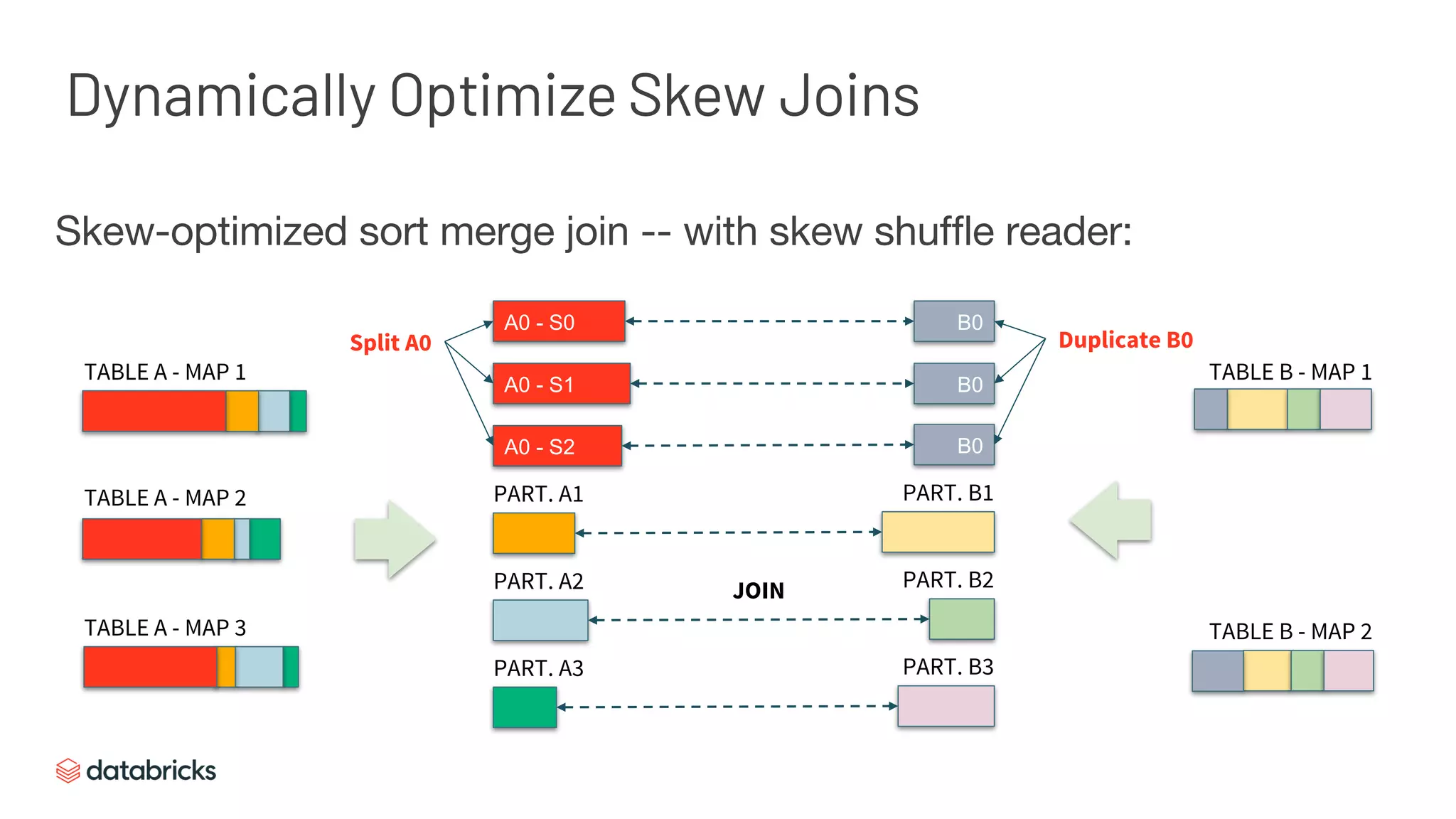
Skew-optimized sort merge join -- with skew shuffle reader:
A0 - S2
TABLE A - MAP 1
B0
TABLE A - MAP 2
TABLE A - MAP 3
Split A0
PART. A1
PART. A2
PART. A3
PART. B1
PART. B2
PART. B3
TABLE B - MAP 1
TABLE B - MAP 2
A0 - S1
A0 - S0
B0
B0
Duplicate B0
JOIN
Dynamically Optimize Skew Joins
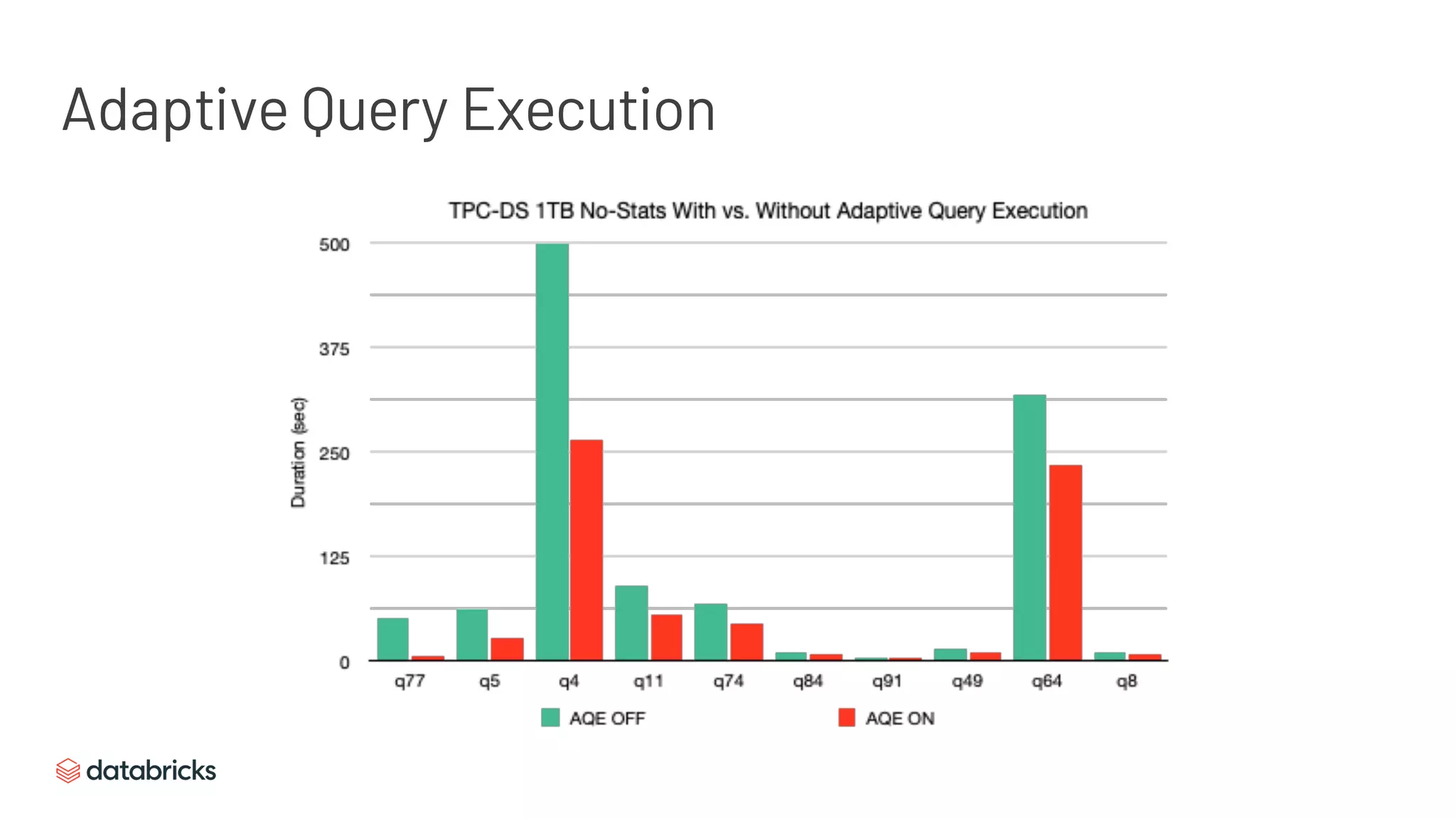
Adaptive Query Execution
Performance
Achieve high performance for interactive, batch, streaming and ML workloads
Adaptive Query
Execution
Dynamic Partition
Pruning
Join Hints
Query Compilation
Speedup
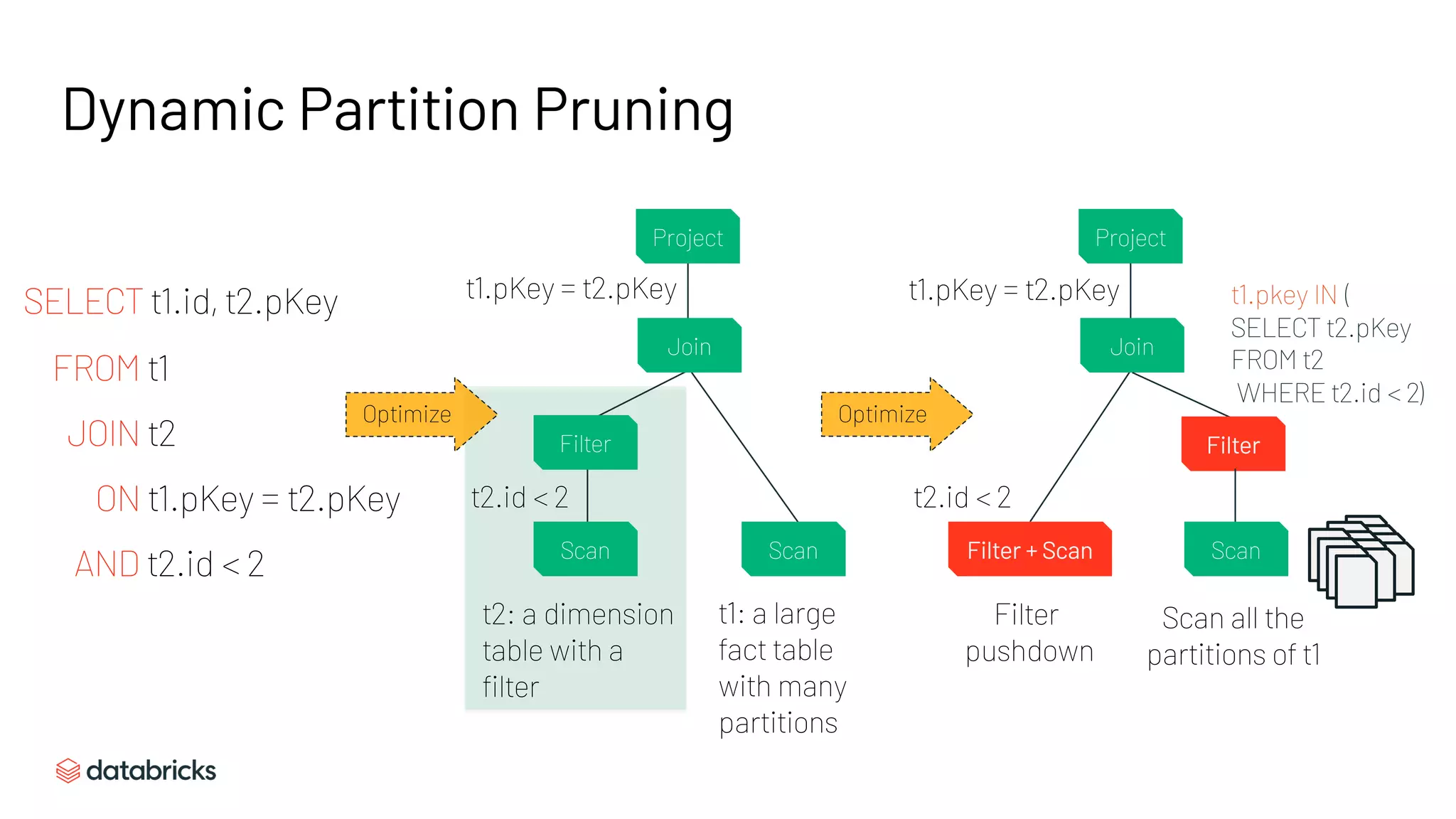
Dynamic Partition Pruning
• Avoid partition scanning based on
the query results of the other query
fragments.
• Important for star-schema queries.
• Significant speedup in TPC-DS.
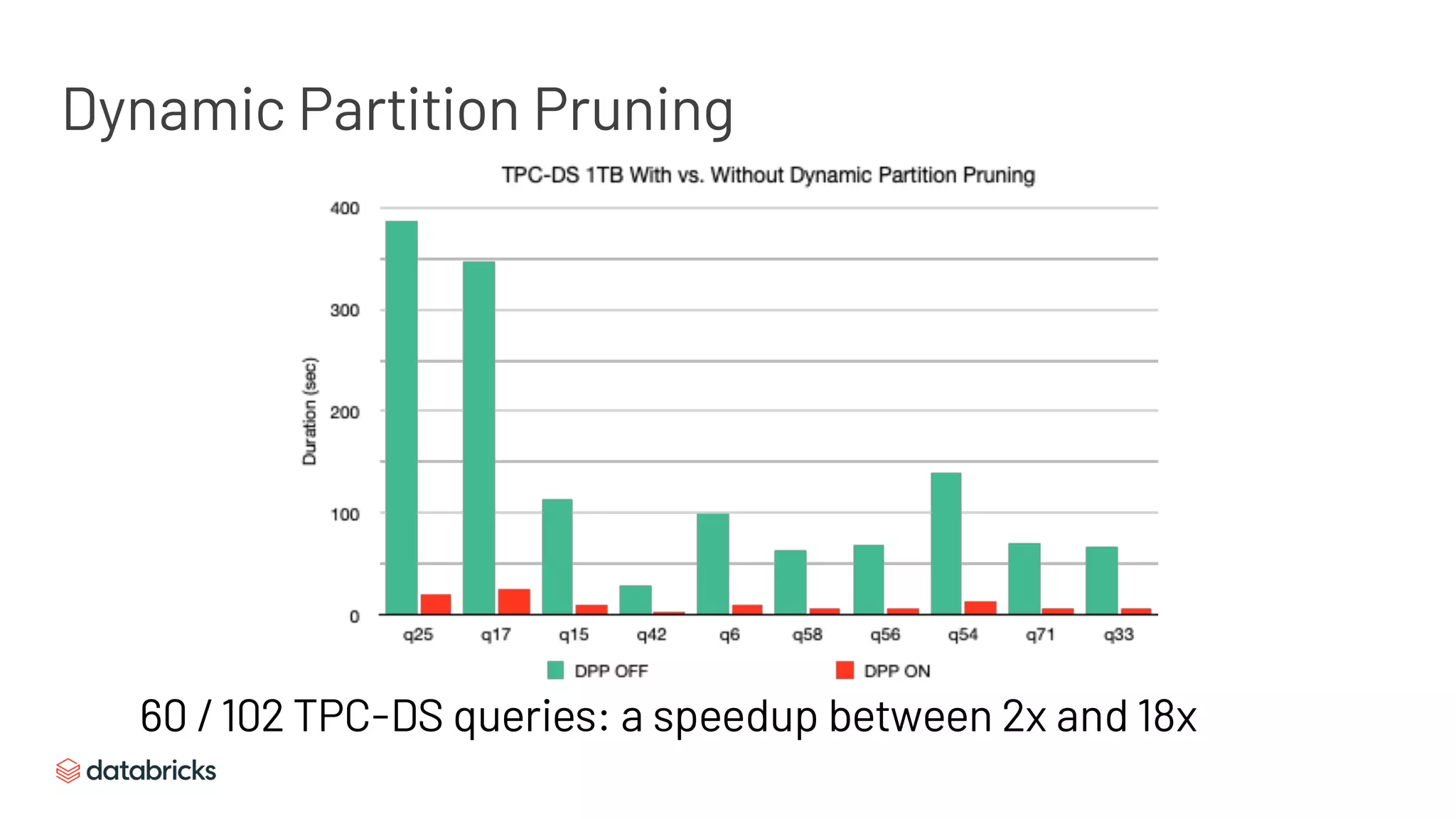
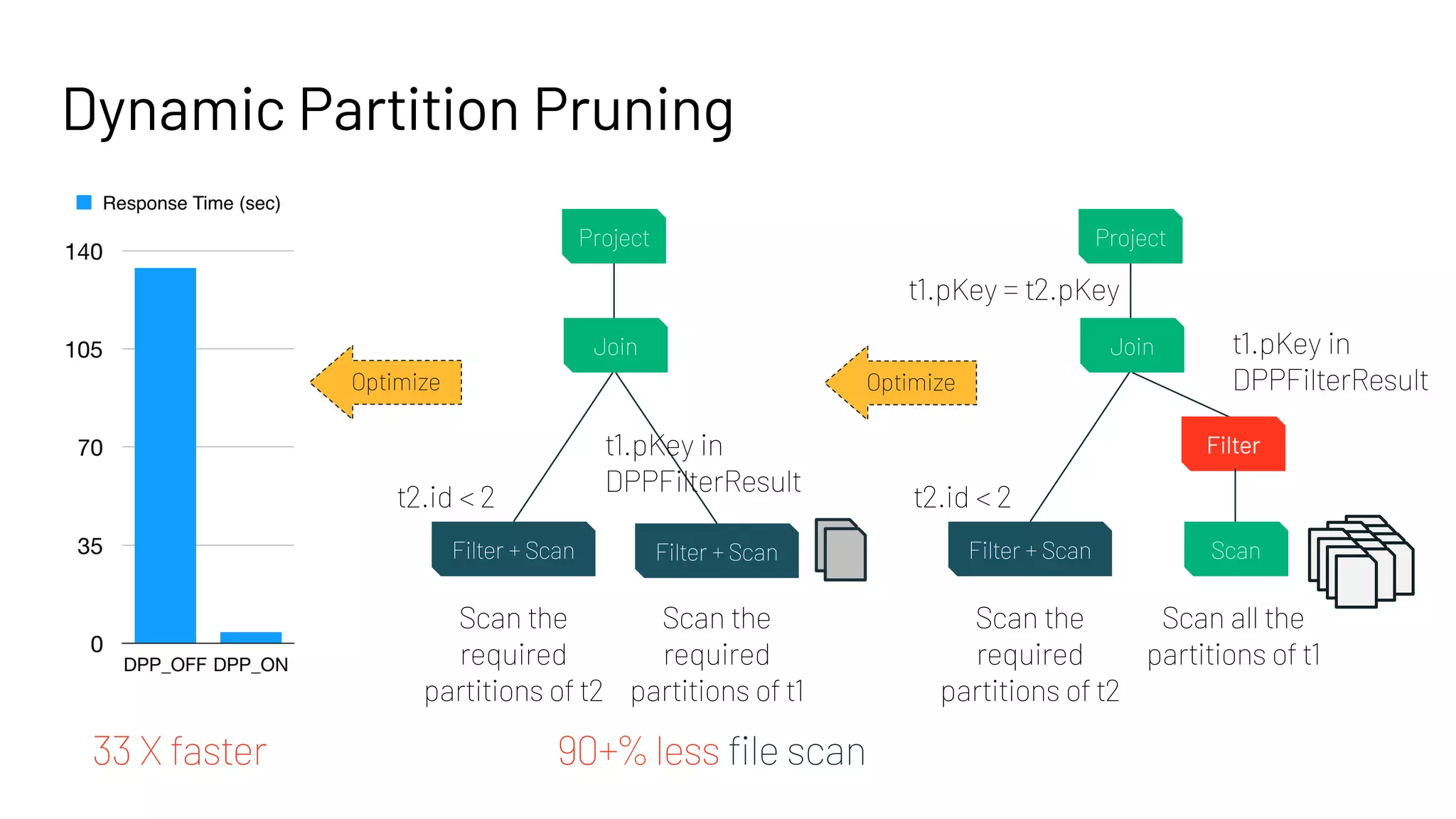
Dynamic Partition Pruning
60 / 102 TPC-DS queries: a speedup between 2x and 18x
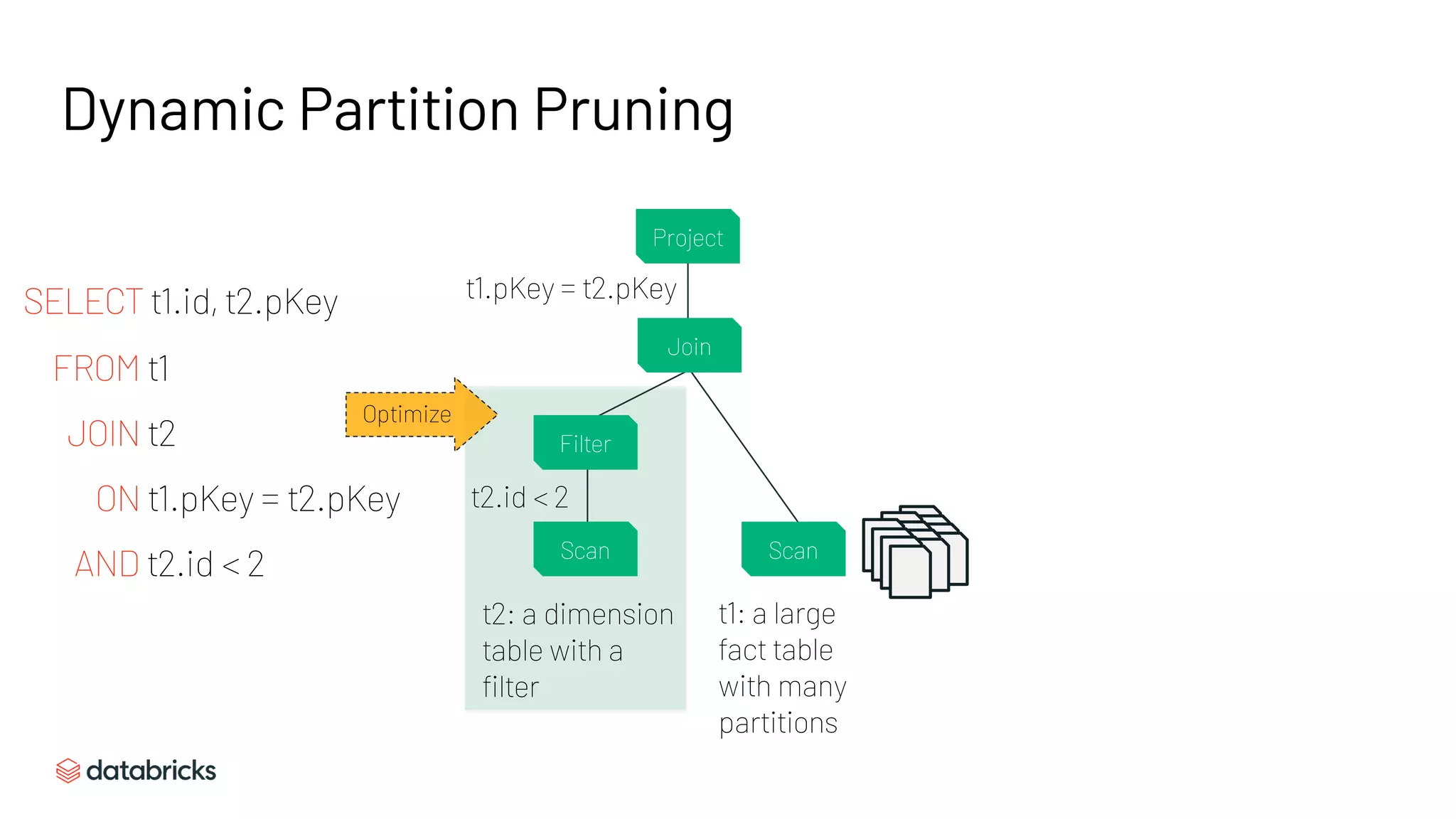
t1: a large
fact table
with many
partitions
t2.id < 2
t2: a dimension
table with a
filter
SELECT t1.id, t2.pKey
FROM t1
JOIN t2
ON t1.pKey = t2.pKey
AND t2.id < 2
t1.pKey = t2.pKey
Dynamic Partition Pruning
Project
Join
Filter
Scan Scan
Optimize
t1: a large
fact table
with many
partitions
t2.id < 2
t2: a dimension
table with a
filter
SELECT t1.id, t2.pKey
FROM t1
JOIN t2
ON t1.pKey = t2.pKey
AND t2.id < 2
t1.pKey = t2.pKey
Dynamic Partition Pruning
Project
Join
Filter
Scan Scan
Optimize
Scan all the
partitions of t1
Filter
pushdown
t1.pkey IN (
SELECT t2.pKey
FROM t2
WHERE t2.id < 2)
t2.id < 2
Project
Join
Filter + Scan
Filter
Optimize
Scan
t1.pKey = t2.pKey
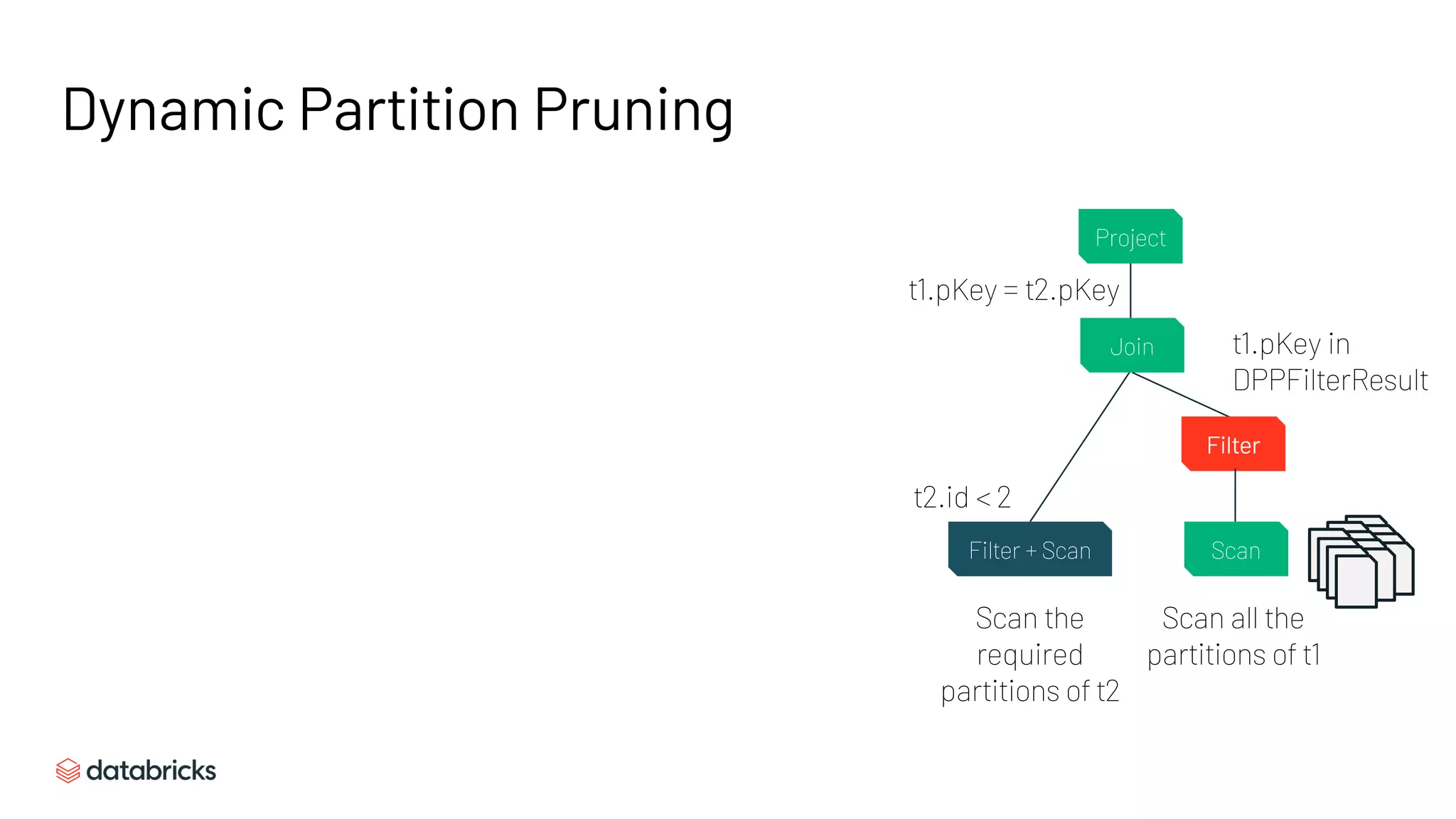
Dynamic Partition Pruning
Scan all the
partitions of t1
t2.id < 2
Project
Join
Filter + Scan
Filter
Scan
t1.pKey = t2.pKey
Scan the
required
partitions of t2
t1.pKey in
DPPFilterResult
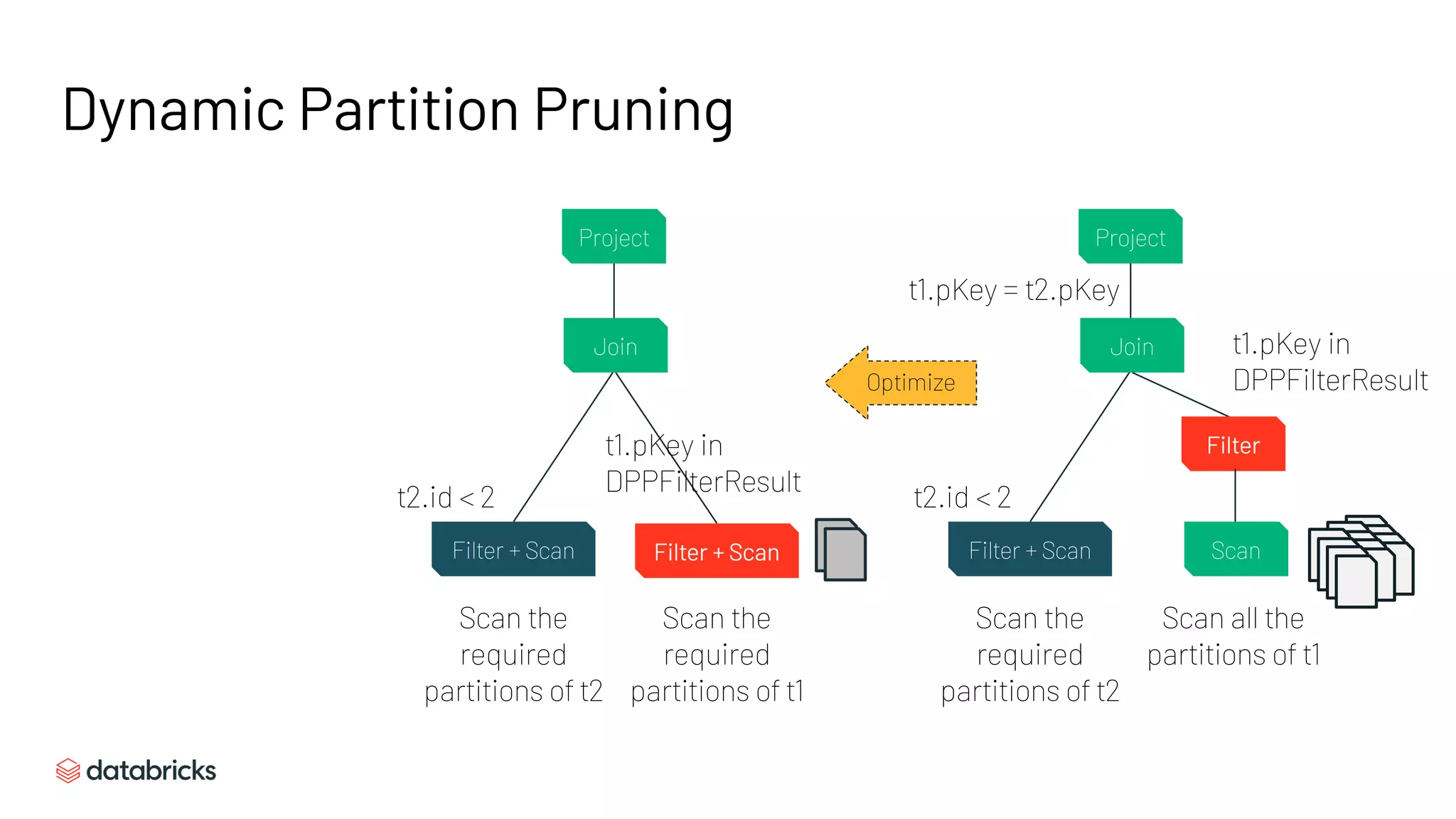
Dynamic Partition Pruning
Scan all the
partitions of t1
t2.id < 2
Project
Join
Filter + Scan
Filter
Scan
t1.pKey = t2.pKey
Scan the
required
partitions of t2
t1.pKey in
DPPFilterResultOptimize
Scan the
required
partitions of t1
t2.id < 2
Project
Join
Filter + Scan Filter + Scan
Scan the
required
partitions of t2
t1.pKey in
DPPFilterResult
Dynamic Partition Pruning
Scan all the
partitions of t1
t2.id < 2
Project
Join
Filter + Scan
Filter
Scan
t1.pKey = t2.pKey
Scan the
required
partitions of t2
t1.pKey in
DPPFilterResultOptimize
Scan the
required
partitions of t1
t2.id < 2
Project
Join
Filter + Scan Filter + Scan
Scan the
required
partitions of t2
t1.pKey in
DPPFilterResult
90+% less file scan33 X faster
Optimize
Performance
Achieve high performance for interactive, batch, streaming and ML workloads
Adaptive Query
Execution
Dynamic Partition
Pruning
Join Hints
Query Compilation
Speedup
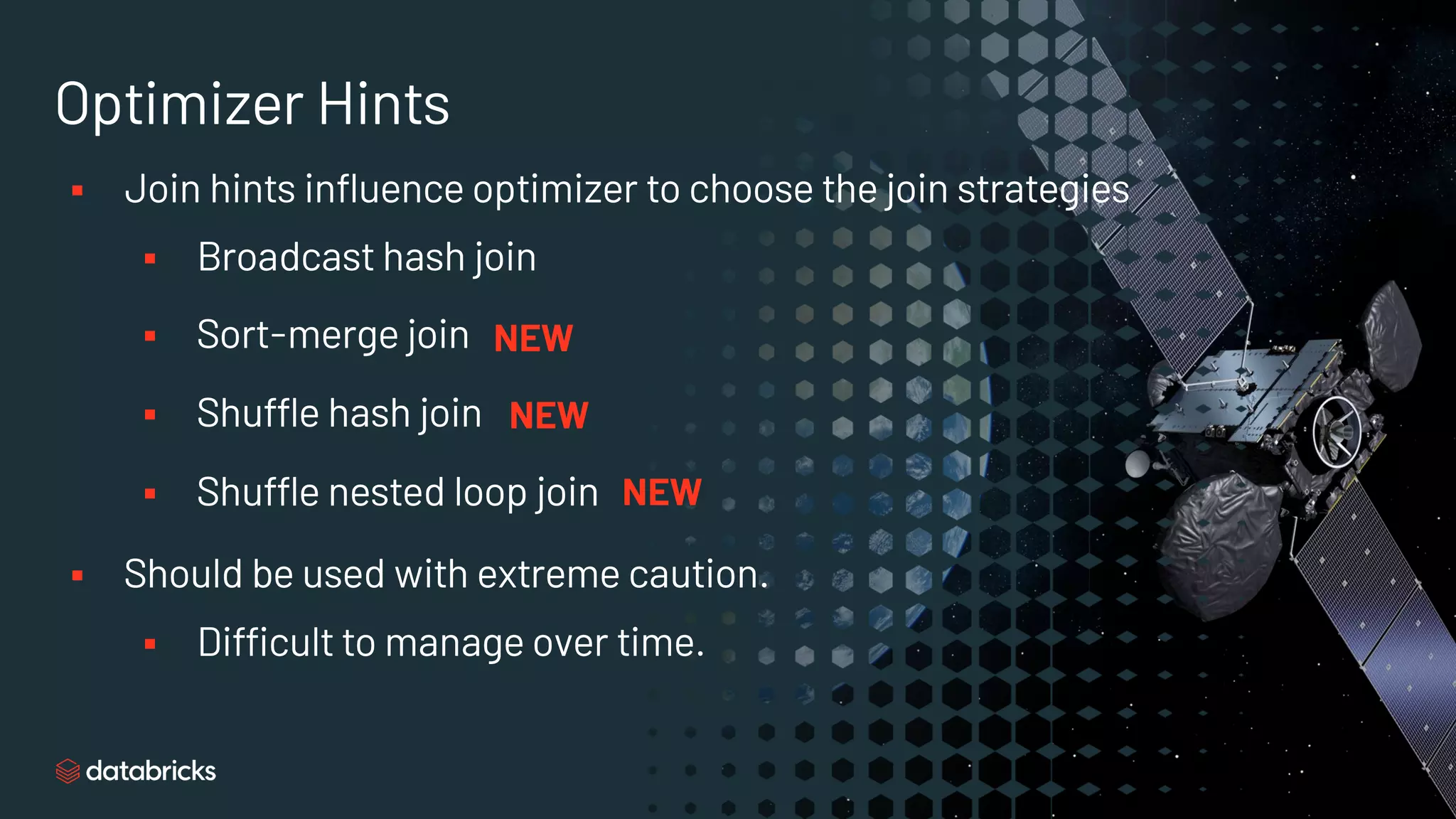
Optimizer Hints
§ Join hints influence optimizer to choose the join strategies
§ Broadcast hash join
§ Sort-merge join
§ Shuffle hash join
§ Shuffle nested loop join
§ Should be used with extreme caution.
§ Difficult to manage over time.
NEW
NEW
NEW
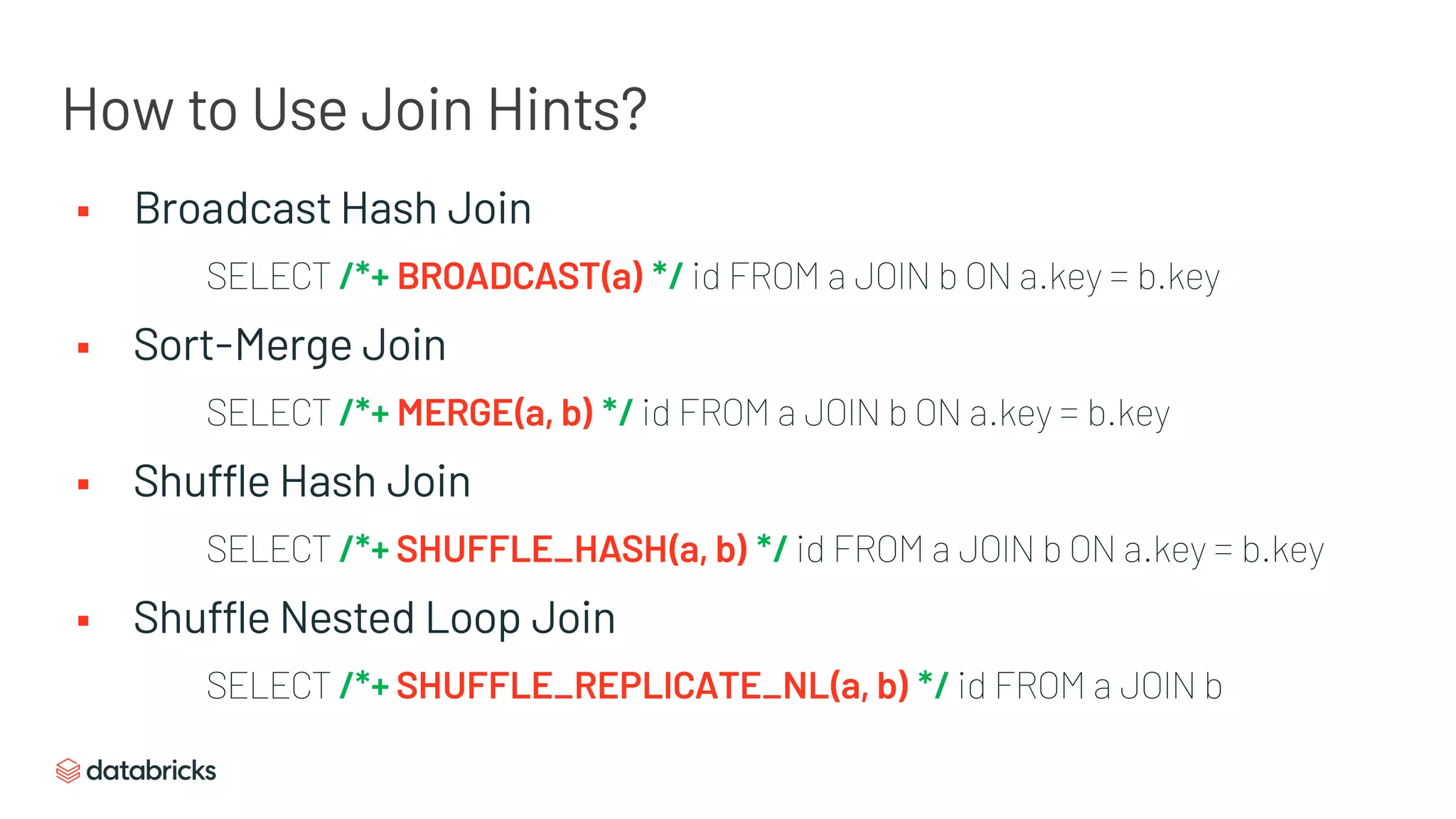
§ Broadcast Hash Join
SELECT /*+ BROADCAST(a) */ id FROM a JOIN b ON a.key = b.key
§ Sort-Merge Join
SELECT /*+ MERGE(a, b) */ id FROM a JOIN b ON a.key = b.key
§ Shuffle Hash Join
SELECT /*+ SHUFFLE_HASH(a, b) */ id FROM a JOIN b ON a.key = b.key
§ Shuffle Nested Loop Join
SELECT /*+ SHUFFLE_REPLICATE_NL(a, b) */ id FROM a JOIN b
How to Use Join Hints?
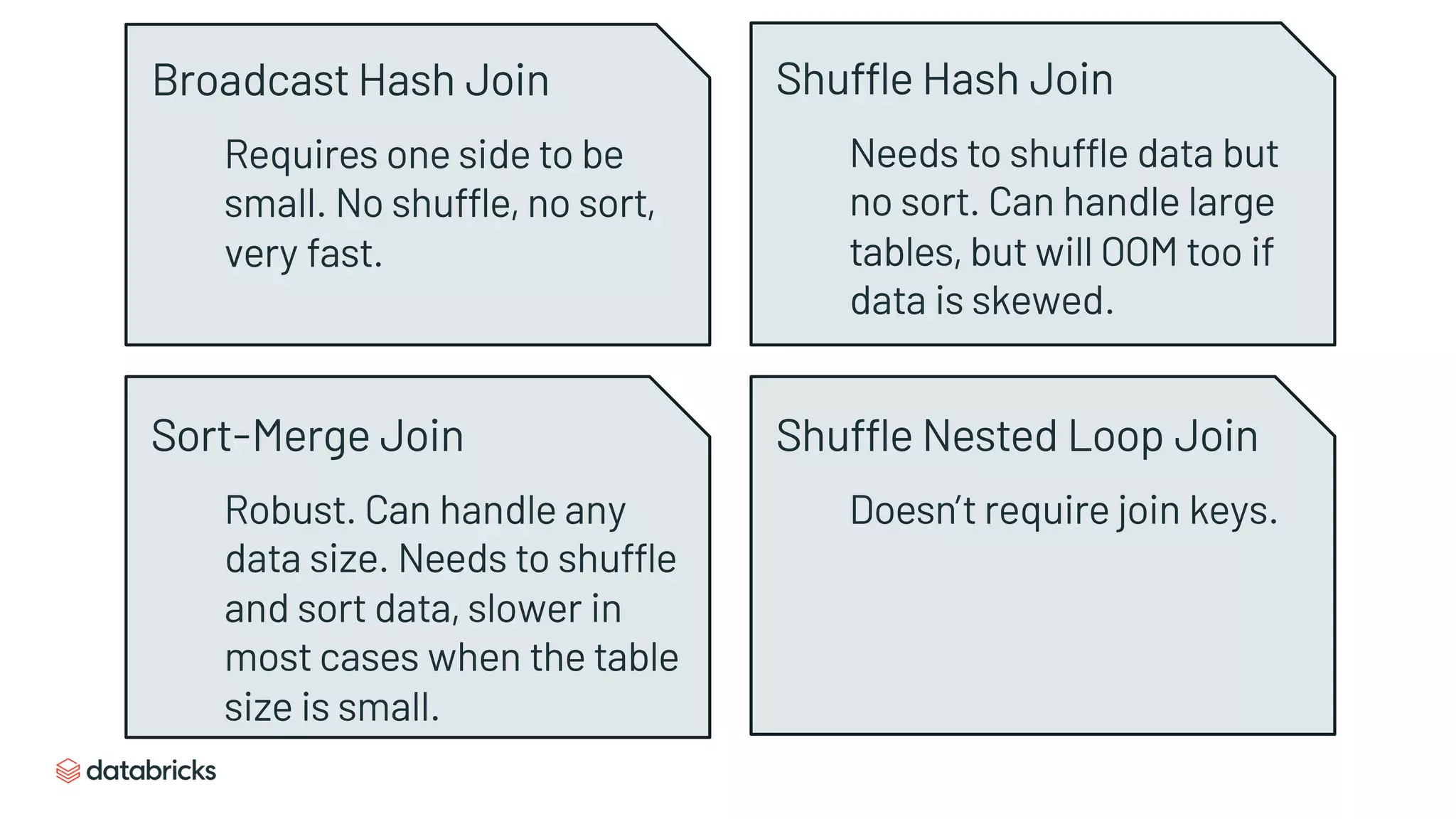
Broadcast Hash Join
Requires one side to be
small. No shuffle, no sort,
very fast.
Sort-Merge Join
Robust. Can handle any
data size. Needs to shuffle
and sort data, slower in
most cases when the table
size is small.
Shuffle Hash Join
Needs to shuffle data but
no sort. Can handle large
tables, but will OOM too if
data is skewed.
Shuffle Nested Loop Join
Doesn’t require join keys.
Enable new use cases and simplify the Spark application development
Accelerator-aware
Scheduler
Built-in
Functions
pandas UDF
enhancements
DELETE/UPDATE/
MERGE in Catalyst
Richer APIs
Enable new use cases and simplify the Spark application development
Accelerator-aware
Scheduler
Built-in
Functions
pandas UDF
enhancements
DELETE/UPDATE/
MERGE in Catalyst
Richer APIs
Accelerator-aware Scheduling
§ Widely used for accelerating special workloads,
e.g., deep learning and signal processing.
§ Supports Standalone, YARN and K8S.
§ Supports GPU now, FPGA, TPU, etc. in the future.
§ Needs to specify required resources by configs
§ Application level. Will support job/stage/task
level in the future.
Enable new use cases and simplify the Spark application development
Richer APIs
Accelerator-aware
Scheduler
Built-in
Functions
pandas UDF
enhancements
DELETE/UPDATE/
MERGE in Catalyst
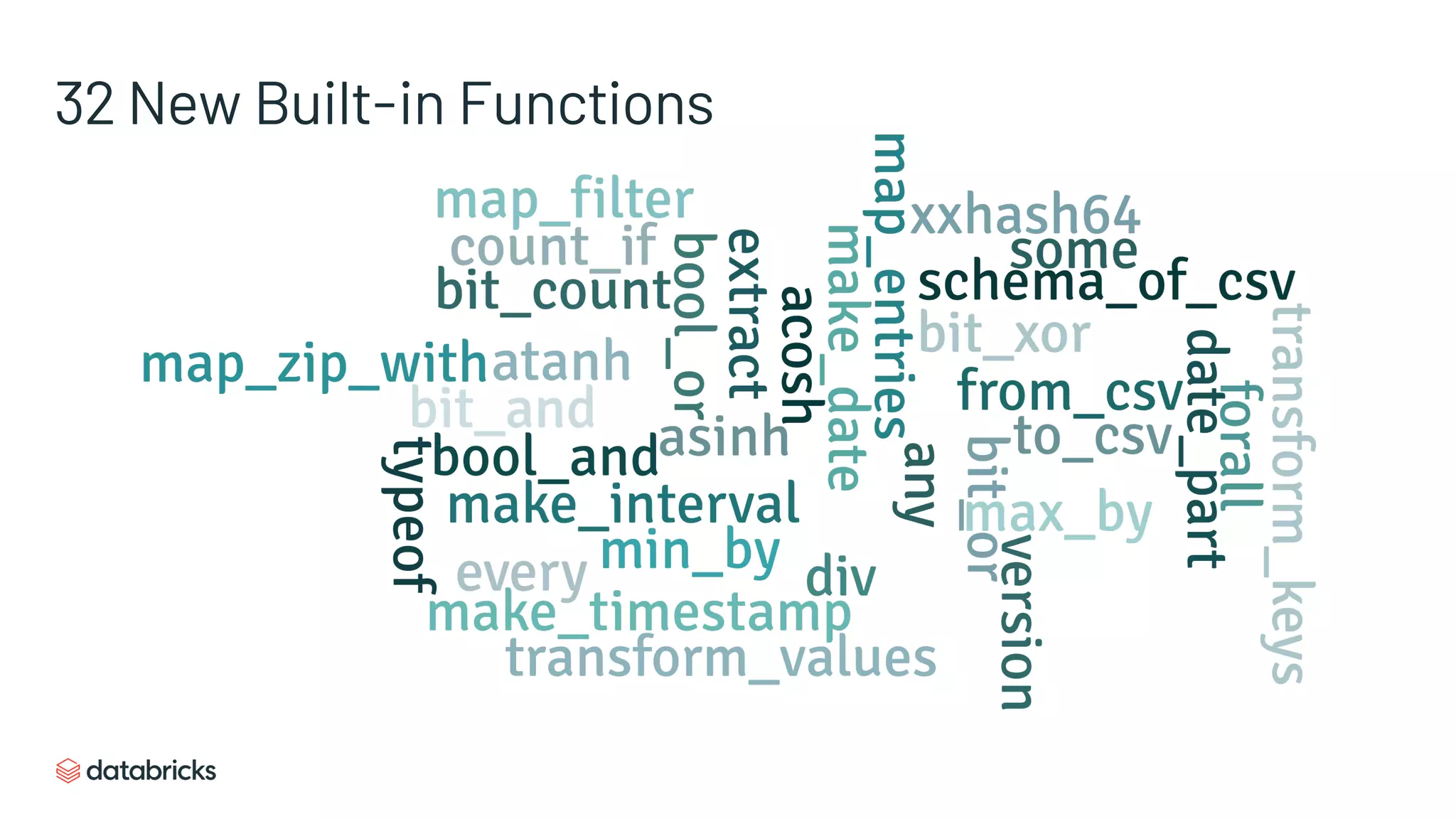
32 New Built-in Functions
Enable new use cases and simplify the Spark application development
Richer APIs
Accelerator-aware
Scheduler
Built-in
Functions
pandas UDF
enhancements
DELETE/UPDATE/
MERGE in Catalyst
Python
UDF
for SQL
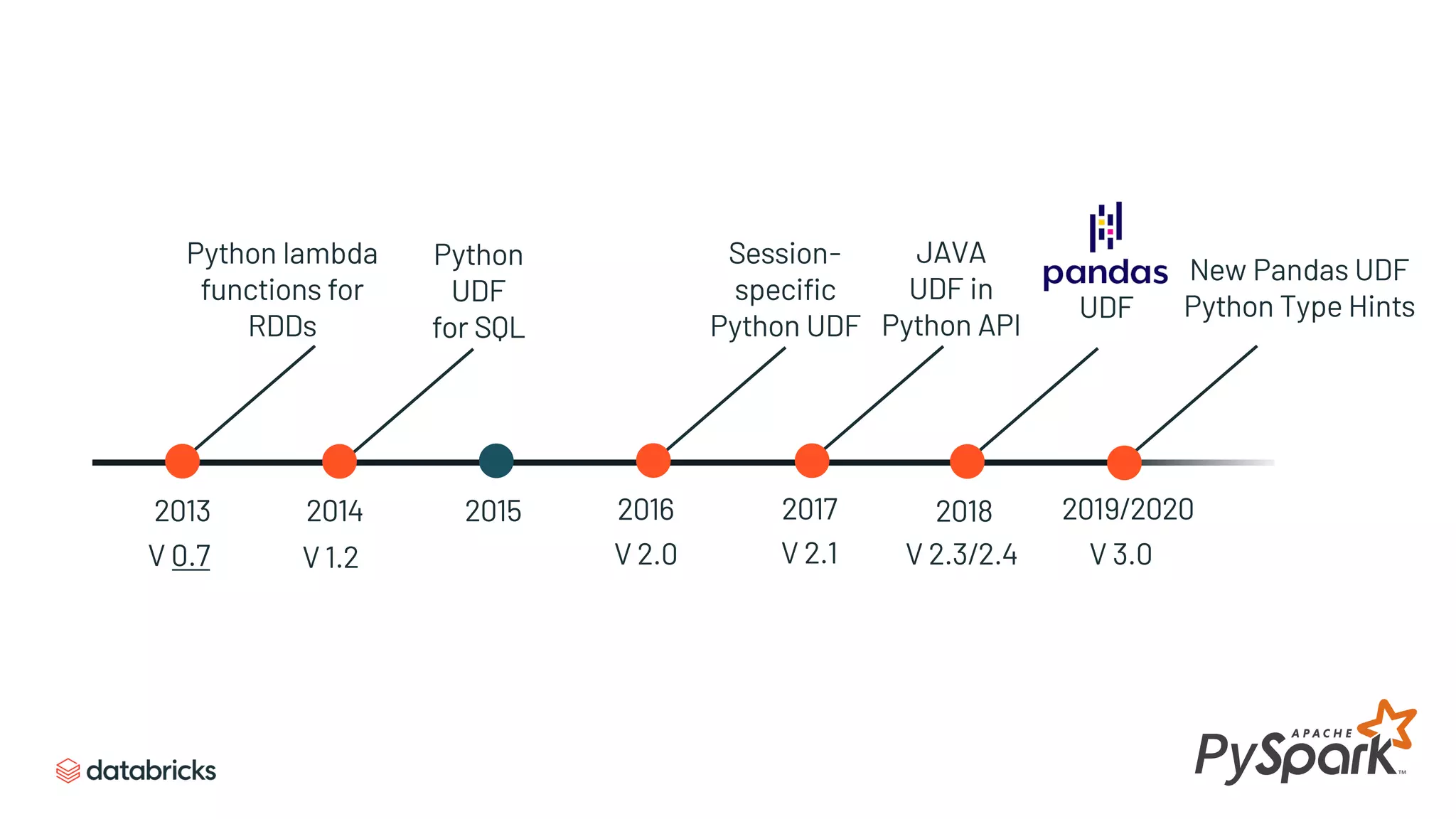
Python lambda
functions for
RDDs
Session-
specific
Python UDF
JAVA
UDF in
Python API
New Pandas UDF
Python Type Hints
Py
UDF
V 3.0V 0.7 V 1.2
2013 2015 20182014 2019/20202016 2017
V 2.0 V 2.1 V 2.3/2.4
Scalar Pandas UDF
[pandas.Series to pandas.Series]
SPARK 2.3 SPARK 3.0
Python Type Hints
Grouped Map Pandas Function API
[pandas.DataFrame to pandas.DataFrame]
SPARK 2.3 SPARK 3.0
Python Type Hints
Grouped Aggregate Pandas UDF
[pandas.Series to Scalar]
SPARK 2.4 SPARK 3.0
Python Type Hints
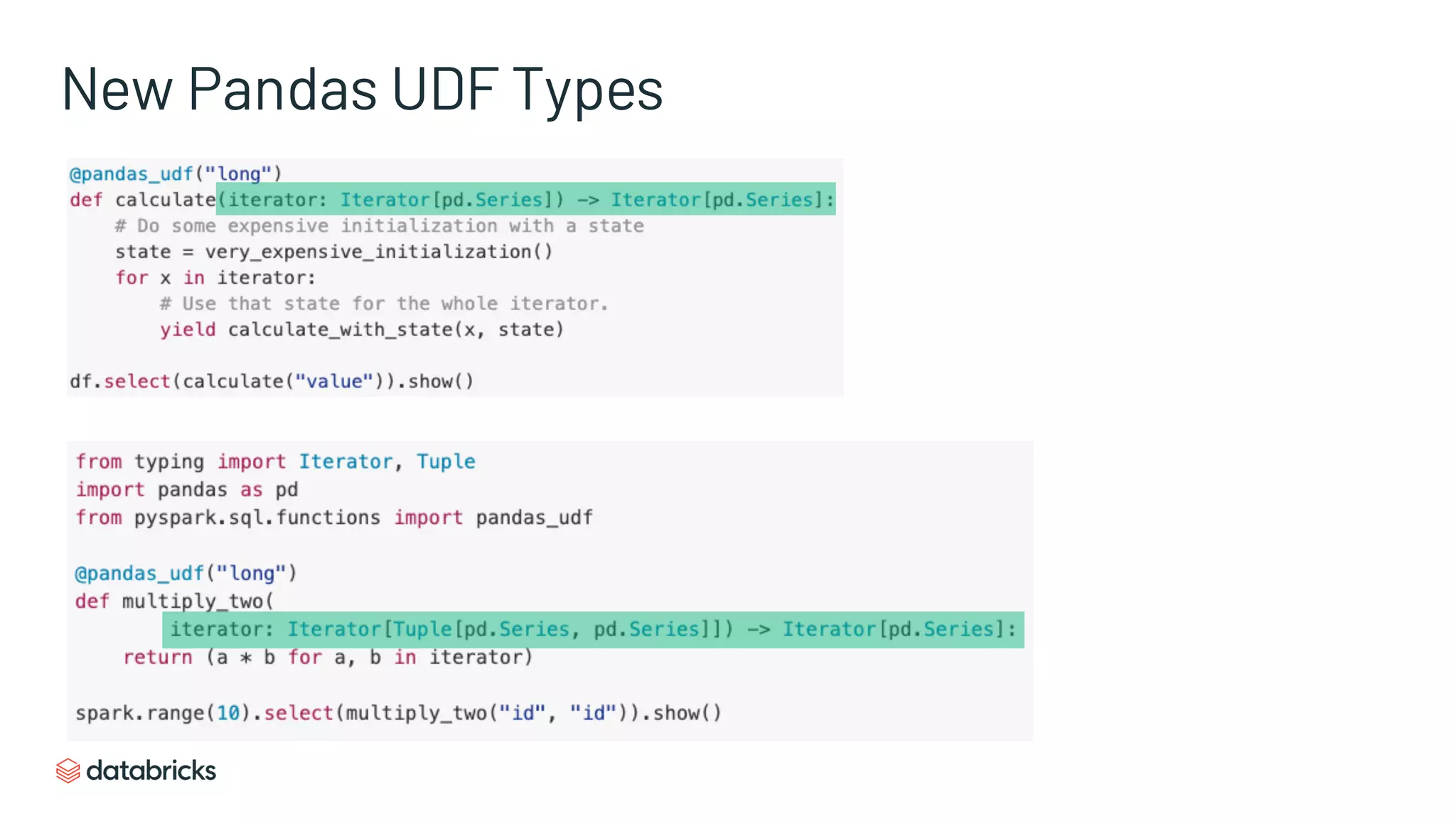
New Pandas UDF Types
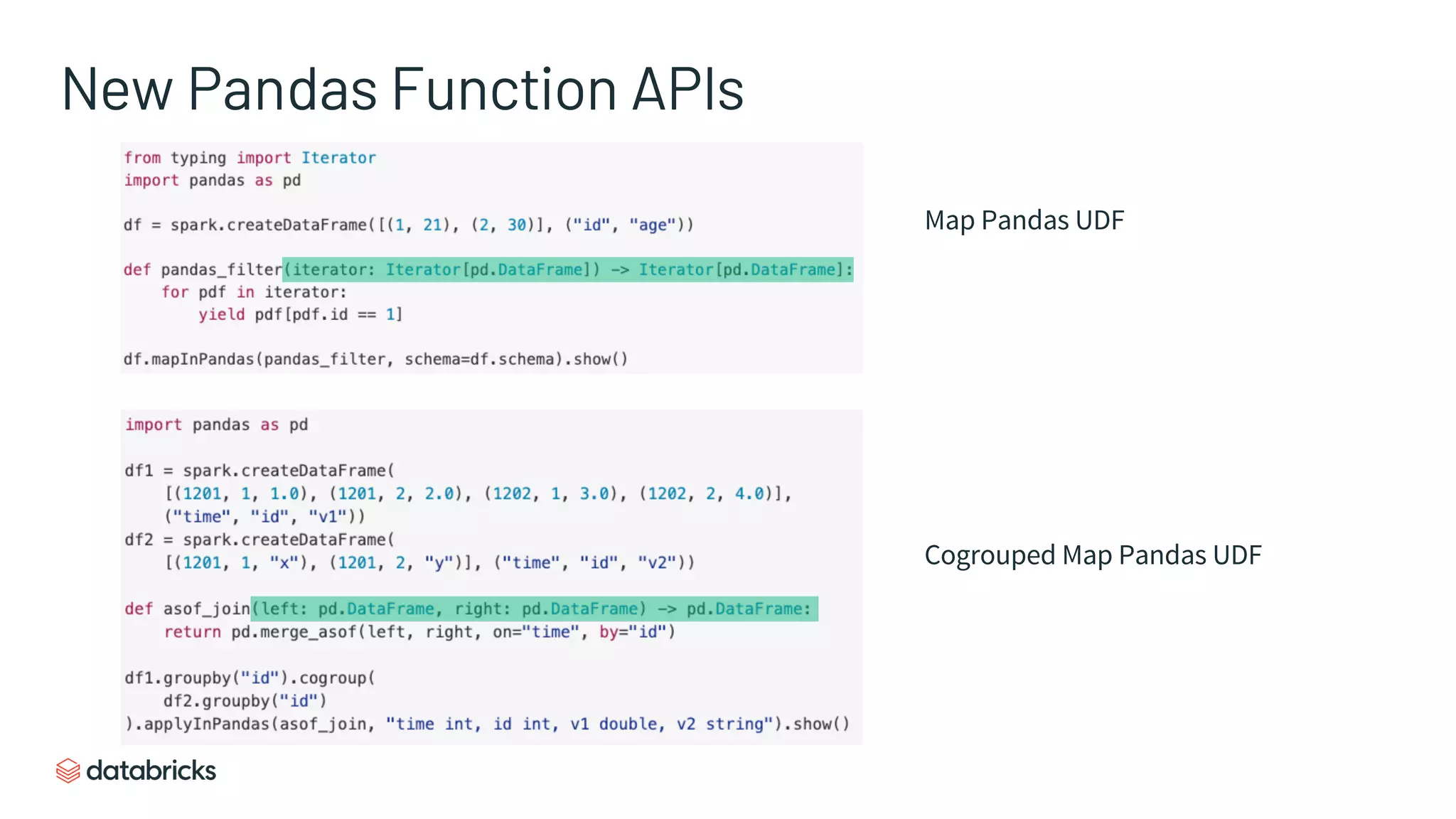
Map Pandas UDF
Cogrouped Map Pandas UDF
New Pandas Function APIs
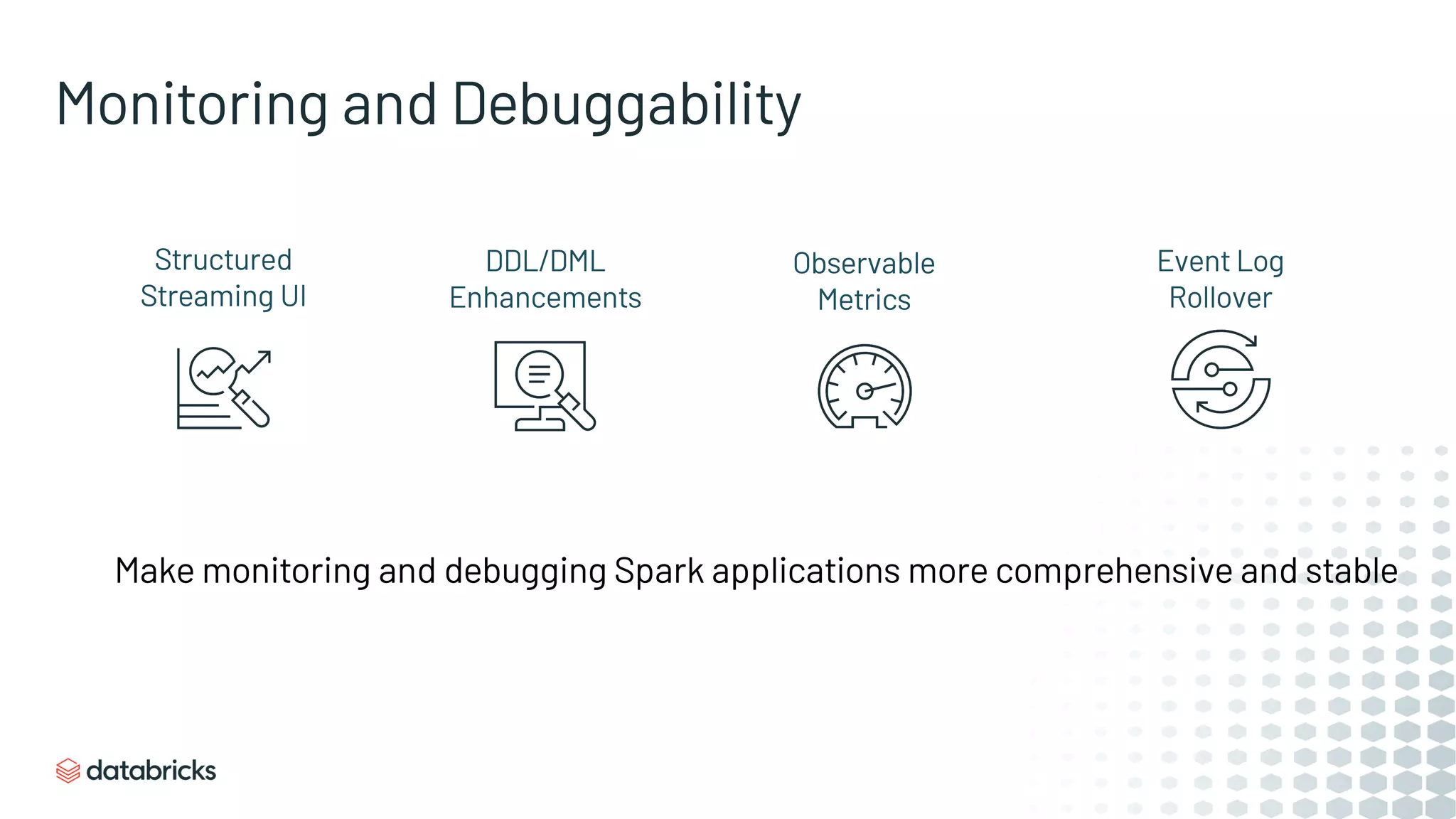
Make monitoring and debugging Spark applications more comprehensive and stable
Structured
Streaming UI
DDL/DML
Enhancements
Observable
Metrics
Event Log
Rollover
Monitoring and Debuggability
Make monitoring and debugging Spark applications more comprehensive and stable
Monitoring and Debuggability
Structured
Streaming UI
DDL/DML
Enhancements
Observable
Metrics
Event Log
Rollover
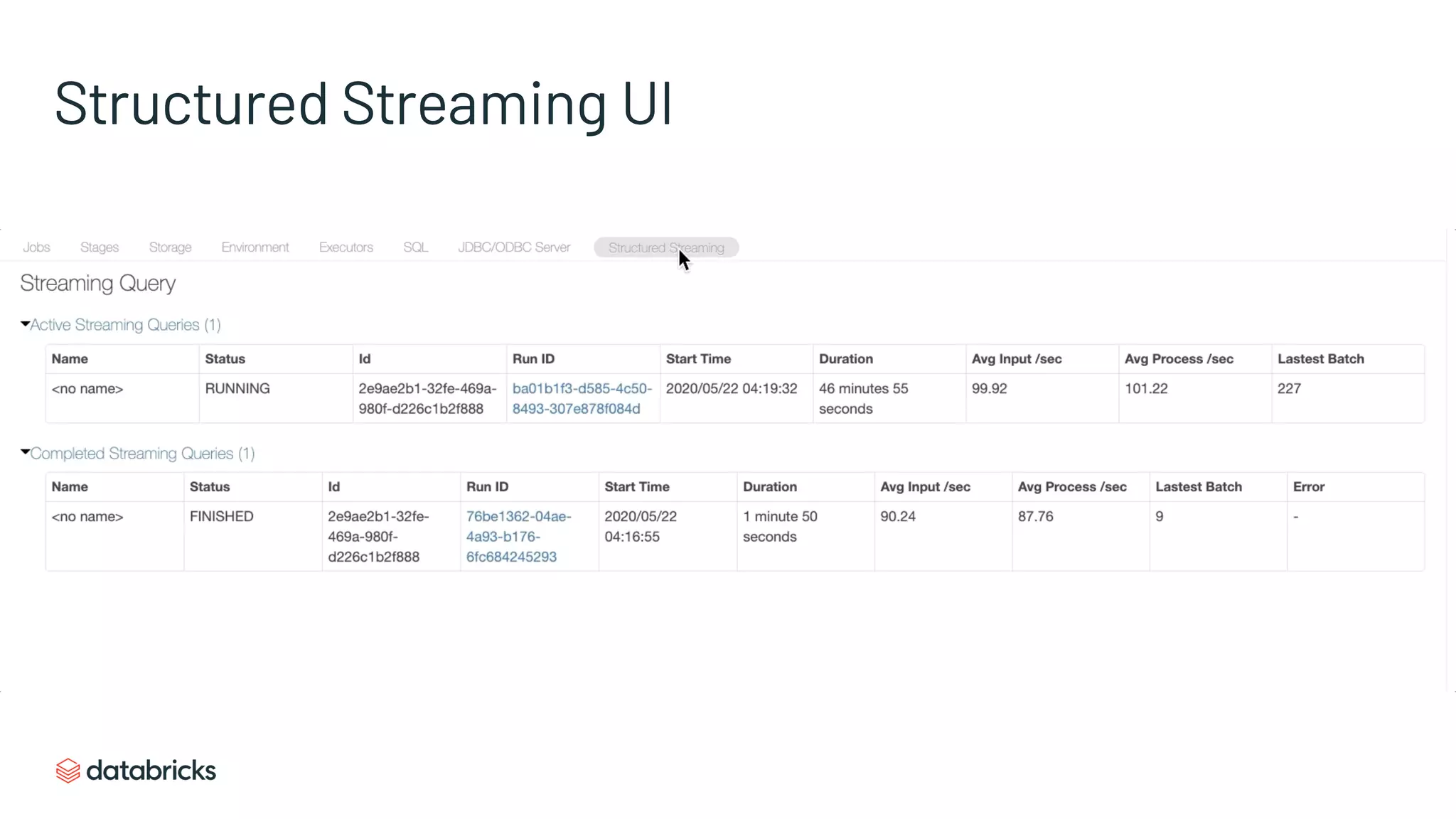
Structured Streaming UI
Make monitoring and debugging Spark applications more comprehensive and stable
Monitoring and Debuggability
Structured
Streaming UI
DDL/DML
Enhancements
Observable
Metrics
Event Log
Rollover
New Command EXPLAIN FORMATTED
*(1) Project [key#5, val#6]
+- *(1) Filter (isnotnull(key#5) AND (key#5 = Subquery scalar-subquery#15, [id=#113]))
: +- Subquery scalar-subquery#15, [id=#113]
: +- *(2) HashAggregate(keys=[], functions=[max(key#21)])
: +- Exchange SinglePartition, true, [id=#109]
: +- *(1) HashAggregate(keys=[], functions=[partial_max(key#21)])
: +- *(1) Project [key#21]
: +- *(1) Filter (isnotnull(val#22) AND (val#22 > 5))
: +- *(1) ColumnarToRow
: +- FileScan parquet default.tab2[key#21,val#22] Batched: true, DataFilters: [isnotnull(val#22), (val#22 > 5)],
Format: Parquet, Location: InMemoryFileIndex[file:/user/hive/warehouse/tab2], PartitionFilters: [], PushedFilters:
[IsNotNull(val), GreaterThan(val,5)], ReadSchema: struct<key:int,val:int>
+- *(1) ColumnarToRow
+- FileScan parquet default.tab1[key#5,val#6] Batched: true, DataFilters: [isnotnull(key#5)], Format: Parquet,
Location: InMemoryFileIndex[file:/user/hive/warehouse/tab1], PartitionFilters: [], PushedFilters: [IsNotNull(key)],
ReadSchema: struct<key:int,val:int>
EXPLAIN FORMATTED
SELECT *
FROM tab1
WHERE key = (SELECT max(key)
FROM tab2
WHERE val > 5
* Project (4)
+- * Filter (3)
+- * ColumnarToRow (2)
+- Scan parquet default.tab1 (1)
(1) Scan parquet default.tab1
Output [2]: [key#5, val#6]
Batched: true
Location: InMemoryFileIndex [file:/user/hive/warehouse/tab1]
PushedFilters: [IsNotNull(key)]
ReadSchema: struct<key:int,val:int>
(2) ColumnarToRow [codegen id : 1]
Input [2]: [key#5, val#6]
(3) Filter [codegen id : 1]
Input [2]: [key#5, val#6]
Condition : (isnotnull(key#5) AND (key#5 = Subquery scalar-subquery#27, [id=#164]))
(4) Project [codegen id : 1]
Output [2]: [key#5, val#6]
Input [2]: [key#5, val#6]
EXPLAIN FORMATTED
SELECT *
FROM tab1
WHERE key = (SELECT max(key)
FROM tab2
WHERE val > 5
(5) Scan parquet default.tab2
Output [2]: [key#21, val#22]
Batched: true
Location: InMemoryFileIndex [file:/user/hive/warehouse/tab2]
PushedFilters: [IsNotNull(val), GreaterThan(val,5)]
ReadSchema: struct<key:int,val:int>
(6) ColumnarToRow [codegen id : 1]
Input [2]: [key#21, val#22]
(7) Filter [codegen id : 1]
Input [2]: [key#21, val#22]
Condition : (isnotnull(val#22) AND (val#22 > 5))
===== Subqueries =====
Subquery:1 Hosting operator id = 3 Hosting Expression = Subquery scalar-subquery#27, [id=#164]
* HashAggregate (11)
+- Exchange (10)
+- * HashAggregate (9)
+- * Project (8)
+- * Filter (7)
+- * ColumnarToRow (6)
+- Scan parquet default.tab2 (5)
(8) Project [codegen id : 1]
Output [1]: [key#21]
Input [2]: [key#21, val#22]
(9) HashAggregate [codegen id : 1]
Input [1]: [key#21]
Keys: []
Functions [1]: [partial_max(key#21)]
Aggregate Attributes [1]: [max#35]
Results [1]: [max#36]
(10) Exchange
Input [1]: [max#36]
Arguments: SinglePartition, true, [id=#160]
(11) HashAggregate [codegen id : 2]
Input [1]: [max#36]
Keys: []
Functions [1]: [max(key#21)]
Aggregate Attributes [1]: [max(key#21)#33]
Results [1]: [max(key#21)#33 AS max(key)#34]
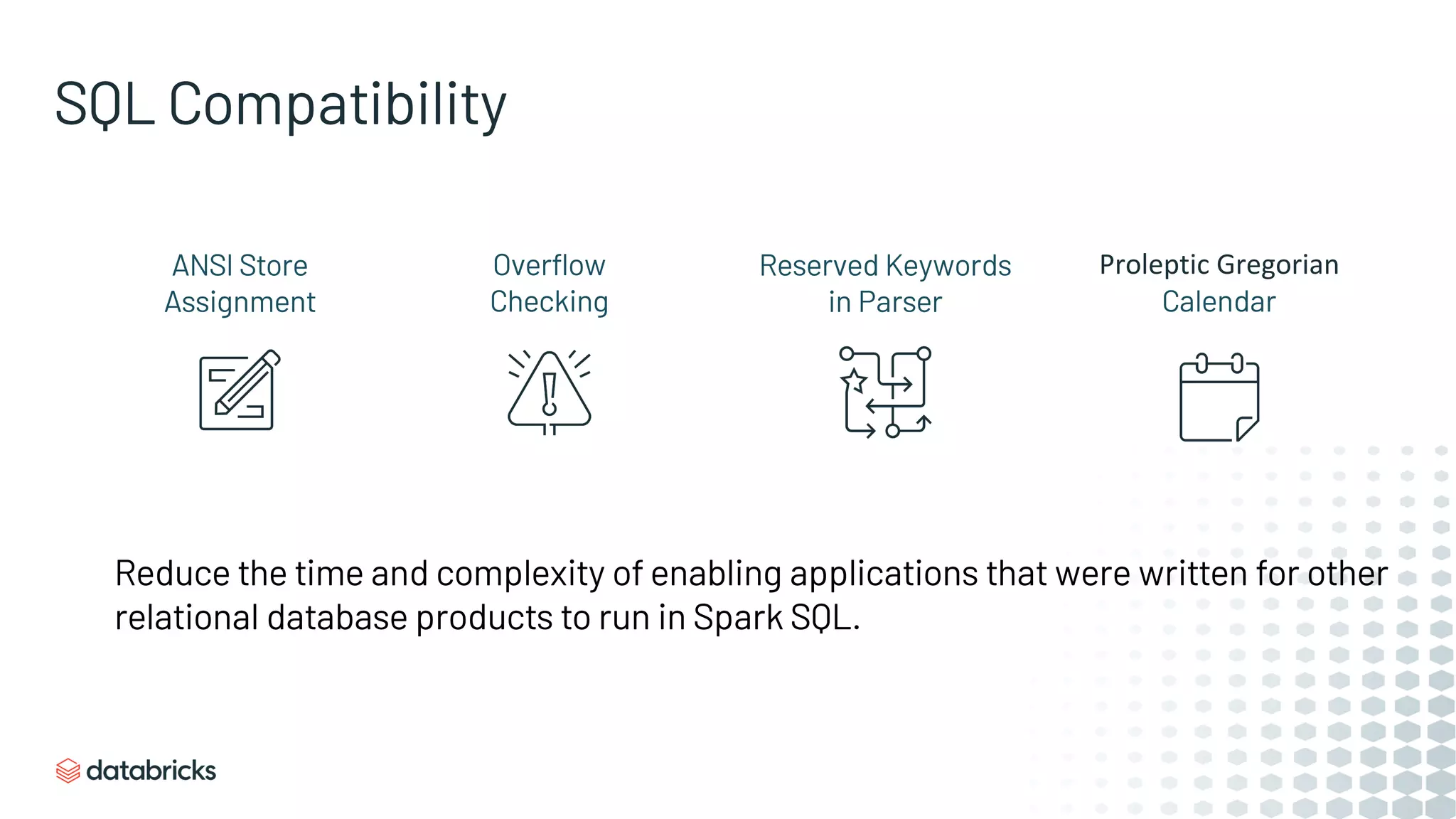
Reduce the time and complexity of enabling applications that were written for other
relational database products to run in Spark SQL.
Reserved Keywords
in Parser
Proleptic Gregorian
Calendar
ANSI Store
Assignment
Overflow
Checking
SQL Compatibility
Enhance the performance and functionalities of the built-in data sources
Parquet/ORC Nested
Column Pruning
Parquet: Nested Column
Filter Pushdown
New Binary
Data Source
CSV Filter
Pushdown
Built-in Data Sources
Improve the plug-in interface and extend the deployment environments
Data Source V2 API +
Catalog Support
Hive 3.x Metastore
Hive 2.3 Execution
Hadoop 3
Support
JDK 11
Support
Extensibility and Ecosystem
Spark 3.0 Builds
• Only builds with Scala 2.12
• Deprecates Python 2 (already EOL)
• Can build with various Hadoop/Hive versions
– Hadoop 2.7 + Hive 1.2
– Hadoop 2.7 + Hive 2.3 (supports Java 11) [Default]
– Hadoop 3.2 + Hive 2.3 (supports Java 11)
• Supports the following Hive metastore versions:
– "0.12", "0.13", "0.14", "1.0", "1.1", "1.2", "2.0", "2.1", "2.2", "2.3", "3.0", "3.1"
32 New Built-in Functions
§ map
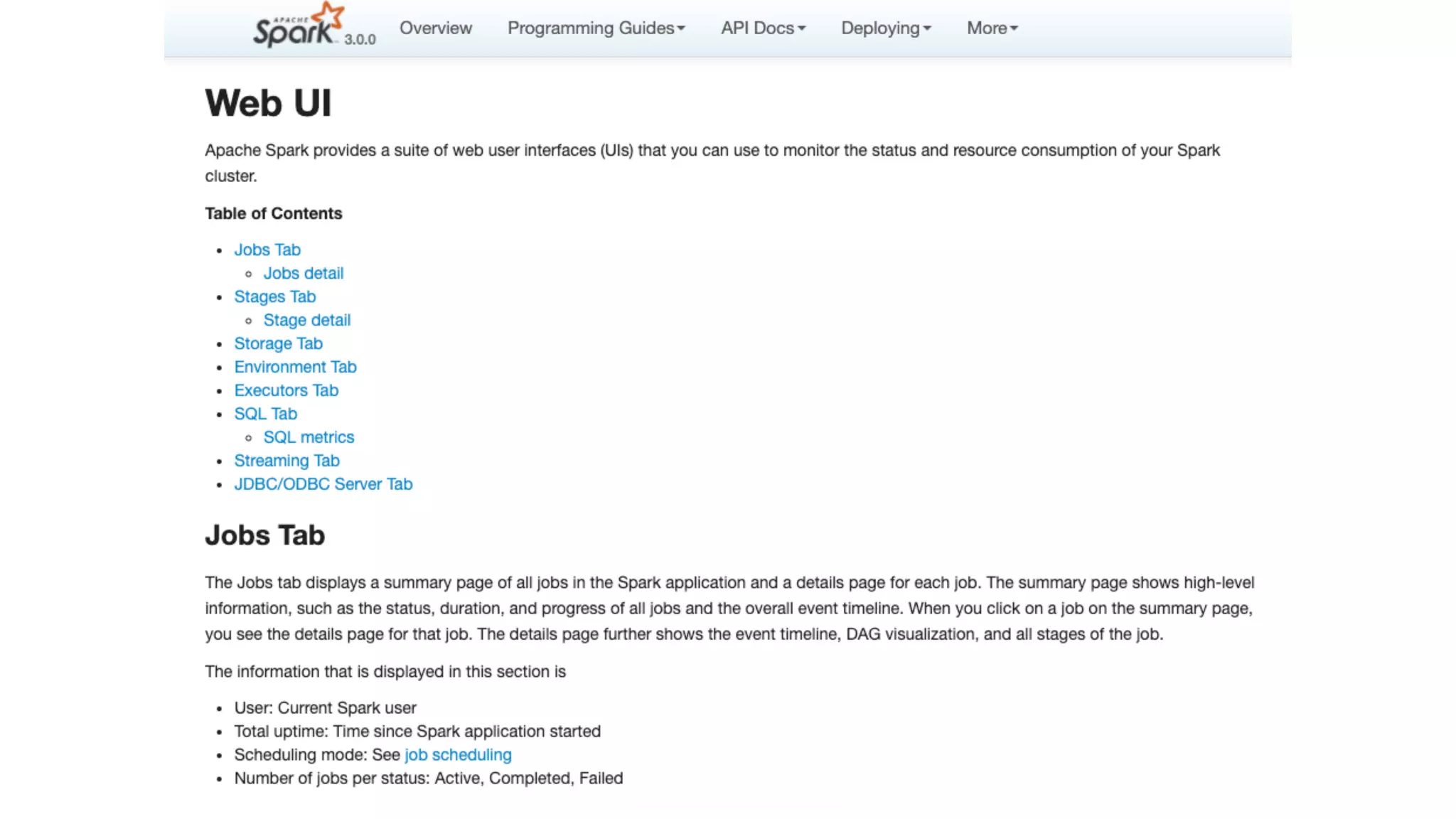
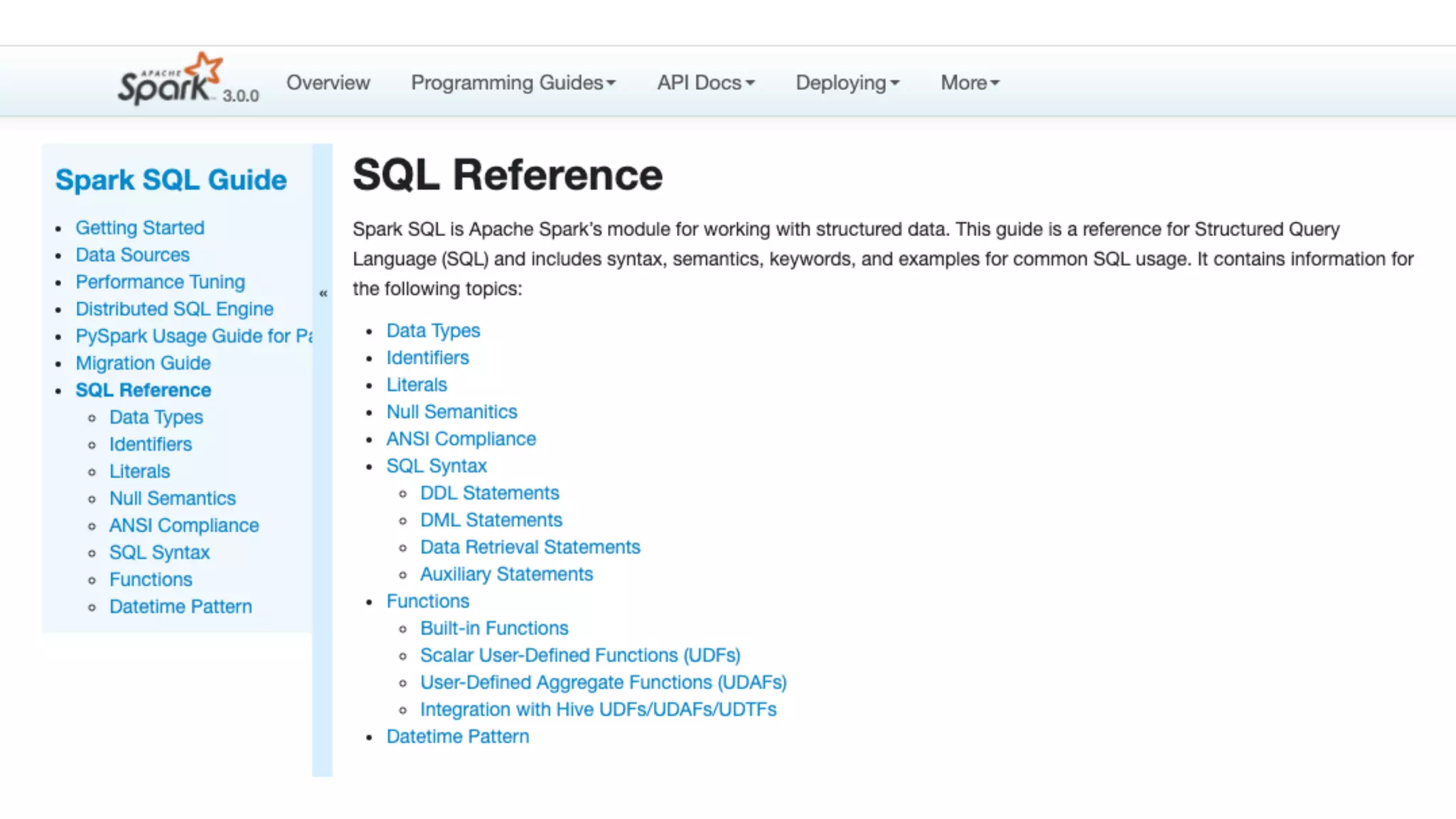
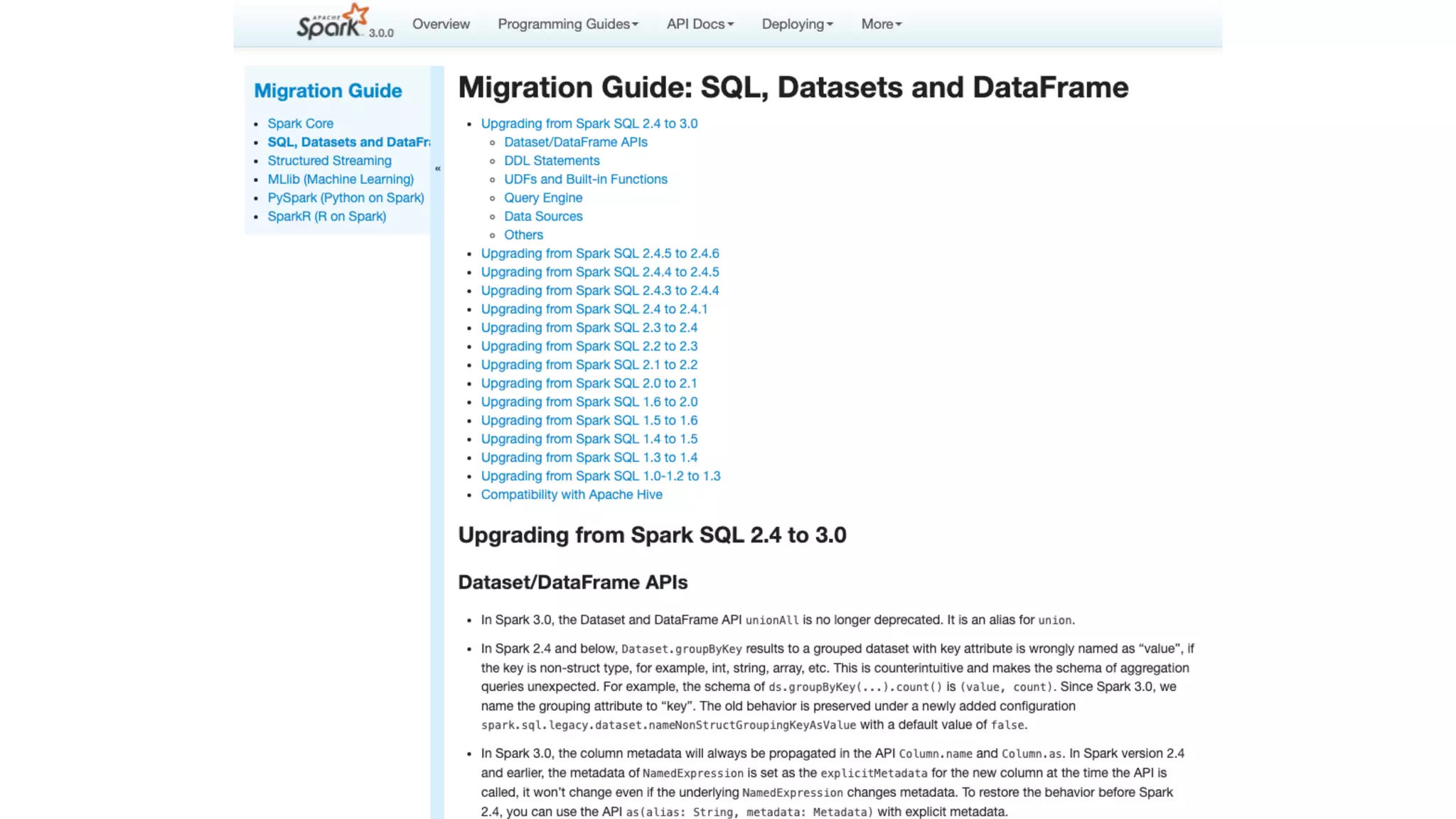
Documentation
• Web UI
• SQL reference
• Migration guide
• Semantic versioning guidelines
Adaptive Query
Execution
Dynamic Partition
Pruning
Query Compilation
Speedup
Join Hints
Performance
Richer APIs
Accelerator-aware
Scheduler
Built-in
Functions
pandas UDF
Enhancements
DELETE/UPDATE/
MERGE in Catalyst
Reserved
Keywords
Proleptic Gregorian
Calendar
ANSI Store
Assignment
Overflow
Checking
SQL Compatibility
Built-in Data Sources
Parquet/ORC Nested
Column Pruning
Parquet: Nested Column
Filter Pushdown
CSV Filter
Pushdown
New Binary
Data Source
Data Source V2 API +
Catalog Support
JDK 11 Support
Hadoop 3
Support
Hive 3.x Metastore
Hive 2.3 Execution
Extensibility and Ecosystem
Structured
Streaming UI
DDL/DML
Enhancements
Observable
Metrics
Event Log
Rollover
Monitoring and Debuggability
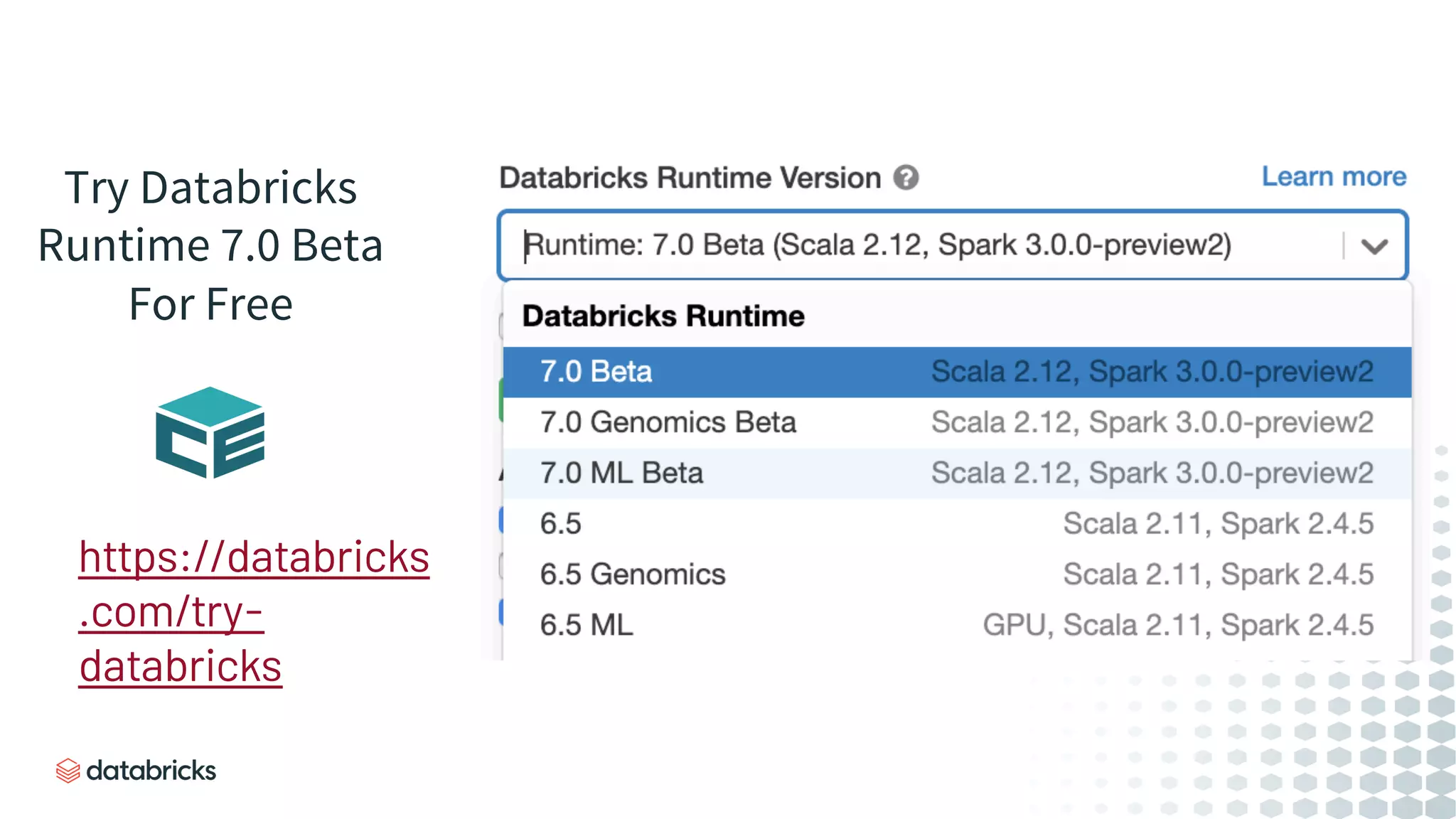
Try Databricks
Runtime 7.0 Beta
For Free
https://databricks
.com/try-
databricks
Thank you for your
contributions!
THE VIRTUAL EVENT
FOR DATA TEAMS
● Extended to 5 days with over 200 sessions
● 4x the pre-conference training
● Keynotes by visionaries and thought
leaders
June 22-26 | Organized by

What’s New in the Upcoming Apache Spark 3.0

  • 1.
    What’s New inthe Upcoming Apache Spark 3.0 Xiao Li gatorsmile June 2020
  • 2.
    • Engineering Managerat Databricks • Apache Spark Committer and PMC • Previously, IBM Master Inventor • Ph.D. in CISE at University of Florida • GitHub: gatorsmile About Me
  • 3.
    Unified data analyticsplatform for accelerating innovation across data science, data engineering, and business analytics Original creators of popular data and machine learning open source projects Global company with 5,000 customers and 450+ partners
  • 4.
  • 5.
    Adaptive Query Execution Dynamic Partition Pruning QueryCompilation Speedup Join Hints Performance Richer APIs Accelerator-aware Scheduler Built-in Functions pandas UDF Enhancements DELETE/UPDATE/ MERGE in Catalyst Reserved Keywords Proleptic Gregorian Calendar ANSI Store Assignment Overflow Checking SQL Compatibility Built-in Data Sources Parquet/ORC Nested Column Pruning Parquet: Nested Column Filter Pushdown CSV Filter Pushdown New Binary Data Source Data Source V2 API + Catalog Support JDK 11 Support Hadoop 3 Support Hive 3.x Metastore Hive 2.3 Execution Extensibility and Ecosystem Structured Streaming UI DDL/DML Enhancements Observable Metrics Event Log Rollover Monitoring and Debuggability
  • 6.
    Performance Achieve high performancefor interactive, batch, streaming and ML workloads Adaptive Query Execution Dynamic Partition Pruning Query Compilation Speedup Join Hints
  • 7.
    Performance Achieve high performancefor interactive, batch, streaming and ML workloads Adaptive Query Execution Dynamic Partition Pruning Join Hints Query Compilation Speedup
  • 8.
    Spark Catalyst Optimizer Spark1.x, Rule Spark 2.x, Rule + Cost
  • 9.
    Query Optimization inSpark 2.x § Missing statistics Expensive statistics collection § Out-of-date statistics Compute and storage separated § Suboptimal Heuristics Local § Misestimated costs Complex environments User-defined functions
  • 10.
    Spark Catalyst Optimizer Spark1.x, Rule Spark 2.x, Rule + Cost Spark 3.0, Rule + Cost + Runtime
  • 11.
    adaptive planning Based onstatistics of the finished plan nodes, re-optimize the execution plan of the remaining queries Adaptive Query Execution
  • 12.
    Blog post: https://databricks.com/blog/2020/05/29/adaptive- query-execution-speeding-up-spark-sql-at-runtime.html Basedon statistics of the finished plan nodes, re-optimize the execution plan of the remaining queries • Convert Sort Merge Join to Broadcast Hash Join • Shrink the number of reducers • Handle skew join Adaptive Query Execution
  • 13.
    One of theMost Popular Performance Tuning Tips § Choose Broadcast Hash Join? § Increase “spark.sql.autoBroadcastJoinThreshold”? § Use “broadcast” hint? However ▪ Hard to tune ▪ Hard to maintain over time ▪ OOM…
  • 14.
    Why Spark notMaking the Best Choice Automatically? § Inaccurate/missing statistics; § File is compressed; columnar store; § Complex filters; black-box UDFs; § Complex query fragments…
  • 15.
    Convert Sort MergeJoin to Broadcast Hash Join Sort Merge Join Filter Scan Execute Shuffle Sort Scan Shuffle Sort Sort Merge Join Filter Scan Shuffle Sort Scan Shuffle Sort Stage 1 Stage 2 Stage 1 Stage 2 Estimate size: 100 MB Estimate size: 30 MB Actual size: 86 MB Actual size: 8 MB Optimize Broadcast Hash Join Filter Scan Shuffle Broadcast Scan Shuffle Stage 1 Stage 2 Actual size: 86 MB Actual size: 8 MB
  • 16.
    One More PopularPerformance Tuning Tip § Tuning spark.sql.shuffle.partitions § Default magic number: 200 !?! However § Too small: GC pressure; disk spilling § Too large: Inefficient I/O; scheduler pressure ▪ Hard to tune over the whole query plan ▪ Hard to maintain over time
  • 17.
    Dynamically Coalesce ShufflePartitions Filter Scan Execute Shuffle (50 part.) Sort Stage 1 OptimizeFilter Scan Shuffle (50 part.) Sort Stage 1 Filter Scan Shuffle (50 part.) Sort Stage 1 Coalesce (5 part.) ▪ Set the initial partition number high to accommodate the largest data size of the entire query execution ▪ Automatically coalesce partitions if needed after each query stage
  • 18.
    Another Popular PerformanceTuning Tip § Symptoms of data skew § Frozen/long-running tasks § Disk spilling § Low resource utilization in most nodes § OOM § Various ways § Find the skew values and rewrite the queries § Adding extra skew keys…
  • 19.
    TABLE A -MAP 1 TABLE A - MAP 2 TABLE A - MAP 3 PART. A0 PART. A1 PART. A2 PART. A3 PART. B0 PART. B1 PART. B2 PART. B3 TABLE B - MAP 1 TABLE B - MAP 2 JOIN Data Skew in Sort Merge Join
  • 20.
    Dynamically Optimize SkewJoins Sort Merge Join Filter Scan Execute Shuffle Sort Scan Shuffle Sort Sort Merge Join Filter Scan Shuffle Sort Scan Shuffle Sort Stage 1 Stage 2 Stage 1 Stage 2 Optimize Sort Merge Join Filter Scan Shuffle Sort Scan Shuffle Sort Stage 1 Stage 2 Skew Reader Skew Reader • Detect skew from partition sizes using runtime statistics • Split skew partitions into smaller sub-partitions
  • 21.
    Skew-optimized sort mergejoin -- with skew shuffle reader: A0 - S2 TABLE A - MAP 1 B0 TABLE A - MAP 2 TABLE A - MAP 3 Split A0 PART. A1 PART. A2 PART. A3 PART. B1 PART. B2 PART. B3 TABLE B - MAP 1 TABLE B - MAP 2 A0 - S1 A0 - S0 B0 B0 Duplicate B0 JOIN Dynamically Optimize Skew Joins
  • 22.
  • 23.
    Performance Achieve high performancefor interactive, batch, streaming and ML workloads Adaptive Query Execution Dynamic Partition Pruning Join Hints Query Compilation Speedup
  • 24.
    Dynamic Partition Pruning •Avoid partition scanning based on the query results of the other query fragments. • Important for star-schema queries. • Significant speedup in TPC-DS.
  • 25.
    Dynamic Partition Pruning 60/ 102 TPC-DS queries: a speedup between 2x and 18x
  • 26.
    t1: a large facttable with many partitions t2.id < 2 t2: a dimension table with a filter SELECT t1.id, t2.pKey FROM t1 JOIN t2 ON t1.pKey = t2.pKey AND t2.id < 2 t1.pKey = t2.pKey Dynamic Partition Pruning Project Join Filter Scan Scan Optimize
  • 27.
    t1: a large facttable with many partitions t2.id < 2 t2: a dimension table with a filter SELECT t1.id, t2.pKey FROM t1 JOIN t2 ON t1.pKey = t2.pKey AND t2.id < 2 t1.pKey = t2.pKey Dynamic Partition Pruning Project Join Filter Scan Scan Optimize Scan all the partitions of t1 Filter pushdown t1.pkey IN ( SELECT t2.pKey FROM t2 WHERE t2.id < 2) t2.id < 2 Project Join Filter + Scan Filter Optimize Scan t1.pKey = t2.pKey
  • 28.
    Dynamic Partition Pruning Scanall the partitions of t1 t2.id < 2 Project Join Filter + Scan Filter Scan t1.pKey = t2.pKey Scan the required partitions of t2 t1.pKey in DPPFilterResult
  • 29.
    Dynamic Partition Pruning Scanall the partitions of t1 t2.id < 2 Project Join Filter + Scan Filter Scan t1.pKey = t2.pKey Scan the required partitions of t2 t1.pKey in DPPFilterResultOptimize Scan the required partitions of t1 t2.id < 2 Project Join Filter + Scan Filter + Scan Scan the required partitions of t2 t1.pKey in DPPFilterResult
  • 30.
    Dynamic Partition Pruning Scanall the partitions of t1 t2.id < 2 Project Join Filter + Scan Filter Scan t1.pKey = t2.pKey Scan the required partitions of t2 t1.pKey in DPPFilterResultOptimize Scan the required partitions of t1 t2.id < 2 Project Join Filter + Scan Filter + Scan Scan the required partitions of t2 t1.pKey in DPPFilterResult 90+% less file scan33 X faster Optimize
  • 31.
    Performance Achieve high performancefor interactive, batch, streaming and ML workloads Adaptive Query Execution Dynamic Partition Pruning Join Hints Query Compilation Speedup
  • 32.
    Optimizer Hints § Joinhints influence optimizer to choose the join strategies § Broadcast hash join § Sort-merge join § Shuffle hash join § Shuffle nested loop join § Should be used with extreme caution. § Difficult to manage over time. NEW NEW NEW
  • 33.
    § Broadcast HashJoin SELECT /*+ BROADCAST(a) */ id FROM a JOIN b ON a.key = b.key § Sort-Merge Join SELECT /*+ MERGE(a, b) */ id FROM a JOIN b ON a.key = b.key § Shuffle Hash Join SELECT /*+ SHUFFLE_HASH(a, b) */ id FROM a JOIN b ON a.key = b.key § Shuffle Nested Loop Join SELECT /*+ SHUFFLE_REPLICATE_NL(a, b) */ id FROM a JOIN b How to Use Join Hints?
  • 34.
    Broadcast Hash Join Requiresone side to be small. No shuffle, no sort, very fast. Sort-Merge Join Robust. Can handle any data size. Needs to shuffle and sort data, slower in most cases when the table size is small. Shuffle Hash Join Needs to shuffle data but no sort. Can handle large tables, but will OOM too if data is skewed. Shuffle Nested Loop Join Doesn’t require join keys.
  • 35.
    Enable new usecases and simplify the Spark application development Accelerator-aware Scheduler Built-in Functions pandas UDF enhancements DELETE/UPDATE/ MERGE in Catalyst Richer APIs
  • 36.
    Enable new usecases and simplify the Spark application development Accelerator-aware Scheduler Built-in Functions pandas UDF enhancements DELETE/UPDATE/ MERGE in Catalyst Richer APIs
  • 37.
    Accelerator-aware Scheduling § Widelyused for accelerating special workloads, e.g., deep learning and signal processing. § Supports Standalone, YARN and K8S. § Supports GPU now, FPGA, TPU, etc. in the future. § Needs to specify required resources by configs § Application level. Will support job/stage/task level in the future.
  • 38.
    Enable new usecases and simplify the Spark application development Richer APIs Accelerator-aware Scheduler Built-in Functions pandas UDF enhancements DELETE/UPDATE/ MERGE in Catalyst
  • 39.
    32 New Built-inFunctions
  • 40.
    Enable new usecases and simplify the Spark application development Richer APIs Accelerator-aware Scheduler Built-in Functions pandas UDF enhancements DELETE/UPDATE/ MERGE in Catalyst
  • 41.
    Python UDF for SQL Python lambda functionsfor RDDs Session- specific Python UDF JAVA UDF in Python API New Pandas UDF Python Type Hints Py UDF V 3.0V 0.7 V 1.2 2013 2015 20182014 2019/20202016 2017 V 2.0 V 2.1 V 2.3/2.4
  • 42.
    Scalar Pandas UDF [pandas.Seriesto pandas.Series] SPARK 2.3 SPARK 3.0 Python Type Hints
  • 43.
    Grouped Map PandasFunction API [pandas.DataFrame to pandas.DataFrame] SPARK 2.3 SPARK 3.0 Python Type Hints
  • 44.
    Grouped Aggregate PandasUDF [pandas.Series to Scalar] SPARK 2.4 SPARK 3.0 Python Type Hints
  • 45.
  • 46.
    Map Pandas UDF CogroupedMap Pandas UDF New Pandas Function APIs
  • 47.
    Make monitoring anddebugging Spark applications more comprehensive and stable Structured Streaming UI DDL/DML Enhancements Observable Metrics Event Log Rollover Monitoring and Debuggability
  • 48.
    Make monitoring anddebugging Spark applications more comprehensive and stable Monitoring and Debuggability Structured Streaming UI DDL/DML Enhancements Observable Metrics Event Log Rollover
  • 49.
  • 50.
    Make monitoring anddebugging Spark applications more comprehensive and stable Monitoring and Debuggability Structured Streaming UI DDL/DML Enhancements Observable Metrics Event Log Rollover
  • 51.
    New Command EXPLAINFORMATTED *(1) Project [key#5, val#6] +- *(1) Filter (isnotnull(key#5) AND (key#5 = Subquery scalar-subquery#15, [id=#113])) : +- Subquery scalar-subquery#15, [id=#113] : +- *(2) HashAggregate(keys=[], functions=[max(key#21)]) : +- Exchange SinglePartition, true, [id=#109] : +- *(1) HashAggregate(keys=[], functions=[partial_max(key#21)]) : +- *(1) Project [key#21] : +- *(1) Filter (isnotnull(val#22) AND (val#22 > 5)) : +- *(1) ColumnarToRow : +- FileScan parquet default.tab2[key#21,val#22] Batched: true, DataFilters: [isnotnull(val#22), (val#22 > 5)], Format: Parquet, Location: InMemoryFileIndex[file:/user/hive/warehouse/tab2], PartitionFilters: [], PushedFilters: [IsNotNull(val), GreaterThan(val,5)], ReadSchema: struct<key:int,val:int> +- *(1) ColumnarToRow +- FileScan parquet default.tab1[key#5,val#6] Batched: true, DataFilters: [isnotnull(key#5)], Format: Parquet, Location: InMemoryFileIndex[file:/user/hive/warehouse/tab1], PartitionFilters: [], PushedFilters: [IsNotNull(key)], ReadSchema: struct<key:int,val:int> EXPLAIN FORMATTED SELECT * FROM tab1 WHERE key = (SELECT max(key) FROM tab2 WHERE val > 5
  • 52.
    * Project (4) +-* Filter (3) +- * ColumnarToRow (2) +- Scan parquet default.tab1 (1) (1) Scan parquet default.tab1 Output [2]: [key#5, val#6] Batched: true Location: InMemoryFileIndex [file:/user/hive/warehouse/tab1] PushedFilters: [IsNotNull(key)] ReadSchema: struct<key:int,val:int> (2) ColumnarToRow [codegen id : 1] Input [2]: [key#5, val#6] (3) Filter [codegen id : 1] Input [2]: [key#5, val#6] Condition : (isnotnull(key#5) AND (key#5 = Subquery scalar-subquery#27, [id=#164])) (4) Project [codegen id : 1] Output [2]: [key#5, val#6] Input [2]: [key#5, val#6] EXPLAIN FORMATTED SELECT * FROM tab1 WHERE key = (SELECT max(key) FROM tab2 WHERE val > 5
  • 53.
    (5) Scan parquetdefault.tab2 Output [2]: [key#21, val#22] Batched: true Location: InMemoryFileIndex [file:/user/hive/warehouse/tab2] PushedFilters: [IsNotNull(val), GreaterThan(val,5)] ReadSchema: struct<key:int,val:int> (6) ColumnarToRow [codegen id : 1] Input [2]: [key#21, val#22] (7) Filter [codegen id : 1] Input [2]: [key#21, val#22] Condition : (isnotnull(val#22) AND (val#22 > 5)) ===== Subqueries ===== Subquery:1 Hosting operator id = 3 Hosting Expression = Subquery scalar-subquery#27, [id=#164] * HashAggregate (11) +- Exchange (10) +- * HashAggregate (9) +- * Project (8) +- * Filter (7) +- * ColumnarToRow (6) +- Scan parquet default.tab2 (5) (8) Project [codegen id : 1] Output [1]: [key#21] Input [2]: [key#21, val#22] (9) HashAggregate [codegen id : 1] Input [1]: [key#21] Keys: [] Functions [1]: [partial_max(key#21)] Aggregate Attributes [1]: [max#35] Results [1]: [max#36] (10) Exchange Input [1]: [max#36] Arguments: SinglePartition, true, [id=#160] (11) HashAggregate [codegen id : 2] Input [1]: [max#36] Keys: [] Functions [1]: [max(key#21)] Aggregate Attributes [1]: [max(key#21)#33] Results [1]: [max(key#21)#33 AS max(key)#34]
  • 54.
    Reduce the timeand complexity of enabling applications that were written for other relational database products to run in Spark SQL. Reserved Keywords in Parser Proleptic Gregorian Calendar ANSI Store Assignment Overflow Checking SQL Compatibility
  • 55.
    Enhance the performanceand functionalities of the built-in data sources Parquet/ORC Nested Column Pruning Parquet: Nested Column Filter Pushdown New Binary Data Source CSV Filter Pushdown Built-in Data Sources
  • 56.
    Improve the plug-ininterface and extend the deployment environments Data Source V2 API + Catalog Support Hive 3.x Metastore Hive 2.3 Execution Hadoop 3 Support JDK 11 Support Extensibility and Ecosystem
  • 57.
    Spark 3.0 Builds •Only builds with Scala 2.12 • Deprecates Python 2 (already EOL) • Can build with various Hadoop/Hive versions – Hadoop 2.7 + Hive 1.2 – Hadoop 2.7 + Hive 2.3 (supports Java 11) [Default] – Hadoop 3.2 + Hive 2.3 (supports Java 11) • Supports the following Hive metastore versions: – "0.12", "0.13", "0.14", "1.0", "1.1", "1.2", "2.0", "2.1", "2.2", "2.3", "3.0", "3.1"
  • 58.
    32 New Built-inFunctions § map Documentation • Web UI • SQL reference • Migration guide • Semantic versioning guidelines
  • 62.
    Adaptive Query Execution Dynamic Partition Pruning QueryCompilation Speedup Join Hints Performance Richer APIs Accelerator-aware Scheduler Built-in Functions pandas UDF Enhancements DELETE/UPDATE/ MERGE in Catalyst Reserved Keywords Proleptic Gregorian Calendar ANSI Store Assignment Overflow Checking SQL Compatibility Built-in Data Sources Parquet/ORC Nested Column Pruning Parquet: Nested Column Filter Pushdown CSV Filter Pushdown New Binary Data Source Data Source V2 API + Catalog Support JDK 11 Support Hadoop 3 Support Hive 3.x Metastore Hive 2.3 Execution Extensibility and Ecosystem Structured Streaming UI DDL/DML Enhancements Observable Metrics Event Log Rollover Monitoring and Debuggability
  • 63.
    Try Databricks Runtime 7.0Beta For Free https://databricks .com/try- databricks
  • 64.
    Thank you foryour contributions!
  • 65.
    THE VIRTUAL EVENT FORDATA TEAMS ● Extended to 5 days with over 200 sessions ● 4x the pre-conference training ● Keynotes by visionaries and thought leaders June 22-26 | Organized by