Skew Mitigation For Facebook’s
Petabyte-Scale Joins
Suganthi Dewakar & Guanzhong (Tony) Xu
Agenda
Skew Join Journey
▪ Skew Hint
▪ Runtime Skew Mitigation
▪ Customized AQE Skew Mitigation
Cosco + Skew Join
▪ Shuffle Recap
▪ Working with Original Cosco
▪ Splitting in File Boundaries
What Is Data Skew
▪ Uneven distribution of partitioned data
▪ Affects aggregate operations e.g Group By and Join
▪ E.g. count number of people group by country
▪ Data skew at FB
▪ PB sized table Joins with TB sized skewed partitions
▪ Task latency
▪ Non-skewed partition: mins to few hours
▪ Skewed partition: hours to days
▪ Skewed pipelines
▪ Latency sensitive daily jobs
▪ Complex DAG with several upstream/downstream dependencies
▪ Can cause delay in hundreds of downsteam pipelines
0.01GB 1TB
Percentile
shuffle
partition 1
partition 2
partition 3 (skewed)
partition 4
Data Skew In Join
▪ Join strategies in Spark
▪ SortMergeJoin/ ShuffleHashJoin
▪ Not skew resistant – requires input data to be partitioned
▪ BroadcastHashJoin
▪ Skew resistant – requires no data partitioning
▪ Requires one of side of join to be small
▪ Skew Join
▪ Hybrid join that combines above strategies
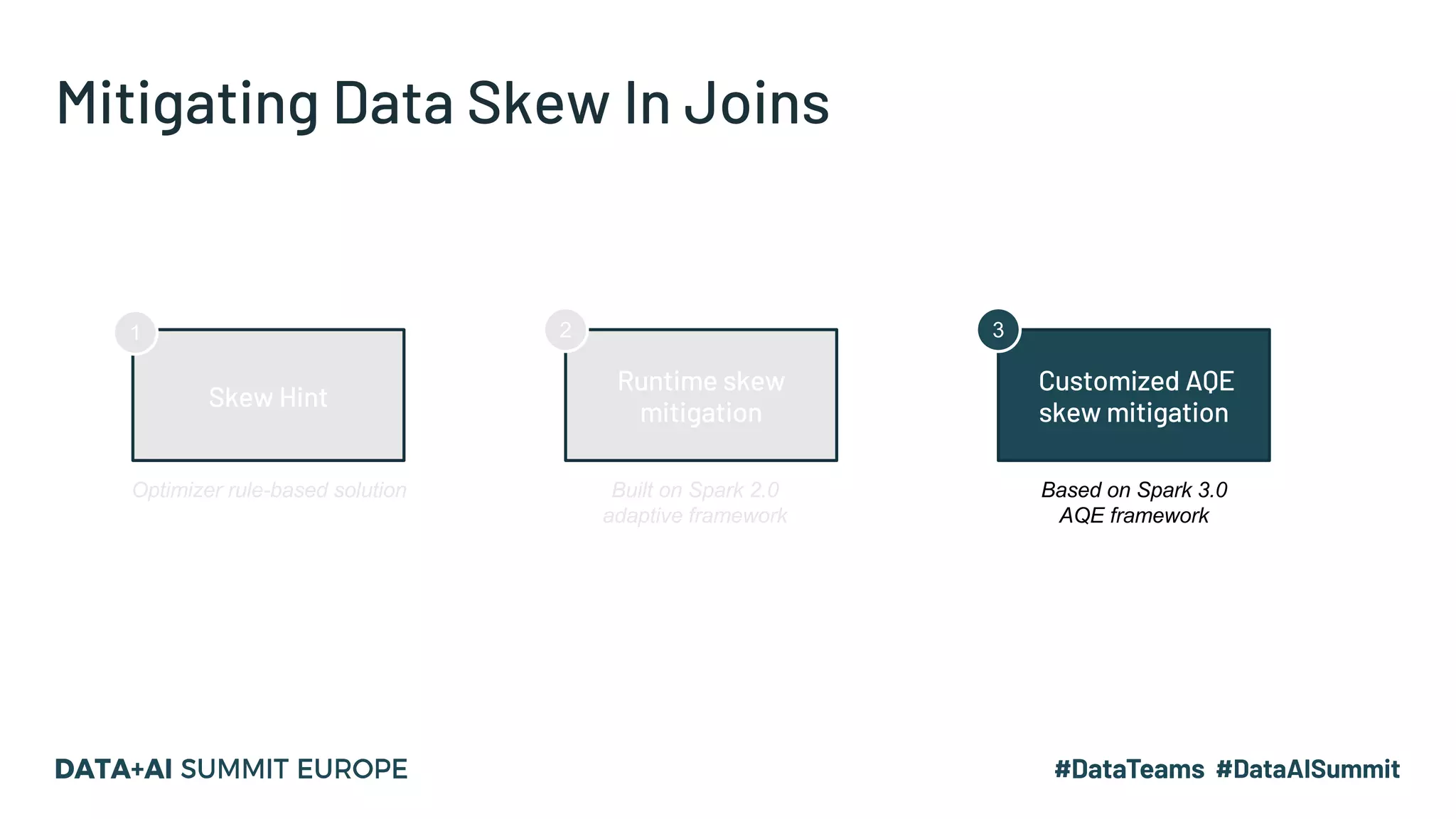
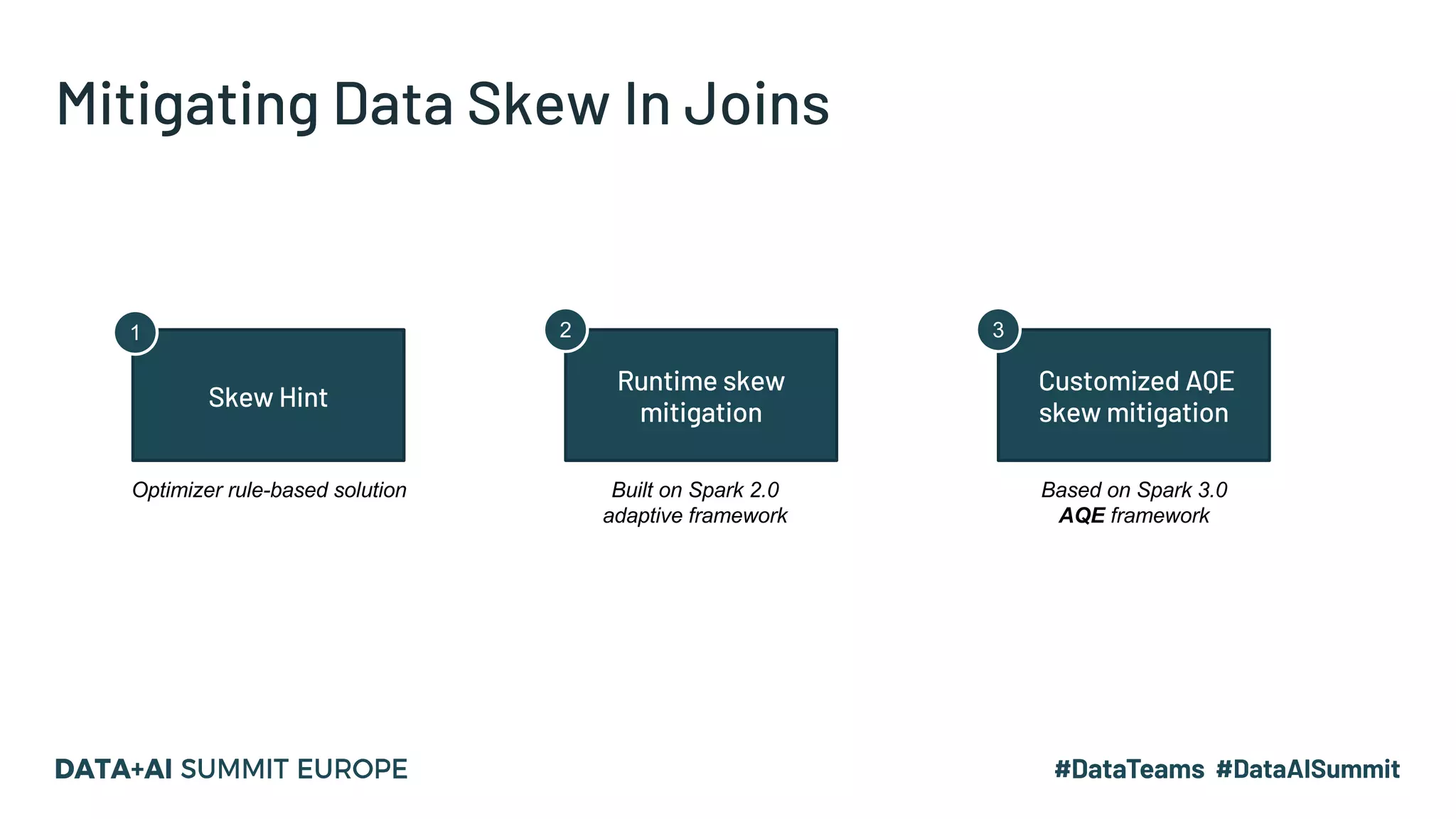
Mitigating Data Skew In Joins
Skew Hint
Runtime skew
mitigation
Customized AQE
skew mitigation
1 2 3
Optimizer rule-based solution Built on Spark 2.0
adaptive framework
Based on Spark 3.0
AQE framework
Mitigating Data Skew In Joins
Skew Hint
Runtime skew
mitigation
Customized AQE
skew mitigation
1 2 3
Optimizer rule-based solution Built on Spark 2.0
adaptive framework
Based on Spark 3.0
AQE framework
Skew Hint
▪ User provides skew information as
hints
▪ /*+ SKEWED_ON(column=value1,..) */
▪ Split input into two parts
▪ Skewed keys
▪ Non-skewed keys
▪ Broadcast join skewed keys
▪ Shuffle/Sort join non-skewed keys
▪ Union both join outputs
Skew Hint
Scan table_A Scan table_B
SortMergeJoin
Exchange Exchange
Skew Hint
Union
Scan table_A Scan table_B
Filter
[skewed keys]
BroadcastHashJoin
Filter
[skewed keys]
Scan table_A Scan table_B
SortMergeJoin
Filter
[non-skewed keys]
Filter
[non-skewed keys]
Exchange Exchange
Skewed dataNon-skewed data
Skew Hint
Skew Hint
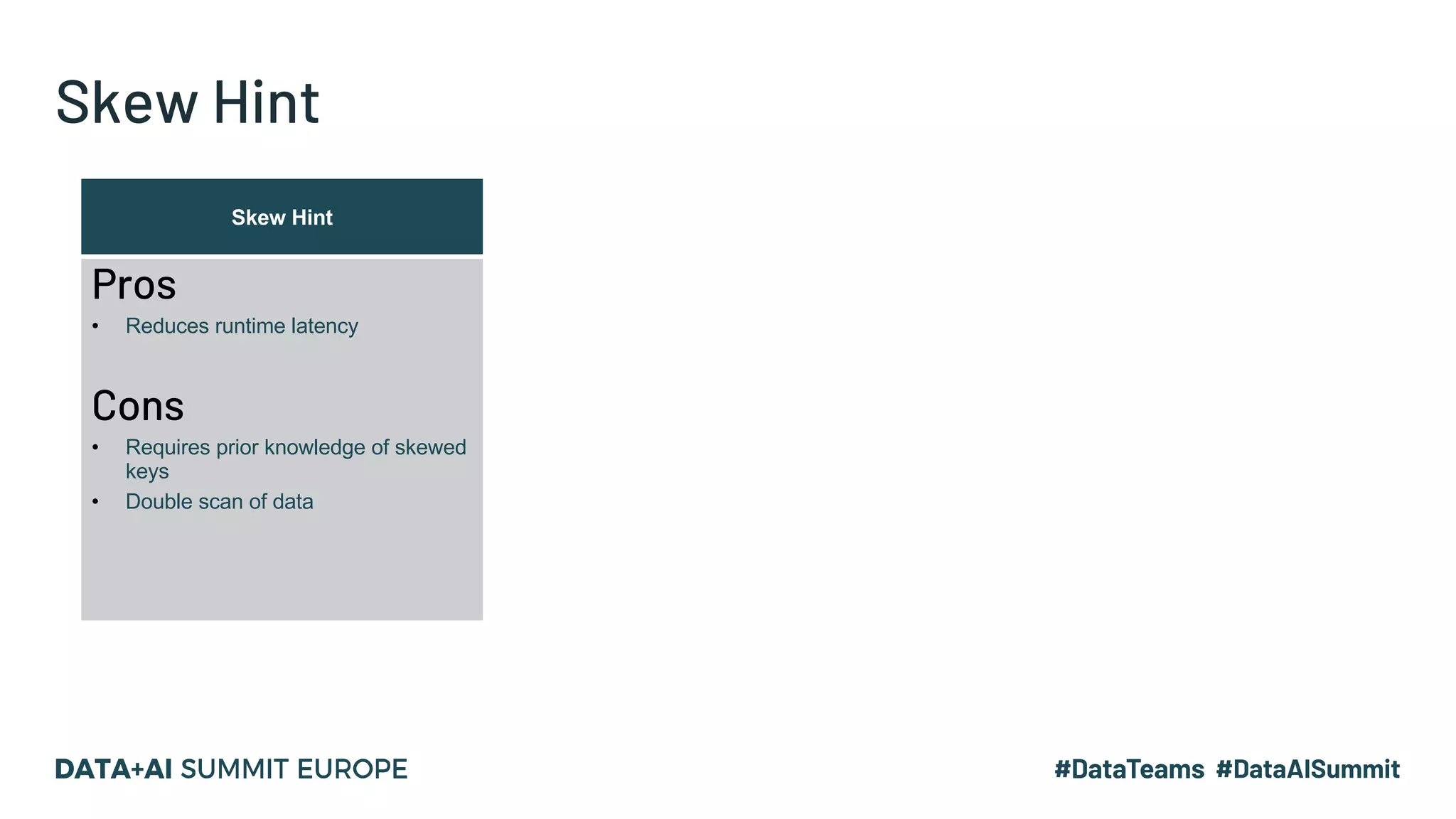
Pros
• Reduces runtime latency
Cons
• Requires prior knowledge of skewed
keys
• Double scan of data
Mitigating Data Skew In Joins
Skew Hint
Runtime skew
mitigation
Customized AQE
skew mitigation
1 2 3
Optimizer rule-based solution Built on Spark 2.0
adaptive framework
Based on Spark 3.0
AQE framework
Runtime skew mitigation
§ Spark 2.0 adaptive framework
§ Adds ExchangeCoordinator to all shuffle Exchange nodes
§ ExchangeCoordinator merges small partitions based on runtime stats
§ Runtime skewed partition detection
§ Collect MapOutputStatistics of a joins input stages
§ Partition is skewed iff size of partition is:
§ > min_threshold_config_value (e.g. 1GB)
§ > median_ratio X median_size(shuffle) (e.g. 10 times median size)
§ > pct_99_ratio X pct99_size(shuffle) (e.g. 3 times 99 percentile size)
Built on Spark 2.0 adaptive framework
Runtime skew mitigation
§ Split large partitions into smaller sub-partitions
shuffle table_A shuffle table_B
skewed partition split
Built on Spark 2.0 adaptive framework
table_A join table_B
Built on Spark 2.0 adaptive framework
Skew Hint
Runtime Skew Mitigation
Spark 2.0 adaptive framework
Pros
• Reduces runtime latency
Cons
• Requires prior knowledge of skewed
keys
• Double scan of data
Pros
• Reduces runtime latency
• No prior skew key knowledge
required
• No double scan of data
Cons
Additional shuffles even when a join is
not skewed
• Between joins
• Between joins and aggregates
Runtime skew mitigation
Mitigating Data Skew In Joins
Skew Hint
Runtime skew
mitigation
Customized AQE
skew mitigation
1 2 3
Optimizer rule-based solution Built on Spark 2.0
adaptive framework
Based on Spark 3.0
AQE framework
AQE skew mitigation
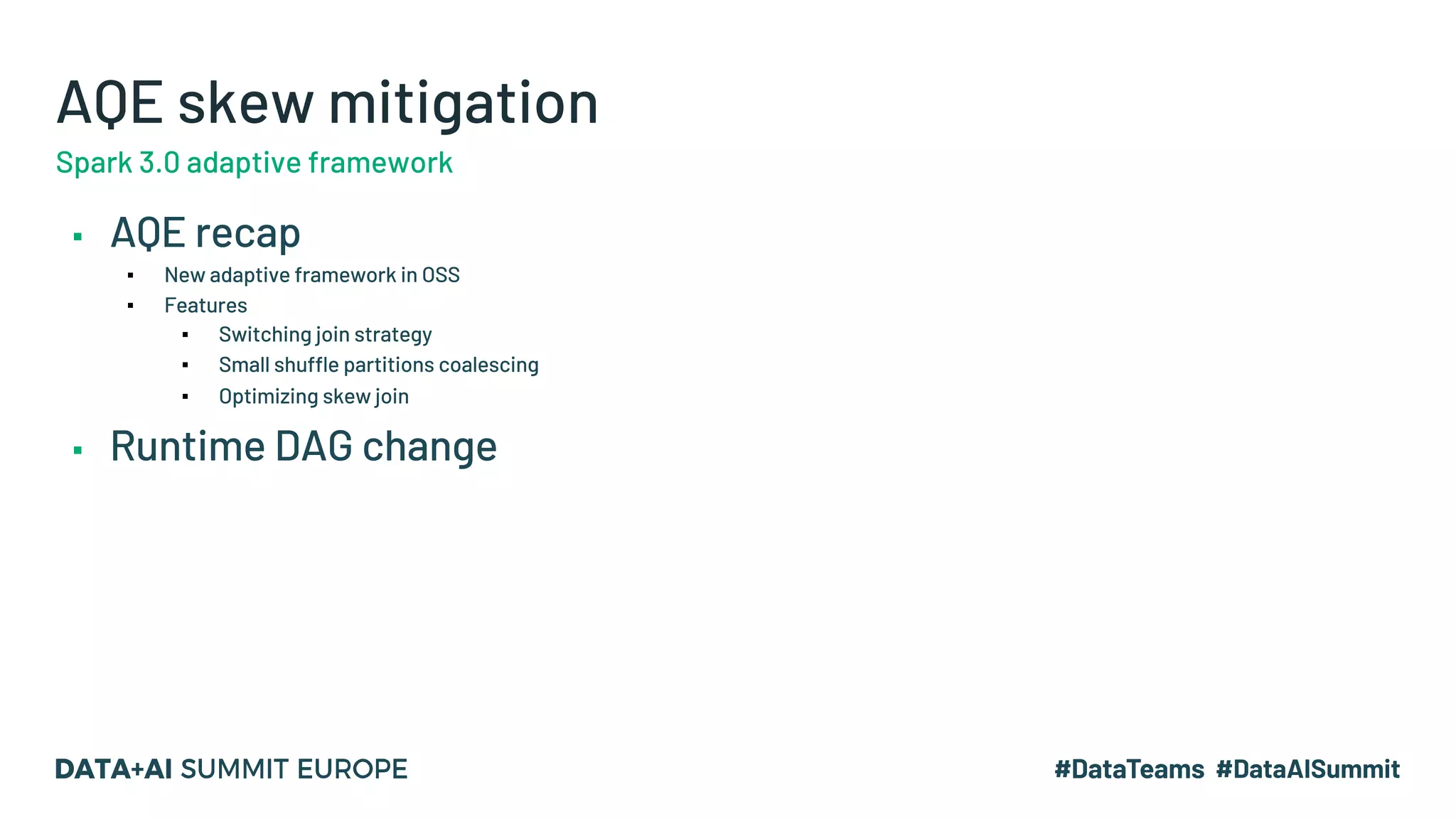
▪ AQE recap
▪ New adaptive framework in OSS
▪ Features
▪ Switching join strategy
▪ Small shuffle partitions coalescing
▪ Optimizing skew join
▪ Runtime DAG change
Spark 3.0 adaptive framework
AQE skew mitigation
Limitation
▪ Supports two table join only
▪ Single stage skewed join + reducer operation
▪ Skewed Join + Aggregate
▪ Skewed multi table joins
▪ Single stage skewed join + mapper operation
▪ Skewed join + union
▪ Skewed join + broadcast join
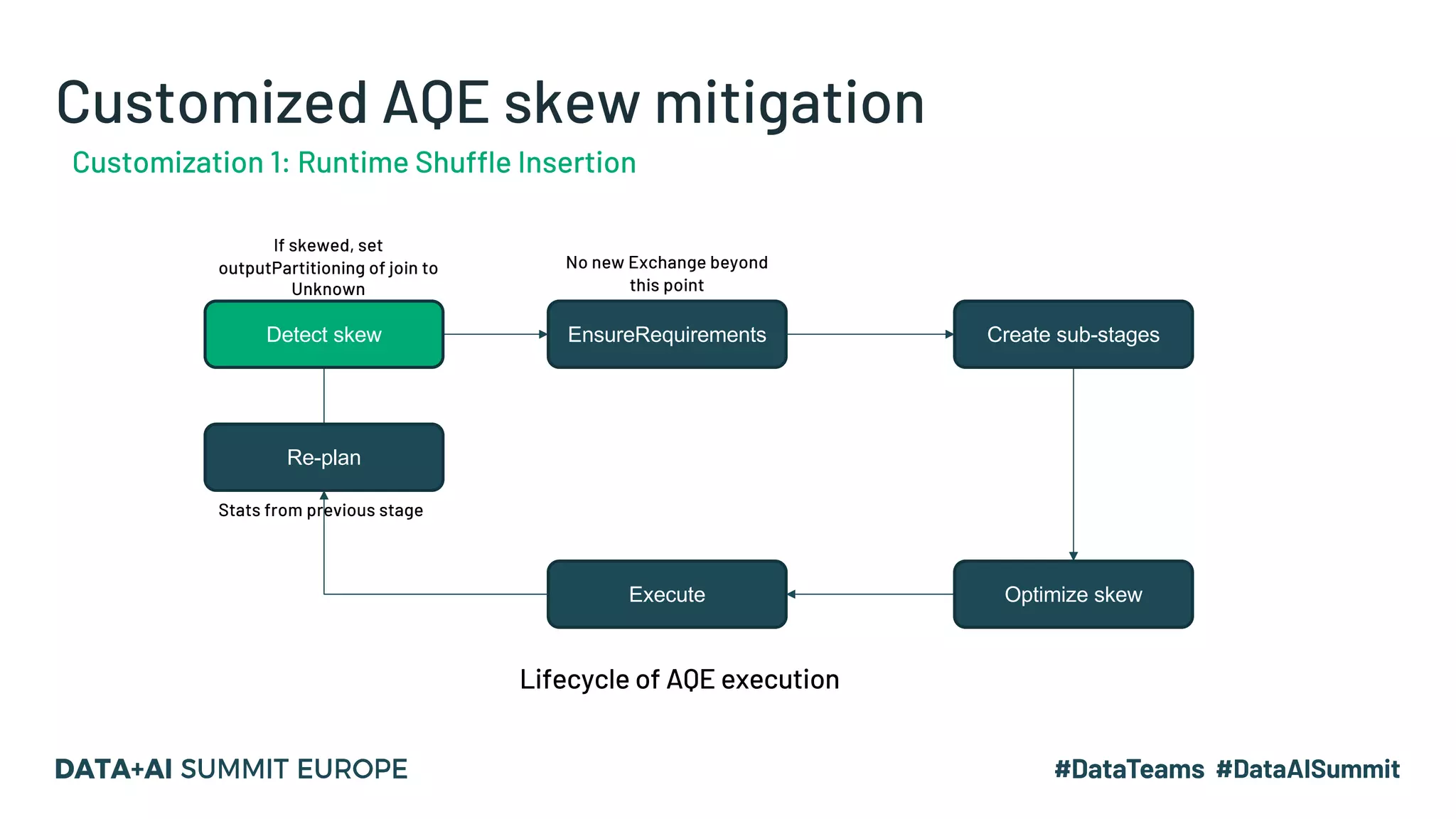
Customized AQE skew mitigation
Customization 1: Runtime Shuffle Insertion
Lifecycle of AQE execution
EnsureRequirements
Execute
Stats from previous stage
No new Exchange beyond
this point
Optimize skew
Create sub-stages
Re-plan
Customized AQE skew mitigation
Customization 1: Runtime Shuffle Insertion
Lifecycle of AQE execution
EnsureRequirements
Execute
Stats from previous stage
No new Exchange beyond
this point
Optimize skew
Create sub-stages
Re-plan
If skewed, set
outputPartitioning of join to
Unknown
Detect skew
table_A (petabye) table_B
Left Outer Join
table_C
Left Outer Join
Customized AQE skew mitigation
[Limitation] Customization 1: Runtime Shuffle Insertion
table_D
Left Outer Join
table_A (petabye) table_B
Left Outer Join
table_C
Left Outer Join
Customized AQE skew mitigation
[Limitation] Customization 1: Runtime Shuffle Insertion
table_D
Left Outer Join
Exchange
Exchange
Shuffles PB sized
data
Shuffles PB sized
data
Customized AQE skew mitigation
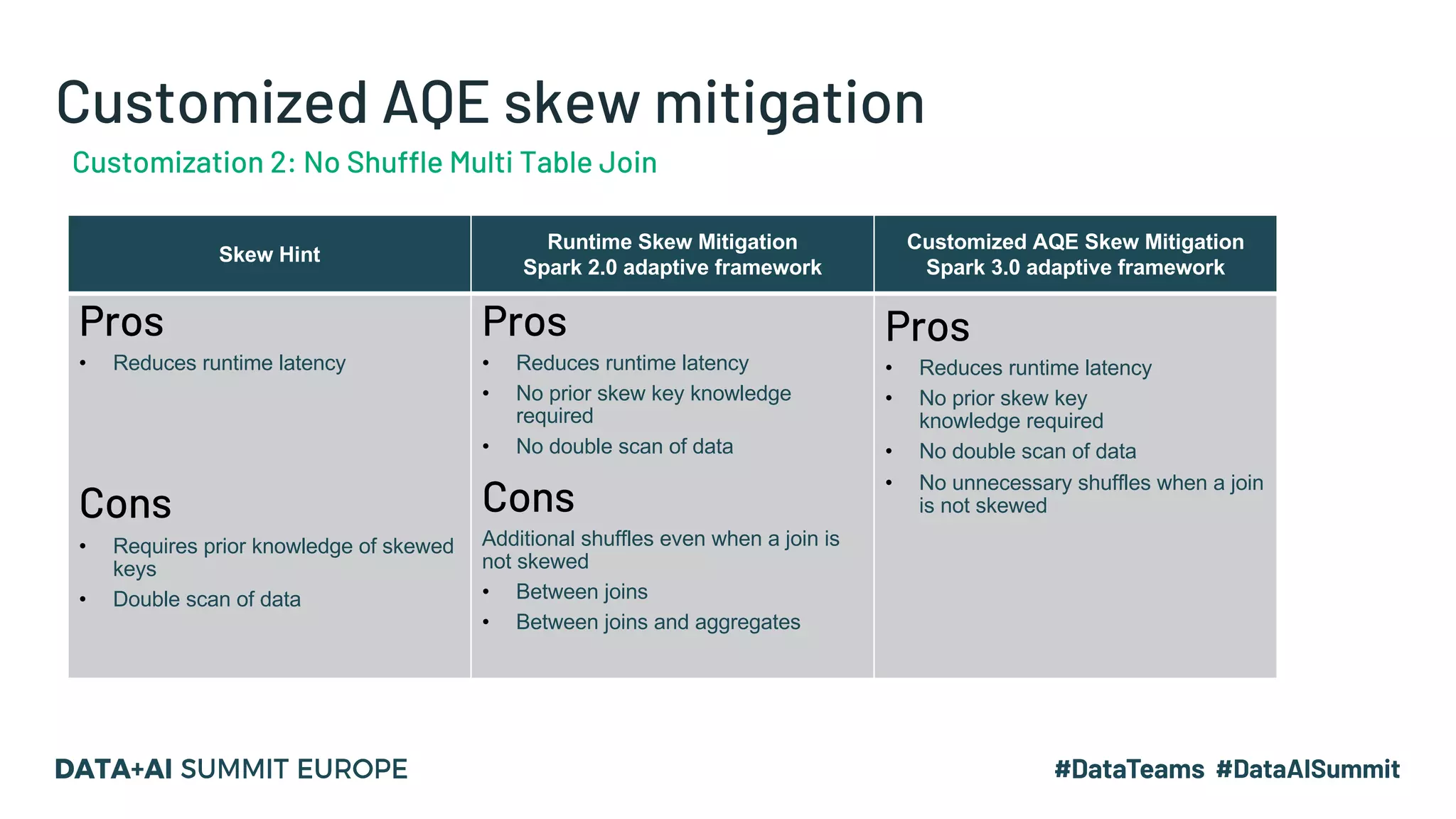
Customization 2: No Shuffle Multi Table Join
shuffle table_A
shuffle table_B
skewed partition split
shuffle table_C
▪ Split skewed partition in one table
▪ Replicate the corresponding partitions in the rest of the input tables
shuffle table_Dshuffle table_A
Skew Hint
Runtime Skew Mitigation
Spark 2.0 adaptive framework
Customized AQE Skew Mitigation
Spark 3.0 adaptive framework
Pros
• Reduces runtime latency
Cons
• Requires prior knowledge of skewed
keys
• Double scan of data
Pros
• Reduces runtime latency
• No prior skew key knowledge
required
• No double scan of data
Cons
Additional shuffles even when a join is
not skewed
• Between joins
• Between joins and aggregates
Pros
• Reduces runtime latency
• No prior skew key
knowledge required
• No double scan of data
• No unnecessary shuffles when a join
is not skewed
Customized AQE skew mitigation
Customization 2: No Shuffle Multi Table Join
Skew Join With Cosco
▪ Adaptive Skew Mitigation Splits in Mapper Boundaries
▪ Each sub-reducer is only required to read data from a subset of mappers.
▪ Only partial data is required
▪ E.g.: a skewed partition 0 is split that: sub-reducer 0 reads {mapper 1}, sub-reducer 1 reads {mapper 0, mapper 2}, sub-reducer 1
reads {mapper 0, mapper 2}
Partition 0
The Problem
File 0 File 1 File 3
Sub-reducer 0 Sub-reducer 1 Sub-reducer 2 Sub-reducer i…
Sub-reducer i
Mapper outputs
are merged in
files :(
Cosco Shuffle Recap
▪ Why Cosco?
▪ Shuffle as a service: IO Efficiency
▪ Write-ahead buffer
▪ Groups shuffled output based on partition id instead of mapper id.
▪ Data deduplication is performed in reducer side
▪ Efficiency Wins:
▪ Solve the write amplification problem: avoid spills: 3X -> 1X
▪ Solve the small IO problem: average IO size: 200KB -> 2.5MB
▪ Previous Talk
▪ Cosco: An Efficient Facebook-Scale Shuffle Service
DFS
Cosco
Shuffle ServiceCosco
Shuffle Service
Cosco Shuffle Recap
Cosco
Shuffle Service
Partition 0
(file 2 buffer)
Partition 0
(file 1 buffer)
Mapper 0
Mapper 0
Mapper 0
Reducer 0
Reducer 1
File 1
File 0
File 2
File 0
File 1
Cosco
Metadata Service
Working with Mapper Boundaries
▪ Load all data but filter out uninterested ones
▪ Each sub-reducer still has to load all data from all file chunks of the partition.
▪ Filtering out records from uninterested mappers.
▪ IO inefficient
Record (mapper-1)
Record (mapper-3)
Record (mapper-2)
Record (mapper-2)
Record (mapper-4)
Record (mapper-1)
…
File 0
Read
Drop
Drop
Drop
Read
Read
Sub-reducer for
mapper {1, 4}
Skewed partition worst cases
▪ For the most heavily skewed partitions, it
could be up to XXX TB and requires XX k
splits, which means the skewed partition
data has to be read XX k times as well.
▪ Very inefficient, most times are spent on
disk IO.
▪ Compared to vanilla Spark shuffle, it no
longer has any advantages in terms of IO.
Why cannot we split in file boundaries?
Terminology
▪ Record
▪ Unit of a data row
▪ Package
▪ Unit to be sent from mapper to shuffle service
▪ Chunk
▪ Unit to be flushed
Record
Record
Record
Record
Package
Package
Package
Package
Chunk
Multiple records to form a package
Multiple packages to form a chunk
▪ Duplicated records
▪ A record could be duplicated in multiple files due to package resending which might be caused by various reasons.
▪ Cosco relies on reducer client to perform deduplication which requires it to read the entire partition data from a mapper.
▪ Simply splitting on file boundaries requires no overlap of mappers between file sets for different sub-reducers, which is not feasible.
File 2 File 3
Restrictions
Sub-reducer 0
File 0 File 1
Sub-reducer 0 is assigned to
read file 0 & 1. But it has to
read file 2 & 3 as well
because they have mapper
overlap with file 0 & 1.
Duplication
▪ Mapper failure
▪ Each mapper is assigned a unique id.
▪ Each package is attached with its mapper’s unique id.
▪ Reducer consumes records from interested mappers based on those unique ids.
▪ It would not cause duplicated records in reducer if a mapper output is not fully read by a reducer.
Mapper 0
(id: abc)
Mapper 0
(id: xyz)
Partition Package Id MapperId
...
0 3 abc
0 3 xyz
...
Failed
Sub-reducer 0
(read from `xyz`)
Dropped
Accepted
Duplication
▪ Network issues
▪ A mapper fails to receive ack message after timeout, it will resend the package.
▪ We call such packages "suspected packages”: a suspected package is not necessary to be a duplicated packaged, but a duplicated
package is always a suspected package.
Shuffle service - 1
Shuffle service - 2Package-1
Package-2
Package-3
Mapper - 1
Ack Queue
Chunk - i
Records from package-
{1,2,3} are flushed to chunks
Chunk - j
Records from package-
{1,2,3} are duplicated to
chunks
Resend packages
in ack queues
Identify suspected packages in mapper
Suspected Map
▪ Map<partition, Map<packageId, chunkId>>
▪ Each mapper keeps a map to track the resent packages due to connection.
▪ Whenever a resend happens, all the packages in the ACK queue are added to the map.
Shuffle service - 1
Shuffle service - 2
Package-1
Pakcage-2
Package-3
Mapper - 1
ACK Queue
Resend packages
in ack queues
Add to suspected
package map
packageId chunkId
Package-x Chunk-xyz
Package-1 null
Package-2 null
Package-3 null
Partition - 1
Suspected Map
▪ Map<partition, Map<packageId, chunkId>>
▪ An ACK message eventually returned contains a unique identifier of the chunk containing the package.
▪ Mapper keeps the mapping from those suspected packages to their authorized chunks.
▪ Once the mapper is done, reports the suspected map to Spark driver.
▪ Spark driver aggregate the suspected package info from different mappers.
Shuffle service - 2
Pakcage-2
Package-3
Mapper - 1
ACK Queue
Return ACK for Package-1
with chunkId
1. Remove package-1
from ACK queue.
2. Update the chunkId in
suspected map
packageId chunkId
Package-x Chunk-xyz
Package-1 Chunk-abc
Package-2 null
Package-3 null
Partition - 1
▪ Each sub-reducer would be assigned a subset of files along with the
corresponding suspected map of the partition.
Reading subset of files on sub-reducer
Chunk Set - 1 Chunk Set - 2
...
Skewed Partition
Sub-reducer - 1 Sub-reducer - 2 ...
▪ Duplicated records would only be accepted if it is read from
authorized chunk.
Reading subset of files on sub-reducer
Record
{mapper-3,package-4,chunk-15}
Chunk-15
Record
{mapper-3,package-4,chunk-15}
Chunk-4
Sub-reducer-2 Sub-reducer-7
Record Accepted Record Dropped
{MapperId, PackageId} ChunkId
... ...
{mapper-3, package-4} chunk-15
... ...
Chunk Lost
▪ Chunk lost failure requires restart of all sub-reducers accordingly: .
▪ Spark driver to restart mappers to regenerate data of that particular partition.
▪ Data in new chunks are non-deterministic.
▪ Spark driver broadcasts failures to all corresponding sub-reducer tasks and restarts them all.
▪ This is rare since chunks are RS-encoded
Putting It All Together
▪ Motivation:
▪ To split a skewed partition into multiple non-overlapping file sets that each sub-reducer would be assigned one of them.
▪ Mapper:
▪ Keeps tracking of suspected packages along with authorized chunks.
▪ Report suspected package info to Spark driver when finishes.
▪ Driver:
▪ Aggregate suspect package info from all mappers and pass along to sub-reducers if necessary.
▪ Detects skewed partitions and split them based on file boundaries of each partition.
▪ Fail and restart all corresponding sub-reducer tasks of a partition if there is a chunk lost.
▪ Reducer:
▪ Fetches file list from driver along with suspected package info.
▪ Accept a record of a suspected package only if it is read from the authorized chunk.
▪ Data Correctness
▪ End-to-end checksum
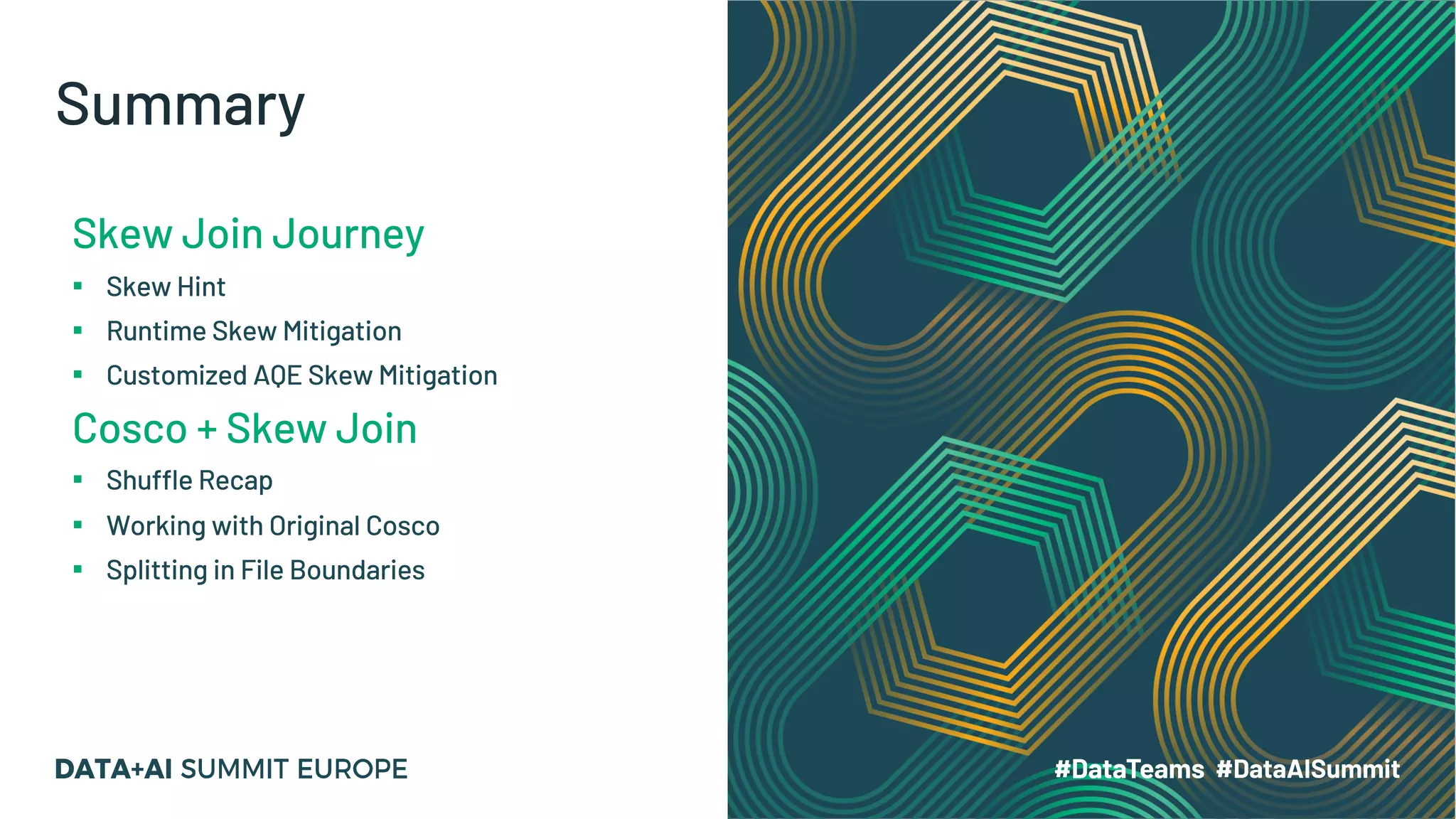
Summary
Skew Join Journey
▪ Skew Hint
▪ Runtime Skew Mitigation
▪ Customized AQE Skew Mitigation
Cosco + Skew Join
▪ Shuffle Recap
▪ Working with Original Cosco
▪ Splitting in File Boundaries
Feedback
Your feedback is important to us.
Don’t forget to rate
and review the sessions.

Skew Mitigation For Facebook PetabyteScale Joins

  • 1.
    Skew Mitigation ForFacebook’s Petabyte-Scale Joins Suganthi Dewakar & Guanzhong (Tony) Xu
  • 2.
    Agenda Skew Join Journey ▪Skew Hint ▪ Runtime Skew Mitigation ▪ Customized AQE Skew Mitigation Cosco + Skew Join ▪ Shuffle Recap ▪ Working with Original Cosco ▪ Splitting in File Boundaries
  • 3.
    What Is DataSkew ▪ Uneven distribution of partitioned data ▪ Affects aggregate operations e.g Group By and Join ▪ E.g. count number of people group by country ▪ Data skew at FB ▪ PB sized table Joins with TB sized skewed partitions ▪ Task latency ▪ Non-skewed partition: mins to few hours ▪ Skewed partition: hours to days ▪ Skewed pipelines ▪ Latency sensitive daily jobs ▪ Complex DAG with several upstream/downstream dependencies ▪ Can cause delay in hundreds of downsteam pipelines 0.01GB 1TB Percentile shuffle partition 1 partition 2 partition 3 (skewed) partition 4
  • 4.
    Data Skew InJoin ▪ Join strategies in Spark ▪ SortMergeJoin/ ShuffleHashJoin ▪ Not skew resistant – requires input data to be partitioned ▪ BroadcastHashJoin ▪ Skew resistant – requires no data partitioning ▪ Requires one of side of join to be small ▪ Skew Join ▪ Hybrid join that combines above strategies
  • 5.
    Mitigating Data SkewIn Joins Skew Hint Runtime skew mitigation Customized AQE skew mitigation 1 2 3 Optimizer rule-based solution Built on Spark 2.0 adaptive framework Based on Spark 3.0 AQE framework
  • 6.
    Mitigating Data SkewIn Joins Skew Hint Runtime skew mitigation Customized AQE skew mitigation 1 2 3 Optimizer rule-based solution Built on Spark 2.0 adaptive framework Based on Spark 3.0 AQE framework
  • 7.
    Skew Hint ▪ Userprovides skew information as hints ▪ /*+ SKEWED_ON(column=value1,..) */ ▪ Split input into two parts ▪ Skewed keys ▪ Non-skewed keys ▪ Broadcast join skewed keys ▪ Shuffle/Sort join non-skewed keys ▪ Union both join outputs
  • 8.
    Skew Hint Scan table_AScan table_B SortMergeJoin Exchange Exchange
  • 9.
    Skew Hint Union Scan table_AScan table_B Filter [skewed keys] BroadcastHashJoin Filter [skewed keys] Scan table_A Scan table_B SortMergeJoin Filter [non-skewed keys] Filter [non-skewed keys] Exchange Exchange Skewed dataNon-skewed data
  • 10.
    Skew Hint Skew Hint Pros •Reduces runtime latency Cons • Requires prior knowledge of skewed keys • Double scan of data
  • 11.
    Mitigating Data SkewIn Joins Skew Hint Runtime skew mitigation Customized AQE skew mitigation 1 2 3 Optimizer rule-based solution Built on Spark 2.0 adaptive framework Based on Spark 3.0 AQE framework
  • 12.
    Runtime skew mitigation §Spark 2.0 adaptive framework § Adds ExchangeCoordinator to all shuffle Exchange nodes § ExchangeCoordinator merges small partitions based on runtime stats § Runtime skewed partition detection § Collect MapOutputStatistics of a joins input stages § Partition is skewed iff size of partition is: § > min_threshold_config_value (e.g. 1GB) § > median_ratio X median_size(shuffle) (e.g. 10 times median size) § > pct_99_ratio X pct99_size(shuffle) (e.g. 3 times 99 percentile size) Built on Spark 2.0 adaptive framework
  • 13.
    Runtime skew mitigation §Split large partitions into smaller sub-partitions shuffle table_A shuffle table_B skewed partition split Built on Spark 2.0 adaptive framework table_A join table_B
  • 14.
    Built on Spark2.0 adaptive framework Skew Hint Runtime Skew Mitigation Spark 2.0 adaptive framework Pros • Reduces runtime latency Cons • Requires prior knowledge of skewed keys • Double scan of data Pros • Reduces runtime latency • No prior skew key knowledge required • No double scan of data Cons Additional shuffles even when a join is not skewed • Between joins • Between joins and aggregates Runtime skew mitigation
  • 15.
    Mitigating Data SkewIn Joins Skew Hint Runtime skew mitigation Customized AQE skew mitigation 1 2 3 Optimizer rule-based solution Built on Spark 2.0 adaptive framework Based on Spark 3.0 AQE framework
  • 16.
    AQE skew mitigation ▪AQE recap ▪ New adaptive framework in OSS ▪ Features ▪ Switching join strategy ▪ Small shuffle partitions coalescing ▪ Optimizing skew join ▪ Runtime DAG change Spark 3.0 adaptive framework
  • 17.
    AQE skew mitigation Limitation ▪Supports two table join only ▪ Single stage skewed join + reducer operation ▪ Skewed Join + Aggregate ▪ Skewed multi table joins ▪ Single stage skewed join + mapper operation ▪ Skewed join + union ▪ Skewed join + broadcast join
  • 18.
    Customized AQE skewmitigation Customization 1: Runtime Shuffle Insertion Lifecycle of AQE execution EnsureRequirements Execute Stats from previous stage No new Exchange beyond this point Optimize skew Create sub-stages Re-plan
  • 19.
    Customized AQE skewmitigation Customization 1: Runtime Shuffle Insertion Lifecycle of AQE execution EnsureRequirements Execute Stats from previous stage No new Exchange beyond this point Optimize skew Create sub-stages Re-plan If skewed, set outputPartitioning of join to Unknown Detect skew
  • 20.
    table_A (petabye) table_B LeftOuter Join table_C Left Outer Join Customized AQE skew mitigation [Limitation] Customization 1: Runtime Shuffle Insertion table_D Left Outer Join
  • 21.
    table_A (petabye) table_B LeftOuter Join table_C Left Outer Join Customized AQE skew mitigation [Limitation] Customization 1: Runtime Shuffle Insertion table_D Left Outer Join Exchange Exchange Shuffles PB sized data Shuffles PB sized data
  • 22.
    Customized AQE skewmitigation Customization 2: No Shuffle Multi Table Join shuffle table_A shuffle table_B skewed partition split shuffle table_C ▪ Split skewed partition in one table ▪ Replicate the corresponding partitions in the rest of the input tables shuffle table_Dshuffle table_A
  • 23.
    Skew Hint Runtime SkewMitigation Spark 2.0 adaptive framework Customized AQE Skew Mitigation Spark 3.0 adaptive framework Pros • Reduces runtime latency Cons • Requires prior knowledge of skewed keys • Double scan of data Pros • Reduces runtime latency • No prior skew key knowledge required • No double scan of data Cons Additional shuffles even when a join is not skewed • Between joins • Between joins and aggregates Pros • Reduces runtime latency • No prior skew key knowledge required • No double scan of data • No unnecessary shuffles when a join is not skewed Customized AQE skew mitigation Customization 2: No Shuffle Multi Table Join
  • 24.
  • 25.
    ▪ Adaptive SkewMitigation Splits in Mapper Boundaries ▪ Each sub-reducer is only required to read data from a subset of mappers. ▪ Only partial data is required ▪ E.g.: a skewed partition 0 is split that: sub-reducer 0 reads {mapper 1}, sub-reducer 1 reads {mapper 0, mapper 2}, sub-reducer 1 reads {mapper 0, mapper 2} Partition 0 The Problem File 0 File 1 File 3 Sub-reducer 0 Sub-reducer 1 Sub-reducer 2 Sub-reducer i… Sub-reducer i Mapper outputs are merged in files :(
  • 26.
    Cosco Shuffle Recap ▪Why Cosco? ▪ Shuffle as a service: IO Efficiency ▪ Write-ahead buffer ▪ Groups shuffled output based on partition id instead of mapper id. ▪ Data deduplication is performed in reducer side ▪ Efficiency Wins: ▪ Solve the write amplification problem: avoid spills: 3X -> 1X ▪ Solve the small IO problem: average IO size: 200KB -> 2.5MB ▪ Previous Talk ▪ Cosco: An Efficient Facebook-Scale Shuffle Service
  • 27.
    DFS Cosco Shuffle ServiceCosco Shuffle Service CoscoShuffle Recap Cosco Shuffle Service Partition 0 (file 2 buffer) Partition 0 (file 1 buffer) Mapper 0 Mapper 0 Mapper 0 Reducer 0 Reducer 1 File 1 File 0 File 2 File 0 File 1 Cosco Metadata Service
  • 28.
    Working with MapperBoundaries ▪ Load all data but filter out uninterested ones ▪ Each sub-reducer still has to load all data from all file chunks of the partition. ▪ Filtering out records from uninterested mappers. ▪ IO inefficient Record (mapper-1) Record (mapper-3) Record (mapper-2) Record (mapper-2) Record (mapper-4) Record (mapper-1) … File 0 Read Drop Drop Drop Read Read Sub-reducer for mapper {1, 4}
  • 29.
    Skewed partition worstcases ▪ For the most heavily skewed partitions, it could be up to XXX TB and requires XX k splits, which means the skewed partition data has to be read XX k times as well. ▪ Very inefficient, most times are spent on disk IO. ▪ Compared to vanilla Spark shuffle, it no longer has any advantages in terms of IO.
  • 30.
    Why cannot wesplit in file boundaries?
  • 31.
    Terminology ▪ Record ▪ Unitof a data row ▪ Package ▪ Unit to be sent from mapper to shuffle service ▪ Chunk ▪ Unit to be flushed Record Record Record Record Package Package Package Package Chunk Multiple records to form a package Multiple packages to form a chunk
  • 32.
    ▪ Duplicated records ▪A record could be duplicated in multiple files due to package resending which might be caused by various reasons. ▪ Cosco relies on reducer client to perform deduplication which requires it to read the entire partition data from a mapper. ▪ Simply splitting on file boundaries requires no overlap of mappers between file sets for different sub-reducers, which is not feasible. File 2 File 3 Restrictions Sub-reducer 0 File 0 File 1 Sub-reducer 0 is assigned to read file 0 & 1. But it has to read file 2 & 3 as well because they have mapper overlap with file 0 & 1.
  • 33.
    Duplication ▪ Mapper failure ▪Each mapper is assigned a unique id. ▪ Each package is attached with its mapper’s unique id. ▪ Reducer consumes records from interested mappers based on those unique ids. ▪ It would not cause duplicated records in reducer if a mapper output is not fully read by a reducer. Mapper 0 (id: abc) Mapper 0 (id: xyz) Partition Package Id MapperId ... 0 3 abc 0 3 xyz ... Failed Sub-reducer 0 (read from `xyz`) Dropped Accepted
  • 34.
    Duplication ▪ Network issues ▪A mapper fails to receive ack message after timeout, it will resend the package. ▪ We call such packages "suspected packages”: a suspected package is not necessary to be a duplicated packaged, but a duplicated package is always a suspected package. Shuffle service - 1 Shuffle service - 2Package-1 Package-2 Package-3 Mapper - 1 Ack Queue Chunk - i Records from package- {1,2,3} are flushed to chunks Chunk - j Records from package- {1,2,3} are duplicated to chunks Resend packages in ack queues
  • 35.
  • 36.
    Suspected Map ▪ Map<partition,Map<packageId, chunkId>> ▪ Each mapper keeps a map to track the resent packages due to connection. ▪ Whenever a resend happens, all the packages in the ACK queue are added to the map. Shuffle service - 1 Shuffle service - 2 Package-1 Pakcage-2 Package-3 Mapper - 1 ACK Queue Resend packages in ack queues Add to suspected package map packageId chunkId Package-x Chunk-xyz Package-1 null Package-2 null Package-3 null Partition - 1
  • 37.
    Suspected Map ▪ Map<partition,Map<packageId, chunkId>> ▪ An ACK message eventually returned contains a unique identifier of the chunk containing the package. ▪ Mapper keeps the mapping from those suspected packages to their authorized chunks. ▪ Once the mapper is done, reports the suspected map to Spark driver. ▪ Spark driver aggregate the suspected package info from different mappers. Shuffle service - 2 Pakcage-2 Package-3 Mapper - 1 ACK Queue Return ACK for Package-1 with chunkId 1. Remove package-1 from ACK queue. 2. Update the chunkId in suspected map packageId chunkId Package-x Chunk-xyz Package-1 Chunk-abc Package-2 null Package-3 null Partition - 1
  • 38.
    ▪ Each sub-reducerwould be assigned a subset of files along with the corresponding suspected map of the partition. Reading subset of files on sub-reducer Chunk Set - 1 Chunk Set - 2 ... Skewed Partition Sub-reducer - 1 Sub-reducer - 2 ...
  • 39.
    ▪ Duplicated recordswould only be accepted if it is read from authorized chunk. Reading subset of files on sub-reducer Record {mapper-3,package-4,chunk-15} Chunk-15 Record {mapper-3,package-4,chunk-15} Chunk-4 Sub-reducer-2 Sub-reducer-7 Record Accepted Record Dropped {MapperId, PackageId} ChunkId ... ... {mapper-3, package-4} chunk-15 ... ...
  • 40.
    Chunk Lost ▪ Chunklost failure requires restart of all sub-reducers accordingly: . ▪ Spark driver to restart mappers to regenerate data of that particular partition. ▪ Data in new chunks are non-deterministic. ▪ Spark driver broadcasts failures to all corresponding sub-reducer tasks and restarts them all. ▪ This is rare since chunks are RS-encoded
  • 41.
    Putting It AllTogether ▪ Motivation: ▪ To split a skewed partition into multiple non-overlapping file sets that each sub-reducer would be assigned one of them. ▪ Mapper: ▪ Keeps tracking of suspected packages along with authorized chunks. ▪ Report suspected package info to Spark driver when finishes. ▪ Driver: ▪ Aggregate suspect package info from all mappers and pass along to sub-reducers if necessary. ▪ Detects skewed partitions and split them based on file boundaries of each partition. ▪ Fail and restart all corresponding sub-reducer tasks of a partition if there is a chunk lost. ▪ Reducer: ▪ Fetches file list from driver along with suspected package info. ▪ Accept a record of a suspected package only if it is read from the authorized chunk. ▪ Data Correctness ▪ End-to-end checksum
  • 42.
    Summary Skew Join Journey ▪Skew Hint ▪ Runtime Skew Mitigation ▪ Customized AQE Skew Mitigation Cosco + Skew Join ▪ Shuffle Recap ▪ Working with Original Cosco ▪ Splitting in File Boundaries
  • 43.
    Feedback Your feedback isimportant to us. Don’t forget to rate and review the sessions.