Name: Jon Jyoti Sahariah
B.Pharm 6th Sem
Roll No: 05
Year: 2017
Department of Pharmaceutical Sciences
Dibrugarh university
General term for those nutrients, including iron, folic
acid, and vitamin B12, required for the formation and
development of blood cells in bone marrow (the process of
haematopoiesis), deficiency of which may result in
anaemia.
Treatment of anemia
Increase the number of RBC or hemoglobin content of
RBC or both when there is deficiency
Main Haematinics are:
1.Iron
2.Vit-B12
3. Folic acid
Aneamia
 Not a single disease
 Results from a number of different pathologies
 Defined as a reduction from the normal quantity of Hb in
blood
 WHO defines anemia as Hb levels less than 13 g/dl for
males and less than 12 g/dl for females
 Low Hb levels results in decreased oxygen carrying
capacity of blood
 Causes:
 Blood loss
 Impaired RBC functions due to deficiency
Iron As Haematinic Agent
 Hematopoiesis
 The production of circulating erythrocytes, leukocytes and
platelets from undifferentiated stem cells, is called
hematopoiesis.
 It requires:
 Iron –for Hb formation
Iron storage
 Iron is the integral component of haemoglobin In our
body:
 66-67% of iron is present in hemoglobin.
 3% occurs in myoglobin
 1% in enzymes -cytochrome, catalase, peroxidase
 25% is stored in form of ferritin and hemosiderin
Pharmacokinetics :
Absorption:
 absorbs 5–10% of iron ingested or about 0.5–1 mg daily.
 normally absorbed in the duodenum and proximal
jejunum.
 absorption increases in response to low iron stores or
increased iron requirements.
STORAGE
 primarily as ferritin, in macrophages in the liver, spleen,
and bone, and in parenchymal liver cells. Apoferritin
synthesis is regulated by the levels of free iron.
 Ferritin is detectable in serum. Since the ferritin present in
serum is in equilibrium with storage ferritin in
reticuloendothelial tissues, the serum ferritin level can be
used to estimate total body iron stores.
Transport:
 transported in the plasma bound to transferrin, a -globulin
that specifically binds two molecules of ferrous iron The
transferrin-iron complex enters maturing erythroid cells by a
specific receptor mechanism. Transferrin receptors
internalize the transferrin-iron complex through the process
of receptor-mediated endocytosis.
 Increased erythropoiesis is associated with an increase in the
number of transferrin receptors on developing erythroid
cells. Iron store depletion and iron deficiency anemia are
associated with an increased concentration of serum
transferrin.
ELIMINATION
 Small amounts are lost in the feces by exfoliation of
intestinal mucosal cells, and trace amounts are excreted in
bile, urine, and sweat.
Indications of oral iron therapy
Prophylactic use :
1) pregnancy- from 4th month to lactation.
2) Menstruation
3) Infancy and childhood
4) Premature babies and babies weaned late
5) Professional blood donors
 Therapeutic use :
1) Iron deficiency anemia
2) Iron deficiency anemia due to:
- menorrhagia
- peptic ulcer
- piles
- hook worm infestation
3) Malabsorption syndrome
4) Anemia of pregnancy
5) Treatment of severe pernicious anemia
Parenteral iron preparations:
 Iron dextran is a stable complex of ferric hydroxide and
low-molecular-weight dextran containing 50 mg of
elemental iron per milliliter of solution. It can be given by
deep intramuscular injection or by intravenous infusion,
although the intravenous route is used most commonly
 Headache, light-headedness, fever, arthralgias, nausea
and vomiting, back pain, flushing, urticaria,
bronchospasm, and rarely, anaphylaxis and death.
 Hypersensitivity reaction to the dextran component.
Hypersensitivity reactions may be delayed for 48–72
hours after administration.
 Anaphylactic reactions
 Iron-sucrose complex and iron sodium gluconate
complex only by the intravenous route.
 Sources :
Yeast, liver, green vegetables, Fruits, nuts and cereals
Daily requirements :
Adult: 50 mcg / day
Pregnant women : 100-200 mcg / day
Lactating women : 100-200 mcg / day
FOLIC ACID:
Pharmacokinetics :
 Route : oral , parenteral
 Absorption: from proximal jejunum
 Excretion: Folates are excreted in the urine and stool
and are also destroyed by catabolism
 folic acid deficiency and megaloblastic anemia can
develop within 1–6 months after the intake of folic acid
stops.
Pharmacodynamics:
 Functions :
Tetrahydrofolate cofactors participate in one-carbon
transfer reactions
1) DNA synthesis : cofactors for the synthesis of
purines and pyrimidines
2) Synthesis of thymidylic acid :
Enzyme thymidylate synthase catalyzes the transfer
of the one-carbon unit.
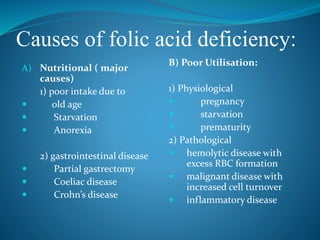
Causes of folic acid deficiency:
A) Nutritional ( major
causes)
1) poor intake due to
 old age
 Starvation
 Anorexia
2) gastrointestinal disease
 Partial gastrectomy
 Coeliac disease
 Crohn’s disease
B) Poor Utilisation:
1) Physiological
 pregnancy
 starvation
 prematurity
2) Pathological
 hemolytic disease with
excess RBC formation
 malignant disease with
increased cell turnover
 inflammatory disease
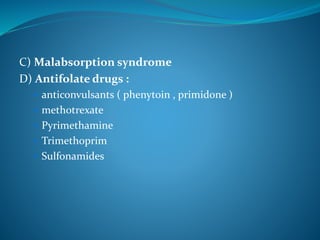
C) Malabsorption syndrome
D) Antifolate drugs :
 anticonvulsants ( phenytoin , primidone )
 methotrexate
 Pyrimethamine
 Trimethoprim
 Sulfonamides
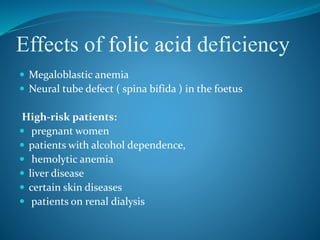
Effects of folic acid deficiency
 Megaloblastic anemia
 Neural tube defect ( spina bifida ) in the foetus
High-risk patients:
 pregnant women
 patients with alcohol dependence,
 hemolytic anemia
 liver disease
 certain skin diseases
 patients on renal dialysis
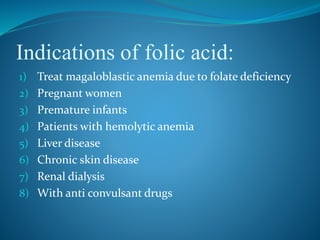
Indications of folic acid:
1) Treat magaloblastic anemia due to folate deficiency
2) Pregnant women
3) Premature infants
4) Patients with hemolytic anemia
5) Liver disease
6) Chronic skin disease
7) Renal dialysis
8) With anti convulsant drugs
 Folic acid in large amounts may counteract the
antiepileptic effect of phenobarbital, phenytoin, and
primidone, and increase the frequency of seizures in
susceptible children
Liquid oral preparations and injectables in combination form
Given im
Dose
Therapeutic : 2-5 mg / day
Prophylactic : 0.5 mg / day
Preparations and doses of folic acid :
Vit B12
 consists of a porphyrin-like ring with a central cobalt atom
attached to a nucleotide.
 Deoxyadenosylcobalamin and methylcobalamin are the active
forms
 The chief dietary source of vitamin B12 is microbially derived
vitamin B12 in meat (especially liver), eggs, and dairy
products
 extrinsic factor
Pharmacokinetics
 stored, primarily in the liver, with an average adult having a
total vitamin B12 storage pool of 3000–5000 mcg
 normal daily requirements of vitamin B12 are only about 2 mcg
 is absorbed only after it complexes with intrinsic factor, a
glycoprotein secreted by the parietal cells of the gastric mucosa
 the intrinsic factor-vitamin B12 complex is subsequently
absorbed in the distal ileum by a highly specific receptor-
mediated transport system.
 Nutritional deficiency is rare but may be seen in strict
vegetarians after many years without meat, eggs, or dairy
products.
 vitamin B12 is transported to the various cells of the body
bound to a plasma glycoprotein, transcobalamin II
 Stored in liver
 Excreted through urine
Indications of Vit B12
a) Megaloblastic anemia
b) Neurologic syndrome associated with cobalamin
deficiency
c) Pernicious anemia
 Vitamin B12 for parenteral injection is available as
cyanocobalamin or hydroxocobalamin
 Administered im
 Initial therapy should consist of 100–1000 mcg of
vitamin B12
 Maintenance therapy consists of 100–1000 mcg
intramuscularly once a month for life
 neurologic abnormalities are present, maintenance
therapy injections should be given every 1–2 weeks for
6 months before switching to monthly injections
 oral doses of 1000 mcg of vitamin B12 daily are usually
sufficient to treat patients with pernicious anemia
Dose:
 In india both oral and injectables vit B12 is available
mostly or combination preparation along with other
vitamines, with or without iron.
1.Treatment and prophylaxis of vitamin B12 deficiency
(megaloblastic anemia)
2. Vit B12 injection in pernicious anemia (condition where
Vit B12 is not absorbed from the stomach)
Uses of vitamin B12
THANK YOU

Hematinics

  • 1.
    Name: Jon JyotiSahariah B.Pharm 6th Sem Roll No: 05 Year: 2017 Department of Pharmaceutical Sciences Dibrugarh university
  • 2.
    General term forthose nutrients, including iron, folic acid, and vitamin B12, required for the formation and development of blood cells in bone marrow (the process of haematopoiesis), deficiency of which may result in anaemia. Treatment of anemia Increase the number of RBC or hemoglobin content of RBC or both when there is deficiency
  • 3.
  • 4.
    Aneamia  Not asingle disease  Results from a number of different pathologies  Defined as a reduction from the normal quantity of Hb in blood  WHO defines anemia as Hb levels less than 13 g/dl for males and less than 12 g/dl for females  Low Hb levels results in decreased oxygen carrying capacity of blood  Causes:  Blood loss  Impaired RBC functions due to deficiency
  • 5.
    Iron As HaematinicAgent  Hematopoiesis  The production of circulating erythrocytes, leukocytes and platelets from undifferentiated stem cells, is called hematopoiesis.  It requires:  Iron –for Hb formation
  • 6.
    Iron storage  Ironis the integral component of haemoglobin In our body:  66-67% of iron is present in hemoglobin.  3% occurs in myoglobin  1% in enzymes -cytochrome, catalase, peroxidase  25% is stored in form of ferritin and hemosiderin
  • 7.
    Pharmacokinetics : Absorption:  absorbs5–10% of iron ingested or about 0.5–1 mg daily.  normally absorbed in the duodenum and proximal jejunum.  absorption increases in response to low iron stores or increased iron requirements. STORAGE  primarily as ferritin, in macrophages in the liver, spleen, and bone, and in parenchymal liver cells. Apoferritin synthesis is regulated by the levels of free iron.  Ferritin is detectable in serum. Since the ferritin present in serum is in equilibrium with storage ferritin in reticuloendothelial tissues, the serum ferritin level can be used to estimate total body iron stores.
  • 8.
    Transport:  transported inthe plasma bound to transferrin, a -globulin that specifically binds two molecules of ferrous iron The transferrin-iron complex enters maturing erythroid cells by a specific receptor mechanism. Transferrin receptors internalize the transferrin-iron complex through the process of receptor-mediated endocytosis.  Increased erythropoiesis is associated with an increase in the number of transferrin receptors on developing erythroid cells. Iron store depletion and iron deficiency anemia are associated with an increased concentration of serum transferrin.
  • 9.
    ELIMINATION  Small amountsare lost in the feces by exfoliation of intestinal mucosal cells, and trace amounts are excreted in bile, urine, and sweat.
  • 10.
    Indications of oraliron therapy Prophylactic use : 1) pregnancy- from 4th month to lactation. 2) Menstruation 3) Infancy and childhood 4) Premature babies and babies weaned late 5) Professional blood donors
  • 11.
     Therapeutic use: 1) Iron deficiency anemia 2) Iron deficiency anemia due to: - menorrhagia - peptic ulcer - piles - hook worm infestation 3) Malabsorption syndrome 4) Anemia of pregnancy 5) Treatment of severe pernicious anemia
  • 12.
    Parenteral iron preparations: Iron dextran is a stable complex of ferric hydroxide and low-molecular-weight dextran containing 50 mg of elemental iron per milliliter of solution. It can be given by deep intramuscular injection or by intravenous infusion, although the intravenous route is used most commonly  Headache, light-headedness, fever, arthralgias, nausea and vomiting, back pain, flushing, urticaria, bronchospasm, and rarely, anaphylaxis and death.  Hypersensitivity reaction to the dextran component. Hypersensitivity reactions may be delayed for 48–72 hours after administration.  Anaphylactic reactions  Iron-sucrose complex and iron sodium gluconate complex only by the intravenous route.
  • 13.
     Sources : Yeast,liver, green vegetables, Fruits, nuts and cereals Daily requirements : Adult: 50 mcg / day Pregnant women : 100-200 mcg / day Lactating women : 100-200 mcg / day FOLIC ACID:
  • 14.
    Pharmacokinetics :  Route: oral , parenteral  Absorption: from proximal jejunum  Excretion: Folates are excreted in the urine and stool and are also destroyed by catabolism  folic acid deficiency and megaloblastic anemia can develop within 1–6 months after the intake of folic acid stops.
  • 15.
    Pharmacodynamics:  Functions : Tetrahydrofolatecofactors participate in one-carbon transfer reactions 1) DNA synthesis : cofactors for the synthesis of purines and pyrimidines 2) Synthesis of thymidylic acid : Enzyme thymidylate synthase catalyzes the transfer of the one-carbon unit.
  • 16.
    Causes of folicacid deficiency: A) Nutritional ( major causes) 1) poor intake due to  old age  Starvation  Anorexia 2) gastrointestinal disease  Partial gastrectomy  Coeliac disease  Crohn’s disease B) Poor Utilisation: 1) Physiological  pregnancy  starvation  prematurity 2) Pathological  hemolytic disease with excess RBC formation  malignant disease with increased cell turnover  inflammatory disease
  • 17.
    C) Malabsorption syndrome D)Antifolate drugs :  anticonvulsants ( phenytoin , primidone )  methotrexate  Pyrimethamine  Trimethoprim  Sulfonamides
  • 18.
    Effects of folicacid deficiency  Megaloblastic anemia  Neural tube defect ( spina bifida ) in the foetus High-risk patients:  pregnant women  patients with alcohol dependence,  hemolytic anemia  liver disease  certain skin diseases  patients on renal dialysis
  • 19.
    Indications of folicacid: 1) Treat magaloblastic anemia due to folate deficiency 2) Pregnant women 3) Premature infants 4) Patients with hemolytic anemia 5) Liver disease 6) Chronic skin disease 7) Renal dialysis 8) With anti convulsant drugs
  • 20.
     Folic acidin large amounts may counteract the antiepileptic effect of phenobarbital, phenytoin, and primidone, and increase the frequency of seizures in susceptible children
  • 21.
    Liquid oral preparationsand injectables in combination form Given im Dose Therapeutic : 2-5 mg / day Prophylactic : 0.5 mg / day Preparations and doses of folic acid :
  • 22.
    Vit B12  consistsof a porphyrin-like ring with a central cobalt atom attached to a nucleotide.  Deoxyadenosylcobalamin and methylcobalamin are the active forms  The chief dietary source of vitamin B12 is microbially derived vitamin B12 in meat (especially liver), eggs, and dairy products  extrinsic factor
  • 23.
    Pharmacokinetics  stored, primarilyin the liver, with an average adult having a total vitamin B12 storage pool of 3000–5000 mcg  normal daily requirements of vitamin B12 are only about 2 mcg  is absorbed only after it complexes with intrinsic factor, a glycoprotein secreted by the parietal cells of the gastric mucosa  the intrinsic factor-vitamin B12 complex is subsequently absorbed in the distal ileum by a highly specific receptor- mediated transport system.  Nutritional deficiency is rare but may be seen in strict vegetarians after many years without meat, eggs, or dairy products.  vitamin B12 is transported to the various cells of the body bound to a plasma glycoprotein, transcobalamin II  Stored in liver  Excreted through urine
  • 24.
    Indications of VitB12 a) Megaloblastic anemia b) Neurologic syndrome associated with cobalamin deficiency c) Pernicious anemia
  • 25.
     Vitamin B12for parenteral injection is available as cyanocobalamin or hydroxocobalamin  Administered im  Initial therapy should consist of 100–1000 mcg of vitamin B12  Maintenance therapy consists of 100–1000 mcg intramuscularly once a month for life  neurologic abnormalities are present, maintenance therapy injections should be given every 1–2 weeks for 6 months before switching to monthly injections  oral doses of 1000 mcg of vitamin B12 daily are usually sufficient to treat patients with pernicious anemia
  • 26.
    Dose:  In indiaboth oral and injectables vit B12 is available mostly or combination preparation along with other vitamines, with or without iron.
  • 27.
    1.Treatment and prophylaxisof vitamin B12 deficiency (megaloblastic anemia) 2. Vit B12 injection in pernicious anemia (condition where Vit B12 is not absorbed from the stomach) Uses of vitamin B12
  • 28.