Yenepoya Pharmacy College & Research Centre
Yenepoya (Deemed to be University), Deralakatte, Mangaluru
Haematinics
By
Tahreen Taj
Asst. Professor YPCRC
Objectives
Hematinics-Iron
VitaminB12
Folicacid
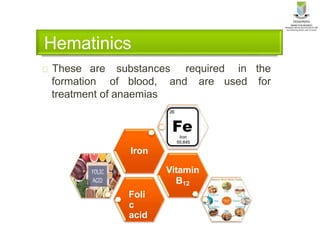
Hematinics
These are substances required in the
for
formation of blood, and are used
treatment of anaemias
Iron
Vitamin
B12
Foli
c
acid
Anemia
Anaemia is a condition of RBC/Hb
deficiency and occurs when there is an
imbalance between production and
destruction of RBC
Imbalance
RBC
production
RBC
destruction
Causes of Anemia
Blood loss (acute orchronic)
Impaired red cell formation dueto:
Deficiency of essential factors, i.e. iron, vit- B12,
FA.
Bone marrow depression (hypoplastic
anaemia), erythropoietin deficiency.
Increased destruction of RBCs(haemolytic
anaemia)
IRON
Essential body component
Normal range of Iron in adults is 2.5 – 5 g
It is present in following forms in the body
• 66
%
Hemoglobin
• 25
%
Ferritin and
Hemosiderin
• 3
%
Myoglobin
• 6%
• Cytochromes, catalases,xanthine
oxidases etc…
Parenchymal Iron
Hemoglobin = Heme + Globin
Dietary sources
Rich: Liver, egg yolk, oyster, dry beans, dry
fruits, wheat germ, yeast.
Medium: Meat, chicken, fish, spinach,
banana, apple
Poor: Milk products, rootvegetables
Pharmacokinetics of Iron
Ironabsorption
Factors affecting ionabsorption
Mucosalblock
Transport, utilization, storage andexcretion
Essentials of medical pharmacology by K.D.Tripati,
JAYPEE 2008
Iron absorption
Elsevier, kumar et al: Robins basic pathology
Factors affecting Iron absorption
Acid
Reducing substances
Meat
Factors Facilitating Factors Impending
Tea, coffee, antacids
Phosphates
Phytates
Tetracyclins
Presence of food
Transport & Utilization
Fe 2+ transported to blood is oxidized toFe3+
It complexes with Transferrin (Tf) inplasma
Fe-Tf-Fe complex enters RBC through
transferrin receptors (TfR) by endocytosis
Iron dissociates at acidic pH and will be
utilized to form Hb.
Storage
Stored in RE cells of liver, spleen, bone marrow,
hepatocytes and myocytes
by iron status in
Apoferritin synthesis is regulated
the body
Fe Less- less Af, more Tf
Fe More – More Af
Excretion
0.5 – 1 mg per day
Highly conserved
Excreted by shedding of mucosal cells, bile,
desquamatted skin, urine and sweat
Menstruation
Iron formulations
Oral
Parenteral
Iron oral formulations
Preferred route
Ferrous salts preferred- cheap, high iron content,
better absorption
Preparations
1. Ferrous sulfate(20-32 %): cheapest. It often leaves a
metallic taste in mouth- 200mg tab
2. Ferrous gluconate (12% iron): 300 mg tab
3. Ferrous fumarate (33% iron): is less water soluble than
ferrous sulfate and tasteless; 200 mg tab
4. Colloidal ferric hydroxide; 50 mg/ml drops
Indications of Oral Iron therapy
Prophylactic use:
Pregnancy from 4th month to lactation
Menstruation
Infancy andchildhood
Prematurebabies
Professional blooddonors
Therapeutic use
Iron deficiency anemia (due
to menorrhagia, peptic
ulcer, piles, hookworm
infection)
Mal-absorption syndrome
Anemia of pregnancy
Severe pernecious
anemia
Adverse effects
pain,
vomiting,
Epigastric
nausea,
heart pain
Bloating, staining of
teeth, metallic taste
is more
than
Constipation
common
diarrhoea
Acute Iron Poisoning
• It occurs mostly in infants and children
• 10-20mg tablets or equivalent of the liquid preparation (>
60 mg/kg iron) may cause serious toxicity
• It is very rare in adults.
• Manifestations - vomiting, abdominal pain, diarrhoea,
dehydration, acidosis, convulsions.
Treatment for Acute Iron Poisoning
• It should be prompt.
• To prevent further absorption of iron from gut
a) Induce vomiting or perform gastric lavage with sodium
bicarbonate.
b) Give egg yolk and milk orally: to complex iron. Activated
charcoal does not adsorb iron.
• To bind and remove iron already absorbed
Desferrioxamine, Alternatively DTPA or calcium edetate
• Supportive measures:
• Fluid and electrolyte balance should be maintained
Respiration and BP may need support.
• Diazepam i.v. should be cautiously used to control
convulsions, if they occur.
Maturation factors
Vitamin – B12
Folic acid
Vitamin-B12 (COBALAMIN)
• Complex cobalt containing compounds
• Synthesized from microorganisms
• Dietary sources- liver, kidney, seafish, egg yolk,
meat
• Vegetables and fruits lack cobalamin
• Daily requirement: 1-2ug, pregnancy and
lactation-3-5
• ug/day
Metabolic functions of Vit-B12
Conversion of homocystein to methionine
Propionic acid metabolism (Succinic acid
producion)
Fattyacid synthesis (phospholipids and
myelin) in neural tissue
Required for cell growth and multiplication
Folate metabolism
Pharmacokinetics
Absorption: Present in food conjugate and will be released
during cooking and forms complex with intrinsic factor and will
absorbed into the intestine actively
Transportation: Transcobalamin II
Storage: liver
Degradation: not degraded in the body. Excreted through
bile
Vit – B12
Deficiency
Megaloblastic anemia
Gastric mucosal
damage
Degeneration of spinal
cord
Peripheral neuritis
Poor memory, mood
changes
Preparations
Cyanocobalamine
injection
Hydroxocobalamin
injection
Methylcobalamin
tablets
Uses
Vit B12 deficiency
Prophylactically in
diabetes and
alcoholics
Neuropathies,
psychiatric disorders
Tobacco amblyopia
Adverse effects
Safe
Allergicreactions
due to
contaminants
Folic acid
Contain 2-8 molecules of glutamicacid
Humans
obtained
do not synthesize FA but
from green leafy vegeables,
milk, meat and egg
Synthesized by gutflora
Metabolic functions of FA
FA DHFA THFA
Conversion of homocystein tomethionine
Conversion of serine toglycine
Purinesynthesis
Synthesis ofthymidylate
Histidinemetabolism
Pharmacokinetics of FA
Route: oral, parenteral
Absorption: from proximaljejunum
Excretion: urine andstool
Uses
Megaloblastic anemia
Pregnant women
Premature infants
Hemolytic anemia
Liver disease
Renal dialysis
Methotrexate toxicity
Megaloblastic anemia
Neural tubedefect
Allergicreactions due to
contaminants
Deficiency of FA
It regulates red blood cell proliferation
and differentiation in bone marrow

1. Hematinics.pptx

  • 1.
    Yenepoya Pharmacy College& Research Centre Yenepoya (Deemed to be University), Deralakatte, Mangaluru Haematinics By Tahreen Taj Asst. Professor YPCRC
  • 2.
  • 3.
    Hematinics These are substancesrequired in the for formation of blood, and are used treatment of anaemias Iron Vitamin B12 Foli c acid
  • 4.
    Anemia Anaemia is acondition of RBC/Hb deficiency and occurs when there is an imbalance between production and destruction of RBC
  • 5.
  • 6.
    Causes of Anemia Bloodloss (acute orchronic) Impaired red cell formation dueto: Deficiency of essential factors, i.e. iron, vit- B12, FA. Bone marrow depression (hypoplastic anaemia), erythropoietin deficiency. Increased destruction of RBCs(haemolytic anaemia)
  • 7.
    IRON Essential body component Normalrange of Iron in adults is 2.5 – 5 g It is present in following forms in the body • 66 % Hemoglobin • 25 % Ferritin and Hemosiderin • 3 % Myoglobin • 6% • Cytochromes, catalases,xanthine oxidases etc… Parenchymal Iron
  • 8.
  • 9.
    Dietary sources Rich: Liver,egg yolk, oyster, dry beans, dry fruits, wheat germ, yeast. Medium: Meat, chicken, fish, spinach, banana, apple Poor: Milk products, rootvegetables
  • 10.
    Pharmacokinetics of Iron Ironabsorption Factorsaffecting ionabsorption Mucosalblock Transport, utilization, storage andexcretion
  • 11.
    Essentials of medicalpharmacology by K.D.Tripati, JAYPEE 2008
  • 12.
    Iron absorption Elsevier, kumaret al: Robins basic pathology
  • 13.
    Factors affecting Ironabsorption Acid Reducing substances Meat Factors Facilitating Factors Impending Tea, coffee, antacids Phosphates Phytates Tetracyclins Presence of food
  • 14.
    Transport & Utilization Fe2+ transported to blood is oxidized toFe3+ It complexes with Transferrin (Tf) inplasma Fe-Tf-Fe complex enters RBC through transferrin receptors (TfR) by endocytosis Iron dissociates at acidic pH and will be utilized to form Hb.
  • 15.
    Storage Stored in REcells of liver, spleen, bone marrow, hepatocytes and myocytes by iron status in Apoferritin synthesis is regulated the body Fe Less- less Af, more Tf Fe More – More Af Excretion 0.5 – 1 mg per day Highly conserved Excreted by shedding of mucosal cells, bile, desquamatted skin, urine and sweat Menstruation
  • 16.
  • 17.
    Iron oral formulations Preferredroute Ferrous salts preferred- cheap, high iron content, better absorption Preparations 1. Ferrous sulfate(20-32 %): cheapest. It often leaves a metallic taste in mouth- 200mg tab 2. Ferrous gluconate (12% iron): 300 mg tab 3. Ferrous fumarate (33% iron): is less water soluble than ferrous sulfate and tasteless; 200 mg tab 4. Colloidal ferric hydroxide; 50 mg/ml drops
  • 18.
    Indications of OralIron therapy Prophylactic use: Pregnancy from 4th month to lactation Menstruation Infancy andchildhood Prematurebabies Professional blooddonors
  • 19.
    Therapeutic use Iron deficiencyanemia (due to menorrhagia, peptic ulcer, piles, hookworm infection) Mal-absorption syndrome Anemia of pregnancy Severe pernecious anemia Adverse effects pain, vomiting, Epigastric nausea, heart pain Bloating, staining of teeth, metallic taste is more than Constipation common diarrhoea
  • 20.
    Acute Iron Poisoning •It occurs mostly in infants and children • 10-20mg tablets or equivalent of the liquid preparation (> 60 mg/kg iron) may cause serious toxicity • It is very rare in adults. • Manifestations - vomiting, abdominal pain, diarrhoea, dehydration, acidosis, convulsions.
  • 21.
    Treatment for AcuteIron Poisoning • It should be prompt. • To prevent further absorption of iron from gut a) Induce vomiting or perform gastric lavage with sodium bicarbonate. b) Give egg yolk and milk orally: to complex iron. Activated charcoal does not adsorb iron. • To bind and remove iron already absorbed Desferrioxamine, Alternatively DTPA or calcium edetate • Supportive measures: • Fluid and electrolyte balance should be maintained Respiration and BP may need support. • Diazepam i.v. should be cautiously used to control convulsions, if they occur.
  • 23.
  • 25.
    Vitamin-B12 (COBALAMIN) • Complexcobalt containing compounds • Synthesized from microorganisms • Dietary sources- liver, kidney, seafish, egg yolk, meat • Vegetables and fruits lack cobalamin • Daily requirement: 1-2ug, pregnancy and lactation-3-5 • ug/day
  • 26.
    Metabolic functions ofVit-B12 Conversion of homocystein to methionine Propionic acid metabolism (Succinic acid producion) Fattyacid synthesis (phospholipids and myelin) in neural tissue Required for cell growth and multiplication Folate metabolism
  • 27.
    Pharmacokinetics Absorption: Present infood conjugate and will be released during cooking and forms complex with intrinsic factor and will absorbed into the intestine actively Transportation: Transcobalamin II Storage: liver Degradation: not degraded in the body. Excreted through bile
  • 28.
    Vit – B12 Deficiency Megaloblasticanemia Gastric mucosal damage Degeneration of spinal cord Peripheral neuritis Poor memory, mood changes Preparations Cyanocobalamine injection Hydroxocobalamin injection Methylcobalamin tablets
  • 29.
    Uses Vit B12 deficiency Prophylacticallyin diabetes and alcoholics Neuropathies, psychiatric disorders Tobacco amblyopia Adverse effects Safe Allergicreactions due to contaminants
  • 30.
    Folic acid Contain 2-8molecules of glutamicacid Humans obtained do not synthesize FA but from green leafy vegeables, milk, meat and egg Synthesized by gutflora
  • 31.
    Metabolic functions ofFA FA DHFA THFA Conversion of homocystein tomethionine Conversion of serine toglycine Purinesynthesis Synthesis ofthymidylate Histidinemetabolism
  • 32.
    Pharmacokinetics of FA Route:oral, parenteral Absorption: from proximaljejunum Excretion: urine andstool
  • 33.
    Uses Megaloblastic anemia Pregnant women Prematureinfants Hemolytic anemia Liver disease Renal dialysis Methotrexate toxicity Megaloblastic anemia Neural tubedefect Allergicreactions due to contaminants Deficiency of FA
  • 34.
    It regulates redblood cell proliferation and differentiation in bone marrow