
Gynecologic Disorders
for Board Review
Jennifer H. Horan, DO PGY-4

Emergency Medicine
Arrowhead Regional Medical Center
Gynecology


Cervix



◦ Cervicitis
◦ Tumors




◦
◦
◦
◦

Vagina
◦
◦
◦
◦

Bartholin’s Abscess
Foreign Body
Vaginitis
Vulvovaginitis

Dysfunctional Bleeding
Endometriosis
Prolapse
Tumors
 GTD
 Leiomyoma



Infections
◦ PID
◦ Fitz-Hugh-Curtis
◦ Tubo-ovarian Abscess

Ovary
◦ Torsion
◦ Tumors

Uterus



Lesions
◦ HSV
◦ HPV
Ovary


Ovarian Cysts
◦ Most frequently seen in reproductive
years
◦ Follicular Cyst - MC
 1st 2 weeks of cycle
 Thin-walled, fluid filled

◦ Corpus Luteal Cyst
 Last 2 weeks of cycle
 More likely to hemorrhage

◦ Clinical Presentation: Pelvic Pain
(generalized, dull)
Ovarian Cysts
Exclude pregnancy
Check Hemoglobin (in case hemorrhagic
cyst)
 Dx: ultrasound
 Tx: symptomatic treatment &
out-patient follow-up
 D/C: torsion precautions





Cyst is considered large if >3 cm
(increased risk for torsion)
Ovary


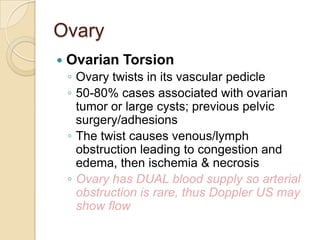
Ovarian Torsion
◦ Ovary twists in its vascular pedicle
◦ 50-80% cases associated with ovarian
tumor or large cysts; previous pelvic
surgery/adhesions
◦ The twist causes venous/lymph
obstruction leading to congestion and
edema, then ischemia & necrosis
◦ Ovary has DUAL blood supply so arterial
obstruction is rare, thus Doppler US may
show flow
Ovarian Torsion
Sxs: unilateral severe pain, nausea,
NO fever
 Risk factors


◦ Hx cyst, assisted reproductive therapy

Presentation atypical
 Exam: unilateral tenderness
 Labs NOT helpful
 Dx: Doppler ultrasound; laparoscopy
(gold standard)

Ovary


Ovarian Cancer

◦ Peak age 55-65
◦ Affects 1 in 70 women
◦ Disease is often advanced at time of
diagnosis
 50% mortality

◦ Risk Factors:

 FMH ovarian, breast or colon ca
 Infertility, low parity, high-fat diet, lactose
intolerance

◦ Sxs: subacute abdominal pain, bloating,
weight loss/gain, ascites, pleural effusion
◦ Dx: US and CT Scan, CA-125
◦ Tx: surgery, chemotherapy, and/or radiation
Cervix


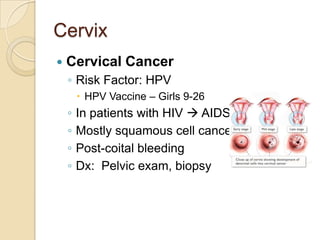
Cervical Cancer
◦ Risk Factor: HPV
 HPV Vaccine – Girls 9-26

◦
◦
◦
◦

In patients with HIV  AIDS
Mostly squamous cell cancers
Post-coital bleeding
Dx: Pelvic exam, biopsy
Cervix


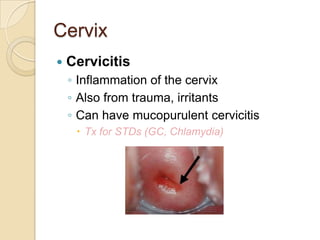
Cervicitis
◦ Inflammation of the cervix
◦ Also from trauma, irritants
◦ Can have mucopurulent cervicitis
 Tx for STDs (GC, Chlamydia)
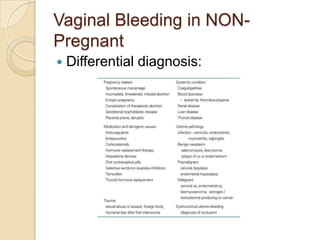
Vaginal Bleeding in NONPregnant


Differential diagnosis:
Vaginal Bleeding in NONPregnant


DUB mcc abnormal vaginal bleeding in
reproductive women
◦ MC adolescence or perimenopausal



Anovulatory bleeding – failure of
corpus luteal cyst formation
◦ Tx: OCPs, D&C, NSAIDs for pain



Ovulatory Bleeding – 10%, less
understood
◦ Bleeding disorder, medications



Sever bleeding – CBC,
transfusion/resuscitation, and consider
(IV) Premarin
Uterus


Endometriosis
◦ Endometrial tissue outside of the uterus
◦ 6-8% of women
◦ Ovaries (MC) (aka chocolate cyst),
fallopian tubes, abdomen, bladder,
lung (catamenial pneumothorax)
◦ Menses-related abdominal pain
◦ Infertility, chronic pelvic pain
◦ Tx: pain management, hormonal therapy,
surgical management
Uterus


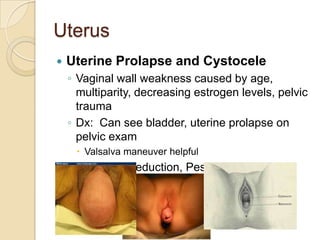
Uterine Prolapse and Cystocele
◦ Vaginal wall weakness caused by age,
multiparity, decreasing estrogen levels, pelvic
trauma
◦ Dx: Can see bladder, uterine prolapse on
pelvic exam
 Valsalva maneuver helpful

◦ Tx: digital reduction, Pessary, surgery
Uterus


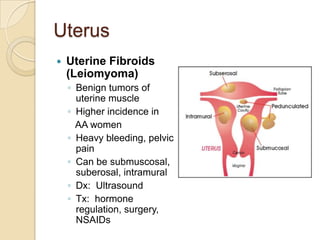
Uterine Fibroids
(Leiomyoma)
◦ Benign tumors of
uterine muscle
◦ Higher incidence in
AA women
◦ Heavy bleeding, pelvic
pain
◦ Can be submuscosal,
suberosal, intramural
◦ Dx: Ultrasound
◦ Tx: hormone
regulation, surgery,
NSAIDs
Uterus


Uterine Cancer

◦ MC GYN malignancy, specifically
endometrial
◦ Risk Factors:
 Early menses, late menopause, nulliparity
 Unopposed estrogen use
 DM, HTN, obesity

◦ Sxs: post-menopausal bleeding
◦ Dx: biopsy, D&C, Hysteroscopy
◦ Tx: surgery, chemotherapy, and/or radiation
◦ *Vaginal bleeding in a postmenopausal
woman is (endometrial) cancer until proven
otherwise*
While we are in the pelvis…


Pelvic Inflammatory Disease (PID)
◦
◦
◦
◦



Polymicrobial
Complications: infertility, ectopic pregnancy
Clinical Dx – CMT (Chandelier Sign)
Admit: pregnant, oral intolerance, TOA

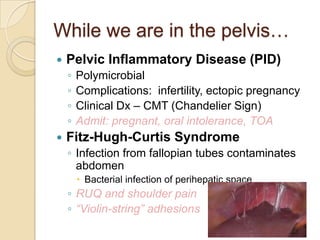
Fitz-Hugh-Curtis Syndrome
◦ Infection from fallopian tubes contaminates
abdomen
 Bacterial infection of perihepatic space

◦ RUQ and shoulder pain
◦ “Violin-string” adhesions
Vagina


Vulvovagintis
◦ Vaginal discharge, itching
◦ Causes:
 Infection, allergic reaction, foreign body,
irritant/chemical
 Atrophic Vaginitis
 Post-menopausal secondary to estrogen deficiency
 Tx: topical or oral estrogen replacement therapy

◦ MC problem in children
◦ Normal vaginal pH 4.0-4.5
◦ Any condition changing the vaginal pH
Vagina


Bacterial Vaginosis
◦ MCC of abnormal vaginal discharge
◦ Gardnerella/anerobes take over normal flora
◦ Dx: Amsel Criteria (3 of 4)





Copious think white discharge
pH >4.5
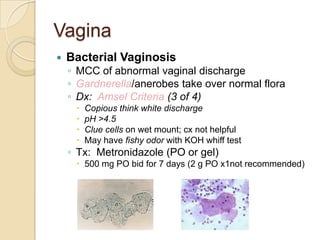
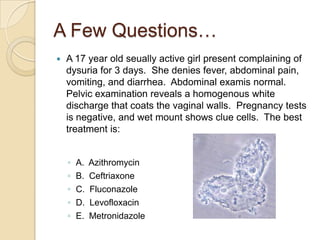
Clue cells on wet mount; cx not helpful
May have fishy odor with KOH whiff test

◦ Tx: Metronidazole (PO or gel)

 500 mg PO bid for 7 days (2 g PO x1not recommended)
Vagina


Candidal Vaginitis

◦ Candida Albicans is part of normal flora
◦
◦
◦
◦

 Overgrows

Associated with DM, abx, pregnancy
Sxs: vulvar pruritis (MC)
Exam: vulvar erythema
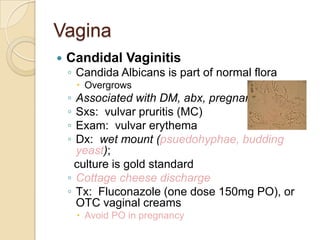
Dx: wet mount (psuedohyphae, budding
yeast);
culture is gold standard
◦ Cottage cheese discharge
◦ Tx: Fluconazole (one dose 150mg PO), or
OTC vaginal creams
 Avoid PO in pregnancy
Vagina


Vaginitis
◦ Trichimoniasis
 Protozoa
 Sxs: yellow-green, frothy, malodorous
discharge
 Exam: strawberry cervix
 Dx: wet mount
 Tx: Metronidazole PO
Vagina


Bartholin’s Cyst
◦ Bartholin’s glands are normal
 Located inferiorly at vaginal introitus

◦ Cyst (painless), abscess (painful)
◦ Abscess: polymicrobial
 Staph, Strep, E.Coli, or STD

◦ Tx: I&D, Word Catheter, Abx
◦ Definitive Tx: Marsupialization
Uterus


Gestational Trophoblastic Disease
◦ Tumors formed form abnormal placental cells that implant and
proliferate within the uterus
◦ Choriocarcinoma
◦ Hydatidaform Mole – molar pregnancies
 Complete
 MC
 Develops from 1 (duplicates) or 2 sperm fertilizing an empty egg
 46XX or 46XY karyotype
 Lacks a fetus
 Uterus LARGER than dates
 „grapelike vesicles‟ „snowstorm‟ on US with empty egg
 20% malignant

 Partial
 2 sperm fertilize a normal egg
 69XXX or 69XXY
 Fetus present
 Uterus SMALLER than dates
 Non-viable fetus AND normal &vesicular chorionic villi
 5% to malignancy
GTDs


Hydatidaform Mole
◦ Sxs:






Painless, abnormal vaginal bleeding
Uterine size greater than normal
Hyperemesis gravidarum (hCG levels >100k)
Symptoms of hyperthyroid
Early preeclampsia

◦ Tx: depends on type/pathology
 More benign (80%)or slow growing – D&C,
chemotherapy
 Malignant (2% choriocarcinoma), metastatic tumors –
chemo/XRT/surgery

◦ Often fertility can be maintained
 Monitor hCG levels after evacuation
A Few Questions…


A 17 year old seually active girl present complaining of
dysuria for 3 days. She denies fever, abdominal pain,
vomiting, and diarrhea. Abdominal examis normal.
Pelvic examination reveals a homogenous white
discharge that coats the vaginal walls. Pregnancy tests
is negative, and wet mount shows clue cells. The best
treatment is:
◦
◦
◦
◦
◦

A.
B.
C.
D.
E.

Azithromycin
Ceftriaxone
Fluconazole
Levofloxacin
Metronidazole
A Few Questions…


A 17 year old seually active girl present complaining of
dysuria for 3 days. She denies fever, abdominal pain,
vomiting, and diarrhea. Abdominal examis normal. Pelvic
examination reveals a homogenous white discharge that
coats the vaginal walls. Pregnancy tests is negative, and wet
mount shows clue cells. The best treatment is:

◦
◦
◦
◦
◦

A.
B.
C.
D.
E.

Azithromycin
Ceftriaxone
Fluconazole
Levofloxacin
Metronidazole


A 23 year old woman presents complaining of lower
abdominal pain. Pelvic examination reveals yellow vaginal
discharge, as well as moderate cervical motion tenderness.
Adnexa are tender, but no masses are present. Outpatient
management may be considered if the patient has:
◦
◦
◦
◦
◦

A.
B.
C.
D.
E.

A physician who can provide follow-up
Pelvic Abscess
Positive pregnancy test result
Taken antibiotics already for similar complaints
Temperature >38.8C (>102F)


A 23 year old woman presents complaining of lower
abdominal pain. Pelvic examination reveals yellow vaginal
discharge, as well as moderate cervical motion tenderness.
Adnexa are tender, but no masses are present. Outpatient
management may be considered if the patient has:
◦
◦
◦
◦
◦

A.
B.
C.
D.
E.

A physician who can provide follow-up
Pelvic Abscess
Positive pregnancy test result
Taken antibiotics already for similar complaints
Temperature >38.8C (>102F)


A 25 year old female presents to the ER with left lower
quadrant pain, nausea and vomiting for 6 hours. Her last
menstrual period ended 10 days ago, She is afebrile, and
CBC and chemistry are grossly normal. Her pregnancy test
is negative. Ultrasound reveals multiple small cysts
throughout both ovaries consistent with PCOS, the largest of
which is on the left ovary and measures 2.5 cm. What is the
most likely diagnosis?
◦
◦
◦
◦

A.
B.
C.
D.

Arterial blood supply obstruction
Ectopic pregnancy
Follicular rupture
Venous blood supply obstruction


A 25 year old female presents to the ER with left lower
quadrant pain, nausea and vomiting for 6 hours. Her last
menstrual period ended 10 days ago, She is afebrile, and
CBC and chemistry are grossly normal. Her pregnancy test
is negative. Ultrasound reveals multiple small cysts
throughout both ovaries consistent with PCOS, the largest of
which is on the left ovary and measures 2.5 cm. What is the
most likely diagnosis?
◦
◦
◦
◦

A.
B.
C.
D.

Arterial blood supply obstruction
Ectopic pregnancy
Follicular rupture
Venous blood supply obstruction


A 65 year old female presents to the ER with a chief
complaint of vaginal bleeding for 5 days. She is using about
2 pads per day. Prior to this episode, she has not had a
menstrual period for 9 years. She has no PMH, and her only
medications include hormone replacement therapy. Vital
signs are normal and Hgb is 12.5. Pelvic exam reveals a
small amount of blood in the vaginal vault, but no lesions,
CMT, or adnexal tenderness. What is the most likely cause of
this patient’s vaginal bleeding?
◦
◦
◦
◦

A.
B.
C.
D.

Atrophic vaginitis
Estrogen deficiency
Endometrial neoplasm
Hormonal supplementation


A 65 year old female presents to the ER with a chief
complaint of vaginal bleeding for 5 days. She is using about
2 pads per day. Prior to this episode, she has not had a
menstrual period for 9 years. She has no PMH, and her only
medications include hormone replacement therapy. Vital
signs are normal and Hgb is 12.5. Pelvic exam reveals a
small amount of blood in the vaginal vault, but no lesions,
CMT, or adnexal tenderness. What is the most likely cause of
this patient’s vaginal bleeding?
◦
◦
◦
◦

A.
B.
C.
D.

Atrophic vaginitis
Estrogen deficiency
Endometrial neoplasm
Hormonal supplementation


A 23 year old G1P0 woman 7 weeks pregnant by dates, was
discharged form another ED 3 weeks ago with a diagnosis of
‘threatened abortion’ and was given instructions for pelvic
rest. She presents today for persistent vaginal bleeding and
sever nausea and vomiting. She has not passed any tissue.
Urine pregnancy test is positive. The top of the uterus is felt
halfway between the umbilicus and pubic bone. You
repeated the transvaginal ultrasound today, with the finding
below. What is the clinical suspicion at this time?
◦
◦
◦
◦

A.
B.
C.
D.

Choriocarcinoma
Hydatdiform mole, complete
Hydatidiform mole, incomplete
Incomplete abortion


A 23 year old G1P0 woman 7 weeks pregnant by dates, was
discharged form another ED 3 weeks ago with a diagnosis of
‘threatened abortion’ and was given instructions for pelvic
rest. She presents today for persistent vaginal bleeding and
sever nausea and vomiting. She has not passed any tissue.
Urine pregnancy test is positive. The top of the uterus is felt
halfway between the umbilicus and pubic bone. You
repeated the transvaginal ultrasound today, with the finding
below. What is the clinical suspicion at this time?
◦
◦
◦
◦

A.
B.
C.
D.

Choriocarcinoma
Hydatdiform mole, complete
Hydatidiform mole, incomplete
Incomplete abortion
References


HippoEM.com



Naderi, Sassan. Intensive Review for Emergency Medicine Qualifying
Examination. McGraw-Hill Companies. New York. 2010



Tintinalli MD, Judith E. Tintinalli’s Emergency Medicine: A Comprehensive
Study Guide. 7th Edition. McGraw-Hill Companies. New York. 2011.



Wagner MD, Mary Jo. Peer VII. ACEP. Dallas, Texas. 2006.
Jennifer H. Horan, DO- Gynecologic Disorders Board Review 2014 - ARMC Emergency Medicine

Jennifer H. Horan, DO- Gynecologic Disorders Board Review 2014 - ARMC Emergency Medicine

  • 1.
    Gynecologic Disorders for BoardReview Jennifer H. Horan, DO PGY-4 Emergency Medicine Arrowhead Regional Medical Center
  • 2.
    Gynecology  Cervix  ◦ Cervicitis ◦ Tumors   ◦ ◦ ◦ ◦ Vagina ◦ ◦ ◦ ◦ Bartholin’sAbscess Foreign Body Vaginitis Vulvovaginitis Dysfunctional Bleeding Endometriosis Prolapse Tumors  GTD  Leiomyoma  Infections ◦ PID ◦ Fitz-Hugh-Curtis ◦ Tubo-ovarian Abscess Ovary ◦ Torsion ◦ Tumors Uterus  Lesions ◦ HSV ◦ HPV
  • 3.
    Ovary  Ovarian Cysts ◦ Mostfrequently seen in reproductive years ◦ Follicular Cyst - MC  1st 2 weeks of cycle  Thin-walled, fluid filled ◦ Corpus Luteal Cyst  Last 2 weeks of cycle  More likely to hemorrhage ◦ Clinical Presentation: Pelvic Pain (generalized, dull)
  • 4.
    Ovarian Cysts Exclude pregnancy CheckHemoglobin (in case hemorrhagic cyst)  Dx: ultrasound  Tx: symptomatic treatment & out-patient follow-up  D/C: torsion precautions    Cyst is considered large if >3 cm (increased risk for torsion)
  • 5.
    Ovary  Ovarian Torsion ◦ Ovarytwists in its vascular pedicle ◦ 50-80% cases associated with ovarian tumor or large cysts; previous pelvic surgery/adhesions ◦ The twist causes venous/lymph obstruction leading to congestion and edema, then ischemia & necrosis ◦ Ovary has DUAL blood supply so arterial obstruction is rare, thus Doppler US may show flow
  • 6.
    Ovarian Torsion Sxs: unilateralsevere pain, nausea, NO fever  Risk factors  ◦ Hx cyst, assisted reproductive therapy Presentation atypical  Exam: unilateral tenderness  Labs NOT helpful  Dx: Doppler ultrasound; laparoscopy (gold standard) 
  • 7.
    Ovary  Ovarian Cancer ◦ Peakage 55-65 ◦ Affects 1 in 70 women ◦ Disease is often advanced at time of diagnosis  50% mortality ◦ Risk Factors:  FMH ovarian, breast or colon ca  Infertility, low parity, high-fat diet, lactose intolerance ◦ Sxs: subacute abdominal pain, bloating, weight loss/gain, ascites, pleural effusion ◦ Dx: US and CT Scan, CA-125 ◦ Tx: surgery, chemotherapy, and/or radiation
  • 8.
    Cervix  Cervical Cancer ◦ RiskFactor: HPV  HPV Vaccine – Girls 9-26 ◦ ◦ ◦ ◦ In patients with HIV  AIDS Mostly squamous cell cancers Post-coital bleeding Dx: Pelvic exam, biopsy
  • 9.
    Cervix  Cervicitis ◦ Inflammation ofthe cervix ◦ Also from trauma, irritants ◦ Can have mucopurulent cervicitis  Tx for STDs (GC, Chlamydia)
  • 10.
    Vaginal Bleeding inNONPregnant  Differential diagnosis:
  • 11.
    Vaginal Bleeding inNONPregnant  DUB mcc abnormal vaginal bleeding in reproductive women ◦ MC adolescence or perimenopausal  Anovulatory bleeding – failure of corpus luteal cyst formation ◦ Tx: OCPs, D&C, NSAIDs for pain  Ovulatory Bleeding – 10%, less understood ◦ Bleeding disorder, medications  Sever bleeding – CBC, transfusion/resuscitation, and consider (IV) Premarin
  • 12.
    Uterus  Endometriosis ◦ Endometrial tissueoutside of the uterus ◦ 6-8% of women ◦ Ovaries (MC) (aka chocolate cyst), fallopian tubes, abdomen, bladder, lung (catamenial pneumothorax) ◦ Menses-related abdominal pain ◦ Infertility, chronic pelvic pain ◦ Tx: pain management, hormonal therapy, surgical management
  • 13.
    Uterus  Uterine Prolapse andCystocele ◦ Vaginal wall weakness caused by age, multiparity, decreasing estrogen levels, pelvic trauma ◦ Dx: Can see bladder, uterine prolapse on pelvic exam  Valsalva maneuver helpful ◦ Tx: digital reduction, Pessary, surgery
  • 14.
    Uterus  Uterine Fibroids (Leiomyoma) ◦ Benigntumors of uterine muscle ◦ Higher incidence in AA women ◦ Heavy bleeding, pelvic pain ◦ Can be submuscosal, suberosal, intramural ◦ Dx: Ultrasound ◦ Tx: hormone regulation, surgery, NSAIDs
  • 15.
    Uterus  Uterine Cancer ◦ MCGYN malignancy, specifically endometrial ◦ Risk Factors:  Early menses, late menopause, nulliparity  Unopposed estrogen use  DM, HTN, obesity ◦ Sxs: post-menopausal bleeding ◦ Dx: biopsy, D&C, Hysteroscopy ◦ Tx: surgery, chemotherapy, and/or radiation ◦ *Vaginal bleeding in a postmenopausal woman is (endometrial) cancer until proven otherwise*
  • 16.
    While we arein the pelvis…  Pelvic Inflammatory Disease (PID) ◦ ◦ ◦ ◦  Polymicrobial Complications: infertility, ectopic pregnancy Clinical Dx – CMT (Chandelier Sign) Admit: pregnant, oral intolerance, TOA Fitz-Hugh-Curtis Syndrome ◦ Infection from fallopian tubes contaminates abdomen  Bacterial infection of perihepatic space ◦ RUQ and shoulder pain ◦ “Violin-string” adhesions
  • 17.
    Vagina  Vulvovagintis ◦ Vaginal discharge,itching ◦ Causes:  Infection, allergic reaction, foreign body, irritant/chemical  Atrophic Vaginitis  Post-menopausal secondary to estrogen deficiency  Tx: topical or oral estrogen replacement therapy ◦ MC problem in children ◦ Normal vaginal pH 4.0-4.5 ◦ Any condition changing the vaginal pH
  • 18.
    Vagina  Bacterial Vaginosis ◦ MCCof abnormal vaginal discharge ◦ Gardnerella/anerobes take over normal flora ◦ Dx: Amsel Criteria (3 of 4)     Copious think white discharge pH >4.5 Clue cells on wet mount; cx not helpful May have fishy odor with KOH whiff test ◦ Tx: Metronidazole (PO or gel)  500 mg PO bid for 7 days (2 g PO x1not recommended)
  • 19.
    Vagina  Candidal Vaginitis ◦ CandidaAlbicans is part of normal flora ◦ ◦ ◦ ◦  Overgrows Associated with DM, abx, pregnancy Sxs: vulvar pruritis (MC) Exam: vulvar erythema Dx: wet mount (psuedohyphae, budding yeast); culture is gold standard ◦ Cottage cheese discharge ◦ Tx: Fluconazole (one dose 150mg PO), or OTC vaginal creams  Avoid PO in pregnancy
  • 20.
    Vagina  Vaginitis ◦ Trichimoniasis  Protozoa Sxs: yellow-green, frothy, malodorous discharge  Exam: strawberry cervix  Dx: wet mount  Tx: Metronidazole PO
  • 21.
    Vagina  Bartholin’s Cyst ◦ Bartholin’sglands are normal  Located inferiorly at vaginal introitus ◦ Cyst (painless), abscess (painful) ◦ Abscess: polymicrobial  Staph, Strep, E.Coli, or STD ◦ Tx: I&D, Word Catheter, Abx ◦ Definitive Tx: Marsupialization
  • 22.
    Uterus  Gestational Trophoblastic Disease ◦Tumors formed form abnormal placental cells that implant and proliferate within the uterus ◦ Choriocarcinoma ◦ Hydatidaform Mole – molar pregnancies  Complete  MC  Develops from 1 (duplicates) or 2 sperm fertilizing an empty egg  46XX or 46XY karyotype  Lacks a fetus  Uterus LARGER than dates  „grapelike vesicles‟ „snowstorm‟ on US with empty egg  20% malignant  Partial  2 sperm fertilize a normal egg  69XXX or 69XXY  Fetus present  Uterus SMALLER than dates  Non-viable fetus AND normal &vesicular chorionic villi  5% to malignancy
  • 23.
    GTDs  Hydatidaform Mole ◦ Sxs:      Painless,abnormal vaginal bleeding Uterine size greater than normal Hyperemesis gravidarum (hCG levels >100k) Symptoms of hyperthyroid Early preeclampsia ◦ Tx: depends on type/pathology  More benign (80%)or slow growing – D&C, chemotherapy  Malignant (2% choriocarcinoma), metastatic tumors – chemo/XRT/surgery ◦ Often fertility can be maintained  Monitor hCG levels after evacuation
  • 24.
    A Few Questions…  A17 year old seually active girl present complaining of dysuria for 3 days. She denies fever, abdominal pain, vomiting, and diarrhea. Abdominal examis normal. Pelvic examination reveals a homogenous white discharge that coats the vaginal walls. Pregnancy tests is negative, and wet mount shows clue cells. The best treatment is: ◦ ◦ ◦ ◦ ◦ A. B. C. D. E. Azithromycin Ceftriaxone Fluconazole Levofloxacin Metronidazole
  • 25.
    A Few Questions…  A17 year old seually active girl present complaining of dysuria for 3 days. She denies fever, abdominal pain, vomiting, and diarrhea. Abdominal examis normal. Pelvic examination reveals a homogenous white discharge that coats the vaginal walls. Pregnancy tests is negative, and wet mount shows clue cells. The best treatment is: ◦ ◦ ◦ ◦ ◦ A. B. C. D. E. Azithromycin Ceftriaxone Fluconazole Levofloxacin Metronidazole
  • 26.
     A 23 yearold woman presents complaining of lower abdominal pain. Pelvic examination reveals yellow vaginal discharge, as well as moderate cervical motion tenderness. Adnexa are tender, but no masses are present. Outpatient management may be considered if the patient has: ◦ ◦ ◦ ◦ ◦ A. B. C. D. E. A physician who can provide follow-up Pelvic Abscess Positive pregnancy test result Taken antibiotics already for similar complaints Temperature >38.8C (>102F)
  • 27.
     A 23 yearold woman presents complaining of lower abdominal pain. Pelvic examination reveals yellow vaginal discharge, as well as moderate cervical motion tenderness. Adnexa are tender, but no masses are present. Outpatient management may be considered if the patient has: ◦ ◦ ◦ ◦ ◦ A. B. C. D. E. A physician who can provide follow-up Pelvic Abscess Positive pregnancy test result Taken antibiotics already for similar complaints Temperature >38.8C (>102F)
  • 28.
     A 25 yearold female presents to the ER with left lower quadrant pain, nausea and vomiting for 6 hours. Her last menstrual period ended 10 days ago, She is afebrile, and CBC and chemistry are grossly normal. Her pregnancy test is negative. Ultrasound reveals multiple small cysts throughout both ovaries consistent with PCOS, the largest of which is on the left ovary and measures 2.5 cm. What is the most likely diagnosis? ◦ ◦ ◦ ◦ A. B. C. D. Arterial blood supply obstruction Ectopic pregnancy Follicular rupture Venous blood supply obstruction
  • 29.
     A 25 yearold female presents to the ER with left lower quadrant pain, nausea and vomiting for 6 hours. Her last menstrual period ended 10 days ago, She is afebrile, and CBC and chemistry are grossly normal. Her pregnancy test is negative. Ultrasound reveals multiple small cysts throughout both ovaries consistent with PCOS, the largest of which is on the left ovary and measures 2.5 cm. What is the most likely diagnosis? ◦ ◦ ◦ ◦ A. B. C. D. Arterial blood supply obstruction Ectopic pregnancy Follicular rupture Venous blood supply obstruction
  • 30.
     A 65 yearold female presents to the ER with a chief complaint of vaginal bleeding for 5 days. She is using about 2 pads per day. Prior to this episode, she has not had a menstrual period for 9 years. She has no PMH, and her only medications include hormone replacement therapy. Vital signs are normal and Hgb is 12.5. Pelvic exam reveals a small amount of blood in the vaginal vault, but no lesions, CMT, or adnexal tenderness. What is the most likely cause of this patient’s vaginal bleeding? ◦ ◦ ◦ ◦ A. B. C. D. Atrophic vaginitis Estrogen deficiency Endometrial neoplasm Hormonal supplementation
  • 31.
     A 65 yearold female presents to the ER with a chief complaint of vaginal bleeding for 5 days. She is using about 2 pads per day. Prior to this episode, she has not had a menstrual period for 9 years. She has no PMH, and her only medications include hormone replacement therapy. Vital signs are normal and Hgb is 12.5. Pelvic exam reveals a small amount of blood in the vaginal vault, but no lesions, CMT, or adnexal tenderness. What is the most likely cause of this patient’s vaginal bleeding? ◦ ◦ ◦ ◦ A. B. C. D. Atrophic vaginitis Estrogen deficiency Endometrial neoplasm Hormonal supplementation
  • 32.
     A 23 yearold G1P0 woman 7 weeks pregnant by dates, was discharged form another ED 3 weeks ago with a diagnosis of ‘threatened abortion’ and was given instructions for pelvic rest. She presents today for persistent vaginal bleeding and sever nausea and vomiting. She has not passed any tissue. Urine pregnancy test is positive. The top of the uterus is felt halfway between the umbilicus and pubic bone. You repeated the transvaginal ultrasound today, with the finding below. What is the clinical suspicion at this time? ◦ ◦ ◦ ◦ A. B. C. D. Choriocarcinoma Hydatdiform mole, complete Hydatidiform mole, incomplete Incomplete abortion
  • 33.
     A 23 yearold G1P0 woman 7 weeks pregnant by dates, was discharged form another ED 3 weeks ago with a diagnosis of ‘threatened abortion’ and was given instructions for pelvic rest. She presents today for persistent vaginal bleeding and sever nausea and vomiting. She has not passed any tissue. Urine pregnancy test is positive. The top of the uterus is felt halfway between the umbilicus and pubic bone. You repeated the transvaginal ultrasound today, with the finding below. What is the clinical suspicion at this time? ◦ ◦ ◦ ◦ A. B. C. D. Choriocarcinoma Hydatdiform mole, complete Hydatidiform mole, incomplete Incomplete abortion
  • 34.
    References  HippoEM.com  Naderi, Sassan. IntensiveReview for Emergency Medicine Qualifying Examination. McGraw-Hill Companies. New York. 2010  Tintinalli MD, Judith E. Tintinalli’s Emergency Medicine: A Comprehensive Study Guide. 7th Edition. McGraw-Hill Companies. New York. 2011.  Wagner MD, Mary Jo. Peer VII. ACEP. Dallas, Texas. 2006.

Editor's Notes

  • #6 Ovarian tumor – usu benign, OHSS (ovarian hyperstimulation syndrome) someone receiving infertility treatment, PCO –hxirreg periods
  • #7 No labs: anatomic issues, not infectiousDoppler for mass or other suspicious pathology, blood flow but CAN HAVE FALSE -BUT If you clinically suspect torsion in a person with ovarian cysts or mass, there is no foolproof way to rule it out. CALL GYN.
  • #8 Bloating “pants don’t fit”Ascites is women without other liver hx – gynca until proven otherwise
  • #9 Refer for bx
  • #10 Inflammation – “think urethritis in men”Latex allergy, diaphragm
  • #11 Differential dxOCPirreg use, thyroid dis, coagulopaties, DUB
  • #12 Premarin = IV EstrogenAlso ovulatory bleeding (10%) – less well understood – bleeding d/o (VWB), rx (NSAIDs, Coumadin, ASA)
  • #13 Chocolate cyst
  • #14 CC – ‘ball’ or ‘something coming out of my vagina’Sxs: pressure, pain, constipation, back painPessary – retaining wall
  • #15 US does not have to be ordered in ED, but US is where you will see them/dx.
  • #17 …while we are in the abd…Polymicrobial – mostly GC, Chlam, other organismsCMT  US to r/o abscess/TOACx: scarringF-H-C: BOARD FAVORITE; think outside the box with RUQ pain cc in age approp female
  • #18 Irritant – douches, soaps
  • #19 pH closer to six, if using nitrazine paperMay see clue cell slide – ‘potato chip sprinkled with pepper’ epithelial cell + bactCx NOT helpful, gardnerellavaginalis colonized >50% women
  • #20 Cottage cheese dc – cc or examPO and topical equally effectiveComplicated infections - >4/yr, require longer tx
  • #21 Strawberry cervix – punctate hemorrhagesDon’t forget to treat sexual partners
  • #22 Located 4 & 7 o’clock at vaginal opening
  • #24 TSH and hCG have similar structuresMore sever sxs seen with COMPLETE Mole
  • #26 Clindamycin vaginal cream or pills can also be used
  • #28 Remember ADMIT pregnant, oral intolerance, TOA
  • #32 VB in previously menopausal pts is endometrialca until proven otherwise. Refer to gyn for further eval