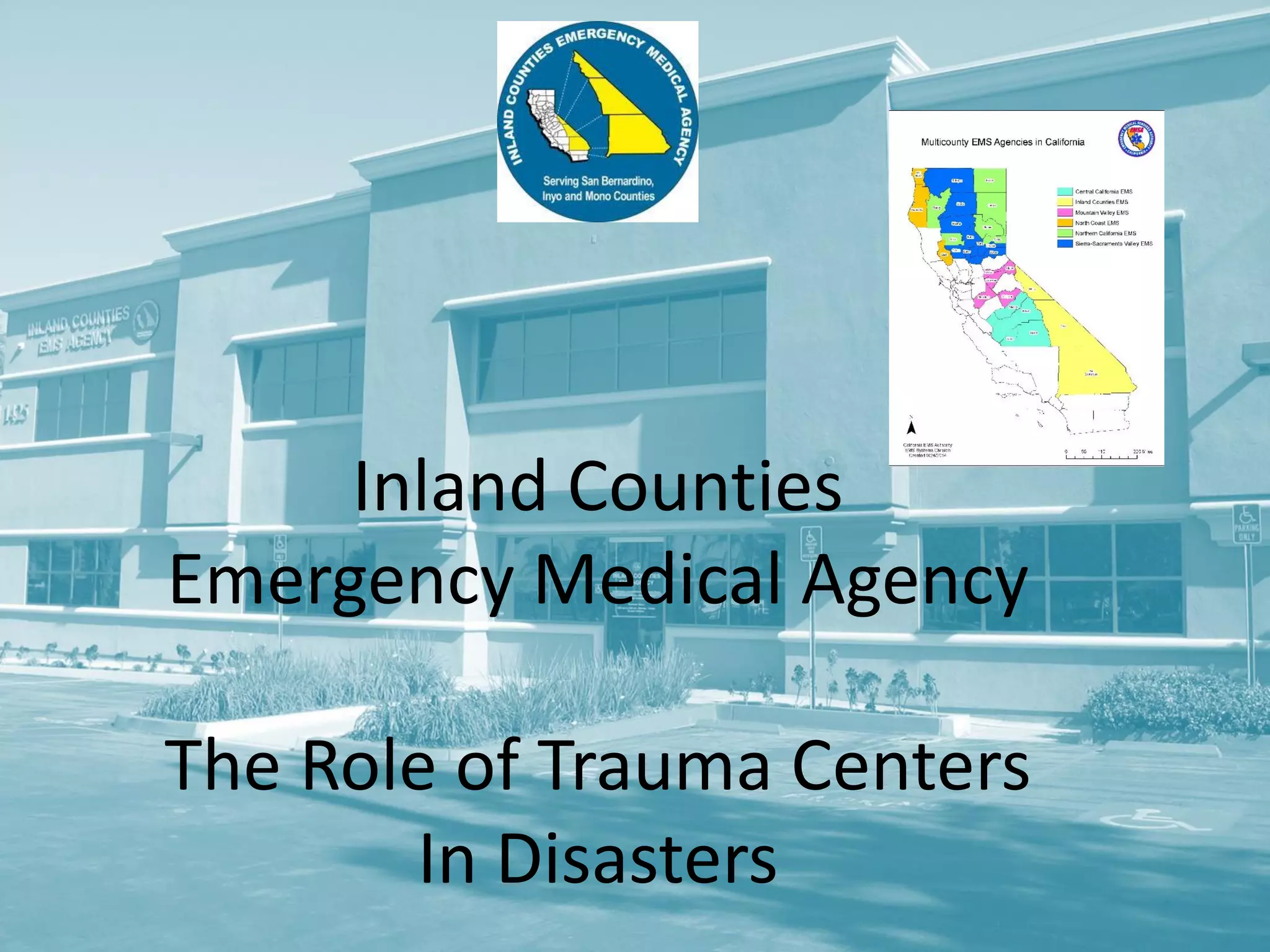
Inland Counties
Emergency Medical Agency
The Role of Trauma Centers
In Disasters
ICEMA Mission
Ensure an effective system of quality patient care
and coordinated emergency medical response that
best serves the public, our most important
stakeholder.
This is accomplished by planning, implementing and
evaluating an effective EMS system for all
participants and stakeholders.
ICEMA mission is in line with the County Vision at
all levels of organization.
California EMS Regulations
California Health and Safety Code, Division 2.5
The local EMS agency shall plan, implement, and evaluate an emergency medical services system,
in accordance with the provisions of this part, consisting of an organized pattern of readiness and
response services based on public and private agreements and operational procedures (1797.204)
California Health and Safety Code, Division 2.5
Requires the LEMSA Medical Director to establish policies and procedures pertaining to medical
control including dispatch, patient destination, patient care guidelines, and quality assurance
(1797.220)
California Code of Regulations, Title 22
Requires the Medical Director of the LEMSA to maintain medical control by developing written
medical policies establishing the requirements for the initiation, completion, review, evaluation
and retention of patient care records (Chapter 4. Section 100169)
ICEMA Responsibilities/Services
 EMS System Organization, Management and Maintenance
 Paramedic Accreditation, EMT Certification and Continuing Education
 Prehospital Treatment and Medical Control
 EMS and Hospital Communications Coordination
 Ground and Air Ambulance Transportation
 Public Information and Education
 Regional Trauma, Stroke and STEMI Specialty Care Center Designation and Oversight
 Data Collection and Evaluation
 Continuous Quality Improvement
 Disaster Medical and Resource Management
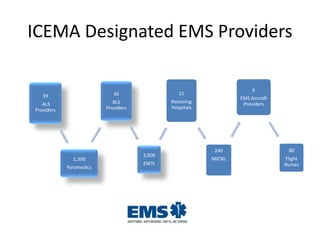
ICEMA Designated EMS Providers
39
ALS
Providers
1,300
Paramedics
36
BLS
Providers
3,000
EMTs
21
Receiving
Hospitals
240
MICNs
6
EMS Aircraft
Providers
80
Flight
Nurses
ICEMA Designated Hospitals
21
Paramedic
Receiving
Hospitals
8
Base Hospitals
2
Adult/1
Pediatric
Trauma
Centers
6
STEMI
Receiving
Centers
6
Neurovascular
Stroke
Receiving
Centers
Trauma Center
Overview
• All Trauma Centers are licensed acute care
hospitals
• All provide specialized care at one of four
levels of designation
• Level I and II
– Similar personnel, services and resources
• Surgeons and OR teams must be available 24/7
– Primary difference
• Level I conducts research and provides training
Trauma Center
Overview
• Level III and IV
– Generally provide initial stabilization
– Transfer to Level I or II as needed
– Greatest difference between Levels I and II
• Surgical capabilities not in house 24/7
• Surgeons and OR Teams on call back
• Level I and II Pediatric
– Focus specifically on pediatric trauma patients
– Level I also requires research and training
Inland Empire
Trauma Centers
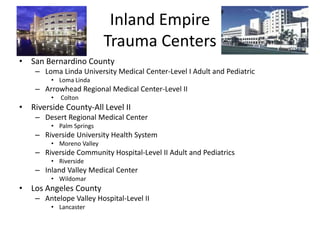
• San Bernardino County
– Loma Linda University Medical Center-Level I Adult and Pediatric
• Loma Linda
– Arrowhead Regional Medical Center-Level II
• Colton
• Riverside County-All Level II
– Desert Regional Medical Center
• Palm Springs
– Riverside University Health System
• Moreno Valley
– Riverside Community Hospital-Level II Adult and Pediatrics
• Riverside
– Inland Valley Medical Center
• Wildomar
• Los Angeles County
– Antelope Valley Hospital-Level II
• Lancaster
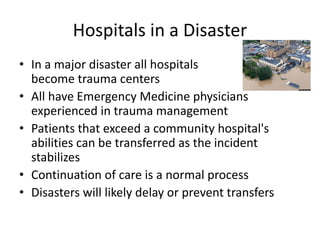
Hospitals in a Disaster
• In a major disaster all hospitals
become trauma centers
• All have Emergency Medicine physicians
experienced in trauma management
• Patients that exceed a community hospital's
abilities can be transferred as the incident
stabilizes
• Continuation of care is a normal process
• Disasters will likely delay or prevent transfers
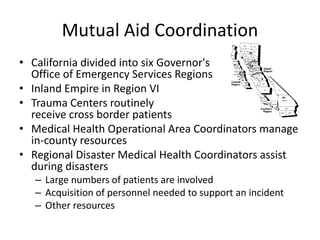
Mutual Aid Coordination
• California divided into six Governor's
Office of Emergency Services Regions
• Inland Empire in Region VI
• Trauma Centers routinely
receive cross border patients
• Medical Health Operational Area Coordinators manage
in-county resources
• Regional Disaster Medical Health Coordinators assist
during disasters
– Large numbers of patients are involved
– Acquisition of personnel needed to support an incident
– Other resources
Medical Health Mutual Aid
• California Disaster and Civil Defense Master Mutual Aid Agreement-1950
– Established the framework for the use of Mutual Aid assets
– 11 County OES Regions I and VI M/H Mutual Aid aggreement-1997
– An outcome of the Northridge Earthquake
• ICEMA/Public Health/Behavioral Health MOU-2013
– Identifies the lead roles of the EMS Administrator and the Health Officer who share the
Medical Health Operational Area Coordinator (MHOAC) positon
– Medical incidents-ICEMA
– Health-Public Health
• The Riverside County EMS Agency Director is the Region VI Regional Disaster
Medical Health Coordinator (RDMHC)
EMS
Response
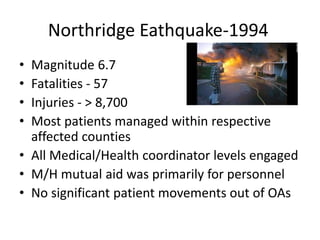
Northridge Eathquake-1994
• Magnitude 6.7
• Fatalities - 57
• Injuries - > 8,700
• Most patients managed within respective
affected counties
• All Medical/Health coordinator levels engaged
• M/H mutual aid was primarily for personnel
• No significant patient movements out of OAs
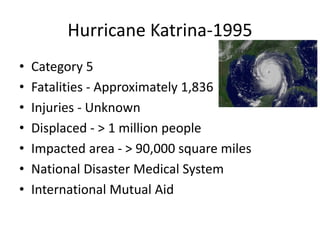
Hurricane Katrina-1995
• Category 5
• Fatalities - Approximately 1,836
• Injuries - Unknown
• Displaced - > 1 million people
• Impacted area - > 90,000 square miles
• National Disaster Medical System
• International Mutual Aid
Trauma Centers
• The use of trauma centers in disaster is scalable
• All hospitals must be ready to receive major
trauma patients
• Mutual aid levels:
County
Region
State
Federal
International
Questions?
ICEMA Contact Information
Tom Lynch,
EMS Administrator
Office: 909.388.5830
Cell: 909.841.6876
Fax: 909.388.5825
tom.lynch@cao.sbcounty.gov
ICEMA Duty Officer 24/7 number: 909.208.8618
ICEMA
1425 South “D” Street
San Bernardino, CA 92415-0060
Mail Code 0060

Icema overview our lemsa rev 5: 2019

  • 1.
    Inland Counties Emergency MedicalAgency The Role of Trauma Centers In Disasters
  • 2.
    ICEMA Mission Ensure aneffective system of quality patient care and coordinated emergency medical response that best serves the public, our most important stakeholder. This is accomplished by planning, implementing and evaluating an effective EMS system for all participants and stakeholders. ICEMA mission is in line with the County Vision at all levels of organization.
  • 3.
    California EMS Regulations CaliforniaHealth and Safety Code, Division 2.5 The local EMS agency shall plan, implement, and evaluate an emergency medical services system, in accordance with the provisions of this part, consisting of an organized pattern of readiness and response services based on public and private agreements and operational procedures (1797.204) California Health and Safety Code, Division 2.5 Requires the LEMSA Medical Director to establish policies and procedures pertaining to medical control including dispatch, patient destination, patient care guidelines, and quality assurance (1797.220) California Code of Regulations, Title 22 Requires the Medical Director of the LEMSA to maintain medical control by developing written medical policies establishing the requirements for the initiation, completion, review, evaluation and retention of patient care records (Chapter 4. Section 100169)
  • 4.
    ICEMA Responsibilities/Services  EMSSystem Organization, Management and Maintenance  Paramedic Accreditation, EMT Certification and Continuing Education  Prehospital Treatment and Medical Control  EMS and Hospital Communications Coordination  Ground and Air Ambulance Transportation  Public Information and Education  Regional Trauma, Stroke and STEMI Specialty Care Center Designation and Oversight  Data Collection and Evaluation  Continuous Quality Improvement  Disaster Medical and Resource Management
  • 5.
    ICEMA Designated EMSProviders 39 ALS Providers 1,300 Paramedics 36 BLS Providers 3,000 EMTs 21 Receiving Hospitals 240 MICNs 6 EMS Aircraft Providers 80 Flight Nurses
  • 6.
    ICEMA Designated Hospitals 21 Paramedic Receiving Hospitals 8 BaseHospitals 2 Adult/1 Pediatric Trauma Centers 6 STEMI Receiving Centers 6 Neurovascular Stroke Receiving Centers
  • 7.
    Trauma Center Overview • AllTrauma Centers are licensed acute care hospitals • All provide specialized care at one of four levels of designation • Level I and II – Similar personnel, services and resources • Surgeons and OR teams must be available 24/7 – Primary difference • Level I conducts research and provides training
  • 8.
    Trauma Center Overview • LevelIII and IV – Generally provide initial stabilization – Transfer to Level I or II as needed – Greatest difference between Levels I and II • Surgical capabilities not in house 24/7 • Surgeons and OR Teams on call back • Level I and II Pediatric – Focus specifically on pediatric trauma patients – Level I also requires research and training
  • 9.
    Inland Empire Trauma Centers •San Bernardino County – Loma Linda University Medical Center-Level I Adult and Pediatric • Loma Linda – Arrowhead Regional Medical Center-Level II • Colton • Riverside County-All Level II – Desert Regional Medical Center • Palm Springs – Riverside University Health System • Moreno Valley – Riverside Community Hospital-Level II Adult and Pediatrics • Riverside – Inland Valley Medical Center • Wildomar • Los Angeles County – Antelope Valley Hospital-Level II • Lancaster
  • 10.
    Hospitals in aDisaster • In a major disaster all hospitals become trauma centers • All have Emergency Medicine physicians experienced in trauma management • Patients that exceed a community hospital's abilities can be transferred as the incident stabilizes • Continuation of care is a normal process • Disasters will likely delay or prevent transfers
  • 11.
    Mutual Aid Coordination •California divided into six Governor's Office of Emergency Services Regions • Inland Empire in Region VI • Trauma Centers routinely receive cross border patients • Medical Health Operational Area Coordinators manage in-county resources • Regional Disaster Medical Health Coordinators assist during disasters – Large numbers of patients are involved – Acquisition of personnel needed to support an incident – Other resources
  • 12.
    Medical Health MutualAid • California Disaster and Civil Defense Master Mutual Aid Agreement-1950 – Established the framework for the use of Mutual Aid assets – 11 County OES Regions I and VI M/H Mutual Aid aggreement-1997 – An outcome of the Northridge Earthquake • ICEMA/Public Health/Behavioral Health MOU-2013 – Identifies the lead roles of the EMS Administrator and the Health Officer who share the Medical Health Operational Area Coordinator (MHOAC) positon – Medical incidents-ICEMA – Health-Public Health • The Riverside County EMS Agency Director is the Region VI Regional Disaster Medical Health Coordinator (RDMHC)
  • 14.
  • 16.
    Northridge Eathquake-1994 • Magnitude6.7 • Fatalities - 57 • Injuries - > 8,700 • Most patients managed within respective affected counties • All Medical/Health coordinator levels engaged • M/H mutual aid was primarily for personnel • No significant patient movements out of OAs
  • 17.
    Hurricane Katrina-1995 • Category5 • Fatalities - Approximately 1,836 • Injuries - Unknown • Displaced - > 1 million people • Impacted area - > 90,000 square miles • National Disaster Medical System • International Mutual Aid
  • 18.
    Trauma Centers • Theuse of trauma centers in disaster is scalable • All hospitals must be ready to receive major trauma patients • Mutual aid levels: County Region State Federal International
  • 19.
  • 20.
    ICEMA Contact Information TomLynch, EMS Administrator Office: 909.388.5830 Cell: 909.841.6876 Fax: 909.388.5825 tom.lynch@cao.sbcounty.gov ICEMA Duty Officer 24/7 number: 909.208.8618 ICEMA 1425 South “D” Street San Bernardino, CA 92415-0060 Mail Code 0060