Abnormal
uterine bleeding
Raheef Alatassi
5th year medical student
Obstetrics & Gynecology
Objectives
• Definition
• Causes
• Approach
• management
Definition
History
• A 26 years old G0P0 present to the office
with a menstrual period every 3-4 months.
Her periods are heavy and lasting for 7-9
days. Her BMI is 40. She complains of severe
acne since puberty. Recently she was
diagnosed with diabetes mellitus type 2 and
there is No palpable masses in abdomen or
genitourinary exams.
• What are the initial lab test should be order ?
Definition
• Polymenorrhea ?
• Menorrhagia ?
• Oligomenorrhea ?
• Metrorrhagia ?
• Menometrorrhagia ?
• Dysfunctional Uterine bleeding ?
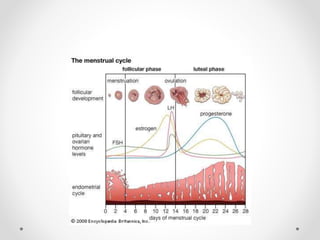
• The follicular phase
first-half of the menstrual cycle and is the source of the
variation in cycle length.
The follicular phase begins with the onset of menses
and end in the ovulation of a mature oocyte
• The luteal phase
second-half of the cycle and is more consistent in
length, lasting 12 to 14 days in most individuals
Definition
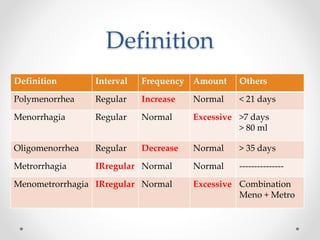
Definition Interval Frequency Amount Others
Polymenorrhea Regular Increase Normal < 21 days
Menorrhagia Regular Normal Excessive >7 days
> 80 ml
Oligomenorrhea Regular Decrease Normal > 35 days
Metrorrhagia IRregular Normal Normal ---------------
Menometrorrhagia IRregular Normal Excessive Combination
Meno + Metro
Definition
• Abnormal uterine bleeding :
• Bleeding in > 35 days.
• Bleeding in < 21 days.
• Bleeding is Unpredictable or irregular.
• Normal menstrual cycle occurs every 28 days +/- 7
Causes ?
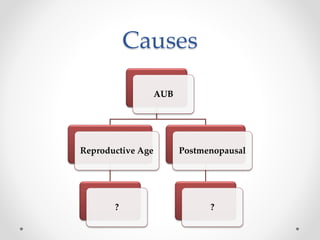
Causes
AUB
Reproductive Age
?
Postmenopausal
?
Reproductive
Age
causes
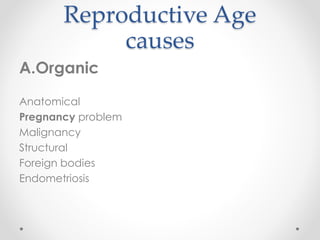
Reproductive Age
causes
A.Organic
Anatomical
Pregnancy problem
Malignancy
Structural
Foreign bodies
Endometriosis
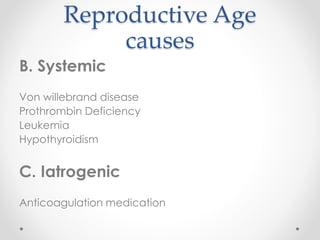
Reproductive Age
causes
B. Systemic
Von willebrand disease
Prothrombin Deficiency
Leukemia
Hypothyroidism
C. Iatrogenic
Anticoagulation medication
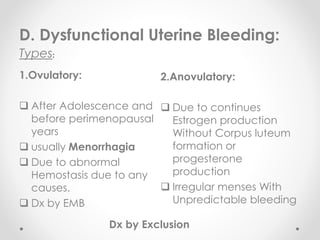
1.Ovulatory:
 After Adolescence and
before perimenopausal
years
 usually Menorrhagia
 Due to abnormal
Hemostasis due to any
causes.
 Dx by EMB
2.Anovulatory:
 Due to continues
Estrogen production
Without Corpus luteum
formation or
progesterone
production
 Irregular menses With
Unpredictable bleeding
D. Dysfunctional Uterine Bleeding:
Types:
Dx by Exclusion
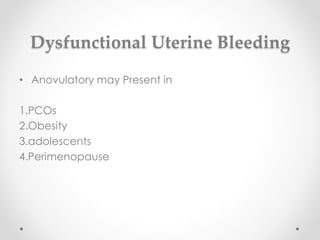
Dysfunctional Uterine Bleeding
• Anovulatory may Present in
1.PCOs
2.Obesity
3.adolescents
4.Perimenopause
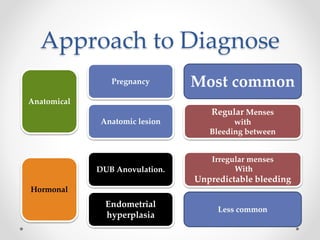
Approach to Diagnose
Anatomical
Hormonal
Pregnancy
Anatomic lesion
DUB Anovulation.
Endometrial
hyperplasia
Most common
Regular Menses
with
Bleeding between
Irregular menses
With
Unpredictable bleeding
Less common
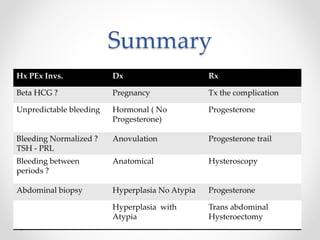
Summary
Hx PEx Invs. Dx Rx
Beta HCG ? Pregnancy Tx the complication
Unpredictable bleeding Hormonal ( No
Progesterone)
Progesterone
Bleeding Normalized ?
TSH - PRL
Anovulation Progesterone trail
Bleeding between
periods ?
Anatomical Hysteroscopy
Abdominal biopsy Hyperplasia No Atypia Progesterone
Hyperplasia with
Atypia
Trans abdominal
Hysteroectomy
Postmenopausal
Age
causes
A 55-year-old female with LMP 5 years ago presents
with a chief complaint of vaginal spotting.
She reports painful intercourse and burning in the
vagina. Her spotting is not related to sexual activity.
She denies any medical conditions and is not on any
medications.
Pelvic exam reveals a dry vagina
• What is the most likely diagnosis for this patient?
• Bleeding due to atrophy
Postmenopausal bleeding is defined as
bleeding that occurs after 1 year of amenorrhea.
• Vaginal bleeding after the menopause, In women who are
not taking HRT
• INCIDENCE
4 to 11
The incidence of bleeding decreasing over time
Frequency of spontaneously occurring postmenopausal bleeding
in the general population.
ETIOLOGY
• It is usually related to an intrauterine source, but
sometimes arise from the cervix, vagina, vulva, or
fallopian tubes and also may involve
nongynecologic sites, such as the urethra, bladder,
and rectum/bowel.
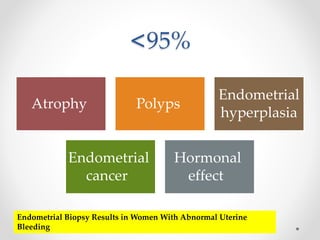
>95%
Atrophy Polyps
Endometrial
hyperplasia
Endometrial
cancer
Hormonal
effect
Endometrial Biopsy Results in Women With Abnormal Uterine
Bleeding
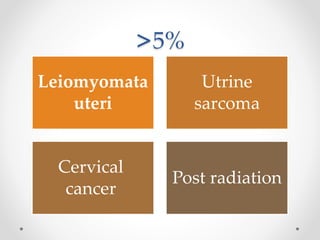
<5%
Leiomyomata
uteri
Utrine
sarcoma
Cervical
cancer
Post radiation
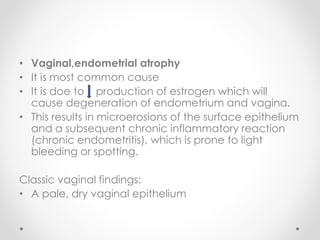
• Vaginal,endometrial atrophy
• It is most common cause
• It is doe to production of estrogen which will
cause degeneration of endometrium and vagina.
• This results in microerosions of the surface epithelium
and a subsequent chronic inflammatory reaction
(chronic endometritis), which is prone to light
bleeding or spotting.
Classic vaginal findings:
• A pale, dry vaginal epithelium
• Endometrial hyperplasia
 Endogenous estrogen production from
ovarian or adrenal tumors
 exogenous estrogen therapy
 Obesity
HISTORY
When did the bleeding start?
What is the nature of the bleeding?
Were there precipitating factors, such as trauma?
History of bleeding in relation to sexual activity.
Foul smelling discharge ?
Are there any associated symptoms such as
dyspareunia, fever, weight loss, abdominal pain or
changes in bladder or bowel function .
HISTORY
• Number of children and age of menarche?
• When was your last period?
• Last pap smear?
• past medical history.
• Chronic diseases: DM-HTN
• Medications: HRT(tamoxfien )-anticoagulants
• Family history of bleeding, gynecologic cancer,
breast cancer.
physical examination
• General examination
• Unstable vital sign
• BMI
• Pallor
• Abdominal examination
• Assess the size, contour, and tenderness of the
uterus
• Vaginal examination
 Inspection
lesions, lacerations, discharge, or foreign bodies.
 speculum
vaginal tissues for atrophy (pale - dry vaginal
epithelium )and the cervix for polyps
 Pap smear
Investigation
and
management
Investigation
• Initial workup :
o Complete blood count
o Blood type and cross match
o Pregnancy test
• Hematological disorders :
o Partial thromboplastin time
o Prothrombin time
o Activated partial thromboplastin time
o Fibrinogen
• All women with abnormal hematological disorders
test should go for von Willebrand disease :
o von Willebrand factor antigen
o Ristocetin cofactor assay
o Factor VII
• Other test can be done:
o Thyroid stimulating hormone
o Serum iron, total iron binding capacity and ferritin
o Liver function test
o FSH
o prolactine
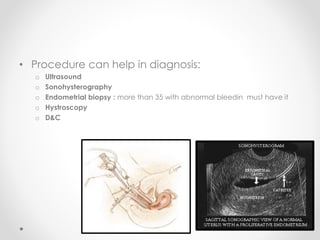
• Procedure can help in diagnosis:
o Ultrasound
o Sonohysterography
o Endometrial biopsy : more than 35 with abnormal bleedin must have it
o Hystroscopy
o D&C
Management
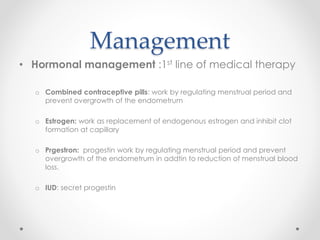
• Hormonal management :1st line of medical therapy
o Combined contraceptive pills: work by regulating menstrual period and
prevent overgrowth of the endometrum
o Estrogen: work as replacement of endogenous estrogen and inhibit clot
formation at capillary
o Prgestron: progestin work by regulating menstrual period and prevent
overgrowth of the endometrum in addtin to reduction of menstrual blood
loss.
o IUD: secret progestin
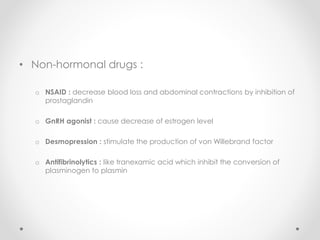
• Non-hormonal drugs :
o NSAID : decrease blood loss and abdominal contractions by inhibition of
prostaglandin
o GnRH agonist : cause decrease of estrogen level
o Desmopression : stimulate the production of von Willebrand factor
o Antifibrinolytics : like tranexamic acid which inhibit the conversion of
plasminogen to plasmin
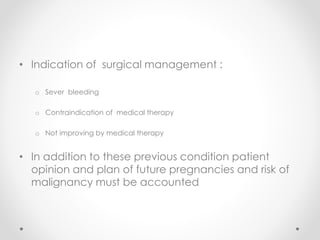
• Indication of surgical management :
o Sever bleeding
o Contraindication of medical therapy
o Not improving by medical therapy
• In addition to these previous condition patient
opinion and plan of future pregnancies and risk of
malignancy must be accounted
• Options of surgical management :
o D&C : can be done for endometrial polyps , submucosal fibroid and
endometrial hyperplasia. In case of DUB s/s treatment
o Uterine artery embolization : obstruct blood supply to fibroid
o Endometrial ablation : thermal or laser. Used for DUB
o Hysterectomy : the definitive treatment
Any
Questions
Thank you
References
Essentials of Obstetrics and Gynecology ( Hacker and
Moore’s) 5th Edition.
First aid for the Obstetrics and Gynecology 3th Edition.
Up-to-date

Abnormal Uterine Bleeding AUB

  • 1.
    Abnormal uterine bleeding Raheef Alatassi 5thyear medical student Obstetrics & Gynecology
  • 2.
  • 3.
  • 4.
    History • A 26years old G0P0 present to the office with a menstrual period every 3-4 months. Her periods are heavy and lasting for 7-9 days. Her BMI is 40. She complains of severe acne since puberty. Recently she was diagnosed with diabetes mellitus type 2 and there is No palpable masses in abdomen or genitourinary exams. • What are the initial lab test should be order ?
  • 5.
    Definition • Polymenorrhea ? •Menorrhagia ? • Oligomenorrhea ? • Metrorrhagia ? • Menometrorrhagia ? • Dysfunctional Uterine bleeding ?
  • 7.
    • The follicularphase first-half of the menstrual cycle and is the source of the variation in cycle length. The follicular phase begins with the onset of menses and end in the ovulation of a mature oocyte • The luteal phase second-half of the cycle and is more consistent in length, lasting 12 to 14 days in most individuals
  • 8.
    Definition Definition Interval FrequencyAmount Others Polymenorrhea Regular Increase Normal < 21 days Menorrhagia Regular Normal Excessive >7 days > 80 ml Oligomenorrhea Regular Decrease Normal > 35 days Metrorrhagia IRregular Normal Normal --------------- Menometrorrhagia IRregular Normal Excessive Combination Meno + Metro
  • 9.
    Definition • Abnormal uterinebleeding : • Bleeding in > 35 days. • Bleeding in < 21 days. • Bleeding is Unpredictable or irregular. • Normal menstrual cycle occurs every 28 days +/- 7
  • 10.
  • 11.
  • 12.
  • 13.
  • 14.
    Reproductive Age causes B. Systemic Vonwillebrand disease Prothrombin Deficiency Leukemia Hypothyroidism C. Iatrogenic Anticoagulation medication
  • 15.
    1.Ovulatory:  After Adolescenceand before perimenopausal years  usually Menorrhagia  Due to abnormal Hemostasis due to any causes.  Dx by EMB 2.Anovulatory:  Due to continues Estrogen production Without Corpus luteum formation or progesterone production  Irregular menses With Unpredictable bleeding D. Dysfunctional Uterine Bleeding: Types: Dx by Exclusion
  • 16.
    Dysfunctional Uterine Bleeding •Anovulatory may Present in 1.PCOs 2.Obesity 3.adolescents 4.Perimenopause
  • 17.
    Approach to Diagnose Anatomical Hormonal Pregnancy Anatomiclesion DUB Anovulation. Endometrial hyperplasia Most common Regular Menses with Bleeding between Irregular menses With Unpredictable bleeding Less common
  • 18.
    Summary Hx PEx Invs.Dx Rx Beta HCG ? Pregnancy Tx the complication Unpredictable bleeding Hormonal ( No Progesterone) Progesterone Bleeding Normalized ? TSH - PRL Anovulation Progesterone trail Bleeding between periods ? Anatomical Hysteroscopy Abdominal biopsy Hyperplasia No Atypia Progesterone Hyperplasia with Atypia Trans abdominal Hysteroectomy
  • 19.
  • 20.
    A 55-year-old femalewith LMP 5 years ago presents with a chief complaint of vaginal spotting. She reports painful intercourse and burning in the vagina. Her spotting is not related to sexual activity. She denies any medical conditions and is not on any medications. Pelvic exam reveals a dry vagina • What is the most likely diagnosis for this patient? • Bleeding due to atrophy
  • 21.
    Postmenopausal bleeding isdefined as bleeding that occurs after 1 year of amenorrhea. • Vaginal bleeding after the menopause, In women who are not taking HRT
  • 22.
    • INCIDENCE 4 to11 The incidence of bleeding decreasing over time Frequency of spontaneously occurring postmenopausal bleeding in the general population.
  • 23.
    ETIOLOGY • It isusually related to an intrauterine source, but sometimes arise from the cervix, vagina, vulva, or fallopian tubes and also may involve nongynecologic sites, such as the urethra, bladder, and rectum/bowel.
  • 24.
  • 25.
  • 26.
    • Vaginal,endometrial atrophy •It is most common cause • It is doe to production of estrogen which will cause degeneration of endometrium and vagina. • This results in microerosions of the surface epithelium and a subsequent chronic inflammatory reaction (chronic endometritis), which is prone to light bleeding or spotting. Classic vaginal findings: • A pale, dry vaginal epithelium
  • 27.
    • Endometrial hyperplasia Endogenous estrogen production from ovarian or adrenal tumors  exogenous estrogen therapy  Obesity
  • 28.
    HISTORY When did thebleeding start? What is the nature of the bleeding? Were there precipitating factors, such as trauma? History of bleeding in relation to sexual activity. Foul smelling discharge ? Are there any associated symptoms such as dyspareunia, fever, weight loss, abdominal pain or changes in bladder or bowel function .
  • 29.
    HISTORY • Number ofchildren and age of menarche? • When was your last period? • Last pap smear? • past medical history. • Chronic diseases: DM-HTN • Medications: HRT(tamoxfien )-anticoagulants • Family history of bleeding, gynecologic cancer, breast cancer.
  • 30.
    physical examination • Generalexamination • Unstable vital sign • BMI • Pallor • Abdominal examination • Assess the size, contour, and tenderness of the uterus
  • 31.
    • Vaginal examination Inspection lesions, lacerations, discharge, or foreign bodies.  speculum vaginal tissues for atrophy (pale - dry vaginal epithelium )and the cervix for polyps  Pap smear
  • 32.
  • 33.
    Investigation • Initial workup: o Complete blood count o Blood type and cross match o Pregnancy test • Hematological disorders : o Partial thromboplastin time o Prothrombin time o Activated partial thromboplastin time o Fibrinogen
  • 34.
    • All womenwith abnormal hematological disorders test should go for von Willebrand disease : o von Willebrand factor antigen o Ristocetin cofactor assay o Factor VII • Other test can be done: o Thyroid stimulating hormone o Serum iron, total iron binding capacity and ferritin o Liver function test o FSH o prolactine
  • 35.
    • Procedure canhelp in diagnosis: o Ultrasound o Sonohysterography o Endometrial biopsy : more than 35 with abnormal bleedin must have it o Hystroscopy o D&C
  • 36.
    Management • Hormonal management:1st line of medical therapy o Combined contraceptive pills: work by regulating menstrual period and prevent overgrowth of the endometrum o Estrogen: work as replacement of endogenous estrogen and inhibit clot formation at capillary o Prgestron: progestin work by regulating menstrual period and prevent overgrowth of the endometrum in addtin to reduction of menstrual blood loss. o IUD: secret progestin
  • 37.
    • Non-hormonal drugs: o NSAID : decrease blood loss and abdominal contractions by inhibition of prostaglandin o GnRH agonist : cause decrease of estrogen level o Desmopression : stimulate the production of von Willebrand factor o Antifibrinolytics : like tranexamic acid which inhibit the conversion of plasminogen to plasmin
  • 38.
    • Indication ofsurgical management : o Sever bleeding o Contraindication of medical therapy o Not improving by medical therapy • In addition to these previous condition patient opinion and plan of future pregnancies and risk of malignancy must be accounted
  • 39.
    • Options ofsurgical management : o D&C : can be done for endometrial polyps , submucosal fibroid and endometrial hyperplasia. In case of DUB s/s treatment o Uterine artery embolization : obstruct blood supply to fibroid o Endometrial ablation : thermal or laser. Used for DUB o Hysterectomy : the definitive treatment
  • 40.
  • 41.
  • 42.
    References Essentials of Obstetricsand Gynecology ( Hacker and Moore’s) 5th Edition. First aid for the Obstetrics and Gynecology 3th Edition. Up-to-date

Editor's Notes

  • #5 HCG, FSH, TSH, PRL.
  • #10 Unpredictable in amount or frequency.
  • #16 EMB endometrium biopsy
  • #18 DUB Anovulation : unstable endometrium
  • #25 Atrophy (59 percent) ●Polyps (12 percent) ●Endometrial cancer (10 percent) ●Endometrial hyperplasia (9.8 percent) ●Hormonal effect (7 percent) ●Cervical cancer (less than 1 percent) ●Other (eg, hydrometra, pyometra, hematometra: 2 percen
  • #28 Since postmenopausal women should be estrogen deficient, endometrial hyperplasia at this time is abnormal and requires an explanation. Endogenous estrogen production from ovarian or adrenal tumors or exogenous estrogen therapy are possible causes. Obese women also have high levels of endogenous estrogen due to the conversion of androstenedione to estrone and the aromatization of androgens to estradiol, both of which occur in peripheral adipose tissue
  • #29 What is the nature of the bleeding (temporal pattern, duration, postcoital, quantity)? Foul smelling discharge ?=cevical cancer
  • #31 Any abdominal mass