 Abortion is the expulsion (or extraction from its
mother) of an embryo or fetus weighing 500 g or less
when it is not capable of independent survival
(WHO).
 The current cut off for fetal viability is 22 weeks by
the WHO.
 15% of all clinically recognized pregnancies.
 80% of this occur in the first trimester .
 Rates vary with maternal age.
 High in elderly and in women with previous
miscarriage
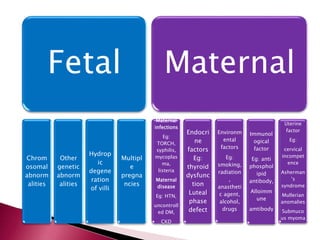
Fetal
Chrom
osomal
abnorm
alities
Other
genetic
abnorm
alities
Hydrop
ic
degene
ration
of villi
Multipl
e
pregna
ncies
Maternal
Maternal
infections
Eg:
TORCH,
syphilis,
mycoplas
ma,
listeria
Maternal
disease
Eg: HTN,
uncontroll
ed DM,
CKD
Endocri
ne
factors
Eg:
thyroid
dysfunc
tion
Luteal
phase
defect
Environm
ental
factors
Eg:
smoking,
radiation
,
anastheti
c agent,
alcohol,
drugs
Immunol
ogical
factor
Eg: anti
phosphol
ipid
antibody,
Alloimm
une
amtibody
Uterine
factor
Eg:
cervical
incompet
ence
Asherman
’s
syndrome
Mullerian
anomalies
Submuco
us myoma
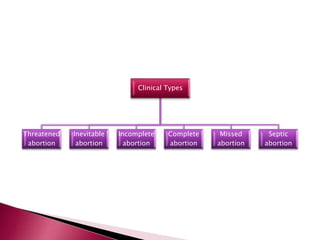
Clinical Types
Threatened
abortion
Inevitable
abortion
Incomplete
abortion
Complete
abortion
Missed
abortion
Septic
abortion
It is a clinical entity where the process of
miscarriage has started but has not progressed to a state
from which recovery is impossible.
Clinical presentation :
 Vaginal bleeding
 Usually painless , may have abdominal cramps and back ache
Examination :
 Cervix soft with closed internal os.
 Size of uterus corresponds to period of amenorrhoea
Differential diagnosis
1. Ectopic gestation ( serial serum beta HCG )
2. Hydatidiform mole
3. Missed abortion
Ultrasonography is diagnostic
Management
 The patient should be in bed for few days until bleeding stops.
 Coitus is avoided during this period
 Relief of pain may be ensured by diazepam 5 mg tablet twice daily
 Anti-D for Rh negative mother.(beyond 12 weeks)
 There is some evidence that treatment with progesterone improves the
outcome.(controversial)
 should be followed up with repeat sonography at 3–4 weeks’ time
Ultrasonography (TVS) findings may be:
(1) A well-formed gestation ring with
central echoes from the embryo
indicating healthy fetus (2) Observation
of fetal cardiac motion. With this there
is 98% chance of continuation of
pregnancy. (3) A blighted ovum is
evidenced by loss of definition of the
gestation sac, smaller mean gestational
sac diameter, absent fetal echoes and
absent fetal cardiac movements
Prognosis and outcome
 The prognosis is very unpredictable.
 80% willl go on to term.
 In the rest, it terminates either as inevitable or missed
miscarriage
 If the pregnancy continues, there is increased frequency
of preterm labor, placenta previa, intrauterine
growth restriction of the fetus and fetal anomalies.
It is the clinical type of abortion
where the changes have progressed to a state from
where continuation of pregnancy is impossible.
Clinical presentation :
 Vaginal bleeding, profuse
 Associated with severe pain, colicky in nature
Examination :
 Internal examination reveals dilated internal os of
the cervix through which the products of conception
are felt .
Management
 The blood loss should corrected by intravenous (IV)
fluid therapy and blood transfusion.
 Before 12 weeks: suction evacuation followed by
curettage is done.
 After 12 weeks: The uterine contraction is accelerated
by oxytocin drip (10 units in 500 mL of normal saline)
40–60 drops per minute to hasten expulsion. Anti-D is
given to Rh negative mother.
When the process of abortion has already taken
place but entire products of conception are not
expelled, instead a part of it is left inside the
uterine cavity, it is called incomplete miscarriage.
This is the commonest type met amongst women
CLINICAL FEATURES:
 History of expulsion of a fleshy mass per vaginam
 pain in lower abdomen.
 Persistence of vaginal bleeding.
EXAMINATION
 uterus smaller than the period of amenorrhea
 internal os is open
 on examination, the expelled mass is found incomplete

Ultrasonography—reveals echogenic material (products of
conception) within the cavity.
COMPLICATIONS:
The retained products may cause:
(a) profuse bleeding
(b) sepsis or
(c) placental polyp.
MANAGEMENT:
 Resuscitation
 Early abortion: evacuation of uterus by suction
evacuation
 Late abortion: dilatation and curettage
 The removed materials are subjected to a histological
examination.
 In stable patients with closed os, Tablet misoprostol 200
µg is used vaginally every 4 hours
 anti-D gamma globulin 50 μg or 100 μg intramuscularly
when the products of conception are expelled en
masse, it is called complete miscarriage.
CLINICAL FEATURES:
There is history of expulsion of a fleshy mass per vaginam
followed by:
 Subsidence of abdominal pain.
 Vaginal bleeding becomes trace or absent.
EXAMINATION
 Uterus is smaller than the period of amenorrhea and a little firmer.
 Cervical os is closed
 Examination of the expelled fleshy mass is found complete.
 Ultrasonography (TVS): reveals empty uterine cavity.
Management is usually conservative.
In this the fetus is dead and retained inside the
uterus for a variable period.
CLINICAL FEATURES:
 Spotting or bleeding
 Persistence of brownish vaginal discharge.
 Subsidence of pregnancy symptoms.
EXAMINATION
 Uterine size smaller
 Nonaudibility of the fetal heart sound
 Cervix feels firm and os is closed
 immunological test for pregnancy becomes negative.
ULTRASONOGRAPHY
 Missed abortion is diagnosed when there is a crown
rump length of 15 mm without a fetal heart.
 Anembryonic pregnancy (blighted ovum) is
considered when there is a gestational sac more than 16mm
in diameter without a fetal node.
COMPLICATIONS
 Sepsis
 DIC (thromboplastin like substance from dead fetus)
 Psycological trauma
Uterus less than 12 weeks:
 Medical management: Prostaglandin E1
(misoprostol) 800 µg vaginally in the posterior
fornix is given and repeated after 24 hours if
needed. Expulsion usually occurs within 48
hours.
 Suction evacuation or dilatation and evacuation
is done either as a definitive treatment or it can
be done when the medical method fails.
Uterus more than 12 weeks:
Induction is done by the following methods:
 Prostaglandin E1 analog (misoprostol) 200 µg
tablet is inserted into the posterior vaginal fornix
every 6 hours for a maximum of 5 such.
 If it fails extra-amniotic instilliation of ethacridine
lactate can be done
Following medical treatment, ultrasonography should
be done to document empty uterine cavity. Otherwise
evacuation of the retained products of conception
(ERPC) should be done.
Any abortion associated with clinical
evidences of infection of the uterus and its contents is
called septic abortion. Abortion is usually considered septic
when there are:
(1) rise of temperature of at least 100.4°F (38°C) for 24 hours
or more,
(2) offensive or purulent vaginal discharge and
(3) other evidences of pelvic infection such as lower
abdominal pain and tenderness.
in the majority of cases, the infection occurs following illegal
induced abortion but infection can occur even after
spontaneous abortion
CLINICAL FEATURES
 History of unsafe termination
 Fever
 Abdominal pain and vomiting or diarrhoea
 Purulent discharge and bleeding per vaginum
 Hypotension
 Tachycardia
 Abdominal tenderness
 Cervix may be soft and os open
 Tenderness in the fornicess
 A soft boggy mass may be felt
CLINICAL GRADING:
 Grade I: The infection is localized in the uterus.
 Grade II: The infection spreads beyond the uterus to the
parametrium, tubes and ovaries or pelvic peritoneum.
 Grade III: Generalized peritonitis and/or endotoxic
shock or jaundice or acute renal failure.
 Complete blood count
 High vaginal swab for culture and sensitivity
 Blood urea, creatinine, and electrolyte
 Blood culture if septicemia is suspected
 Ultrasonography of pelvis and abdomen to detect intrauterine
retained products of conception.
 Plain X-ray—
(a) Abdomen—in suspected cases of bowel injury
(b) Chest—for cases with pulmonary complications
(atelectasis).
 Police notification in criminal abortion
 Maintenance of perfusion and ventilation is of prime concern.
 Crystalloids are used to restore circulation and if necessary blood
transfusion is given
 monitoring of pulse, respiration, temperature, urinary output and
progress of the pain, tenderness and mass in lower abdomen,
CVP .
 Broad spectrum antibiotics : combination of ampicillin,
gentamicin, and metronidazole or cefotaxime/sefuroxime along
with metronidazole/clindamycin.
 Once infection is controlled evacuation of uterus is done.
 If pelvic abscess has formed, it can be drained by posterior
colpotomy.
Indication For Exploratory Laprotomy
 Uterine perforation with suspected injury to the bowel
 No response to evacuation and medical therapy
 Generalised peritonitis with intraabdominal abscessess
 It is defined as three or more spontaneous abortion.
 Affects 1% of women
 Can be primary ( no successful pregnancy) or
secondary ( repetitive loss following a live birth)
 As number of miscarriages increase , the prevelance of
maternal cause increases and that of chromosomal
abnormality decreases.
Recurrent
miscarriage
First Trimester
genetic Balanced translocation
Endocrine and
metabolic
Uncontrolled DM
PCOS
Thyroid Autoantibody
Luteal phase defect
Inherited
thrombophilias
Protein C or protein S
deficiency
Hyperhomocystenemia
prothrombin gene
mutation
Immune factor
Antiphospholipid
antibody syndrome
Alloimmune factors
infections
Second
Trimester
Anatomic
abnormality
Cervical
incompetence
Bicornuate uterus
Septate uterus
Chronic
maternal illness
Hypertension
Heart disease
Infection
Syphilis
Bacterial vaginosis
unexplained
 Autoimmune cause.
 15% of recurrent miscarriage
 Antiphospholipid antibodies are:
 lupus anticoagulant,
 anticardiolipin antibodies and
 anti b glycoprotein-I.
Causes of miscarriage are
 release of local inflammatory mediators (cytokines)
through complement pathway,
 spiral artery and placental intervillous thrombosis
Management
 Diagnosis is by detection of lupus anticoagulant,
or IgM/IgG anticardiolipin antibodies or b2
glycoprotein-I.
 Lupus anticoagulant can be detected by APTT or
dilute Russel viper venom test.
 treated with low-dose aspirin (50 mg/day) and heparin
(5,000 units SC twice daily) may have to be continued
till postpartum.
 immune response directed against foreign or non self
antigens.
 Mother mounts an immune response against the
paternal antigen in the fetus.
 Normal pregnancy is due T helper-2 cytokines response
but women with recurrent miscarriage have T helper-1
type response
 Uterine anomalies like bicornuate uterus and septate
uterus
 Miscarriage due to reduced size of uterine cavity and
decreased blood supply causing defective implantation
and placentation
 Asherman syndrome – intrauterine adhesions due to
previous curettage
 Submucous fibroid
 Transvaginal ultrasound in secretory phase is very
useful
 3 D ultrasound and MRI are confirmatory
 Hysteroscopic resection in case of septum or divison of
adhesions in Asherman’s syndrome
 Myomectomy in submucous fibroid
 Cervical insufficency in charctericed by
painless cervical dilation in the second or early third trimester
with ballooning of the amniotic sac into the vagina, followed
by rupture of membrane and expulsion of a live fetus.
 Usually at 16 – 24 week
COMPETENT CERVIX INCOMPETENT CERVIX
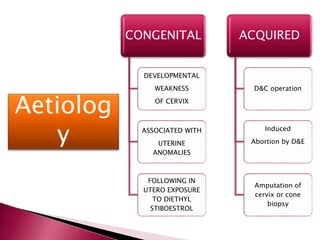
CONGENITAL
DEVELOPMENTAL
WEAKNESS
OF CERVIX
ASSOCIATED WITH
UTERINE
ANOMALIES
FOLLOWING IN
UTERO EXPOSURE
TO DIETHYL
STIBOESTROL
ACQUIRED
D&C operation
Induced
Abortion by D&E
Amputation of
cervix or cone
biopsy
Aetiolog
y
 History :
Repeated mid trimester painless cervical dilatation
(without apparent cause) and escape of liquor amnii
followed by painless expulsion of the products of
conception
 Interconceptional period:
Passage number 6–8 Hegar dilator beyond the internal
os without any resistance and pain
Premenstrual hysterocervicography shows funnel-
shaped shadow
HEGAR
DILATOR
During pregnancy
 Transvaginal Sonography:
cervix length < 25 mm (nor 35-40); internal
os diameter > 20 mm (nor <20mm) at 14
weeks is suggestive of cervical insufficency.
funnelling of os can also be seen
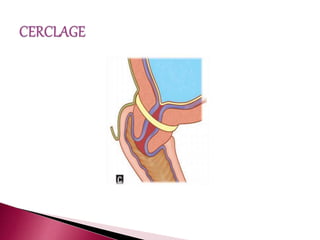
 Surgical – cervical cerclage
 The procedure reinforces the weak cervix by a
nonabsorbable tape, placed around the cervix at the
level of internal os.
 12-14 weeks
 Two types of operation are in current use :
Shirodkar (1955) and McDonald (1963)
 History indicated:
definite history with three previous second
trimester losses or preterm births.
 Ultrasound indicated:
shortened cervix or early funnelling seen in
transvaginal sonography
 Rescue or Examination indicated:
when the cervix is dilated and there is
bulging of the membranes
 light general anesthesia
 lithotomy position
 Exposure of the cervix by a posterior Sims vaginal
speculum.
 The lips of the cervix are pulled down by sponge holding
forceps or Allis tissue forceps.
 The nonabsorbable suture (Mersilene) material is placed as
a purse-string suture as high as possible (level of internal
os) .
 The suture starts at the anterior wall of the cervix. Taking
successive deep bites (4–5 sites), it is carried around the
lateral and posterior walls back to the anterior wall again
where the two ends of the suture are tied.
 A transverse incision is made anteriorly at cervicovaginal
junction and the bladder is pushed up to expose the level of
the internal os.
 A vertical incision is made posteriorly on the cervicovaginal
junction.
 The nonabsorbable suture material—Mersilene tape is
passed submucously with the help of shirodkar needle so as
to bring the suture ends through the posterior incision.
 The ends of the tapes are tied up posteriorly by a reef knot.
 The anterior and posterior incisions are repaired by
interrupted stitches using chromic catgut.
 A Mersilene tape is placed at the level of the isthmus
 This is done between 11 weeks and 13 weeks following
laparotomy.
 Disadvantages are: (i) Increased complications during
operation.
(ii) Subsequent CS for delivery
 Indications are—cases where cervix is hypoplastic or where
prior vaginal cerclage has failed.
Postoperative care:
 The patient should be in bed for at least 2–3 days.
 antibiotic cover
 avoid intercourse
 Weekly injections of 17α-hydroxyprogesterone
caproate 500 mg IM.
 Isoxsuprine (tocolytics) 10 mg tablet may be given
thrice daily to avoid uterine irritability.
 The stitch should be removed at 37th week or earlier if
labor pain starts or features of abortion appear.
If the stitch is not cut in time, uterine rupture or cervical
tear may occur.
Contraindications :
 intrauterine infection ,
 bleeding ,
 contractions or rupture membrane ,
 cervical diltation more than 4cm
 Fetal death or defect
Complications :
 Rupture of membrane
 Chorioamnonitis and infection
 Rupture of uterus
 Necrosis of cervix
 A thorough medical, surgical and obstetric history taking
should be done
 Blood-glucose (fasting and postprandial),
 thyroid function test,
 ABO and Rh grouping (husband and wife),
 Autoimmune screening—lupus anticoagulant and anticardiolipin
antibodies
 Ultrasonography—to detect congenital malformation of uterus,
polycystic ovaries and uterine fibroid.
 Hysterosalpingography in the secretory phase to detect—cervical
incompetence, uterine synechiae and uterine malformation
 Karyotyping (husband and wife).
 Endocervical swab to detect chlamydia, mycoplasma and
bacterial vaginosis
 VDRL,
 Deliberate termination of pregnancy either by medical
or by surgical method before the viability of the fetus is
called induction of abortion.
 Termination is permitted up to 20 weeks of pregnancy.
 200 mg of mifepristone orally is given on day 1. On
day 3, misoprostol (PGE1) 400 µg orally or 800 µg
vaginally is given. Expulsion occurs in 4-6 hrs.
 Menstrual regulation
 Suction evacuation and/or curettage
 Dilatation and evacuation
 Misoprostol (PGE1 analog): 400–800 µg of
misoprostol given vaginally at an interval of 3–4 hours
is most effective as the bioavailability is high.
 OXYTOCIN: High-dose oxytocin as a single agent can
be used for second trimester abortion
 Intrauterine instillation of hypertonic solution (Between
16 weeks and 20 week)
 Hysterotomy
THA
NK

Abortion-spontaneous miscarriage

  • 2.
     Abortion isthe expulsion (or extraction from its mother) of an embryo or fetus weighing 500 g or less when it is not capable of independent survival (WHO).  The current cut off for fetal viability is 22 weeks by the WHO.
  • 3.
     15% ofall clinically recognized pregnancies.  80% of this occur in the first trimester .  Rates vary with maternal age.  High in elderly and in women with previous miscarriage
  • 4.
    Fetal Chrom osomal abnorm alities Other genetic abnorm alities Hydrop ic degene ration of villi Multipl e pregna ncies Maternal Maternal infections Eg: TORCH, syphilis, mycoplas ma, listeria Maternal disease Eg: HTN, uncontroll edDM, CKD Endocri ne factors Eg: thyroid dysfunc tion Luteal phase defect Environm ental factors Eg: smoking, radiation , anastheti c agent, alcohol, drugs Immunol ogical factor Eg: anti phosphol ipid antibody, Alloimm une amtibody Uterine factor Eg: cervical incompet ence Asherman ’s syndrome Mullerian anomalies Submuco us myoma
  • 5.
  • 6.
    It is aclinical entity where the process of miscarriage has started but has not progressed to a state from which recovery is impossible. Clinical presentation :  Vaginal bleeding  Usually painless , may have abdominal cramps and back ache Examination :  Cervix soft with closed internal os.  Size of uterus corresponds to period of amenorrhoea
  • 7.
    Differential diagnosis 1. Ectopicgestation ( serial serum beta HCG ) 2. Hydatidiform mole 3. Missed abortion Ultrasonography is diagnostic Management  The patient should be in bed for few days until bleeding stops.  Coitus is avoided during this period  Relief of pain may be ensured by diazepam 5 mg tablet twice daily  Anti-D for Rh negative mother.(beyond 12 weeks)  There is some evidence that treatment with progesterone improves the outcome.(controversial)  should be followed up with repeat sonography at 3–4 weeks’ time Ultrasonography (TVS) findings may be: (1) A well-formed gestation ring with central echoes from the embryo indicating healthy fetus (2) Observation of fetal cardiac motion. With this there is 98% chance of continuation of pregnancy. (3) A blighted ovum is evidenced by loss of definition of the gestation sac, smaller mean gestational sac diameter, absent fetal echoes and absent fetal cardiac movements
  • 8.
    Prognosis and outcome The prognosis is very unpredictable.  80% willl go on to term.  In the rest, it terminates either as inevitable or missed miscarriage  If the pregnancy continues, there is increased frequency of preterm labor, placenta previa, intrauterine growth restriction of the fetus and fetal anomalies.
  • 9.
    It is theclinical type of abortion where the changes have progressed to a state from where continuation of pregnancy is impossible. Clinical presentation :  Vaginal bleeding, profuse  Associated with severe pain, colicky in nature Examination :  Internal examination reveals dilated internal os of the cervix through which the products of conception are felt .
  • 10.
    Management  The bloodloss should corrected by intravenous (IV) fluid therapy and blood transfusion.  Before 12 weeks: suction evacuation followed by curettage is done.  After 12 weeks: The uterine contraction is accelerated by oxytocin drip (10 units in 500 mL of normal saline) 40–60 drops per minute to hasten expulsion. Anti-D is given to Rh negative mother.
  • 11.
    When the processof abortion has already taken place but entire products of conception are not expelled, instead a part of it is left inside the uterine cavity, it is called incomplete miscarriage. This is the commonest type met amongst women
  • 12.
    CLINICAL FEATURES:  Historyof expulsion of a fleshy mass per vaginam  pain in lower abdomen.  Persistence of vaginal bleeding. EXAMINATION  uterus smaller than the period of amenorrhea  internal os is open  on examination, the expelled mass is found incomplete  Ultrasonography—reveals echogenic material (products of conception) within the cavity. COMPLICATIONS: The retained products may cause: (a) profuse bleeding (b) sepsis or (c) placental polyp.
  • 13.
    MANAGEMENT:  Resuscitation  Earlyabortion: evacuation of uterus by suction evacuation  Late abortion: dilatation and curettage  The removed materials are subjected to a histological examination.  In stable patients with closed os, Tablet misoprostol 200 µg is used vaginally every 4 hours  anti-D gamma globulin 50 μg or 100 μg intramuscularly
  • 14.
    when the productsof conception are expelled en masse, it is called complete miscarriage. CLINICAL FEATURES: There is history of expulsion of a fleshy mass per vaginam followed by:  Subsidence of abdominal pain.  Vaginal bleeding becomes trace or absent. EXAMINATION  Uterus is smaller than the period of amenorrhea and a little firmer.  Cervical os is closed  Examination of the expelled fleshy mass is found complete.  Ultrasonography (TVS): reveals empty uterine cavity. Management is usually conservative.
  • 15.
    In this thefetus is dead and retained inside the uterus for a variable period. CLINICAL FEATURES:  Spotting or bleeding  Persistence of brownish vaginal discharge.  Subsidence of pregnancy symptoms. EXAMINATION  Uterine size smaller  Nonaudibility of the fetal heart sound  Cervix feels firm and os is closed  immunological test for pregnancy becomes negative.
  • 16.
    ULTRASONOGRAPHY  Missed abortionis diagnosed when there is a crown rump length of 15 mm without a fetal heart.  Anembryonic pregnancy (blighted ovum) is considered when there is a gestational sac more than 16mm in diameter without a fetal node. COMPLICATIONS  Sepsis  DIC (thromboplastin like substance from dead fetus)  Psycological trauma
  • 17.
    Uterus less than12 weeks:  Medical management: Prostaglandin E1 (misoprostol) 800 µg vaginally in the posterior fornix is given and repeated after 24 hours if needed. Expulsion usually occurs within 48 hours.  Suction evacuation or dilatation and evacuation is done either as a definitive treatment or it can be done when the medical method fails.
  • 18.
    Uterus more than12 weeks: Induction is done by the following methods:  Prostaglandin E1 analog (misoprostol) 200 µg tablet is inserted into the posterior vaginal fornix every 6 hours for a maximum of 5 such.  If it fails extra-amniotic instilliation of ethacridine lactate can be done Following medical treatment, ultrasonography should be done to document empty uterine cavity. Otherwise evacuation of the retained products of conception (ERPC) should be done.
  • 19.
    Any abortion associatedwith clinical evidences of infection of the uterus and its contents is called septic abortion. Abortion is usually considered septic when there are: (1) rise of temperature of at least 100.4°F (38°C) for 24 hours or more, (2) offensive or purulent vaginal discharge and (3) other evidences of pelvic infection such as lower abdominal pain and tenderness. in the majority of cases, the infection occurs following illegal induced abortion but infection can occur even after spontaneous abortion
  • 20.
    CLINICAL FEATURES  Historyof unsafe termination  Fever  Abdominal pain and vomiting or diarrhoea  Purulent discharge and bleeding per vaginum  Hypotension  Tachycardia  Abdominal tenderness  Cervix may be soft and os open  Tenderness in the fornicess  A soft boggy mass may be felt
  • 21.
    CLINICAL GRADING:  GradeI: The infection is localized in the uterus.  Grade II: The infection spreads beyond the uterus to the parametrium, tubes and ovaries or pelvic peritoneum.  Grade III: Generalized peritonitis and/or endotoxic shock or jaundice or acute renal failure.
  • 22.
     Complete bloodcount  High vaginal swab for culture and sensitivity  Blood urea, creatinine, and electrolyte  Blood culture if septicemia is suspected  Ultrasonography of pelvis and abdomen to detect intrauterine retained products of conception.  Plain X-ray— (a) Abdomen—in suspected cases of bowel injury (b) Chest—for cases with pulmonary complications (atelectasis).
  • 23.
     Police notificationin criminal abortion  Maintenance of perfusion and ventilation is of prime concern.  Crystalloids are used to restore circulation and if necessary blood transfusion is given  monitoring of pulse, respiration, temperature, urinary output and progress of the pain, tenderness and mass in lower abdomen, CVP .  Broad spectrum antibiotics : combination of ampicillin, gentamicin, and metronidazole or cefotaxime/sefuroxime along with metronidazole/clindamycin.  Once infection is controlled evacuation of uterus is done.  If pelvic abscess has formed, it can be drained by posterior colpotomy.
  • 24.
    Indication For ExploratoryLaprotomy  Uterine perforation with suspected injury to the bowel  No response to evacuation and medical therapy  Generalised peritonitis with intraabdominal abscessess
  • 27.
     It isdefined as three or more spontaneous abortion.  Affects 1% of women  Can be primary ( no successful pregnancy) or secondary ( repetitive loss following a live birth)  As number of miscarriages increase , the prevelance of maternal cause increases and that of chromosomal abnormality decreases.
  • 28.
    Recurrent miscarriage First Trimester genetic Balancedtranslocation Endocrine and metabolic Uncontrolled DM PCOS Thyroid Autoantibody Luteal phase defect Inherited thrombophilias Protein C or protein S deficiency Hyperhomocystenemia prothrombin gene mutation Immune factor Antiphospholipid antibody syndrome Alloimmune factors infections Second Trimester Anatomic abnormality Cervical incompetence Bicornuate uterus Septate uterus Chronic maternal illness Hypertension Heart disease Infection Syphilis Bacterial vaginosis unexplained
  • 30.
     Autoimmune cause. 15% of recurrent miscarriage  Antiphospholipid antibodies are:  lupus anticoagulant,  anticardiolipin antibodies and  anti b glycoprotein-I.
  • 31.
    Causes of miscarriageare  release of local inflammatory mediators (cytokines) through complement pathway,  spiral artery and placental intervillous thrombosis Management  Diagnosis is by detection of lupus anticoagulant, or IgM/IgG anticardiolipin antibodies or b2 glycoprotein-I.  Lupus anticoagulant can be detected by APTT or dilute Russel viper venom test.  treated with low-dose aspirin (50 mg/day) and heparin (5,000 units SC twice daily) may have to be continued till postpartum.
  • 32.
     immune responsedirected against foreign or non self antigens.  Mother mounts an immune response against the paternal antigen in the fetus.  Normal pregnancy is due T helper-2 cytokines response but women with recurrent miscarriage have T helper-1 type response
  • 34.
     Uterine anomalieslike bicornuate uterus and septate uterus  Miscarriage due to reduced size of uterine cavity and decreased blood supply causing defective implantation and placentation  Asherman syndrome – intrauterine adhesions due to previous curettage  Submucous fibroid
  • 36.
     Transvaginal ultrasoundin secretory phase is very useful  3 D ultrasound and MRI are confirmatory  Hysteroscopic resection in case of septum or divison of adhesions in Asherman’s syndrome  Myomectomy in submucous fibroid
  • 37.
     Cervical insufficencyin charctericed by painless cervical dilation in the second or early third trimester with ballooning of the amniotic sac into the vagina, followed by rupture of membrane and expulsion of a live fetus.  Usually at 16 – 24 week
  • 38.
  • 39.
    CONGENITAL DEVELOPMENTAL WEAKNESS OF CERVIX ASSOCIATED WITH UTERINE ANOMALIES FOLLOWINGIN UTERO EXPOSURE TO DIETHYL STIBOESTROL ACQUIRED D&C operation Induced Abortion by D&E Amputation of cervix or cone biopsy Aetiolog y
  • 40.
     History : Repeatedmid trimester painless cervical dilatation (without apparent cause) and escape of liquor amnii followed by painless expulsion of the products of conception  Interconceptional period: Passage number 6–8 Hegar dilator beyond the internal os without any resistance and pain Premenstrual hysterocervicography shows funnel- shaped shadow
  • 41.
  • 42.
    During pregnancy  TransvaginalSonography: cervix length < 25 mm (nor 35-40); internal os diameter > 20 mm (nor <20mm) at 14 weeks is suggestive of cervical insufficency. funnelling of os can also be seen
  • 43.
     Surgical –cervical cerclage  The procedure reinforces the weak cervix by a nonabsorbable tape, placed around the cervix at the level of internal os.  12-14 weeks  Two types of operation are in current use : Shirodkar (1955) and McDonald (1963)
  • 45.
     History indicated: definitehistory with three previous second trimester losses or preterm births.  Ultrasound indicated: shortened cervix or early funnelling seen in transvaginal sonography  Rescue or Examination indicated: when the cervix is dilated and there is bulging of the membranes
  • 46.
     light generalanesthesia  lithotomy position  Exposure of the cervix by a posterior Sims vaginal speculum.  The lips of the cervix are pulled down by sponge holding forceps or Allis tissue forceps.  The nonabsorbable suture (Mersilene) material is placed as a purse-string suture as high as possible (level of internal os) .  The suture starts at the anterior wall of the cervix. Taking successive deep bites (4–5 sites), it is carried around the lateral and posterior walls back to the anterior wall again where the two ends of the suture are tied.
  • 48.
     A transverseincision is made anteriorly at cervicovaginal junction and the bladder is pushed up to expose the level of the internal os.  A vertical incision is made posteriorly on the cervicovaginal junction.  The nonabsorbable suture material—Mersilene tape is passed submucously with the help of shirodkar needle so as to bring the suture ends through the posterior incision.  The ends of the tapes are tied up posteriorly by a reef knot.  The anterior and posterior incisions are repaired by interrupted stitches using chromic catgut.
  • 50.
     A Mersilenetape is placed at the level of the isthmus  This is done between 11 weeks and 13 weeks following laparotomy.  Disadvantages are: (i) Increased complications during operation. (ii) Subsequent CS for delivery  Indications are—cases where cervix is hypoplastic or where prior vaginal cerclage has failed.
  • 51.
    Postoperative care:  Thepatient should be in bed for at least 2–3 days.  antibiotic cover  avoid intercourse  Weekly injections of 17α-hydroxyprogesterone caproate 500 mg IM.  Isoxsuprine (tocolytics) 10 mg tablet may be given thrice daily to avoid uterine irritability.  The stitch should be removed at 37th week or earlier if labor pain starts or features of abortion appear. If the stitch is not cut in time, uterine rupture or cervical tear may occur.
  • 52.
    Contraindications :  intrauterineinfection ,  bleeding ,  contractions or rupture membrane ,  cervical diltation more than 4cm  Fetal death or defect Complications :  Rupture of membrane  Chorioamnonitis and infection  Rupture of uterus  Necrosis of cervix
  • 53.
     A thoroughmedical, surgical and obstetric history taking should be done  Blood-glucose (fasting and postprandial),  thyroid function test,  ABO and Rh grouping (husband and wife),  Autoimmune screening—lupus anticoagulant and anticardiolipin antibodies  Ultrasonography—to detect congenital malformation of uterus, polycystic ovaries and uterine fibroid.  Hysterosalpingography in the secretory phase to detect—cervical incompetence, uterine synechiae and uterine malformation  Karyotyping (husband and wife).  Endocervical swab to detect chlamydia, mycoplasma and bacterial vaginosis  VDRL,
  • 54.
     Deliberate terminationof pregnancy either by medical or by surgical method before the viability of the fetus is called induction of abortion.  Termination is permitted up to 20 weeks of pregnancy.
  • 55.
     200 mgof mifepristone orally is given on day 1. On day 3, misoprostol (PGE1) 400 µg orally or 800 µg vaginally is given. Expulsion occurs in 4-6 hrs.  Menstrual regulation  Suction evacuation and/or curettage  Dilatation and evacuation
  • 56.
     Misoprostol (PGE1analog): 400–800 µg of misoprostol given vaginally at an interval of 3–4 hours is most effective as the bioavailability is high.  OXYTOCIN: High-dose oxytocin as a single agent can be used for second trimester abortion  Intrauterine instillation of hypertonic solution (Between 16 weeks and 20 week)  Hysterotomy
  • 57.

Editor's Notes

  • #8 Ectopic 1500IU/l Hydatidiform mole snow storm appearnce in us
  • #29 PCOS hyperinsulinemia hypergonadism hypersecretion of lutensing hormone
  • #31 Self antigen
  • #56 Oral mifepristone 200 mg (1 tab) with vaginal misoprostol 800 µg (4 tab, 200 µg each) after 6–48 hours is equally effective.