Prepared by: Cheng Chan Mara
Definition
                         
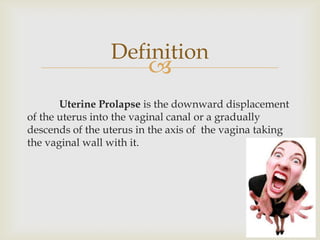
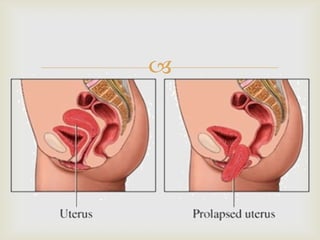
       Uterine Prolapse is the downward displacement
of the uterus into the vaginal canal or a gradually
descends of the uterus in the axis of the vagina taking
the vaginal wall with it.

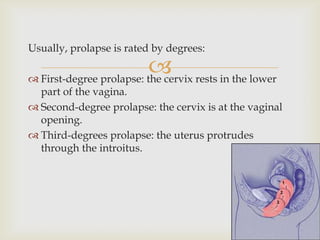
Usually, prolapse is rated by degrees:

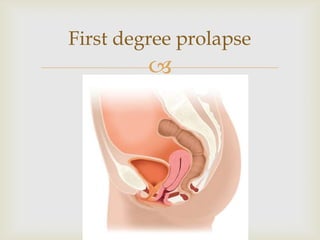
                          rests in the lower
 First-degree prolapse: the cervix
  part of the vagina.
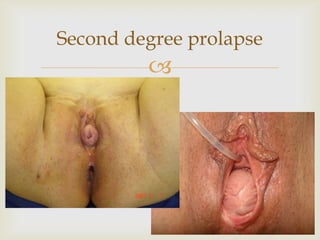
 Second-degree prolapse: the cervix is at the vaginal
  opening.
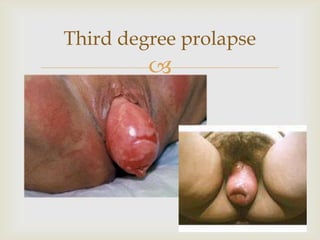
 Third-degrees prolapse: the uterus protrudes
  through the introitus.
First degree prolapse
         
Second degree prolapse
         
Third degree prolapse
         
Etiology
                      
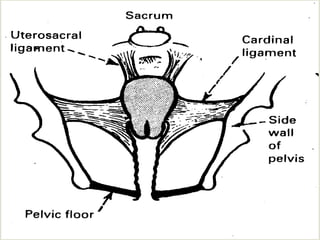
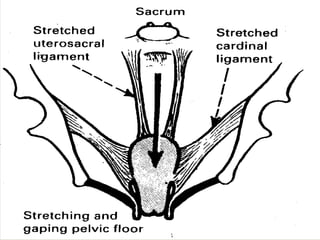
 Stretching of muscle and fibrous tissue.
      eg. Pregnancy and childbirth.
 Increased intra-abdominal pressure as a result of
  chronic coughing, lifting of heavy objects and
  obesity, place pressure on the pelvic floor.
 A constitutional predisposition to stretching of the
  ligaments as a response presumably to years in the
  erect position.
 Menopause and ageing increase the risk of prolapse.
  (The female hormone estrogen plays an important role in
  maintaining the strength of the pelvic floor).


Clinical Manifestation
                         on a small ball
 Feeling like you are sitting
 Difficult or painful sexual intercourse
 Frequent urination or a sudden urge to empty the
  bladder
 Low backache
 Uterus and cervix that stick out through the vaginal
  opening
 Repeated bladder infections
 Feeling of heaviness or pulling in the pelvis
 Vaginal bleeding
 Increased vaginal discharge
Treatment
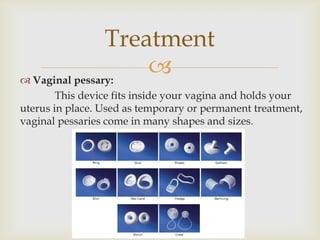
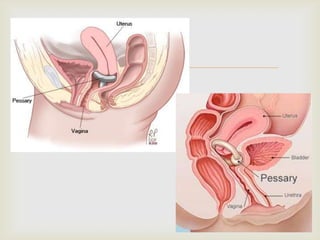
 Vaginal pessary:
                    
        This device fits inside your vagina and holds your
uterus in place. Used as temporary or permanent treatment,
vaginal pessaries come in many shapes and sizes.

Treatment (cont.)
              
 Surgery:
        Several different types of surgery can be used to
treat a severe genital prolapse. These procedures
include:
   • surgery to repair the tissue that supports the
     prolapsed organ
   • surgery to repair the tissue around the vagina
   • surgery to close the opening of the vagina
   • surgery to remove the womb (hysterectomy)
Collaborative Care
                
 preventive measures:
   Early visits to HC provider = early detection
   Teach Kegel’s exercises during PP period
 preoperative nursing care:
   Thorough explanation of procedure, expectation and effect
     on future sexual f(x)
   Laxative and cleansing edema (rectocele) – independently,
     at home a day prior procedure
   Perineal shave prescribed also
   Lithotomy position for surgery
 postop nursing care:
      Pt. is to void few hours after surgery; catheter if unable (after 6
       hrs)


Thanks You!
Reference
                       
 http://www.davincihysterectomy.com/assets/images/uterus_pr
  olapse_after_220x201.jpg
 http://1.bp.blogspot.com/-
  AgGyPkYlLRI/UF0MM5nArgI/AAAAAAAAGf0/aLGNf4gtPDU
  /s320/vaginal-prolapse.JPG
 http://sdlc-esd.sun.com/ESD6/JSCDL/jdk/7u7-
  b11/jxpiinstall.exe?AuthParam=1348826780_3c1d68b448bc8c2e320
  c4a720ab8fce3&GroupName=JSC&FilePath=/ESD6/JSCDL/jdk/7
  u7-b11/jxpiinstall.exe&File=jxpiinstall.exe&BHost=javadl.sun.com
 http://www.nhs.uk/conditions/prolapse-of-the-
  uterus/pages/treatment.aspx
 http://www.ncbi.nlm.nih.gov/pubmedhealth/PMH0002477/
 http://www.mayoclinic.com/health/uterine-
  prolapse/DS00700/DSECTION=symptoms
 http://www.mayoclinic.com/health/uterine-
  prolapse/DS00700/DSECTION=treatments-and-drugs
 Medical Surgical Nursing (Volume 2) by Lewis, Heitkemper,
  Dirksen, O’Brien, Bucher.

Uterine prolapse

  • 1.
  • 2.
    Definition  Uterine Prolapse is the downward displacement of the uterus into the vaginal canal or a gradually descends of the uterus in the axis of the vagina taking the vaginal wall with it.
  • 3.
  • 4.
    Usually, prolapse israted by degrees:  rests in the lower  First-degree prolapse: the cervix part of the vagina.  Second-degree prolapse: the cervix is at the vaginal opening.  Third-degrees prolapse: the uterus protrudes through the introitus.
  • 5.
  • 6.
  • 7.
  • 8.
    Etiology   Stretching of muscle and fibrous tissue. eg. Pregnancy and childbirth.  Increased intra-abdominal pressure as a result of chronic coughing, lifting of heavy objects and obesity, place pressure on the pelvic floor.  A constitutional predisposition to stretching of the ligaments as a response presumably to years in the erect position.  Menopause and ageing increase the risk of prolapse. (The female hormone estrogen plays an important role in maintaining the strength of the pelvic floor).
  • 9.
  • 10.
  • 11.
    Clinical Manifestation  on a small ball  Feeling like you are sitting  Difficult or painful sexual intercourse  Frequent urination or a sudden urge to empty the bladder  Low backache  Uterus and cervix that stick out through the vaginal opening  Repeated bladder infections  Feeling of heaviness or pulling in the pelvis  Vaginal bleeding  Increased vaginal discharge
  • 12.
    Treatment  Vaginal pessary:  This device fits inside your vagina and holds your uterus in place. Used as temporary or permanent treatment, vaginal pessaries come in many shapes and sizes.
  • 13.
  • 14.
    Treatment (cont.)   Surgery: Several different types of surgery can be used to treat a severe genital prolapse. These procedures include: • surgery to repair the tissue that supports the prolapsed organ • surgery to repair the tissue around the vagina • surgery to close the opening of the vagina • surgery to remove the womb (hysterectomy)
  • 15.
    Collaborative Care   preventive measures:  Early visits to HC provider = early detection  Teach Kegel’s exercises during PP period  preoperative nursing care:  Thorough explanation of procedure, expectation and effect on future sexual f(x)  Laxative and cleansing edema (rectocele) – independently, at home a day prior procedure  Perineal shave prescribed also  Lithotomy position for surgery  postop nursing care:  Pt. is to void few hours after surgery; catheter if unable (after 6 hrs)
  • 16.
  • 17.
    Reference   http://www.davincihysterectomy.com/assets/images/uterus_pr olapse_after_220x201.jpg  http://1.bp.blogspot.com/- AgGyPkYlLRI/UF0MM5nArgI/AAAAAAAAGf0/aLGNf4gtPDU /s320/vaginal-prolapse.JPG  http://sdlc-esd.sun.com/ESD6/JSCDL/jdk/7u7- b11/jxpiinstall.exe?AuthParam=1348826780_3c1d68b448bc8c2e320 c4a720ab8fce3&GroupName=JSC&FilePath=/ESD6/JSCDL/jdk/7 u7-b11/jxpiinstall.exe&File=jxpiinstall.exe&BHost=javadl.sun.com  http://www.nhs.uk/conditions/prolapse-of-the- uterus/pages/treatment.aspx  http://www.ncbi.nlm.nih.gov/pubmedhealth/PMH0002477/  http://www.mayoclinic.com/health/uterine- prolapse/DS00700/DSECTION=symptoms  http://www.mayoclinic.com/health/uterine- prolapse/DS00700/DSECTION=treatments-and-drugs  Medical Surgical Nursing (Volume 2) by Lewis, Heitkemper, Dirksen, O’Brien, Bucher.