Dr. R. D. Anpin Raja
Lepidodendron
Taxonomic position, Features &
Reproductive Structure
3D illustration of the triceratops in Lepidodendron grove
TAXONOMIC POSITION
Division : Pteridophyta
Class :Lycopsida
Order :Lepidodendrales
Family
:Lepidodendraceae
Genus :Lepidodendron
Lepidodendron: Taxonomic position, Features & Reproductive Structure
Lepidodendron
Reconstructed from 4 fossil
form genus
1. Stigmaria
2. Lepidophylloides
3. Lepidostrobus
4. Lepidocarpon
Lepidodendron: Taxonomic position, Features & Reproductive Structure
Lepidodendron
 also known as “scale tree”
 one of the most abundant
trees of the Carboniferous
period
 It lived in some of the wettest
parts of the prehistoric coal
swamps
 commonly grew in dense
stands
 only lived about 10 to 15
years.
Lepidodendron: Taxonomic position, Features & Reproductive Structure
Lepidodendron
 Groups of arborescent (tree like)
lycopods
 evolved from the Middle Devonian
lycopods
 The petrified trunks were sometimes
as long as 100 feet
 assumed that the plant reached a
height of over 160 ft (50 m)
 trunks were often over 1 m diameter
 Lepidodendron with 100 species
 the best-investigated genus
 Fossils from Sandstones of coal
bearing formations
Lepidodendron: Taxonomic position, Features & Reproductive Structure
 Trunk was straight up to 35 m
height).
 Dichotomously branched only
at the top
 Branches were short
 Ultimate dichotomies
produced the leaves.
 The branches and the foliage
formed as a crown at the apex
of the long trunk
 Cones formed at their tips.
Lepidodendron: Morphology
Lepidodendron: Taxonomic position, Features & Reproductive Structure
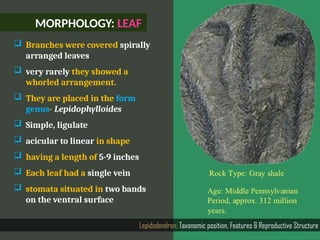
MORPHOLOGY: LEAF
Lepidodendron: Taxonomic position, Features & Reproductive Structure
 Branches were covered spirally
arranged leaves
 very rarely they showed a
whorled arrangement.
 They are placed in the form
genus- Lepidophylloides
 Simple, ligulate
 acicular to linear in shape
 having a length of 5-9 inches
 Each leaf had a single vein
 stomata situated in two bands
on the ventral surface
MORPHOLOGY: LEAF
 The leaves were deciduous
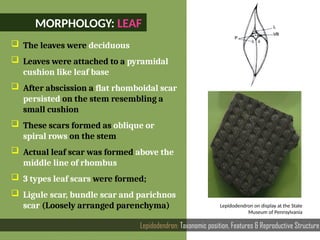
 Leaves were attached to a pyramidal
cushion like leaf base
 After abscission a flat rhomboidal scar
persisted on the stem resembling a
small cushion
 These scars formed as oblique or
spiral rows on the stem
 Actual leaf scar was formed above the
middle line of rhombus
 3 types leaf scars were formed;
 Ligule scar, bundle scar and parichnos
scar (Loosely arranged parenchyma)
Lepidodendron: Taxonomic position, Features & Reproductive Structure
Lepidodendron on display at the State
Museum of Pennsylvania
MORPHOLOGY: ROOT
Lepidodendron: Taxonomic position, Features & Reproductive Structure
 The base of the stem was attached
to the root system
 Root system is included in the form
genus, Stigmaria
 In S. ficoides, base of the trunk is
divided into 4 massive rhizophore
 Rhizophore later again form
repeated dichoto­
mous branches in
the horizontal plane
 The Stigmaria spread over an area
of about 20 ft (6 m) across
 younger portions had spirally
arranged roots, known as
Stigmarian rootlet
ANATOMY: STEM
Lepidodendron: Taxonomic position, Features & Reproductive Structure
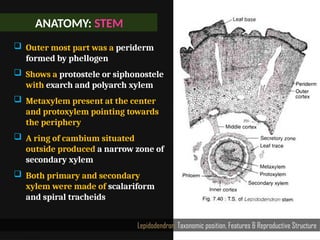
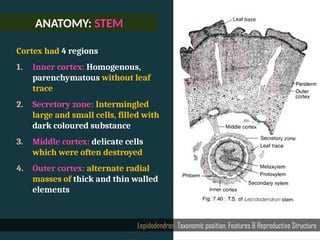
 Outer most part was a periderm
formed by phellogen
 Shows a protostele or siphonostele
with exarch and polyarch xylem
 Metaxylem present at the center
and protoxylem pointing towards
the periphery
 A ring of cambium situated
outside produced a narrow zone of
secondary xylem
 Both primary and secondary
xylem were made of scalariform
and spiral tracheids
ANATOMY: STEM
Lepidodendron: Taxonomic position, Features & Reproductive Structure
Cortex had 4 regions
1. Inner cortex: Homogenous,
parenchymatous without leaf
trace
2. Secretory zone: Intermingled
large and small cells, filled with
dark coloured substance
3. Middle cortex: delicate cells
which were often destroyed
4. Outer cortex: alternate radial
masses of thick and thin walled
elements
STROBILUS
Lepidodendron: Taxonomic position, Features & Reproductive Structure
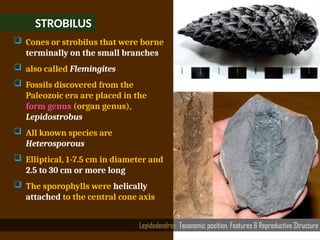
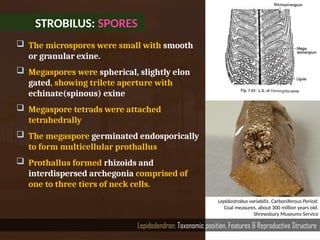
 Cones or strobilus that were borne
terminally on the small branches
 also called Flemingites
 Fossils discovered from the
Paleozoic era are placed in the
form genus (organ genus),
Lepidostrobus
 All known species are
Heterosporous
 Elliptical, 1-7.5 cm in diameter and
2.5 to 30 cm or more long
 The sporophylls were helically
attached to the central cone axis
STROBILUS
Lepidodendron: Taxonomic position, Features & Reproductive Structure
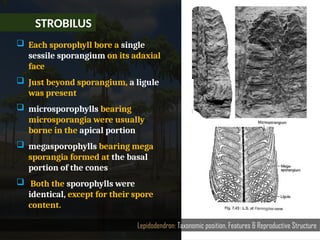
 Each sporophyll bore a single
sessile sporangium on its adaxial
face
 Just beyond sporangium, a ligule
was present
 microsporophylls bearing
microsporangia were usually
borne in the apical portion
 megasporophylls bearing mega­
sporangia formed at the basal
portion of the cones
 Both the sporophylls were
identical, except for their spore
content.
STROBILUS: SPORANGIUM
Lepidodendron: Taxonomic position, Features & Reproductive Structure
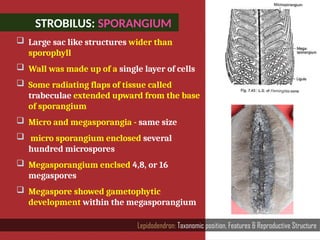
 Large sac like structures wider than
sporophyll
 Wall was made up of a single layer of cells
 Some radiating flaps of tissue called
trabeculae extended upward from the base
of sporangium
 Micro and megasporangia - same size
 micro sporangium enclosed several
hundred microspores
 Megasporangium enclsed 4,8, or 16
megaspores
 Megaspore showed gametophytic
development within the megasporangium
STROBILUS: SPORES
Lepidodendron: Taxonomic position, Features & Reproductive Structure
 The microspores were small with smooth
or granular exine.
 Megaspores were spherical, slightly elon­
gated, showing trilete aperture with
echinate(spinous) exine
 Megaspore tetrads were attached
tetrahedrally
 The megaspore germinated endosporically
to form multicellular prothallus
 Prothallus formed rhizoids and
interdispersed archegonia comprised of
one to three tiers of neck cells.
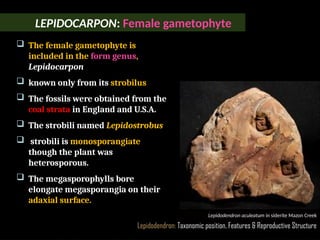
Lepidostrobus variabilis. Carboniferous Period:
Coal measures, about 300 million years old.
Shrewsbury Museums Service
Lepidodendron: Taxonomic position, Features & Reproductive Structure
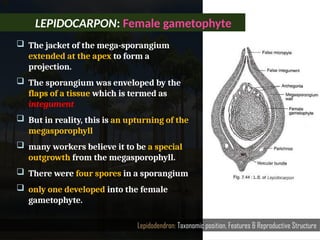
 The female gametophyte is
included in the form genus,
Lepidocarpon
 known only from its strobilus
 The fossils were obtained from the
coal strata in England and U.S.A.
 The strobili named Lepidostrobus
 strobili is monosporangiate
though the plant was
heterosporous.
 The megasporophylls bore
elongate megasporangia on their
adaxial surface.
Lepidodendron aculeatum in siderite Mazon Creek
LEPIDOCARPON: Female gametophyte
Lepidodendron: Taxonomic position, Features & Reproductive Structure
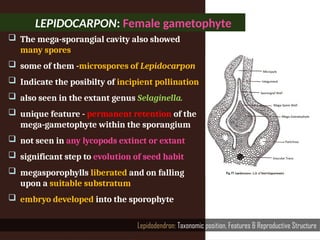
 The jacket of the mega-sporangium
extended at the apex to form a
projection.
 The sporangium was enveloped by the
flaps of a tissue which is termed as
integument
 But in reality, this is an upturning of the
megasporophyll
 many workers believe it to be a special
outgrowth from the megasporophyll.
 There were four spores in a sporangium
 only one developed into the female
gametophyte.
LEPIDOCARPON: Female gametophyte
Lepidodendron: Taxonomic position, Features & Reproductive Structure
 The mega-sporangial cavity also showed
many spores
 some of them -microspores of Lepidocarpon
 Indicate the posibilty of incipient pollination
 also seen in the extant genus Selaginella.
 unique feature - permanent retention of the
mega-gametophyte within the sporangium
 not seen in any lycopods extinct or extant
 significant step to evolution of seed habit
 megasporophylls liberated and on falling
upon a suitable substratum
 embryo developed into the sporophyte
LEPIDOCARPON: Female gametophyte
LEPIDOCARPON: SEED HABIT
Lepidodendron: Taxonomic position, Features & Reproductive Structure
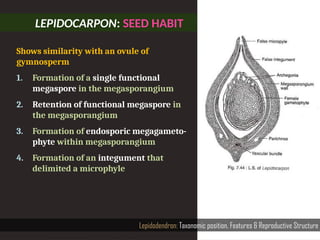
Shows simi­
larity with an ovule of
gymnosperm
1. Formation of a single functional
megaspore in the megasporangium
2. Retention of functional megaspore in
the megasporangium
3. Formation of endosporic megagameto-
phyte within megasporangium
4. Formation of an integument that
delimited a microphyle
LEPIDOCARPON: FALSE SEED
Lepidodendron: Taxonomic position, Features & Reproductive Structure
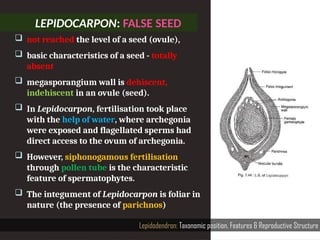
 not reached the level of a seed (ovule),
 basic charac­
teristics of a seed - totally
absent
 megasporangium wall is dehiscent,
indehiscent in an ovule (seed).
 In Lepidocarpon, fertilisation took place
with the help of water, where archegonia
were exposed and flagellated sperms had
direct access to the ovum of archegonia.
 However, siphonogamous fertilisation
through pollen tube is the characteristic
feature of spermatophytes.
 The integument of Lepidocarpon is foliar in
nature (the presence of parichnos)
LEPIDOCARPON: FALSE SEED
Lepidodendron: Taxonomic position, Features & Reproductive Structure
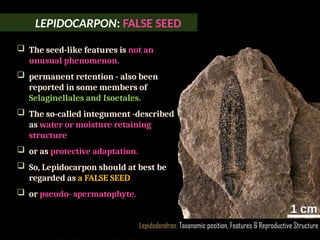
 The seed-like features is not an
unusual phenomenon.
 permanent retention - also been
reported in some members of
Selaginellales and Isoetales.
 The so-called integument -described
as water or moisture retaining
structure
 or as protective adaptation.
 So, Lepidocarpon should at best be
regarded as a FALSE SEED
 or pseudo- spermatophyte.
THANK YOU