Group Dynamics for the Capstone Course in Action Learning Based on Process Consultation by Edgar Schein, 1998 and Productive Workplaces by Marvin Weisbord, 2004
Problems in Entering a New Group  Identity -  Who am I to be? Control & Influence -  Will I be able to control and influence others? Needs & Goals -  Will the group goals include my own needs? Acceptance & Intimacy -  Will I be liked and accepted by the group?
Self-Oriented Coping Responses “ Tough” responses:  fighting, controlling, and resisting authority “ Tender” responses:  supporting, helping, forming alliances, dependency Withdrawal or denial responses:  passivity, indifference, overuse of “logic and reason”
Group Development  First, a period of self-oriented behavior  As self-oriented concerns are addressed, people pay more attention to each other and the task at hand The work of “building” the group occurs simultaneously with task accomplishment
Weisbord’s Conditions for Team Success  Interdependence -  people are working on problems in which each person has a stake   Leadership -  the boss wants to improve team performance and is willing to take some risks Joint decision -  all members agree to participate  Equal influence -  each person has a chance to influence the agenda
Questions Asked by Team Members  Am I in or out? Do I have any power or control? Can I use, develop, and be appreciated for my skills and resources?
Tuckman’s Stages of Group Development Forming Storming Norming Performing Adjourning
Task Dimensions  T he relationship between group members and the task they are to perform.  Task refers to the job they have to do and how they go about doing it.
Process dimensions   The relationships of group members with one another -- how they feel toward one another and how they feel about their membership in the group.
Task and Process Dimensions Highly interdependent in practice; without both dimensions, group process does not exist Task output is productivity Process output is cohesiveness
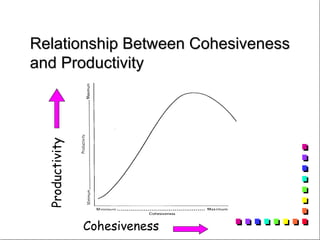
Relationship Between Cohesiveness and Productivity Productivity Cohesiveness
Promoting Cohesiveness in Groups Encourage interpersonal attraction through attitudinal similarity  Increase contact time Build perceptions of others as likeable Create opportunities for self-disclosure  Promote group identification
Cohesiveness in Groups, con’t Create history Accomplish something Develop relationships and shared norms Promote acceptance of all members Encourage external threats
An Effective Team Possesses...  Adequate mechanisms for getting feedback Optimal cohesion Flexible organization and procedures Maximum use of member resources Clear communications Clear goals accepted by all members Feelings of interdependence  Shared participation in leadership functions, including decision making Acceptance of minority views and persons

Group Dynamics Overiew For Capstone Course Jan 09

  • 1.
    Group Dynamics forthe Capstone Course in Action Learning Based on Process Consultation by Edgar Schein, 1998 and Productive Workplaces by Marvin Weisbord, 2004
  • 2.
    Problems in Enteringa New Group Identity - Who am I to be? Control & Influence - Will I be able to control and influence others? Needs & Goals - Will the group goals include my own needs? Acceptance & Intimacy - Will I be liked and accepted by the group?
  • 3.
    Self-Oriented Coping Responses“ Tough” responses: fighting, controlling, and resisting authority “ Tender” responses: supporting, helping, forming alliances, dependency Withdrawal or denial responses: passivity, indifference, overuse of “logic and reason”
  • 4.
    Group Development First, a period of self-oriented behavior As self-oriented concerns are addressed, people pay more attention to each other and the task at hand The work of “building” the group occurs simultaneously with task accomplishment
  • 5.
    Weisbord’s Conditions forTeam Success Interdependence - people are working on problems in which each person has a stake Leadership - the boss wants to improve team performance and is willing to take some risks Joint decision - all members agree to participate Equal influence - each person has a chance to influence the agenda
  • 6.
    Questions Asked byTeam Members Am I in or out? Do I have any power or control? Can I use, develop, and be appreciated for my skills and resources?
  • 7.
    Tuckman’s Stages ofGroup Development Forming Storming Norming Performing Adjourning
  • 8.
    Task Dimensions T he relationship between group members and the task they are to perform. Task refers to the job they have to do and how they go about doing it.
  • 9.
    Process dimensions The relationships of group members with one another -- how they feel toward one another and how they feel about their membership in the group.
  • 10.
    Task and ProcessDimensions Highly interdependent in practice; without both dimensions, group process does not exist Task output is productivity Process output is cohesiveness
  • 11.
    Relationship Between Cohesivenessand Productivity Productivity Cohesiveness
  • 12.
    Promoting Cohesiveness inGroups Encourage interpersonal attraction through attitudinal similarity Increase contact time Build perceptions of others as likeable Create opportunities for self-disclosure Promote group identification
  • 13.
    Cohesiveness in Groups,con’t Create history Accomplish something Develop relationships and shared norms Promote acceptance of all members Encourage external threats
  • 14.
    An Effective TeamPossesses... Adequate mechanisms for getting feedback Optimal cohesion Flexible organization and procedures Maximum use of member resources Clear communications Clear goals accepted by all members Feelings of interdependence Shared participation in leadership functions, including decision making Acceptance of minority views and persons