Tuckman’s Model of Team
Formation
By A. Student
ENGR240
Introduce topic
and self in the
first slide
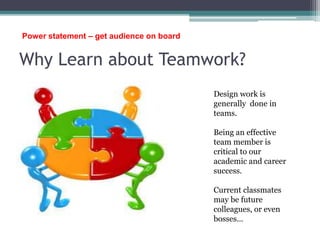
Why Learn about Teamwork?
Design work is
generally done in
teams.
Being an effective
team member is
critical to our
academic and career
success.
Current classmates
may be future
colleagues, or even
bosses…
Power statement – get audience on board
Questions you may have
• How do interpersonal dynamics work?
• What can I expect from my teammates and
team leader in terms of behaviour and
expectations?
• What is a successful, high-performing team?
How can I help to turn mine into one?
Get audience input
Bruce Tuckman
• An American psychologist
• Did research with the navy into small-group
dynamics: what makes teams succeed, what makes
them fail?
• Isolated teams, stressful conditions
• Reviewed the psychological literature on team
dynamics
• Generalized to a staged theory of the development of
small groups
Some relevant background
1. Bruce Tuckman, “The Tuckman model of team
formation” – published in Psychological
Bulletin in 1965
1. Tuckman and Mary Ann Jensen, “Stages of
small-group development revisited” –
published in Group & Organisational Studies
in 1977. Added Adjourning/Mourning.
1. Then refined and updated continuously by
other researchers.
The Tuckman Model Forming
Storming
Norming
Performing
Adjourning
Overview Slide
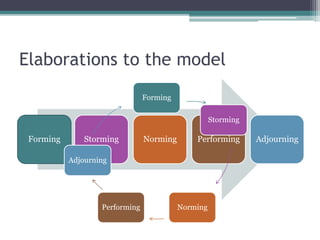
Elaborations to the model
Forming Storming Norming Performing Adjourning
Forming
Storming
Norming
Performing
Adjourning
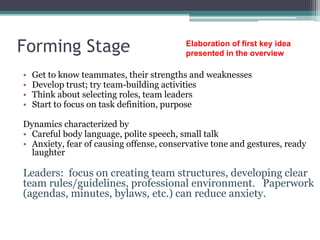
Forming Stage
• Get to know teammates, their strengths and weaknesses
• Develop trust; try team-building activities
• Think about selecting roles, team leaders
• Start to focus on task definition, purpose
Dynamics characterized by
• Careful body language, polite speech, small talk
• Anxiety, fear of causing offense, conservative tone and gestures, ready
laughter
Leaders: focus on creating team structures, developing clear
team rules/guidelines, professional environment. Paperwork
(agendas, minutes, bylaws, etc.) can reduce anxiety.
Elaboration of first key idea
presented in the overview
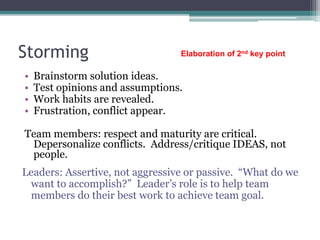
Storming
• Brainstorm solution ideas.
• Test opinions and assumptions.
• Work habits are revealed.
• Frustration, conflict appear.
Team members: respect and maturity are critical.
Depersonalize conflicts. Address/critique IDEAS, not
people.
Leaders: Assertive, not aggressive or passive. “What do we
want to accomplish?” Leader’s role is to help team
members do their best work to achieve team goal.
Elaboration of 2nd key point
Norming
• Team members are aware of their roles.
• Norms of behaviour appear; expectations are known.
• Body language, speech, terms of address become more
relaxed.
• Implicit as well as explicit rules established.
• “we” and “us” replacing “me” and “I”
• Taking individual responsibility for group decisions.
• Willingness to compromise and abide by team decisions.
Leaders: Time to back off. Monitor and enable; be
ready to reassert if necessary.
Elaboration of 3rd key point
Ask audience for suggestions: what might be an “implicit rule”?
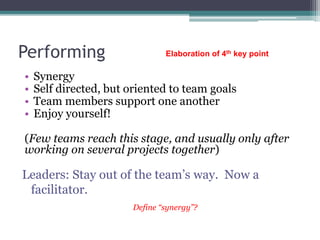
Performing
• Synergy
• Self directed, but oriented to team goals
• Team members support one another
• Enjoy yourself!
(Few teams reach this stage, and usually only after
working on several projects together)
Leaders: Stay out of the team’s way. Now a
facilitator.
Elaboration of 4th key point
Define “synergy”?
Adjourning / Mourning
• End of project or departure of member
• Take pride in your work. Celebrate success!
• Review lessons learned
• Enjoy group loyalty, but beware of avoidant
behaviour / formation of cliques.
Elaboration of 5th Key point
Skyrim Development Team Photo
[6]
Example of “end of project celebration”
Insights
• Conflict during the Storming stage is NOT a sign
of a defective team – it’s a necessary and
productive precondition for success and
innovative thinking. Conflict can be productive
if handled well, but destructive if managed
poorly.
• It’s OK to return to a previous stage if
circumstances warrant.
Draw on previous material; highlight important
“take-aways”
Potential issues
• Stage metaphor – what if stages are missed?
• Causation – what allows movement between
stages?
• Pedagogical concerns
• Self-fulfilling prophecy?
• Generalizability
Engage audience in discussion about
“potential issues” – get critical feedback?
Conclusion
Tuckman’s model and its derivatives are powerful,
insightful and useful tools for understanding your
team dynamics, but his stages are not necessarily
prerequisites for success, and this is not the only
successful model of successful teamwork.
Think for yourself – apply your own critical thinking
capacity to your team experience.
Summation/wrap up
Any Questions?
Give audience a chance to ask questions and have
further input/discussion
Thank you!
References
[1] B. W. Tuckman, “Developmental sequence in small groups”, Psychological Bulletin #63(6), pp.
384-399, 1965.
[2] B. W. Tuckman, and M. C. Jensen, “Stages of small-group development revisited”, Group &
Organizational Studies (pre 1986), p. 419, 1977.
[3] M. K. Smith, “Bruce W Tuckman – forming, storming, norming and performing in groups”,
infed.org: The Encyclopedia of Informal Education, 2005. http://infed.org/mobi/bruce-w-
tuckman-forming-storming-norming-and -performing-in-groups/. Retrieved Feb 26, 2016.
[4] A. C. Hurt and S. M. Trombley, “The punctuated Tuckman: towards a new group development
model.” Texas A&M University, 2007. http://www.eric.ed.gov/PDFS/ED504567.pdf Retrieved
Feb 26, 2016.
[5] S. McCahan, et al., “Introduction to teamwork,” in Designing Engineers: An Introductory Text.
Wiley, 2015, pp 2019-246.
[6] Skyrim: Development Team [Photo]. Available:
http://en.uesp.net/wiki/Skyrim:Development_Team
Provide references and
sources for further study

Tuckman’s-Model-of-Team-Formation-sample-student-presentation.pptx

  • 1.
    Tuckman’s Model ofTeam Formation By A. Student ENGR240 Introduce topic and self in the first slide
  • 2.
    Why Learn aboutTeamwork? Design work is generally done in teams. Being an effective team member is critical to our academic and career success. Current classmates may be future colleagues, or even bosses… Power statement – get audience on board
  • 3.
    Questions you mayhave • How do interpersonal dynamics work? • What can I expect from my teammates and team leader in terms of behaviour and expectations? • What is a successful, high-performing team? How can I help to turn mine into one? Get audience input
  • 4.
    Bruce Tuckman • AnAmerican psychologist • Did research with the navy into small-group dynamics: what makes teams succeed, what makes them fail? • Isolated teams, stressful conditions • Reviewed the psychological literature on team dynamics • Generalized to a staged theory of the development of small groups Some relevant background
  • 5.
    1. Bruce Tuckman,“The Tuckman model of team formation” – published in Psychological Bulletin in 1965 1. Tuckman and Mary Ann Jensen, “Stages of small-group development revisited” – published in Group & Organisational Studies in 1977. Added Adjourning/Mourning. 1. Then refined and updated continuously by other researchers. The Tuckman Model Forming Storming Norming Performing Adjourning Overview Slide
  • 6.
    Elaborations to themodel Forming Storming Norming Performing Adjourning Forming Storming Norming Performing Adjourning
  • 7.
    Forming Stage • Getto know teammates, their strengths and weaknesses • Develop trust; try team-building activities • Think about selecting roles, team leaders • Start to focus on task definition, purpose Dynamics characterized by • Careful body language, polite speech, small talk • Anxiety, fear of causing offense, conservative tone and gestures, ready laughter Leaders: focus on creating team structures, developing clear team rules/guidelines, professional environment. Paperwork (agendas, minutes, bylaws, etc.) can reduce anxiety. Elaboration of first key idea presented in the overview
  • 8.
    Storming • Brainstorm solutionideas. • Test opinions and assumptions. • Work habits are revealed. • Frustration, conflict appear. Team members: respect and maturity are critical. Depersonalize conflicts. Address/critique IDEAS, not people. Leaders: Assertive, not aggressive or passive. “What do we want to accomplish?” Leader’s role is to help team members do their best work to achieve team goal. Elaboration of 2nd key point
  • 9.
    Norming • Team membersare aware of their roles. • Norms of behaviour appear; expectations are known. • Body language, speech, terms of address become more relaxed. • Implicit as well as explicit rules established. • “we” and “us” replacing “me” and “I” • Taking individual responsibility for group decisions. • Willingness to compromise and abide by team decisions. Leaders: Time to back off. Monitor and enable; be ready to reassert if necessary. Elaboration of 3rd key point Ask audience for suggestions: what might be an “implicit rule”?
  • 10.
    Performing • Synergy • Selfdirected, but oriented to team goals • Team members support one another • Enjoy yourself! (Few teams reach this stage, and usually only after working on several projects together) Leaders: Stay out of the team’s way. Now a facilitator. Elaboration of 4th key point Define “synergy”?
  • 11.
    Adjourning / Mourning •End of project or departure of member • Take pride in your work. Celebrate success! • Review lessons learned • Enjoy group loyalty, but beware of avoidant behaviour / formation of cliques. Elaboration of 5th Key point
  • 12.
    Skyrim Development TeamPhoto [6] Example of “end of project celebration”
  • 13.
    Insights • Conflict duringthe Storming stage is NOT a sign of a defective team – it’s a necessary and productive precondition for success and innovative thinking. Conflict can be productive if handled well, but destructive if managed poorly. • It’s OK to return to a previous stage if circumstances warrant. Draw on previous material; highlight important “take-aways”
  • 14.
    Potential issues • Stagemetaphor – what if stages are missed? • Causation – what allows movement between stages? • Pedagogical concerns • Self-fulfilling prophecy? • Generalizability Engage audience in discussion about “potential issues” – get critical feedback?
  • 15.
    Conclusion Tuckman’s model andits derivatives are powerful, insightful and useful tools for understanding your team dynamics, but his stages are not necessarily prerequisites for success, and this is not the only successful model of successful teamwork. Think for yourself – apply your own critical thinking capacity to your team experience. Summation/wrap up
  • 16.
    Any Questions? Give audiencea chance to ask questions and have further input/discussion
  • 17.
    Thank you! References [1] B.W. Tuckman, “Developmental sequence in small groups”, Psychological Bulletin #63(6), pp. 384-399, 1965. [2] B. W. Tuckman, and M. C. Jensen, “Stages of small-group development revisited”, Group & Organizational Studies (pre 1986), p. 419, 1977. [3] M. K. Smith, “Bruce W Tuckman – forming, storming, norming and performing in groups”, infed.org: The Encyclopedia of Informal Education, 2005. http://infed.org/mobi/bruce-w- tuckman-forming-storming-norming-and -performing-in-groups/. Retrieved Feb 26, 2016. [4] A. C. Hurt and S. M. Trombley, “The punctuated Tuckman: towards a new group development model.” Texas A&M University, 2007. http://www.eric.ed.gov/PDFS/ED504567.pdf Retrieved Feb 26, 2016. [5] S. McCahan, et al., “Introduction to teamwork,” in Designing Engineers: An Introductory Text. Wiley, 2015, pp 2019-246. [6] Skyrim: Development Team [Photo]. Available: http://en.uesp.net/wiki/Skyrim:Development_Team Provide references and sources for further study

Editor's Notes

  • #2 Topic Intro – Hello Everyone, today I’m going to talk about… Self Intro: My name is David; I’m a 2nd year software design student…
  • #3 power statement: why is learning more about teamwork important for us? Software design work is done in teams! Audience experience: For the last week, we’ve all been starting a team project with our classmates. Now that you’ve had a chance to meet and interact with your teammates, you undoubtedly have questions about how this team is going to function...
  • #4 Others?
  • #5 Bruce Tuckman is an American psychologist, who did research for the US Navy into small-team dynamics under conditions of stress and isolation. Basically the Navy was trying to figure out what made certain small groups fail and others succeed over time. After that project, Tuckman generalized his theory by looking into the psychological literature and was able to isolate the development of teams into four stages.
  • #6 Tuckman published his model in the journal Psychological Bulletin in 1965, at which time it had the four stages you see here. Forming, Storming, Norming and Performing. Yes, they rhyme. In 1977, he collaborated with Mary Ann Jensen and added a fifth stage, which they called Adjourning. I guess it didn’t rhyme that well, so they changed it to Mourning. Since then, his basic model has been elaborated and refined, but has never been replaced. Incidentally, even though he published this 51 years ago, he’s still alive, and has a twitter account. So if your team doesn’t work out, you can go tweet at him about it.
  • #7 The most important refinement of the model came from system theory, and it addressed the staged, sequential nature of Tuckman’s theory. Other researchers suggested that the model should actually look like this: a more “iterative” model, with a more flexible understanding of the order of the stages. Anyway, let’s talk about the stages themselves
  • #10 Ask for suggestions: what might be an “implicit rule”? When might team leaders need to be assertive?
  • #11 Define “synergy”?
  • #13 Source: http://en.uesp.net/wiki/Skyrim:Development_Team Skyrim had a team of about 100 people
  • #14 Ask audience for examples that might warrant a return to forming? Storming?
  • #17 Any questions?