UNDERSTANDING WORK TEAMS PRESENTED BY   Vaishnavi Ragunathan
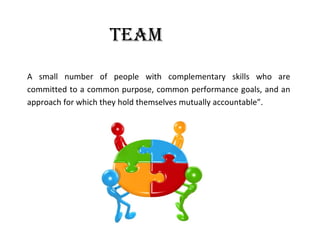
TEAM A small number of people with complementary skills who are committed to a common purpose, common performance goals, and an approach for which they hold themselves mutually accountable”.
What does Team Do???? Team creates positive synergy. Teams creates and fosters comraderies among the members through regular and repeated interactions. It encourages members to sublimate their individual goals for those of the team. Also encourages members’ involvement in the team work.
DIFFERENCES BETWEEN   GROUPS AND TEAMS Work Group A group that interacts primarily to share information and to make decisions to help each group member perform within his or her area of responsibility. Work Team The individual efforts result in a performance that is greater than the sum of the individual inputs.
 
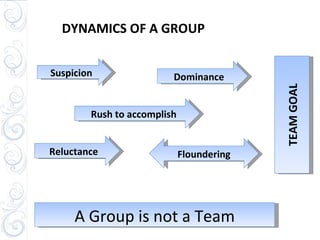
DYNAMICS OF A GROUP Suspicion Dominance Rush to accomplish Reluctance Floundering A Group is not a Team TEAM GOAL
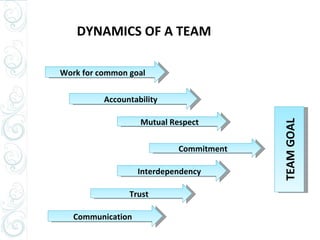
DYNAMICS OF A TEAM Work for common goal Accountability Mutual Respect Commitment Interdependency Trust Communication TEAM GOAL
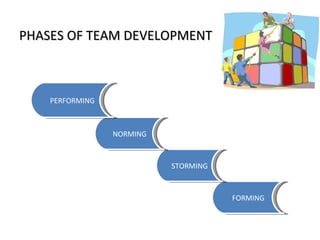
PHASES OF TEAM DEVELOPMENT FORMING STORMING NORMING PERFORMING
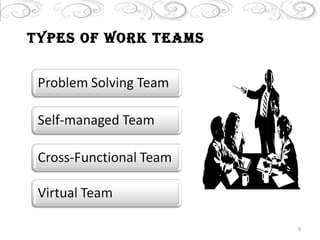
TYPES OF WORK TEAMS
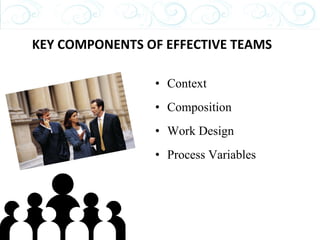
KEY COMPONENTS OF EFFECTIVE TEAMS Context Composition Work Design Process Variables
 
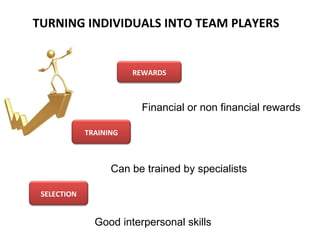
TURNING INDIVIDUALS INTO TEAM PLAYERS Good interpersonal skills  Can be trained by specialists Financial or non financial rewards SELECTION TRAINING REWARDS
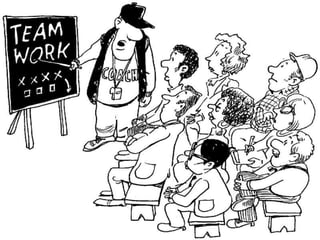
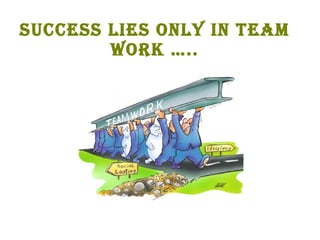
Success lies only in Team Work …..


Understanding work teams

  • 1.
    UNDERSTANDING WORK TEAMSPRESENTED BY Vaishnavi Ragunathan
  • 2.
    TEAM A smallnumber of people with complementary skills who are committed to a common purpose, common performance goals, and an approach for which they hold themselves mutually accountable”.
  • 3.
    What does TeamDo???? Team creates positive synergy. Teams creates and fosters comraderies among the members through regular and repeated interactions. It encourages members to sublimate their individual goals for those of the team. Also encourages members’ involvement in the team work.
  • 4.
    DIFFERENCES BETWEEN GROUPS AND TEAMS Work Group A group that interacts primarily to share information and to make decisions to help each group member perform within his or her area of responsibility. Work Team The individual efforts result in a performance that is greater than the sum of the individual inputs.
  • 5.
  • 6.
    DYNAMICS OF AGROUP Suspicion Dominance Rush to accomplish Reluctance Floundering A Group is not a Team TEAM GOAL
  • 7.
    DYNAMICS OF ATEAM Work for common goal Accountability Mutual Respect Commitment Interdependency Trust Communication TEAM GOAL
  • 8.
    PHASES OF TEAMDEVELOPMENT FORMING STORMING NORMING PERFORMING
  • 9.
  • 10.
    KEY COMPONENTS OFEFFECTIVE TEAMS Context Composition Work Design Process Variables
  • 11.
  • 12.
    TURNING INDIVIDUALS INTOTEAM PLAYERS Good interpersonal skills Can be trained by specialists Financial or non financial rewards SELECTION TRAINING REWARDS
  • 13.
    Success lies onlyin Team Work …..
  • 14.
  • 15.

Editor's Notes

  • #10 Problem-Solving Teams meet periodically to share ideas and suggest improvements to work processes and methods. Quality circles are problem solving teams that consist of eight to ten employees and supervisors who assume responsibility for solving quality problems. These teams recommend their solutions to management for final approval. Functional teams are composed of a manager and the employees in his or her unit. Functional teams are often formed to improve work-related activities or to solve specific problems within a particular functional unit. Self-managed work teams consist of ten to fifteen people who assume the responsibilities of their former supervisors: such as, controlling the pace of work, organizing breaks, determining work assignments, choosing inspection procedures, and choosing and evaluating members. These teams implement their own suggestions and take responsibility for the outcomes. On cross-functional teams , equally ranked employees from different functional areas work together to accomplish a task. Cross-functional teams expedite the following: exchanging ideas from diverse areas within or between organizations, developing new ideas and solving problems, and coordinating complex projects. Virtual teams are an extension of electronic meetings. Team members use communication technology to meet or solve problems without concern for time or space.