Some Concepts  to Help the Development of a Strategic Planning April 2008 Mário Luís Tavares Ferreira
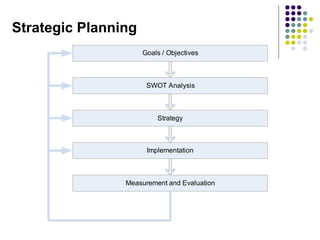
Strategic Planning
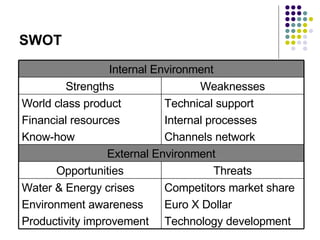
SWOT Technical support Internal processes Channels network World class product Financial resources Know-how External Environment Competitors market share Euro X Dollar Technology development Water & Energy crises Environment awareness Productivity improvement Threats Opportunities Weaknesses Strengths Internal Environment
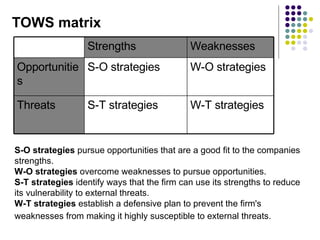
TOWS matrix S-O strategies  pursue opportunities that are a good fit to the companies strengths. W-O strategies  overcome weaknesses to pursue opportunities. S-T strategies  identify ways that the firm can use its strengths to reduce its vulnerability to external threats. W-T strategies  establish a defensive plan to prevent the firm's weaknesses from making it highly susceptible to external threats.   W-T strategies  S-T strategies  Threats W-O strategies  S-O strategies  Opportunities Weaknesses Strengths
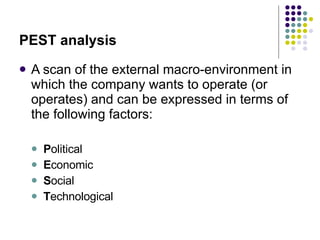
PEST analysis A scan of the external macro-environment in which the company wants to operate (or operates) and can be expressed in terms of the following factors: P olitical  E conomic  S ocial  T echnological
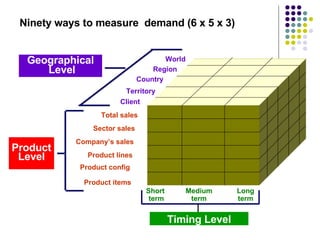
Ninety ways to measure  demand (6 x 5 x 3) Total sales Company’s sales Product lines Product config Product items Sector sales Product Level Territory Region Country Client World Geographical Level Short term Medium term Long term Timing Level
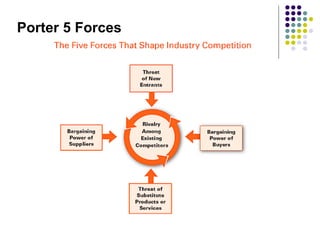
Porter 5 Forces
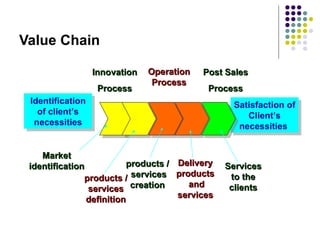
Value Chain Identification of client’s necessities Satisfaction of Client’s necessities  Innovation Process Operation Process Post Sales Process Market identification products / services definition products /  services creation Delivery products  and services Services to the clients
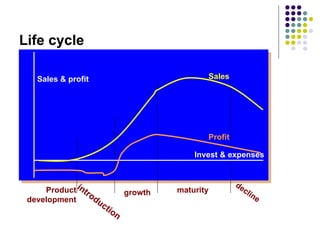
Life cycle Product development introduction maturity decline Sales & profit  Invest & expenses Sales Profit  growth
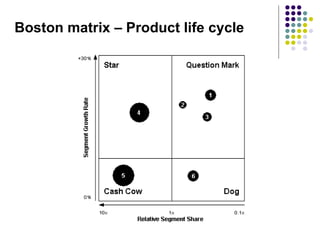
Boston matrix – Product life cycle
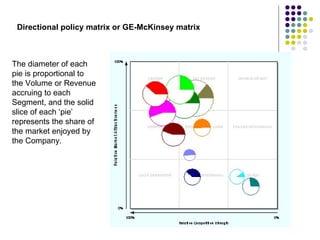
Directional policy matrix or GE-McKinsey matrix   The diameter of each pie is proportional to the Volume or Revenue accruing to each Segment, and the solid slice of each ‘pie’ represents the share of the market enjoyed by the Company.
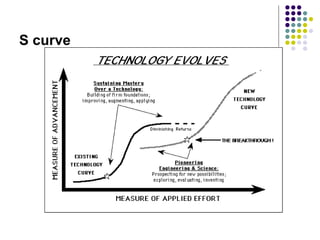
S curve
Management Management, control and evaluation
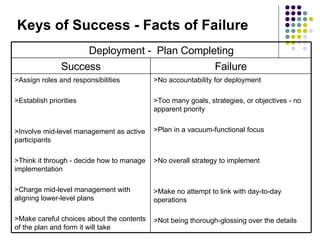
Keys of Success - Facts of Failure >No accountability for deployment >Too many goals, strategies, or objectives - no apparent priority >Plan in a vacuum-functional focus >No overall strategy to implement >Make no attempt to link with day-to-day operations >Not being thorough-glossing over the details >Assign roles and responsibilities >Establish priorities >Involve mid-level management as active participants >Think it through - decide how to manage implementation >Charge mid-level management with aligning lower-level plans >Make careful choices about the contents of the plan and form it will take Failure Success Deployment -  Plan Completing
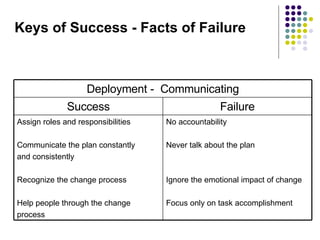
Keys of Success - Facts of Failure No accountability Never talk about the plan Ignore the emotional impact of change Focus only on task accomplishment Assign roles and responsibilities Communicate the plan constantly and consistently Recognize the change process Help people through the change process Failure Success Deployment -  Communicating
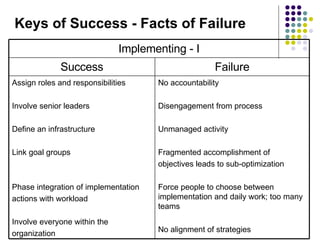
Keys of Success - Facts of Failure No accountability Disengagement from process Unmanaged activity Fragmented accomplishment of objectives leads to sub-optimization Force people to choose between implementation and daily work; too many teams No alignment of strategies Assign roles and responsibilities Involve senior leaders Define an infrastructure Link goal groups Phase integration of implementation actions with workload Involve everyone within the organization Failure Success Implementing - I
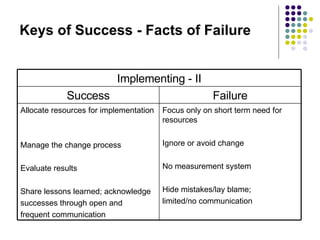
Keys of Success - Facts of Failure Focus only on short term need for resources Ignore or avoid change No measurement system Hide mistakes/lay blame; limited/no communication Allocate resources for implementation Manage the change process Evaluate results Share lessons learned; acknowledge successes through open and frequent communication Failure Success Implementing - II
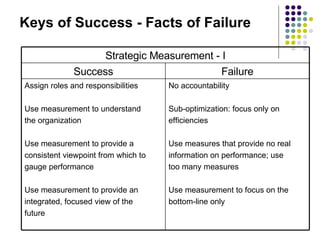
Keys of Success - Facts of Failure No accountability Sub-optimization: focus only on efficiencies Use measures that provide no real information on performance; use too many measures Use measurement to focus on the bottom-line only Assign roles and responsibilities Use measurement to understand the organization Use measurement to provide a consistent viewpoint from which to gauge performance Use measurement to provide an integrated, focused view of the future Failure Success Strategic Measurement - I
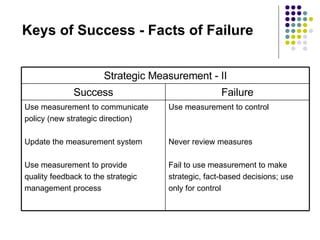
Keys of Success - Facts of Failure Use measurement to control Never review measures Fail to use measurement to make strategic, fact-based decisions; use only for control Use measurement to communicate policy (new strategic direction) Update the measurement system Use measurement to provide quality feedback to the strategic management process Failure Success Strategic Measurement - II
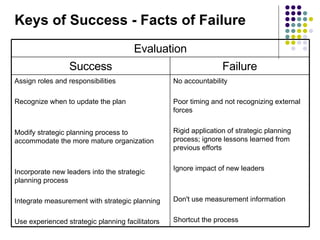
Keys of Success - Facts of Failure No accountability Poor timing and not recognizing external forces Rigid application of strategic planning process; ignore lessons learned from previous efforts Ignore impact of new leaders Don't use measurement information Shortcut the process Assign roles and responsibilities Recognize when to update the plan Modify strategic planning process to accommodate the more mature organization Incorporate new leaders into the strategic planning process Integrate measurement with strategic planning Use experienced strategic planning facilitators Failure Success Evaluation
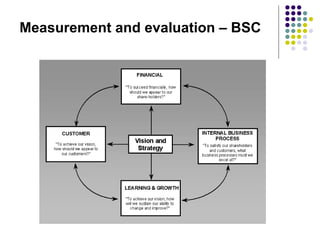
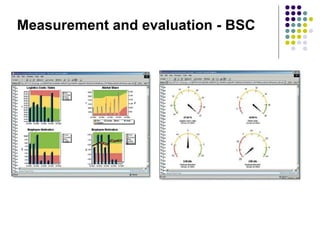
Measurement and evaluation – BSC
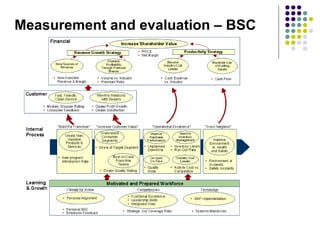
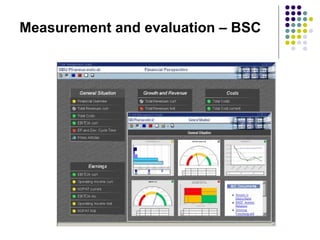
Measurement and evaluation - BSC
Five disciplines – Peter Senge Personal Mastery:   Aspiration involves formulating a coherent picture of the results people most desire to gain as individuals, alongside a realistic assessment of the current state of their lives today. Learning to cultivate the tension between vision and reality can expand people's capacity to make better choices, and to achieve more of the results that they have chosen.   Mental Models : Reflection and inquiry skills is focused around developing awareness of the attitudes and perceptions that influence thought and interaction.  By continually reflecting upon, talking about, and reconsidering these internal pictures of the world, people can gain more capability in governing their actions and decisions.
Five disciplines – Peter Senge Shared Vision :  Establishes a focus on mutual purpose. People learn to nourish a sense of commitment in a group or organization by developing shared images of the future they seek to create, and the principles and guiding practices by which they hope to get there.  Team Learning : Group interaction.   Through techniques like dialogue and skillful discussion, teams transform their collective thinking, learning to mobilize their energies and actions to achieve common goals, and drawing forth an intelligence and ability greater than the sum of individual members' talents.
Five disciplines – Peter Senge Systems Thinking :  People learn to better understand interdependency and change, and thereby to deal more effectively with the forces that shape the consequences of our actions.   Systems thinking is based upon a growing body of theory about the behavior of feedback and complexity - the innate tendencies of a system that lead to growth or stability over time.  To help people see how to change systems more effectively and how to act more in tune with the larger processes of the natural and economic world.
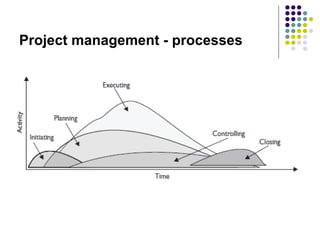
Project management - processes
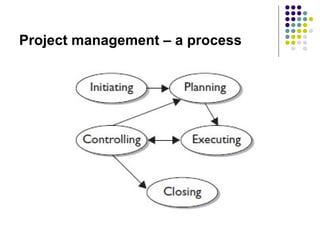
Project management – a process
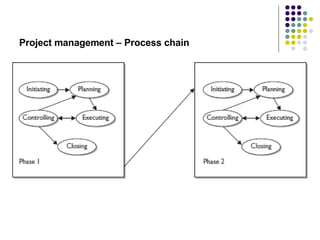
Project management – Process chain
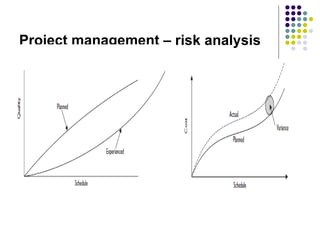
Project management – risk analysis

Strategic Planning Concepts

  • 1.
    Some Concepts to Help the Development of a Strategic Planning April 2008 Mário Luís Tavares Ferreira
  • 2.
  • 3.
    SWOT Technical supportInternal processes Channels network World class product Financial resources Know-how External Environment Competitors market share Euro X Dollar Technology development Water & Energy crises Environment awareness Productivity improvement Threats Opportunities Weaknesses Strengths Internal Environment
  • 4.
    TOWS matrix S-Ostrategies pursue opportunities that are a good fit to the companies strengths. W-O strategies overcome weaknesses to pursue opportunities. S-T strategies identify ways that the firm can use its strengths to reduce its vulnerability to external threats. W-T strategies establish a defensive plan to prevent the firm's weaknesses from making it highly susceptible to external threats. W-T strategies S-T strategies Threats W-O strategies S-O strategies Opportunities Weaknesses Strengths
  • 5.
    PEST analysis Ascan of the external macro-environment in which the company wants to operate (or operates) and can be expressed in terms of the following factors: P olitical E conomic S ocial T echnological
  • 6.
    Ninety ways tomeasure demand (6 x 5 x 3) Total sales Company’s sales Product lines Product config Product items Sector sales Product Level Territory Region Country Client World Geographical Level Short term Medium term Long term Timing Level
  • 7.
  • 8.
    Value Chain Identificationof client’s necessities Satisfaction of Client’s necessities Innovation Process Operation Process Post Sales Process Market identification products / services definition products / services creation Delivery products and services Services to the clients
  • 9.
    Life cycle Productdevelopment introduction maturity decline Sales & profit Invest & expenses Sales Profit growth
  • 10.
    Boston matrix –Product life cycle
  • 11.
    Directional policy matrixor GE-McKinsey matrix The diameter of each pie is proportional to the Volume or Revenue accruing to each Segment, and the solid slice of each ‘pie’ represents the share of the market enjoyed by the Company.
  • 12.
  • 13.
  • 14.
    Keys of Success- Facts of Failure >No accountability for deployment >Too many goals, strategies, or objectives - no apparent priority >Plan in a vacuum-functional focus >No overall strategy to implement >Make no attempt to link with day-to-day operations >Not being thorough-glossing over the details >Assign roles and responsibilities >Establish priorities >Involve mid-level management as active participants >Think it through - decide how to manage implementation >Charge mid-level management with aligning lower-level plans >Make careful choices about the contents of the plan and form it will take Failure Success Deployment - Plan Completing
  • 15.
    Keys of Success- Facts of Failure No accountability Never talk about the plan Ignore the emotional impact of change Focus only on task accomplishment Assign roles and responsibilities Communicate the plan constantly and consistently Recognize the change process Help people through the change process Failure Success Deployment - Communicating
  • 16.
    Keys of Success- Facts of Failure No accountability Disengagement from process Unmanaged activity Fragmented accomplishment of objectives leads to sub-optimization Force people to choose between implementation and daily work; too many teams No alignment of strategies Assign roles and responsibilities Involve senior leaders Define an infrastructure Link goal groups Phase integration of implementation actions with workload Involve everyone within the organization Failure Success Implementing - I
  • 17.
    Keys of Success- Facts of Failure Focus only on short term need for resources Ignore or avoid change No measurement system Hide mistakes/lay blame; limited/no communication Allocate resources for implementation Manage the change process Evaluate results Share lessons learned; acknowledge successes through open and frequent communication Failure Success Implementing - II
  • 18.
    Keys of Success- Facts of Failure No accountability Sub-optimization: focus only on efficiencies Use measures that provide no real information on performance; use too many measures Use measurement to focus on the bottom-line only Assign roles and responsibilities Use measurement to understand the organization Use measurement to provide a consistent viewpoint from which to gauge performance Use measurement to provide an integrated, focused view of the future Failure Success Strategic Measurement - I
  • 19.
    Keys of Success- Facts of Failure Use measurement to control Never review measures Fail to use measurement to make strategic, fact-based decisions; use only for control Use measurement to communicate policy (new strategic direction) Update the measurement system Use measurement to provide quality feedback to the strategic management process Failure Success Strategic Measurement - II
  • 20.
    Keys of Success- Facts of Failure No accountability Poor timing and not recognizing external forces Rigid application of strategic planning process; ignore lessons learned from previous efforts Ignore impact of new leaders Don't use measurement information Shortcut the process Assign roles and responsibilities Recognize when to update the plan Modify strategic planning process to accommodate the more mature organization Incorporate new leaders into the strategic planning process Integrate measurement with strategic planning Use experienced strategic planning facilitators Failure Success Evaluation
  • 21.
  • 22.
  • 23.
  • 24.
  • 25.
    Five disciplines –Peter Senge Personal Mastery: Aspiration involves formulating a coherent picture of the results people most desire to gain as individuals, alongside a realistic assessment of the current state of their lives today. Learning to cultivate the tension between vision and reality can expand people's capacity to make better choices, and to achieve more of the results that they have chosen. Mental Models : Reflection and inquiry skills is focused around developing awareness of the attitudes and perceptions that influence thought and interaction. By continually reflecting upon, talking about, and reconsidering these internal pictures of the world, people can gain more capability in governing their actions and decisions.
  • 26.
    Five disciplines –Peter Senge Shared Vision : Establishes a focus on mutual purpose. People learn to nourish a sense of commitment in a group or organization by developing shared images of the future they seek to create, and the principles and guiding practices by which they hope to get there. Team Learning : Group interaction. Through techniques like dialogue and skillful discussion, teams transform their collective thinking, learning to mobilize their energies and actions to achieve common goals, and drawing forth an intelligence and ability greater than the sum of individual members' talents.
  • 27.
    Five disciplines –Peter Senge Systems Thinking : People learn to better understand interdependency and change, and thereby to deal more effectively with the forces that shape the consequences of our actions. Systems thinking is based upon a growing body of theory about the behavior of feedback and complexity - the innate tendencies of a system that lead to growth or stability over time. To help people see how to change systems more effectively and how to act more in tune with the larger processes of the natural and economic world.
  • 28.
  • 29.
  • 30.
  • 31.