Occupational Therapy the Group Process
Occupational Therapy and Groups
Groups provide a natural learning environment (through complex
interactions)
Multiple layers of relationships (therapeutic potential)
Opportunity for sharing and support
Use of activities to develop interpersonal skills (Denton, and
encourage social interaction
Doing rather than being
Group dynamics a source of energy and creativity
Social learning
Expression and exploration of emotion
Shapers of behavior (norms and pressures)
May be time efficient ( work with multiple clients in an effective
way)
Group Dynamics
The forces that influence the interrelationships of members and
ultimately affect group outcomes
Implications for OT
We need to understand stages of group development as this will
impact on activity choices
Group dynamics impact how we may lead groups
Yalom’s 11 Curative/Therapeutic factors of Group Therapy
1. Instillation of hope:
Hope that treatment can be effective
Therapist conveys this
2. Universality:
Group members are not alone
Problems are not unique
Listening without judgement
3. Imparting Information:
Key learning (formal or informal)
4. Altruism:
Gaining benefit from giving
Yalom’s 11 Curative/Therapeutic factors of Group Therapy
5. Corrective recapitulation of primary family group:
Projection of feelings
Working through issues
6. Development of social skills:
Role-play, games and feedback
7. Imitative behavior:
Observing new ways of behaving (other group members or
facilitator)
8. Interpersonal learning:
Self reflection
Social microcosm
Yalom’s 11 Curative/Therapeutic factors of Group Therapy
9. Group cohesiveness:
Like the ‘relationship’ in individual therapy
Unconditional acceptance
Shape behavior, increase self esteem, more stable and more
attendance if cohesive
10. Catharsis :
Enhance free expression of feelings
Relief from getting things off chest
11. Existential factors:
Part of group = dealing with responsibility, basic
isolation, contingency, recognition of mortality
realizations
3 Stage Model of Change
Unfreezing:
Overcoming inertia and dismantling the existing "mind set".
Defense mechanisms have to be bypassed.
Change:
Change occurs in second stage. This is typically a period of
confusion and transition. One is aware that the old ways are being
challenged but does not have a clear picture to replace them with
yet.
Freezing:
In the third stage the new mindset is crystallizing and one's comfort
level is returning to previous levels
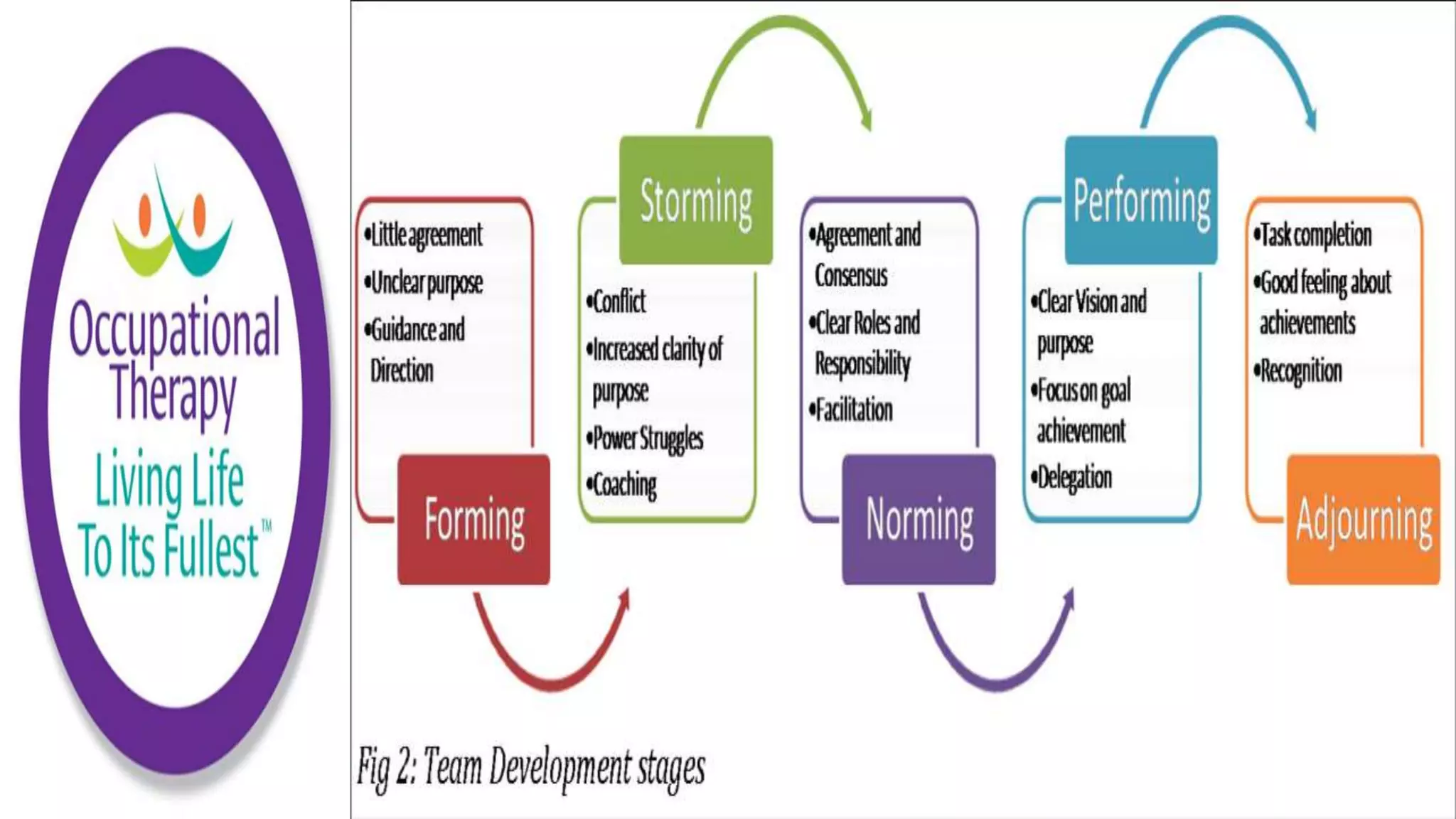
Groups progress through 4 allocated stages
1.Forming
2.Storming
3.Norming
4.Performing
5.Adjourning
STAGE 1:FORMING
Interpersonal issues:
● Dealing with issues of coming together
● Trying to get to know each other
● Seeking leadership and direction
Task Issues:
● Concerns include defining the purpose of the group and its goals
● Who has knowledge and information pertinent to those goals
STAGE 2: STORMING
Interpersonal issues:
● A period of tension and conflict
● Subgroups may form based on interests/points of view
● Subgroups may clash conflicts and disagreements
Task Issues:
● Disagreements the best way to proceed
● Disagreements about leadership and control
STAGE 3: NORMING
Interpersonal issues:
● Conflicts have settled
● Group develops norms conducive to working together and cohesion
Task Issues:
● Group members share interpretations and perspectives on tasks
● Members seek to reach consensus
● Co-operative working relationships are developed
STAGE 4: PERFORMING
Interpersonal issues:
● Group is ready to work together as an effective unit
● Functional role relationships are established
● Time spent together is productive
Task Issues:
● The group seeks solutions to task issues that bought them together
as a group in the first place
STAGE 5: ADJOURNING
● Also referred to as Deforming and Mourning
● Adjourning is an adjunct to the original four stage model
● The break-up of the group
● Everyone can move on to new things, feeling good about what's
been achieved
● Recognition of and sensitivity to people's vulnerabilities is helpful
Tuckman’s model
What makes a group effective is more complex than this model
The model largely ignores context
If the context provides rules, task definitions, information
and resources, a high functioning group can be formed
within minutes
e.g. Olympic athletes changing teams, combat, etc.
Schutz 1958
1. Inclusion
Concern with being accepted into the group
Behaviors include over talking, attention seeking and
individual self centeredness
Speak to leader rather than group
2. Control
Leadership struggles
Disagree about structure and subgroups may form
Leader needs to be able to facilitate
3. Affection
Stage of group cohesiveness
This is the goal for any therapy group.
Members feel safe and trust one another.
Yalom 2005
1. Orientation
Importance of preparation prior to starting a group
Members size each other up and consider whether they fit
2. Conflict
Issues of power and control
Leader helps process the conflict
May be hostility towards the leader
3. Cohesive Maturity
Cohesiveness: group successfully resolves the conflict
/ positive feelings and trust
Maturity occurs once both positive and negative feelings may be
discussed.
Cohesion
The degree of connectedness and closeness group members
feel towards each other
High cohesion = clear sense of belonging and strong belief in the
group
Low cohesion = more distant and critical of the group
“a dynamic process that is reflected in the tendency of a group to
stick together and remain united in the pursuit of its instrumental
objectives and/or for the satisfaction of member needs”
Cohesion
Advantages:
Loyalty, trust and warmth
Sense of security
Enables risk taking and self disclosure
Disadvantages:
Group has influence over its members
Pressures to conform to group norms
An issue when group norms are ‘deviant’ or ‘unhelpful’
Members may become so attached to each other that their
outside interaction is limited.
Cohesion
Relevance to Occupational Therapy
The importance of trying to work towards a mature cohesive
group to maximize effectiveness for participants
Corey et al. (1998) gave these guidelines to help members get the
most out of groups.
These guidelines might help you get the most out of your group
work
Have a focus
Pay attention to feelings
Be an active participant
Give feedback
Be open to feedback
Take responsibility for what you want to accomplish
Group Norms
Standard customary ways of performing in groups
Norms allow expression of group’s central values = sense of identity
Create a distinctive identity
Members can understand how they are different from others
Gives them criteria to evaluate deviant behavior within the group
Coordinate activities for group members
Make behavior predictable
Group Norms
social standards and acceptable behaviors;
collectively held expectations of group functioning;
provide regularity and predictability to group functioning
Types of Norms
Standards relate to:
conduct;
work performance/attendance;
rearranging personal space;
assisting co-workers;
loyalty;
dress codes;
rewards.
How do group norms impact on behavior?
1. Personality characteristics predict conformity
Low self confidence more likely to conform
2. The clarity of the norm
The more clear and specific the norm, the more likely members
will conform
3. Cohesion of group contributes to conformity
Formation of Norms
• Mutual influence and interactions of group members
• Previous experience of group members
• Outside standards
• Strongly influenced by events in early development of group
• Make norms explicit early to avoid development of inappropriate
norms and to set expectations
Signs of problems with Group Norms
Topics are avoided
Irrelevant conversations or activities keep occurring
No one acknowledges or follows norms
Conflict over the meaning of group norms
When norms are detrimental
Defensive/Institutionalized
Stuck in patterns of behavior that
- Reduces creativity
- Narrow the group’s viewpoint
Motivation in Groups
Motivation may vary according to
Tasks
↑ motivation when the task is interesting
How performance is evaluated and rewarded
Related to the goals of team and team members’ sense of
commitment or belonging
Increasing Motivation
• Tasks are interesting, challenging and meaningful
• Experience of responsibility
• Knowledge of results
• Task interdependence
• Distribution of required skills across members
• Each member believes their contribution is unique and valuable
Power is shared amongst members
Each member must feel independent and group responsibility
Results must be based on interdependence not individual
performance
Group goals and reward systems, balanced with individual based
rewards
Increasing Motivation
Individual contributions to a team are identifiable and
linked to performance evaluation and reward system
Goal setting is crucial
Need to set challenging, relevant but attainable goals
Conformity
Conformity is not based on power, but rather on the subjective
validity of social norms
A feeling of confidence and certainty that the beliefs and actions
described by the norms are correct, appropriate, valid, and socially
desirable
Social loafing
Reduction of individual contribution when people are working in
groups rather than alone
Across genders and cultures and tasks
‘free rider’’ and ‘sucker effect’
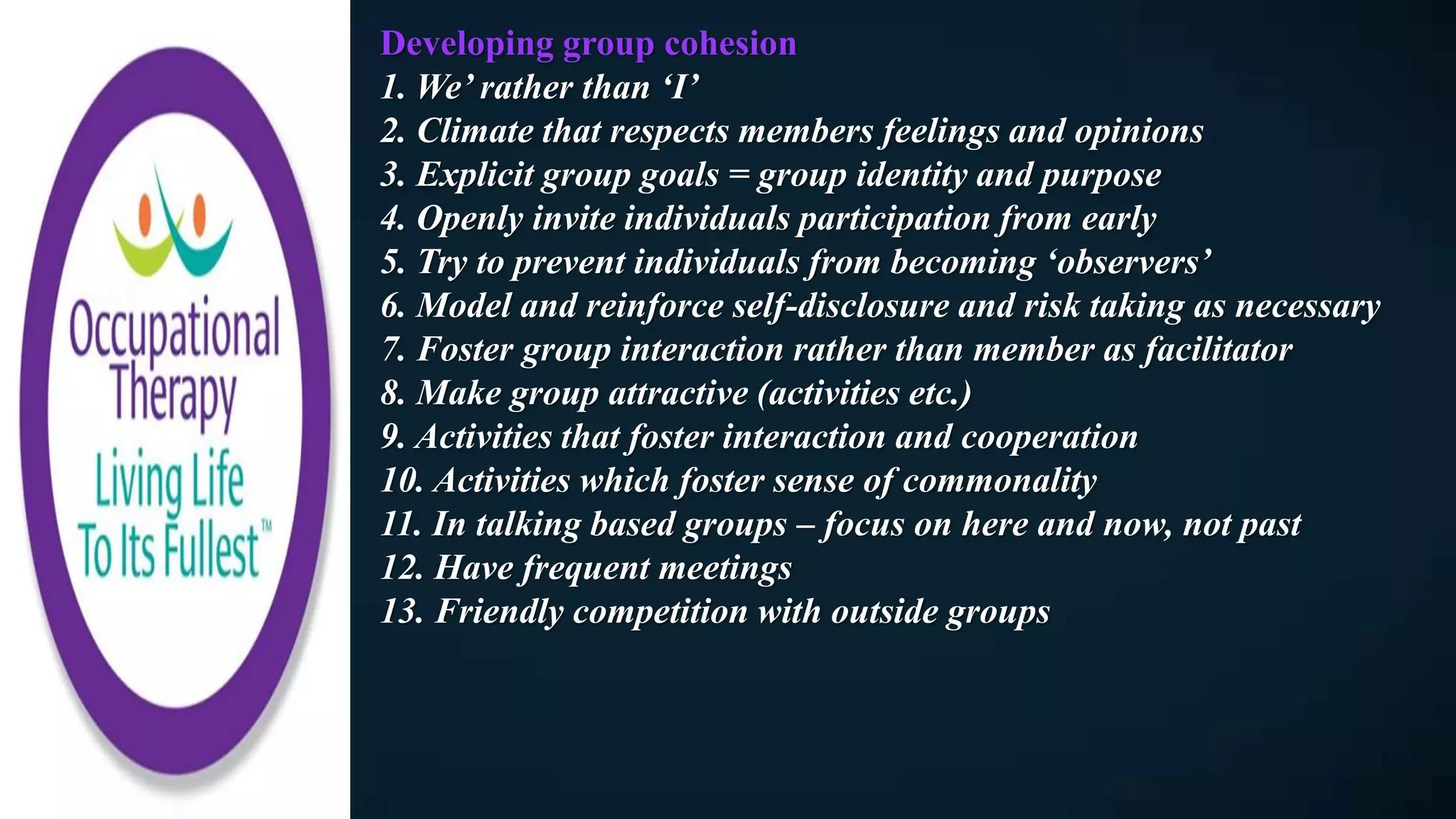
Developing group cohesion
1. We’ rather than ‘I’
2. Climate that respects members feelings and opinions
3. Explicit group goals = group identity and purpose
4. Openly invite individuals participation from early
5. Try to prevent individuals from becoming ‘observers’
6. Model and reinforce self-disclosure and risk taking as necessary
7. Foster group interaction rather than member as facilitator
8. Make group attractive (activities etc.)
9. Activities that foster interaction and cooperation
10. Activities which foster sense of commonality
11. In talking based groups – focus on here and now, not past
12. Have frequent meetings
13. Friendly competition with outside groups
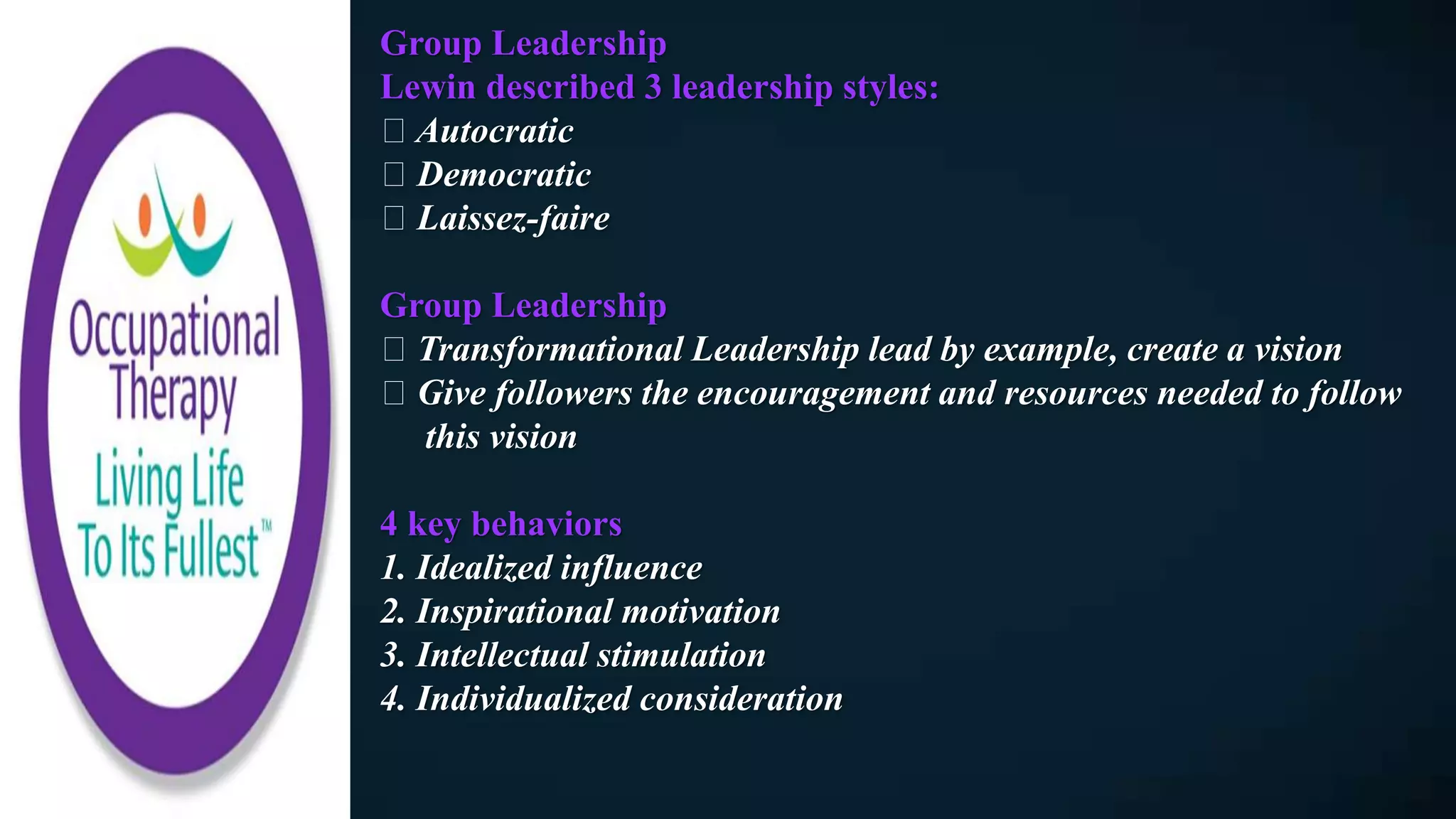
Group Leadership
Lewin described 3 leadership styles:
Autocratic
Democratic
Laissez-faire
Group Leadership
Transformational Leadership lead by example, create a vision
Give followers the encouragement and resources needed to follow
this vision
4 key behaviors
1. Idealized influence
2. Inspirational motivation
3. Intellectual stimulation
4. Individualized consideration
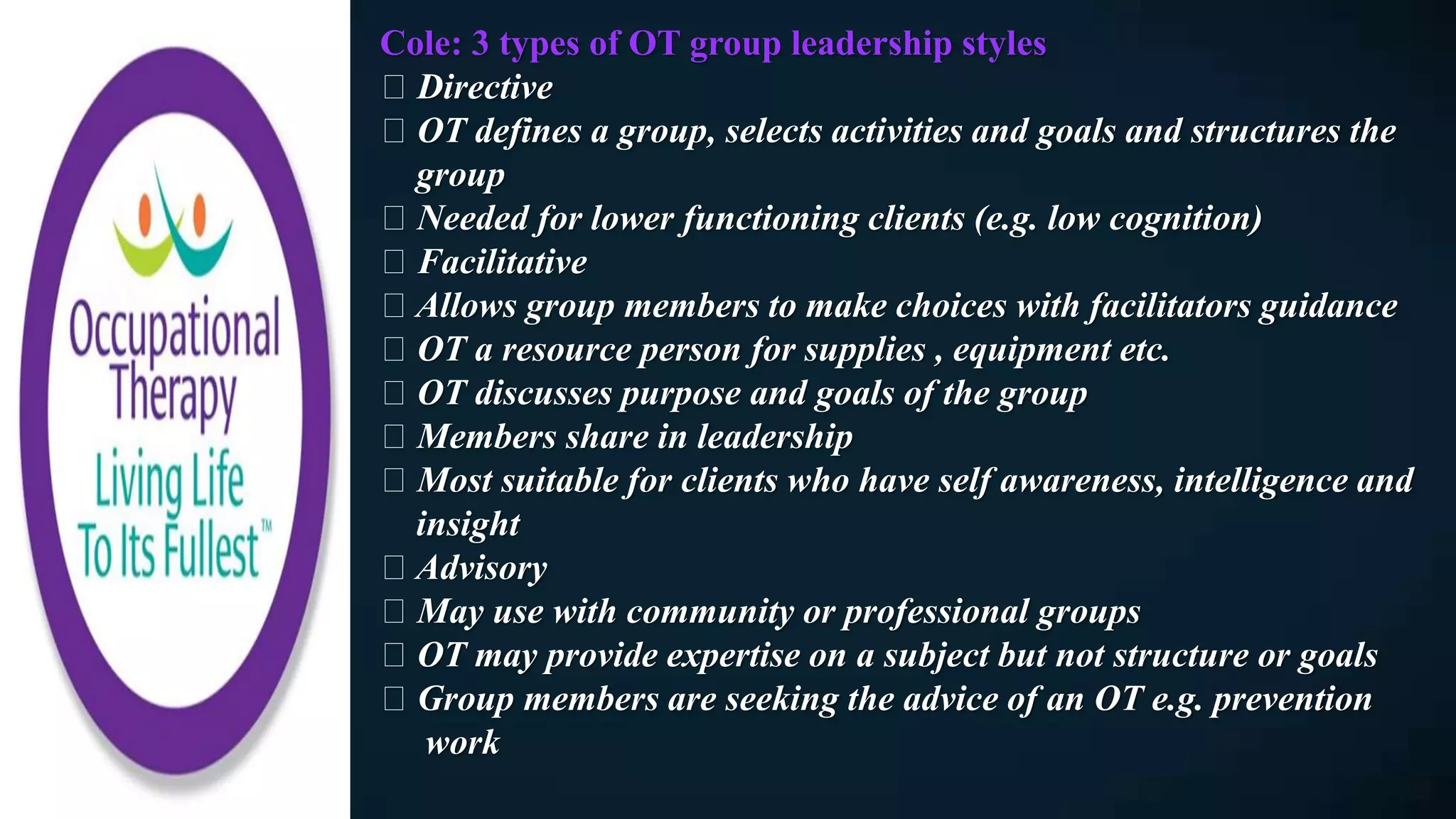
Cole: 3 types of OT group leadership styles
Directive
OT defines a group, selects activities and goals and structures the
group
Needed for lower functioning clients (e.g. low cognition)
Facilitative
Allows group members to make choices with facilitators guidance
OT a resource person for supplies , equipment etc.
OT discusses purpose and goals of the group
Members share in leadership
Most suitable for clients who have self awareness, intelligence and
insight
Advisory
May use with community or professional groups
OT may provide expertise on a subject but not structure or goals
Group members are seeking the advice of an OT e.g. prevention
work
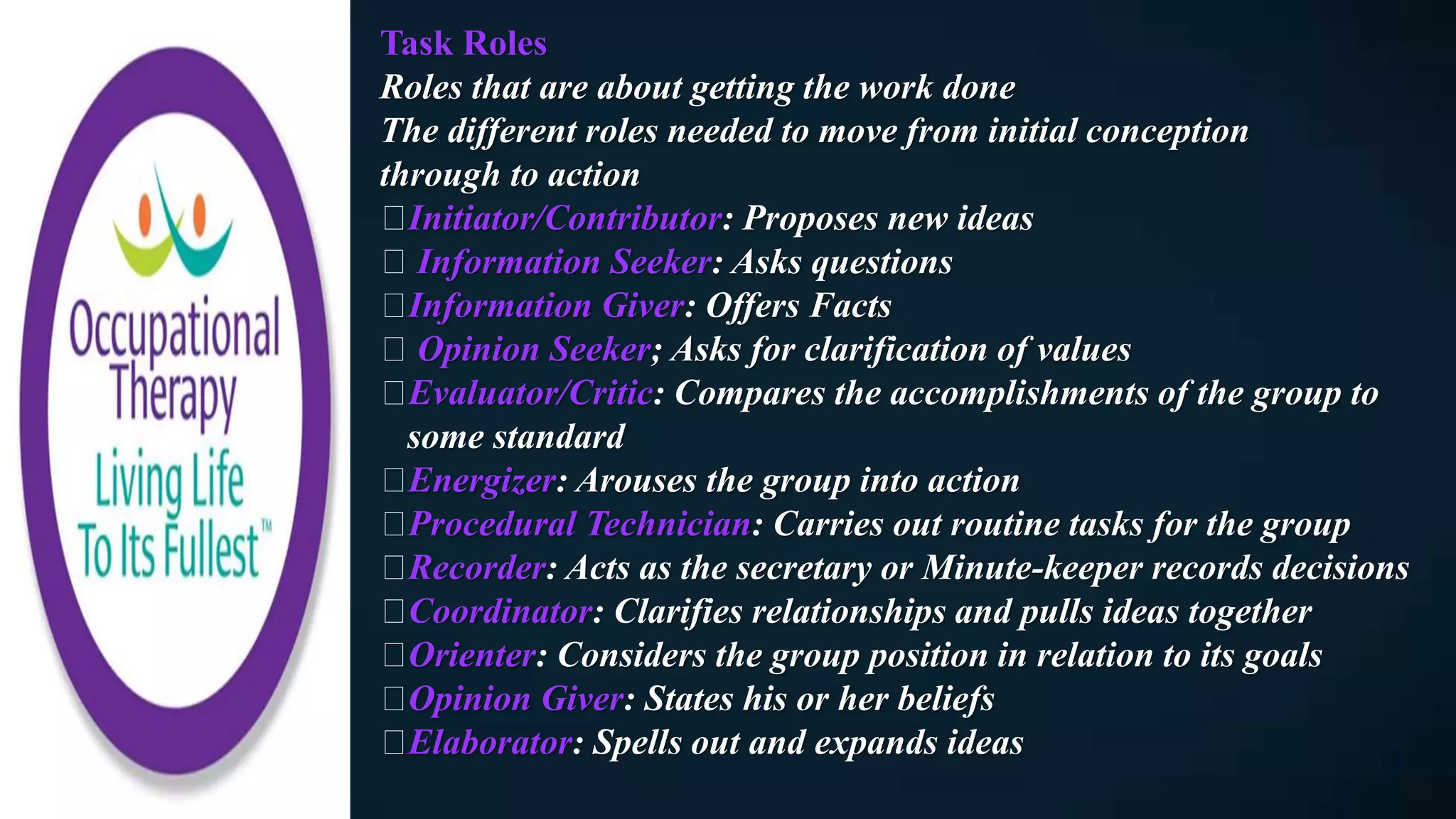
Task Roles
Roles that are about getting the work done
The different roles needed to move from initial conception
through to action
Initiator/Contributor: Proposes new ideas
Information Seeker: Asks questions
Information Giver: Offers Facts
Opinion Seeker; Asks for clarification of values
Evaluator/Critic: Compares the accomplishments of the group to
some standard
Energizer: Arouses the group into action
Procedural Technician: Carries out routine tasks for the group
Recorder: Acts as the secretary or Minute-keeper records decisions
Coordinator: Clarifies relationships and pulls ideas together
Orienter: Considers the group position in relation to its goals
Opinion Giver: States his or her beliefs
Elaborator: Spells out and expands ideas
Maintenance Roles
These roles contribute to the positive functioning of the group.
Encourager: Praises and understands others points of view
Harmonizer: Mediates differences between members, relieving
tensions
Compromiser: Meets other half way to maintain the group harmony
Timekeeper/Expediter: Facilitates the flow of communication and
encourages others to participate.
Observer/Commentator: Notes, interprets and presents information
about the group process
Follower: Goes along with group ideas and actions
Individual/ Self interest roles
These roles disrupt group progress and weaken its cohesion.
Aggressor: Deflates and attacks others expresses disapproval
Blocker: Tends to resist and be negative
Recognition Seeker: Calls attention to him/herself by boasting or
acting in unusual ways
Self-confessor: Uses the group as an audience to expand on
personal feelings and philosophies
Disrupter: Uses group meetings as fun, distracts other people in the
group
Dominator: Tries to control the conversation, often exaggerates his
or her knowledge
Help Seeker: Actively looks for sympathy by expressing feelings of
inadequacy.
Special Interest Pleader: Makes suggestions based on what others
would think or feel, avoids revealing his/her own opinion.
Group leader functions
Task – activity functions:
Teach
Supply equipment
Organize
Give feedback
Social-emotional functions:
Give support and meet members needs
Enable communication and self-expression
Motivate and facilitate group cohesion
Parallel Group
Each member:
Engages in some activity, but acts as if this is an individual
task as opposed to a group activity
Is aware of others in the group
Initiates some verbal or nonverbal interaction with others
Appears to be relatively comfortable in this situation
Leader role:
Chooses and assists with task
Meets all social-emotional needs of members
Enforce inappropriate behavior such as engaging in the task,
Answering questions, shape behavior by giving praise and
ignoring inappropriate behaviors
Project (Associative) Group
Each member:
Occasionally engages in the group activity, moving in and
out according to his or her own wish
Seeks some assistance from others
Gives some assistance when directly asked to do so
Competes, cooperates with therapist prompting
Leader:
Assists group with task and meet members needs
reinforces behaviors when two or more members work
together or interact
Egocentric-Cooperative Group
Member behaviors:
Aware of group’s goal relative to the task
Acts as if he belongs in the group
Willing to participate
Responsible for organizing their activity
Not overly competitive
Leader
Less of director role and more of a role model
May make suggestions and give assistance
Meet love and safety needs
Cooperative Group
Meets needs of other members and express feelings
Leader
Consultation
Participant
Makes own wishes, desires, and needs known
Participates in group activity
Both members and leader have mutual responsibility for the
group activities and reinforcing behavior
Mature Group
Flexibly take on various roles
Leader
Acts as group member
Responsive to all group members
Take a variety of task roles
Take a variety of social-emotional roles
Able to share leadership
Promotes a good balance between task accomplishment and
satisfaction of group members’ needs
Leader roles- Support Groups
Creation and maintenance of the group
Culture building
Activation and process illumination
Dealing with transference
Directive Leadership is Appropriate When:
Members have cognitive impairment, poor capacity for insight,
immaturity, poor verbal skills, or low motivation
Specific goals and activities are desired
Topic is educational and requires therapist
expertise/demonstration
Most group roles are performed by the leader
Feedback to members given mostly by the leader
Facilitative Leadership
Leader gathers support from members
OT earns their support by giving them choices and asking
them to collaborate in reaching goals
Presumes a certain level of ability and rational thought
Allows group to experience advanced levels of group
development
Facilitative Leadership is Appropriate When:
Members have a middle-high level of cognition and capacity
for insight
Members have at least a medium level of maturity, verbal skills
and motivation
Members are capable of making choices of activity, topic,
structure
Members can learn from experience
Therapist can delegate some leadership roles to members
Members are encouraged to give each other feedback
Therapist/leader does not do anything for the group that they
can do for themselves
Advisory Leadership
Assumes high level of functioning
Appropriate for more informal activities
Assumes motivation of members
OT leader acts as resource
OT imparts information as needed
Advisory Leadership is Appropriate When:
OT’s role is consulting, wellness, or care-giver education
Members have high cognition, verbal skills, insight capacity,
and motivation
Members have selected a specific activity or topic area
Members can seek advice from leader on as-needed basis
Members lead their own group and experience natural
consequences from the environment
Role of OT Group Leader
Select members
Design group based on client needs
Set goals, write group protocol
Determine best leadership style based on client needs and
preferences and purpose of the group
Oversee group roles, maintain therapeutic norms, support
positive efforts of members
Process group according to member needs
Evaluate progress and determine group outcomes
Co-Leadership
Advantages:
Offers mutual support
Increases objectivity
Uses collective knowledge
Modeling for each other
Taking on different roles
Examples:
Male and female
COTA /OTR
Co-Leadership
Disadvantages
Splitting – Member subgroups ally themselves with one or the
other
Competition – Need to downplay and recognize one another’s
assets as leader
Unequal contribution – Use supervision to discuss how to
redistribute responsibilities
Need to meet on a regular basis to coordinate leadership and
support one another
Co-Leadership
Studied the development of the co-therapy relationship. They
identified four developmental stages that parallel the group’s
development
A. Formative Stage. In this stage, co-leaders are pre-occupied with their feelings of
self-worth as a leader, and plagued by fears of inadequacy. These feelings naturally
lead co-leaders to compete with one another. By trying too hard to be “good”
leaders, they could end up in a power struggle with one another, or a popularity
contest with the group members
B. Development Stage. This stage requires much interpersonal discussion and the
recognition of differences. This stage must be resolved if the co-therapy team is to
work effectively together
C. Stabilization. After having their fights and talking it out, co-therapists view each
other as individuals and recognize each other’s strengths and weaknesses as well as
their own. They are able to capitalize on their differences by taking on different
leadership roles, and discussing their perceptions openly during the group as well as
afterwards
Co-Leadership
D. Refreshment. From the process of the first three stages, a relationship between
co-leaders forms that allows each to grow in their role as leader. Their interaction
results in renewed enthusiasm for the group experience and it’s potential to help
others. They may experiment with new ideas, do research together, or present their
group experiences at professional meetings. They take pride and enjoyment from
working with each other, and this energizes the group members with a sense of hope
and anticipation
Group Intervention Process
Step 1:Introduction
a. Names
Acknowledge each member by name
Self as OT leader, title of the group activity
Ask members to greet each other by saying their names in turn
Important even if members know each other
Shows recognition of each individual as important
Reinforces inclusion in the group
Creates a friendly atmosphere
Group
A collection of two or more individuals, who meet in face to face
(or other) interaction, interdependently,
with the awareness that each belongs to the group and
for the purpose of achieving mutually agreed upon goals...
Groups have power to influence in healthy and unhealthy ways
A group can be defined as individuals who share a
common purpose that can be attained only by group
members interacting and working together
Group Work
- All types of activities performed by organized groups
- Giving of help or accomplishment of tasks in a group setting.
- Application of group theory and process by a suitable practitioner
to assist an interdependent collection of people to reach their
mutual goals, which may be personal, interpersonal or task-related
in nature.
Occupational Therapy and Groups
- Occupational Therapy Groups are formed to address specific
intervention goals
- Members usually have similar issues
(motor/psychological/cognitive)
- Members may share similar experiences (e.g. mothers, school aged
children)
- Similar age cohort
- May have specific diagnosis (stroke, hip fracture, CP)

Occupational Therapy Group Process part 1

  • 1.
  • 2.
    Occupational Therapy andGroups Groups provide a natural learning environment (through complex interactions) Multiple layers of relationships (therapeutic potential) Opportunity for sharing and support Use of activities to develop interpersonal skills (Denton, and encourage social interaction Doing rather than being Group dynamics a source of energy and creativity Social learning Expression and exploration of emotion Shapers of behavior (norms and pressures) May be time efficient ( work with multiple clients in an effective way)
  • 3.
    Group Dynamics The forcesthat influence the interrelationships of members and ultimately affect group outcomes Implications for OT We need to understand stages of group development as this will impact on activity choices Group dynamics impact how we may lead groups
  • 4.
    Yalom’s 11 Curative/Therapeuticfactors of Group Therapy 1. Instillation of hope: Hope that treatment can be effective Therapist conveys this 2. Universality: Group members are not alone Problems are not unique Listening without judgement 3. Imparting Information: Key learning (formal or informal) 4. Altruism: Gaining benefit from giving
  • 5.
    Yalom’s 11 Curative/Therapeuticfactors of Group Therapy 5. Corrective recapitulation of primary family group: Projection of feelings Working through issues 6. Development of social skills: Role-play, games and feedback 7. Imitative behavior: Observing new ways of behaving (other group members or facilitator) 8. Interpersonal learning: Self reflection Social microcosm
  • 6.
    Yalom’s 11 Curative/Therapeuticfactors of Group Therapy 9. Group cohesiveness: Like the ‘relationship’ in individual therapy Unconditional acceptance Shape behavior, increase self esteem, more stable and more attendance if cohesive 10. Catharsis : Enhance free expression of feelings Relief from getting things off chest 11. Existential factors: Part of group = dealing with responsibility, basic isolation, contingency, recognition of mortality realizations
  • 7.
    3 Stage Modelof Change Unfreezing: Overcoming inertia and dismantling the existing "mind set". Defense mechanisms have to be bypassed. Change: Change occurs in second stage. This is typically a period of confusion and transition. One is aware that the old ways are being challenged but does not have a clear picture to replace them with yet. Freezing: In the third stage the new mindset is crystallizing and one's comfort level is returning to previous levels
  • 9.
    Groups progress through4 allocated stages 1.Forming 2.Storming 3.Norming 4.Performing 5.Adjourning STAGE 1:FORMING Interpersonal issues: ● Dealing with issues of coming together ● Trying to get to know each other ● Seeking leadership and direction Task Issues: ● Concerns include defining the purpose of the group and its goals ● Who has knowledge and information pertinent to those goals
  • 10.
    STAGE 2: STORMING Interpersonalissues: ● A period of tension and conflict ● Subgroups may form based on interests/points of view ● Subgroups may clash conflicts and disagreements Task Issues: ● Disagreements the best way to proceed ● Disagreements about leadership and control
  • 11.
    STAGE 3: NORMING Interpersonalissues: ● Conflicts have settled ● Group develops norms conducive to working together and cohesion Task Issues: ● Group members share interpretations and perspectives on tasks ● Members seek to reach consensus ● Co-operative working relationships are developed
  • 12.
    STAGE 4: PERFORMING Interpersonalissues: ● Group is ready to work together as an effective unit ● Functional role relationships are established ● Time spent together is productive Task Issues: ● The group seeks solutions to task issues that bought them together as a group in the first place
  • 13.
    STAGE 5: ADJOURNING ●Also referred to as Deforming and Mourning ● Adjourning is an adjunct to the original four stage model ● The break-up of the group ● Everyone can move on to new things, feeling good about what's been achieved ● Recognition of and sensitivity to people's vulnerabilities is helpful
  • 14.
    Tuckman’s model What makesa group effective is more complex than this model The model largely ignores context If the context provides rules, task definitions, information and resources, a high functioning group can be formed within minutes e.g. Olympic athletes changing teams, combat, etc.
  • 15.
    Schutz 1958 1. Inclusion Concernwith being accepted into the group Behaviors include over talking, attention seeking and individual self centeredness Speak to leader rather than group 2. Control Leadership struggles Disagree about structure and subgroups may form Leader needs to be able to facilitate 3. Affection Stage of group cohesiveness This is the goal for any therapy group. Members feel safe and trust one another.
  • 16.
    Yalom 2005 1. Orientation Importanceof preparation prior to starting a group Members size each other up and consider whether they fit 2. Conflict Issues of power and control Leader helps process the conflict May be hostility towards the leader 3. Cohesive Maturity Cohesiveness: group successfully resolves the conflict / positive feelings and trust Maturity occurs once both positive and negative feelings may be discussed.
  • 17.
    Cohesion The degree ofconnectedness and closeness group members feel towards each other High cohesion = clear sense of belonging and strong belief in the group Low cohesion = more distant and critical of the group “a dynamic process that is reflected in the tendency of a group to stick together and remain united in the pursuit of its instrumental objectives and/or for the satisfaction of member needs”
  • 18.
    Cohesion Advantages: Loyalty, trust andwarmth Sense of security Enables risk taking and self disclosure Disadvantages: Group has influence over its members Pressures to conform to group norms An issue when group norms are ‘deviant’ or ‘unhelpful’ Members may become so attached to each other that their outside interaction is limited.
  • 19.
    Cohesion Relevance to OccupationalTherapy The importance of trying to work towards a mature cohesive group to maximize effectiveness for participants Corey et al. (1998) gave these guidelines to help members get the most out of groups. These guidelines might help you get the most out of your group work Have a focus Pay attention to feelings Be an active participant Give feedback Be open to feedback Take responsibility for what you want to accomplish
  • 20.
    Group Norms Standard customaryways of performing in groups Norms allow expression of group’s central values = sense of identity Create a distinctive identity Members can understand how they are different from others Gives them criteria to evaluate deviant behavior within the group Coordinate activities for group members Make behavior predictable Group Norms social standards and acceptable behaviors; collectively held expectations of group functioning; provide regularity and predictability to group functioning
  • 21.
    Types of Norms Standardsrelate to: conduct; work performance/attendance; rearranging personal space; assisting co-workers; loyalty; dress codes; rewards.
  • 22.
    How do groupnorms impact on behavior? 1. Personality characteristics predict conformity Low self confidence more likely to conform 2. The clarity of the norm The more clear and specific the norm, the more likely members will conform 3. Cohesion of group contributes to conformity
  • 23.
    Formation of Norms •Mutual influence and interactions of group members • Previous experience of group members • Outside standards • Strongly influenced by events in early development of group • Make norms explicit early to avoid development of inappropriate norms and to set expectations Signs of problems with Group Norms Topics are avoided Irrelevant conversations or activities keep occurring No one acknowledges or follows norms Conflict over the meaning of group norms
  • 24.
    When norms aredetrimental Defensive/Institutionalized Stuck in patterns of behavior that - Reduces creativity - Narrow the group’s viewpoint Motivation in Groups Motivation may vary according to Tasks ↑ motivation when the task is interesting How performance is evaluated and rewarded Related to the goals of team and team members’ sense of commitment or belonging
  • 25.
    Increasing Motivation • Tasksare interesting, challenging and meaningful • Experience of responsibility • Knowledge of results • Task interdependence • Distribution of required skills across members • Each member believes their contribution is unique and valuable Power is shared amongst members Each member must feel independent and group responsibility Results must be based on interdependence not individual performance Group goals and reward systems, balanced with individual based rewards
  • 26.
    Increasing Motivation Individual contributionsto a team are identifiable and linked to performance evaluation and reward system Goal setting is crucial Need to set challenging, relevant but attainable goals Conformity Conformity is not based on power, but rather on the subjective validity of social norms A feeling of confidence and certainty that the beliefs and actions described by the norms are correct, appropriate, valid, and socially desirable Social loafing Reduction of individual contribution when people are working in groups rather than alone Across genders and cultures and tasks ‘free rider’’ and ‘sucker effect’
  • 27.
    Developing group cohesion 1.We’ rather than ‘I’ 2. Climate that respects members feelings and opinions 3. Explicit group goals = group identity and purpose 4. Openly invite individuals participation from early 5. Try to prevent individuals from becoming ‘observers’ 6. Model and reinforce self-disclosure and risk taking as necessary 7. Foster group interaction rather than member as facilitator 8. Make group attractive (activities etc.) 9. Activities that foster interaction and cooperation 10. Activities which foster sense of commonality 11. In talking based groups – focus on here and now, not past 12. Have frequent meetings 13. Friendly competition with outside groups
  • 28.
    Group Leadership Lewin described3 leadership styles: Autocratic Democratic Laissez-faire Group Leadership Transformational Leadership lead by example, create a vision Give followers the encouragement and resources needed to follow this vision 4 key behaviors 1. Idealized influence 2. Inspirational motivation 3. Intellectual stimulation 4. Individualized consideration
  • 29.
    Cole: 3 typesof OT group leadership styles Directive OT defines a group, selects activities and goals and structures the group Needed for lower functioning clients (e.g. low cognition) Facilitative Allows group members to make choices with facilitators guidance OT a resource person for supplies , equipment etc. OT discusses purpose and goals of the group Members share in leadership Most suitable for clients who have self awareness, intelligence and insight Advisory May use with community or professional groups OT may provide expertise on a subject but not structure or goals Group members are seeking the advice of an OT e.g. prevention work
  • 30.
    Task Roles Roles thatare about getting the work done The different roles needed to move from initial conception through to action Initiator/Contributor: Proposes new ideas Information Seeker: Asks questions Information Giver: Offers Facts Opinion Seeker; Asks for clarification of values Evaluator/Critic: Compares the accomplishments of the group to some standard Energizer: Arouses the group into action Procedural Technician: Carries out routine tasks for the group Recorder: Acts as the secretary or Minute-keeper records decisions Coordinator: Clarifies relationships and pulls ideas together Orienter: Considers the group position in relation to its goals Opinion Giver: States his or her beliefs Elaborator: Spells out and expands ideas
  • 31.
    Maintenance Roles These rolescontribute to the positive functioning of the group. Encourager: Praises and understands others points of view Harmonizer: Mediates differences between members, relieving tensions Compromiser: Meets other half way to maintain the group harmony Timekeeper/Expediter: Facilitates the flow of communication and encourages others to participate. Observer/Commentator: Notes, interprets and presents information about the group process Follower: Goes along with group ideas and actions
  • 32.
    Individual/ Self interestroles These roles disrupt group progress and weaken its cohesion. Aggressor: Deflates and attacks others expresses disapproval Blocker: Tends to resist and be negative Recognition Seeker: Calls attention to him/herself by boasting or acting in unusual ways Self-confessor: Uses the group as an audience to expand on personal feelings and philosophies Disrupter: Uses group meetings as fun, distracts other people in the group Dominator: Tries to control the conversation, often exaggerates his or her knowledge Help Seeker: Actively looks for sympathy by expressing feelings of inadequacy. Special Interest Pleader: Makes suggestions based on what others would think or feel, avoids revealing his/her own opinion.
  • 33.
    Group leader functions Task– activity functions: Teach Supply equipment Organize Give feedback Social-emotional functions: Give support and meet members needs Enable communication and self-expression Motivate and facilitate group cohesion
  • 34.
    Parallel Group Each member: Engagesin some activity, but acts as if this is an individual task as opposed to a group activity Is aware of others in the group Initiates some verbal or nonverbal interaction with others Appears to be relatively comfortable in this situation Leader role: Chooses and assists with task Meets all social-emotional needs of members Enforce inappropriate behavior such as engaging in the task, Answering questions, shape behavior by giving praise and ignoring inappropriate behaviors
  • 35.
    Project (Associative) Group Eachmember: Occasionally engages in the group activity, moving in and out according to his or her own wish Seeks some assistance from others Gives some assistance when directly asked to do so Competes, cooperates with therapist prompting Leader: Assists group with task and meet members needs reinforces behaviors when two or more members work together or interact
  • 36.
    Egocentric-Cooperative Group Member behaviors: Awareof group’s goal relative to the task Acts as if he belongs in the group Willing to participate Responsible for organizing their activity Not overly competitive Leader Less of director role and more of a role model May make suggestions and give assistance Meet love and safety needs
  • 37.
    Cooperative Group Meets needsof other members and express feelings Leader Consultation Participant Makes own wishes, desires, and needs known Participates in group activity Both members and leader have mutual responsibility for the group activities and reinforcing behavior
  • 38.
    Mature Group Flexibly takeon various roles Leader Acts as group member Responsive to all group members Take a variety of task roles Take a variety of social-emotional roles Able to share leadership Promotes a good balance between task accomplishment and satisfaction of group members’ needs
  • 39.
    Leader roles- SupportGroups Creation and maintenance of the group Culture building Activation and process illumination Dealing with transference Directive Leadership is Appropriate When: Members have cognitive impairment, poor capacity for insight, immaturity, poor verbal skills, or low motivation Specific goals and activities are desired Topic is educational and requires therapist expertise/demonstration Most group roles are performed by the leader Feedback to members given mostly by the leader
  • 40.
    Facilitative Leadership Leader gatherssupport from members OT earns their support by giving them choices and asking them to collaborate in reaching goals Presumes a certain level of ability and rational thought Allows group to experience advanced levels of group development
  • 41.
    Facilitative Leadership isAppropriate When: Members have a middle-high level of cognition and capacity for insight Members have at least a medium level of maturity, verbal skills and motivation Members are capable of making choices of activity, topic, structure Members can learn from experience Therapist can delegate some leadership roles to members Members are encouraged to give each other feedback Therapist/leader does not do anything for the group that they can do for themselves
  • 42.
    Advisory Leadership Assumes highlevel of functioning Appropriate for more informal activities Assumes motivation of members OT leader acts as resource OT imparts information as needed Advisory Leadership is Appropriate When: OT’s role is consulting, wellness, or care-giver education Members have high cognition, verbal skills, insight capacity, and motivation Members have selected a specific activity or topic area Members can seek advice from leader on as-needed basis Members lead their own group and experience natural consequences from the environment
  • 43.
    Role of OTGroup Leader Select members Design group based on client needs Set goals, write group protocol Determine best leadership style based on client needs and preferences and purpose of the group Oversee group roles, maintain therapeutic norms, support positive efforts of members Process group according to member needs Evaluate progress and determine group outcomes
  • 44.
    Co-Leadership Advantages: Offers mutual support Increasesobjectivity Uses collective knowledge Modeling for each other Taking on different roles Examples: Male and female COTA /OTR
  • 45.
    Co-Leadership Disadvantages Splitting – Membersubgroups ally themselves with one or the other Competition – Need to downplay and recognize one another’s assets as leader Unequal contribution – Use supervision to discuss how to redistribute responsibilities Need to meet on a regular basis to coordinate leadership and support one another
  • 46.
    Co-Leadership Studied the developmentof the co-therapy relationship. They identified four developmental stages that parallel the group’s development A. Formative Stage. In this stage, co-leaders are pre-occupied with their feelings of self-worth as a leader, and plagued by fears of inadequacy. These feelings naturally lead co-leaders to compete with one another. By trying too hard to be “good” leaders, they could end up in a power struggle with one another, or a popularity contest with the group members B. Development Stage. This stage requires much interpersonal discussion and the recognition of differences. This stage must be resolved if the co-therapy team is to work effectively together C. Stabilization. After having their fights and talking it out, co-therapists view each other as individuals and recognize each other’s strengths and weaknesses as well as their own. They are able to capitalize on their differences by taking on different leadership roles, and discussing their perceptions openly during the group as well as afterwards
  • 47.
    Co-Leadership D. Refreshment. Fromthe process of the first three stages, a relationship between co-leaders forms that allows each to grow in their role as leader. Their interaction results in renewed enthusiasm for the group experience and it’s potential to help others. They may experiment with new ideas, do research together, or present their group experiences at professional meetings. They take pride and enjoyment from working with each other, and this energizes the group members with a sense of hope and anticipation
  • 48.
    Group Intervention Process Step1:Introduction a. Names Acknowledge each member by name Self as OT leader, title of the group activity Ask members to greet each other by saying their names in turn Important even if members know each other Shows recognition of each individual as important Reinforces inclusion in the group Creates a friendly atmosphere
  • 49.
    Group A collection oftwo or more individuals, who meet in face to face (or other) interaction, interdependently, with the awareness that each belongs to the group and for the purpose of achieving mutually agreed upon goals... Groups have power to influence in healthy and unhealthy ways A group can be defined as individuals who share a common purpose that can be attained only by group members interacting and working together
  • 50.
    Group Work - Alltypes of activities performed by organized groups - Giving of help or accomplishment of tasks in a group setting. - Application of group theory and process by a suitable practitioner to assist an interdependent collection of people to reach their mutual goals, which may be personal, interpersonal or task-related in nature.
  • 51.
    Occupational Therapy andGroups - Occupational Therapy Groups are formed to address specific intervention goals - Members usually have similar issues (motor/psychological/cognitive) - Members may share similar experiences (e.g. mothers, school aged children) - Similar age cohort - May have specific diagnosis (stroke, hip fracture, CP)