The Organizational
Quandary
Qubit commissioned a Forrester Consulting
survey to find out the issues marketers face
with digital marketing technology

What did we learn?
1. Executives support
digital marketing
technology
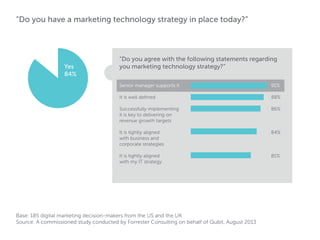
“Do you have a marketing technology strategy in place today?”

Yes
84%

“Do you agree with the following statements regarding
you marketing technology strategy?”
Senior manager supports it

91%

It is well defined

88%

Successfully implementing
it is key to delivering on
revenue growth targets

86%

It is tightly aligned
with business and
corporate strategies

84%

It is tightly aligned
with my IT strategy

81%

Base: 185 digital marketing decision-makers from the US and the UK
Source: A commissioned study conducted by Forrester Consulting on behalf of Qubit, August 2013
2. Having no marketing
technology strategy
affects business
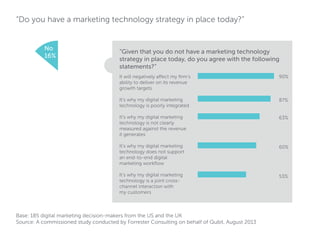
“Do you have a marketing technology strategy in place today?”

No
16%

“Given that you do not have a marketing technology
strategy in place today, do you agree with the following
statements?”
It will negatively affect my firm’s
ability to deliver on its revenue
growth targets

90%

It’s why my digital marketing
technology is poorly integrated

87%

It’s why my digital marketing
technology is not clearly
measured against the revenue
it generates

63%

It’s why my digital marketing
technology does not support
an end-to-end digital
marketing workflow

60%

It’s why my digital marketing
technology is a joint crosschannel interaction with
my customers

53%

Base: 185 digital marketing decision-makers from the US and the UK
Source: A commissioned study conducted by Forrester Consulting on behalf of Qubit, August 2013
3. Companies believe
their digital marketing
is integrated
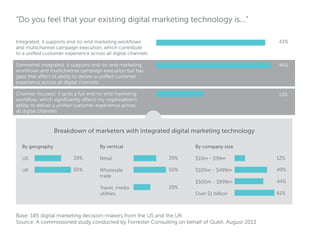
“Do you feel that your existing digital marketing technology is...”
Integrated; it supports end-to-end marketing workflows
and multichannel campaign execution, which contribute
to a unified customer experience across all digital channels

43%

Somewhat integrated; it supports end-to-end marketing
workflows and multichannel campaign execution but has
gaps that affect its ability to deliver a unified customer
experience across all digital channels

44%

Channel-focused; it lacks a full end-to-end marketing
workflow, which significantly affects my organisation’s
ability to deliver a unified customer experience across
all digital channels

13%

Breakdown of marketers with integrated digital marketing technology
By geography

By vertical

By company size

US

39%

Retail

39%

$10m - $99m

12%

UK

50%

Wholesale
trade

50%

$100m - $499m

49%

$500m - $999m

44%

Over $1 billion

61%

Travel, media
utilities

29%

Base: 185 digital marketing decision-makers from the US and the UK
Source: A commissioned study conducted by Forrester Consulting on behalf of Qubit, August 2013
4. But the majority
have existing
digital marketing
technology that
lacks full integration
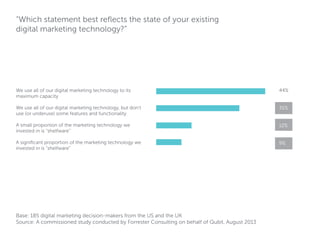
“Which statement best reflects the state of your existing
digital marketing technology?”

We use all of our digital marketing technology to its
maximum capacity

44%

We use all of our digital marketing technology, but don’t
use (or underuse) some features and functionality

35%

A small proportion of the marketing technology we
invested in is “shelfware”

12%

A significant proportion of the marketing technology we
invested in is “shelfware”

9%

Base: 185 digital marketing decision-makers from the US and the UK
Source: A commissioned study conducted by Forrester Consulting on behalf of Qubit, August 2013
5. When marketing
technology does not work,
business costs increase
and revenues suffer
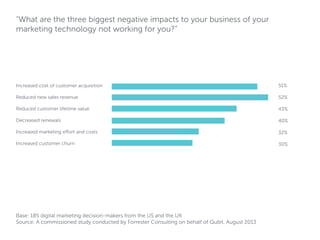
“What are the three biggest negative impacts to your business of your
marketing technology not working for you?”

Increased cost of customer acquisition

51%

Reduced new sales revenue

52%

Reduced customer lifetime value

43%

Decreased renewals

40%

Increased marketing effort and costs

32%

Increased customer churn

30%

Base: 185 digital marketing decision-makers from the US and the UK
Source: A commissioned study conducted by Forrester Consulting on behalf of Qubit, August 2013
6. Ecommerce and
marketing own
digital marketing
technology
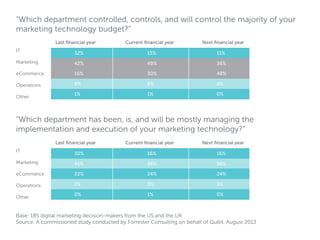
“Which department controlled, controls, and will control the majority of your
marketing technology budget?”
Last financial year
IT

Current financial year

Next financial year

32%

15%

11%

Marketing

42%

49%

36%

eCommerce

16%

30%

48%

Operations

9%

6%

6%

1%

1%

0%

Other

“Which department has been, is, and will be mostly managing the
implementation and execution of your marketing technology?”
Last financial year
IT

Current financial year

Next financial year

30%

16%

16%

Marketing

41%

56%

56%

eCommerce

22%

24%

24%

Operations

7%

3%

3%

0%

1%

0%

Other

Base: 185 digital marketing decision-makers from the US and the UK
Source: A commissioned study conducted by Forrester Consulting on behalf of Qubit, August 2013
7. Digital marketing
toolkit expands to
include optimization
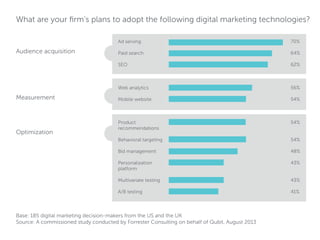
What are your firm’s plans to adopt the following digital marketing technologies?
Ad serving

62%

56%

Mobile website

54%

Product
recommendations

54%

Behavioral targeting

54%

Bid management

48%

Personalization
platform

43%

Multivariate testing

43%

A/B testing

Optimization

64%

Web analytics

Measurement

Paid search
SEO

Audience acquisition

70%

41%

Base: 185 digital marketing decision-makers from the US and the UK
Source: A commissioned study conducted by Forrester Consulting on behalf of Qubit, August 2013
8. Optimizing digital
experience is
currently a
top priority
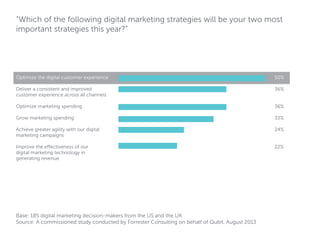
“Which of the following digital marketing strategies will be your two most
important strategies this year?”

Optimize the digital customer experience

50%

Deliver a consistent and improved
customer experience across all channels

36%

Optimize marketing spending

36%

Grow marketing spending

33%

Achieve greater agility with our digital
marketing campaigns

24%

Improve the effectiveness of our
digital marketing technology in
generating revenue

22%

Base: 185 digital marketing decision-makers from the US and the UK
Source: A commissioned study conducted by Forrester Consulting on behalf of Qubit, August 2013
9. Several factors interfere
with effective marketing
technology use
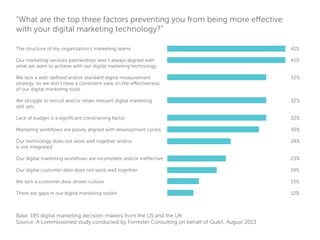
“What are the top three factors preventing you from being more effective
with your digital marketing technology?”
The structure of my organization’s marketing teams

41%

Our marketing services partnerships aren’t always aligned with
what we want to achieve with our digital marketing technology

41%

We lack a well-defined and/or standard digital measurement
strategy, so we don’t have a consistent view on the effectiveness
of our digital marketing tools

32%

We struggle to recruit and/or retain relevant digital marketing
skill sets

32%

Lack of budget is a significant constraining factor

32%

Marketing workflows are poorly aligned with development cycles

30%

Our technology does not work well together and/or
is not integrated

24%

Our digital marketing workflows are incomplete and/or ineffective

23%

Our digital customer data does not work well together

19%

We lack a customer data-driven culture

13%

There are gaps in our digital marketing toolkit

12%

Base: 185 digital marketing decision-makers from the US and the UK
Source: A commissioned study conducted by Forrester Consulting on behalf of Qubit, August 2013
10. Building out mobile

channel and integrating
technology is in the top
three priorities
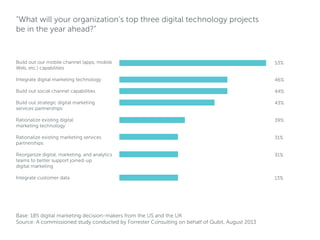
“What will your organization’s top three digital technology projects
be in the year ahead?”

Build out our mobile channel (apps, mobile
Web, etc.) capabilities

53%

Integrate digital marketing technology

46%

Build out social channel capabilities

44%

Build out strategic digital marketing
services partnerships

43%

Rationalize existing digital
marketing technology

39%

Rationalize existing marketing services
partnerships

31%

Reorganize digital, marketing, and analytics
teams to better support joined-up
digital marketing

31%

Integrate customer data

13%

Base: 185 digital marketing decision-makers from the US and the UK
Source: A commissioned study conducted by Forrester Consulting on behalf of Qubit, August 2013
Download the
whitepaper here
to read more

Digital Technology: The Organizational Quandary, Qubit and Forrester research

  • 1.
    The Organizational Quandary Qubit commissioneda Forrester Consulting survey to find out the issues marketers face with digital marketing technology What did we learn?
  • 2.
    1. Executives support digitalmarketing technology
  • 3.
    “Do you havea marketing technology strategy in place today?” Yes 84% “Do you agree with the following statements regarding you marketing technology strategy?” Senior manager supports it 91% It is well defined 88% Successfully implementing it is key to delivering on revenue growth targets 86% It is tightly aligned with business and corporate strategies 84% It is tightly aligned with my IT strategy 81% Base: 185 digital marketing decision-makers from the US and the UK Source: A commissioned study conducted by Forrester Consulting on behalf of Qubit, August 2013
  • 4.
    2. Having nomarketing technology strategy affects business
  • 5.
    “Do you havea marketing technology strategy in place today?” No 16% “Given that you do not have a marketing technology strategy in place today, do you agree with the following statements?” It will negatively affect my firm’s ability to deliver on its revenue growth targets 90% It’s why my digital marketing technology is poorly integrated 87% It’s why my digital marketing technology is not clearly measured against the revenue it generates 63% It’s why my digital marketing technology does not support an end-to-end digital marketing workflow 60% It’s why my digital marketing technology is a joint crosschannel interaction with my customers 53% Base: 185 digital marketing decision-makers from the US and the UK Source: A commissioned study conducted by Forrester Consulting on behalf of Qubit, August 2013
  • 6.
    3. Companies believe theirdigital marketing is integrated
  • 7.
    “Do you feelthat your existing digital marketing technology is...” Integrated; it supports end-to-end marketing workflows and multichannel campaign execution, which contribute to a unified customer experience across all digital channels 43% Somewhat integrated; it supports end-to-end marketing workflows and multichannel campaign execution but has gaps that affect its ability to deliver a unified customer experience across all digital channels 44% Channel-focused; it lacks a full end-to-end marketing workflow, which significantly affects my organisation’s ability to deliver a unified customer experience across all digital channels 13% Breakdown of marketers with integrated digital marketing technology By geography By vertical By company size US 39% Retail 39% $10m - $99m 12% UK 50% Wholesale trade 50% $100m - $499m 49% $500m - $999m 44% Over $1 billion 61% Travel, media utilities 29% Base: 185 digital marketing decision-makers from the US and the UK Source: A commissioned study conducted by Forrester Consulting on behalf of Qubit, August 2013
  • 8.
    4. But themajority have existing digital marketing technology that lacks full integration
  • 9.
    “Which statement bestreflects the state of your existing digital marketing technology?” We use all of our digital marketing technology to its maximum capacity 44% We use all of our digital marketing technology, but don’t use (or underuse) some features and functionality 35% A small proportion of the marketing technology we invested in is “shelfware” 12% A significant proportion of the marketing technology we invested in is “shelfware” 9% Base: 185 digital marketing decision-makers from the US and the UK Source: A commissioned study conducted by Forrester Consulting on behalf of Qubit, August 2013
  • 10.
    5. When marketing technologydoes not work, business costs increase and revenues suffer
  • 11.
    “What are thethree biggest negative impacts to your business of your marketing technology not working for you?” Increased cost of customer acquisition 51% Reduced new sales revenue 52% Reduced customer lifetime value 43% Decreased renewals 40% Increased marketing effort and costs 32% Increased customer churn 30% Base: 185 digital marketing decision-makers from the US and the UK Source: A commissioned study conducted by Forrester Consulting on behalf of Qubit, August 2013
  • 12.
    6. Ecommerce and marketingown digital marketing technology
  • 13.
    “Which department controlled,controls, and will control the majority of your marketing technology budget?” Last financial year IT Current financial year Next financial year 32% 15% 11% Marketing 42% 49% 36% eCommerce 16% 30% 48% Operations 9% 6% 6% 1% 1% 0% Other “Which department has been, is, and will be mostly managing the implementation and execution of your marketing technology?” Last financial year IT Current financial year Next financial year 30% 16% 16% Marketing 41% 56% 56% eCommerce 22% 24% 24% Operations 7% 3% 3% 0% 1% 0% Other Base: 185 digital marketing decision-makers from the US and the UK Source: A commissioned study conducted by Forrester Consulting on behalf of Qubit, August 2013
  • 14.
    7. Digital marketing toolkitexpands to include optimization
  • 15.
    What are yourfirm’s plans to adopt the following digital marketing technologies? Ad serving 62% 56% Mobile website 54% Product recommendations 54% Behavioral targeting 54% Bid management 48% Personalization platform 43% Multivariate testing 43% A/B testing Optimization 64% Web analytics Measurement Paid search SEO Audience acquisition 70% 41% Base: 185 digital marketing decision-makers from the US and the UK Source: A commissioned study conducted by Forrester Consulting on behalf of Qubit, August 2013
  • 16.
    8. Optimizing digital experienceis currently a top priority
  • 17.
    “Which of thefollowing digital marketing strategies will be your two most important strategies this year?” Optimize the digital customer experience 50% Deliver a consistent and improved customer experience across all channels 36% Optimize marketing spending 36% Grow marketing spending 33% Achieve greater agility with our digital marketing campaigns 24% Improve the effectiveness of our digital marketing technology in generating revenue 22% Base: 185 digital marketing decision-makers from the US and the UK Source: A commissioned study conducted by Forrester Consulting on behalf of Qubit, August 2013
  • 18.
    9. Several factorsinterfere with effective marketing technology use
  • 19.
    “What are thetop three factors preventing you from being more effective with your digital marketing technology?” The structure of my organization’s marketing teams 41% Our marketing services partnerships aren’t always aligned with what we want to achieve with our digital marketing technology 41% We lack a well-defined and/or standard digital measurement strategy, so we don’t have a consistent view on the effectiveness of our digital marketing tools 32% We struggle to recruit and/or retain relevant digital marketing skill sets 32% Lack of budget is a significant constraining factor 32% Marketing workflows are poorly aligned with development cycles 30% Our technology does not work well together and/or is not integrated 24% Our digital marketing workflows are incomplete and/or ineffective 23% Our digital customer data does not work well together 19% We lack a customer data-driven culture 13% There are gaps in our digital marketing toolkit 12% Base: 185 digital marketing decision-makers from the US and the UK Source: A commissioned study conducted by Forrester Consulting on behalf of Qubit, August 2013
  • 20.
    10. Building outmobile channel and integrating technology is in the top three priorities
  • 21.
    “What will yourorganization’s top three digital technology projects be in the year ahead?” Build out our mobile channel (apps, mobile Web, etc.) capabilities 53% Integrate digital marketing technology 46% Build out social channel capabilities 44% Build out strategic digital marketing services partnerships 43% Rationalize existing digital marketing technology 39% Rationalize existing marketing services partnerships 31% Reorganize digital, marketing, and analytics teams to better support joined-up digital marketing 31% Integrate customer data 13% Base: 185 digital marketing decision-makers from the US and the UK Source: A commissioned study conducted by Forrester Consulting on behalf of Qubit, August 2013
  • 22.