Chapter 11 Effective Team Building
Objectives Upon completion of this chapter, the reader should be able to: Discuss advantages and disadvantages of teamwork Review key concepts of creating an effective team Discuss the stages of a team process Discuss ways to create a conducive environment for teamwork Identify the qualities of an effective team member Identify the qualities of an effective team leader
Definition of a Team A small number of people with complementary skills who are committed to a common purpose, performance goals, and approach for which they are mutually accountable Teams exist for specific purposes
Types of Teams Multidisciplinary or interdisciplinary Comprised of varied disciplines contributing to an individual patient’s care Team works closely and communicates frequently Allows the disciplines to work together collaboratively
Types of Teams Committees Teams serve on several types of committees, which are created for specific goals or tasks The goal is to improve patient care
Advantages of Teamwork Promotes safe and efficient patient care delivery Creates effective interprofessional communication Equalizes power through shared governance Improves interpersonal relationships and job satisfaction Promotes free exchange of ideas, team cohesion, trust, and mutual respect Improves stability in employee satisfaction
Disadvantages of Teamwork May take longer to achieve a goal than one individual Team members may have disagreements on the best course of action Teams develop through time-consuming predictable stages of selecting the right members for the team, organizing team goals and manpower, and team collaboration Some team members may lack interest, motivation, or skills to participate in the team process
Informal Teams Can influence the organization either positively or negatively Are not directly established or sanctioned by the organization, but often form naturally Can become very powerful Often responsible for facilitating improvements in the working conditions
Stages of Group  and Team Process  Forming stage Storming phase Norming phase Performing stage Adjourning phase
Forming Stage Occurs when the group is created and they meet as a team for the first time They explore the purpose of the team, why they are called to be part of a team, and what contribution they can bring to the table Proceed to establishing team goals and expectations
Storming Stage As the group relaxes into a more comfortable team setting, interpersonal issues or opposing opinions may arise to cause conflict between the members Conflict is healthy and a natural process Must openly confront issues and conflict Real teams don’t emerge unless individuals on them take risks involving conflict, trust, interdependence, and hard work
Norming Stage A feeling of group cohesion develops Team members master the ability to resolve conflict Team members learn to respect differences of opinion and work together Overcoming barriers to performance is how groups become teams
Performing Stage Group cohesion, collaboration, and solidarity are evident Personal opinions are set aside in order to achieve group goals Team members are openly communicating, know each other’s roles and responsibilities, are taking risks, and trusting and relying on each other
Adjourning Stage Termination and consolidation occur in this stage The team reviews their activities and evaluates their progress The team leader summarizes the group’s accomplishments and the roles each member played in achieving these goals It is important to provide closure so each member leaves with a sense of accomplishment
A Winning Team Achieved when there is synergy Things work together harmoniously The whole is greater than the sum of the parts The needs and characteristics of a patient, clinical unit, or system are matched with the nurse’s competencies
Conducive  Teamwork Environment Requires ongoing time and effort Facility design allows for collaboration and interaction Social factors Clear identification and ownership of the team goal Clear definition and acceptance of each person’s roles and responsibilities Clear delineation of team processes Clear opportunities to build trust
Team Communication Ambassador activities Communicate with those in the hierarchy Used to protect the team from outside pressures Task coordinator activities Communicate with lateral levels in the organization Scout activities Occur in general ideas Scanning in the external environment
Team Size Team size affects performance in that too few or too many affect performance Communication and coordination problems increase with large teams Smaller teams have lower incidence of social loafing Individuals in large teams are able to maintain anonymity and gain from the work of the group without making a suitable contribution
Status Differences Status is the measure of worth conferred on an individual by a group High-status members initiate communication more often and are provided more opportunities to participate A lower-status member may be ignored or intimidated Status differences have significant impacts on patient outcomes Need to build a trust-sensitive environment
Psychological Safety Describes individual’s perceptions about the consequences of interpersonal risks in their work environment Created by mutual respect and trust among team members  Describes a climate that fosters productive discussion and non-punitive action
Qualities of  Effective Team Members Proactive Motivated Take responsibility for one’s actions, decisions, and behavior Seize initiatives to do whatever is necessary to get the job done consistent with correct principles
Qualities of  Effective Team Leaders Will organize, facilitate, and manage the entire team Must understand how various learning styles, cultural diversity, and personality differences play into the dynamics of teamwork Have good communication skills, conflict resolution skills, and leadership skills
Qualities of  Effective Team Leaders Focus the team on outcome improvement Track reports Recognize contributing members
Guidelines for Meetings Set a time frame for the meetings and stick to it Review the progress Help group members feel comfortable with one another Establish ground rules Get a report from each member
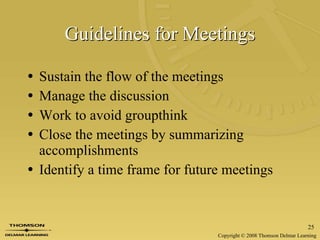
Guidelines for Meetings Sustain the flow of the meetings Manage the discussion Work to avoid groupthink Close the meetings by summarizing accomplishments Identify a time frame for future meetings
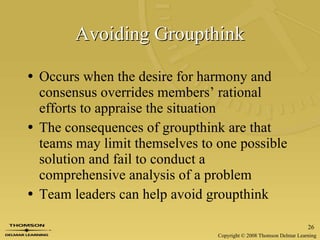
Avoiding Groupthink Occurs when the desire for harmony and consensus overrides members’ rational efforts to appraise the situation The consequences of groupthink are that teams may limit themselves to one possible solution and fail to conduct a comprehensive analysis of a problem Team leaders can help avoid groupthink
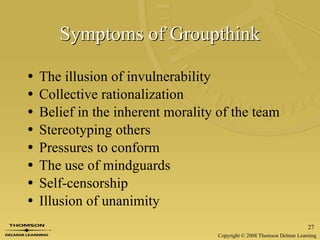
Symptoms of Groupthink The illusion of invulnerability Collective rationalization Belief in the inherent morality of the team Stereotyping others Pressures to conform The use of mindguards Self-censorship Illusion of unanimity

Chapter11

  • 1.
    Chapter 11 EffectiveTeam Building
  • 2.
    Objectives Upon completionof this chapter, the reader should be able to: Discuss advantages and disadvantages of teamwork Review key concepts of creating an effective team Discuss the stages of a team process Discuss ways to create a conducive environment for teamwork Identify the qualities of an effective team member Identify the qualities of an effective team leader
  • 3.
    Definition of aTeam A small number of people with complementary skills who are committed to a common purpose, performance goals, and approach for which they are mutually accountable Teams exist for specific purposes
  • 4.
    Types of TeamsMultidisciplinary or interdisciplinary Comprised of varied disciplines contributing to an individual patient’s care Team works closely and communicates frequently Allows the disciplines to work together collaboratively
  • 5.
    Types of TeamsCommittees Teams serve on several types of committees, which are created for specific goals or tasks The goal is to improve patient care
  • 6.
    Advantages of TeamworkPromotes safe and efficient patient care delivery Creates effective interprofessional communication Equalizes power through shared governance Improves interpersonal relationships and job satisfaction Promotes free exchange of ideas, team cohesion, trust, and mutual respect Improves stability in employee satisfaction
  • 7.
    Disadvantages of TeamworkMay take longer to achieve a goal than one individual Team members may have disagreements on the best course of action Teams develop through time-consuming predictable stages of selecting the right members for the team, organizing team goals and manpower, and team collaboration Some team members may lack interest, motivation, or skills to participate in the team process
  • 8.
    Informal Teams Caninfluence the organization either positively or negatively Are not directly established or sanctioned by the organization, but often form naturally Can become very powerful Often responsible for facilitating improvements in the working conditions
  • 9.
    Stages of Group and Team Process Forming stage Storming phase Norming phase Performing stage Adjourning phase
  • 10.
    Forming Stage Occurswhen the group is created and they meet as a team for the first time They explore the purpose of the team, why they are called to be part of a team, and what contribution they can bring to the table Proceed to establishing team goals and expectations
  • 11.
    Storming Stage Asthe group relaxes into a more comfortable team setting, interpersonal issues or opposing opinions may arise to cause conflict between the members Conflict is healthy and a natural process Must openly confront issues and conflict Real teams don’t emerge unless individuals on them take risks involving conflict, trust, interdependence, and hard work
  • 12.
    Norming Stage Afeeling of group cohesion develops Team members master the ability to resolve conflict Team members learn to respect differences of opinion and work together Overcoming barriers to performance is how groups become teams
  • 13.
    Performing Stage Groupcohesion, collaboration, and solidarity are evident Personal opinions are set aside in order to achieve group goals Team members are openly communicating, know each other’s roles and responsibilities, are taking risks, and trusting and relying on each other
  • 14.
    Adjourning Stage Terminationand consolidation occur in this stage The team reviews their activities and evaluates their progress The team leader summarizes the group’s accomplishments and the roles each member played in achieving these goals It is important to provide closure so each member leaves with a sense of accomplishment
  • 15.
    A Winning TeamAchieved when there is synergy Things work together harmoniously The whole is greater than the sum of the parts The needs and characteristics of a patient, clinical unit, or system are matched with the nurse’s competencies
  • 16.
    Conducive TeamworkEnvironment Requires ongoing time and effort Facility design allows for collaboration and interaction Social factors Clear identification and ownership of the team goal Clear definition and acceptance of each person’s roles and responsibilities Clear delineation of team processes Clear opportunities to build trust
  • 17.
    Team Communication Ambassadoractivities Communicate with those in the hierarchy Used to protect the team from outside pressures Task coordinator activities Communicate with lateral levels in the organization Scout activities Occur in general ideas Scanning in the external environment
  • 18.
    Team Size Teamsize affects performance in that too few or too many affect performance Communication and coordination problems increase with large teams Smaller teams have lower incidence of social loafing Individuals in large teams are able to maintain anonymity and gain from the work of the group without making a suitable contribution
  • 19.
    Status Differences Statusis the measure of worth conferred on an individual by a group High-status members initiate communication more often and are provided more opportunities to participate A lower-status member may be ignored or intimidated Status differences have significant impacts on patient outcomes Need to build a trust-sensitive environment
  • 20.
    Psychological Safety Describesindividual’s perceptions about the consequences of interpersonal risks in their work environment Created by mutual respect and trust among team members Describes a climate that fosters productive discussion and non-punitive action
  • 21.
    Qualities of Effective Team Members Proactive Motivated Take responsibility for one’s actions, decisions, and behavior Seize initiatives to do whatever is necessary to get the job done consistent with correct principles
  • 22.
    Qualities of Effective Team Leaders Will organize, facilitate, and manage the entire team Must understand how various learning styles, cultural diversity, and personality differences play into the dynamics of teamwork Have good communication skills, conflict resolution skills, and leadership skills
  • 23.
    Qualities of Effective Team Leaders Focus the team on outcome improvement Track reports Recognize contributing members
  • 24.
    Guidelines for MeetingsSet a time frame for the meetings and stick to it Review the progress Help group members feel comfortable with one another Establish ground rules Get a report from each member
  • 25.
    Guidelines for MeetingsSustain the flow of the meetings Manage the discussion Work to avoid groupthink Close the meetings by summarizing accomplishments Identify a time frame for future meetings
  • 26.
    Avoiding Groupthink Occurswhen the desire for harmony and consensus overrides members’ rational efforts to appraise the situation The consequences of groupthink are that teams may limit themselves to one possible solution and fail to conduct a comprehensive analysis of a problem Team leaders can help avoid groupthink
  • 27.
    Symptoms of GroupthinkThe illusion of invulnerability Collective rationalization Belief in the inherent morality of the team Stereotyping others Pressures to conform The use of mindguards Self-censorship Illusion of unanimity