Consulting Process Models
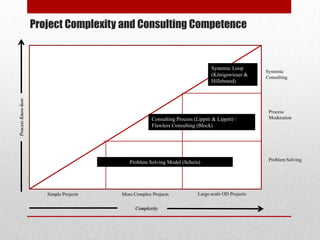
Project Complexity and Consulting Competence


                                                                                 Systemic Loop
                                                                                                    Systemic
                                                                                 (Königswieser &    Consulting
                                                                                 Hillebrand)
Process Know-how


                                                                                                     Process
                                                     Consulting Process (Lippitt & Lippitt) /        Moderation
                                                     Flawless Consulting (Block)


                                                                                                     Problem Solving
                                           Problem Solving Model (Schein)


                      Simple Projects   More Complex Projects             Large-scale OD Projects

                                             Complexity
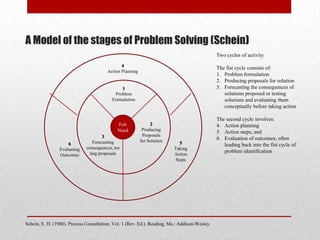
A Model of the stages of Problem Solving (Schein)
                                                                                               Two cycles of activity
                                               4
                                                                                               The fist cycle consists of:
                                        Action Planning
                                                                                               1. Problem formulation
                                                                                               2. Producing proposals for solution
                                               1                                               3. Forecasting the consequences of
                                            Problem                                               solutions proposed or testing
                                           Formulation                                            solutions and evaluating them
                                                                                                  conceptually before taking action

                                                                                               The second cycle involves:
                                              Felt             2                               4. Action planning
                                              Need         Producing
                                                                                               5. Action steps; and
                                       3                   Proposals
                                                          for Solution                         6. Evaluation of outcomes; often
                    6             Forecasting                               5                     leading back into the fist cycle of
                Evaluating    consequences, tes                          Taking
                                ting proposals                                                    problem identification
                Outcomes                                                 Action
                                                                          Steps


Schein, E. H. (1988). Process Consultation. Vol. 1 (Rev. Ed.). Reading, Ma.: Addison-Wesley.
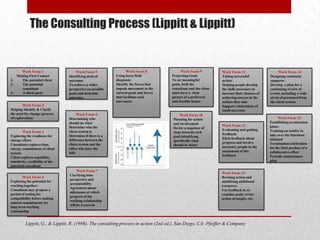
The Consulting Process (Lippitt & Lippitt)


     Work Focus 1                     Work Focus 5                 Work Focus 8              Work Focus 9          Work Focus 11                     Work Focus 14
   Making First Contact           Identifying desired       Using force-field          Projecting Goals            Taking successful           Designing continuity
1.    The potential client        outcomes                  diagnosis:                 To set meaningful           action:                     supports:
2.    The potential               To achieve a wider        Identify the forces that   goals, both the             Helping people develop      Develop a plan for a
      consultant                  perspective on possible   impede movement to the     consultant and the client   the skills necessary to     continuing review of
3.    A third party               goals and desirable       current goals and forces   must have a clear           increase their chances of   events, including a wide
                                  outcomes                  that facilitate such       picture of a preferred      achieving success in the    circle of personnel from
                                                            movement                   and feasible future         actions they take           the client system
        Work Focus 2                                                                                               Support celebrations of
Helping Identify & Clarify                                                                                         small successes
the need for change (process            Work Focus 6                                       Work Focus 10
of exploration)                   Determining who                                      Planning for action                                           Work Focus 15
                                  should do what                                       and involvement                                         Establishing termination
                                  Determine who the                                                                Work Focus 12               plans:
                                                                                       Devise a sequence of
                                  client system is                                                                 Evaluating and guiding      Training an insider to
        Work Focus 3                                                                   steps towards each
                                  Determine if there is a                                                          feedback:                   take over the functions
Exploring the readiness for                                                            goal (identifying
                                  difference between the                                                           Elicit feedback about       initiated
change effort:                                                                         specifically what
                                  client system and the                                                            progress and involve        Termination celebration
Consultant explores time,                                                              should be done)
                                  office who pays the                                                              necessary people in the     for the final product of a
energy, commitment of client
                                  bills                                                                            assessment of this          collaborative effort
system
                                                                                                                   feedback                    Periodic maintenance
Client explores capability,
sensitivity, credibility of the                                                                                                                plan
potential consultant
                                       Work Focus 7
                                                                                                                   Work Focus 13
                                  Clarifying time
        Work Focus 4                                                                                               Revising action and
                                  perspective and
Exploring the potential for                                                                                        mobilizing additional
                                  accountability
working together:                                                                                                  resources:
                                  Agreement about
Consultant may propose a                                                                                           Use feedback to re-
                                  milestones at which
period of testing for                                                                                              examine goals, revise
                                  progress of the
compatibility before making                                                                                        action strategies, etc.
                                  working relationship
mutual commitments for
                                  will be reviewed
long-term working
relationship


          Lippitt, G., & Lippitt, R. (1986). The consulting process in action (2nd ed.). San Diego, CA: Pfeiffer & Company
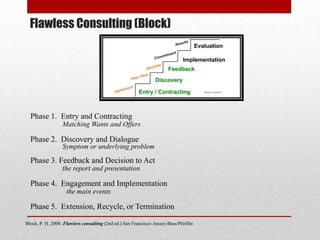
Flawless Consulting (Block)


  Phase 1. Entry and Contracting
                  Matching Wants and Offers

  Phase 2. Discovery and Dialogue
                  Symptom or underlying problem

  Phase 3. Feedback and Decision to Act
                  the report and presentation

  Phase 4. Engagement and Implementation
                    the main events

  Phase 5. Extension, Recycle, or Termination

Block, P. H. 2000. Flawless consulting (2nd ed.) San Francisco: Jossey-Bass/Pfeiffer.
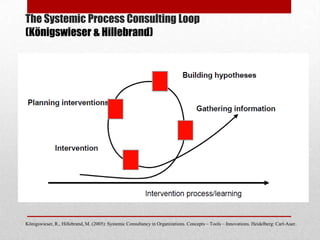
The Systemic Process Consulting Loop
(Königswieser & Hillebrand)


Königswieser, R., Hillebrand, M. (2005): Systemic Consultancy in Organizations. Concepts – Tools – Innovations. Heidelberg: Carl-Auer.
Consultant Roles
Eight Roles of a Consultant (Lippitt & Lippitt)
 1. Objective Observer. In this role the consultant does not express personal beliefs or ideas and does not assume responsibility for
    the work or the result of that work. Instead, the consultant observes the client’s behavior and provides feedback; the client
    alone is responsible for the direction that is ultimately chosen.
 2. Process Counselor. This role consists of observing the client’s problem-solving processes and offering suggestions for
    improvement. The consultant and the client jointly diagnose the client’s process, and the consultant assists the client in
    acquiring whatever skills are necessary to continue diagnosing the process.
 3. Fact Finder. In this role the consultant serves as a researcher, collecting and interpreting information in areas of importance to
    the client. Fact finding enables the consultant to develop an understanding of the client’s processes and performance; as a result
    of the insights gained, the consultant and the client can evaluate the effectiveness of a change process in terms of solving the
    client’s problem.
 4. Identifier of Alternatives and Linker to Resources. The consultant identifies alternative solutions to a problem; establishes
    criteria for evaluating each alternative; determines the likely consequences of each alternative; and then links the client with
    resources that may be able to help in solving the problem. However, the consultant does not assist in selecting the final
    solution.
 5. Joint Problem Solver. The consultant works actively with the client to identify and solve the problem at hand, often taking a
    major role in defining the results. The consultant also may act as a third-party mediator when conflict arises during the
    problem-solving process.
 6. Trainer/Educator. The consultant provides instruction, information, or other kinds of directed learning opportunities for the
    client. As a trainer/educator, the consultant must be able to assess training needs, write learning objectives, design learning
    experiences and educational events, employ a range of educational techniques and media, and function as a group facilitator.
 7. Information Specialist. The consultant serves as content expert for the client, often defining “right” and “wrong” approaches
    to a problem. The client is primarily responsible for defining the problem and the objectives of the consultation, and the
    consultant plays a directive role until the client is comfortable with the approach that has been recommended.
 8. Advocate. The consultant consciously strives to have the client move in a direction desired by the consultant. In the most
    directive of the eight roles, the consultant uses power and influence to impose his or her ideas and values about either content
    or process issues. As a content advocate, the consultant tries to influence the client’s choice of goals and means; as a process
    advocate, the consultant tries to influence the methodology underlying the client’s problem-solving behavior.

 Lippitt, G., & Lippitt, R. (1986). The consulting process in action (2nd ed.). San Diego, CA: Pfeiffer & Company
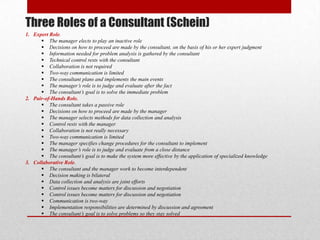
Three Roles of a Consultant (Schein)
1. Expert Role.
       The manager elects to play an inactive role
       Decisions on how to proceed are made by the consultant, on the basis of his or her expert judgment
       Information needed for problem analysis is gathered by the consultant
       Technical control rests with the consultant
       Collaboration is not required
       Two-way communication is limited
       The consultant plans and implements the main events
       The manager’s role is to judge and evaluate after the fact
       The consultant’s goal is to solve the immediate problem
2. Pair-of-Hands Role.
       The consultant takes a passive role
       Decisions on how to proceed are made by the manager
       The manager selects methods for data collection and analysis
       Control rests with the manager
       Collaboration is not really necessary
       Two-way communication is limited
       The manager specifies change procedures for the consultant to implement
       The manager’s role is to judge and evaluate from a close distance
       The consultant’s goal is to make the system more effective by the application of specialized knowledge
3. Collaborative Role.
       The consultant and the manager work to become interdependent
       Decision making is bilateral
       Data collection and analysis are joint efforts
       Control issues become matters for discussion and negotiation
       Control issues become matters for discussion and negotiation
       Communication is two-way
       Implementation responsibilities are determined by discussion and agreement
       The consultant’s goal is to solve problems so they stay solved

The consulting process models

  • 1.
  • 2.
    Project Complexity andConsulting Competence Systemic Loop Systemic (Königswieser & Consulting Hillebrand) Process Know-how Process Consulting Process (Lippitt & Lippitt) / Moderation Flawless Consulting (Block) Problem Solving Problem Solving Model (Schein) Simple Projects More Complex Projects Large-scale OD Projects Complexity
  • 3.
    A Model ofthe stages of Problem Solving (Schein) Two cycles of activity 4 The fist cycle consists of: Action Planning 1. Problem formulation 2. Producing proposals for solution 1 3. Forecasting the consequences of Problem solutions proposed or testing Formulation solutions and evaluating them conceptually before taking action The second cycle involves: Felt 2 4. Action planning Need Producing 5. Action steps; and 3 Proposals for Solution 6. Evaluation of outcomes; often 6 Forecasting 5 leading back into the fist cycle of Evaluating consequences, tes Taking ting proposals problem identification Outcomes Action Steps Schein, E. H. (1988). Process Consultation. Vol. 1 (Rev. Ed.). Reading, Ma.: Addison-Wesley.
  • 4.
    The Consulting Process(Lippitt & Lippitt) Work Focus 1 Work Focus 5 Work Focus 8 Work Focus 9 Work Focus 11 Work Focus 14 Making First Contact Identifying desired Using force-field Projecting Goals Taking successful Designing continuity 1. The potential client outcomes diagnosis: To set meaningful action: supports: 2. The potential To achieve a wider Identify the forces that goals, both the Helping people develop Develop a plan for a consultant perspective on possible impede movement to the consultant and the client the skills necessary to continuing review of 3. A third party goals and desirable current goals and forces must have a clear increase their chances of events, including a wide outcomes that facilitate such picture of a preferred achieving success in the circle of personnel from movement and feasible future actions they take the client system Work Focus 2 Support celebrations of Helping Identify & Clarify small successes the need for change (process Work Focus 6 Work Focus 10 of exploration) Determining who Planning for action Work Focus 15 should do what and involvement Establishing termination Determine who the Work Focus 12 plans: Devise a sequence of client system is Evaluating and guiding Training an insider to Work Focus 3 steps towards each Determine if there is a feedback: take over the functions Exploring the readiness for goal (identifying difference between the Elicit feedback about initiated change effort: specifically what client system and the progress and involve Termination celebration Consultant explores time, should be done) office who pays the necessary people in the for the final product of a energy, commitment of client bills assessment of this collaborative effort system feedback Periodic maintenance Client explores capability, sensitivity, credibility of the plan potential consultant Work Focus 7 Work Focus 13 Clarifying time Work Focus 4 Revising action and perspective and Exploring the potential for mobilizing additional accountability working together: resources: Agreement about Consultant may propose a Use feedback to re- milestones at which period of testing for examine goals, revise progress of the compatibility before making action strategies, etc. working relationship mutual commitments for will be reviewed long-term working relationship Lippitt, G., & Lippitt, R. (1986). The consulting process in action (2nd ed.). San Diego, CA: Pfeiffer & Company
  • 5.
    Flawless Consulting (Block) Phase 1. Entry and Contracting Matching Wants and Offers Phase 2. Discovery and Dialogue Symptom or underlying problem Phase 3. Feedback and Decision to Act the report and presentation Phase 4. Engagement and Implementation the main events Phase 5. Extension, Recycle, or Termination Block, P. H. 2000. Flawless consulting (2nd ed.) San Francisco: Jossey-Bass/Pfeiffer.
  • 6.
    The Systemic ProcessConsulting Loop (Königswieser & Hillebrand) Königswieser, R., Hillebrand, M. (2005): Systemic Consultancy in Organizations. Concepts – Tools – Innovations. Heidelberg: Carl-Auer.
  • 7.
  • 8.
    Eight Roles ofa Consultant (Lippitt & Lippitt) 1. Objective Observer. In this role the consultant does not express personal beliefs or ideas and does not assume responsibility for the work or the result of that work. Instead, the consultant observes the client’s behavior and provides feedback; the client alone is responsible for the direction that is ultimately chosen. 2. Process Counselor. This role consists of observing the client’s problem-solving processes and offering suggestions for improvement. The consultant and the client jointly diagnose the client’s process, and the consultant assists the client in acquiring whatever skills are necessary to continue diagnosing the process. 3. Fact Finder. In this role the consultant serves as a researcher, collecting and interpreting information in areas of importance to the client. Fact finding enables the consultant to develop an understanding of the client’s processes and performance; as a result of the insights gained, the consultant and the client can evaluate the effectiveness of a change process in terms of solving the client’s problem. 4. Identifier of Alternatives and Linker to Resources. The consultant identifies alternative solutions to a problem; establishes criteria for evaluating each alternative; determines the likely consequences of each alternative; and then links the client with resources that may be able to help in solving the problem. However, the consultant does not assist in selecting the final solution. 5. Joint Problem Solver. The consultant works actively with the client to identify and solve the problem at hand, often taking a major role in defining the results. The consultant also may act as a third-party mediator when conflict arises during the problem-solving process. 6. Trainer/Educator. The consultant provides instruction, information, or other kinds of directed learning opportunities for the client. As a trainer/educator, the consultant must be able to assess training needs, write learning objectives, design learning experiences and educational events, employ a range of educational techniques and media, and function as a group facilitator. 7. Information Specialist. The consultant serves as content expert for the client, often defining “right” and “wrong” approaches to a problem. The client is primarily responsible for defining the problem and the objectives of the consultation, and the consultant plays a directive role until the client is comfortable with the approach that has been recommended. 8. Advocate. The consultant consciously strives to have the client move in a direction desired by the consultant. In the most directive of the eight roles, the consultant uses power and influence to impose his or her ideas and values about either content or process issues. As a content advocate, the consultant tries to influence the client’s choice of goals and means; as a process advocate, the consultant tries to influence the methodology underlying the client’s problem-solving behavior. Lippitt, G., & Lippitt, R. (1986). The consulting process in action (2nd ed.). San Diego, CA: Pfeiffer & Company
  • 9.
    Three Roles ofa Consultant (Schein) 1. Expert Role.  The manager elects to play an inactive role  Decisions on how to proceed are made by the consultant, on the basis of his or her expert judgment  Information needed for problem analysis is gathered by the consultant  Technical control rests with the consultant  Collaboration is not required  Two-way communication is limited  The consultant plans and implements the main events  The manager’s role is to judge and evaluate after the fact  The consultant’s goal is to solve the immediate problem 2. Pair-of-Hands Role.  The consultant takes a passive role  Decisions on how to proceed are made by the manager  The manager selects methods for data collection and analysis  Control rests with the manager  Collaboration is not really necessary  Two-way communication is limited  The manager specifies change procedures for the consultant to implement  The manager’s role is to judge and evaluate from a close distance  The consultant’s goal is to make the system more effective by the application of specialized knowledge 3. Collaborative Role.  The consultant and the manager work to become interdependent  Decision making is bilateral  Data collection and analysis are joint efforts  Control issues become matters for discussion and negotiation  Control issues become matters for discussion and negotiation  Communication is two-way  Implementation responsibilities are determined by discussion and agreement  The consultant’s goal is to solve problems so they stay solved