Introduction
Name - Niraj Mourya
Class – TE IT
Division – A
Roll No. – TEITA17165
Audit Course - Leadership and Personality Development
Topic – Group Dynamics &Team Building
Unit No. – 4
College – D.Y.Patil College of Engineering,Pune
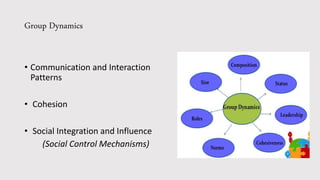
Group Dynamics
• Communication and Interaction
Patterns
• Cohesion
• Social Integration and Influence
(Social Control Mechanisms)
Communication and Interaction Patterns
• “Whenever people are together in a group, they are communicating.”
(T & R)
• Communication patterns can be helpful or harmful.
Communication and Interaction Patterns
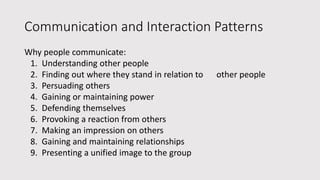
Why people communicate:
1. Understanding other people
2. Finding out where they stand in relation to other people
3. Persuading others
4. Gaining or maintaining power
5. Defending themselves
6. Provoking a reaction from others
7. Making an impression on others
8. Gaining and maintaining relationships
9. Presenting a unified image to the group
Communication and Interaction Patterns
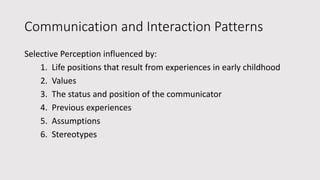
Selective Perception influenced by:
1. Life positions that result from experiences in early childhood
2. Values
3. The status and position of the communicator
4. Previous experiences
5. Assumptions
6. Stereotypes
Communication and Interaction Patterns
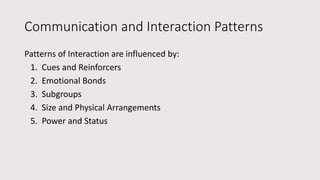
Patterns of Interaction are influenced by:
1. Cues and Reinforcers
2. Emotional Bonds
3. Subgroups
4. Size and Physical Arrangements
5. Power and Status
Cohesion
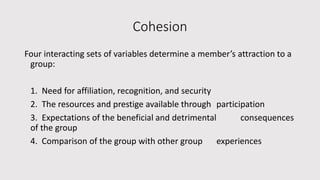
Four interacting sets of variables determine a member’s attraction to a
group:
1. Need for affiliation, recognition, and security
2. The resources and prestige available through participation
3. Expectations of the beneficial and detrimental consequences
of the group
4. Comparison of the group with other group experiences
Social Integration and Influence
(Social Control Mechanisms)
How members fit together and are accepted in a group.
 Groups are not able to function effectively unless there is a fairly
high level of social integration among members
Social Control Mechanisms – the processes by which the group-as-a-
whole gains sufficient compliance and conformity from its members to
enable it to function in an orderly manner.
“Social order and stability are prerequisites for the formation and
maintenance of a cohesive group.”
Social Integration and Influence
Norms – shared expectations and beliefs about appropriate ways to act
in a social situation such as a group.
• increase predictability, stability, and security
• result from what is valued, preferred, and accepted behavior
• overt or covert
Social Integration and Influence
Roles – shared expectations about the functions of individuals in the
group
Status – an evaluation and ranking of each member’s position in the
group relative to all other members
Team Building
Team Building Objective
• Build and serve on high-performance, effective teams
• Help meet our goals and objectives
WHAT IS A TEAM?
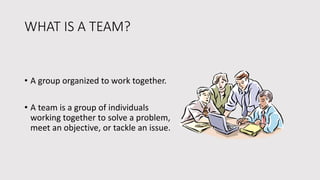
• A group organized to work together.
• A team is a group of individuals
working together to solve a problem,
meet an objective, or tackle an issue.
WHY DO TEAMS WORK?
• Whole is greater than the sum of its parts
• Individuals bring a range of talents, knowledge, experience, contacts,
etc.
• Working together, a team can accomplish more
INTANGIBLE BENEFITS
• Sense of accomplishment
• Self-fulfillment
• Esprit de corps
• Get to know one another
• More participation in activities
• Enhance club/OI reputation
BUILDING AN EFFECTIVE TEAM
• Get to know one another
• Establish consensus as to team’s purpose
• Identify available resources
• Establish rules of behavior
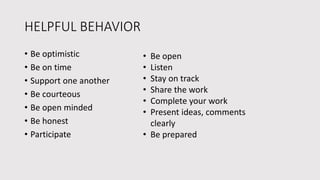
HELPFUL BEHAVIOR
• Be optimistic
• Be on time
• Support one another
• Be courteous
• Be open minded
• Be honest
• Participate
• Be open
• Listen
• Stay on track
• Share the work
• Complete your work
• Present ideas, comments
clearly
• Be prepared
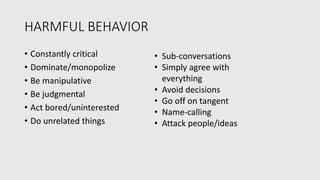
HARMFUL BEHAVIOR
• Constantly critical
• Dominate/monopolize
• Be manipulative
• Be judgmental
• Act bored/uninterested
• Do unrelated things
• Sub-conversations
• Simply agree with
everything
• Avoid decisions
• Go off on tangent
• Name-calling
• Attack people/ideas
References
• www.optimistleaders.org
• www.mnstate.edu
• www.google.com
• www.slideshare.net

Group Dynamcs and Team Building

  • 1.
    Introduction Name - NirajMourya Class – TE IT Division – A Roll No. – TEITA17165 Audit Course - Leadership and Personality Development Topic – Group Dynamics &Team Building Unit No. – 4 College – D.Y.Patil College of Engineering,Pune
  • 2.
    Group Dynamics • Communicationand Interaction Patterns • Cohesion • Social Integration and Influence (Social Control Mechanisms)
  • 3.
    Communication and InteractionPatterns • “Whenever people are together in a group, they are communicating.” (T & R) • Communication patterns can be helpful or harmful.
  • 4.
    Communication and InteractionPatterns Why people communicate: 1. Understanding other people 2. Finding out where they stand in relation to other people 3. Persuading others 4. Gaining or maintaining power 5. Defending themselves 6. Provoking a reaction from others 7. Making an impression on others 8. Gaining and maintaining relationships 9. Presenting a unified image to the group
  • 5.
    Communication and InteractionPatterns Selective Perception influenced by: 1. Life positions that result from experiences in early childhood 2. Values 3. The status and position of the communicator 4. Previous experiences 5. Assumptions 6. Stereotypes
  • 6.
    Communication and InteractionPatterns Patterns of Interaction are influenced by: 1. Cues and Reinforcers 2. Emotional Bonds 3. Subgroups 4. Size and Physical Arrangements 5. Power and Status
  • 7.
    Cohesion Four interacting setsof variables determine a member’s attraction to a group: 1. Need for affiliation, recognition, and security 2. The resources and prestige available through participation 3. Expectations of the beneficial and detrimental consequences of the group 4. Comparison of the group with other group experiences
  • 8.
    Social Integration andInfluence (Social Control Mechanisms) How members fit together and are accepted in a group.  Groups are not able to function effectively unless there is a fairly high level of social integration among members Social Control Mechanisms – the processes by which the group-as-a- whole gains sufficient compliance and conformity from its members to enable it to function in an orderly manner. “Social order and stability are prerequisites for the formation and maintenance of a cohesive group.”
  • 9.
    Social Integration andInfluence Norms – shared expectations and beliefs about appropriate ways to act in a social situation such as a group. • increase predictability, stability, and security • result from what is valued, preferred, and accepted behavior • overt or covert
  • 10.
    Social Integration andInfluence Roles – shared expectations about the functions of individuals in the group Status – an evaluation and ranking of each member’s position in the group relative to all other members
  • 11.
    Team Building Team BuildingObjective • Build and serve on high-performance, effective teams • Help meet our goals and objectives
  • 12.
    WHAT IS ATEAM? • A group organized to work together. • A team is a group of individuals working together to solve a problem, meet an objective, or tackle an issue.
  • 13.
    WHY DO TEAMSWORK? • Whole is greater than the sum of its parts • Individuals bring a range of talents, knowledge, experience, contacts, etc. • Working together, a team can accomplish more
  • 14.
    INTANGIBLE BENEFITS • Senseof accomplishment • Self-fulfillment • Esprit de corps • Get to know one another • More participation in activities • Enhance club/OI reputation
  • 15.
    BUILDING AN EFFECTIVETEAM • Get to know one another • Establish consensus as to team’s purpose • Identify available resources • Establish rules of behavior
  • 16.
    HELPFUL BEHAVIOR • Beoptimistic • Be on time • Support one another • Be courteous • Be open minded • Be honest • Participate • Be open • Listen • Stay on track • Share the work • Complete your work • Present ideas, comments clearly • Be prepared
  • 17.
    HARMFUL BEHAVIOR • Constantlycritical • Dominate/monopolize • Be manipulative • Be judgmental • Act bored/uninterested • Do unrelated things • Sub-conversations • Simply agree with everything • Avoid decisions • Go off on tangent • Name-calling • Attack people/ideas
  • 18.