A High-level Summary
On
Knowledge Advantage Presents
On
Becoming a Learning
Organization
http://www.knowledgeadvantage.biz
What is a Learning Organization?
A learning organization is an organization that:
• continually learns,
• supports the learning of its staff,
• listens to everyone and openly communicates, and• listens to everyone and openly communicates, and
• embraces a philosophy of ongoing improvement.
Peter Senge defined a learning organization as:
• “…an organization where people continually expand their capacity to create
the results they truly desire, where new and expansive patterns of thinking are
nurtured, where collective aspiration is set free, and where people are
continually learning to see the whole together.”
Characteristics of a Learning Organization
Research shows learning organizations share these traits:
• Support staff through continuous learning opportunities,
• Learning is planned, systematic and aligned with
organizational goals,organizational goals,
• Belief in the value of learning and each individual’s knowledge
and input,
• Open, top down, and across organizational communication,
• Encouragement of knowledge transfer.
Steps to becoming a Learning Organization
Step 1: Adopt an organizational shift in how training and learning are
approached.
Step 2: This shift, allows learning to become part of a larger framework of
systems and processes of how the organization promotes, supports,systems and processes of how the organization promotes, supports,
and delivers training and development.
Step 3: Inform and communicate this approach to staff to send a positive
message that their work and job performance and success is supported
by the organization.
Gaining a Competitive Advantage
Research shows that learning organizations enjoy a greater competitive
advantage than their non learning organization counterparts.
The Business Dictionary definition of a learning organization confirms the
necessity of supporting the characteristics of a learning organization to respondnecessity of supporting the characteristics of a learning organization to respond
to market needs and survive competitively.
“an organization that acquires knowledge and innovates fast enough to survive
and thrive in a rapidly changing environment. Learning organizations create a
culture that encourages and supports continuous employee learning, critical
thinking, and risk-taking with new ideas.”
The Value of a Learning Organization
Committing to becoming a learning organization will result in greater success in
using learning as a competitive advantage.
Continuous learning supports staff growth and development, increasingContinuous learning supports staff growth and development, increasing
response time to meeting customer needs and delivering on market changes and
trends.
A Shift in Thinking Towards becoming a
Learning Organization
The concept of a learning organization is broad. Peter Senge identified five
organizational practices that take a big picture approach, requiring attitude
changes that include:
Focusing on the whole rather than seeing parts
Planning and creating the future versus reacting to the present
Facilitating open communication, and functioning as a team,
And lastly, determining a learning strategy and how to share knowledge and
build on new information.
Five Practices of a Learning
Organization
The five practices are:
1. Systems thinking
2. Personal mastery
3. Mental models
4. Shared vision
5. Team learning
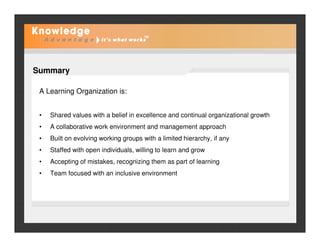
Summary
A Learning Organization is:
• Shared values with a belief in excellence and continual organizational growth
• A collaborative work environment and management approach• A collaborative work environment and management approach
• Built on evolving working groups with a limited hierarchy, if any
• Staffed with open individuals, willing to learn and grow
• Accepting of mistakes, recognizing them as part of learning
• Team focused with an inclusive environment
Knowledge Advantage Experience
Ruth Kustoff founded Knowledge Advantage, a learning and development
consultancy, in 2005.
With over 20 years’ experience in business and learning needs analysis, Ruth’s
approach is strategic, as she learns the business needs of the whole organization toapproach is strategic, as she learns the business needs of the whole organization to
determine how employee knowledge impacts overall goals.
Ruth provides learning needs analysis, strategic planning and implementation, program
and curriculum design, and knowledge and talent management in support of creating
and maintaining a learning organization.
Connect with Ruth on LinkedIn
By phone: 860.256.7879 or email: ruth@knowledgeadvantage.biz

Becoming a learning organization [compatibility mode]

  • 1.
    A High-level Summary On KnowledgeAdvantage Presents On Becoming a Learning Organization http://www.knowledgeadvantage.biz
  • 2.
    What is aLearning Organization? A learning organization is an organization that: • continually learns, • supports the learning of its staff, • listens to everyone and openly communicates, and• listens to everyone and openly communicates, and • embraces a philosophy of ongoing improvement. Peter Senge defined a learning organization as: • “…an organization where people continually expand their capacity to create the results they truly desire, where new and expansive patterns of thinking are nurtured, where collective aspiration is set free, and where people are continually learning to see the whole together.”
  • 3.
    Characteristics of aLearning Organization Research shows learning organizations share these traits: • Support staff through continuous learning opportunities, • Learning is planned, systematic and aligned with organizational goals,organizational goals, • Belief in the value of learning and each individual’s knowledge and input, • Open, top down, and across organizational communication, • Encouragement of knowledge transfer.
  • 4.
    Steps to becominga Learning Organization Step 1: Adopt an organizational shift in how training and learning are approached. Step 2: This shift, allows learning to become part of a larger framework of systems and processes of how the organization promotes, supports,systems and processes of how the organization promotes, supports, and delivers training and development. Step 3: Inform and communicate this approach to staff to send a positive message that their work and job performance and success is supported by the organization.
  • 5.
    Gaining a CompetitiveAdvantage Research shows that learning organizations enjoy a greater competitive advantage than their non learning organization counterparts. The Business Dictionary definition of a learning organization confirms the necessity of supporting the characteristics of a learning organization to respondnecessity of supporting the characteristics of a learning organization to respond to market needs and survive competitively. “an organization that acquires knowledge and innovates fast enough to survive and thrive in a rapidly changing environment. Learning organizations create a culture that encourages and supports continuous employee learning, critical thinking, and risk-taking with new ideas.”
  • 6.
    The Value ofa Learning Organization Committing to becoming a learning organization will result in greater success in using learning as a competitive advantage. Continuous learning supports staff growth and development, increasingContinuous learning supports staff growth and development, increasing response time to meeting customer needs and delivering on market changes and trends.
  • 7.
    A Shift inThinking Towards becoming a Learning Organization The concept of a learning organization is broad. Peter Senge identified five organizational practices that take a big picture approach, requiring attitude changes that include: Focusing on the whole rather than seeing parts Planning and creating the future versus reacting to the present Facilitating open communication, and functioning as a team, And lastly, determining a learning strategy and how to share knowledge and build on new information.
  • 8.
    Five Practices ofa Learning Organization The five practices are: 1. Systems thinking 2. Personal mastery 3. Mental models 4. Shared vision 5. Team learning
  • 9.
    Summary A Learning Organizationis: • Shared values with a belief in excellence and continual organizational growth • A collaborative work environment and management approach• A collaborative work environment and management approach • Built on evolving working groups with a limited hierarchy, if any • Staffed with open individuals, willing to learn and grow • Accepting of mistakes, recognizing them as part of learning • Team focused with an inclusive environment
  • 10.
    Knowledge Advantage Experience RuthKustoff founded Knowledge Advantage, a learning and development consultancy, in 2005. With over 20 years’ experience in business and learning needs analysis, Ruth’s approach is strategic, as she learns the business needs of the whole organization toapproach is strategic, as she learns the business needs of the whole organization to determine how employee knowledge impacts overall goals. Ruth provides learning needs analysis, strategic planning and implementation, program and curriculum design, and knowledge and talent management in support of creating and maintaining a learning organization. Connect with Ruth on LinkedIn By phone: 860.256.7879 or email: ruth@knowledgeadvantage.biz