WHAT IS A GROUP?
a collection of two or more people who work
with one another regularly to achieve common
goals.
is defined as two or more individuals,
interacting and interdependent, who have come
together to achieve particular objectives.
a collection of individuals who interact with
each other such that one person’s actions have
an impact on the others.
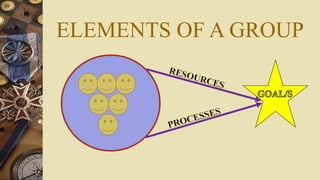
ELEMENTS OF A GROUP
VARIOUS TYPES OF RESOURCES
Staff
Funds
Facilities
Equipment
Supplies
Time
Information
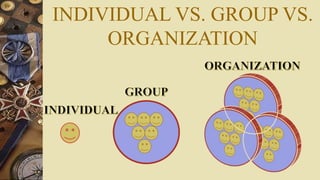
INDIVIDUAL VS. GROUP VS.
ORGANIZATION
TYPES OF GROUPS
Formal groups
– Officially designated to serve a specific
organizational purpose
– Arise from assigned tasks and responsibilities
derived from position in organizational structure.
EXAMPLE OF FORMAL GROUPS
Operations
Finance
Human Resources
Marketing
Research and Development
Informal groups
– Emerge without being officially designated by the
organization.
– alliances that are neither formally structured nor
organizationally determined
– Arise from formal groups
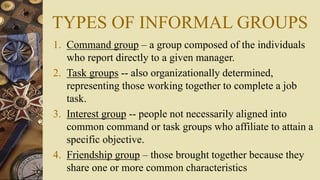
TYPES OF INFORMAL GROUPS
1. Command group – a group composed of the individuals
who report directly to a given manager.
2. Task groups -- also organizationally determined,
representing those working together to complete a job
task.
3. Interest group -- people not necessarily aligned into
common command or task groups who affiliate to attain a
specific objective.
4. Friendship group – those brought together because they
share one or more common characteristics
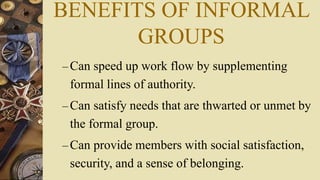
BENEFITS OF INFORMAL
GROUPS
– Can speed up work flow by supplementing
formal lines of authority.
– Can satisfy needs that are thwarted or unmet by
the formal group.
– Can provide members with social satisfaction,
security, and a sense of belonging.
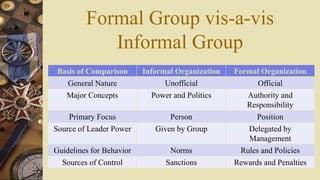
Formal Group vis-a-vis
Informal Group
Basis of Comparison Informal Organization Formal Organization
General Nature Unofficial Official
Major Concepts Power and Politics Authority and
Responsibility
Primary Focus Person Position
Source of Leader Power Given by Group Delegated by
Management
Guidelines for Behavior Norms Rules and Policies
Sources of Control Sanctions Rewards and Penalties
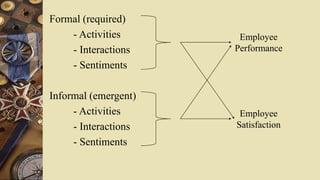
Formal (required)
- Activities
- Interactions
- Sentiments
Informal (emergent)
- Activities
- Interactions
- Sentiments
Employee
Performance
Employee
Satisfaction
IMPORTANCE OF GROUPS IN
A WORK ORGANIZATION

Group and Work Group Behavior

  • 2.
    WHAT IS AGROUP? a collection of two or more people who work with one another regularly to achieve common goals. is defined as two or more individuals, interacting and interdependent, who have come together to achieve particular objectives. a collection of individuals who interact with each other such that one person’s actions have an impact on the others.
  • 3.
  • 4.
    VARIOUS TYPES OFRESOURCES Staff Funds Facilities Equipment Supplies Time Information
  • 5.
    INDIVIDUAL VS. GROUPVS. ORGANIZATION
  • 6.
    TYPES OF GROUPS Formalgroups – Officially designated to serve a specific organizational purpose – Arise from assigned tasks and responsibilities derived from position in organizational structure.
  • 7.
    EXAMPLE OF FORMALGROUPS Operations Finance Human Resources Marketing Research and Development
  • 8.
    Informal groups – Emergewithout being officially designated by the organization. – alliances that are neither formally structured nor organizationally determined – Arise from formal groups
  • 9.
    TYPES OF INFORMALGROUPS 1. Command group – a group composed of the individuals who report directly to a given manager. 2. Task groups -- also organizationally determined, representing those working together to complete a job task. 3. Interest group -- people not necessarily aligned into common command or task groups who affiliate to attain a specific objective. 4. Friendship group – those brought together because they share one or more common characteristics
  • 10.
    BENEFITS OF INFORMAL GROUPS –Can speed up work flow by supplementing formal lines of authority. – Can satisfy needs that are thwarted or unmet by the formal group. – Can provide members with social satisfaction, security, and a sense of belonging.
  • 11.
    Formal Group vis-a-vis InformalGroup Basis of Comparison Informal Organization Formal Organization General Nature Unofficial Official Major Concepts Power and Politics Authority and Responsibility Primary Focus Person Position Source of Leader Power Given by Group Delegated by Management Guidelines for Behavior Norms Rules and Policies Sources of Control Sanctions Rewards and Penalties
  • 12.
    Formal (required) - Activities -Interactions - Sentiments Informal (emergent) - Activities - Interactions - Sentiments Employee Performance Employee Satisfaction
  • 13.
    IMPORTANCE OF GROUPSIN A WORK ORGANIZATION