MODULE 7
PROBABILITY
OF AN EVENT
Simple and Compound Events
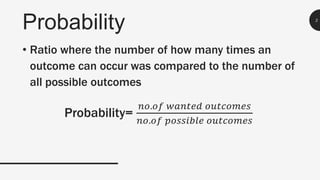
Probability
Probability=
𝑛𝑜.𝑜𝑓 𝑤𝑎𝑛𝑡𝑒𝑑 𝑜𝑢𝑡𝑐𝑜𝑚𝑒𝑠
𝑛𝑜.𝑜𝑓 𝑝𝑜𝑠𝑠𝑖𝑏𝑙𝑒 𝑜𝑢𝑡𝑐𝑜𝑚𝑒𝑠
2
• Ratio where the number of how many times an
outcome can occur was compared to the number of
all possible outcomes
Definition of Terms 3
• Experiment- doing the activity over and
over again
• Outcome- result of the experiment
• Sample space- number of all outcomes
Types of Events: 4
•Simple- consist of 1 outcome
•Compound- consist of more
than 1 outcome
Sample Problems 5
1. What is the probability of
getting no. 6 when you roll a
dice?
Sample Problems 6
2. What is the probability of
getting 4s when you roll 3 dice?
Sample Problems 7
3. What is the probability of
getting 2 red cards in a deck of
cards?
Sample Problems 8
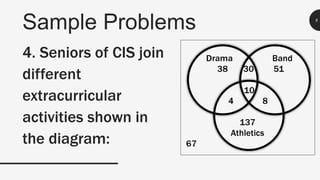
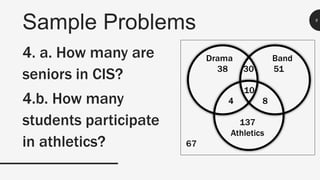
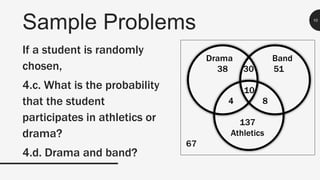
4. Seniors of CIS join
different
extracurricular
activities shown in
the diagram:
Sample Problems 9
4. a. How many are
seniors in CIS?
4.b. How many
students participate
in athletics?
Sample Problems 10
If a student is randomly
chosen,
4.c. What is the probability
that the student
participates in athletics or
drama?
4.d. Drama and band?
Seatwork: 11
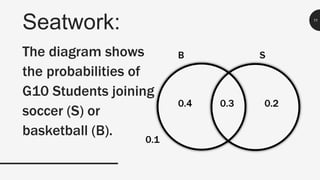
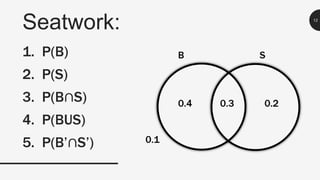
The diagram shows
the probabilities of
G10 Students joining
soccer (S) or
basketball (B).
Seatwork: 12
1. P(B)
2. P(S)
3. P(B∩S)
4. P(BUS)
5. P(B’∩S’)
Quiz: 13
In a group of students, 65 play football, 45 play
hockey, 52 play cricket, 20 play football and hockey,
25 play football and cricket, 15 play hockey and
cricket and 8 play all three games. Let F, H and C
represent the students who play football, hockey and
cricket, respectively.
Find the following: 14
1.How many students play all the
games?
2.How many played football only?
3.Hockey only?
4.Cricket only?
If a student is chosen at random, find the
probability that the student plays:
15
5. Football?
6. Hockey?
7. Cricket?
8. Football and hockey?
9. Hockey only?
10. Hockey and cricket?
Activity: Give Me Something 16
1.Blue or red
2.Round or rectangular
3.Round and blue
4.Round and rectangular
Mutually Exclusive and
Not Mutually Exclusive
Events
17
Analysis: 18
• Say I have a bowl containing 15 chips numbered 1 to 15,
what is a probability if I randomly choose a ball numbered
7 or 15?
• What about even or divisible by 3?
Questions: 19
• Is there a difference between the solution to the two
questions?
• How do you differentiate mutually exclusive to
mutually inclusive events?
Mutually Exclusive Event 20
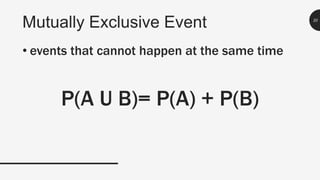
• events that cannot happen at the same time
P(A U B)= P(A) + P(B)
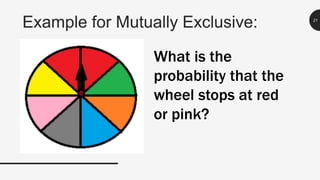
Example for Mutually Exclusive: 21
What is the
probability that the
wheel stops at red
or pink?
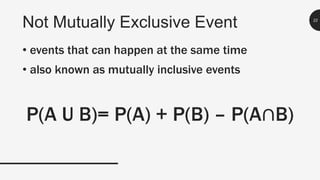
Not Mutually Exclusive Event 22
• events that can happen at the same time
• also known as mutually inclusive events
P(A U B)= P(A) + P(B) – P(A∩B)
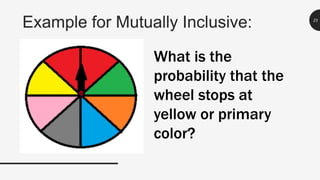
Example for Mutually Inclusive: 23
What is the
probability that the
wheel stops at
yellow or primary
color?
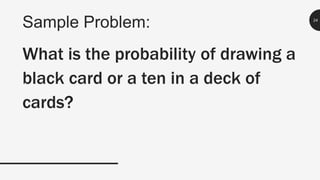
Sample Problem: 24
What is the probability of drawing a
black card or a ten in a deck of
cards?
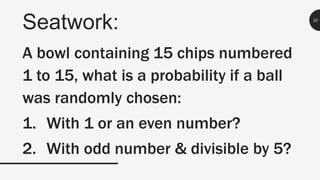
Seatwork: 25
A bowl containing 15 chips numbered
1 to 15, what is a probability if a ball
was randomly chosen:
1. With 1 or an even number?
2. With odd number & divisible by 5?

Probability of an Event.pptx

  • 1.
    MODULE 7 PROBABILITY OF ANEVENT Simple and Compound Events
  • 2.
    Probability Probability= 𝑛𝑜.𝑜𝑓 𝑤𝑎𝑛𝑡𝑒𝑑 𝑜𝑢𝑡𝑐𝑜𝑚𝑒𝑠 𝑛𝑜.𝑜𝑓𝑝𝑜𝑠𝑠𝑖𝑏𝑙𝑒 𝑜𝑢𝑡𝑐𝑜𝑚𝑒𝑠 2 • Ratio where the number of how many times an outcome can occur was compared to the number of all possible outcomes
  • 3.
    Definition of Terms3 • Experiment- doing the activity over and over again • Outcome- result of the experiment • Sample space- number of all outcomes
  • 4.
    Types of Events:4 •Simple- consist of 1 outcome •Compound- consist of more than 1 outcome
  • 5.
    Sample Problems 5 1.What is the probability of getting no. 6 when you roll a dice?
  • 6.
    Sample Problems 6 2.What is the probability of getting 4s when you roll 3 dice?
  • 7.
    Sample Problems 7 3.What is the probability of getting 2 red cards in a deck of cards?
  • 8.
    Sample Problems 8 4.Seniors of CIS join different extracurricular activities shown in the diagram:
  • 9.
    Sample Problems 9 4.a. How many are seniors in CIS? 4.b. How many students participate in athletics?
  • 10.
    Sample Problems 10 Ifa student is randomly chosen, 4.c. What is the probability that the student participates in athletics or drama? 4.d. Drama and band?
  • 11.
    Seatwork: 11 The diagramshows the probabilities of G10 Students joining soccer (S) or basketball (B).
  • 12.
    Seatwork: 12 1. P(B) 2.P(S) 3. P(B∩S) 4. P(BUS) 5. P(B’∩S’)
  • 13.
    Quiz: 13 In agroup of students, 65 play football, 45 play hockey, 52 play cricket, 20 play football and hockey, 25 play football and cricket, 15 play hockey and cricket and 8 play all three games. Let F, H and C represent the students who play football, hockey and cricket, respectively.
  • 14.
    Find the following:14 1.How many students play all the games? 2.How many played football only? 3.Hockey only? 4.Cricket only?
  • 15.
    If a studentis chosen at random, find the probability that the student plays: 15 5. Football? 6. Hockey? 7. Cricket? 8. Football and hockey? 9. Hockey only? 10. Hockey and cricket?
  • 16.
    Activity: Give MeSomething 16 1.Blue or red 2.Round or rectangular 3.Round and blue 4.Round and rectangular
  • 17.
    Mutually Exclusive and NotMutually Exclusive Events 17
  • 18.
    Analysis: 18 • SayI have a bowl containing 15 chips numbered 1 to 15, what is a probability if I randomly choose a ball numbered 7 or 15? • What about even or divisible by 3?
  • 19.
    Questions: 19 • Isthere a difference between the solution to the two questions? • How do you differentiate mutually exclusive to mutually inclusive events?
  • 20.
    Mutually Exclusive Event20 • events that cannot happen at the same time P(A U B)= P(A) + P(B)
  • 21.
    Example for MutuallyExclusive: 21 What is the probability that the wheel stops at red or pink?
  • 22.
    Not Mutually ExclusiveEvent 22 • events that can happen at the same time • also known as mutually inclusive events P(A U B)= P(A) + P(B) – P(A∩B)
  • 23.
    Example for MutuallyInclusive: 23 What is the probability that the wheel stops at yellow or primary color?
  • 24.
    Sample Problem: 24 Whatis the probability of drawing a black card or a ten in a deck of cards?
  • 25.
    Seatwork: 25 A bowlcontaining 15 chips numbered 1 to 15, what is a probability if a ball was randomly chosen: 1. With 1 or an even number? 2. With odd number & divisible by 5?