P A T T E R
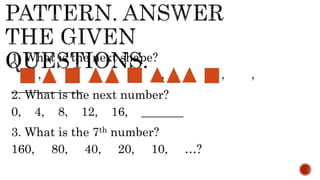
1. What is the next shape?
, , , , , , ,
____________
2. What is the next number?
0, 4, 8, 12, 16, _______
3. What is the 7th number?
160, 80, 40, 20, 10, …?
Is a function whose domain is either
finite set or infinite set arranged in
order.
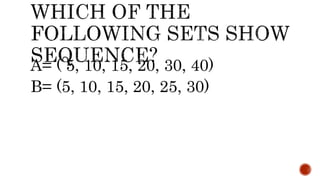
A= ( 5, 10, 15, 20, 30, 40)
B= (5, 10, 15, 20, 25, 30)
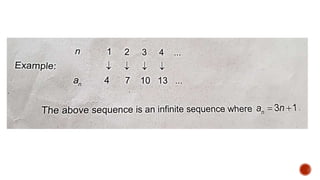
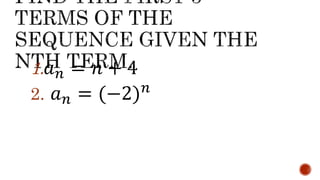
1.𝑎𝑛 = 𝑛 + 4
2. 𝑎𝑛 = (−2)𝑛
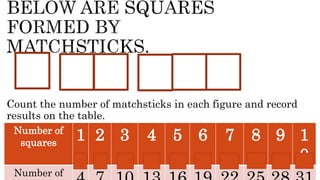
Count the number of matchsticks in each figure and record
results on the table.
Number of
squares
1 2 3 4 5 6 7 8 9 1
0
Number of
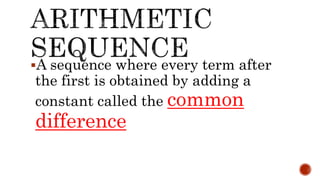
A sequence where every term after
the first is obtained by adding a
constant called the common
difference
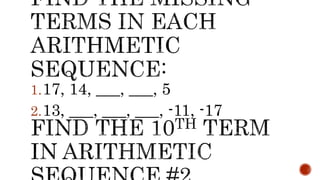
1.17, 14, ___, ___, 5
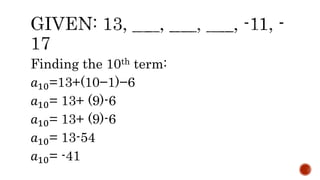
2.13, ___, ___, ___, -11, -17
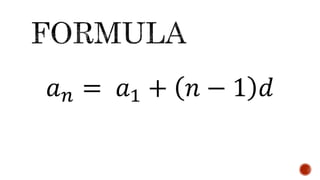
𝑎𝑛 = 𝑎1 + 𝑛 − 1 𝑑
Finding the 10th term:
𝑎10=13+(10−1)−6
𝑎10= 13+ (9)-6
𝑎10= 13+ (9)-6
𝑎10= 13-54
𝑎10= -41
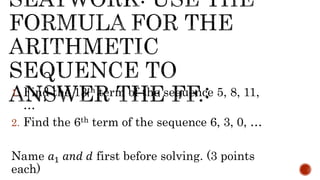
1. Find the 13th term of the sequence 5, 8, 11,
…
2. Find the 6th term of the sequence 6, 3, 0, …
Name 𝑎1 𝑎𝑛𝑑 𝑑 first before solving. (3 points
each)
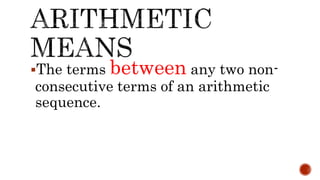
The terms between any two non-
consecutive terms of an arithmetic
sequence.
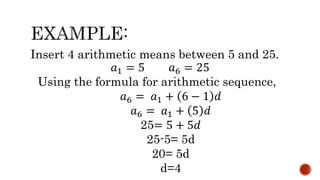
Insert 4 arithmetic means between 5 and 25.
𝑎1 = 5 𝑎6 = 25
Using the formula for arithmetic sequence,
𝑎6 = 𝑎1 + 6 − 1 𝑑
𝑎6 = 𝑎1 + 5 𝑑
25= 5 + 5𝑑
25-5= 5d
20= 5d
d=4
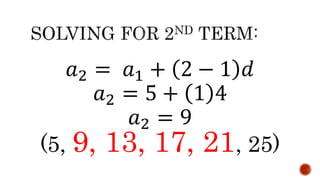
𝑎2 = 𝑎1 + 2 − 1 𝑑
𝑎2 = 5 + 1 4
𝑎2 = 9
(5, 9, 13, 17, 21, 25)
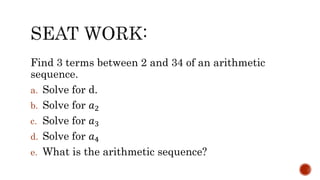
Find 3 terms between 2 and 34 of an arithmetic
sequence.
a. Solve for d.
b. Solve for 𝑎2
c. Solve for 𝑎3
d. Solve for 𝑎4
e. What is the arithmetic sequence?
𝑆𝑛 =
𝑛
2
(𝑎1 + 𝑎𝑛)
𝑆𝑛 =
𝑛
2
[𝑎1 + (𝑎1+ 𝑛 − 1 ]𝑑
𝑆𝑛 =
𝑛
2
[2𝑎1 + 𝑛 − 1 𝑑]
Find the sum of the first 10 terms of arithmetic
sequence 5, 9, 13, 17, …
To solve d,
d= 9 - 5= 4
Using the formula,
𝑆𝑛 =
𝑛
2
[2𝑎1 + 𝑛 − 1 𝑑]
𝑆𝑛 =
10
2
[2(5) + 10 − 1 4]
𝑆𝑛 = 5[10 + 9(4)]
𝑆𝑛 = 5 46 = 230
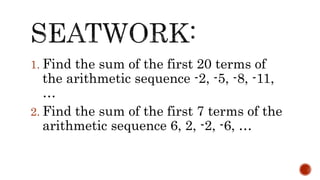
1. Find the sum of the first 20 terms of
the arithmetic sequence -2, -5, -8, -11,
…
2. Find the sum of the first 7 terms of the
arithmetic sequence 6, 2, -2, -6, …
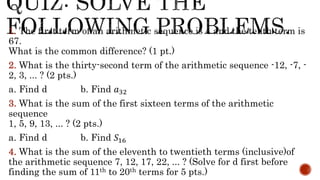
1. The first term of an arithmetic sequence is 4 and the tenth term is
67.
What is the common difference? (1 pt.)
2. What is the thirty-second term of the arithmetic sequence -12, -7, -
2, 3, ... ? (2 pts.)
a. Find d b. Find 𝑎32
3. What is the sum of the first sixteen terms of the arithmetic
sequence
1, 5, 9, 13, ... ? (2 pts.)
a. Find d b. Find 𝑆16
4. What is the sum of the eleventh to twentieth terms (inclusive)of
the arithmetic sequence 7, 12, 17, 22, ... ? (Solve for d first before
finding the sum of 11th to 20th terms for 5 pts.)
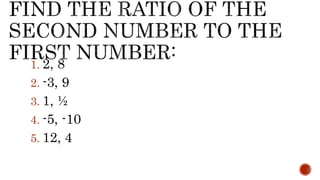
1. 2, 8
2. -3, 9
3. 1, ½
4. -5, -10
5. 12, 4
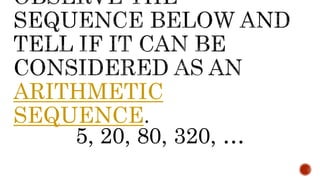
ARITHMETIC
SEQUENCE
5, 20, 80, 320, …
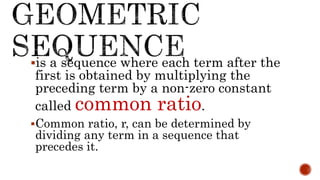
is a sequence where each term after the
first is obtained by multiplying the
preceding term by a non-zero constant
called common ratio.
Common ratio, r, can be determined by
dividing any term in a sequence that
precedes it.
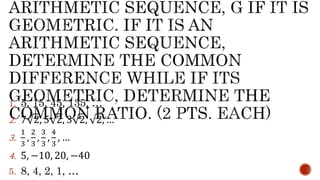
1. 5, 15, 45, 135, …
2. 7 2, 5 2, 3 2, 2, …
3.
1
3
,
2
3
,
3
3
,
4
3
, …
4. 5, −10, 20, −40
5. 8, 4, 2, 1, …
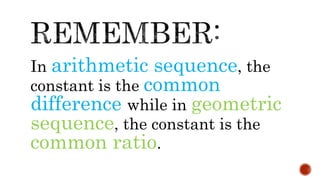
In arithmetic sequence, the
constant is the common
difference while in geometric
sequence, the constant is the
common ratio.
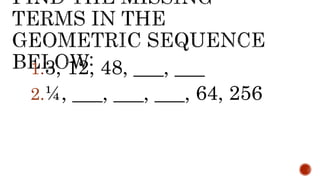
1.3, 12, 48, ___, ___
2.¼, ___, ___, ___, 64, 256
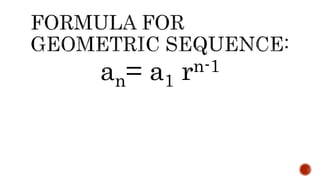
an= a1 rn-1
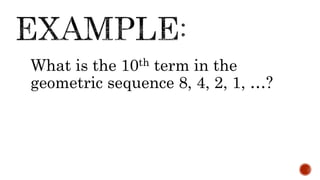
What is the 10th term in the
geometric sequence 8, 4, 2, 1, …?
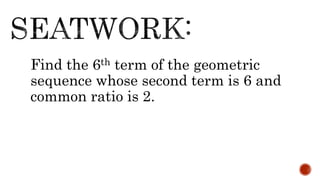
Find the 6th term of the geometric
sequence whose second term is 6 and
common ratio is 2.
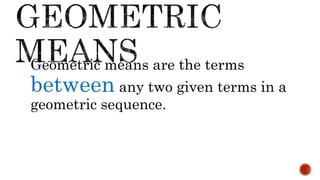
Geometric means are the terms
between any two given terms in a
geometric sequence.
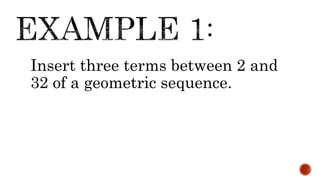
Insert three terms between 2 and
32 of a geometric sequence.
Insert two terms between 5 and
135 of a geometric sequence.
The geometric mean between the
first two terms in a geometric
sequence is 32. If the 3rd term is 4,
find the first term.
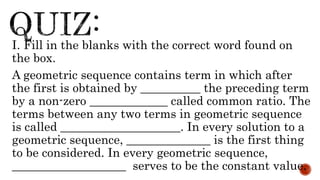
I. Fill in the blanks with the correct word found on
the box.
A geometric sequence contains term in which after
the first is obtained by __________ the preceding term
by a non-zero _____________ called common ratio. The
terms between any two terms in geometric sequence
is called ____________________. In every solution to a
geometric sequence, ______________ is the first thing
to be considered. In every geometric sequence,
___________________ serves to be the constant value.
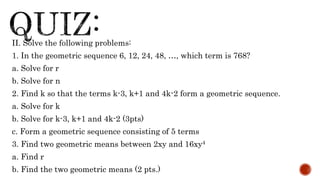
II. Solve the following problems:
1. In the geometric sequence 6, 12, 24, 48, …, which term is 768?
a. Solve for r
b. Solve for n
2. Find k so that the terms k-3, k+1 and 4k-2 form a geometric sequence.
a. Solve for k
b. Solve for k-3, k+1 and 4k-2 (3pts)
c. Form a geometric sequence consisting of 5 terms
3. Find two geometric means between 2xy and 16xy4
a. Find r
b. Find the two geometric means (2 pts.)
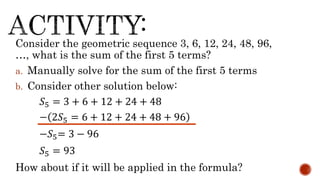
Consider the geometric sequence 3, 6, 12, 24, 48, 96,
…, what is the sum of the first 5 terms?
a. Manually solve for the sum of the first 5 terms
b. Consider other solution below:
𝑆5 = 3 + 6 + 12 + 24 + 48
− 2𝑆5 = 6 + 12 + 24 + 48 + 96
−𝑆5= 3 − 96
𝑆5 = 93
How about if it will be applied in the formula?
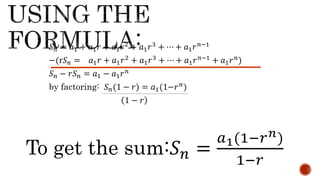
𝑆𝑛 = 𝑎1 + 𝑎1𝑟 + 𝑎1𝑟2 + 𝑎1𝑟3 + ⋯ + 𝑎1𝑟𝑛−1
−(r𝑆𝑛 = 𝑎1𝑟 + 𝑎1𝑟2 + 𝑎1𝑟3 + ⋯ + 𝑎1𝑟𝑛−1 + 𝑎1𝑟𝑛)
𝑆𝑛 − 𝑟𝑆𝑛 = 𝑎1 − 𝑎1𝑟𝑛
by factoring: 𝑆𝑛(1 − 𝑟) = 𝑎1(1−𝑟𝑛
)
1 − 𝑟
To get the sum:𝑆𝑛 =
𝑎1(1−𝑟𝑛)
1−𝑟
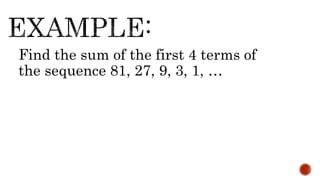
Find the sum of the first 4 terms of
the sequence 81, 27, 9, 3, 1, …
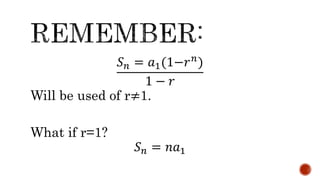
𝑆𝑛 = 𝑎1(1−𝑟𝑛
)
1 − 𝑟
Will be used of r≠1.
What if r=1?
𝑆𝑛 = 𝑛𝑎1
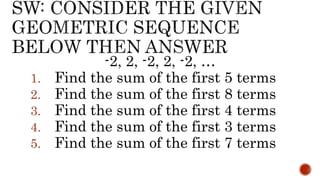
-2, 2, -2, 2, -2, …
1. Find the sum of the first 5 terms
2. Find the sum of the first 8 terms
3. Find the sum of the first 4 terms
4. Find the sum of the first 3 terms
5. Find the sum of the first 7 terms
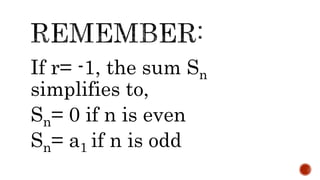
If r= -1, the sum Sn
simplifies to,
Sn= 0 if n is even
Sn= a1 if n is odd
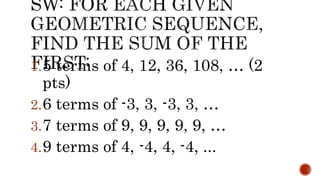
1.5 terms of 4, 12, 36, 108, … (2
pts)
2.6 terms of -3, 3, -3, 3, …
3.7 terms of 9, 9, 9, 9, 9, …
4.9 terms of 4, -4, 4, -4, ...

Sequence.pptx

  • 1.
    P A TT E R
  • 2.
    1. What isthe next shape? , , , , , , , ____________ 2. What is the next number? 0, 4, 8, 12, 16, _______ 3. What is the 7th number? 160, 80, 40, 20, 10, …?
  • 3.
    Is a functionwhose domain is either finite set or infinite set arranged in order.
  • 5.
    A= ( 5,10, 15, 20, 30, 40) B= (5, 10, 15, 20, 25, 30)
  • 6.
    1.𝑎𝑛 = 𝑛+ 4 2. 𝑎𝑛 = (−2)𝑛
  • 7.
    Count the numberof matchsticks in each figure and record results on the table. Number of squares 1 2 3 4 5 6 7 8 9 1 0 Number of
  • 8.
    A sequence whereevery term after the first is obtained by adding a constant called the common difference
  • 9.
    1.17, 14, ___,___, 5 2.13, ___, ___, ___, -11, -17
  • 10.
    𝑎𝑛 = 𝑎1+ 𝑛 − 1 𝑑
  • 11.
    Finding the 10thterm: 𝑎10=13+(10−1)−6 𝑎10= 13+ (9)-6 𝑎10= 13+ (9)-6 𝑎10= 13-54 𝑎10= -41
  • 12.
    1. Find the13th term of the sequence 5, 8, 11, … 2. Find the 6th term of the sequence 6, 3, 0, … Name 𝑎1 𝑎𝑛𝑑 𝑑 first before solving. (3 points each)
  • 13.
    The terms betweenany two non- consecutive terms of an arithmetic sequence.
  • 14.
    Insert 4 arithmeticmeans between 5 and 25. 𝑎1 = 5 𝑎6 = 25 Using the formula for arithmetic sequence, 𝑎6 = 𝑎1 + 6 − 1 𝑑 𝑎6 = 𝑎1 + 5 𝑑 25= 5 + 5𝑑 25-5= 5d 20= 5d d=4
  • 15.
    𝑎2 = 𝑎1+ 2 − 1 𝑑 𝑎2 = 5 + 1 4 𝑎2 = 9 (5, 9, 13, 17, 21, 25)
  • 16.
    Find 3 termsbetween 2 and 34 of an arithmetic sequence. a. Solve for d. b. Solve for 𝑎2 c. Solve for 𝑎3 d. Solve for 𝑎4 e. What is the arithmetic sequence?
  • 17.
    𝑆𝑛 = 𝑛 2 (𝑎1 +𝑎𝑛) 𝑆𝑛 = 𝑛 2 [𝑎1 + (𝑎1+ 𝑛 − 1 ]𝑑 𝑆𝑛 = 𝑛 2 [2𝑎1 + 𝑛 − 1 𝑑]
  • 18.
    Find the sumof the first 10 terms of arithmetic sequence 5, 9, 13, 17, … To solve d, d= 9 - 5= 4 Using the formula, 𝑆𝑛 = 𝑛 2 [2𝑎1 + 𝑛 − 1 𝑑] 𝑆𝑛 = 10 2 [2(5) + 10 − 1 4] 𝑆𝑛 = 5[10 + 9(4)] 𝑆𝑛 = 5 46 = 230
  • 19.
    1. Find thesum of the first 20 terms of the arithmetic sequence -2, -5, -8, -11, … 2. Find the sum of the first 7 terms of the arithmetic sequence 6, 2, -2, -6, …
  • 20.
    1. The firstterm of an arithmetic sequence is 4 and the tenth term is 67. What is the common difference? (1 pt.) 2. What is the thirty-second term of the arithmetic sequence -12, -7, - 2, 3, ... ? (2 pts.) a. Find d b. Find 𝑎32 3. What is the sum of the first sixteen terms of the arithmetic sequence 1, 5, 9, 13, ... ? (2 pts.) a. Find d b. Find 𝑆16 4. What is the sum of the eleventh to twentieth terms (inclusive)of the arithmetic sequence 7, 12, 17, 22, ... ? (Solve for d first before finding the sum of 11th to 20th terms for 5 pts.)
  • 21.
    1. 2, 8 2.-3, 9 3. 1, ½ 4. -5, -10 5. 12, 4
  • 22.
  • 23.
    is a sequencewhere each term after the first is obtained by multiplying the preceding term by a non-zero constant called common ratio. Common ratio, r, can be determined by dividing any term in a sequence that precedes it.
  • 24.
    1. 5, 15,45, 135, … 2. 7 2, 5 2, 3 2, 2, … 3. 1 3 , 2 3 , 3 3 , 4 3 , … 4. 5, −10, 20, −40 5. 8, 4, 2, 1, …
  • 25.
    In arithmetic sequence,the constant is the common difference while in geometric sequence, the constant is the common ratio.
  • 26.
    1.3, 12, 48,___, ___ 2.¼, ___, ___, ___, 64, 256
  • 27.
  • 28.
    What is the10th term in the geometric sequence 8, 4, 2, 1, …?
  • 29.
    Find the 6thterm of the geometric sequence whose second term is 6 and common ratio is 2.
  • 30.
    Geometric means arethe terms between any two given terms in a geometric sequence.
  • 31.
    Insert three termsbetween 2 and 32 of a geometric sequence.
  • 32.
    Insert two termsbetween 5 and 135 of a geometric sequence.
  • 33.
    The geometric meanbetween the first two terms in a geometric sequence is 32. If the 3rd term is 4, find the first term.
  • 34.
    I. Fill inthe blanks with the correct word found on the box. A geometric sequence contains term in which after the first is obtained by __________ the preceding term by a non-zero _____________ called common ratio. The terms between any two terms in geometric sequence is called ____________________. In every solution to a geometric sequence, ______________ is the first thing to be considered. In every geometric sequence, ___________________ serves to be the constant value.
  • 35.
    II. Solve thefollowing problems: 1. In the geometric sequence 6, 12, 24, 48, …, which term is 768? a. Solve for r b. Solve for n 2. Find k so that the terms k-3, k+1 and 4k-2 form a geometric sequence. a. Solve for k b. Solve for k-3, k+1 and 4k-2 (3pts) c. Form a geometric sequence consisting of 5 terms 3. Find two geometric means between 2xy and 16xy4 a. Find r b. Find the two geometric means (2 pts.)
  • 36.
    Consider the geometricsequence 3, 6, 12, 24, 48, 96, …, what is the sum of the first 5 terms? a. Manually solve for the sum of the first 5 terms b. Consider other solution below: 𝑆5 = 3 + 6 + 12 + 24 + 48 − 2𝑆5 = 6 + 12 + 24 + 48 + 96 −𝑆5= 3 − 96 𝑆5 = 93 How about if it will be applied in the formula?
  • 37.
    𝑆𝑛 = 𝑎1+ 𝑎1𝑟 + 𝑎1𝑟2 + 𝑎1𝑟3 + ⋯ + 𝑎1𝑟𝑛−1 −(r𝑆𝑛 = 𝑎1𝑟 + 𝑎1𝑟2 + 𝑎1𝑟3 + ⋯ + 𝑎1𝑟𝑛−1 + 𝑎1𝑟𝑛) 𝑆𝑛 − 𝑟𝑆𝑛 = 𝑎1 − 𝑎1𝑟𝑛 by factoring: 𝑆𝑛(1 − 𝑟) = 𝑎1(1−𝑟𝑛 ) 1 − 𝑟 To get the sum:𝑆𝑛 = 𝑎1(1−𝑟𝑛) 1−𝑟
  • 38.
    Find the sumof the first 4 terms of the sequence 81, 27, 9, 3, 1, …
  • 39.
    𝑆𝑛 = 𝑎1(1−𝑟𝑛 ) 1− 𝑟 Will be used of r≠1. What if r=1? 𝑆𝑛 = 𝑛𝑎1
  • 40.
    -2, 2, -2,2, -2, … 1. Find the sum of the first 5 terms 2. Find the sum of the first 8 terms 3. Find the sum of the first 4 terms 4. Find the sum of the first 3 terms 5. Find the sum of the first 7 terms
  • 41.
    If r= -1,the sum Sn simplifies to, Sn= 0 if n is even Sn= a1 if n is odd
  • 42.
    1.5 terms of4, 12, 36, 108, … (2 pts) 2.6 terms of -3, 3, -3, 3, … 3.7 terms of 9, 9, 9, 9, 9, … 4.9 terms of 4, -4, 4, -4, ...

Editor's Notes

  • #2 Pattern- a repeated decorative design; arrangement or order of objects, set of examples to follow
  • #8 We have different kinds of sequence and for now we will focus on the first one. To have an idea, observe…