A presentation on
Organizational Development and Change
Organizational development is a
technique used for bringing
change in the entire aspect of the
organization, rather than focusing
attention on the individuals. So
that change is readily absorbed.
According to Burke,
"Organizational development is a
planned process of change in an
organization's culture through the
utilization of behavioural science,
technology, research and theory
Defination of organizational development
Characteristics of OD
1. Planned change
2. Encompases the whole organization
3. Long range change
4. System orientation
5. Change agent
6. Problem solving
7. Experiental learning
8. Collaborative Management
9. Group process
10. Contingency orientation
Benefits of OD
1) Continuous Improvement – Companies that engage in
organisational development commit to continually improving
their business and offerings. The OD process creates a
continuous cycle of improvement whereby strategies are
planned, implemented, evaluated, improved and monitored.
2) Increased Communication – One of the key benefits to
OD is increased communication, feedback and interaction
within the organisation. The goal of improving
communication is to align all employees to shared company
goals and values.
3) Employee Development – Organisational development
focuses on increased communication to influence employees
to bring about desired changes.
4) Product & Service Enhancement – A major benefit of
OD is innovation, which leads to product and service
enhancement. Innovation is achieved through employee
development, which focuses on rewarding successes and
boosting motivation anda morale.
5) Increased Profit- Organisational development affects the
bottom line in a variety of ways. Through raised innovation
and productivity, efficiency and profits are increased. Costs
are also reduced by minimizing employee turnover and
absenteeism
Limitations of OD
1. Major time requirements
2. Substantial expense
3. Delayed payoff period
4. Possible failure
5. Possible invasion of privacy
6. Possible Psychological harm
7. Potential conformity
8. Emphasis on group processes rather than
performance
9. Possible conceptual ambiguity
10. Difficulty in evaluation
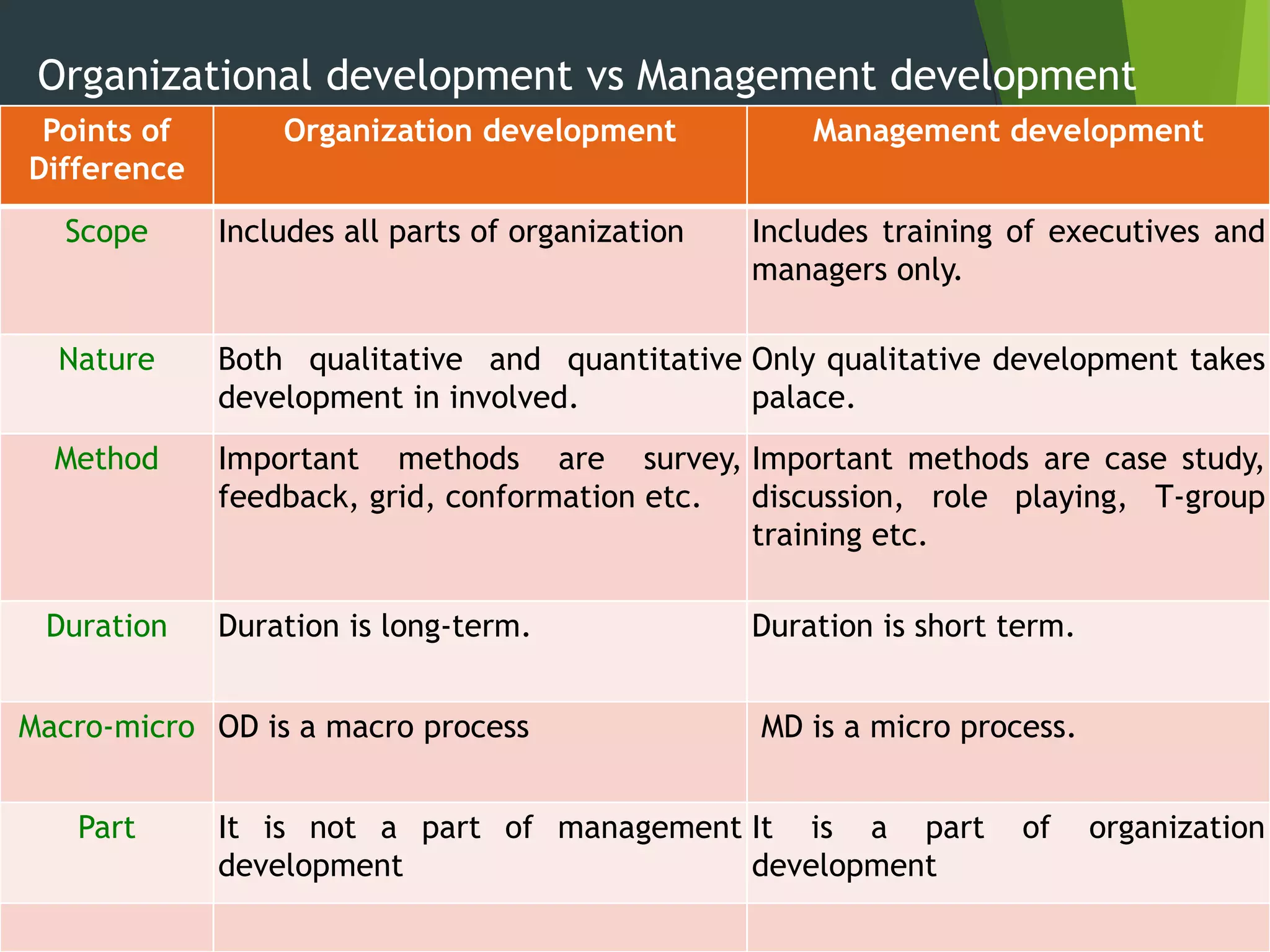
Organizational development vs Management development
Points of
Difference
Organization development Management development
Scope Includes all parts of organization Includes training of executives and
managers only.
Nature Both qualitative and quantitative
development in involved.
Only qualitative development takes
palace.
Method Important methods are survey,
feedback, grid, conformation etc.
Important methods are case study,
discussion, role playing, T-group
training etc.
Duration Duration is long-term. Duration is short term.
Macro-micro OD is a macro process MD is a micro process.
Part It is not a part of management
development
It is a part of organization
development
Md. Abul Hashem
Roll no : 1504001
Reg. no. : 244
Session : 15-16
Dept. of AIs
Islamic University
Methods of OD
1. Survey feedback: Information is collected
through survey method. The manager use this
information for making decision
2. Team building: This method is specifically
designed to make improvement in the ability of
employee and motivating them to work together
3. Sensitivity analysis: It is quite popular organizational
development intervention. Under this method,
employees in groups are asked to interact.
4. Managerial grid: The concept of managerial grid
identifies two major dimension of management. They are
people oriented and production oriented.
5. MBO: It is a method ofachieving organizational
objective and a technique of evaluation and review
of performance
6. Brain storming: it is a technique where a group of
5 to 8 managers come together and solve a problem.
7. Process consultation: Under this technique the
consultant or the expert provide necessary guidline as
to how the participant solve hie own problem
8.Quality circle: Under this system a group of 5 to 12
people come together at their own will during
working hours once in a week and discuss out the
problem and suggest solution to the management for
implementation.
Akter Hossen
Roll no : 1504028
Reg. no. : 274
Session : 15-16
Dept. of AIs
Islamic University
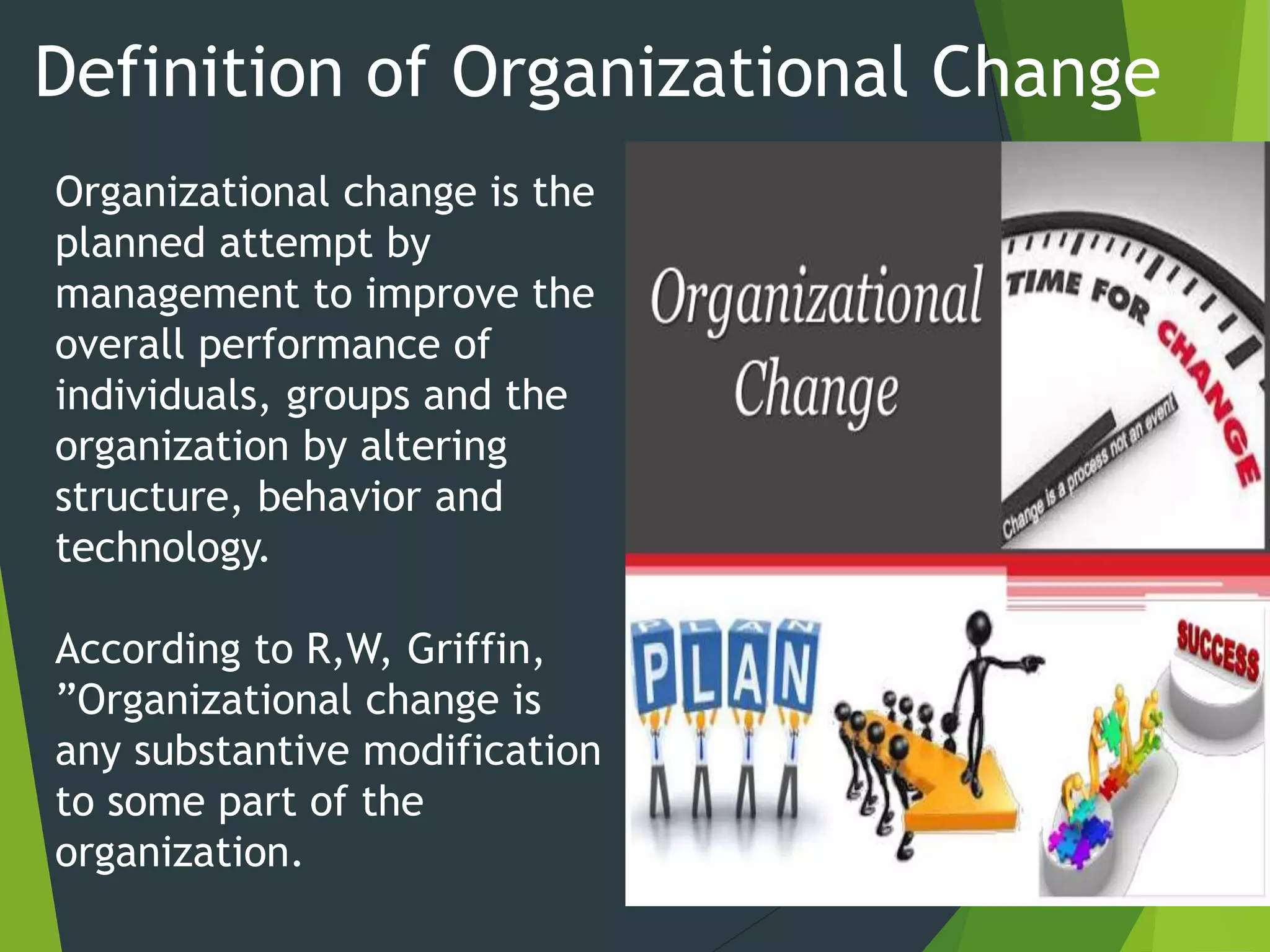
Definition of Organizational Change
Organizational change is the
planned attempt by
management to improve the
overall performance of
individuals, groups and the
organization by altering
structure, behavior and
technology.
According to R,W, Griffin,
”Organizational change is
any substantive modification
to some part of the
organization.
Type of Organizational Change
There are basically two types of organizational
change. They are
1. Planned change
2. Unplanned change
Planned change: When organization change occurs
according to the predetermined plan, it is called
planned change. For example a business can change
its business policy for getting extra benefit by
introducing a new product
Unplanned change: When organization
change occurs due to certain changing
situation , it is called unplanned change.
For example : Changes in government
regulations and change in econpmy often
lead to organizational change.
Forces of Organizational Change
1. People : people are important sources for
change. Present people differ from previous
generation with respect to education,
expectation and value system. These people
have distinct purchasing power that affect
product and service innovation, technological
change and promotional activities.
2. Technology : Technology is changing day by day.
At present, organization is trying hard and soul
to keep with the changing technology.
3. Information processing and communication : Any
change in information processing and communication
will lead to change in organization.
4. Competition : Due to global economy competition
is increasing. As a result it is needed to change in
organization to sustain in global market.
5. Other forces fo changes
a) Environment
b) Economic shocks
c) Social trends
d) Politics & world politics
Steps of planned change
1. Recognize the need for change
2. Develop the goals of the change
3. Select a change agent
4. Diagnose the current climate
5. Select an implementation method
6. Develop a plan
7. Implement the plan
8. Follow the plan and evaluate
Ways of overcoming resistance to change
1.Education and communication : Resistance
can be reduced through communicating with
employees to help them see the logic of a
change and providing education to them.
2.Participation : Resistance to change can be
reduced when those affected by the changes
are involved in designing it.
3.Building and support and commitment:
Resistance can be reduced by offering a range
of supportive efforts to the employee.
4. Implementing fairly : Most people simply do not
like changes. But one way organization can
minimize the negative impact of changes . It is
make sure that the changes is implemented fairly.
5. Selecting people who accept change :
Organization can reduce resistance to change by
selecting those people who have more positive
attitudes about changes than others.
6. Coercion : The last way of reducing resistance to
change is coercion. It is the application of direct
threats to the resistors
Reason for resistance to change
1.Individual resistance : There are five
reasons why individuals may resist changes
are given below :
a) Habit
b) Secruity
c) Economic factor
d) Fear of unknown
e) Selecting information processing
Organizational resistance: There are five
reasons why organization may resist changes
are given below :
a) Structural inertia
b) Limited focus of changes
c) Group inertia
d) Threat of expertise
e) Threat to power
Organizational development and change

Organizational development and change

  • 1.
    A presentation on OrganizationalDevelopment and Change
  • 2.
    Organizational development isa technique used for bringing change in the entire aspect of the organization, rather than focusing attention on the individuals. So that change is readily absorbed. According to Burke, "Organizational development is a planned process of change in an organization's culture through the utilization of behavioural science, technology, research and theory Defination of organizational development
  • 3.
    Characteristics of OD 1.Planned change 2. Encompases the whole organization 3. Long range change 4. System orientation 5. Change agent 6. Problem solving 7. Experiental learning 8. Collaborative Management 9. Group process 10. Contingency orientation
  • 4.
    Benefits of OD 1)Continuous Improvement – Companies that engage in organisational development commit to continually improving their business and offerings. The OD process creates a continuous cycle of improvement whereby strategies are planned, implemented, evaluated, improved and monitored. 2) Increased Communication – One of the key benefits to OD is increased communication, feedback and interaction within the organisation. The goal of improving communication is to align all employees to shared company goals and values.
  • 5.
    3) Employee Development– Organisational development focuses on increased communication to influence employees to bring about desired changes. 4) Product & Service Enhancement – A major benefit of OD is innovation, which leads to product and service enhancement. Innovation is achieved through employee development, which focuses on rewarding successes and boosting motivation anda morale. 5) Increased Profit- Organisational development affects the bottom line in a variety of ways. Through raised innovation and productivity, efficiency and profits are increased. Costs are also reduced by minimizing employee turnover and absenteeism
  • 6.
    Limitations of OD 1.Major time requirements 2. Substantial expense 3. Delayed payoff period 4. Possible failure 5. Possible invasion of privacy 6. Possible Psychological harm 7. Potential conformity 8. Emphasis on group processes rather than performance 9. Possible conceptual ambiguity 10. Difficulty in evaluation
  • 7.
    Organizational development vsManagement development Points of Difference Organization development Management development Scope Includes all parts of organization Includes training of executives and managers only. Nature Both qualitative and quantitative development in involved. Only qualitative development takes palace. Method Important methods are survey, feedback, grid, conformation etc. Important methods are case study, discussion, role playing, T-group training etc. Duration Duration is long-term. Duration is short term. Macro-micro OD is a macro process MD is a micro process. Part It is not a part of management development It is a part of organization development
  • 8.
    Md. Abul Hashem Rollno : 1504001 Reg. no. : 244 Session : 15-16 Dept. of AIs Islamic University
  • 9.
    Methods of OD 1.Survey feedback: Information is collected through survey method. The manager use this information for making decision 2. Team building: This method is specifically designed to make improvement in the ability of employee and motivating them to work together 3. Sensitivity analysis: It is quite popular organizational development intervention. Under this method, employees in groups are asked to interact. 4. Managerial grid: The concept of managerial grid identifies two major dimension of management. They are people oriented and production oriented.
  • 10.
    5. MBO: Itis a method ofachieving organizational objective and a technique of evaluation and review of performance 6. Brain storming: it is a technique where a group of 5 to 8 managers come together and solve a problem. 7. Process consultation: Under this technique the consultant or the expert provide necessary guidline as to how the participant solve hie own problem 8.Quality circle: Under this system a group of 5 to 12 people come together at their own will during working hours once in a week and discuss out the problem and suggest solution to the management for implementation.
  • 11.
    Akter Hossen Roll no: 1504028 Reg. no. : 274 Session : 15-16 Dept. of AIs Islamic University
  • 12.
    Definition of OrganizationalChange Organizational change is the planned attempt by management to improve the overall performance of individuals, groups and the organization by altering structure, behavior and technology. According to R,W, Griffin, ”Organizational change is any substantive modification to some part of the organization.
  • 13.
    Type of OrganizationalChange There are basically two types of organizational change. They are 1. Planned change 2. Unplanned change Planned change: When organization change occurs according to the predetermined plan, it is called planned change. For example a business can change its business policy for getting extra benefit by introducing a new product
  • 14.
    Unplanned change: Whenorganization change occurs due to certain changing situation , it is called unplanned change. For example : Changes in government regulations and change in econpmy often lead to organizational change.
  • 15.
    Forces of OrganizationalChange 1. People : people are important sources for change. Present people differ from previous generation with respect to education, expectation and value system. These people have distinct purchasing power that affect product and service innovation, technological change and promotional activities. 2. Technology : Technology is changing day by day. At present, organization is trying hard and soul to keep with the changing technology.
  • 16.
    3. Information processingand communication : Any change in information processing and communication will lead to change in organization. 4. Competition : Due to global economy competition is increasing. As a result it is needed to change in organization to sustain in global market. 5. Other forces fo changes a) Environment b) Economic shocks c) Social trends d) Politics & world politics
  • 17.
    Steps of plannedchange 1. Recognize the need for change 2. Develop the goals of the change 3. Select a change agent 4. Diagnose the current climate
  • 18.
    5. Select animplementation method 6. Develop a plan 7. Implement the plan 8. Follow the plan and evaluate
  • 19.
    Ways of overcomingresistance to change 1.Education and communication : Resistance can be reduced through communicating with employees to help them see the logic of a change and providing education to them. 2.Participation : Resistance to change can be reduced when those affected by the changes are involved in designing it. 3.Building and support and commitment: Resistance can be reduced by offering a range of supportive efforts to the employee.
  • 20.
    4. Implementing fairly: Most people simply do not like changes. But one way organization can minimize the negative impact of changes . It is make sure that the changes is implemented fairly. 5. Selecting people who accept change : Organization can reduce resistance to change by selecting those people who have more positive attitudes about changes than others. 6. Coercion : The last way of reducing resistance to change is coercion. It is the application of direct threats to the resistors
  • 21.
    Reason for resistanceto change 1.Individual resistance : There are five reasons why individuals may resist changes are given below : a) Habit b) Secruity c) Economic factor d) Fear of unknown e) Selecting information processing
  • 22.
    Organizational resistance: Thereare five reasons why organization may resist changes are given below : a) Structural inertia b) Limited focus of changes c) Group inertia d) Threat of expertise e) Threat to power