Modern Management Theory
 This theory came into force because of the growing
complexities in organizations.
FEATURES:
1. Management is responsive to environmental
changes.
2. Business organizations are dynamic institutions
composed of inter related divisions and sub
divisions.
3. Business firms have multiple objectives. Managers
balance economic and non economic objectives and
maximise the interests of diverse groups of
shareholders like customers, suppliers etc.
4. Management is multi disciplinary in nature
Modern Management Theory
comprises of:
1. Quantitative Theory
Management Science
Operations Management
Management Information System.
2. Systems Theory
3. Contingency Theory
4. Operational Theory
Quantitative Theory
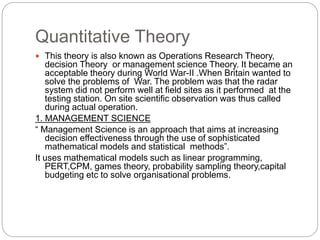
 This theory is also known as Operations Research Theory,
decision Theory or management science Theory. It became an
acceptable theory during World War-II .When Britain wanted to
solve the problems of War. The problem was that the radar
system did not perform well at field sites as it performed at the
testing station. On site scientific observation was thus called
during actual operation.
1. MANAGEMENT SCIENCE
“ Management Science is an approach that aims at increasing
decision effectiveness through the use of sophisticated
mathematical models and statistical methods”.
It uses mathematical models such as linear programming,
PERT,CPM, games theory, probability sampling theory,capital
budgeting etc to solve organisational problems.
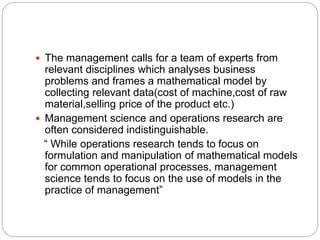
 The management calls for a team of experts from
relevant disciplines which analyses business
problems and frames a mathematical model by
collecting relevant data(cost of machine,cost of raw
material,selling price of the product etc.)
 Management science and operations research are
often considered indistinguishable.
“ While operations research tends to focus on
formulation and manipulation of mathematical models
for common operational processes, management
science tends to focus on the use of models in the
practice of management”
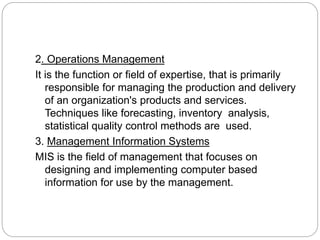
2. Operations Management
It is the function or field of expertise, that is primarily
responsible for managing the production and delivery
of an organization's products and services.
Techniques like forecasting, inventory analysis,
statistical quality control methods are used.
3. Management Information Systems
MIS is the field of management that focuses on
designing and implementing computer based
information for use by the management.
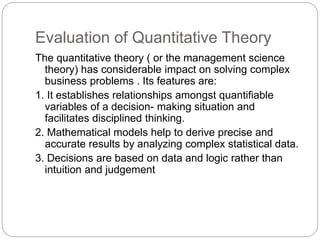
Evaluation of Quantitative Theory
The quantitative theory ( or the management science
theory) has considerable impact on solving complex
business problems . Its features are:
1. It establishes relationships amongst quantifiable
variables of a decision- making situation and
facilitates disciplined thinking.
2. Mathematical models help to derive precise and
accurate results by analyzing complex statistical data.
3. Decisions are based on data and logic rather than
intuition and judgement
Systems Theory
 The systems approach takes a broader view of
management where the organization is viewed as a
unified and purposeful entity composed of different
parts. It assumes that each part bears relationship
with every other part of organization and therefore
the manager must view the company as a whole
consisting of several inter related parts.
 This theory views organization as a whole which
operates in the external environment and has an
internal environment consisting of various
departments(production, marketing, finance etc) inter
related to each other in a manner that input output
conversion is done in the most efficient manner.
Features
 It considers the organization as a dynamic and
inter related set of parts.
 It considers the impact of both near and distant
future on organizational activities.
 It integrates goals of different parts of the
organization( sub systems or departments) with
the organization as a whole.
 It enables the organizations to frame policies that
promote business objectives and social
objectives.
Contingency Theory
 The contingency view point developed in 1950’s
when a research team headed by Joan
Woodward, an industrial sociologist, undertook a
study of 100 British firms of different sizes
producing different products. It was concluded
that difference in performance was not because
of principles of classical theories but because of
better technology to produce goods. This
developed a theory “ appropriate actions by
mangers often depend on( or are contingent on)
the situation.
 “ Contingency theory is a viewpoint that argues
that appropriate managerial action depends on
the particular parameters of the situation. Hence
rather than seeking universal principles that apply
to every situation,contingency theory attempts to
identify contingency principles that prescribe
actions to take depending on the characteristics
of the situation”
Features of Contingency Theory
 Management is situational in nature. The
technique of management depends on complexity
of the situation.
 It is the “ if” and “then” approach to management.
 Management principles are not universal in
nature as there is no best style of management.
Operational Theory
 The operational approach to management theory
and science draws together the pertinent
knowledge of management by relating it to
managerial job that mangers do. It tries to
integrate the concepts, principles and techniques
that underlie the task of managing.
 Rather than applying on one approach , it picks
up the relevant aspects of different theories that
can practically apply to a given situation.
Thankyou!!!!

4 modern management theory, session 2

  • 1.
  • 2.
     This theorycame into force because of the growing complexities in organizations. FEATURES: 1. Management is responsive to environmental changes. 2. Business organizations are dynamic institutions composed of inter related divisions and sub divisions. 3. Business firms have multiple objectives. Managers balance economic and non economic objectives and maximise the interests of diverse groups of shareholders like customers, suppliers etc. 4. Management is multi disciplinary in nature
  • 3.
    Modern Management Theory comprisesof: 1. Quantitative Theory Management Science Operations Management Management Information System. 2. Systems Theory 3. Contingency Theory 4. Operational Theory
  • 4.
    Quantitative Theory  Thistheory is also known as Operations Research Theory, decision Theory or management science Theory. It became an acceptable theory during World War-II .When Britain wanted to solve the problems of War. The problem was that the radar system did not perform well at field sites as it performed at the testing station. On site scientific observation was thus called during actual operation. 1. MANAGEMENT SCIENCE “ Management Science is an approach that aims at increasing decision effectiveness through the use of sophisticated mathematical models and statistical methods”. It uses mathematical models such as linear programming, PERT,CPM, games theory, probability sampling theory,capital budgeting etc to solve organisational problems.
  • 5.
     The managementcalls for a team of experts from relevant disciplines which analyses business problems and frames a mathematical model by collecting relevant data(cost of machine,cost of raw material,selling price of the product etc.)  Management science and operations research are often considered indistinguishable. “ While operations research tends to focus on formulation and manipulation of mathematical models for common operational processes, management science tends to focus on the use of models in the practice of management”
  • 6.
    2. Operations Management Itis the function or field of expertise, that is primarily responsible for managing the production and delivery of an organization's products and services. Techniques like forecasting, inventory analysis, statistical quality control methods are used. 3. Management Information Systems MIS is the field of management that focuses on designing and implementing computer based information for use by the management.
  • 7.
    Evaluation of QuantitativeTheory The quantitative theory ( or the management science theory) has considerable impact on solving complex business problems . Its features are: 1. It establishes relationships amongst quantifiable variables of a decision- making situation and facilitates disciplined thinking. 2. Mathematical models help to derive precise and accurate results by analyzing complex statistical data. 3. Decisions are based on data and logic rather than intuition and judgement
  • 8.
    Systems Theory  Thesystems approach takes a broader view of management where the organization is viewed as a unified and purposeful entity composed of different parts. It assumes that each part bears relationship with every other part of organization and therefore the manager must view the company as a whole consisting of several inter related parts.  This theory views organization as a whole which operates in the external environment and has an internal environment consisting of various departments(production, marketing, finance etc) inter related to each other in a manner that input output conversion is done in the most efficient manner.
  • 9.
    Features  It considersthe organization as a dynamic and inter related set of parts.  It considers the impact of both near and distant future on organizational activities.  It integrates goals of different parts of the organization( sub systems or departments) with the organization as a whole.  It enables the organizations to frame policies that promote business objectives and social objectives.
  • 10.
    Contingency Theory  Thecontingency view point developed in 1950’s when a research team headed by Joan Woodward, an industrial sociologist, undertook a study of 100 British firms of different sizes producing different products. It was concluded that difference in performance was not because of principles of classical theories but because of better technology to produce goods. This developed a theory “ appropriate actions by mangers often depend on( or are contingent on) the situation.
  • 11.
     “ Contingencytheory is a viewpoint that argues that appropriate managerial action depends on the particular parameters of the situation. Hence rather than seeking universal principles that apply to every situation,contingency theory attempts to identify contingency principles that prescribe actions to take depending on the characteristics of the situation”
  • 12.
    Features of ContingencyTheory  Management is situational in nature. The technique of management depends on complexity of the situation.  It is the “ if” and “then” approach to management.  Management principles are not universal in nature as there is no best style of management.
  • 13.
    Operational Theory  Theoperational approach to management theory and science draws together the pertinent knowledge of management by relating it to managerial job that mangers do. It tries to integrate the concepts, principles and techniques that underlie the task of managing.  Rather than applying on one approach , it picks up the relevant aspects of different theories that can practically apply to a given situation.
  • 14.