Asian Mathematics
Geared Towards
Excellence
PARTS:
I. Traditional Curriculum, Instruction and Assessment
II. Why other countries do better in Math?
III. What did our country do to follow the trends/ to be globally competitive?
IV. Traditional vs. Modern Curriculum, Instruction and Assessment
V. Teaching Demonstration
VI. How can Math gears learners towards excellence?
TRADITIONAL
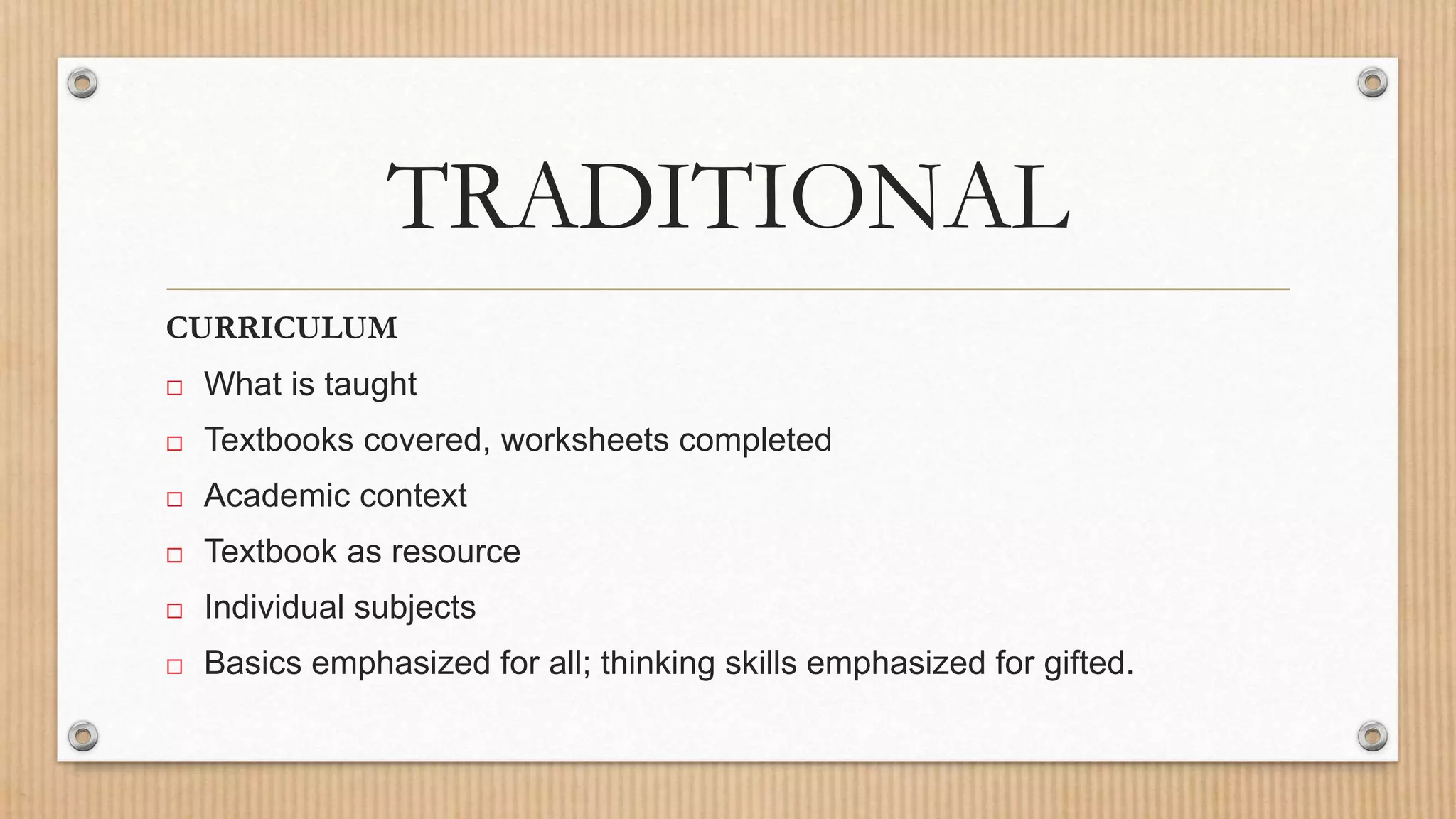
CURRICULUM
 What is taught
 Textbooks covered, worksheets completed
 Academic context
 Textbook as resource
 Individual subjects
 Basics emphasized for all; thinking skills emphasized for gifted.
TRADITIONAL
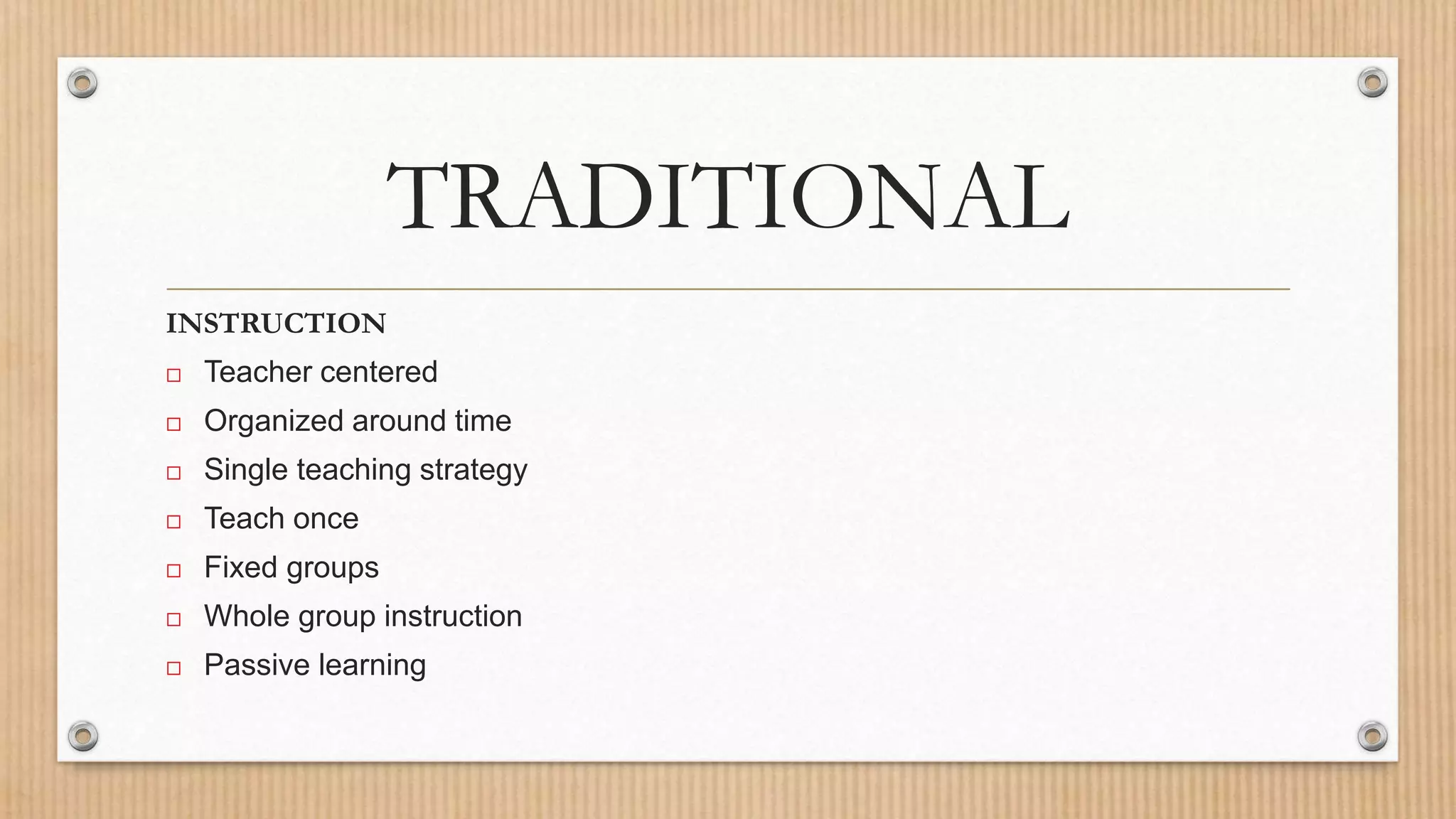
INSTRUCTION
 Teacher centered
 Organized around time
 Single teaching strategy
 Teach once
 Fixed groups
 Whole group instruction
 Passive learning
TRADITIONAL
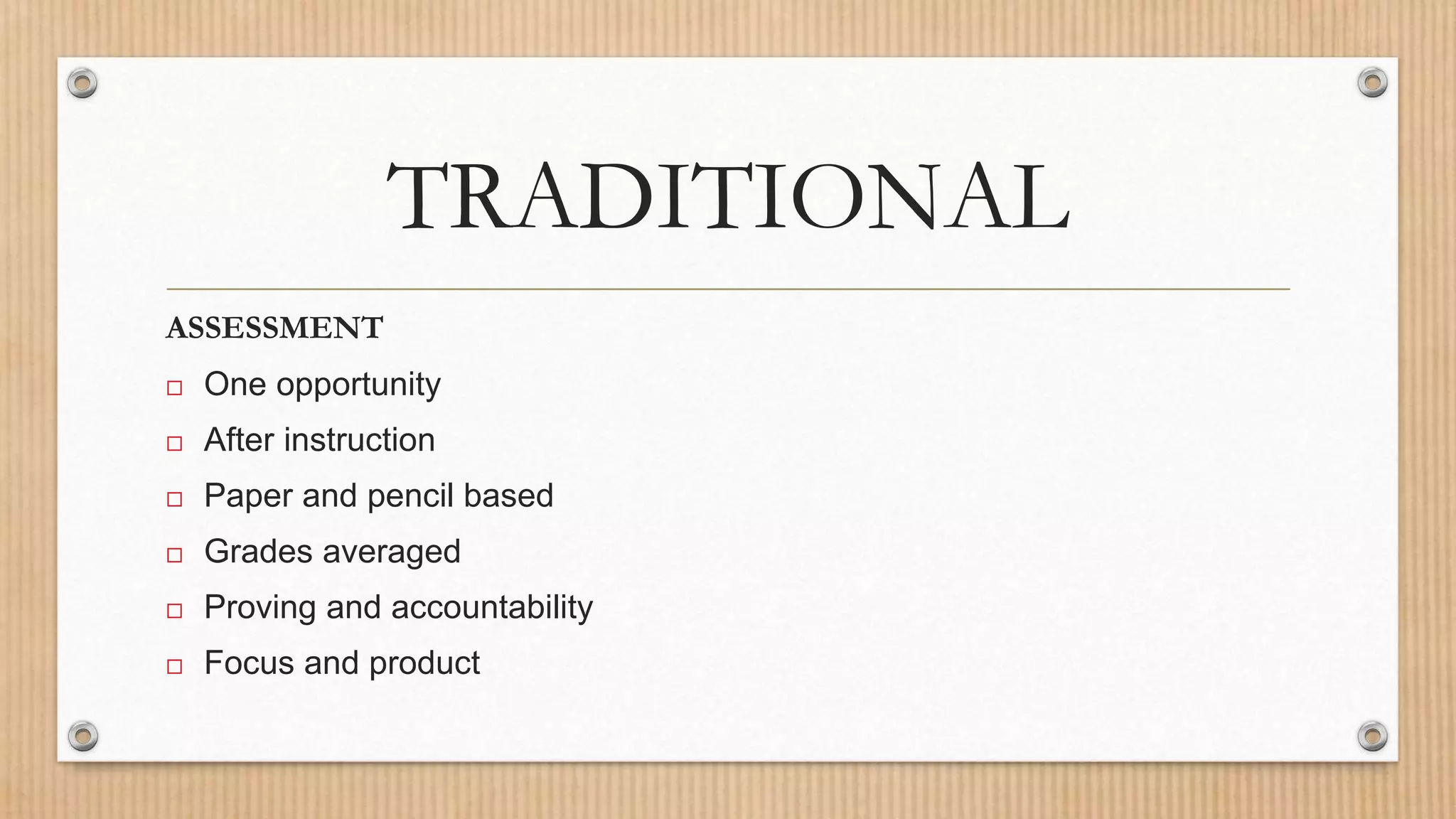
ASSESSMENT
 One opportunity
 After instruction
 Paper and pencil based
 Grades averaged
 Proving and accountability
 Focus and product
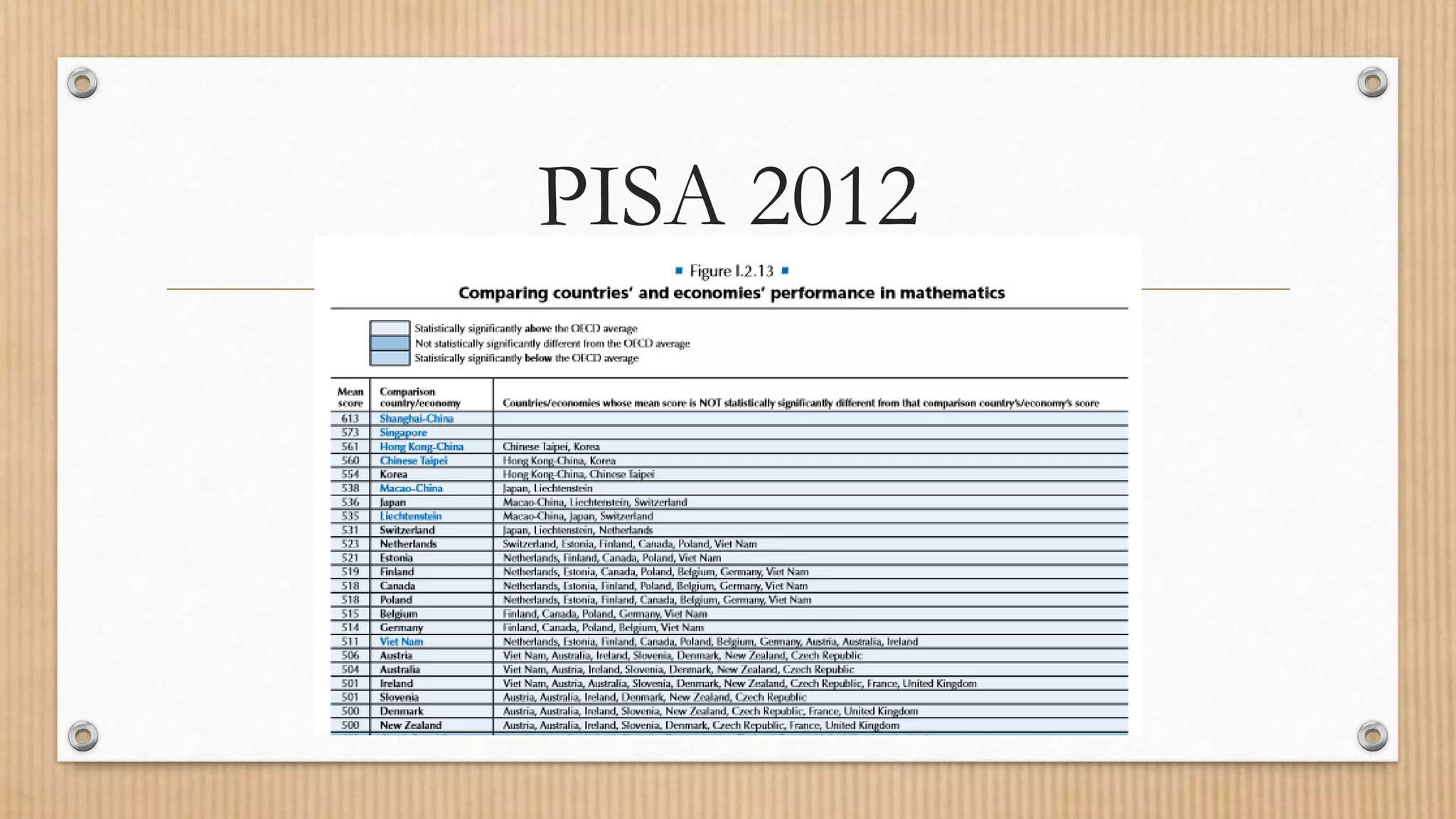
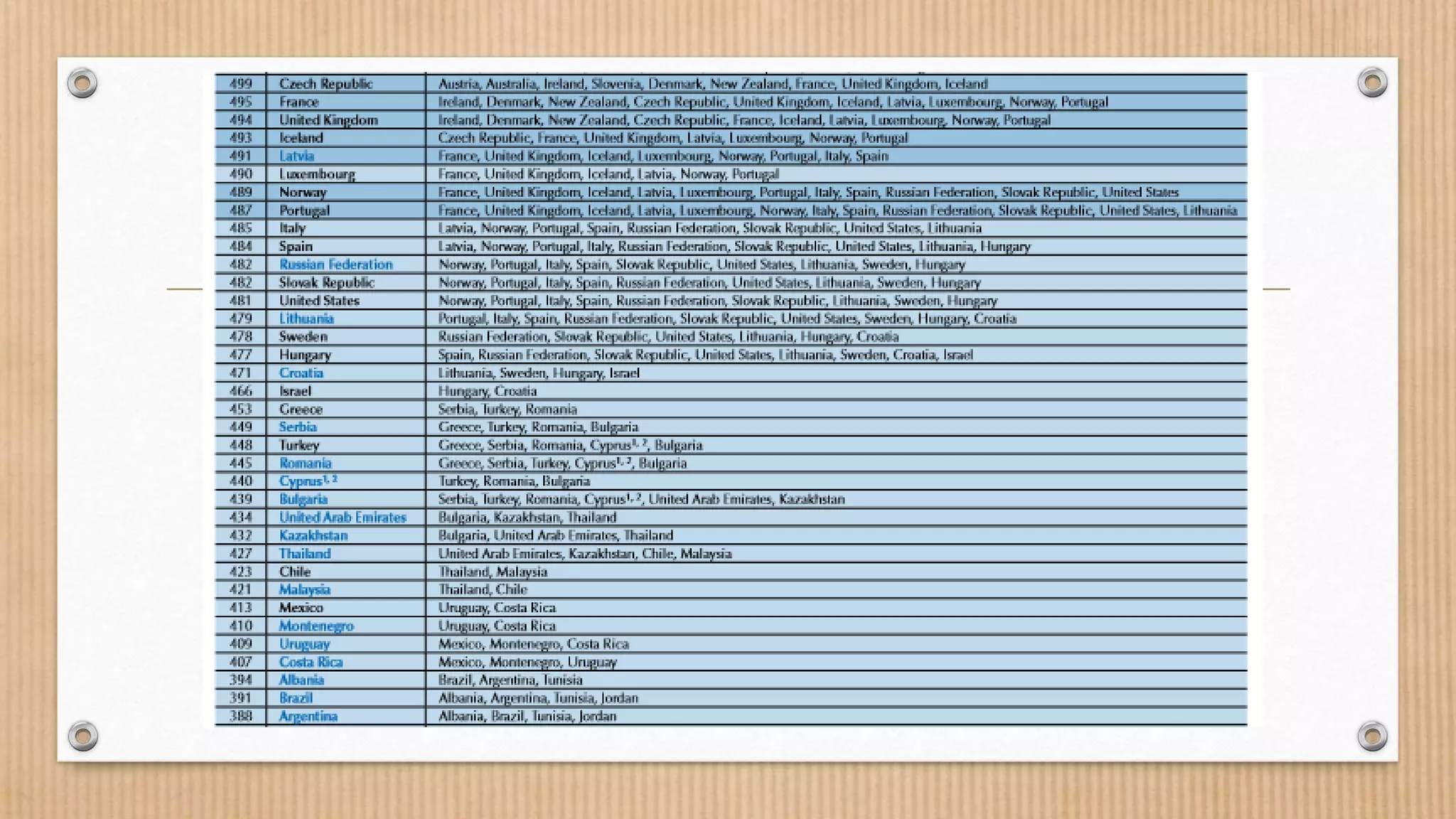
PISA 2012
FACTORS AFFECTING
STUDENTS TOWARDS
EXCELLENCE
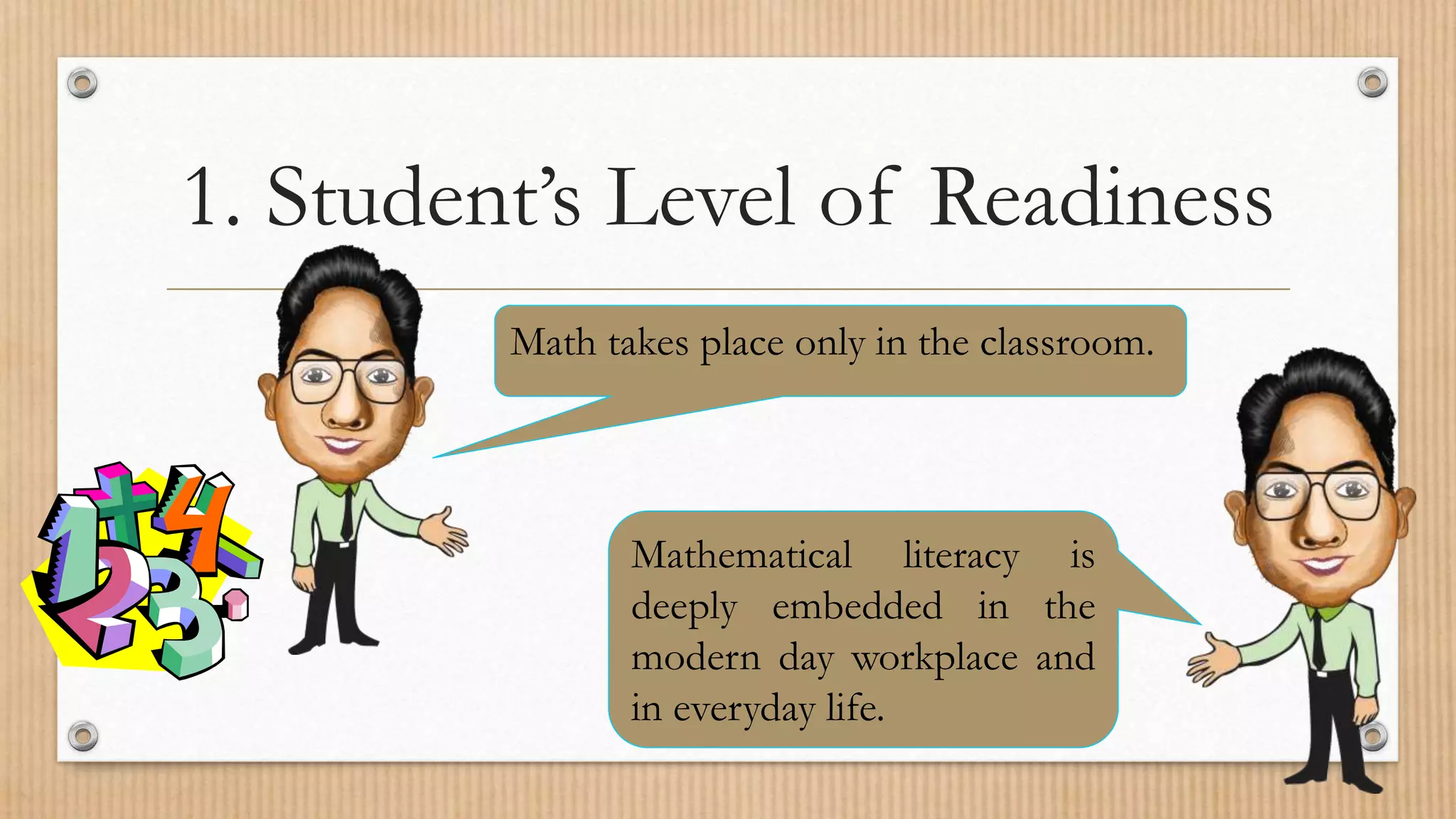
1. Student’s Level of Readiness
Math takes place only in the classroom.
Mathematical literacy is
deeply embedded in the
modern day workplace and
in everyday life.
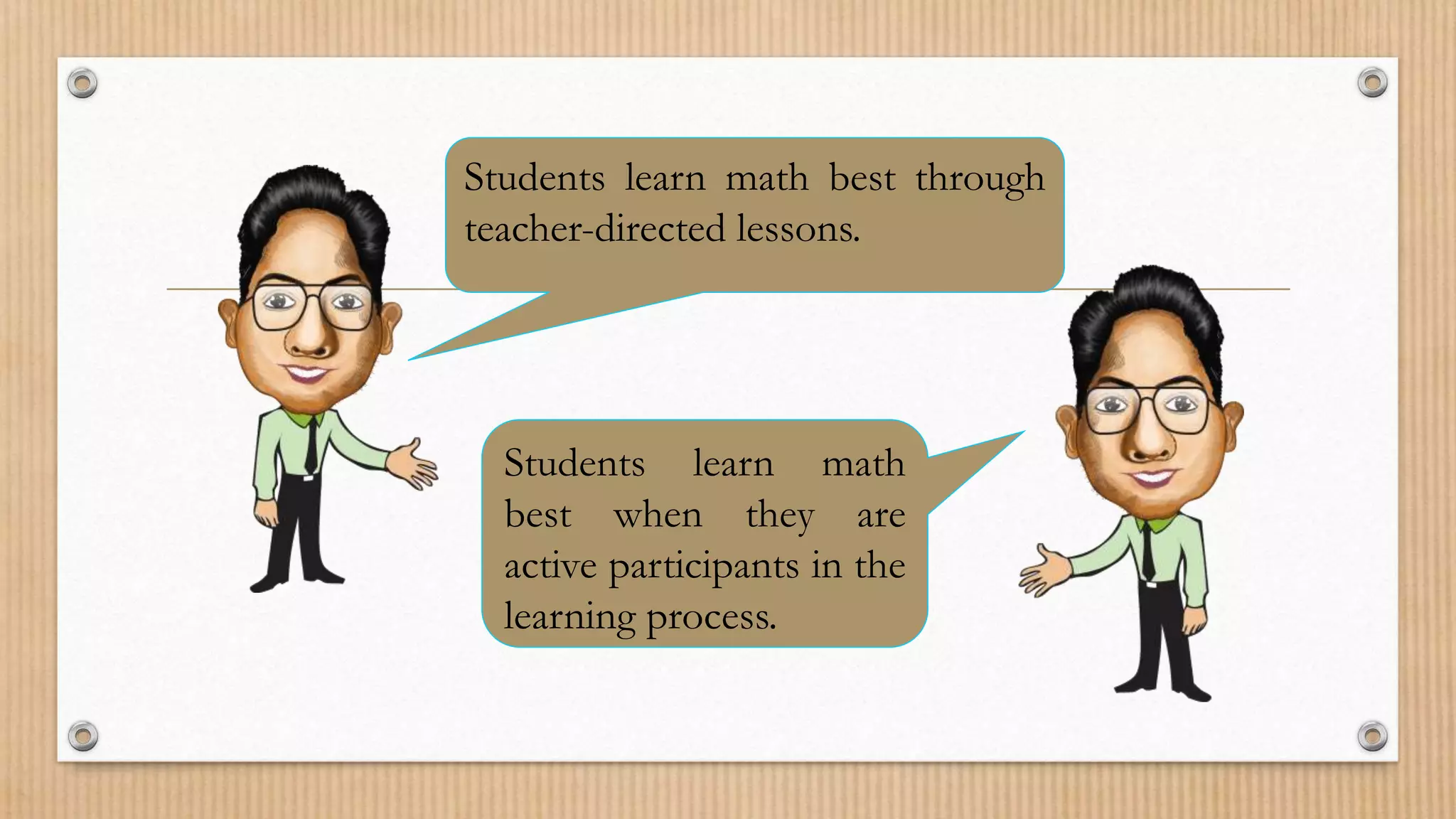
Students learn math best through
teacher-directed lessons.
Students learn math
best when they are
active participants in the
learning process.
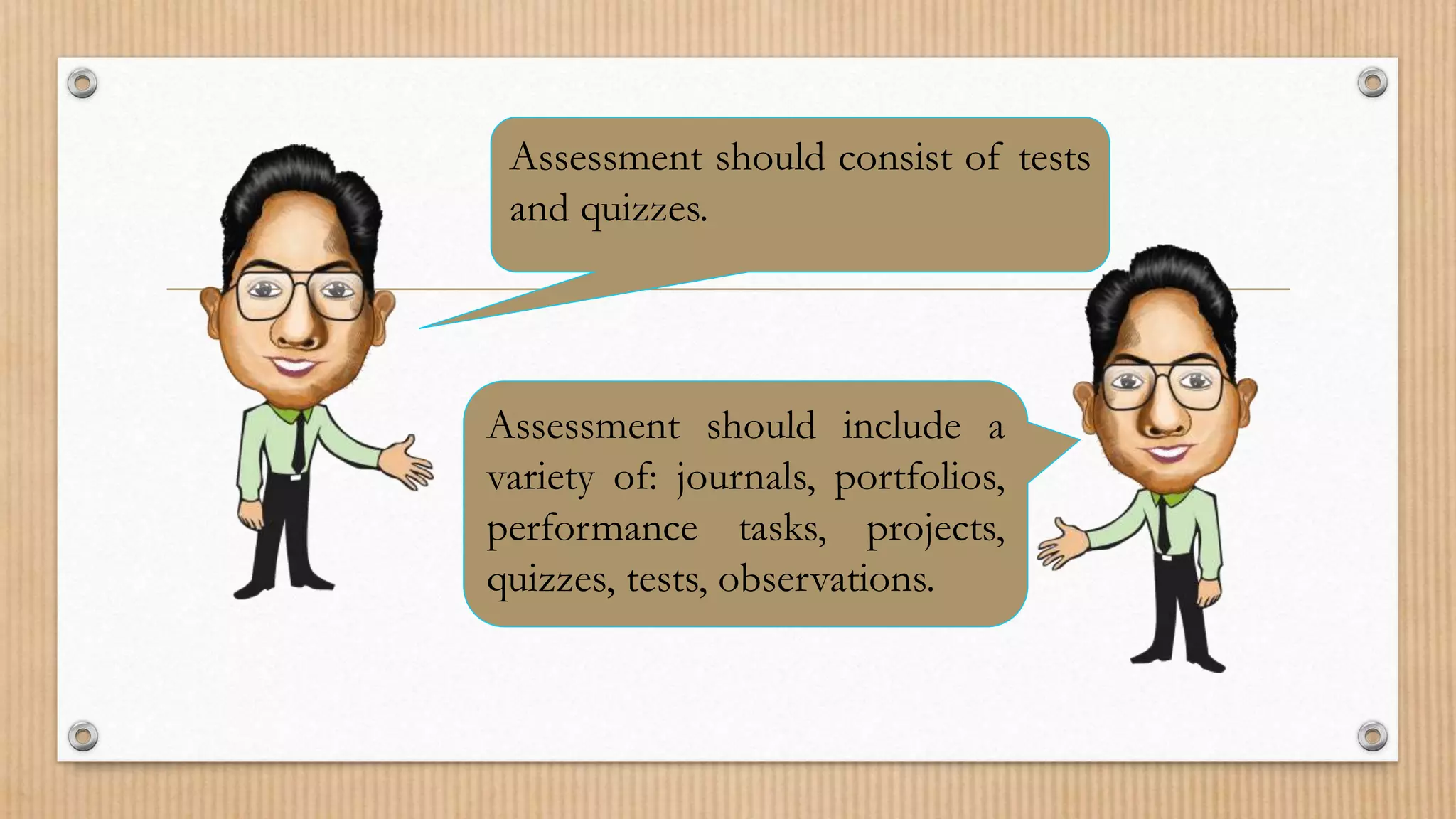
Assessment should consist of tests
and quizzes.
Assessment should include a
variety of: journals, portfolios,
performance tasks, projects,
quizzes, tests, observations.
2. Teacher’s Preparation
• The main reason why these countries are doing so well is the high quality
mathematical learning experiences they provide to children.
• If we want to improve how mathematics is taught, we need to improve the
way teachers are trained.
• Training math teachers is a challenge because many people are “math-
phobic” and often teachers don’t like to teach Math.
EXAMPLE
1. There are 7 boys and 21 girls in a class. How many
more girls than boys are there?
2.There are 21 girls in a class. There are 3 times as
many girls as boys. How many boys are in the class?
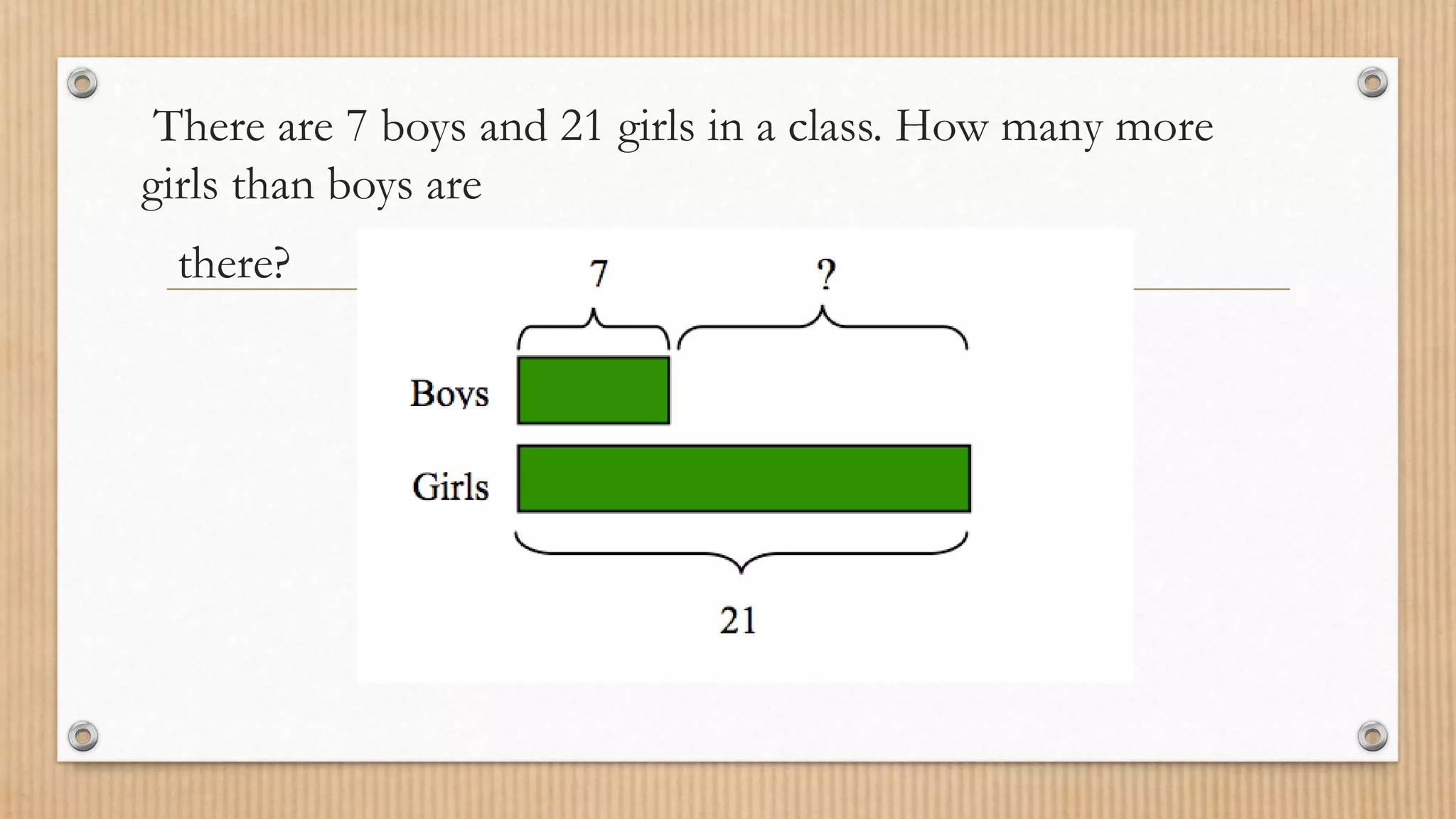
There are 7 boys and 21 girls in a class. How many more
girls than boys are
there?
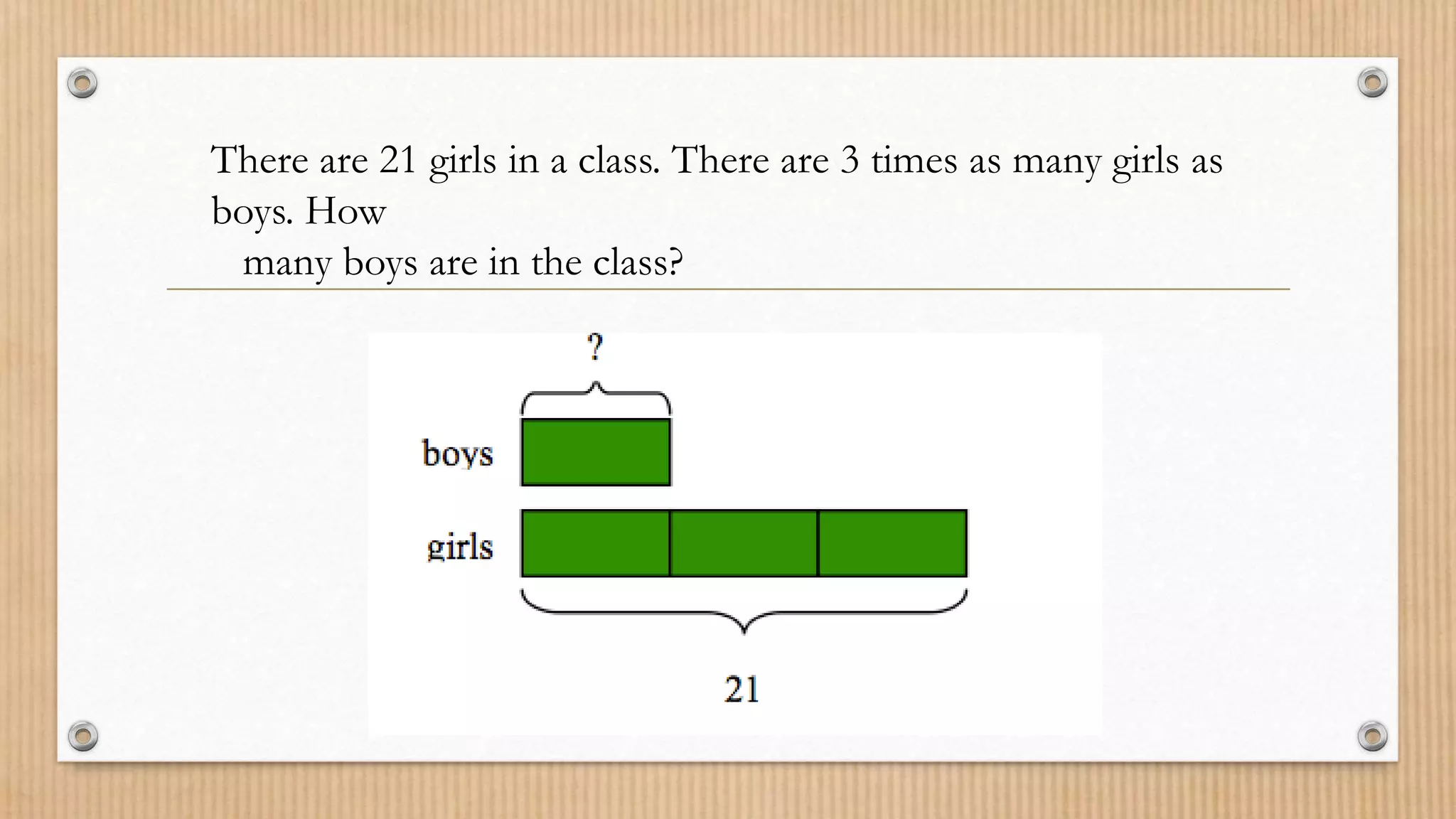
There are 21 girls in a class. There are 3 times as many girls as
boys. How
many boys are in the class?
Meihua spent 1/3 of her money on a
book. She spent 3/4 of the remainder
on a pen. If the pen cost $6 more than
the book, how much money did she
spend altogether?
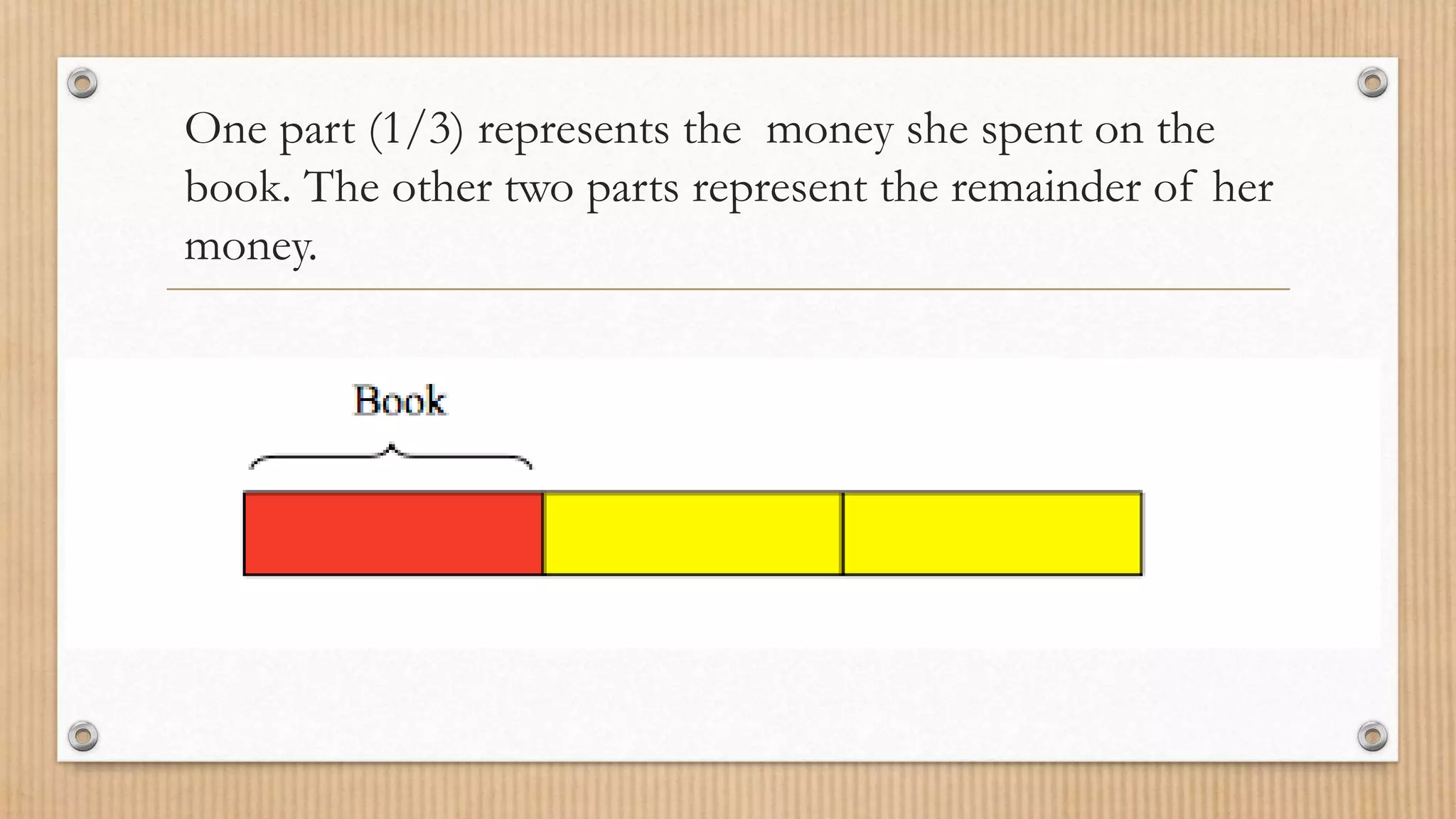
One part (1/3) represents the money she spent on the
book. The other two parts represent the remainder of her
money.
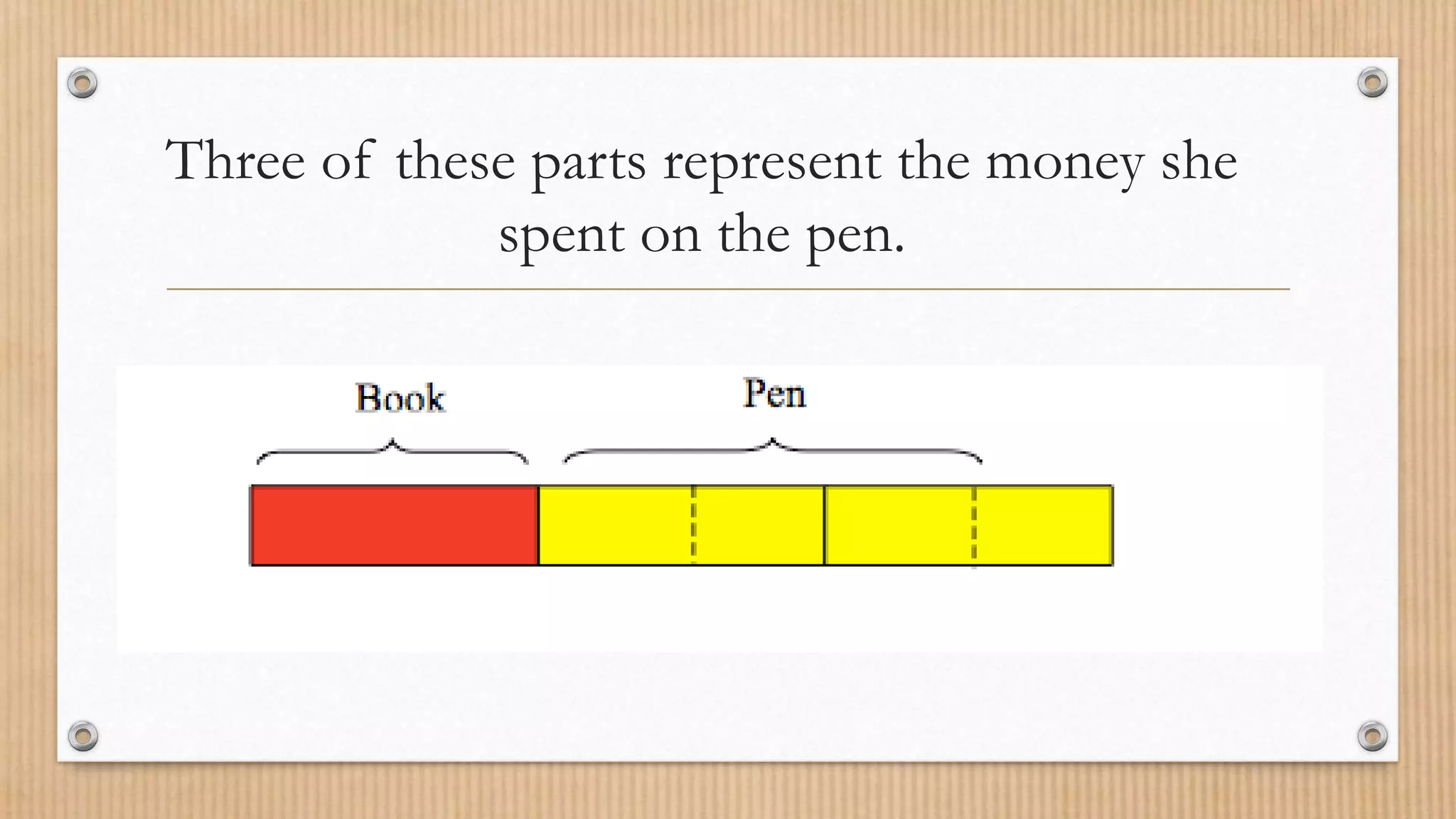
Three of these parts represent the money she
spent on the pen.
If all the parts the same size the problem will
be easier to solve because if we can find the
value of one unit, all the others will be the
same.
(the 3 pen units - the 2 book units). The
amount is equal to $6 since the pen costs $6
more than the book.
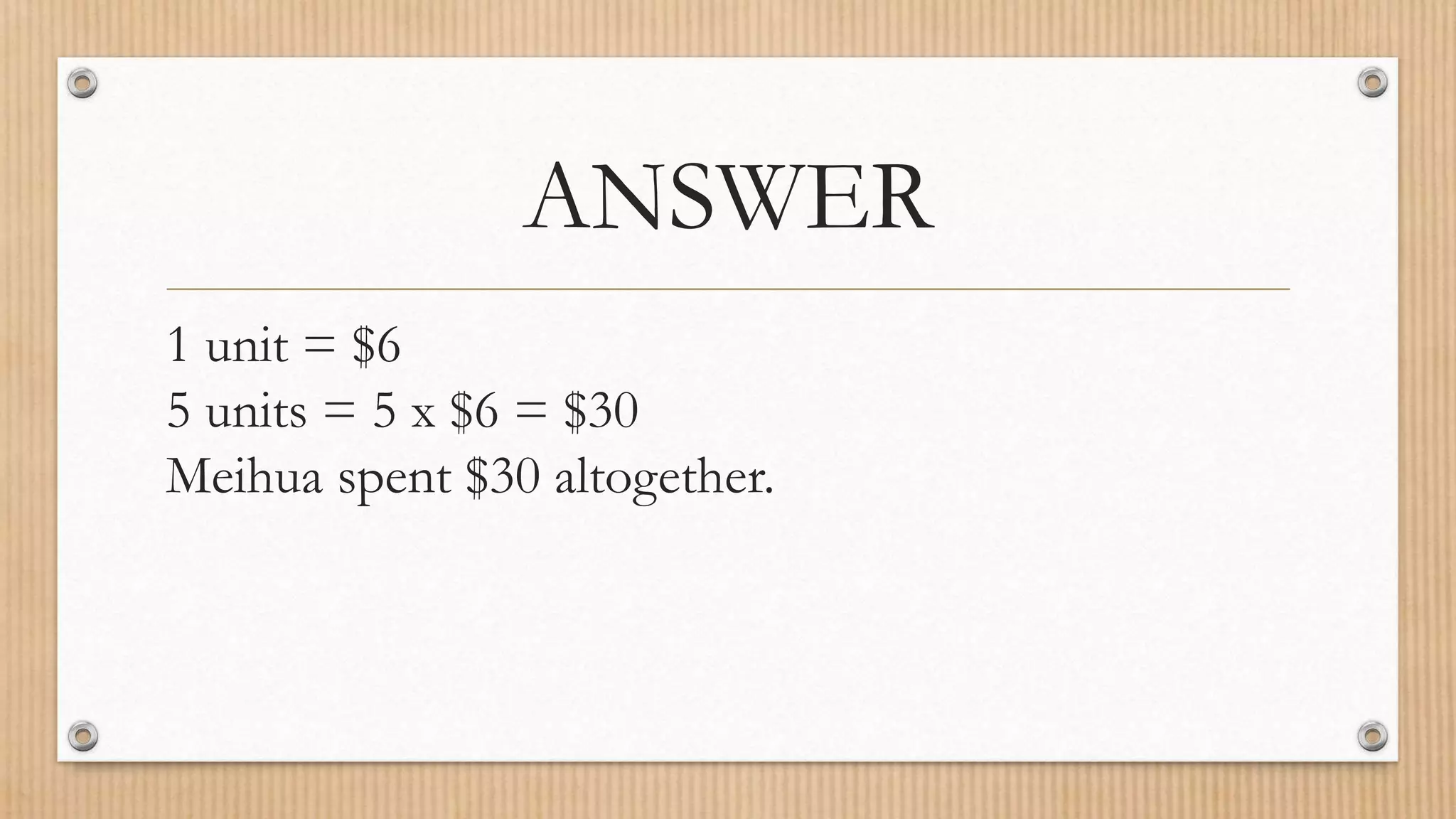
ANSWER
1 unit = $6
5 units = 5 x $6 = $30
Meihua spent $30 altogether.
Model drawing approach is helpful for
several reasons:
(1) It "helps pupils visualize situations"
(2) It "creates concrete pictures from abstract situations."
(3) It "satisfies the pupils' learning through seeing and doing."
(4) It "transforms words into recognizable pictures for young
minds."
3. Parental Support
• Parents pay for tutors not for the lack of what children learn in school but to
improve children’s chances of attaining success.
• Learning should continue even outside the school.
Did our country do
something to follow the
trends/ to be globally
competitive?
K-12
The New
Curriculum
AIM
Produce holistically developed learners who have
21st century skills and are prepared for higher
education, middle level skills development,
employment, and entrepreneurship.
Curriculum
Past 21st Century
 What is taught
 Textbooks covered,
worksheets completed
 Academic context
 Textbook as resource
 Individual subjects
 Basics emphasized for
all; thinking skills
emphasized for gifted.
 What is learned
 Identify what students
should know and be able
to do
 Life context
 Multiple resources
 Integrated subjects
 Basics and thinking skills
emphasized for all.
Grade 7
Number Sense
Measurement
Algebra
Number Sequence and Pattern Finding
Algebraic Expressions
Linear Equations and Inequalities in One Variable
Geometry
Introduction to Geometry
Undefined Terms
Angles
Angle Pairs
Parallel
Transversal
Polygons
Kinds of Polygons
Triangles (including Triangle Inequality)
Quadrilaterals
Interior/Exterior Angles of Convex
Polygons
Probability and Statistics
Introduction to Statistics
Data Representation
Graphical Representation
Measures of Central Tendency (Ungrouped Data)
Grade 8
Algebra
Multiplication of Polynomials
Division of Polynomials
Special Products
Factoring
Application of Special Products and Factoring
Rational Expressions
Linear Functions and Inequalities
Systems of Linear Equations and Inequalities
Probability and Statistics
Measures of Variability (Ungrouped Data)
Simple Probability
Geometry
If–Then Statements
Writing Proofs
Triangle Congruence
Pythagorean Theorem
Geometrical Constructions
Grade 9
Algebra
Quadratic Functions and Equations
Rational Equations
Variations
Radicals
Geometry
Triangle Similarity
Areas of Similar Plane Figure and Volumes
Trigonometry
Trigonometric Ratios
Sine Law and Cosine Law
Area of Triangles
Bearing
Grade 10
Algebra
Sequences and Series
Polynomial Functions
Geometry
Circles
Coordinate Geometry
Probability and Statistics
Measures of Position (Quantiles)
Fundamental Principle of Counting
Combination
Permutation
Probability
Instruction
Past 21st Century
 Teacher centered
 Organized around time
 Single teaching strategy
 Teach once
 Fixed groups
 Whole group instruction
 Passive learning
 Learner centered
 Organized for results
 Multiple teaching
strategies
 Reteaching and
enrichment
 Flexible groups
 Differentiated instruction
 Active learning
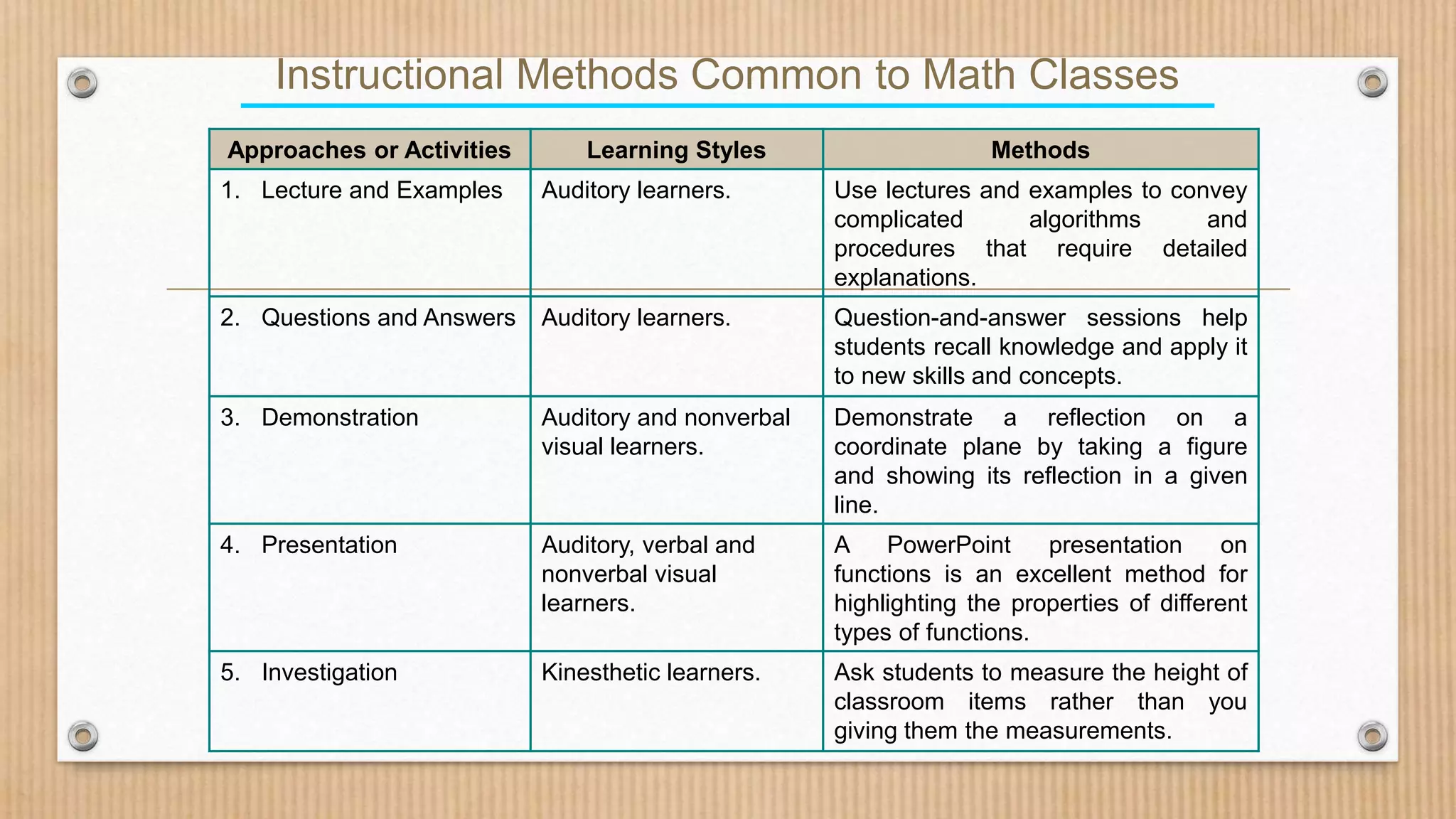
Instructional Methods Common to Math Classes
Approaches or Activities Learning Styles Methods
1. Lecture and Examples Auditory learners. Use lectures and examples to convey
complicated algorithms and
procedures that require detailed
explanations.
2. Questions and Answers Auditory learners. Question-and-answer sessions help
students recall knowledge and apply it
to new skills and concepts.
3. Demonstration Auditory and nonverbal
visual learners.
Demonstrate a reflection on a
coordinate plane by taking a figure
and showing its reflection in a given
line.
4. Presentation Auditory, verbal and
nonverbal visual
learners.
A PowerPoint presentation on
functions is an excellent method for
highlighting the properties of different
types of functions.
5. Investigation Kinesthetic learners. Ask students to measure the height of
classroom items rather than you
giving them the measurements.
Instructional Methods Common to Math Classes
Approaches or Activities Learning Styles Methods
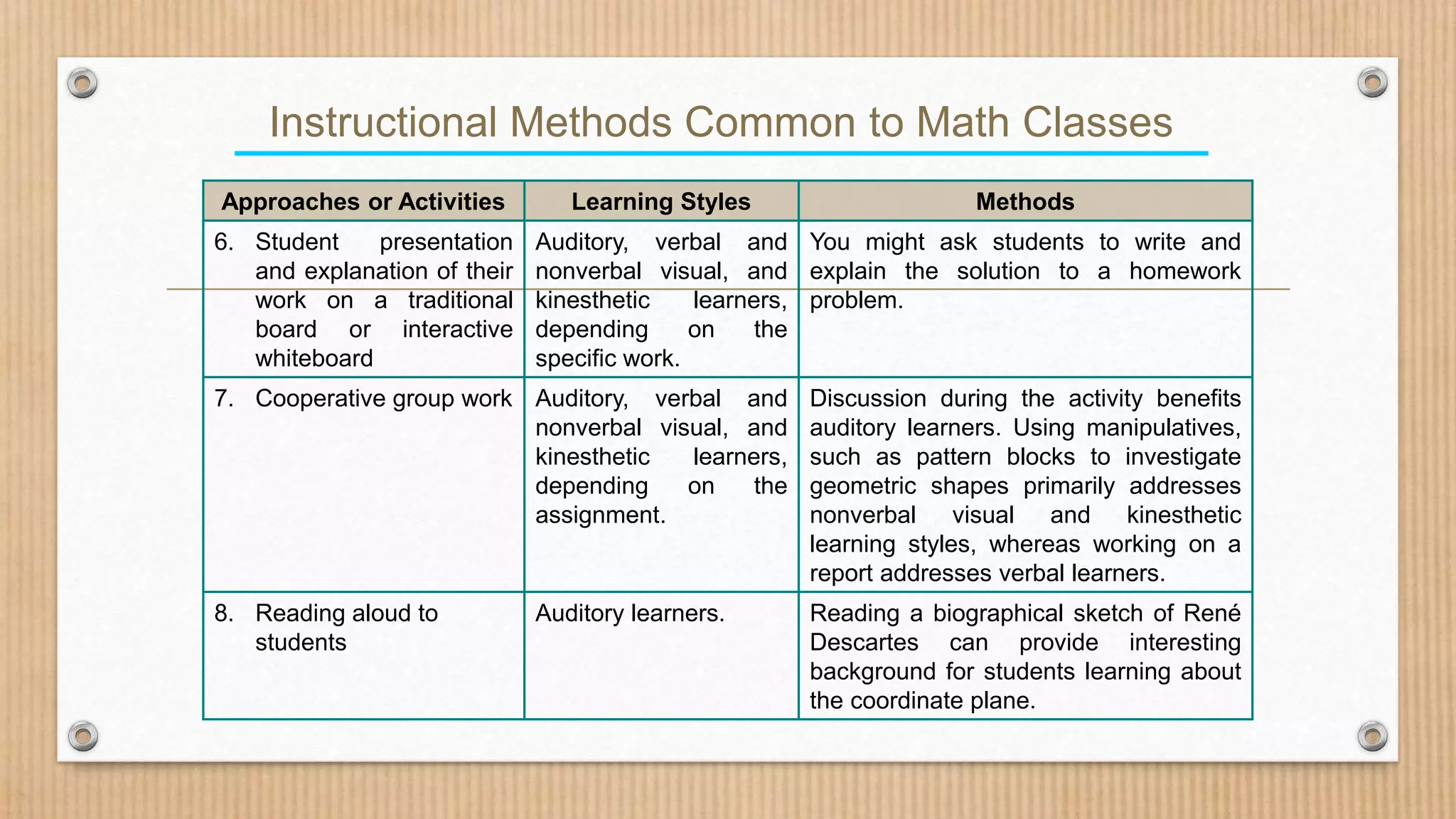
6. Student presentation
and explanation of their
work on a traditional
board or interactive
whiteboard
Auditory, verbal and
nonverbal visual, and
kinesthetic learners,
depending on the
specific work.
You might ask students to write and
explain the solution to a homework
problem.
7. Cooperative group work Auditory, verbal and
nonverbal visual, and
kinesthetic learners,
depending on the
assignment.
Discussion during the activity benefits
auditory learners. Using manipulatives,
such as pattern blocks to investigate
geometric shapes primarily addresses
nonverbal visual and kinesthetic
learning styles, whereas working on a
report addresses verbal learners.
8. Reading aloud to
students
Auditory learners. Reading a biographical sketch of René
Descartes can provide interesting
background for students learning about
the coordinate plane.
Instructional Methods Common to Math Classes
Approaches or Activities Learning Styles Methods
9. Technology Auditory, verbal and
nonverbal visual, and
kinesthetic learners,
depending on the
activity.
A PowerPoint presentation on functions
is an excellent method for highlighting
the properties of different types of
functions.
10. Visual aids Auditory and nonverbal
visual learners.
Showing students a picture of Pascal’s
Triangle to illustrate its properties
addresses nonverbal visual learners.
Use the picture to explain or ask
students to explain the properties of the
triangle.
11. Graphic organizers Verbal and nonverbal
visual learners.
Composed of diagrams and words,
graphic organizers help student
organize, process, and retain
information.
Students can complete a graphic
organizers to classify quadrilaterals.
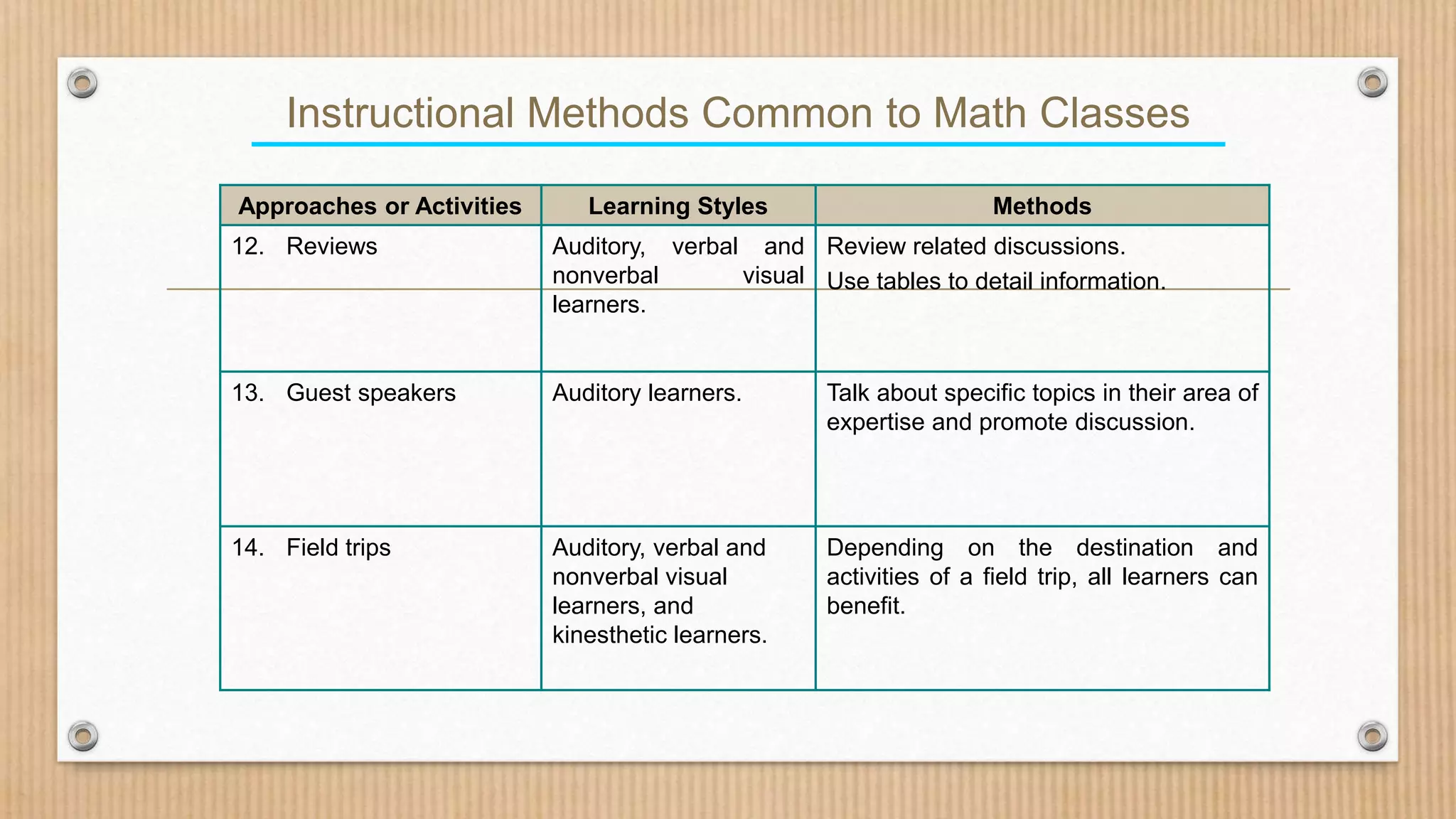
Instructional Methods Common to Math Classes
Approaches or Activities Learning Styles Methods
12. Reviews Auditory, verbal and
nonverbal visual
learners.
Review related discussions.
Use tables to detail information.
13. Guest speakers Auditory learners. Talk about specific topics in their area of
expertise and promote discussion.
14. Field trips Auditory, verbal and
nonverbal visual
learners, and
kinesthetic learners.
Depending on the destination and
activities of a field trip, all learners can
benefit.
EXAMPLE
TEACHING ADDITION OF
INTEGERS
Assessment
Past 21st Century
 One opportunity
 After instruction
 Paper and pencil based
 Grades averaged
 Proving and
accountability
 Focus and product
 Multiple opportunities
 Integrated with instruction
 Performance based
 Grades on final performance
 Diagnose and prescribe
 Focus and product and
performance
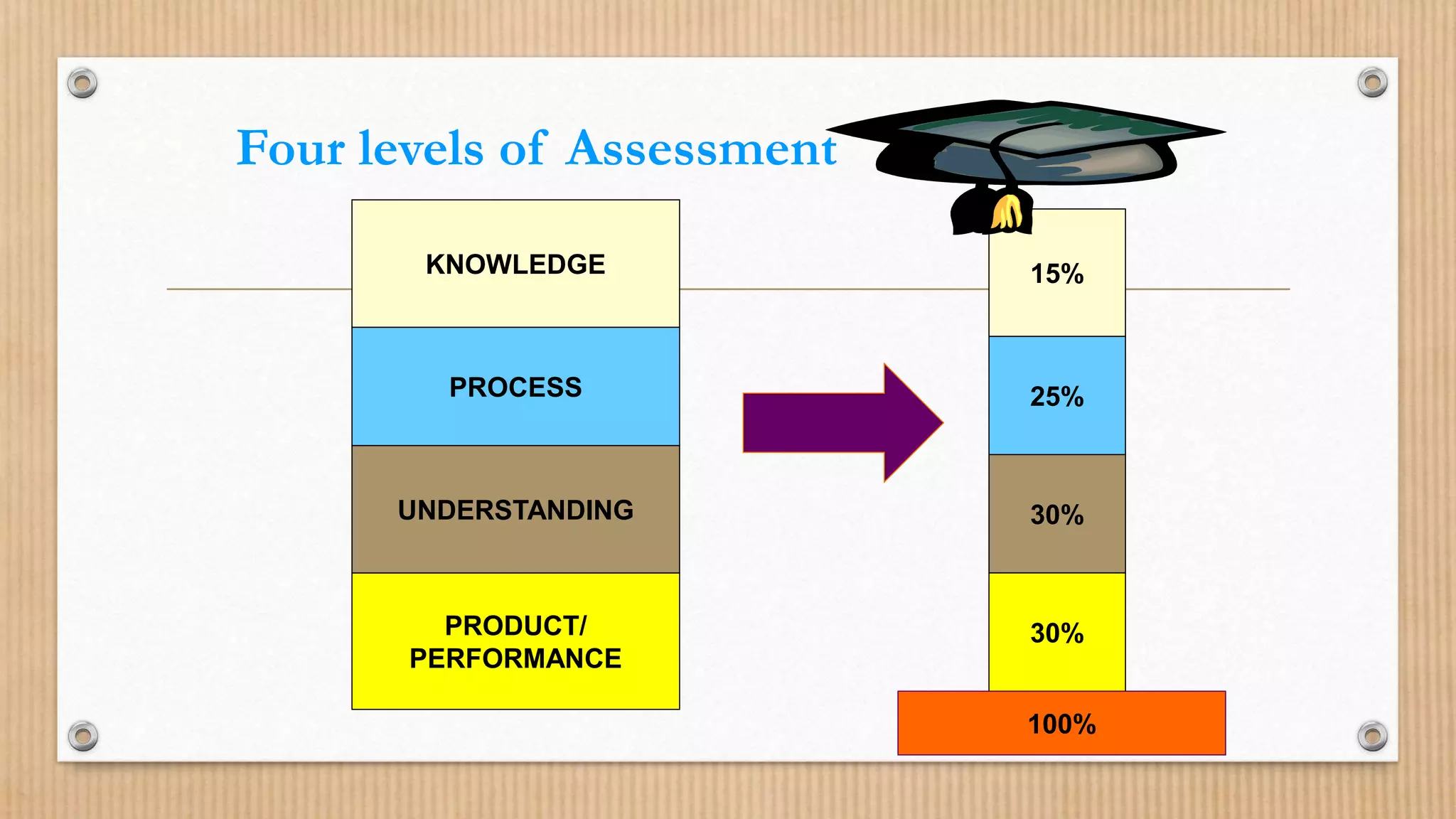
Four levels of Assessment
PRODUCT/
PERFORMANCE
UNDERSTANDING
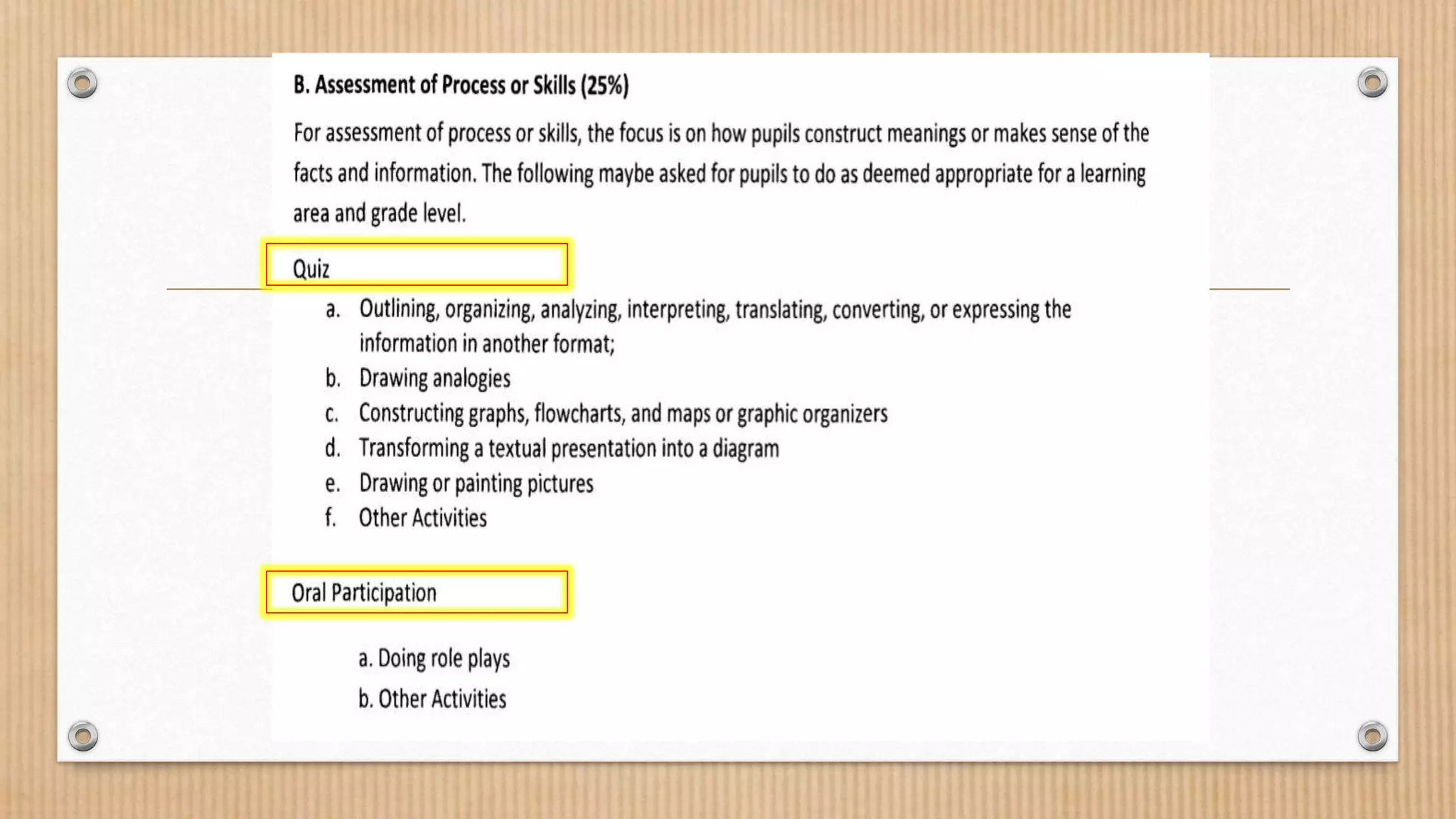
PROCESS
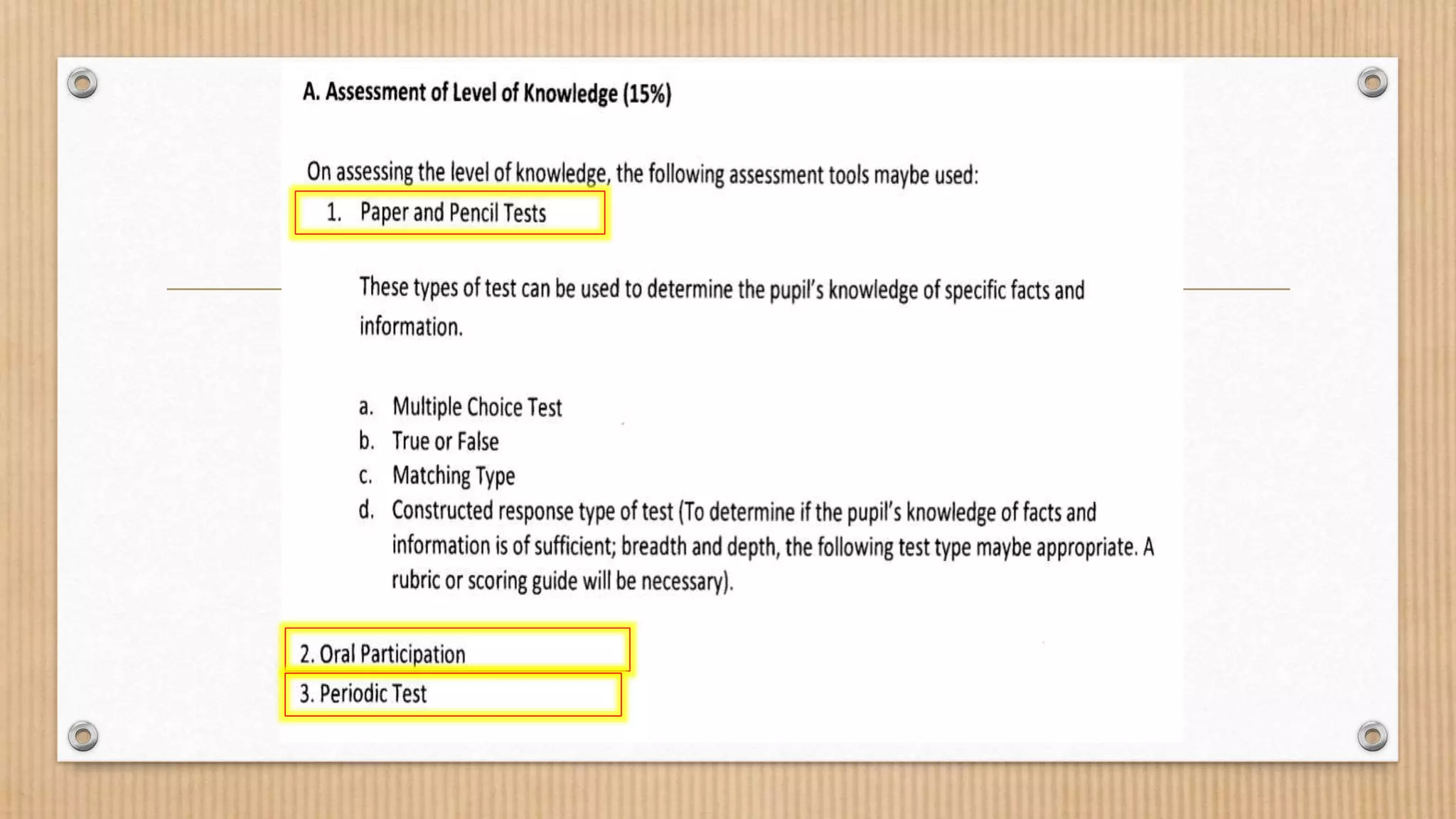
KNOWLEDGE
25%
15%
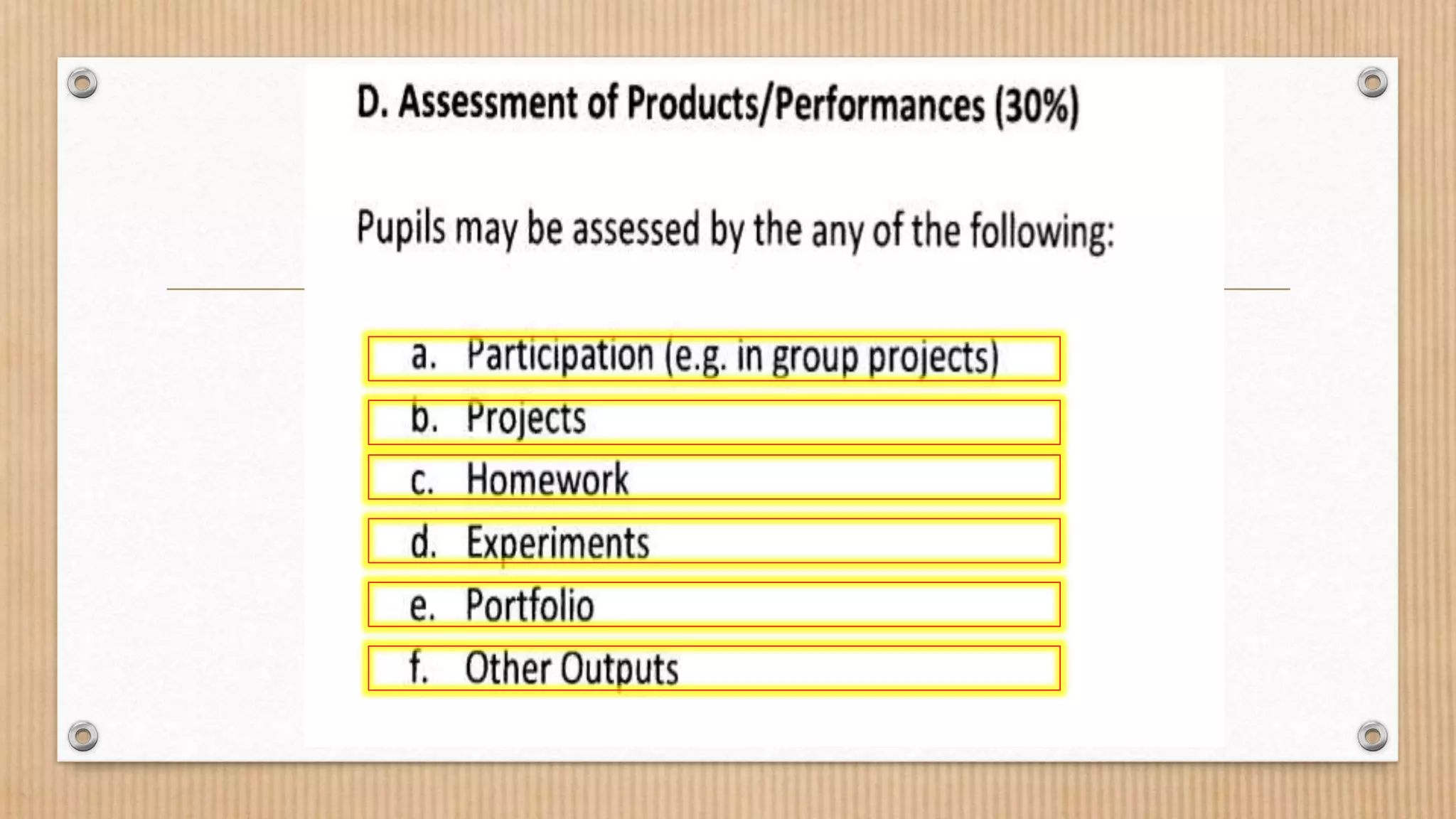
30%
30%
100%
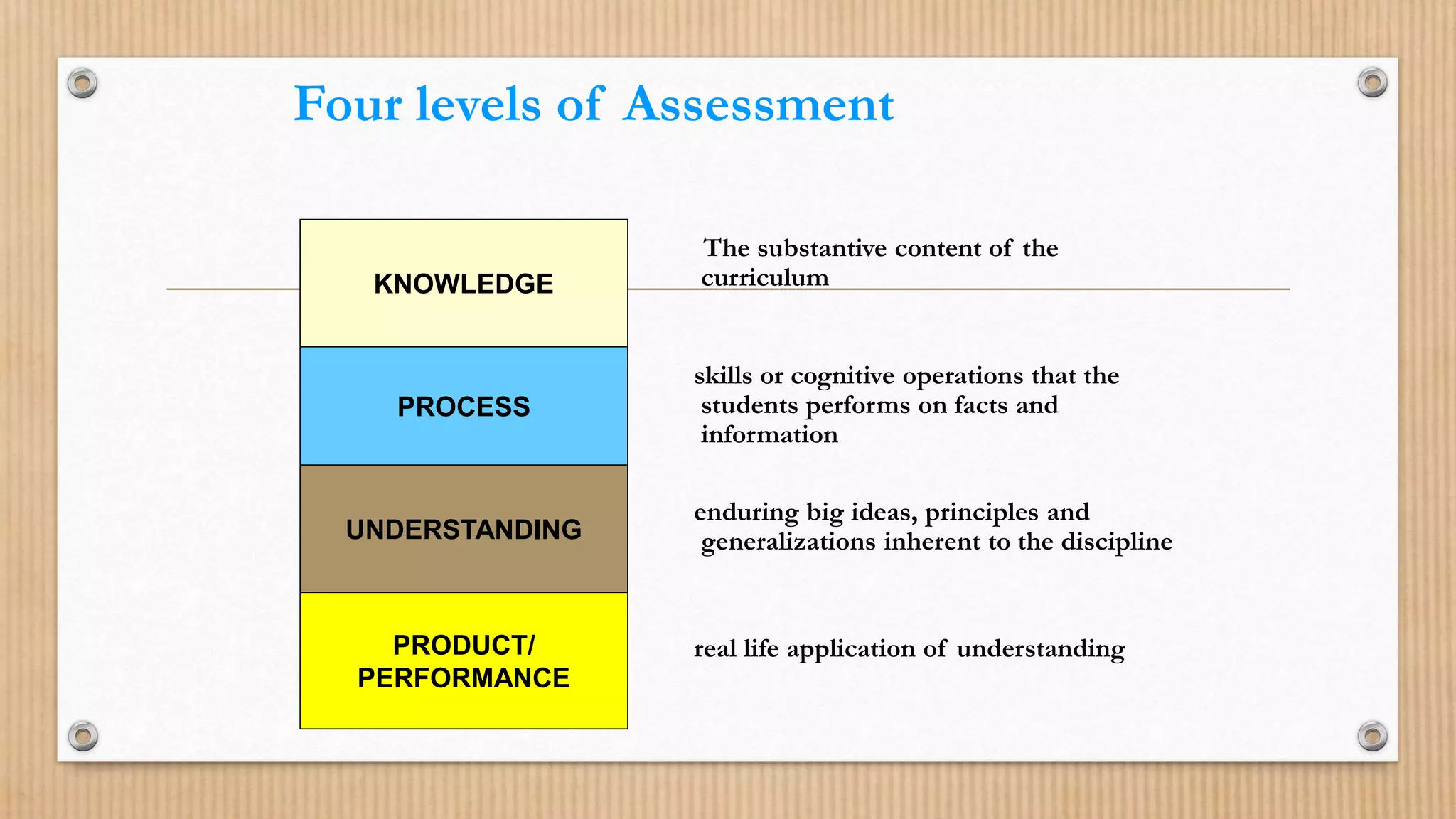
Four levels of Assessment
PRODUCT/
PERFORMANCE
UNDERSTANDING
PROCESS
KNOWLEDGE
The substantive content of the
curriculum
skills or cognitive operations that the
students performs on facts and
information
enduring big ideas, principles and
generalizations inherent to the discipline
real life application of understanding
DIRECT
VARIATION
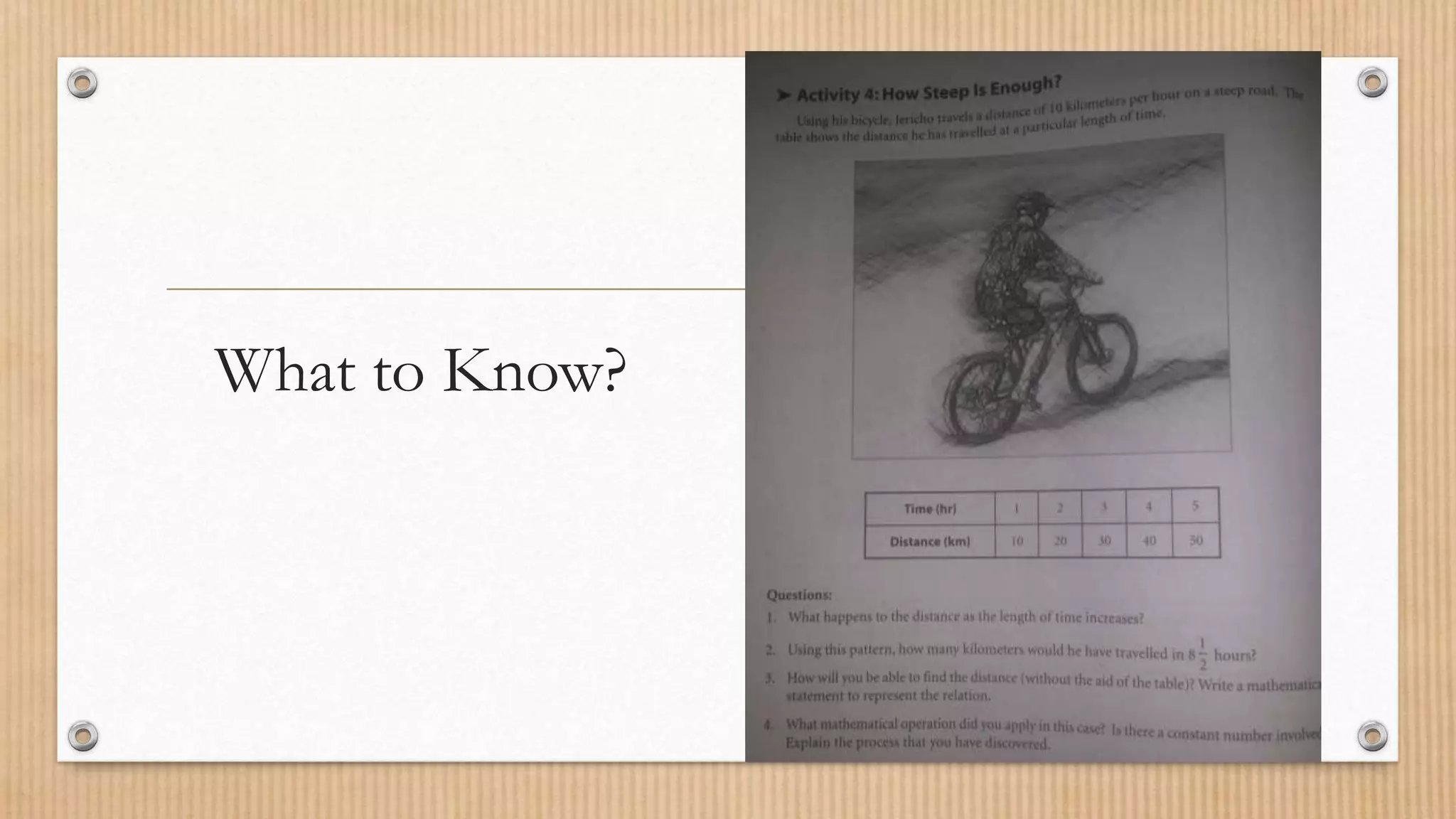
What to Know?
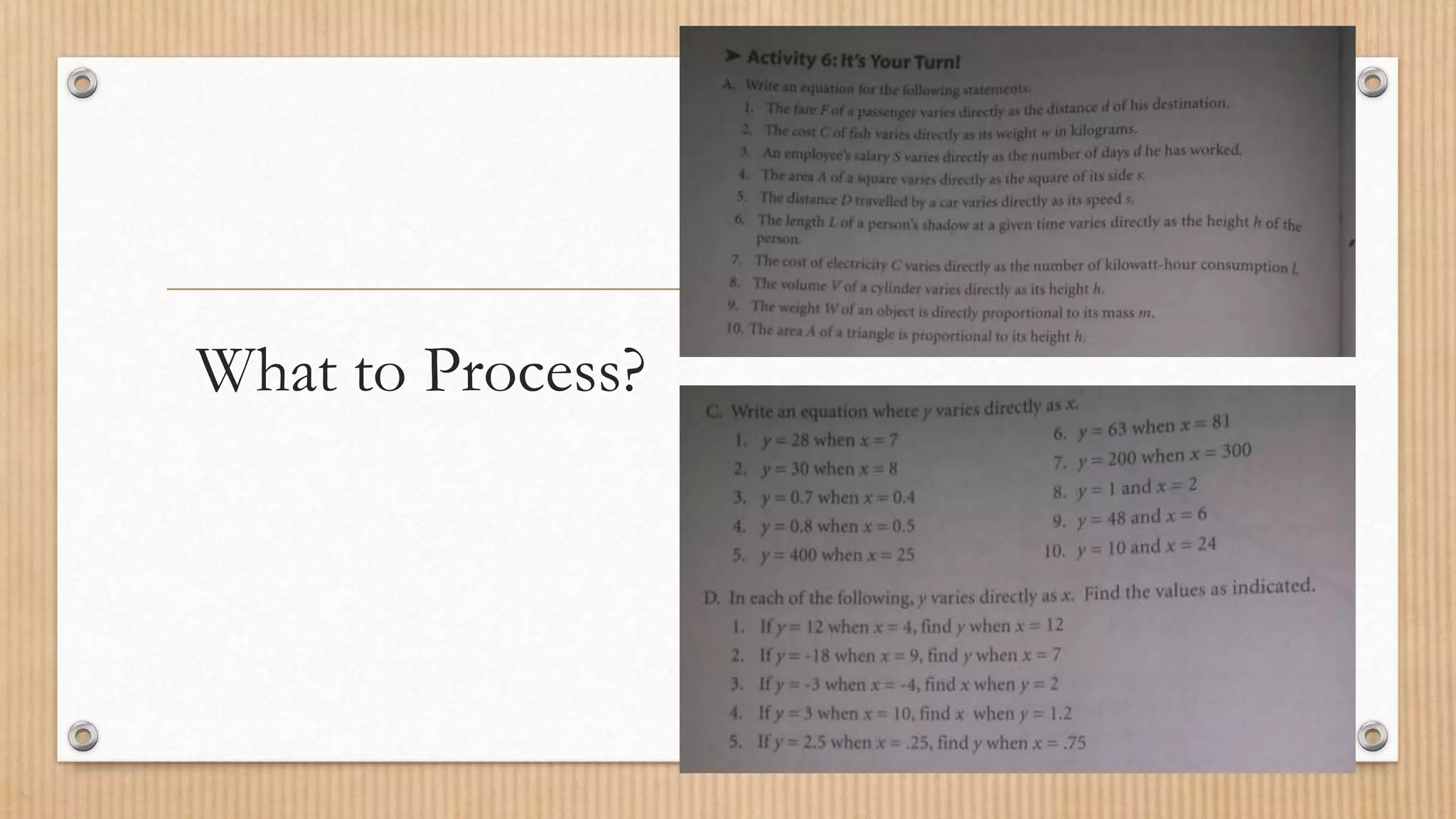
What to Process?
What to
Understand?
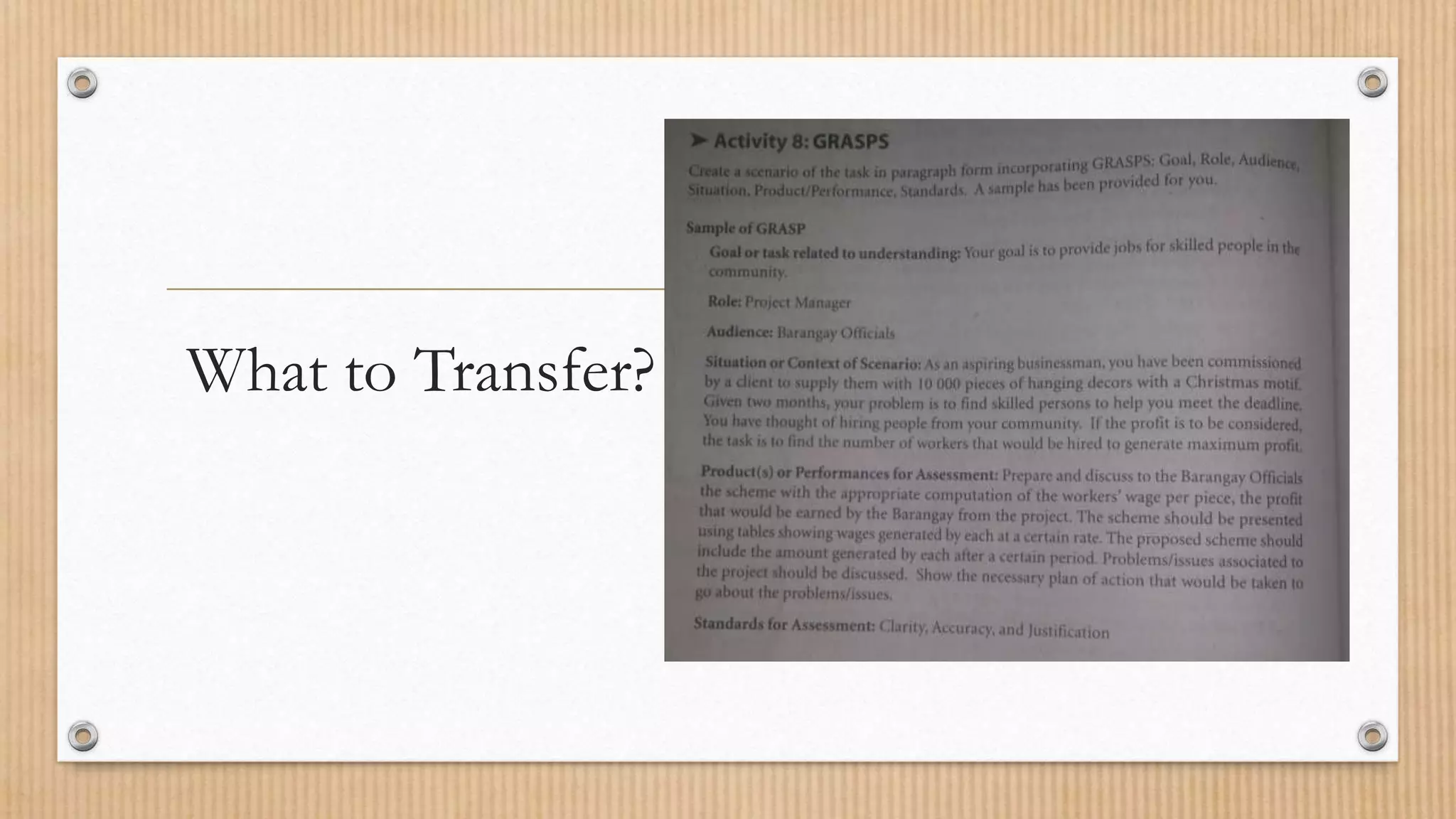
What to Transfer?
RUBRICS
What Math Brought to our World
THE END
Thank You! 
-CJMF-

Aims for mathematics geared towards excellence

  • 1.
  • 2.
    PARTS: I. Traditional Curriculum,Instruction and Assessment II. Why other countries do better in Math? III. What did our country do to follow the trends/ to be globally competitive? IV. Traditional vs. Modern Curriculum, Instruction and Assessment V. Teaching Demonstration VI. How can Math gears learners towards excellence?
  • 3.
    TRADITIONAL CURRICULUM  What istaught  Textbooks covered, worksheets completed  Academic context  Textbook as resource  Individual subjects  Basics emphasized for all; thinking skills emphasized for gifted.
  • 5.
    TRADITIONAL INSTRUCTION  Teacher centered Organized around time  Single teaching strategy  Teach once  Fixed groups  Whole group instruction  Passive learning
  • 6.
    TRADITIONAL ASSESSMENT  One opportunity After instruction  Paper and pencil based  Grades averaged  Proving and accountability  Focus and product
  • 7.
  • 9.
  • 10.
    1. Student’s Levelof Readiness Math takes place only in the classroom. Mathematical literacy is deeply embedded in the modern day workplace and in everyday life.
  • 11.
    Students learn mathbest through teacher-directed lessons. Students learn math best when they are active participants in the learning process.
  • 12.
    Assessment should consistof tests and quizzes. Assessment should include a variety of: journals, portfolios, performance tasks, projects, quizzes, tests, observations.
  • 13.
    2. Teacher’s Preparation •The main reason why these countries are doing so well is the high quality mathematical learning experiences they provide to children. • If we want to improve how mathematics is taught, we need to improve the way teachers are trained. • Training math teachers is a challenge because many people are “math- phobic” and often teachers don’t like to teach Math.
  • 14.
    EXAMPLE 1. There are7 boys and 21 girls in a class. How many more girls than boys are there? 2.There are 21 girls in a class. There are 3 times as many girls as boys. How many boys are in the class?
  • 15.
    There are 7boys and 21 girls in a class. How many more girls than boys are there?
  • 16.
    There are 21girls in a class. There are 3 times as many girls as boys. How many boys are in the class?
  • 17.
    Meihua spent 1/3of her money on a book. She spent 3/4 of the remainder on a pen. If the pen cost $6 more than the book, how much money did she spend altogether?
  • 18.
    One part (1/3)represents the money she spent on the book. The other two parts represent the remainder of her money.
  • 19.
    Three of theseparts represent the money she spent on the pen.
  • 20.
    If all theparts the same size the problem will be easier to solve because if we can find the value of one unit, all the others will be the same.
  • 21.
    (the 3 penunits - the 2 book units). The amount is equal to $6 since the pen costs $6 more than the book.
  • 22.
    ANSWER 1 unit =$6 5 units = 5 x $6 = $30 Meihua spent $30 altogether.
  • 23.
    Model drawing approachis helpful for several reasons: (1) It "helps pupils visualize situations" (2) It "creates concrete pictures from abstract situations." (3) It "satisfies the pupils' learning through seeing and doing." (4) It "transforms words into recognizable pictures for young minds."
  • 24.
    3. Parental Support •Parents pay for tutors not for the lack of what children learn in school but to improve children’s chances of attaining success. • Learning should continue even outside the school.
  • 25.
    Did our countrydo something to follow the trends/ to be globally competitive?
  • 26.
  • 27.
    AIM Produce holistically developedlearners who have 21st century skills and are prepared for higher education, middle level skills development, employment, and entrepreneurship.
  • 28.
    Curriculum Past 21st Century What is taught  Textbooks covered, worksheets completed  Academic context  Textbook as resource  Individual subjects  Basics emphasized for all; thinking skills emphasized for gifted.  What is learned  Identify what students should know and be able to do  Life context  Multiple resources  Integrated subjects  Basics and thinking skills emphasized for all.
  • 29.
    Grade 7 Number Sense Measurement Algebra NumberSequence and Pattern Finding Algebraic Expressions Linear Equations and Inequalities in One Variable Geometry Introduction to Geometry Undefined Terms Angles Angle Pairs Parallel Transversal Polygons Kinds of Polygons Triangles (including Triangle Inequality) Quadrilaterals Interior/Exterior Angles of Convex Polygons Probability and Statistics Introduction to Statistics Data Representation Graphical Representation Measures of Central Tendency (Ungrouped Data) Grade 8 Algebra Multiplication of Polynomials Division of Polynomials Special Products Factoring Application of Special Products and Factoring Rational Expressions Linear Functions and Inequalities Systems of Linear Equations and Inequalities Probability and Statistics Measures of Variability (Ungrouped Data) Simple Probability Geometry If–Then Statements Writing Proofs Triangle Congruence Pythagorean Theorem Geometrical Constructions
  • 30.
    Grade 9 Algebra Quadratic Functionsand Equations Rational Equations Variations Radicals Geometry Triangle Similarity Areas of Similar Plane Figure and Volumes Trigonometry Trigonometric Ratios Sine Law and Cosine Law Area of Triangles Bearing Grade 10 Algebra Sequences and Series Polynomial Functions Geometry Circles Coordinate Geometry Probability and Statistics Measures of Position (Quantiles) Fundamental Principle of Counting Combination Permutation Probability
  • 31.
    Instruction Past 21st Century Teacher centered  Organized around time  Single teaching strategy  Teach once  Fixed groups  Whole group instruction  Passive learning  Learner centered  Organized for results  Multiple teaching strategies  Reteaching and enrichment  Flexible groups  Differentiated instruction  Active learning
  • 32.
    Instructional Methods Commonto Math Classes Approaches or Activities Learning Styles Methods 1. Lecture and Examples Auditory learners. Use lectures and examples to convey complicated algorithms and procedures that require detailed explanations. 2. Questions and Answers Auditory learners. Question-and-answer sessions help students recall knowledge and apply it to new skills and concepts. 3. Demonstration Auditory and nonverbal visual learners. Demonstrate a reflection on a coordinate plane by taking a figure and showing its reflection in a given line. 4. Presentation Auditory, verbal and nonverbal visual learners. A PowerPoint presentation on functions is an excellent method for highlighting the properties of different types of functions. 5. Investigation Kinesthetic learners. Ask students to measure the height of classroom items rather than you giving them the measurements.
  • 33.
    Instructional Methods Commonto Math Classes Approaches or Activities Learning Styles Methods 6. Student presentation and explanation of their work on a traditional board or interactive whiteboard Auditory, verbal and nonverbal visual, and kinesthetic learners, depending on the specific work. You might ask students to write and explain the solution to a homework problem. 7. Cooperative group work Auditory, verbal and nonverbal visual, and kinesthetic learners, depending on the assignment. Discussion during the activity benefits auditory learners. Using manipulatives, such as pattern blocks to investigate geometric shapes primarily addresses nonverbal visual and kinesthetic learning styles, whereas working on a report addresses verbal learners. 8. Reading aloud to students Auditory learners. Reading a biographical sketch of René Descartes can provide interesting background for students learning about the coordinate plane.
  • 34.
    Instructional Methods Commonto Math Classes Approaches or Activities Learning Styles Methods 9. Technology Auditory, verbal and nonverbal visual, and kinesthetic learners, depending on the activity. A PowerPoint presentation on functions is an excellent method for highlighting the properties of different types of functions. 10. Visual aids Auditory and nonverbal visual learners. Showing students a picture of Pascal’s Triangle to illustrate its properties addresses nonverbal visual learners. Use the picture to explain or ask students to explain the properties of the triangle. 11. Graphic organizers Verbal and nonverbal visual learners. Composed of diagrams and words, graphic organizers help student organize, process, and retain information. Students can complete a graphic organizers to classify quadrilaterals.
  • 35.
    Instructional Methods Commonto Math Classes Approaches or Activities Learning Styles Methods 12. Reviews Auditory, verbal and nonverbal visual learners. Review related discussions. Use tables to detail information. 13. Guest speakers Auditory learners. Talk about specific topics in their area of expertise and promote discussion. 14. Field trips Auditory, verbal and nonverbal visual learners, and kinesthetic learners. Depending on the destination and activities of a field trip, all learners can benefit.
  • 36.
  • 37.
    Assessment Past 21st Century One opportunity  After instruction  Paper and pencil based  Grades averaged  Proving and accountability  Focus and product  Multiple opportunities  Integrated with instruction  Performance based  Grades on final performance  Diagnose and prescribe  Focus and product and performance
  • 38.
    Four levels ofAssessment PRODUCT/ PERFORMANCE UNDERSTANDING PROCESS KNOWLEDGE 25% 15% 30% 30% 100%
  • 39.
    Four levels ofAssessment PRODUCT/ PERFORMANCE UNDERSTANDING PROCESS KNOWLEDGE The substantive content of the curriculum skills or cognitive operations that the students performs on facts and information enduring big ideas, principles and generalizations inherent to the discipline real life application of understanding
  • 44.
  • 45.
  • 46.
  • 47.
  • 48.
  • 49.
  • 50.
    What Math Broughtto our World
  • 54.