10-1

ROBBINS & JUDGE

ORGANIZATIONAL BEHAVIOR
13TH EDITION

Chapter 10: Understanding Work Teams
and its Dynamics

Prepared by:
Donna Irene Q. Ituriaga
10-2

Chapter Objectives
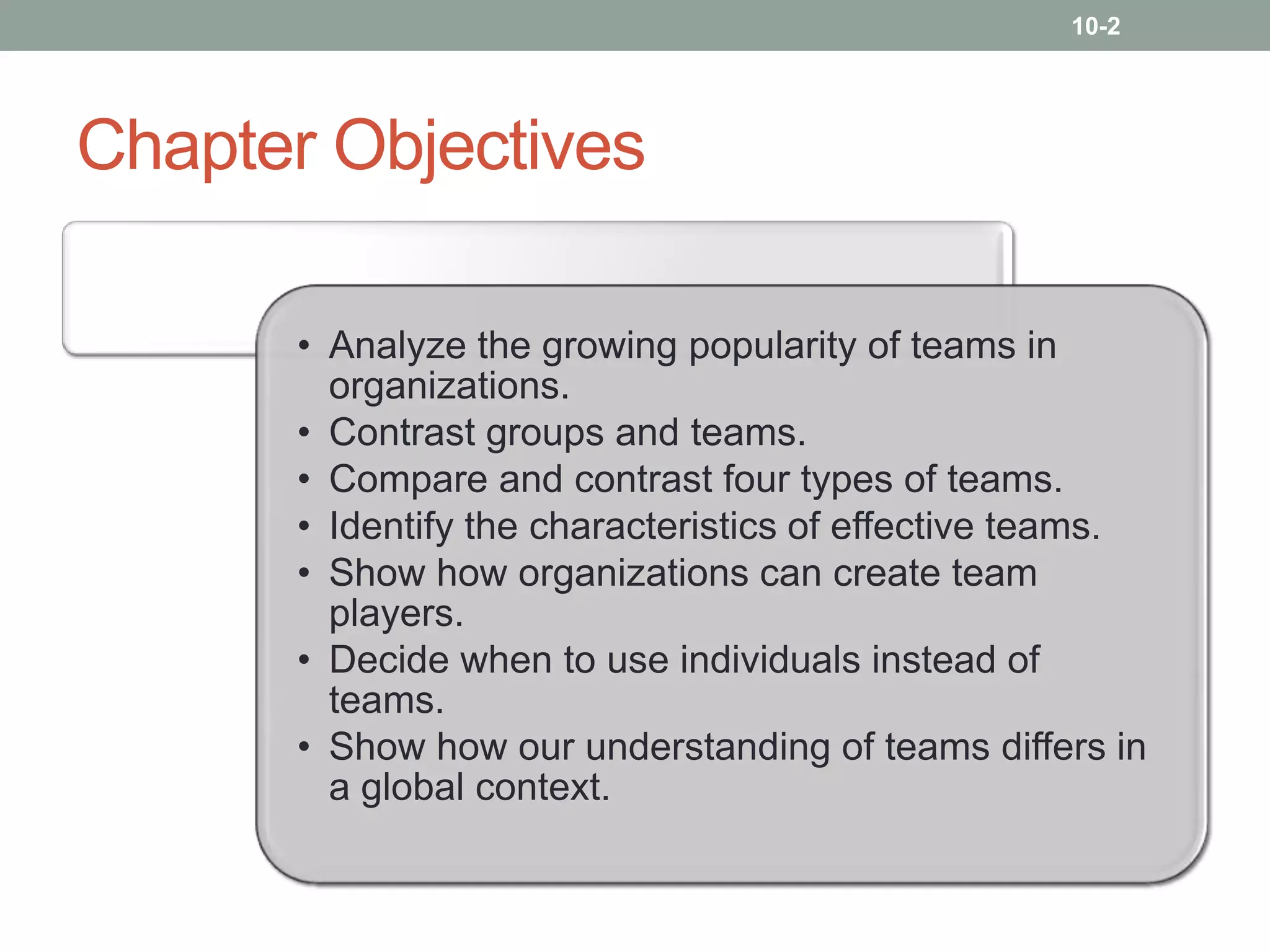
• Analyze the growing popularity of teams in
organizations.
• Contrast groups and teams.
• Compare and contrast four types of teams.
• Identify the characteristics of effective teams.
• Show how organizations can create team
players.
• Decide when to use individuals instead of
teams.
• Show how our understanding of teams differs in
a global context.
10-3

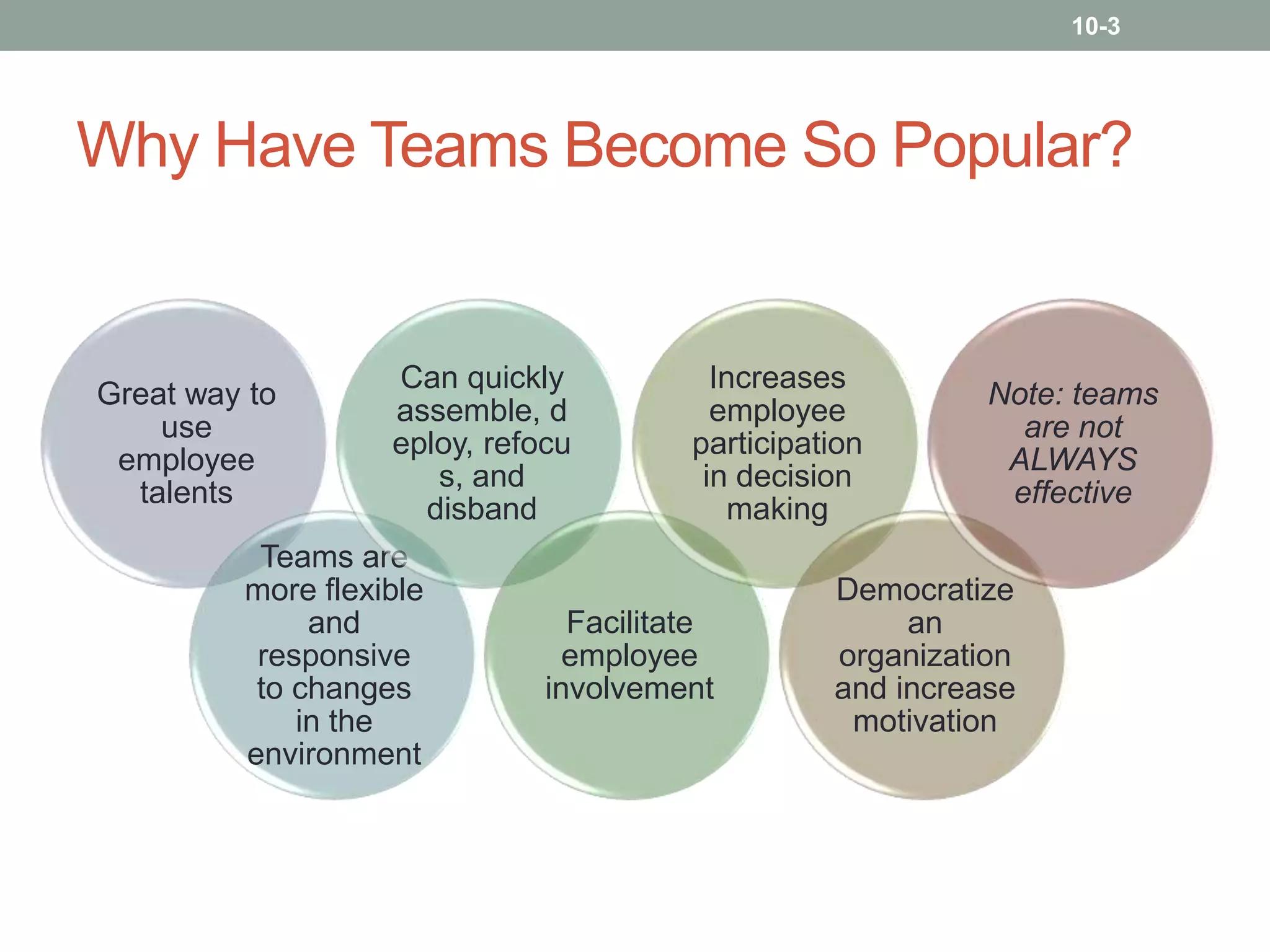
Why Have Teams Become So Popular?

Great way to
use
employee
talents

Can quickly
assemble, d
eploy, refocu
s, and
disband

Teams are
more flexible
and
responsive
to changes
in the
environment

Increases
employee
participation
in decision
making

Facilitate
employee
involvement

Note: teams
are not
ALWAYS
effective

Democratize
an
organization
and increase
motivation
10-4

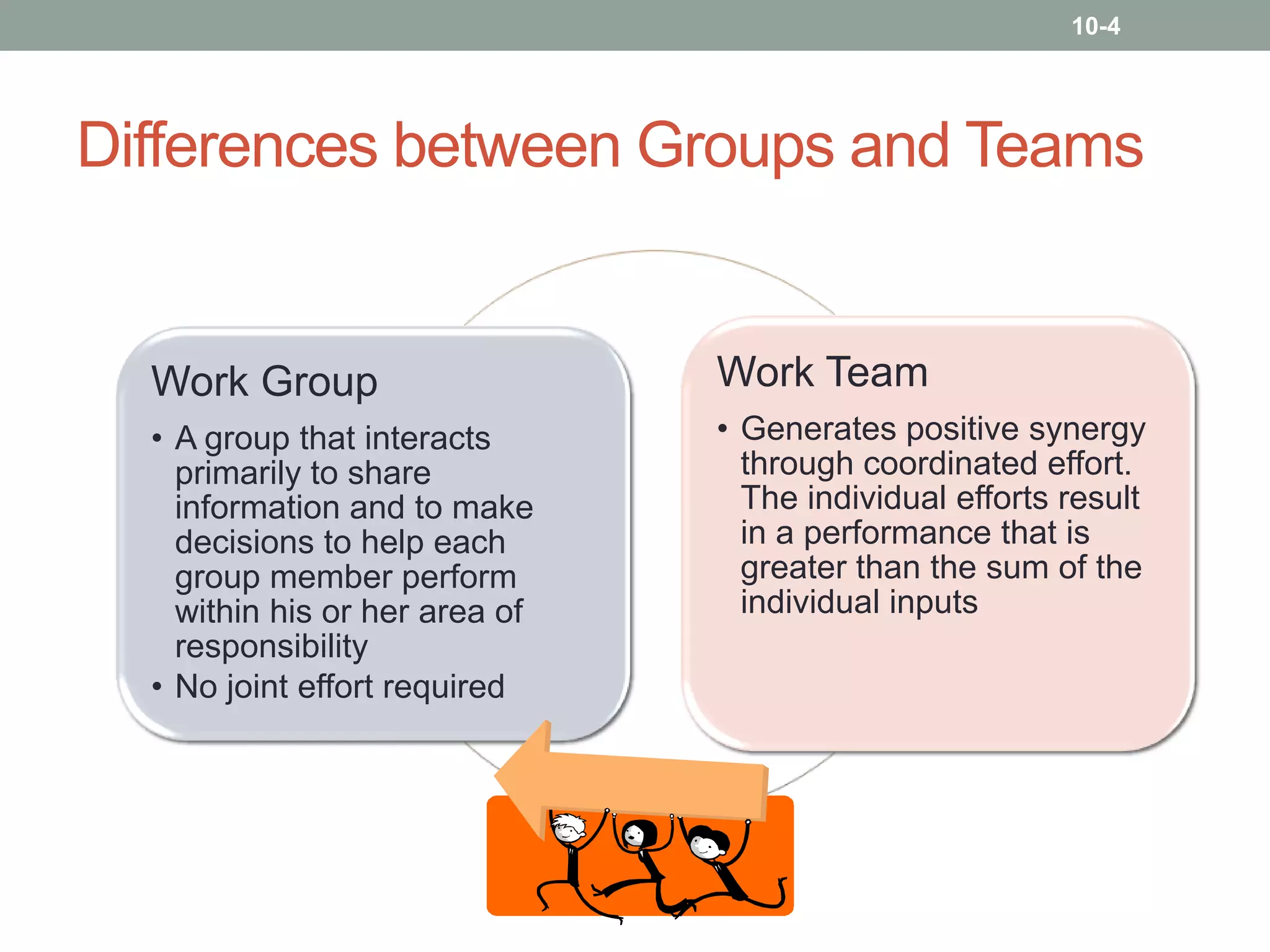
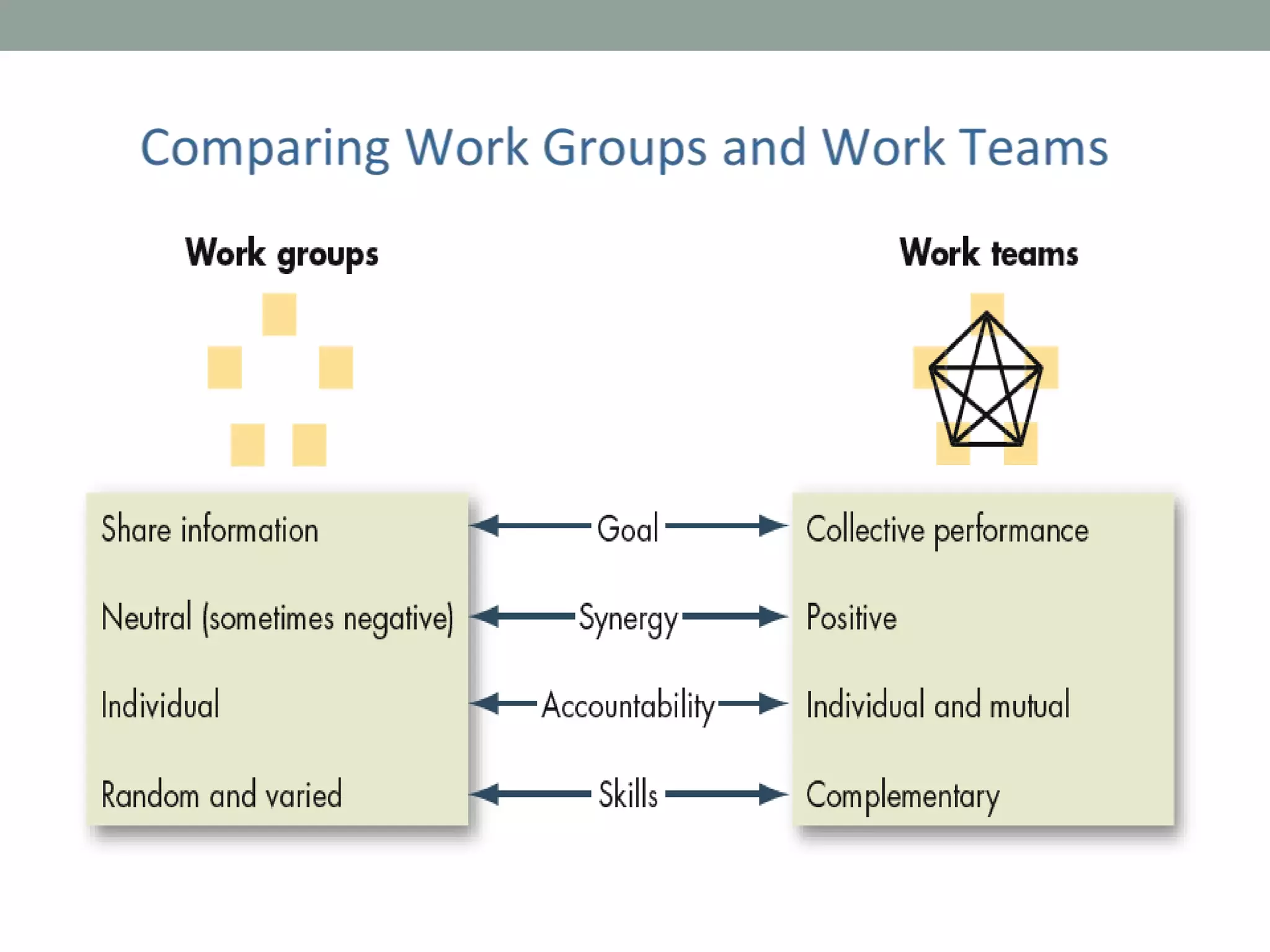
Differences between Groups and Teams

Work Group

Work Team

• A group that interacts
primarily to share
information and to make
decisions to help each
group member perform
within his or her area of
responsibility
• No joint effort required

• Generates positive synergy
through coordinated effort.
The individual efforts result
in a performance that is
greater than the sum of the
individual inputs
10-6

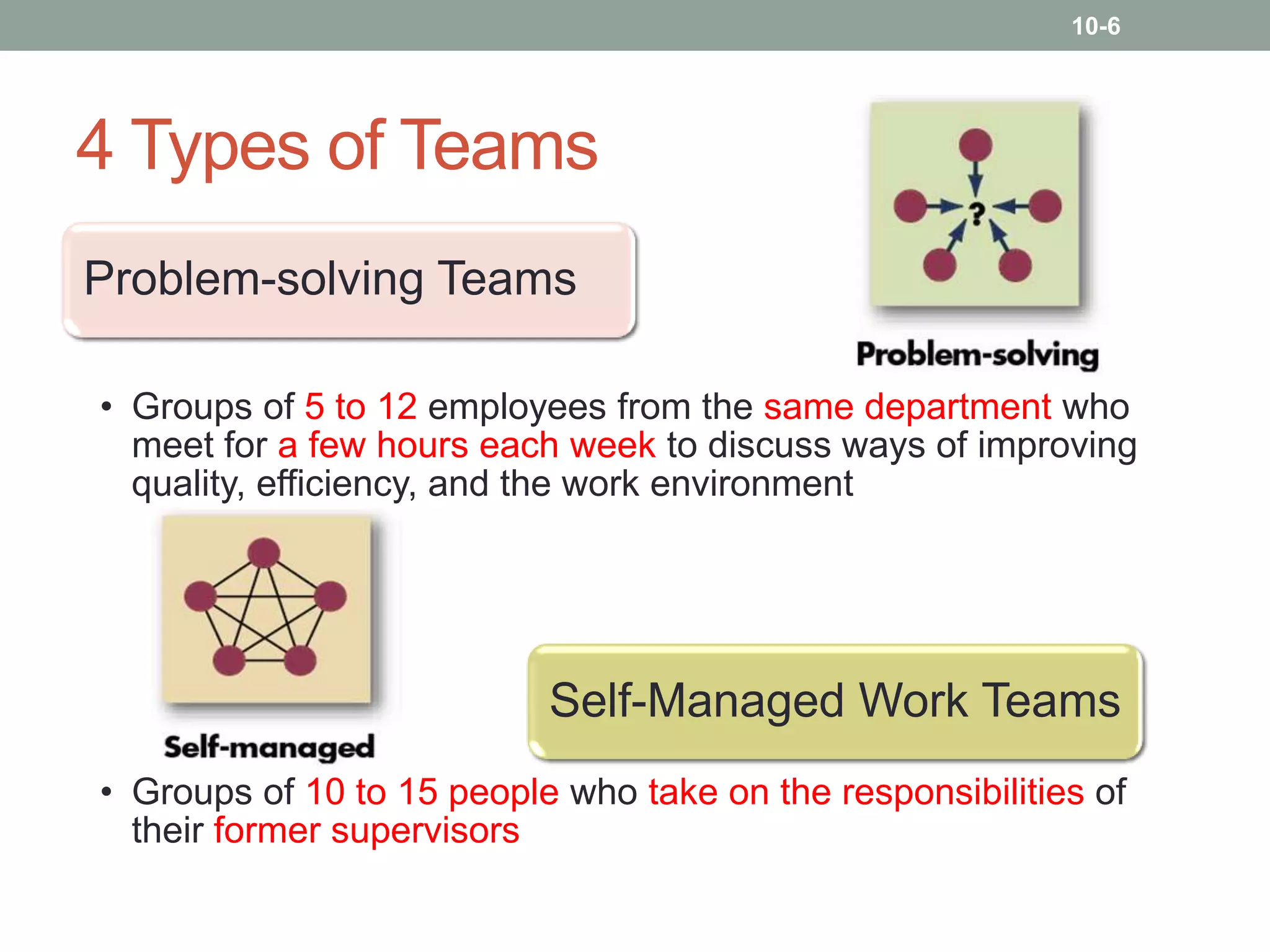
4 Types of Teams
Problem-solving Teams
• Groups of 5 to 12 employees from the same department who
meet for a few hours each week to discuss ways of improving
quality, efficiency, and the work environment

Self-Managed Work Teams
• Groups of 10 to 15 people who take on the responsibilities of
their former supervisors
10-7

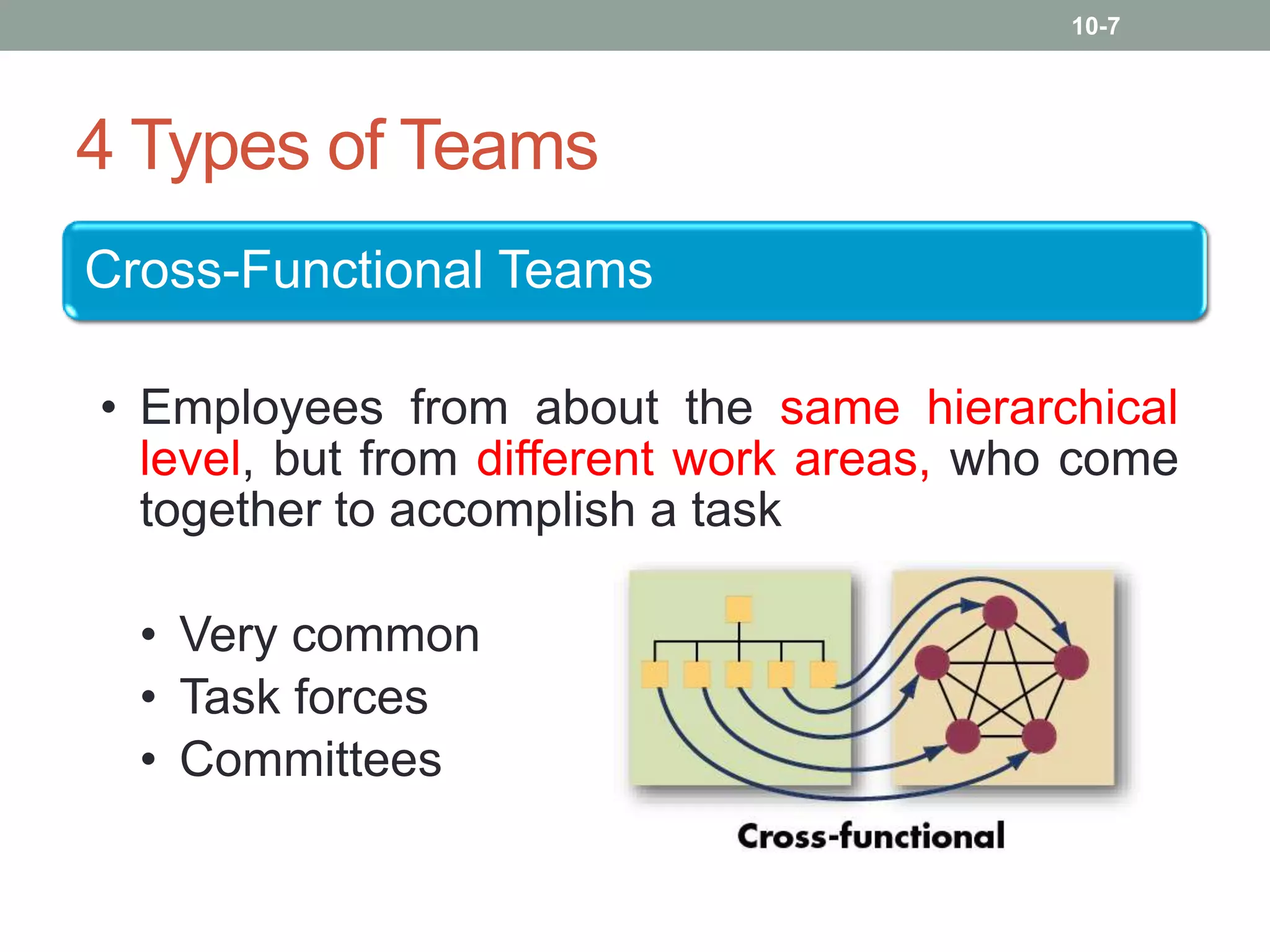
4 Types of Teams
Cross-Functional Teams
• Employees from about the same hierarchical
level, but from different work areas, who come
together to accomplish a task
• Very common
• Task forces
• Committees
10-8

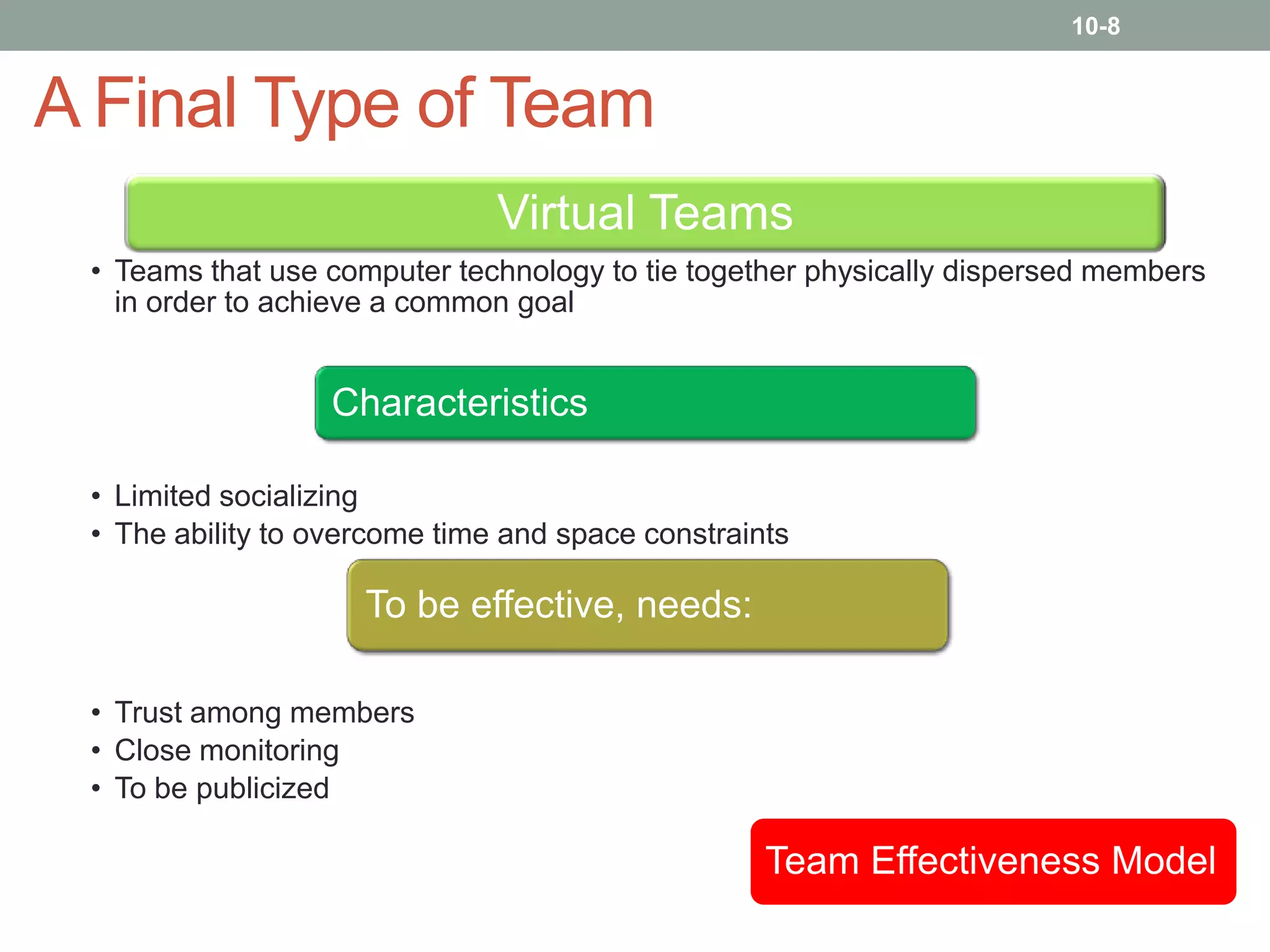
A Final Type of Team
Virtual Teams
• Teams that use computer technology to tie together physically dispersed members
in order to achieve a common goal

Characteristics
• Limited socializing
• The ability to overcome time and space constraints

To be effective, needs:
• Trust among members
• Close monitoring
• To be publicized

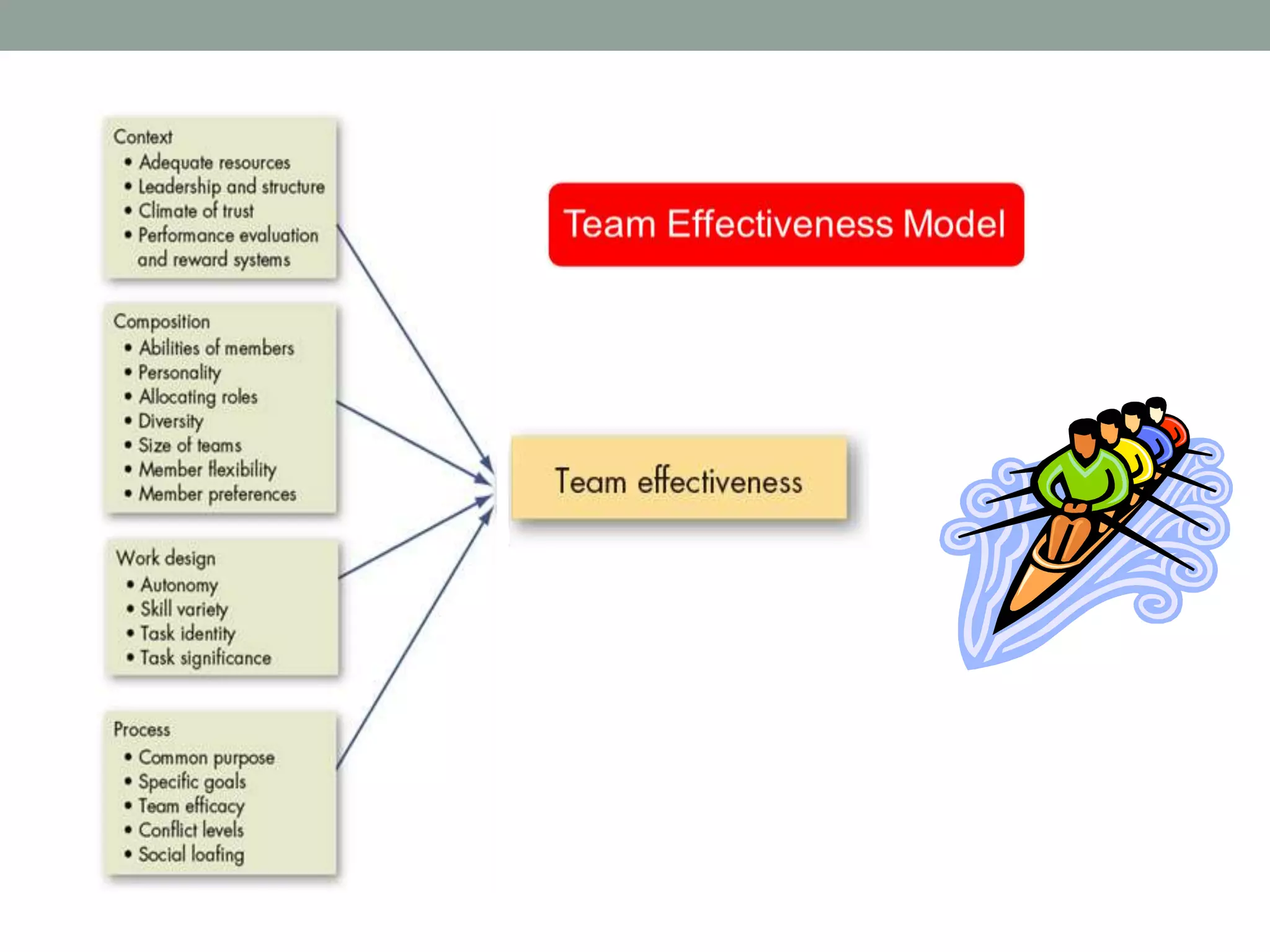
Team Effectiveness Model
10-10

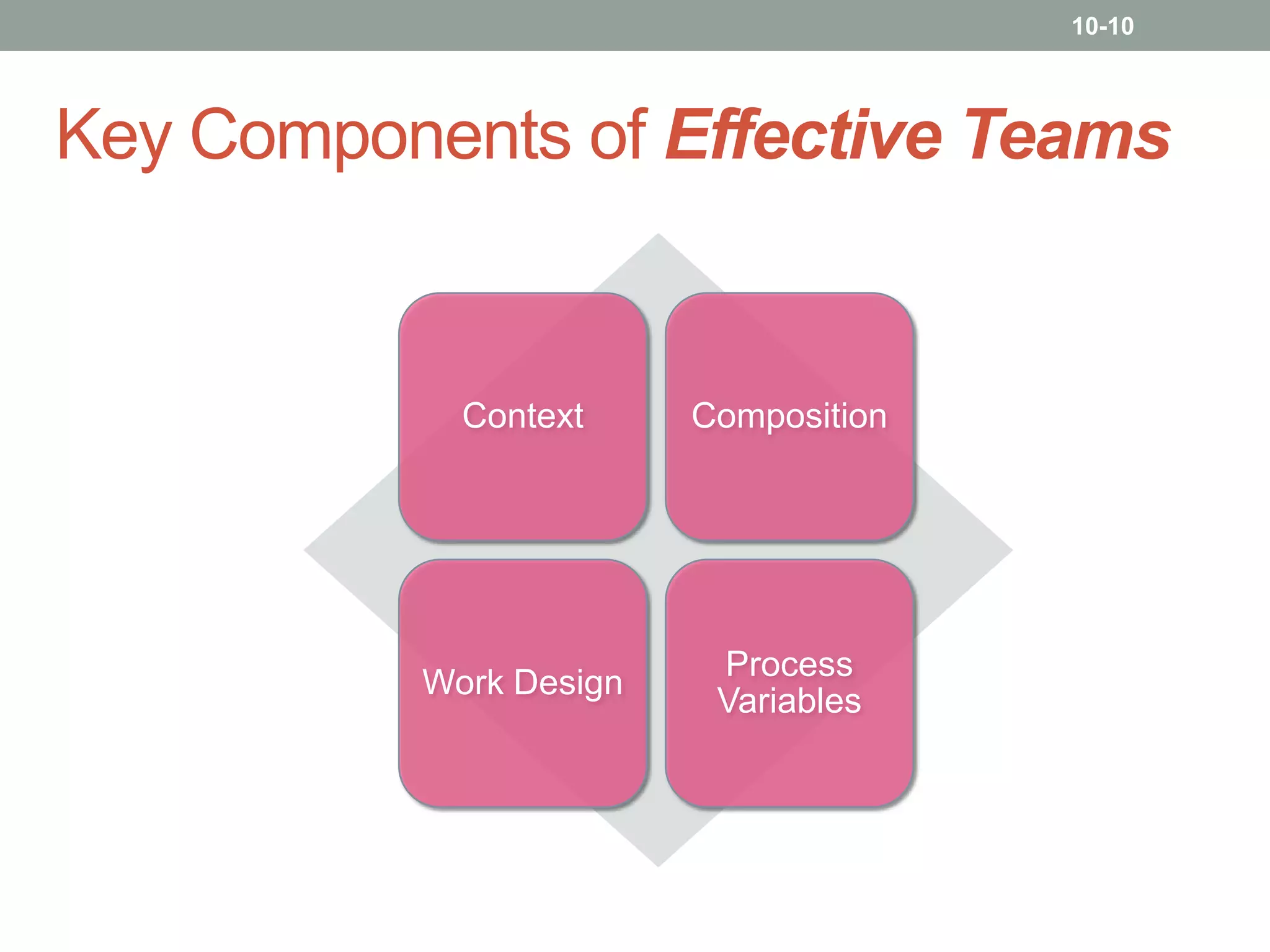
Key Components of Effective Teams

Context

Composition

Work Design

Process
Variables
10-11

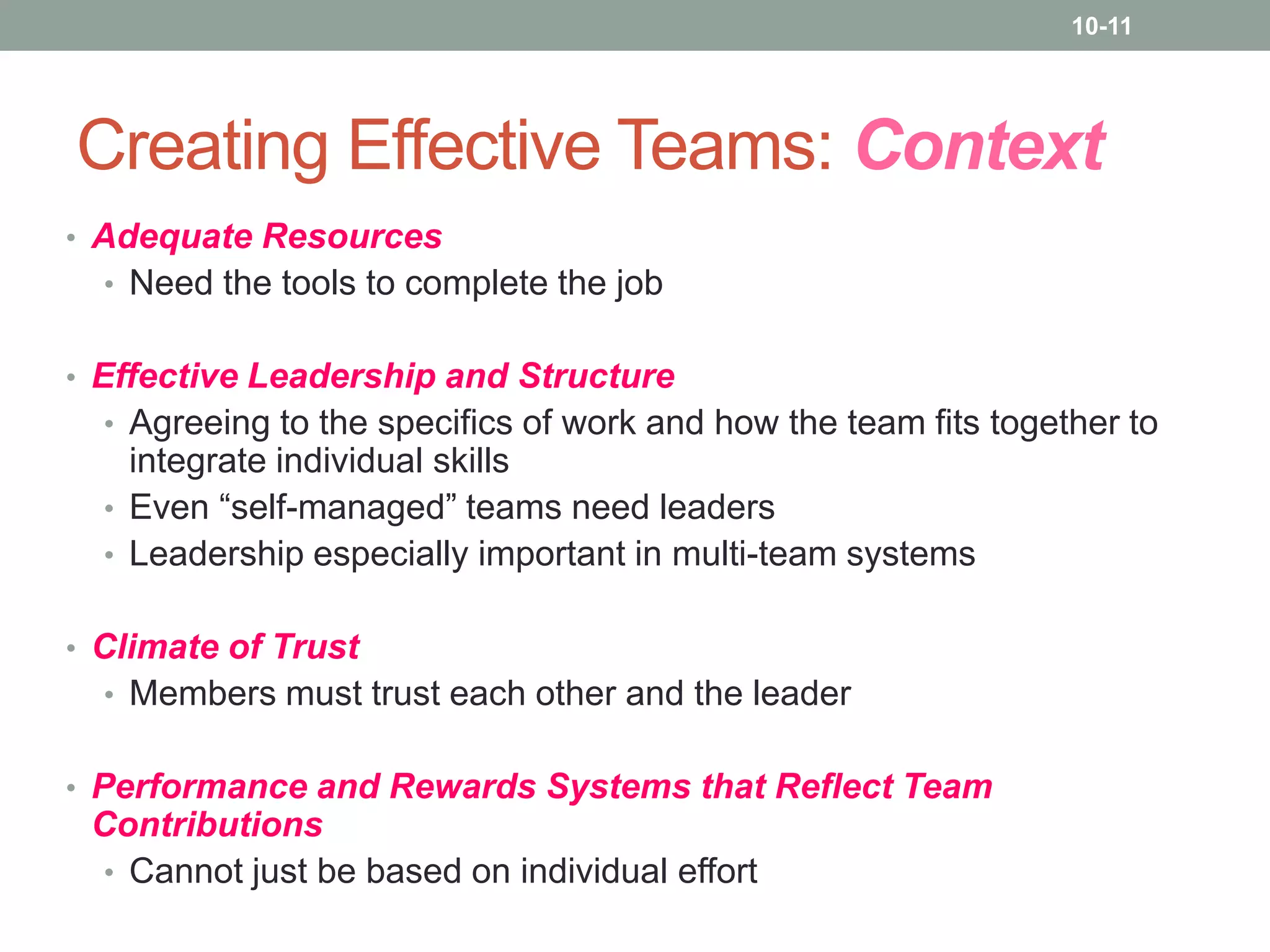
Creating Effective Teams: Context
• Adequate Resources
• Need the tools to complete the job
• Effective Leadership and Structure
• Agreeing to the specifics of work and how the team fits together to

integrate individual skills
• Even “self-managed” teams need leaders
• Leadership especially important in multi-team systems
• Climate of Trust
• Members must trust each other and the leader
• Performance and Rewards Systems that Reflect Team

Contributions
• Cannot just be based on individual effort
10-12

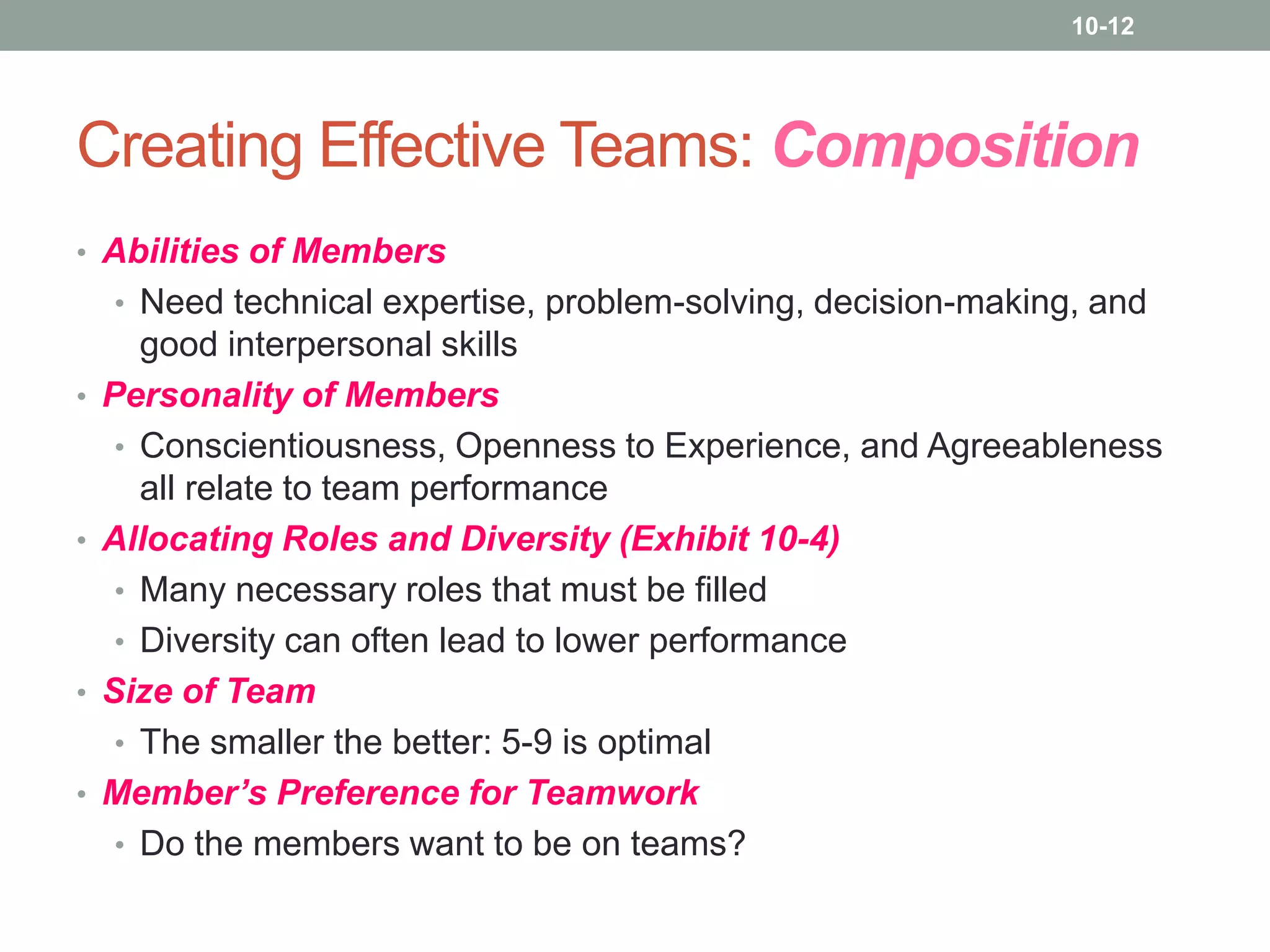
Creating Effective Teams: Composition
• Abilities of Members
• Need technical expertise, problem-solving, decision-making, and
•

•

•
•

good interpersonal skills
Personality of Members
• Conscientiousness, Openness to Experience, and Agreeableness
all relate to team performance
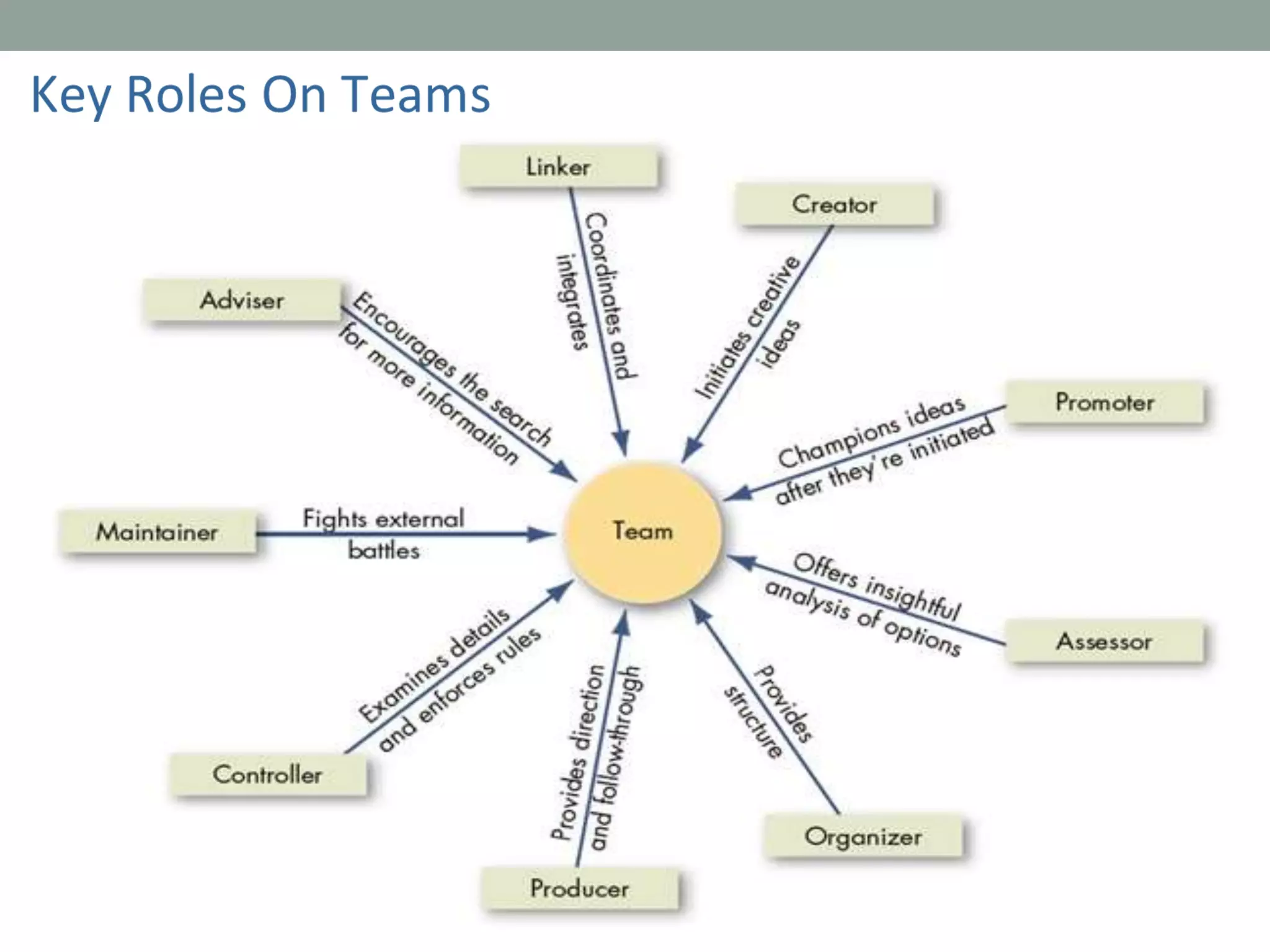
Allocating Roles and Diversity (Exhibit 10-4)
• Many necessary roles that must be filled
• Diversity can often lead to lower performance
Size of Team
• The smaller the better: 5-9 is optimal
Member’s Preference for Teamwork
• Do the members want to be on teams?
10-14

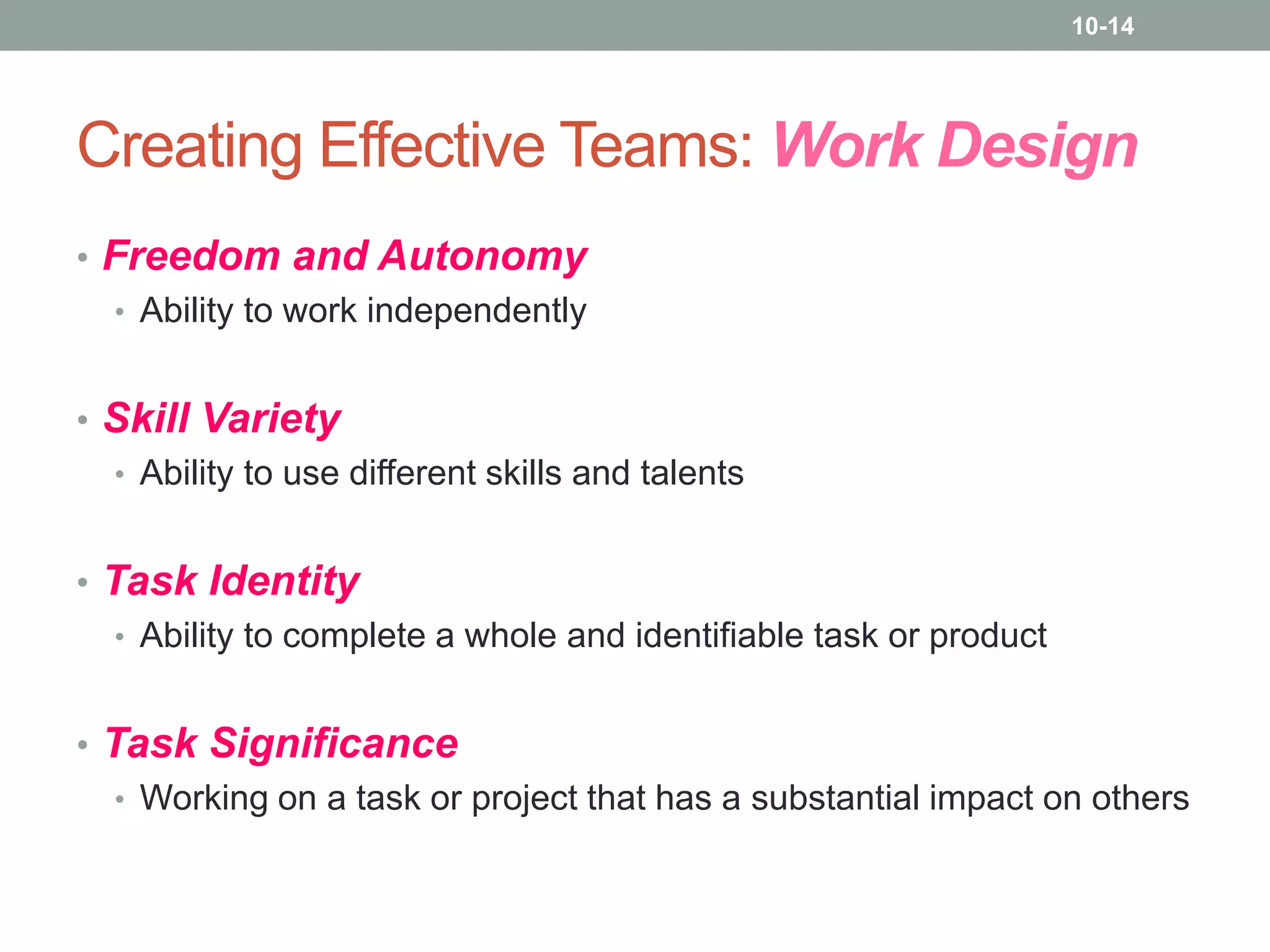
Creating Effective Teams: Work Design
• Freedom and Autonomy
• Ability to work independently
• Skill Variety
• Ability to use different skills and talents
• Task Identity
• Ability to complete a whole and identifiable task or product
• Task Significance
• Working on a task or project that has a substantial impact on others
10-15

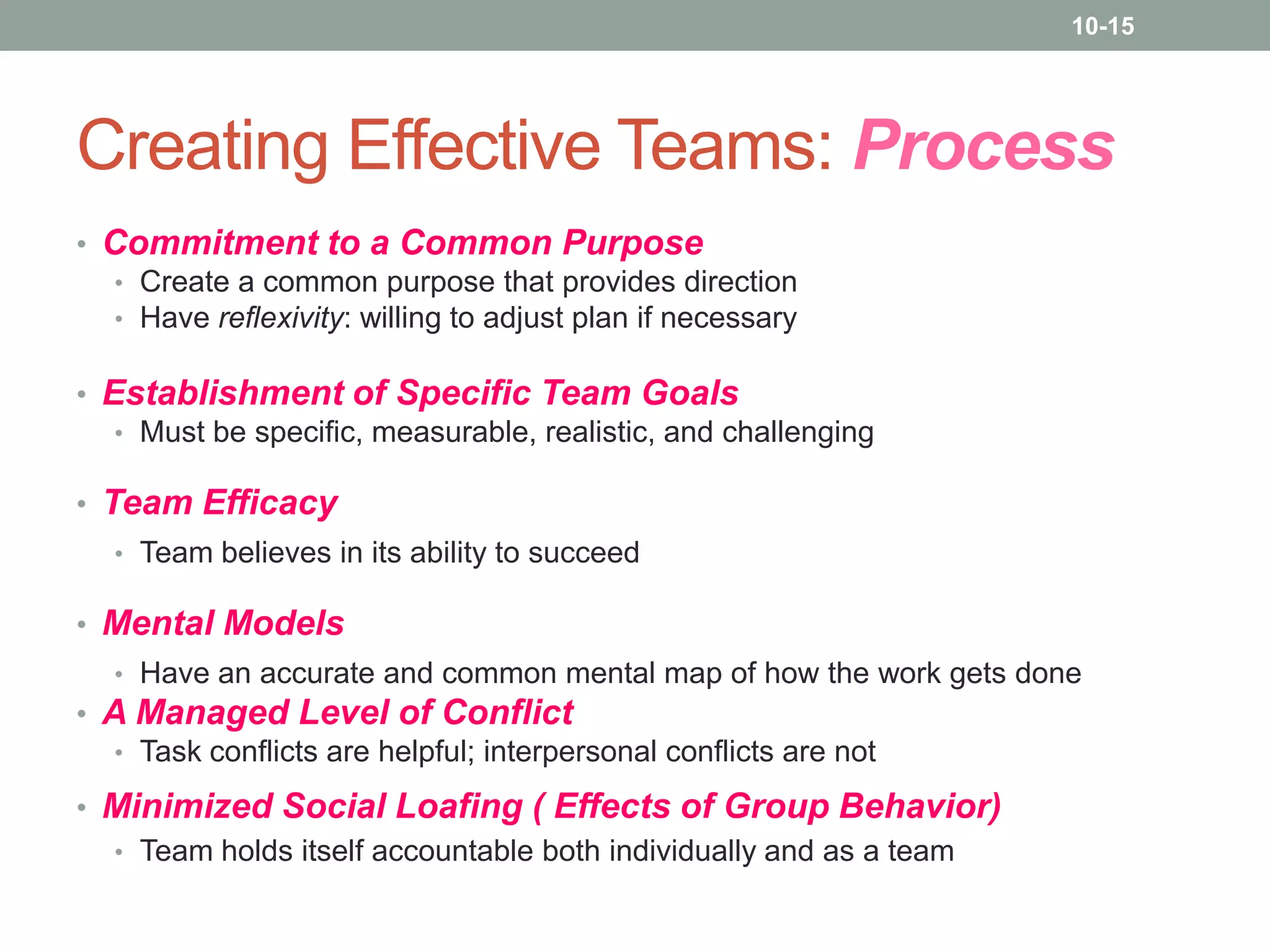
Creating Effective Teams: Process
• Commitment to a Common Purpose
• Create a common purpose that provides direction
• Have reflexivity: willing to adjust plan if necessary
• Establishment of Specific Team Goals
• Must be specific, measurable, realistic, and challenging
• Team Efficacy
• Team believes in its ability to succeed

• Mental Models
• Have an accurate and common mental map of how the work gets done

• A Managed Level of Conflict
• Task conflicts are helpful; interpersonal conflicts are not
• Minimized Social Loafing ( Effects of Group Behavior)
• Team holds itself accountable both individually and as a team
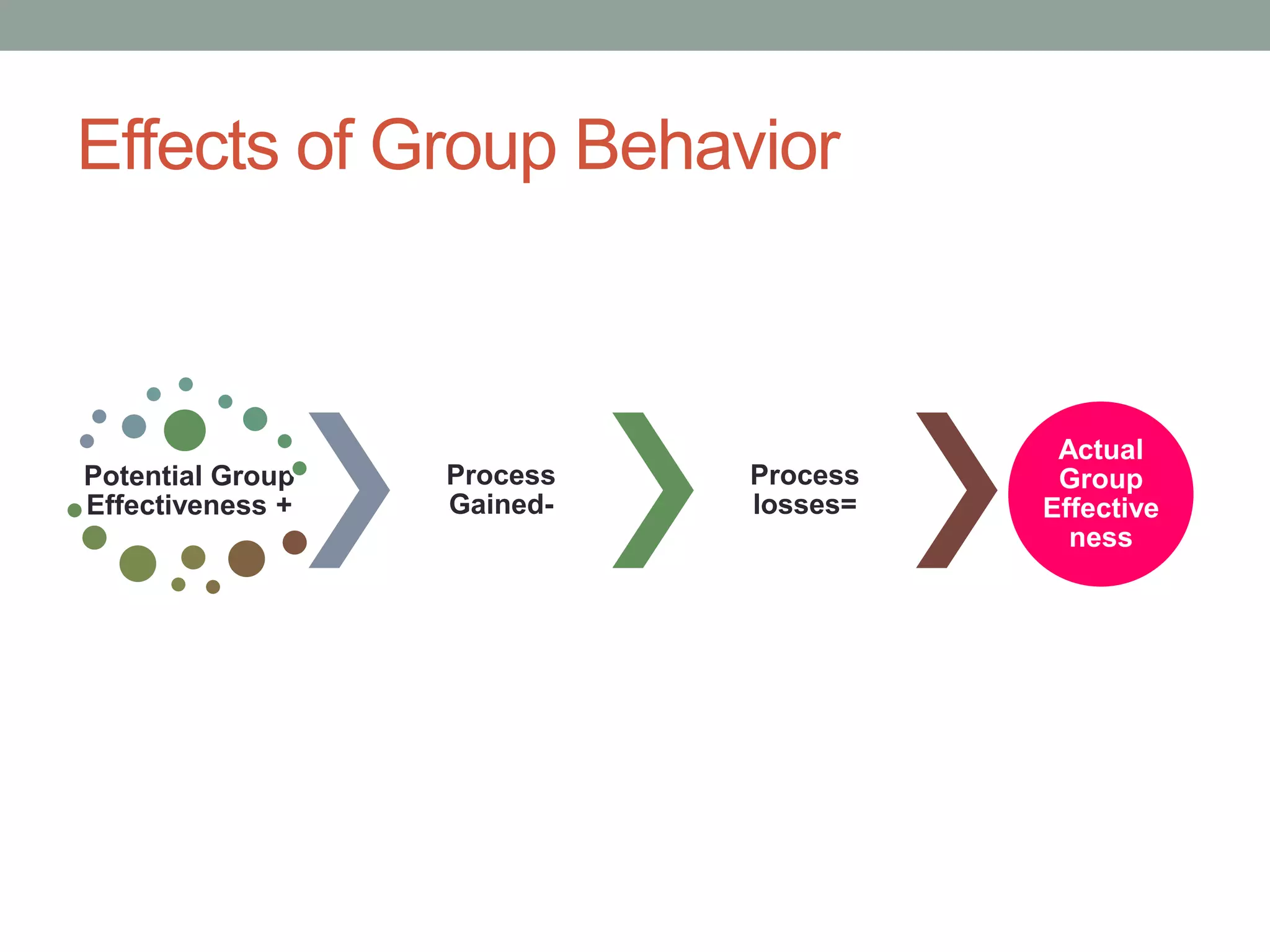
Effects of Group Behavior

Potential Group
Effectiveness +

Process
Gained-

Process
losses=

Actual
Group
Effective
ness
10-17

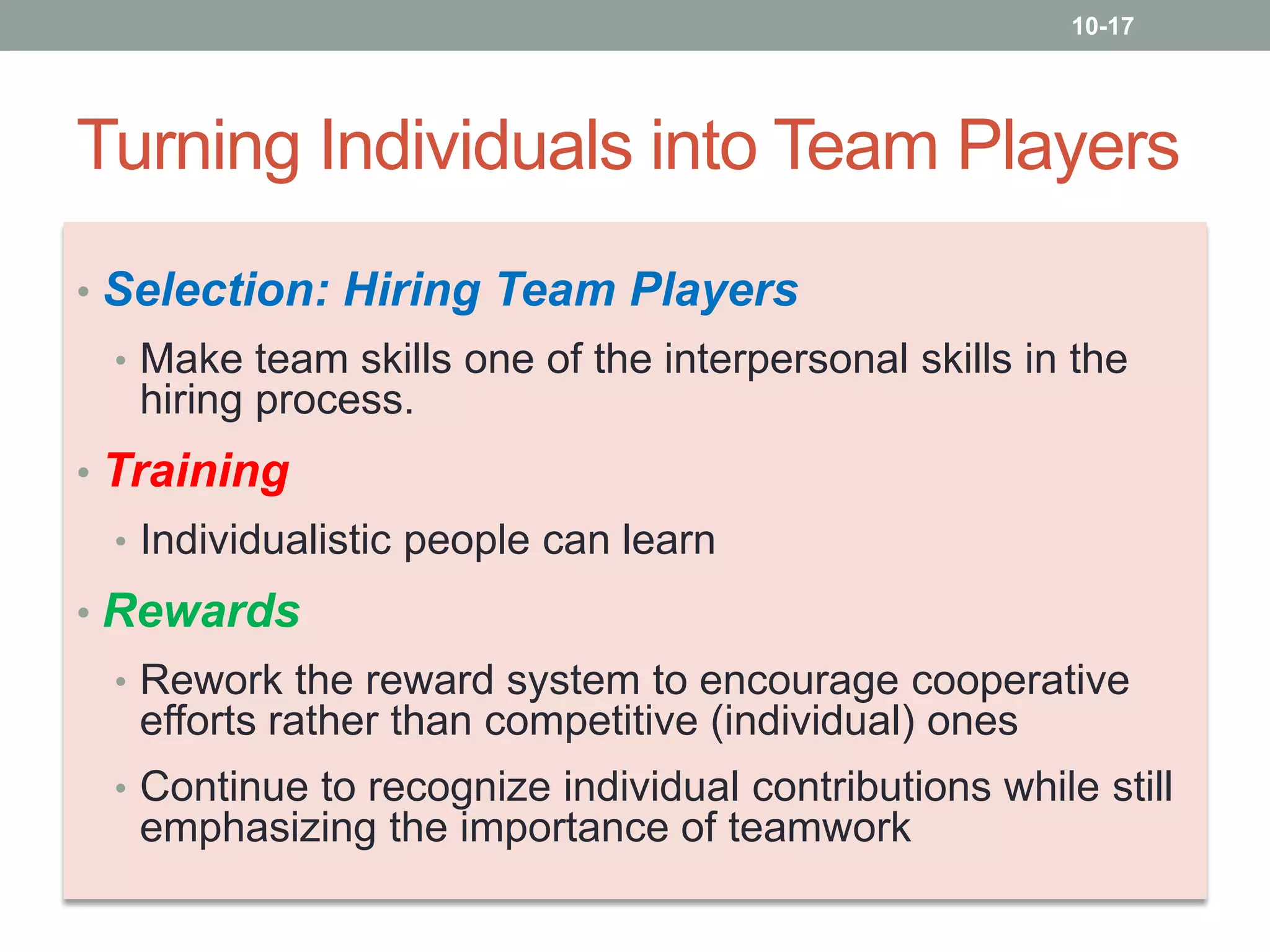
Turning Individuals into Team Players
• Selection: Hiring Team Players
• Make team skills one of the interpersonal skills in the

hiring process.
• Training
• Individualistic people can learn

• Rewards
• Rework the reward system to encourage cooperative

efforts rather than competitive (individual) ones
• Continue to recognize individual contributions while still

emphasizing the importance of teamwork
10-18

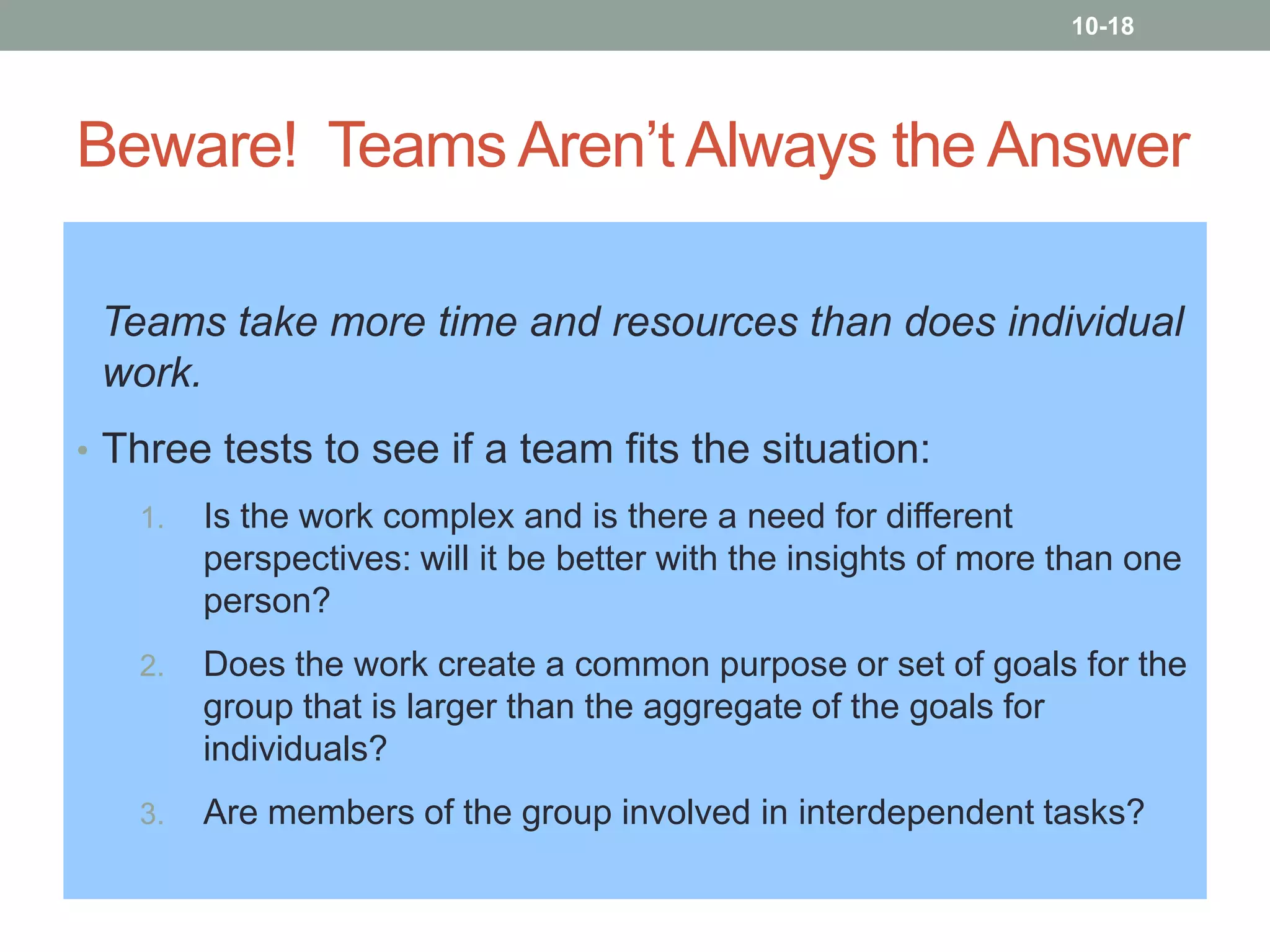
Beware! Teams Aren’t Always the Answer
Teams take more time and resources than does individual
work.
• Three tests to see if a team fits the situation:
1.

Is the work complex and is there a need for different
perspectives: will it be better with the insights of more than one
person?

2.

Does the work create a common purpose or set of goals for the
group that is larger than the aggregate of the goals for
individuals?

3.

Are members of the group involved in interdependent tasks?
10-19

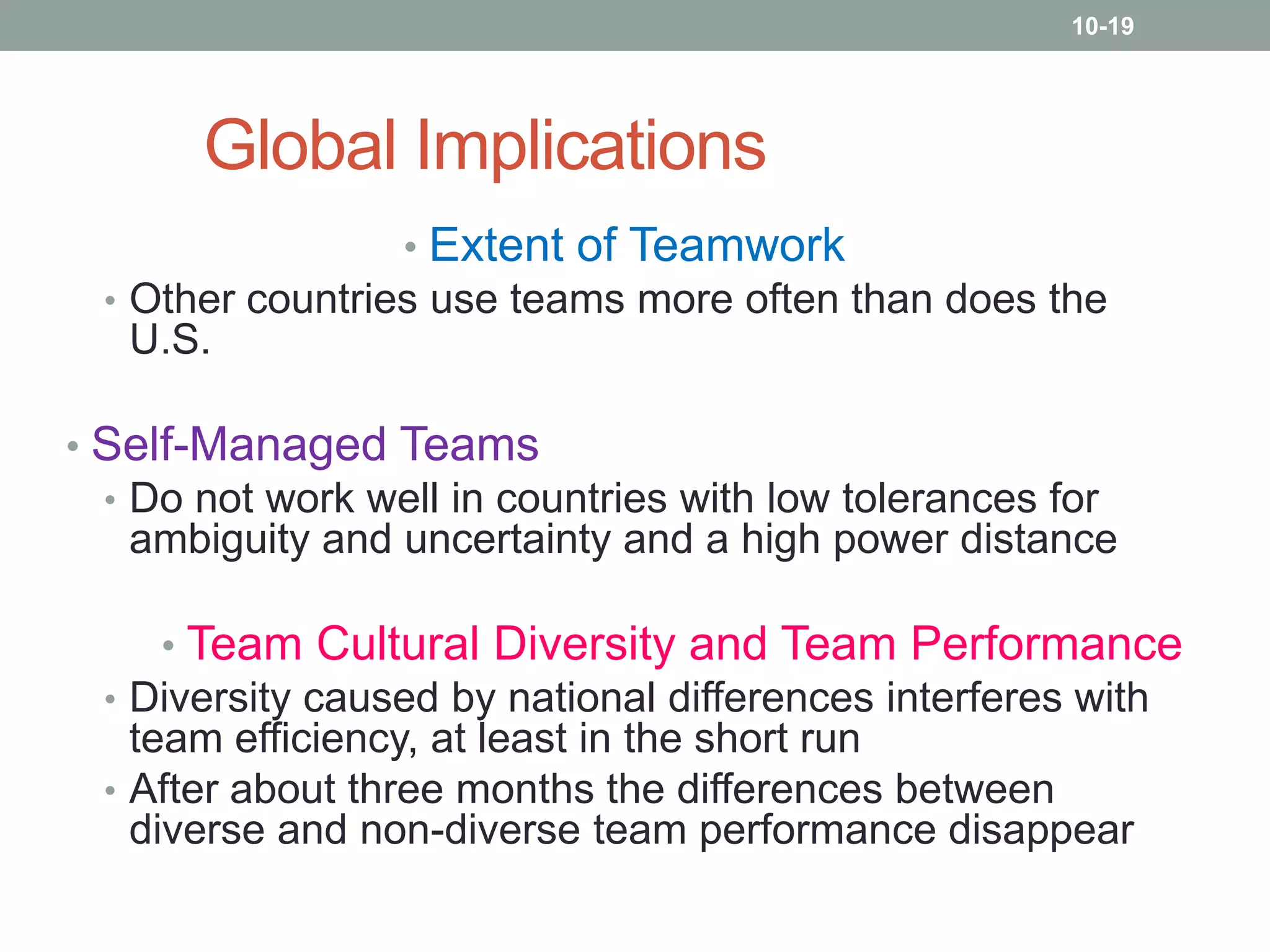
Global Implications
• Extent of Teamwork
• Other countries use teams more often than does the
U.S.
• Self-Managed Teams
• Do not work well in countries with low tolerances for
ambiguity and uncertainty and a high power distance
• Team Cultural Diversity and Team Performance
• Diversity caused by national differences interferes with
team efficiency, at least in the short run
• After about three months the differences between
diverse and non-diverse team performance disappear
10-20

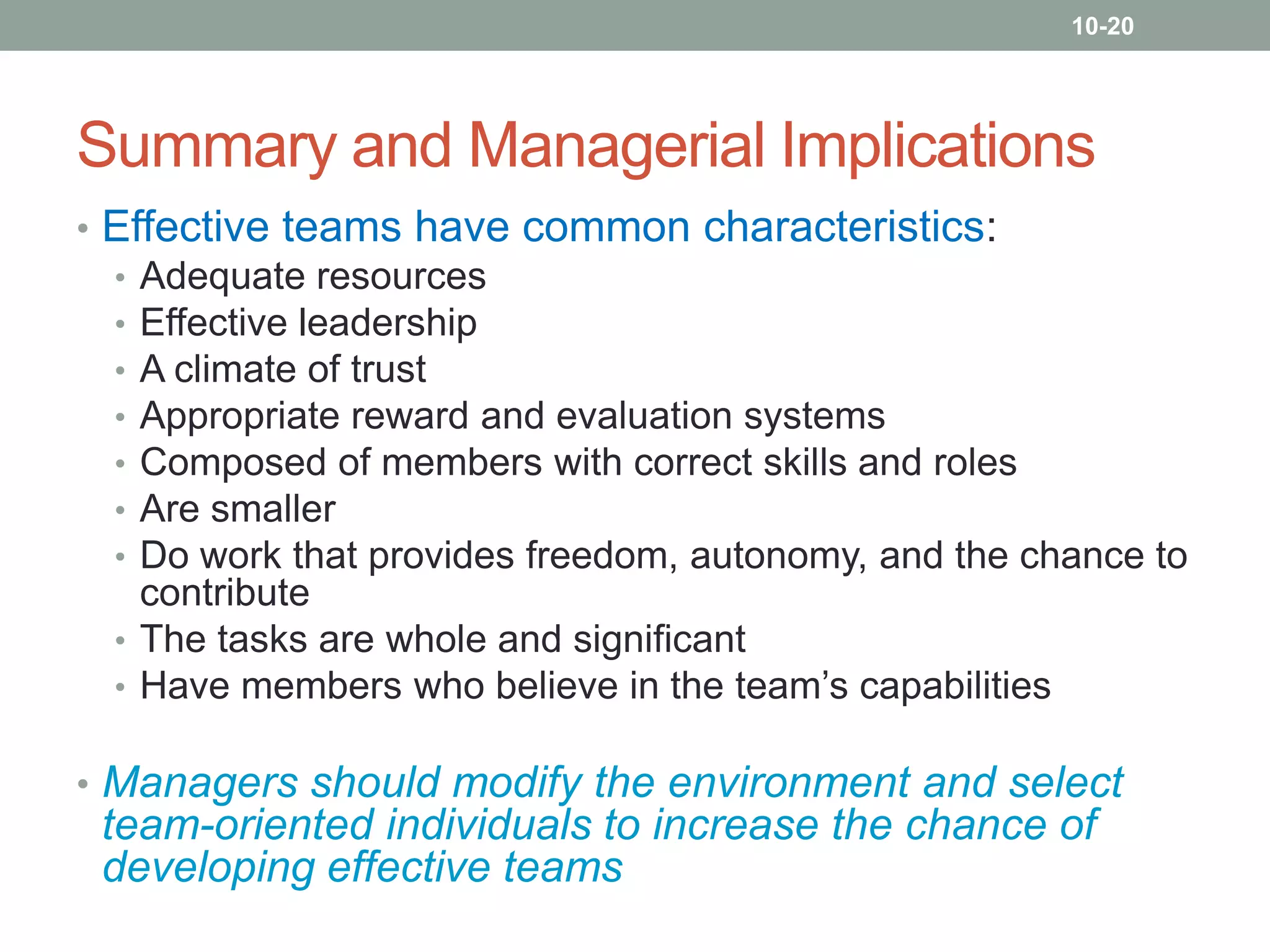
Summary and Managerial Implications
• Effective teams have common characteristics:
• Adequate resources
• Effective leadership
• A climate of trust
• Appropriate reward and evaluation systems
• Composed of members with correct skills and roles
• Are smaller
• Do work that provides freedom, autonomy, and the chance to
contribute
• The tasks are whole and significant
• Have members who believe in the team’s capabilities
• Managers should modify the environment and select

team-oriented individuals to increase the chance of
developing effective teams
• “Alone we can do so little; together we can do so

much”.
-Helen Keller

Thank you and God bless!

Organizational Behavior 13th Edition Robbins & Judge Part 3: Chapter 10, Understanding Work Teams and Its Dynamics

  • 1.
    10-1 ROBBINS & JUDGE ORGANIZATIONALBEHAVIOR 13TH EDITION Chapter 10: Understanding Work Teams and its Dynamics Prepared by: Donna Irene Q. Ituriaga
  • 2.
    10-2 Chapter Objectives • Analyzethe growing popularity of teams in organizations. • Contrast groups and teams. • Compare and contrast four types of teams. • Identify the characteristics of effective teams. • Show how organizations can create team players. • Decide when to use individuals instead of teams. • Show how our understanding of teams differs in a global context.
  • 3.
    10-3 Why Have TeamsBecome So Popular? Great way to use employee talents Can quickly assemble, d eploy, refocu s, and disband Teams are more flexible and responsive to changes in the environment Increases employee participation in decision making Facilitate employee involvement Note: teams are not ALWAYS effective Democratize an organization and increase motivation
  • 4.
    10-4 Differences between Groupsand Teams Work Group Work Team • A group that interacts primarily to share information and to make decisions to help each group member perform within his or her area of responsibility • No joint effort required • Generates positive synergy through coordinated effort. The individual efforts result in a performance that is greater than the sum of the individual inputs
  • 6.
    10-6 4 Types ofTeams Problem-solving Teams • Groups of 5 to 12 employees from the same department who meet for a few hours each week to discuss ways of improving quality, efficiency, and the work environment Self-Managed Work Teams • Groups of 10 to 15 people who take on the responsibilities of their former supervisors
  • 7.
    10-7 4 Types ofTeams Cross-Functional Teams • Employees from about the same hierarchical level, but from different work areas, who come together to accomplish a task • Very common • Task forces • Committees
  • 8.
    10-8 A Final Typeof Team Virtual Teams • Teams that use computer technology to tie together physically dispersed members in order to achieve a common goal Characteristics • Limited socializing • The ability to overcome time and space constraints To be effective, needs: • Trust among members • Close monitoring • To be publicized Team Effectiveness Model
  • 10.
    10-10 Key Components ofEffective Teams Context Composition Work Design Process Variables
  • 11.
    10-11 Creating Effective Teams:Context • Adequate Resources • Need the tools to complete the job • Effective Leadership and Structure • Agreeing to the specifics of work and how the team fits together to integrate individual skills • Even “self-managed” teams need leaders • Leadership especially important in multi-team systems • Climate of Trust • Members must trust each other and the leader • Performance and Rewards Systems that Reflect Team Contributions • Cannot just be based on individual effort
  • 12.
    10-12 Creating Effective Teams:Composition • Abilities of Members • Need technical expertise, problem-solving, decision-making, and • • • • good interpersonal skills Personality of Members • Conscientiousness, Openness to Experience, and Agreeableness all relate to team performance Allocating Roles and Diversity (Exhibit 10-4) • Many necessary roles that must be filled • Diversity can often lead to lower performance Size of Team • The smaller the better: 5-9 is optimal Member’s Preference for Teamwork • Do the members want to be on teams?
  • 14.
    10-14 Creating Effective Teams:Work Design • Freedom and Autonomy • Ability to work independently • Skill Variety • Ability to use different skills and talents • Task Identity • Ability to complete a whole and identifiable task or product • Task Significance • Working on a task or project that has a substantial impact on others
  • 15.
    10-15 Creating Effective Teams:Process • Commitment to a Common Purpose • Create a common purpose that provides direction • Have reflexivity: willing to adjust plan if necessary • Establishment of Specific Team Goals • Must be specific, measurable, realistic, and challenging • Team Efficacy • Team believes in its ability to succeed • Mental Models • Have an accurate and common mental map of how the work gets done • A Managed Level of Conflict • Task conflicts are helpful; interpersonal conflicts are not • Minimized Social Loafing ( Effects of Group Behavior) • Team holds itself accountable both individually and as a team
  • 16.
    Effects of GroupBehavior Potential Group Effectiveness + Process Gained- Process losses= Actual Group Effective ness
  • 17.
    10-17 Turning Individuals intoTeam Players • Selection: Hiring Team Players • Make team skills one of the interpersonal skills in the hiring process. • Training • Individualistic people can learn • Rewards • Rework the reward system to encourage cooperative efforts rather than competitive (individual) ones • Continue to recognize individual contributions while still emphasizing the importance of teamwork
  • 18.
    10-18 Beware! Teams Aren’tAlways the Answer Teams take more time and resources than does individual work. • Three tests to see if a team fits the situation: 1. Is the work complex and is there a need for different perspectives: will it be better with the insights of more than one person? 2. Does the work create a common purpose or set of goals for the group that is larger than the aggregate of the goals for individuals? 3. Are members of the group involved in interdependent tasks?
  • 19.
    10-19 Global Implications • Extentof Teamwork • Other countries use teams more often than does the U.S. • Self-Managed Teams • Do not work well in countries with low tolerances for ambiguity and uncertainty and a high power distance • Team Cultural Diversity and Team Performance • Diversity caused by national differences interferes with team efficiency, at least in the short run • After about three months the differences between diverse and non-diverse team performance disappear
  • 20.
    10-20 Summary and ManagerialImplications • Effective teams have common characteristics: • Adequate resources • Effective leadership • A climate of trust • Appropriate reward and evaluation systems • Composed of members with correct skills and roles • Are smaller • Do work that provides freedom, autonomy, and the chance to contribute • The tasks are whole and significant • Have members who believe in the team’s capabilities • Managers should modify the environment and select team-oriented individuals to increase the chance of developing effective teams
  • 21.
    • “Alone wecan do so little; together we can do so much”. -Helen Keller Thank you and God bless!