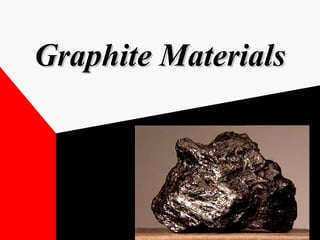
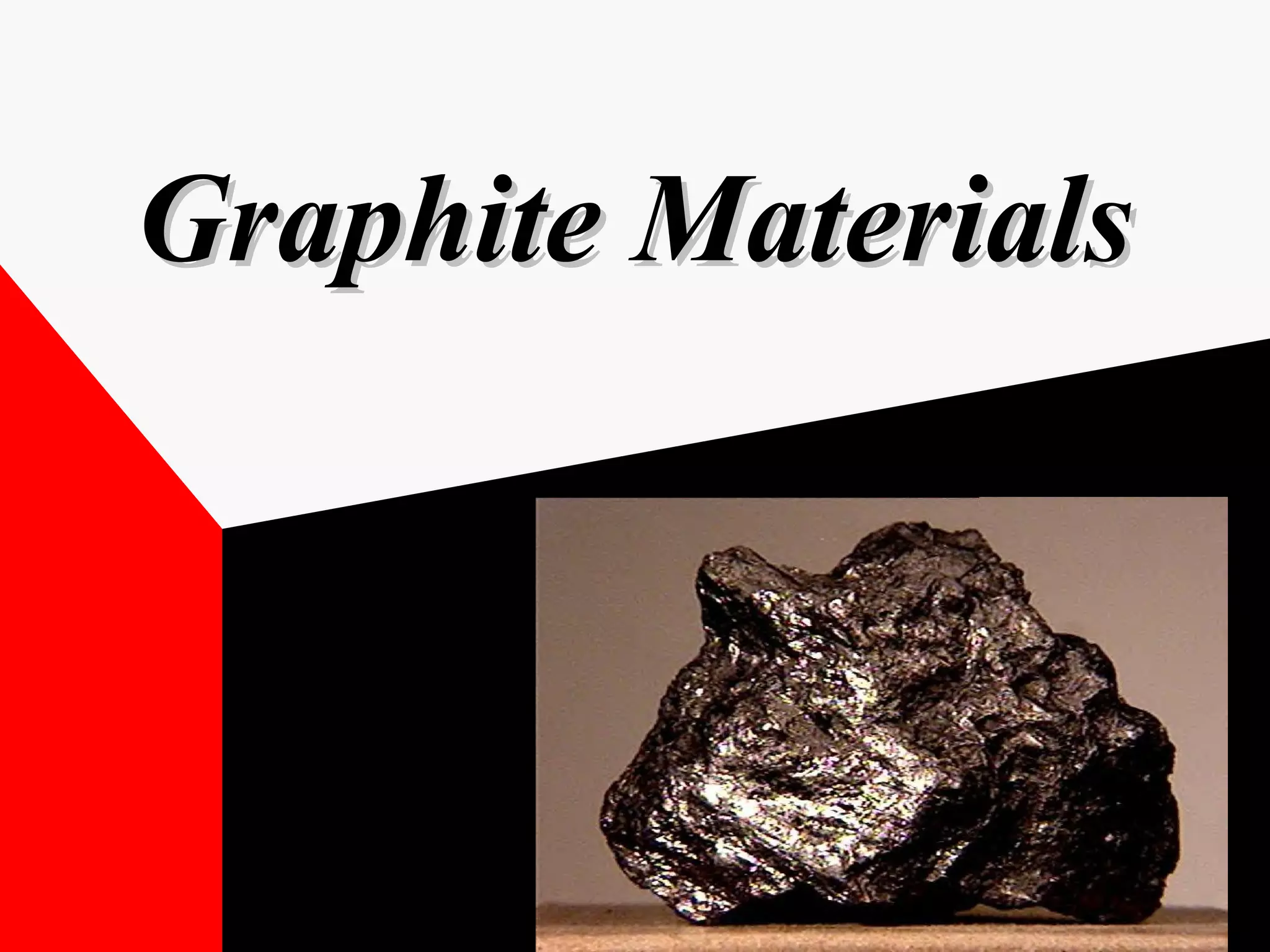
Graphite MaterialsGraphite Materials
History of GraphiteHistory of Graphite
- Naturally discovered around 1565 in Cumberland,- Naturally discovered around 1565 in Cumberland,
BritainBritain
- Also can be found naturally in Siberia, Germany &- Also can be found naturally in Siberia, Germany &
the United Statesthe United States
- Was named ‘graphite’ from the Greek word for- Was named ‘graphite’ from the Greek word for
writingwriting
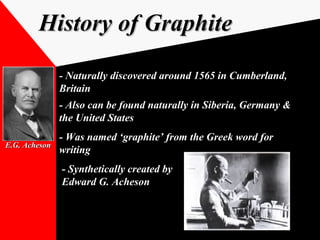
- Synthetically created by- Synthetically created by
Edward G. AchesonEdward G. Acheson
E.G. AchesonE.G. Acheson
Graphite MaterialsGraphite Materials
Graphite:Graphite: Is a form of carbon that occurs as a naturalIs a form of carbon that occurs as a natural
mineral and is manufactured synthetically.mineral and is manufactured synthetically.
- Greasy material- Greasy material
- Strong conductor of electricity- Strong conductor of electricity
- High strength & chemical stability at elevated- High strength & chemical stability at elevated
temperaturestemperatures
- Low coefficient of thermal expansion and high- Low coefficient of thermal expansion and high
resistance to thermal shockresistance to thermal shock
PropertiesProperties
Composition Structure:Composition Structure: Layers of hexagonally arrangedLayers of hexagonally arranged
carbon atoms. Forming a HCPcarbon atoms. Forming a HCP
crystalline structure.crystalline structure.
Appearance:Appearance: Black to gray with a metallic earthly luster.Black to gray with a metallic earthly luster.
- Each carbon atom is bonded to- Each carbon atom is bonded to
three other carbon atoms stronglythree other carbon atoms strongly
but each layer is held togetherbut each layer is held together
with a weak bond due to van derwith a weak bond due to van der
WaalsWaals
ApplicationsApplications
- When mixed with clay & other materials it forms the
“lead” in lead pencils
- Graphite is used in nuclear reactors to act as a- Graphite is used in nuclear reactors to act as a
moderator to slow down neutronsmoderator to slow down neutrons
- Used in manufacturing as a lubricant to smooth- Used in manufacturing as a lubricant to smooth
surfaces so that castings can be removed from moldssurfaces so that castings can be removed from molds
easilyeasily
- Is also used as to produce numerous objects such as- Is also used as to produce numerous objects such as
dry lubricants, and paintsdry lubricants, and paints
ApplicationsApplications
- When mixed with clay & other materials it forms the
“lead” in lead pencils
- Graphite is used in nuclear reactors to act as a- Graphite is used in nuclear reactors to act as a
moderator to slow down neutronsmoderator to slow down neutrons
- Used in manufacturing as a lubricant to smooth- Used in manufacturing as a lubricant to smooth
surfaces so that castings can be removed from moldssurfaces so that castings can be removed from molds
easilyeasily
- Is also used as to produce numerous objects such as- Is also used as to produce numerous objects such as
dry lubricants, and paintsdry lubricants, and paints

Graphite

  • 1.
  • 2.
    History of GraphiteHistoryof Graphite - Naturally discovered around 1565 in Cumberland,- Naturally discovered around 1565 in Cumberland, BritainBritain - Also can be found naturally in Siberia, Germany &- Also can be found naturally in Siberia, Germany & the United Statesthe United States - Was named ‘graphite’ from the Greek word for- Was named ‘graphite’ from the Greek word for writingwriting - Synthetically created by- Synthetically created by Edward G. AchesonEdward G. Acheson E.G. AchesonE.G. Acheson
  • 3.
    Graphite MaterialsGraphite Materials Graphite:Graphite:Is a form of carbon that occurs as a naturalIs a form of carbon that occurs as a natural mineral and is manufactured synthetically.mineral and is manufactured synthetically. - Greasy material- Greasy material - Strong conductor of electricity- Strong conductor of electricity - High strength & chemical stability at elevated- High strength & chemical stability at elevated temperaturestemperatures - Low coefficient of thermal expansion and high- Low coefficient of thermal expansion and high resistance to thermal shockresistance to thermal shock
  • 4.
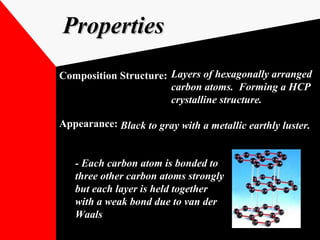
    PropertiesProperties Composition Structure:Composition Structure:Layers of hexagonally arrangedLayers of hexagonally arranged carbon atoms. Forming a HCPcarbon atoms. Forming a HCP crystalline structure.crystalline structure. Appearance:Appearance: Black to gray with a metallic earthly luster.Black to gray with a metallic earthly luster. - Each carbon atom is bonded to- Each carbon atom is bonded to three other carbon atoms stronglythree other carbon atoms strongly but each layer is held togetherbut each layer is held together with a weak bond due to van derwith a weak bond due to van der WaalsWaals
  • 5.
    ApplicationsApplications - When mixedwith clay & other materials it forms the “lead” in lead pencils - Graphite is used in nuclear reactors to act as a- Graphite is used in nuclear reactors to act as a moderator to slow down neutronsmoderator to slow down neutrons - Used in manufacturing as a lubricant to smooth- Used in manufacturing as a lubricant to smooth surfaces so that castings can be removed from moldssurfaces so that castings can be removed from molds easilyeasily - Is also used as to produce numerous objects such as- Is also used as to produce numerous objects such as dry lubricants, and paintsdry lubricants, and paints
  • 6.
    ApplicationsApplications - When mixedwith clay & other materials it forms the “lead” in lead pencils - Graphite is used in nuclear reactors to act as a- Graphite is used in nuclear reactors to act as a moderator to slow down neutronsmoderator to slow down neutrons - Used in manufacturing as a lubricant to smooth- Used in manufacturing as a lubricant to smooth surfaces so that castings can be removed from moldssurfaces so that castings can be removed from molds easilyeasily - Is also used as to produce numerous objects such as- Is also used as to produce numerous objects such as dry lubricants, and paintsdry lubricants, and paints